DR Mahammed Basiony
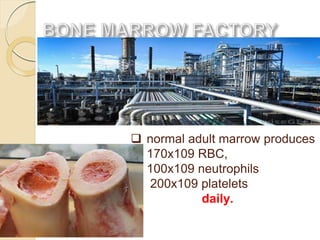
 normal adult marrow produces
170x109 RBC,
100x109 neutrophils
200x109 platelets
daily.
10/1/2018 4
Pancytopenia
Definition
Reduction in the number of red cells,
white cells (neutrophils) and platelets in the
peripheral blood below the lower limits of the age.
Therefore it is combination of
(anemia, leucopenia and thrombocytopenia)
Hb<13.5 in ♂ & 11.5 in♀
Leucocyte count< 4000
Platelet count <150000
Severe pancytopenia
 Absolute neutrophil count < 500/cmm
 Platelet count < 20,000/cmm
 Corrected reticulocyte count < 1%.
Urgent full investigation in 1st 24-48 h
10/1/2018 6
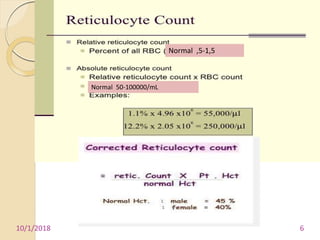
Normal 50-100000/mL
Normal ,5-1,5
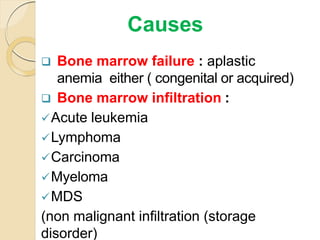
 Bone marrow failure : aplastic
anemia either ( congenital or acquired)
 Bone marrow infiltration :
Acute leukemia
Lymphoma
Carcinoma
Myeloma
MDS
(non malignant infiltration (storage
disorder)
Causes
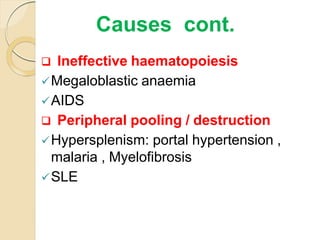
 Ineffective haematopoiesis
Megaloblastic anaemia
AIDS
 Peripheral pooling / destruction
Hypersplenism: portal hypertension ,
malaria , Myelofibrosis
SLE
Causes cont.
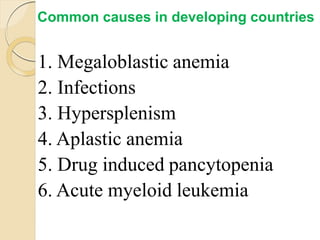
1. Megaloblastic anemia
2. Infections
3. Hypersplenism
4. Aplastic anemia
5. Drug induced pancytopenia
6. Acute myeloid leukemia
Common causes in developing countries
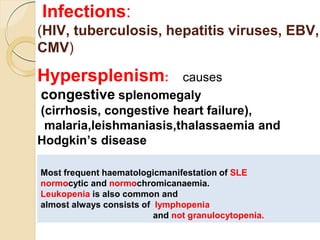
Infections:
(HIV, tuberculosis, hepatitis viruses, EBV,
CMV)
Hypersplenism: causes
congestive splenomegaly
(cirrhosis, congestive heart failure),
malaria,leishmaniasis,thalassaemia and
Hodgkin’s disease
Most frequent haematologicmanifestation of SLE
normocytic and normochromicanaemia.
Leukopenia is also common and
almost always consists of lymphopenia
and not granulocytopenia.
history
• History and associated symptoms
Exam..
Inv1
Inv2
• General
• Systemic
• CBC with PBS, Reticulocyte count
• B12/Folate , LFT,Hepatic serology, Coagulation
profile, combs test, HIV .
• BM aspiration and biopsy
• Cytogenetics (if required)
Inv
3 • Special investigations to confirm the diagnosis
Clinical features
Related to
Pancytopenia
Or
Underlying
condition/disease
10/1/2018 12
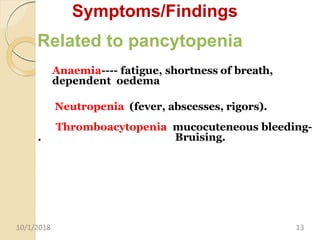
Symptoms/Findings
Related to pancytopenia
Anaemia---- fatigue, shortness of breath,
dependent oedema
Neutropenia (fever, abscesses, rigors).
Thromboacytopenia mucocuteneous bleeding-
. Bruising.
10/1/2018 13
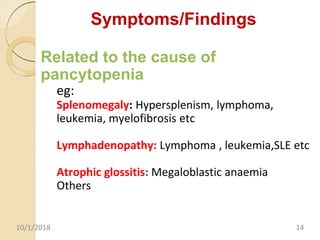
Symptoms/Findings
Related to the cause of
pancytopenia
eg:
Splenomegaly: Hypersplenism, lymphoma,
leukemia, myelofibrosis etc
Lymphadenopathy: Lymphoma , leukemia,SLE etc
Atrophic glossitis: Megaloblastic anaemia
Others
10/1/2018 14
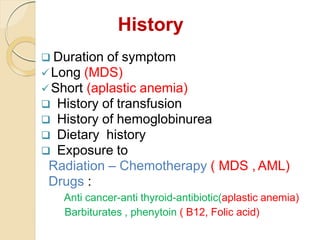
History
 Duration of symptom
Long (MDS)
Short (aplastic anemia)
 History of transfusion
 History of hemoglobinurea
 Dietary history
 Exposure to
Radiation – Chemotherapy ( MDS , AML)
Drugs :
Anti cancer-anti thyroid-antibiotic(aplastic anemia)
Barbiturates , phenytoin ( B12, Folic acid)
History
 Age- inherited cause of bone marrow failure
 Jaundice (hepatitis viruses)
 Joint pain, rash,photosensitivity (lupus)
 Bonepains (acute leukemias)
 Night sweats (Hodgkins disease)
 malaise, weightloss (tuberculosis,malignancy)
 Joint Pain – (SLE)
General examination
A thorough physical exam is required
 Eye examination: retinal hemorrhage
leukemic infiltrations
Pallor (Anemia)
Jaundice (hepatitis-PNH-cirrhosis)
 Oral examination
Stomatitis or cheilitis (neutropenia , B12 deficiency)
Gingival hyperplasia (leukemia)
Oral candidiasis or pharyngeal exudate (neutropenia)
 Abdominal examination :organomegaly
lymphadenopathy
 skin examination : malar rash Petichae
purpura hypo or hyperpigmentation
 Musculoskelatal system :
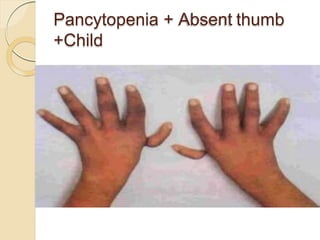
short stature abnormal thumb
(fanconi anemia)
Synovitis/swelling (SLE)
Sternal tenderness (acute leukemia)
Signs of chronic liver disease.
General examination
Pancytopenia + Absent thumb
+Child
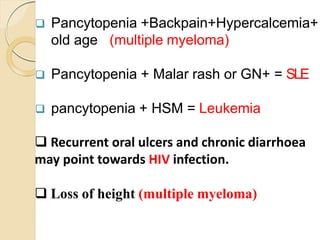
 Pancytopenia +Backpain+Hypercalcemia+
old age (multiple myeloma)
 Pancytopenia + Malar rash or GN+ = SLE
 pancytopenia + HSM = Leukemia
 Recurrent oral ulcers and chronic diarrhoea
may point towards HIV infection.
 Loss of height (multiple myeloma)
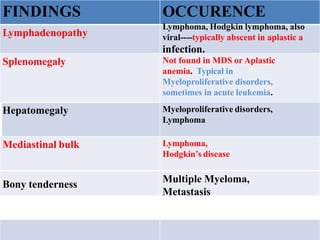
FINDINGS OCCURENCE
Lymphadenopathy
Lymphoma, Hodgkin lymphoma, also
viral----typically abscent in aplastic a
infection.
Splenomegaly Not found in MDS or Aplastic
anemia. Typical in
Myeloproliferative disorders,
sometimes in acute leukemia.
Hepatomegaly Myeloproliferative disorders,
Lymphoma
Mediastinal bulk Lymphoma,
Hodgkin’s disease
Bony tenderness
Multiple Myeloma,
Metastasis
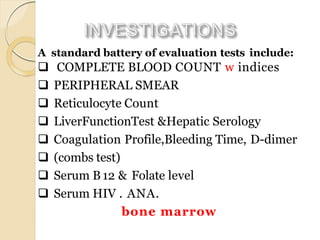
A standard battery of evaluation tests include:
 COMPLETE BLOOD COUNT w indices
 PERIPHERAL SMEAR
 Reticulocyte Count
 LiverFunctionTest &Hepatic Serology
 Coagulation Profile,Bleeding Time, D-dimer
 (combs test)
 Serum B12 & Folate level
 Serum HIV . ANA.
bone marrow
 Anisocytosis & Poikilocytosis.
 WBCs and RBCs Precursors
 Platelets
 Increased or decreased granulation in
neutrophils
 Hypo/Hypersegmentation in neutrophils
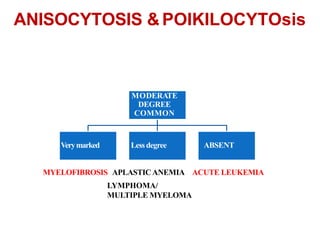
MODERATE
DEGREE
COMMON
ANISOCYTOSIS & POIKILOCYTOsis
Verymarked Less degree ABSENT
MYELOFIBROSIS APLASTIC ANEMIA ACUTE LEUKEMIA
LYMPHOMA/
MULTIPLE MYELOMA
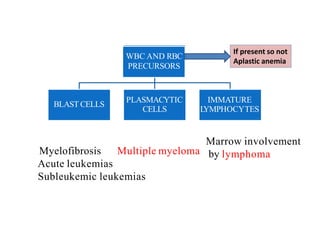
Myelofibrosis Multiple myeloma
Acute leukemias
Subleukemic leukemias
BLAST CELLS
PLASMACYTIC
CELLS
IMMATURE
LYMPHOCYTES
WBC AND RBC
PRECURSORS
Marrow involvement
by lymphoma
If present so not
Aplastic anemia
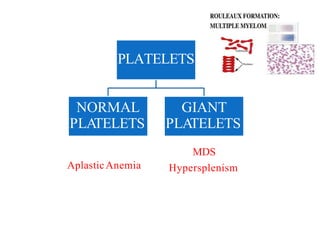
PLATELETS
NORMAL
PLATELETS
GIANT
PLATELETS
AplasticAnemia
MDS
Hypersplenism
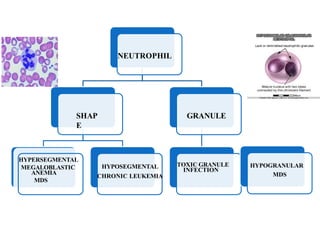
NEUTROPHIL
SHAP
E
HYPERSEGMENTAL
MEGALOBLASTIC
ANEMIA
MDS
HYPOSEGMENTAL
CHRONIC LEUKEMIA
GRANULE
TOXIC GRANULE
INFECTION
HYPOGRANULAR
MDS
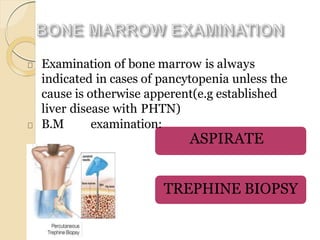
Examination of bone marrow is always
indicated in cases of pancytopenia unless the
cause is otherwise apperent(e.g established
liver disease with PHTN)
B.M examination:
ASPIRATE
TREPHINE BIOPSY
BONE MARROW EXAMINATION
Specifically, bone marrow aspirate permits examination of:
•Cytology
Megaloblastic change,
Dysplastic changes,
Abnormal cell infiltrates
•Immunophenotyping : antigen or marker on cells surfaces e.g
(Leukemias, Lymphoproliferative disorders)
•Cytogenetics : structure of chromosome
•Myelodysplasia, Leukemias,
Lymphoproliferativedisorders
Bone marrow is diagnosic for :
Multiplemyeloma
Myelofibrosis
A leukemic leukemia
Aplastic anemia
Seideroblastic anemia
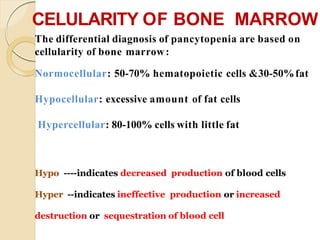
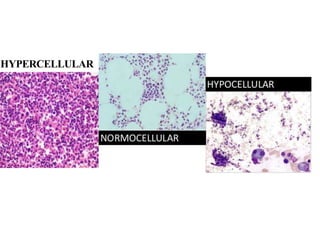
CELULARITY OF BONE MARROW
The differential diagnosis of pancytopenia are based on
cellularity of bone marrow:
Normocellular: 50-70% hematopoietic cells &30-50%fat
Hypocellular: excessive amount of fat cells
Hypercellular: 80-100% cells with little fat
Hypo ----indicates decreased production of blood cells
Hyper --indicates ineffective production or increased
destruction or sequestration of blood cell
HYPERCELLULAR
Causes of Hypocellular BM
1.Aplastic anemia (cong or aqui)
2.Hypoblastic MDS
3.Cytotoxic agents & radiotherapy
Causes of Hypercellular BM with
primary marrow disorders
1.Acute leukemia / lymphoma
2-Myelofibrosis
3- PNH
4- Mutiple myeloma
5. Mylodysblastic leukemia
Causes of Hypercellular BM with
systemic disorders
1.Hypersplenism
2- Megaloblastic anemia
3- Infection (T.B ,kala azar, brucellosis)
4- Overwhelming infections
5- SLE, Sjogren’s
6- Sarcoidosis
7- Storage disease- Gaucher, Niemann-
pick
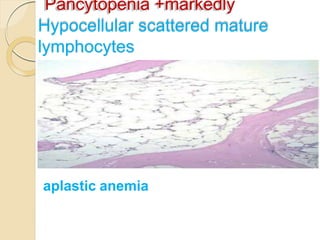
Pancytopenia +markedly
Hypocellular scattered mature
lymphocytes
aplastic anemia
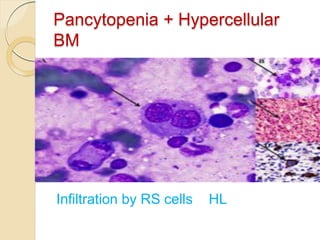
Pancytopenia + Hypercellular
BM
Infiltration by RS cells HL
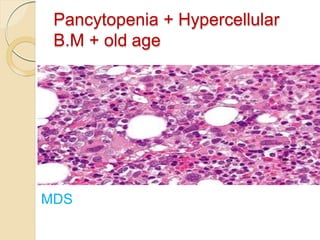
Pancytopenia + Hypercellular
B.M + old age
MDS
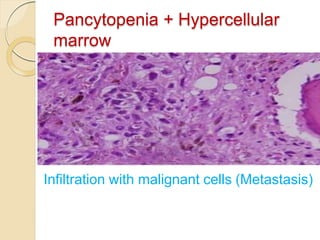
Pancytopenia + Hypercellular
marrow
Infiltration with malignant cells (Metastasis)
SPECIFIC INVESTIGATIONS
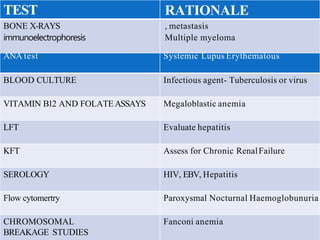
TEST RATIONALE
BONE X-RAYS
immunoelectrophoresis
, metastasis
Multiple myeloma
ANA test Systemic Lupus Erythematous
BLOOD CULTURE Infectious agent- Tuberculosis or virus
VITAMIN B12 AND FOLATEASSAYS Megaloblastic anemia
LFT Evaluate hepatitis
KFT Assess for Chronic RenalFailure
SEROLOGY HIV, EBV, Hepatitis
Flow cytomertry Paroxysmal Nocturnal Haemoglobunuria
CHROMOSOMAL
BREAKAGE STUDIES
Fanconi anemia
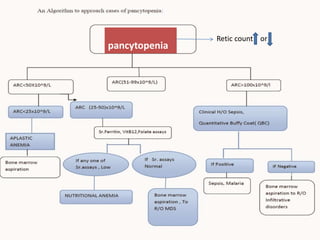
pancytopenia
Retic count or
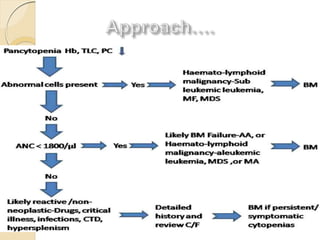
Pancytopenia

Pancytopenia

  • 2.
  • 3.
     normal adultmarrow produces 170x109 RBC, 100x109 neutrophils 200x109 platelets daily.
  • 4.
    10/1/2018 4 Pancytopenia Definition Reduction inthe number of red cells, white cells (neutrophils) and platelets in the peripheral blood below the lower limits of the age. Therefore it is combination of (anemia, leucopenia and thrombocytopenia) Hb<13.5 in ♂ & 11.5 in♀ Leucocyte count< 4000 Platelet count <150000
  • 5.
    Severe pancytopenia  Absoluteneutrophil count < 500/cmm  Platelet count < 20,000/cmm  Corrected reticulocyte count < 1%. Urgent full investigation in 1st 24-48 h
  • 6.
  • 7.
     Bone marrowfailure : aplastic anemia either ( congenital or acquired)  Bone marrow infiltration : Acute leukemia Lymphoma Carcinoma Myeloma MDS (non malignant infiltration (storage disorder) Causes
  • 8.
     Ineffective haematopoiesis Megaloblasticanaemia AIDS  Peripheral pooling / destruction Hypersplenism: portal hypertension , malaria , Myelofibrosis SLE Causes cont.
  • 9.
    1. Megaloblastic anemia 2.Infections 3. Hypersplenism 4. Aplastic anemia 5. Drug induced pancytopenia 6. Acute myeloid leukemia Common causes in developing countries
  • 10.
    Infections: (HIV, tuberculosis, hepatitisviruses, EBV, CMV) Hypersplenism: causes congestive splenomegaly (cirrhosis, congestive heart failure), malaria,leishmaniasis,thalassaemia and Hodgkin’s disease Most frequent haematologicmanifestation of SLE normocytic and normochromicanaemia. Leukopenia is also common and almost always consists of lymphopenia and not granulocytopenia.
  • 11.
    history • History andassociated symptoms Exam.. Inv1 Inv2 • General • Systemic • CBC with PBS, Reticulocyte count • B12/Folate , LFT,Hepatic serology, Coagulation profile, combs test, HIV . • BM aspiration and biopsy • Cytogenetics (if required) Inv 3 • Special investigations to confirm the diagnosis
  • 12.
  • 13.
    Symptoms/Findings Related to pancytopenia Anaemia----fatigue, shortness of breath, dependent oedema Neutropenia (fever, abscesses, rigors). Thromboacytopenia mucocuteneous bleeding- . Bruising. 10/1/2018 13
  • 14.
    Symptoms/Findings Related to thecause of pancytopenia eg: Splenomegaly: Hypersplenism, lymphoma, leukemia, myelofibrosis etc Lymphadenopathy: Lymphoma , leukemia,SLE etc Atrophic glossitis: Megaloblastic anaemia Others 10/1/2018 14
  • 15.
    History  Duration ofsymptom Long (MDS) Short (aplastic anemia)  History of transfusion  History of hemoglobinurea  Dietary history  Exposure to Radiation – Chemotherapy ( MDS , AML) Drugs : Anti cancer-anti thyroid-antibiotic(aplastic anemia) Barbiturates , phenytoin ( B12, Folic acid)
  • 16.
    History  Age- inheritedcause of bone marrow failure  Jaundice (hepatitis viruses)  Joint pain, rash,photosensitivity (lupus)  Bonepains (acute leukemias)  Night sweats (Hodgkins disease)  malaise, weightloss (tuberculosis,malignancy)  Joint Pain – (SLE)
  • 17.
    General examination A thoroughphysical exam is required  Eye examination: retinal hemorrhage leukemic infiltrations Pallor (Anemia) Jaundice (hepatitis-PNH-cirrhosis)  Oral examination Stomatitis or cheilitis (neutropenia , B12 deficiency) Gingival hyperplasia (leukemia) Oral candidiasis or pharyngeal exudate (neutropenia)
  • 18.
     Abdominal examination:organomegaly lymphadenopathy  skin examination : malar rash Petichae purpura hypo or hyperpigmentation  Musculoskelatal system : short stature abnormal thumb (fanconi anemia) Synovitis/swelling (SLE) Sternal tenderness (acute leukemia) Signs of chronic liver disease. General examination
  • 19.
  • 20.
     Pancytopenia +Backpain+Hypercalcemia+ oldage (multiple myeloma)  Pancytopenia + Malar rash or GN+ = SLE  pancytopenia + HSM = Leukemia  Recurrent oral ulcers and chronic diarrhoea may point towards HIV infection.  Loss of height (multiple myeloma)
  • 21.
    FINDINGS OCCURENCE Lymphadenopathy Lymphoma, Hodgkinlymphoma, also viral----typically abscent in aplastic a infection. Splenomegaly Not found in MDS or Aplastic anemia. Typical in Myeloproliferative disorders, sometimes in acute leukemia. Hepatomegaly Myeloproliferative disorders, Lymphoma Mediastinal bulk Lymphoma, Hodgkin’s disease Bony tenderness Multiple Myeloma, Metastasis
  • 22.
    A standard batteryof evaluation tests include:  COMPLETE BLOOD COUNT w indices  PERIPHERAL SMEAR  Reticulocyte Count  LiverFunctionTest &Hepatic Serology  Coagulation Profile,Bleeding Time, D-dimer  (combs test)  Serum B12 & Folate level  Serum HIV . ANA. bone marrow
  • 23.
     Anisocytosis &Poikilocytosis.  WBCs and RBCs Precursors  Platelets  Increased or decreased granulation in neutrophils  Hypo/Hypersegmentation in neutrophils
  • 24.
    MODERATE DEGREE COMMON ANISOCYTOSIS & POIKILOCYTOsis VerymarkedLess degree ABSENT MYELOFIBROSIS APLASTIC ANEMIA ACUTE LEUKEMIA LYMPHOMA/ MULTIPLE MYELOMA
  • 25.
    Myelofibrosis Multiple myeloma Acuteleukemias Subleukemic leukemias BLAST CELLS PLASMACYTIC CELLS IMMATURE LYMPHOCYTES WBC AND RBC PRECURSORS Marrow involvement by lymphoma If present so not Aplastic anemia
  • 26.
  • 27.
  • 28.
    Examination of bonemarrow is always indicated in cases of pancytopenia unless the cause is otherwise apperent(e.g established liver disease with PHTN) B.M examination: ASPIRATE TREPHINE BIOPSY
  • 29.
    BONE MARROW EXAMINATION Specifically,bone marrow aspirate permits examination of: •Cytology Megaloblastic change, Dysplastic changes, Abnormal cell infiltrates •Immunophenotyping : antigen or marker on cells surfaces e.g (Leukemias, Lymphoproliferative disorders) •Cytogenetics : structure of chromosome •Myelodysplasia, Leukemias, Lymphoproliferativedisorders
  • 30.
    Bone marrow isdiagnosic for : Multiplemyeloma Myelofibrosis A leukemic leukemia Aplastic anemia Seideroblastic anemia
  • 31.
    CELULARITY OF BONEMARROW The differential diagnosis of pancytopenia are based on cellularity of bone marrow: Normocellular: 50-70% hematopoietic cells &30-50%fat Hypocellular: excessive amount of fat cells Hypercellular: 80-100% cells with little fat Hypo ----indicates decreased production of blood cells Hyper --indicates ineffective production or increased destruction or sequestration of blood cell
  • 32.
  • 33.
    Causes of HypocellularBM 1.Aplastic anemia (cong or aqui) 2.Hypoblastic MDS 3.Cytotoxic agents & radiotherapy
  • 34.
    Causes of HypercellularBM with primary marrow disorders 1.Acute leukemia / lymphoma 2-Myelofibrosis 3- PNH 4- Mutiple myeloma 5. Mylodysblastic leukemia
  • 35.
    Causes of HypercellularBM with systemic disorders 1.Hypersplenism 2- Megaloblastic anemia 3- Infection (T.B ,kala azar, brucellosis) 4- Overwhelming infections 5- SLE, Sjogren’s 6- Sarcoidosis 7- Storage disease- Gaucher, Niemann- pick
  • 36.
    Pancytopenia +markedly Hypocellular scatteredmature lymphocytes aplastic anemia
  • 37.
  • 38.
  • 39.
    Pancytopenia + Hypercellular marrow Infiltrationwith malignant cells (Metastasis)
  • 40.
  • 41.
    TEST RATIONALE BONE X-RAYS immunoelectrophoresis ,metastasis Multiple myeloma ANA test Systemic Lupus Erythematous BLOOD CULTURE Infectious agent- Tuberculosis or virus VITAMIN B12 AND FOLATEASSAYS Megaloblastic anemia LFT Evaluate hepatitis KFT Assess for Chronic RenalFailure SEROLOGY HIV, EBV, Hepatitis Flow cytomertry Paroxysmal Nocturnal Haemoglobunuria CHROMOSOMAL BREAKAGE STUDIES Fanconi anemia
  • 42.