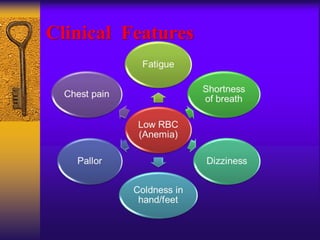
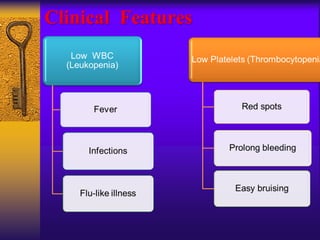
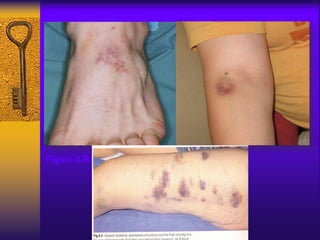
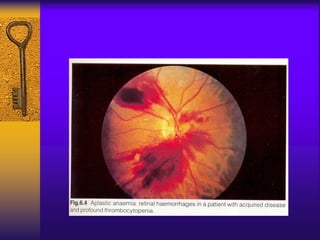
This document discusses aplastic anemia, which is a condition characterized by pancytopenia (low red blood cells, white blood cells, and platelets) due to bone marrow failure. It can be acquired through exposure to drugs, radiation, chemicals, or viruses, or inherited through conditions like Fanconi anemia. Clinically, it presents with anemia, bruising, and increased infection risk. The bone marrow appears hypocellular on biopsy. Treatment involves managing symptoms, stopping any triggers, and attempts to restore bone marrow function through transplantation, immunosuppression, or growth factors.
Aplastic Anemia
Definition:
Pancytopeniawith hypocellularity (Aplasia) of
Bone Marrow
Aplastic anemia is a severe, life threatening
syndrome in which production of erythrocytes,
WBCs, and platlets has failed.
8.
Aplastic anemia mayoccur in all age
groups and both genders.
Failure of the bone marrow percursors to
produce mature cells. Characterized by
hypocellular marrow and pancytopenia.
9.
Etiology
Acquired: More common
Inherited:Fanconi anemia
Acquired:
Idiopathic: 65%
1. Drugs
Inevitable:
Dose related , reversible.g. cytotoxic drugs, ionizing radiation.
The timing, duration of aplasia and recovery depend on the dose.
Recovery is usual except with whole body irradiation.
e.g., chemotherapeutic drugs)
10.
Idiosyncratic:
Unpredictable to drugse.g., anti-inflammatory antibiotics,
anti-epileptic, these agents usually do not produce
marrow failure in the majority of persons exposed to
these agents.
- Cytotoxic drugs - Antibiotics
- Chloramphenicol - Anti-inflammatory
- Anti-convulsant - Sulphonamides
11.
Aplastic Anemia: (Cont.)
Acquired:
Radiations
Chemicals e.g., Benzene and pesticides
Viruses:
– Hepatitis A, Non-A and Non-B
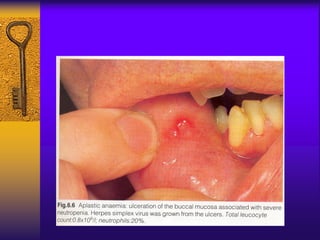
– Herpes simplex
– E-B virus
– Parvovirus: Transient
Immune: SLE, RA (rheumatoid arthritis)
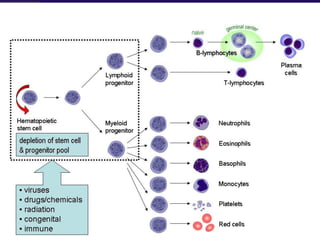
substantial reductionin the number of haemopoietic
pluripotential stem cells, and a fault in the remaining
stem cells or an immune reaction against them, which
makes them unable to divide and differentiate
sufficiently to populate the bone marrow.
A primary fault in the marrow microenviromnent has
also been suggested but the success of stem cell
transplantation (SCT) shows this can only be a rare cause
because normal donor stem cells are usually able to
thrive in the recipient's marrow cavity.
14.
Pathogenesis
Potential mechanisms:
• Absentor defective stem cells (stem cell failure).
• Abnormal marrow micro-environment.
• Inhibition by an abnormal clone of hemopoietic cells.
• Immune mediated suppression of hematopoiesis.
It is believed that genetic factors play a role. There
is a higher incidence with HLA (11) histo comp.
Antigen. Immune mechanism is involved.
15.
Pathogenesis (Cont…)
The latesttheory is:
there is an intrinsic derangement
of hemopoietic proliferative capacity, which is consistent
with life. The immune mechanism I,e autoreactive T cells
attempt to destroy
the abnormal cells (self cure) and the clinical course and
complications depend on the balance. If the immune
mechanism is strong, there will be severe pancytopenia.
If not, there will be myelodysplasia.
Hematological findings: (Cont…)
BoneMarrow:
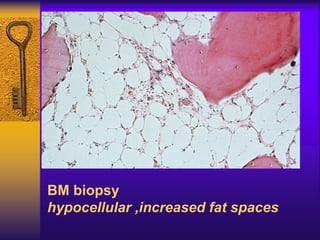
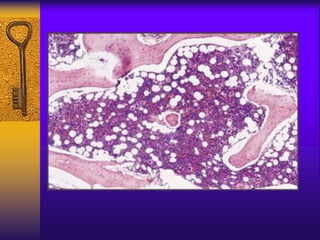
– Hypocellular:
<50% of normal cellularity Trephine biopsy is
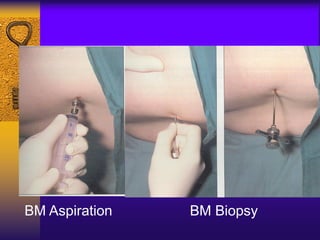
the most important for diagnosis.
– Most of the cells present are lymphocytes,
plasma cells.
– Iron stores: increased
26.
Treatment
Withdrawal ofetiological agents.
Supportive.
Restoration of marrow activity:
– Bone marrow transplant
– Immunosuppressive treatment
- Prednisolone - Antilymphocyte glob.
- Cyclosporin - Anti T cells abs.
- Splenectomy
– Androgens
– Growth factors
27.
Inherited Anemia
Fanconi’s Anemia:
The most common type of inherited aplastic anemias.
Associated with anomalies e.g., skeletal, skin.
Autosomal recessive.
Genetics:
Increased sensitivity of the cells to chromosomal damage
by DNA cross linking agents.
13 genes are responsible
IV54 mutation, is associated with multiple dysmorphism,
severe pancytopenia, higher incidence of AML.
28.
Inherited Anemia
Clinical Features:
Skeletal and skin anomalies seen at birth
e.g., microcephally.
Manifestations of marrow failure, usually
later at age 5-10 yrs. Present as anemia,
mucusal bleeding e.g. nasal.
29.
Clinical Features ofFanconi’s Anemia
Common Findings:
Low birth weight
Short stature
Microcephaly
Microphthalmia
Microstomia
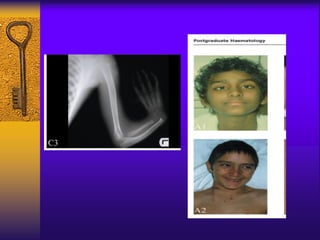
Skeletal abnormalities, particularly of thumbs and radii
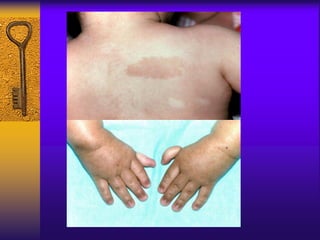
Generalized increased pigmentation of skin
33.
PURE RED CELLAPLASIA
PURE RED CELL APLASIA
Pure red cell aplasia is characterized by a selective decrease in
erythroid precursor cells in the bone marrow. WBCs and platlets are
unaffected.
— Acquired
Transitory with viral or bacterial infections
Patients with hemolytic anemias may suddenly halt erythropoiesis
Patients with thymoma – T-cell mediated responses against bone
marrow erythroblasts or erythropoietin are sometimes produced.
— Congenital
Diamond-Blackfan syndrome – occurs in young children and is
progressive. It is probably due to an intrinsic or regulatory defect in the
committed erythroid stem cell.