MANAGEMENT OF 
APLASTIC ANEMIA 
Presentor – Dr. Ritika Khurana 
Moderator – Dr. Sunil Gomber
APLASTIC ANEMIA 
One of the types of bone 
marrow failure syndromes 
presenting with reduced 
hematopoeitic cells of all 3 
lineages
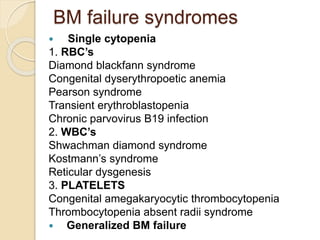
BM failure syndromes 
 Single cytopenia 
1. RBC’s 
Diamond blackfann syndrome 
Congenital dyserythropoetic anemia 
Pearson syndrome 
Transient erythroblastopenia 
Chronic parvovirus B19 infection 
2. WBC’s 
Shwachman diamond syndrome 
Kostmann’s syndrome 
Reticular dysgenesis 
3. PLATELETS 
Congenital amegakaryocytic thrombocytopenia 
Thrombocytopenia absent radii syndrome 
 Generalized BM failure
Classification 
Inherited - 30% 
Acquired - 70%
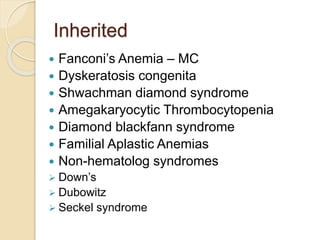
Inherited 
 Fanconi’s Anemia – MC 
 Dyskeratosis congenita 
 Shwachman diamond syndrome 
 Amegakaryocytic Thrombocytopenia 
 Diamond blackfann syndrome 
 Familial Aplastic Anemias 
 Non-hematolog syndromes 
 Down’s 
 Dubowitz 
 Seckel syndrome
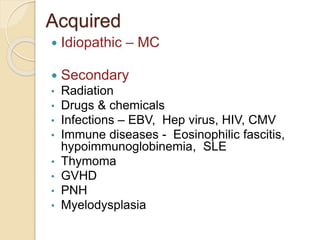
Acquired 
 Idiopathic – MC 
 Secondary 
• Radiation 
• Drugs & chemicals 
• Infections – EBV, Hep virus, HIV, CMV 
• Immune diseases - Eosinophilic fascitis, 
hypoimmunoglobinemia, SLE 
• Thymoma 
• GVHD 
• PNH 
• Myelodysplasia
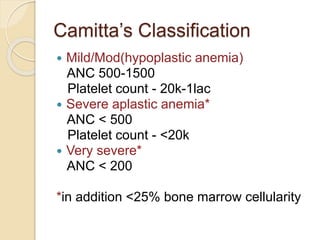
Camitta’s Classification 
 Mild/Mod(hypoplastic anemia) 
ANC 500-1500 
Platelet count - 20k-1lac 
 Severe aplastic anemia* 
ANC < 500 
Platelet count - <20k 
 Very severe* 
ANC < 200 
*in addition <25% bone marrow cellularity
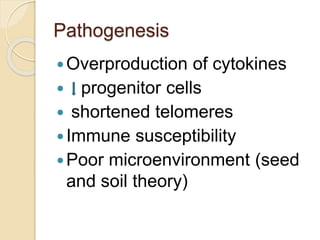
Pathogenesis 
Overproduction of cytokines 
 progenitor cells 
 shortened telomeres 
Immune susceptibility 
Poor microenvironment (seed 
and soil theory)
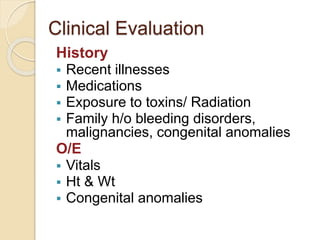
Clinical Evaluation 
History 
 Recent illnesses 
 Medications 
 Exposure to toxins/ Radiation 
 Family h/o bleeding disorders, 
malignancies, congenital anomalies 
O/E 
 Vitals 
 Ht & Wt 
 Congenital anomalies
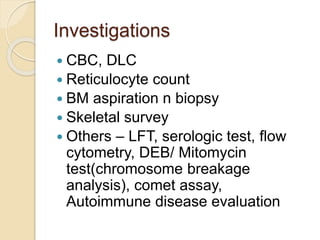
Investigations 
 CBC, DLC 
 Reticulocyte count 
 BM aspiration n biopsy 
 Skeletal survey 
 Others – LFT, serologic test, flow 
cytometry, DEB/ Mitomycin 
test(chromosome breakage 
analysis), comet assay, 
Autoimmune disease evaluation
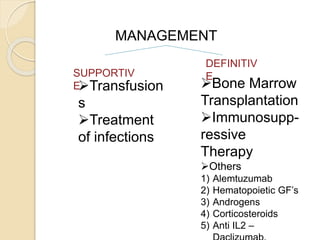
MANAGEMENT 
SUPPORTIV 
E 
DEFINITIV 
E 
Transfusion 
s 
Treatment 
of infections 
Bone Marrow 
Transplantation 
Immunosupp-ressive 
Therapy 
Others 
1) Alemtuzumab 
2) Hematopoietic GF’s 
3) Androgens 
4) Corticosteroids 
5) Anti IL2 – 
Daclizumab,
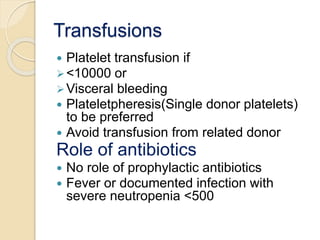
Transfusions 
 Platelet transfusion if 
<10000 or 
Visceral bleeding 
 Plateletpheresis(Single donor platelets) 
to be preferred 
 Avoid transfusion from related donor 
Role of antibiotics 
 No role of prophylactic antibiotics 
 Fever or documented infection with 
severe neutropenia <500
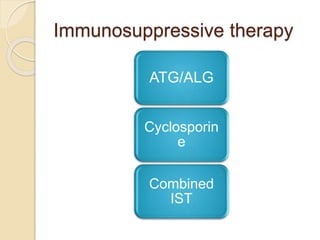
Immunosuppressive therapy 
ATG/ALG 
Cyclosporin 
e 
Combined 
IST
ATG- antithymocyte globulin 
 2 types – horse and rabbit ATG 
 Immunization of both by human 
thoracic duct lymphocytes or 
thymocytes 
 Mechanism – act against T-lymphocytes, 
downregulating 
production of IFN gamma, IL2
Prerequisites 
 Skin testing to be done for 
hypersensitivity 
 Double lumen central catheter 
 Platelet count to be maintained above 
20k 
 Drugs like ß-blockers to be avoided 
 Avoid starting on weekends or late 
during day
How to administer? 
 DOSE –40mg/kg over 4hrs daily for 
4days 
 Prednisone 1 mg/kg started on day1, 
continued for 2 weeks (prophylaxis for 
serum sickness) 
 Premedications – diphenhydramine, 
acetaminophen 
 Hydration n supplemental oxygen
Side effects n management 
 Serum sickness- steroids 
 Rash, fever- diphenhydramine, 
acetaminophen 
 Rigors- mepiridine 
 Inc transaminases – regular 
monitoring
Monitoring response 
 Response – within first 3 months 
 Earliest response – appearance of 
granulocytes and nucleated RBC’s 
 Order of rise – 
1. RBC’s ( inc HbF) 
2. WBC’s 
3. Platelets
Horse vs Rabbit ATG 
 Rabbit ATG more lymphocytotoxic 
 Hematologic response to rabbit ATG 
(37%) about half that observed with 
standard horse ATG (68%), 
 Inferior survival noted in the rabbit 
ATG arm 
Scheinberg P,et al. Horse versus rabbit 
antithymocyte globulin in acquired aplastic 
anemia. N Engl J Med 2011;365(5):430-438.
Cyclosporine 
 Fungal cyclic undecapeptide 
 Inhibits T-cell - IL-2, IFN-gamma 
 Cyclosporine alone lower response rates 
n higher risk of disease progression 
 Best results seen as combined IST(with 
ATG) 
 5yr survival rate- 70% 
Rosenfeld SJ, et al.Intensive 
immunosuppression with antithymocyte 
globulin and cyclosporine as treatment for 
severe acquired aplastic 
anemia. Blood 1995;85(11):3058-3065
How to administer? 
 Twice daily to maintain trough levels 
100-250ng/ml 
 Starting dose 15mg/kg/day 
 Response takes weeks to months 
 Minimum trial period should be 3-6mths 
 Ideally ATG×4days n cyclosporine×6- 
12mths 
 Cyclosporine should be gradually 
tapered 
Scheinberg P, Horse versus rabbit antithymocyte 
globulin in acquired aplastic anemia. N Engl J
Adverse effects n 
management 
 Hypertension – amlodipine 
 Hirsutism 
 Gingival hyperplasia – azithromycin 
 Inc creatinine levels – monitoring and 
adjusting dose 
 if creat > 2mg/ml – temp cessation n 
reintroduction at lower doses 
 P.carinii pneumonia- monthly aerosolized 
pentamidine 
 Dev of Clonal hematopoeitic disorders
Definitions 
 Complete response- transfusion independence, 
neutrophil count >1500/L, platelet count>1lac n 
Hb>10g/dl 
 Partial remission- transfusion independence, 
Hb by atleast 2g/dl n actual value>8, 
granulocytes by atleast 500/L, platelets>30k 
 No response- continued severe aplastic anemia 
 Refractory SAA – severe pancytopenia 6mths 
after initiation of IST 
Chandra J, et al. Antithymocyte globulin and 
cyclosporin in children with acquired aplastic anemia. 
Indian J Pediatr. 2008 Mar;75(3):229-33
Treatment Failure 
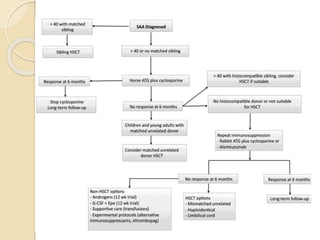
 20-40% fail to respond to combined 
IST 
 Give second course – 77% respond 
 Patients failing to respond to 2 
courses- unlikely to respond to third 
course 
 Give trial of androgens, eltromopag, g-csf
Role of steroids 
 High dose steroids not recommended 
as 1st line 
 Methylprednisolone in the dose 
2mg/kg/day as 0.5mg/kg/dose 6hrly 
 Prednisone taper following 8 day 
course of IV methylprednisolone over 
total of 15 days
Role of G-CSF 
 G-CSF 
increases neutrophil recovery 
no increase in trilineage response 
Flu like symptoms 
Inc risk of clonal evolution 
 Seiji Kojima, et al concluded, G-CSF 
therapy did not modify long-term 
hematopoietic recovery and survival in 
patients with severe and very severe 
AA
Role of eltromopag 
 Thrombopoeitin mimetic 
 Ideally should be ineffective- already high 
levels 
 In contrast – 40% responded 
(bilineage/trilineage) 
 Inc Hb n BM cellularity 
 transfusions 
 SE – risk of progression to MDS 
Young NS. Current concepts in the pathophysiology and 
treatment of aplastic anemia. Hematology Am Soc Hematol 
Educ Program. 2013;2013:76-81
Role of cyclophosphamide 
 Used in past 
 Efficacy similar to horse ATG 
 Fewer relapse rate 
 But excessively toxic and inc risk of 
fungal infections 
 Not recommended anymore 
Tisdale JF, et al.High-dose cyclophosphamide 
in severe aplastic anaemia: a randomised 
trial. Lancet 2000;356(9241):1554-1559
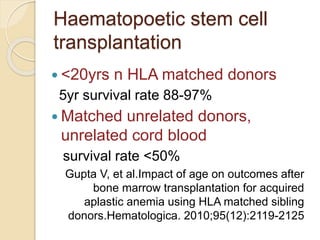
Haematopoetic stem cell 
transplantation 
 <20yrs n HLA matched donors 
5yr survival rate 88-97% 
 Matched unrelated donors, 
unrelated cord blood 
survival rate <50% 
Gupta V, et al.Impact of age on outcomes after 
bone marrow transplantation for acquired 
aplastic anemia using HLA matched sibling 
donors.Hematologica. 2010;95(12):2119-2125
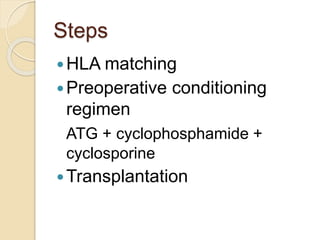
Steps 
HLA matching 
Preoperative conditioning 
regimen 
ATG + cyclophosphamide + 
cyclosporine 
Transplantation
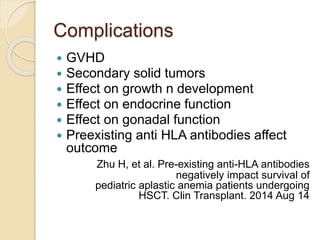
Complications 
 GVHD 
 Secondary solid tumors 
 Effect on growth n development 
 Effect on endocrine function 
 Effect on gonadal function 
 Preexisting anti HLA antibodies affect 
outcome 
Zhu H, et al. Pre-existing anti-HLA antibodies 
negatively impact survival of 
pediatric aplastic anemia patients undergoing 
HSCT. Clin Transplant. 2014 Aug 14
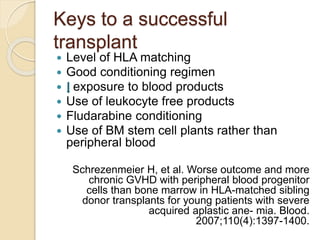
Keys to a successful 
transplant 
 Level of HLA matching 
 Good conditioning regimen 
 exposure to blood products 
 Use of leukocyte free products 
 Fludarabine conditioning 
 Use of BM stem cell plants rather than 
peripheral blood 
Schrezenmeier H, et al. Worse outcome and more 
chronic GVHD with peripheral blood progenitor 
cells than bone marrow in HLA-matched sibling 
donor transplants for young patients with severe 
acquired aplastic ane- mia. Blood. 
2007;110(4):1397-1400.
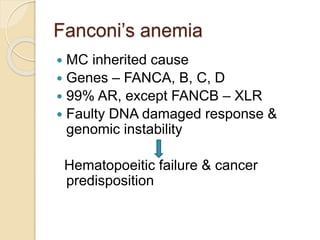
Fanconi’s anemia 
 MC inherited cause 
 Genes – FANCA, B, C, D 
 99% AR, except FANCB – XLR 
 Faulty DNA damaged response & 
genomic instability 
Hematopoeitic failure & cancer 
predisposition
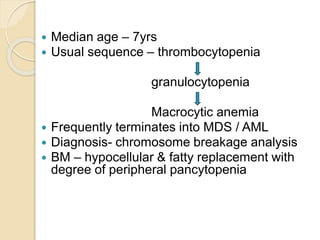
 Median age – 7yrs 
 Usual sequence – thrombocytopenia 
granulocytopenia 
Macrocytic anemia 
 Frequently terminates into MDS / AML 
 Diagnosis- chromosome breakage analysis 
 BM – hypocellular & fatty replacement with 
degree of peripheral pancytopenia
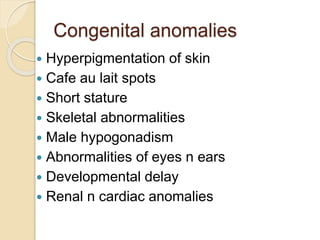
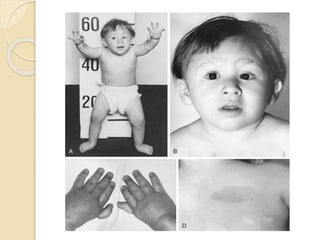
Congenital anomalies 
 Hyperpigmentation of skin 
 Cafe au lait spots 
 Short stature 
 Skeletal abnormalities 
 Male hypogonadism 
 Abnormalities of eyes n ears 
 Developmental delay 
 Renal n cardiac anomalies
complications 
 Risk of hematological 
malignancies – 33% 
 Risk of non-hematological 
malignancies – 28% 
 Limb n skeletal abnormalities – 
70%
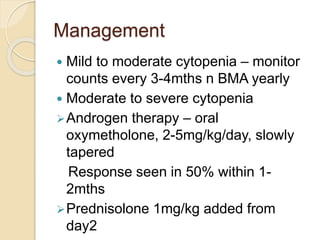
Management 
 Mild to moderate cytopenia – monitor 
counts every 3-4mths n BMA yearly 
 Moderate to severe cytopenia 
Androgen therapy – oral 
oxymetholone, 2-5mg/kg/day, slowly 
tapered 
Response seen in 50% within 1- 
2mths 
Prednisolone 1mg/kg added from 
day2
 G-CSF daily/ every 2days with 
erythropoeitin given sc or iv 
3times/week 
Increase ANC, platelets & Hb levels 
 Allogenic HSCT – only curative 
treatment 
in children < 10yrs, survival rate > 
80% 
 Gene therapy – experimental
THANK YOU

Aplastic anemia

  • 1.
    MANAGEMENT OF APLASTICANEMIA Presentor – Dr. Ritika Khurana Moderator – Dr. Sunil Gomber
  • 2.
    APLASTIC ANEMIA Oneof the types of bone marrow failure syndromes presenting with reduced hematopoeitic cells of all 3 lineages
  • 3.
    BM failure syndromes  Single cytopenia 1. RBC’s Diamond blackfann syndrome Congenital dyserythropoetic anemia Pearson syndrome Transient erythroblastopenia Chronic parvovirus B19 infection 2. WBC’s Shwachman diamond syndrome Kostmann’s syndrome Reticular dysgenesis 3. PLATELETS Congenital amegakaryocytic thrombocytopenia Thrombocytopenia absent radii syndrome  Generalized BM failure
  • 4.
    Classification Inherited -30% Acquired - 70%
  • 5.
    Inherited  Fanconi’sAnemia – MC  Dyskeratosis congenita  Shwachman diamond syndrome  Amegakaryocytic Thrombocytopenia  Diamond blackfann syndrome  Familial Aplastic Anemias  Non-hematolog syndromes  Down’s  Dubowitz  Seckel syndrome
  • 6.
    Acquired  Idiopathic– MC  Secondary • Radiation • Drugs & chemicals • Infections – EBV, Hep virus, HIV, CMV • Immune diseases - Eosinophilic fascitis, hypoimmunoglobinemia, SLE • Thymoma • GVHD • PNH • Myelodysplasia
  • 7.
    Camitta’s Classification Mild/Mod(hypoplastic anemia) ANC 500-1500 Platelet count - 20k-1lac  Severe aplastic anemia* ANC < 500 Platelet count - <20k  Very severe* ANC < 200 *in addition <25% bone marrow cellularity
  • 8.
    Pathogenesis Overproduction ofcytokines  progenitor cells  shortened telomeres Immune susceptibility Poor microenvironment (seed and soil theory)
  • 9.
    Clinical Evaluation History  Recent illnesses  Medications  Exposure to toxins/ Radiation  Family h/o bleeding disorders, malignancies, congenital anomalies O/E  Vitals  Ht & Wt  Congenital anomalies
  • 10.
    Investigations  CBC,DLC  Reticulocyte count  BM aspiration n biopsy  Skeletal survey  Others – LFT, serologic test, flow cytometry, DEB/ Mitomycin test(chromosome breakage analysis), comet assay, Autoimmune disease evaluation
  • 11.
    MANAGEMENT SUPPORTIV E DEFINITIV E Transfusion s Treatment of infections Bone Marrow Transplantation Immunosupp-ressive Therapy Others 1) Alemtuzumab 2) Hematopoietic GF’s 3) Androgens 4) Corticosteroids 5) Anti IL2 – Daclizumab,
  • 12.
    Transfusions  Platelettransfusion if <10000 or Visceral bleeding  Plateletpheresis(Single donor platelets) to be preferred  Avoid transfusion from related donor Role of antibiotics  No role of prophylactic antibiotics  Fever or documented infection with severe neutropenia <500
  • 13.
    Immunosuppressive therapy ATG/ALG Cyclosporin e Combined IST
  • 14.
    ATG- antithymocyte globulin  2 types – horse and rabbit ATG  Immunization of both by human thoracic duct lymphocytes or thymocytes  Mechanism – act against T-lymphocytes, downregulating production of IFN gamma, IL2
  • 15.
    Prerequisites  Skintesting to be done for hypersensitivity  Double lumen central catheter  Platelet count to be maintained above 20k  Drugs like ß-blockers to be avoided  Avoid starting on weekends or late during day
  • 16.
    How to administer?  DOSE –40mg/kg over 4hrs daily for 4days  Prednisone 1 mg/kg started on day1, continued for 2 weeks (prophylaxis for serum sickness)  Premedications – diphenhydramine, acetaminophen  Hydration n supplemental oxygen
  • 17.
    Side effects nmanagement  Serum sickness- steroids  Rash, fever- diphenhydramine, acetaminophen  Rigors- mepiridine  Inc transaminases – regular monitoring
  • 18.
    Monitoring response Response – within first 3 months  Earliest response – appearance of granulocytes and nucleated RBC’s  Order of rise – 1. RBC’s ( inc HbF) 2. WBC’s 3. Platelets
  • 19.
    Horse vs RabbitATG  Rabbit ATG more lymphocytotoxic  Hematologic response to rabbit ATG (37%) about half that observed with standard horse ATG (68%),  Inferior survival noted in the rabbit ATG arm Scheinberg P,et al. Horse versus rabbit antithymocyte globulin in acquired aplastic anemia. N Engl J Med 2011;365(5):430-438.
  • 20.
    Cyclosporine  Fungalcyclic undecapeptide  Inhibits T-cell - IL-2, IFN-gamma  Cyclosporine alone lower response rates n higher risk of disease progression  Best results seen as combined IST(with ATG)  5yr survival rate- 70% Rosenfeld SJ, et al.Intensive immunosuppression with antithymocyte globulin and cyclosporine as treatment for severe acquired aplastic anemia. Blood 1995;85(11):3058-3065
  • 21.
    How to administer?  Twice daily to maintain trough levels 100-250ng/ml  Starting dose 15mg/kg/day  Response takes weeks to months  Minimum trial period should be 3-6mths  Ideally ATG×4days n cyclosporine×6- 12mths  Cyclosporine should be gradually tapered Scheinberg P, Horse versus rabbit antithymocyte globulin in acquired aplastic anemia. N Engl J
  • 22.
    Adverse effects n management  Hypertension – amlodipine  Hirsutism  Gingival hyperplasia – azithromycin  Inc creatinine levels – monitoring and adjusting dose  if creat > 2mg/ml – temp cessation n reintroduction at lower doses  P.carinii pneumonia- monthly aerosolized pentamidine  Dev of Clonal hematopoeitic disorders
  • 23.
    Definitions  Completeresponse- transfusion independence, neutrophil count >1500/L, platelet count>1lac n Hb>10g/dl  Partial remission- transfusion independence, Hb by atleast 2g/dl n actual value>8, granulocytes by atleast 500/L, platelets>30k  No response- continued severe aplastic anemia  Refractory SAA – severe pancytopenia 6mths after initiation of IST Chandra J, et al. Antithymocyte globulin and cyclosporin in children with acquired aplastic anemia. Indian J Pediatr. 2008 Mar;75(3):229-33
  • 24.
    Treatment Failure 20-40% fail to respond to combined IST  Give second course – 77% respond  Patients failing to respond to 2 courses- unlikely to respond to third course  Give trial of androgens, eltromopag, g-csf
  • 25.
    Role of steroids  High dose steroids not recommended as 1st line  Methylprednisolone in the dose 2mg/kg/day as 0.5mg/kg/dose 6hrly  Prednisone taper following 8 day course of IV methylprednisolone over total of 15 days
  • 26.
    Role of G-CSF  G-CSF increases neutrophil recovery no increase in trilineage response Flu like symptoms Inc risk of clonal evolution  Seiji Kojima, et al concluded, G-CSF therapy did not modify long-term hematopoietic recovery and survival in patients with severe and very severe AA
  • 27.
    Role of eltromopag  Thrombopoeitin mimetic  Ideally should be ineffective- already high levels  In contrast – 40% responded (bilineage/trilineage)  Inc Hb n BM cellularity  transfusions  SE – risk of progression to MDS Young NS. Current concepts in the pathophysiology and treatment of aplastic anemia. Hematology Am Soc Hematol Educ Program. 2013;2013:76-81
  • 28.
    Role of cyclophosphamide  Used in past  Efficacy similar to horse ATG  Fewer relapse rate  But excessively toxic and inc risk of fungal infections  Not recommended anymore Tisdale JF, et al.High-dose cyclophosphamide in severe aplastic anaemia: a randomised trial. Lancet 2000;356(9241):1554-1559
  • 29.
    Haematopoetic stem cell transplantation  <20yrs n HLA matched donors 5yr survival rate 88-97%  Matched unrelated donors, unrelated cord blood survival rate <50% Gupta V, et al.Impact of age on outcomes after bone marrow transplantation for acquired aplastic anemia using HLA matched sibling donors.Hematologica. 2010;95(12):2119-2125
  • 30.
    Steps HLA matching Preoperative conditioning regimen ATG + cyclophosphamide + cyclosporine Transplantation
  • 31.
    Complications  GVHD  Secondary solid tumors  Effect on growth n development  Effect on endocrine function  Effect on gonadal function  Preexisting anti HLA antibodies affect outcome Zhu H, et al. Pre-existing anti-HLA antibodies negatively impact survival of pediatric aplastic anemia patients undergoing HSCT. Clin Transplant. 2014 Aug 14
  • 32.
    Keys to asuccessful transplant  Level of HLA matching  Good conditioning regimen  exposure to blood products  Use of leukocyte free products  Fludarabine conditioning  Use of BM stem cell plants rather than peripheral blood Schrezenmeier H, et al. Worse outcome and more chronic GVHD with peripheral blood progenitor cells than bone marrow in HLA-matched sibling donor transplants for young patients with severe acquired aplastic ane- mia. Blood. 2007;110(4):1397-1400.
  • 34.
    Fanconi’s anemia MC inherited cause  Genes – FANCA, B, C, D  99% AR, except FANCB – XLR  Faulty DNA damaged response & genomic instability Hematopoeitic failure & cancer predisposition
  • 35.
     Median age– 7yrs  Usual sequence – thrombocytopenia granulocytopenia Macrocytic anemia  Frequently terminates into MDS / AML  Diagnosis- chromosome breakage analysis  BM – hypocellular & fatty replacement with degree of peripheral pancytopenia
  • 36.
    Congenital anomalies Hyperpigmentation of skin  Cafe au lait spots  Short stature  Skeletal abnormalities  Male hypogonadism  Abnormalities of eyes n ears  Developmental delay  Renal n cardiac anomalies
  • 38.
    complications  Riskof hematological malignancies – 33%  Risk of non-hematological malignancies – 28%  Limb n skeletal abnormalities – 70%
  • 39.
    Management  Mildto moderate cytopenia – monitor counts every 3-4mths n BMA yearly  Moderate to severe cytopenia Androgen therapy – oral oxymetholone, 2-5mg/kg/day, slowly tapered Response seen in 50% within 1- 2mths Prednisolone 1mg/kg added from day2
  • 40.
     G-CSF daily/every 2days with erythropoeitin given sc or iv 3times/week Increase ANC, platelets & Hb levels  Allogenic HSCT – only curative treatment in children < 10yrs, survival rate > 80%  Gene therapy – experimental
  • 41.