Cytopreparatory Technique





Fixation of Various Cytological Samples
Staining Methods
Interpretation and Evaluation
Fixation and Fixatives




Fixation is the basis or foundation of
cytological technique and the results of all
subsequent procedures depend on the
correct selection and use of the fixative
employed.
It is a complex series of chemical events and
differs for the different groups of chemical
substances found in the tissues
Fixation and Fixatives




Fixation is the basis or foundation of
cytological technique and the results of all
subsequent procedures depend on the
correct selection and use of the fixative
employed.
It is a complex series of chemical events and
differs for the different groups of chemical
substances found in the tissues
Fix , means to confine from which it can not move away or to keep in life like
condition shortly after death or removal from the body.

WHY FIX?
 To preserve cell organelles and chemical constituents in a
condition identical to that existing during life .Since this aim is
impossible hence methods are applied: To prevent Autolysis
 To prevent putrefaction (Bacterial decomposition)
 To fortify cells against damage for post fixation procedures e.g.
Dehydration, Clearing, Embedding etc.
 To Facilitate subsequent staining of smears.
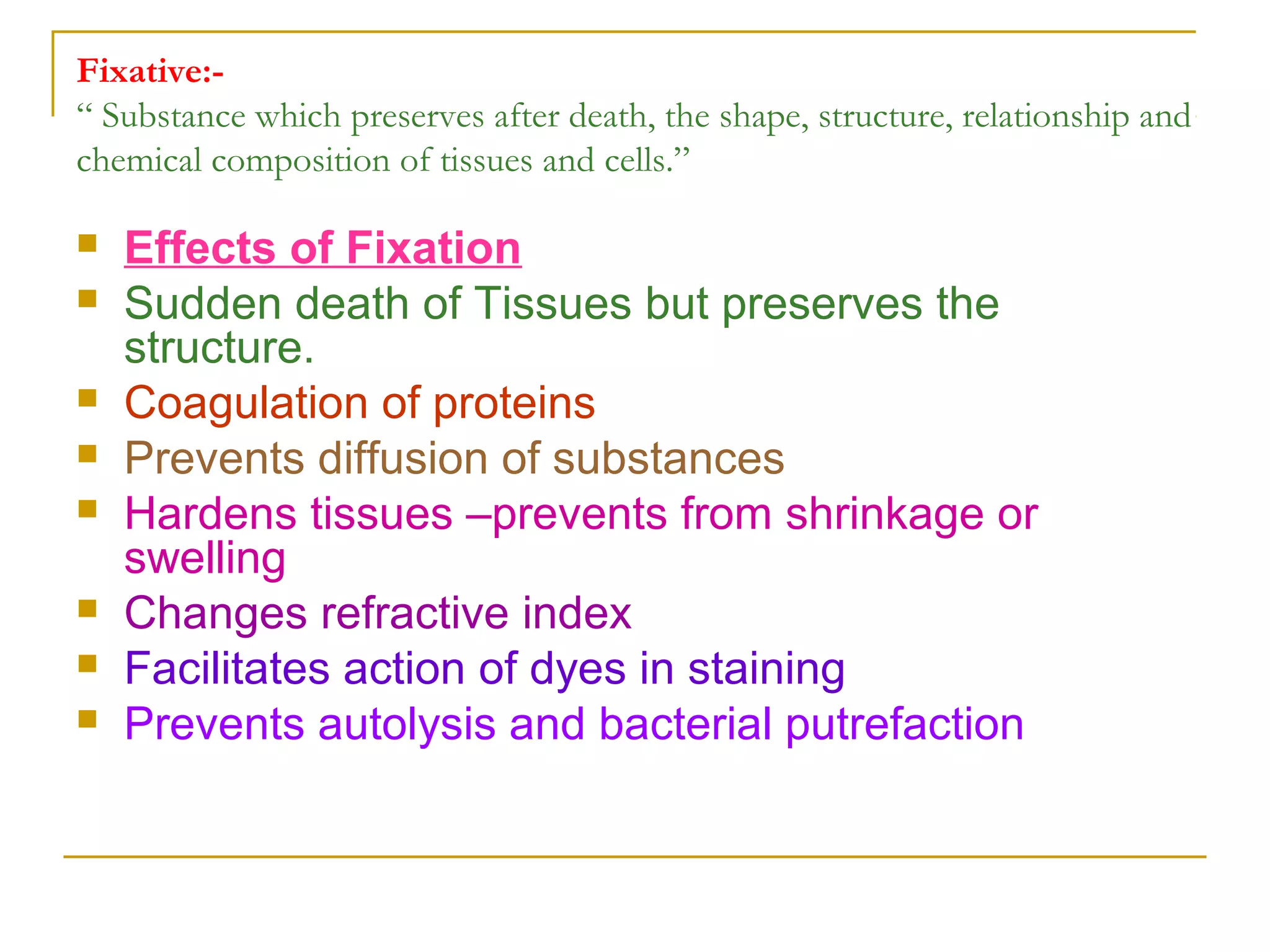
Fixative:“ Substance which preserves after death, the shape, structure, relationship and
chemical composition of tissues and cells.”









Effects of Fixation
Sudden death of Tissues but preserves the
structure.
Coagulation of proteins
Prevents diffusion of substances
Hardens tissues –prevents from shrinkage or
swelling
Changes refractive index
Facilitates action of dyes in staining
Prevents autolysis and bacterial putrefaction
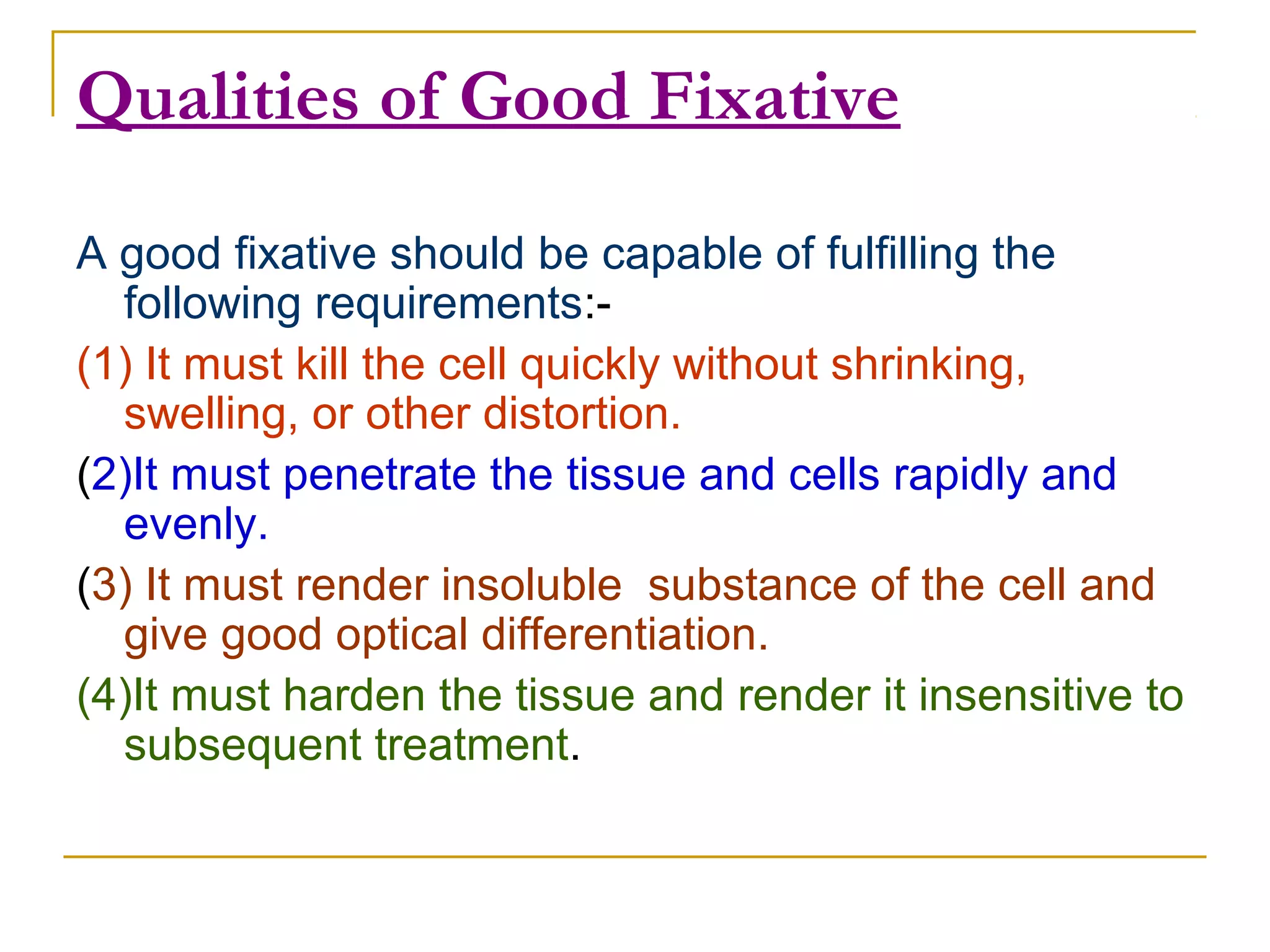
Qualities of Good Fixative
A good fixative should be capable of fulfilling the
following requirements:(1) It must kill the cell quickly without shrinking,
swelling, or other distortion.
(2)It must penetrate the tissue and cells rapidly and
evenly.
(3) It must render insoluble substance of the cell and
give good optical differentiation.
(4)It must harden the tissue and render it insensitive to
subsequent treatment.
Qualities of Good Fixative
(5)It must permit at a later date the application of
numerous staining procedures.
(6)It must inhibit bacterial decay and autolysis.
(7)It should allow tissue to be stored for long period of
time.
(8) It should permit the restoration of natural color for
photography and mounting as museum specimens.
(9) It should be simple to prepare and economical in
use.
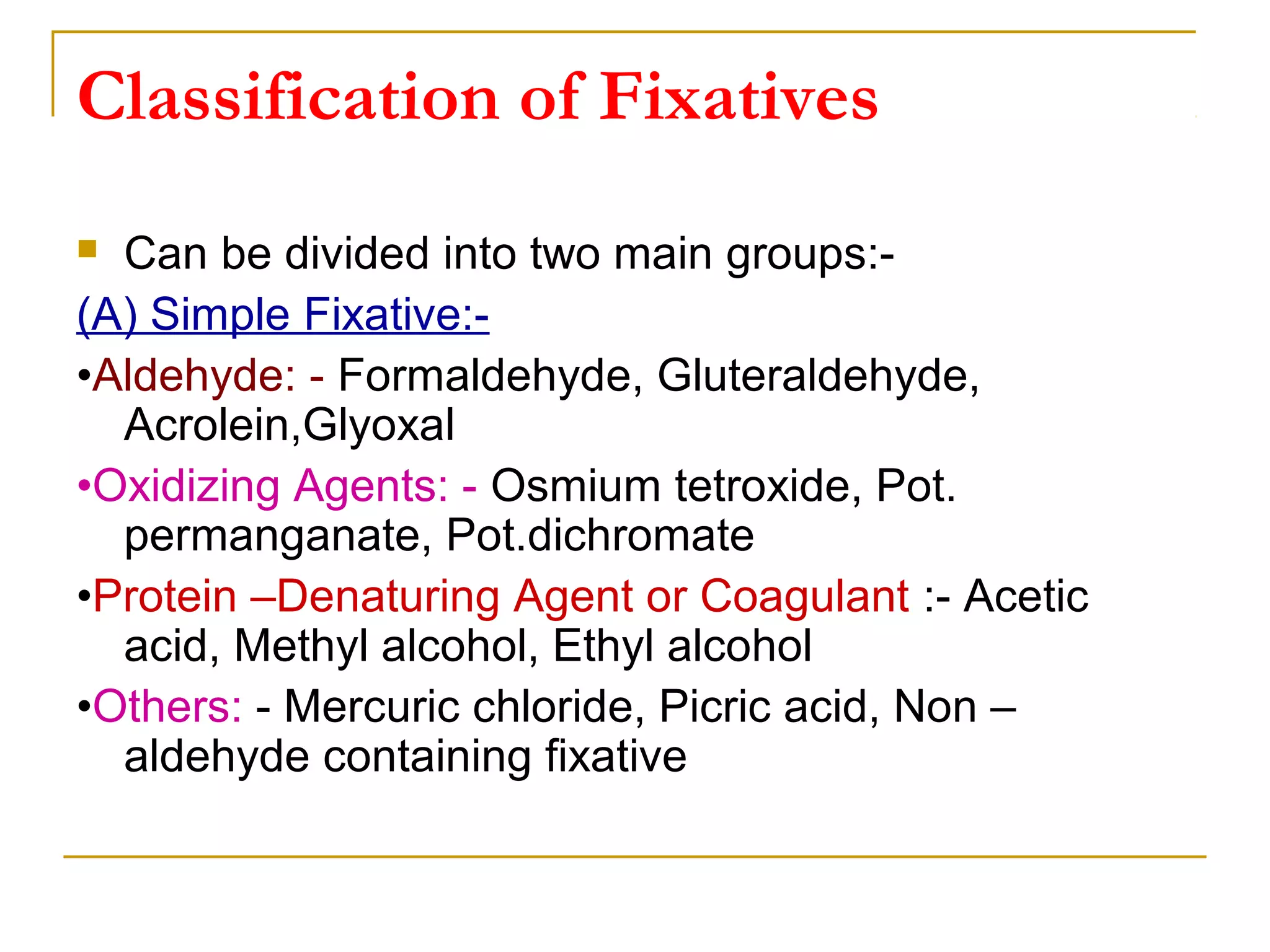
Classification of Fixatives
Can be divided into two main groups:(A) Simple Fixative:•Aldehyde: - Formaldehyde, Gluteraldehyde,
Acrolein,Glyoxal
•Oxidizing Agents: - Osmium tetroxide, Pot.
permanganate, Pot.dichromate
•Protein –Denaturing Agent or Coagulant :- Acetic
acid, Methyl alcohol, Ethyl alcohol
•Others: - Mercuric chloride, Picric acid, Non –
aldehyde containing fixative

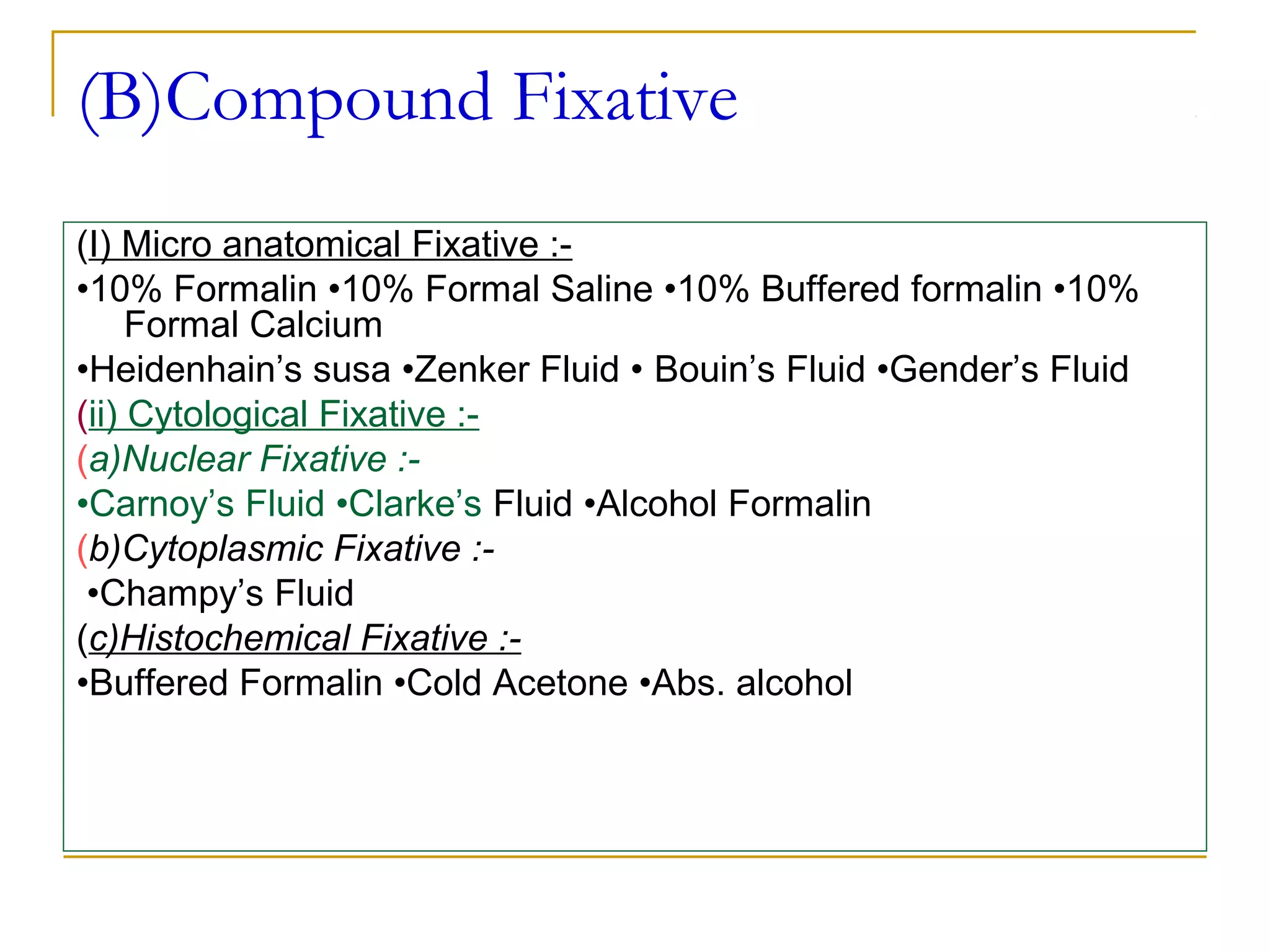
(B)Compound Fixative
(I) Micro anatomical Fixative :•10% Formalin •10% Formal Saline •10% Buffered formalin •10%
Formal Calcium
•Heidenhain’s susa •Zenker Fluid • Bouin’s Fluid •Gender’s Fluid
(ii) Cytological Fixative :(a)Nuclear Fixative :•Carnoy’s Fluid •Clarke’s Fluid •Alcohol Formalin
(b)Cytoplasmic Fixative :•Champy’s Fluid
(c)Histochemical Fixative :•Buffered Formalin •Cold Acetone •Abs. alcohol
Classification of Fixatives
(iii) Other Methods of Fixation
•Vapour Fixation
•Heat Fixation
•Freeze drying etc
Cytolological Fixatives:Alcohols:- Specifically recommended for
cytological preparation
(1)95% Ethanol/Ethyl alcohol
(2)95 %Rectified Spirit
(3)100% Methanol
(4) Isopropyl alcohol/propanol
(5) Alcohol Ether (1:1)

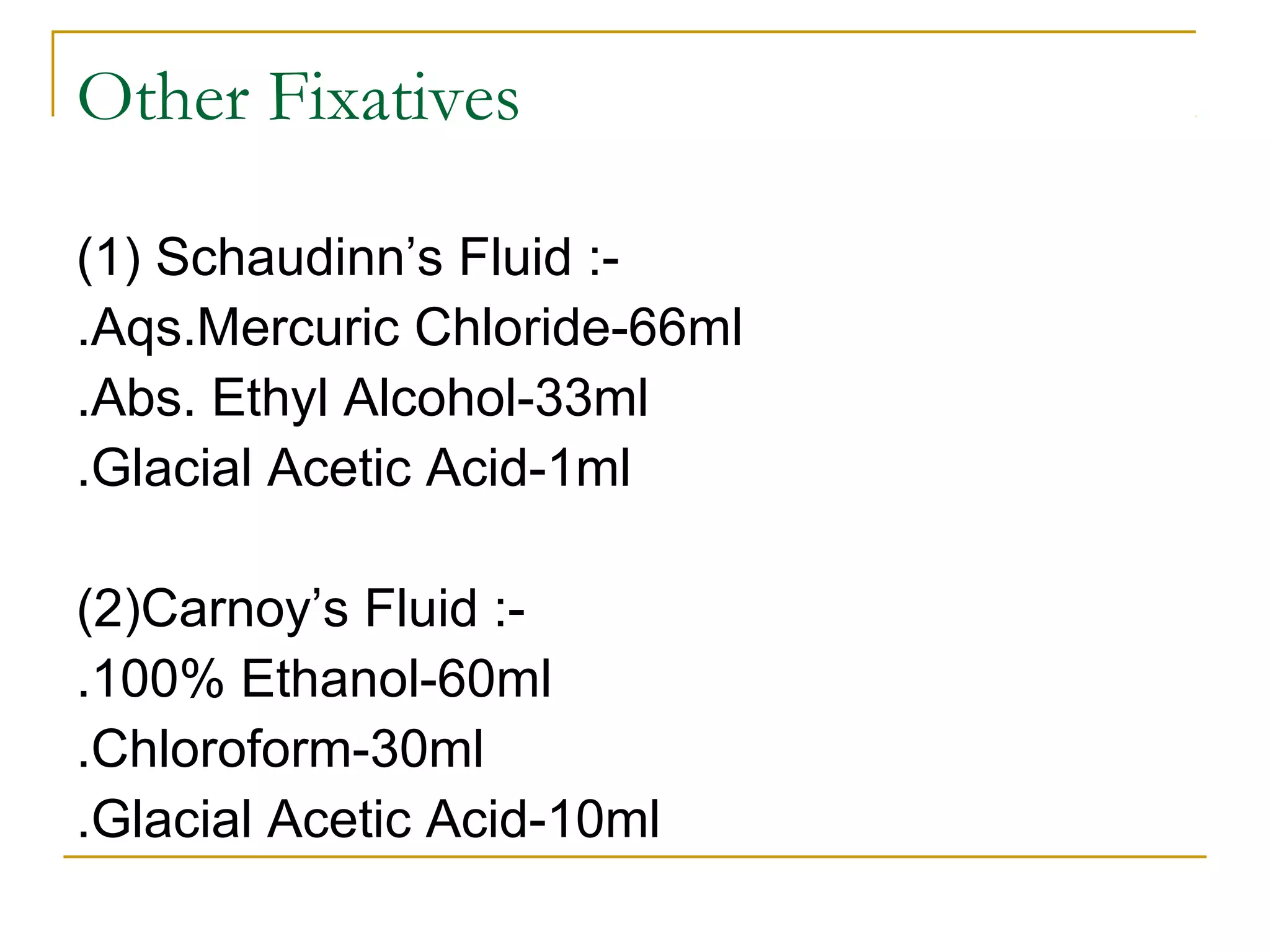
Other Fixatives
(1) Schaudinn’s Fluid :.Aqs.Mercuric Chloride-66ml
.Abs. Ethyl Alcohol-33ml
.Glacial Acetic Acid-1ml
(2)Carnoy’s Fluid :.100% Ethanol-60ml
.Chloroform-30ml
.Glacial Acetic Acid-10ml
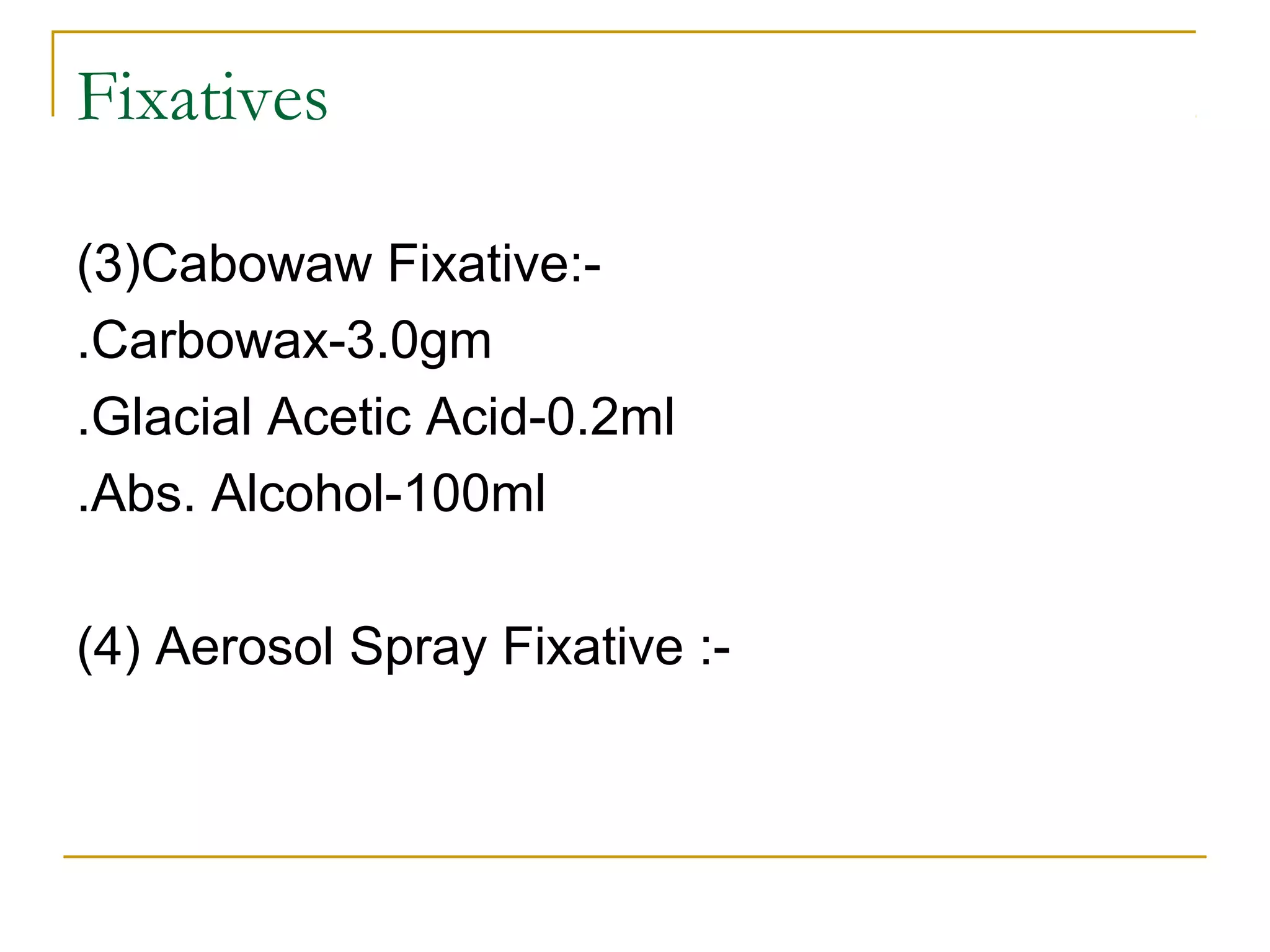
Fixatives
(3)Cabowaw Fixative:.Carbowax-3.0gm
.Glacial Acetic Acid-0.2ml
.Abs. Alcohol-100ml
(4) Aerosol Spray Fixative :-

General 1 fixatives cytology

  • 1.
    Cytopreparatory Technique    Fixation ofVarious Cytological Samples Staining Methods Interpretation and Evaluation
  • 2.
    Fixation and Fixatives   Fixationis the basis or foundation of cytological technique and the results of all subsequent procedures depend on the correct selection and use of the fixative employed. It is a complex series of chemical events and differs for the different groups of chemical substances found in the tissues
  • 3.
    Fixation and Fixatives   Fixationis the basis or foundation of cytological technique and the results of all subsequent procedures depend on the correct selection and use of the fixative employed. It is a complex series of chemical events and differs for the different groups of chemical substances found in the tissues
  • 4.
    Fix , meansto confine from which it can not move away or to keep in life like condition shortly after death or removal from the body. WHY FIX?  To preserve cell organelles and chemical constituents in a condition identical to that existing during life .Since this aim is impossible hence methods are applied: To prevent Autolysis  To prevent putrefaction (Bacterial decomposition)  To fortify cells against damage for post fixation procedures e.g. Dehydration, Clearing, Embedding etc.  To Facilitate subsequent staining of smears.
  • 5.
    Fixative:“ Substance whichpreserves after death, the shape, structure, relationship and chemical composition of tissues and cells.”         Effects of Fixation Sudden death of Tissues but preserves the structure. Coagulation of proteins Prevents diffusion of substances Hardens tissues –prevents from shrinkage or swelling Changes refractive index Facilitates action of dyes in staining Prevents autolysis and bacterial putrefaction
  • 6.
    Qualities of GoodFixative A good fixative should be capable of fulfilling the following requirements:(1) It must kill the cell quickly without shrinking, swelling, or other distortion. (2)It must penetrate the tissue and cells rapidly and evenly. (3) It must render insoluble substance of the cell and give good optical differentiation. (4)It must harden the tissue and render it insensitive to subsequent treatment.
  • 7.
    Qualities of GoodFixative (5)It must permit at a later date the application of numerous staining procedures. (6)It must inhibit bacterial decay and autolysis. (7)It should allow tissue to be stored for long period of time. (8) It should permit the restoration of natural color for photography and mounting as museum specimens. (9) It should be simple to prepare and economical in use.
  • 8.
    Classification of Fixatives Canbe divided into two main groups:(A) Simple Fixative:•Aldehyde: - Formaldehyde, Gluteraldehyde, Acrolein,Glyoxal •Oxidizing Agents: - Osmium tetroxide, Pot. permanganate, Pot.dichromate •Protein –Denaturing Agent or Coagulant :- Acetic acid, Methyl alcohol, Ethyl alcohol •Others: - Mercuric chloride, Picric acid, Non – aldehyde containing fixative 
  • 9.
    (B)Compound Fixative (I) Microanatomical Fixative :•10% Formalin •10% Formal Saline •10% Buffered formalin •10% Formal Calcium •Heidenhain’s susa •Zenker Fluid • Bouin’s Fluid •Gender’s Fluid (ii) Cytological Fixative :(a)Nuclear Fixative :•Carnoy’s Fluid •Clarke’s Fluid •Alcohol Formalin (b)Cytoplasmic Fixative :•Champy’s Fluid (c)Histochemical Fixative :•Buffered Formalin •Cold Acetone •Abs. alcohol
  • 10.
    Classification of Fixatives (iii)Other Methods of Fixation •Vapour Fixation •Heat Fixation •Freeze drying etc
  • 11.
    Cytolological Fixatives:Alcohols:- Specificallyrecommended for cytological preparation (1)95% Ethanol/Ethyl alcohol (2)95 %Rectified Spirit (3)100% Methanol (4) Isopropyl alcohol/propanol (5) Alcohol Ether (1:1) 
  • 12.
    Other Fixatives (1) Schaudinn’sFluid :.Aqs.Mercuric Chloride-66ml .Abs. Ethyl Alcohol-33ml .Glacial Acetic Acid-1ml (2)Carnoy’s Fluid :.100% Ethanol-60ml .Chloroform-30ml .Glacial Acetic Acid-10ml
  • 13.
    Fixatives (3)Cabowaw Fixative:.Carbowax-3.0gm .Glacial AceticAcid-0.2ml .Abs. Alcohol-100ml (4) Aerosol Spray Fixative :-