Sickle cell
  disease


By: Yara Mostafa
 Yasser Mostafa
 Yasser Osama
Sickle Cell Disease

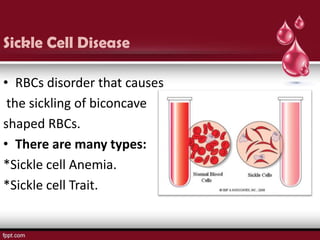
• RBCs disorder that causes
 the sickling of biconcave
shaped RBCs.
• There are many types:
*Sickle cell Anemia.
*Sickle cell Trait.
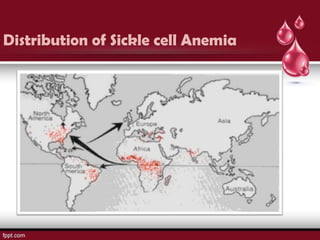
Distribution of Sickle cell Anemia
Brief Medical History

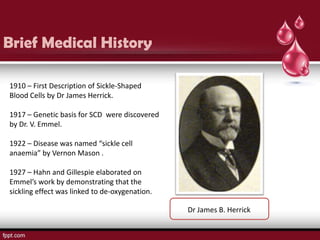
1910 – First Description of Sickle-Shaped
Blood Cells by Dr James Herrick.

1917 – Genetic basis for SCD were discovered
by Dr. V. Emmel.

1922 – Disease was named “sickle cell
anaemia” by Vernon Mason .

1927 – Hahn and Gillespie elaborated on
Emmel’s work by demonstrating that the
sickling effect was linked to de-oxygenation.

                                                Dr James B. Herrick
Pathophysiology

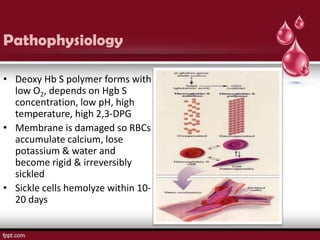
• Deoxy Hb S polymer forms with
  low O2, depends on Hgb S
  concentration, low pH, high
  temperature, high 2,3-DPG
• Membrane is damaged so RBCs
  accumulate calcium, lose
  potassium & water and
  become rigid & irreversibly
  sickled
• Sickle cells hemolyze within 10-
  20 days
Genetics

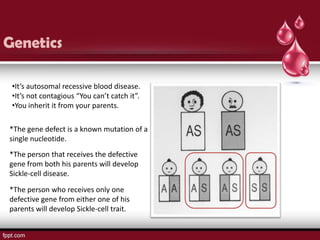
 •It’s autosomal recessive blood disease.
 •It’s not contagious “You can’t catch it”.
 •You inherit it from your parents.

*The gene defect is a known mutation of a
single nucleotide.
*The person that receives the defective
gene from both his parents will develop
Sickle-cell disease.

*The person who receives only one
defective gene from either one of his
parents will develop Sickle-cell trait.
Sickle Cell Trait (AS)
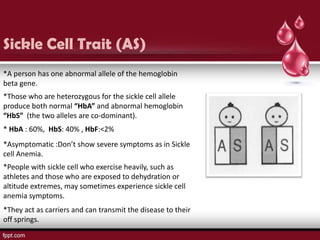
*A person has one abnormal allele of the hemoglobin
beta gene.
*Those who are heterozygous for the sickle cell allele
produce both normal “HbA” and abnormal hemoglobin
“HbS” (the two alleles are co-dominant).
* HbA : 60%, HbS: 40% , HbF:<2%
*Asymptomatic :Don’t show severe symptoms as in Sickle
cell Anemia.
*People with sickle cell who exercise heavily, such as
athletes and those who are exposed to dehydration or
altitude extremes, may sometimes experience sickle cell

anemia symptoms.
*They act as carriers and can transmit the disease to their
off springs.
*It has been suggested that sickle cell trait is linked to two other
medical problems that may elicit health and performance concerns.
These include:


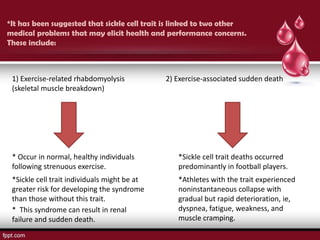
 1) Exercise-related rhabdomyolysis           2) Exercise-associated sudden death
 (skeletal muscle breakdown)


 * Occur in normal, healthy individuals          *Sickle cell trait deaths occurred
 following strenuous exercise.                   predominantly in football players.
 *Sickle cell trait individuals might be at      *Athletes with the trait experienced
 greater risk for developing the syndrome        noninstantaneous collapse with
 than those without this trait.                  gradual but rapid deterioration, ie,
 * This syndrome can result in renal             dyspnea, fatigue, weakness, and
 failure and sudden death.                       muscle cramping.
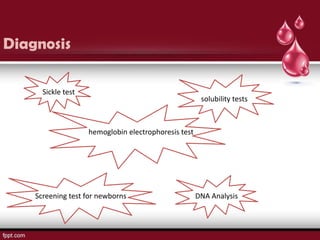
Diagnosis

      Sickle test
                                                       solubility tests


                    hemoglobin electrophoresis test


    Screening test for newborns                       DNA Analysis
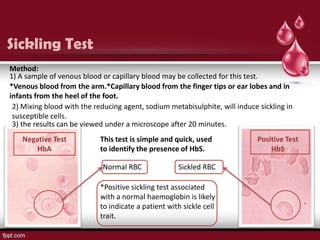
Sickling Test
Method:
1) A sample of venous blood or capillary blood may be collected for this test.
*Venous blood from the arm.*Capillary blood from the finger tips or ear lobes and in
infants from the heel of the foot.
 2) Mixing blood with the reducing agent, sodium metabisulphite, will induce sickling in
 susceptible cells.
 3) the results can be viewed under a microscope after 20 minutes.
    Negative Test           This test is simple and quick, used              Positive Test
        HbA                 to identify the presence of HbS.                     HbS

                            Normal RBC               Sickled RBC

                            *Positive sickling test associated
                            with a normal haemoglobin is likely
                            to indicate a patient with sickle cell
                            trait.
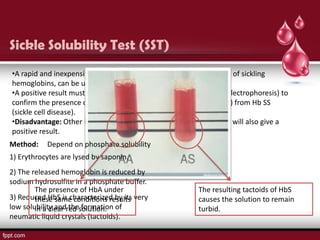
Sickle Solubility Test (SST)
•A rapid and inexpensive technique used to screen for the presence of sickling
hemoglobins, can be used at home.
•A positive result must be confirmed by another method (HPLC or electrophoresis) to
confirm the presence of Hb S and to distinguish Hb AS (carrier state) from Hb SS
(sickle cell disease).
•Disadvantage: Other insoluble hemoglobins, such as Hb C-Harlem, will also give a
positive result.
Method:    Depend on phosphate solubility
1) Erythrocytes are lysed by saponin.
2) The released hemoglobin is reduced by
sodium hydrosulfite in a phosphate buffer.
        The presence of HbA under                       The resulting tactoids of HbS
3) Reduced HbS is characterized by its very
        these same conditions results                   causes the solution to remain
low solubility andred solution. of
        in a clear the formation                        turbid.
neumatic liquid crystals (tactoids).
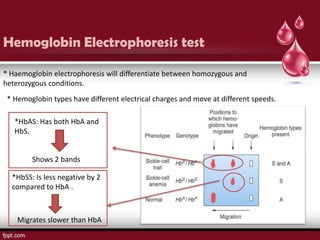
Hemoglobin Electrophoresis test

* Haemoglobin electrophoresis will differentiate between homozygous and
heterozygous conditions.
 * Hemoglobin types have different electrical charges and move at different speeds.

   *HbAS: Has both HbA and
   HbS.


        Shows 2 bands

  *HbSS: Is less negative by 2
  compared to HbA .


    Migrates slower than HbA
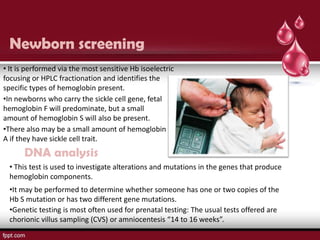
Newborn screening
• It is performed via the most sensitive Hb isoelectric
focusing or HPLC fractionation and identifies the
specific types of hemoglobin present.
•In newborns who carry the sickle cell gene, fetal
hemoglobin F will predominate, but a small
amount of hemoglobin S will also be present.
•There also may be a small amount of hemoglobin
A if they have sickle cell trait.
      DNA analysis
  • This test is used to investigate alterations and mutations in the genes that produce
  hemoglobin components.
  •It may be performed to determine whether someone has one or two copies of the
  Hb S mutation or has two different gene mutations.
  •Genetic testing is most often used for prenatal testing: The usual tests offered are
  chorionic villus sampling (CVS) or amniocentesis “14 to 16 weeks”.
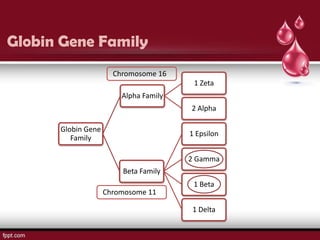
Globin Gene Family
                      Chromosome 16
                                        1 Zeta
                        Alpha Family
                                       2 Alpha

      Globin Gene
                                       1 Epsilon
         Family

                                       2 Gamma
                        Beta Family
                                        1 Beta
                    Chromosome 11

                                       1 Delta
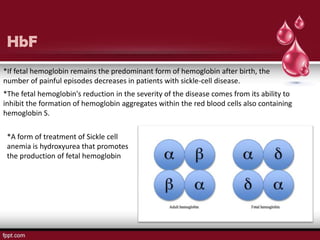
HbF
*If fetal hemoglobin remains the predominant form of hemoglobin after birth, the
number of painful episodes decreases in patients with sickle-cell disease.
*The fetal hemoglobin's reduction in the severity of the disease comes from its ability to
inhibit the formation of hemoglobin aggregates within the red blood cells also containing
hemoglobin S.

 *A form of treatment of Sickle cell
 anemia is hydroxyurea that promotes
 the production of fetal hemoglobin
Signs and Symptoms

• Infection, dehydration, and acidosis act as
  triggers but in most instances no predisposing
  cause is identified.
• They usually appear after 4 months of age.
• Most common signs are linked to Anemia and
  Pain.
Signs and Symptoms


      •   Vaso-occlusive crisis.
      •   Aplastic crisis
      •   Splenic sequestration crisis.
      •   Hemolytic crisis
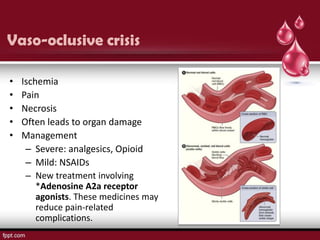
Vaso-oclusive crisis

•   Ischemia
•   Pain
•   Necrosis
•   Often leads to organ damage
•   Management
     – Severe: analgesics, Opioid
     – Mild: NSAIDs
     – New treatment involving
        *Adenosine A2a receptor
        agonists. These medicines may
        reduce pain-related
        complications.
Splenic squestration crisis

• Acute, painful enlargements of the spleen,
  caused by intrasplenic trapping of red cells
• Caused by intrasplenic trapping of red cells
• Die within 1-2 hours due to circulatory failure
• Autosplenectomy
Aplastic crisis
 • Paravirus B19
   –   Divides in RBCs precursors and destroys them
   –   Stops erythropoiesis for two or three days
   –   Causes reticulocytopenia
   –   Disappears within one week with management and
       blood transfusions

Hemolytic crisis
  • Common in patients with G6PD deficiency
Complications
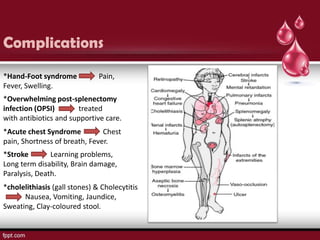
*Hand-Foot syndrome            Pain,
Fever, Swelling.
*Overwhelming post-splenectomy
infection (OPSI)       treated
with antibiotics and supportive care.
*Acute chest Syndrome          Chest
pain, Shortness of breath, Fever.
*Stroke        Learning problems,
Long term disability, Brain damage,
Paralysis, Death.
*cholelithiasis (gall stones) & Cholecytitis
      Nausea, Vomiting, Jaundice,
Sweating, Clay-coloured stool.
Complications
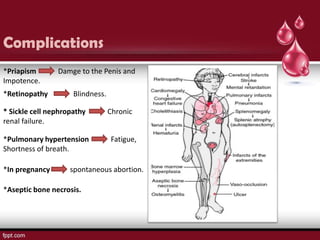
*Priapism       Damge to the Penis and
Impotence.
*Retinopathy         Blindness.

* Sickle cell nephropathy         Chronic
renal failure.

*Pulmonary hypertension           Fatigue,
Shortness of breath.

*In pregnancy       spontaneous abortion.

*Aseptic bone necrosis.
Management

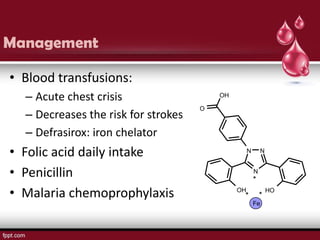
• Blood transfusions:
  – Acute chest crisis                   OH

                                     O
  – Decreases the risk for strokes
  – Defrasirox: iron chelator
• Folic acid daily intake                          N       N


• Penicillin                                           N
                                                       *
• Malaria chemoprophylaxis                    OH
                                               *           *
                                                               HO

                                                       Fe
Treatment
 • Hydroxyurea.
    – Reactivates fetal Hb production
    – Decreases severity of attacks
    – Increases life span
    – More effective with Erythropoietin.
 • Bone marrow transplant during childhood.
 • 5-HMF. This natural compound binds to red blood cells and
   increases their oxygen. This helps prevent the red blood cells
   from sickling.
Prevention

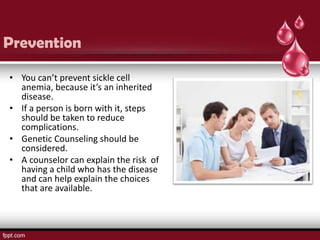
• You can’t prevent sickle cell
  anemia, because it’s an inherited
  disease.
• If a person is born with it, steps
  should be taken to reduce
  complications.
• Genetic Counseling should be
  considered.
• A counselor can explain the risk of
  having a child who has the disease
  and can help explain the choices
  that are available.
Prognosis
*New and aggressive treatments for sickle cell disease are prolonging life and
improving its quality.
*Recently as 1973, the average lifespan for
people with sickle cell disease was only 14
years.
*Currently, life expectancy for these
patients can reach 50 years and over.
*Women with sickle cell live longer than
their male counterparts.
*The median age at death :
-Males : 53years
-Females: 58 years

*As children with sickle cell disease live longer, older patients are now facing medical
problems related to the long-term adverse effects of the disease process.
Malaria


• Parasitic infection: Plasmodium falciparum
• Two stages in the human body:
  – Exoerythrocytic stage in liver (8 to 30 days)
  – Erythrocytic stage
Sickle cell gene and malaria

• Heterozygous individuals are tolerant to
  malaria
• Homozygous individuals are less tolerant to
  malaria because of the common functional
  asplenia
Why?


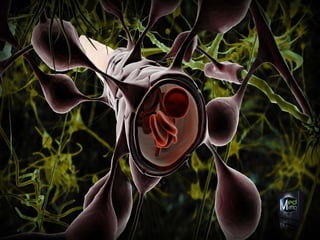
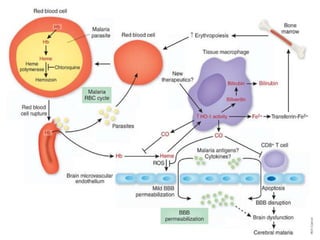
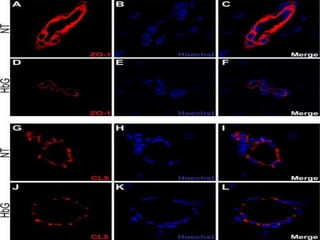
Direct contact       HO-1 and
 with sickle        blood brain
     cells            barrier
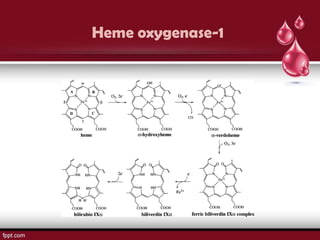
Heme oxygenase-1
Refrences


•   Harper’s illustrated Biochemistry
•   Lippincott’s illustrated reviews of Biochemistry
•   Robbins basic Pathology
•   American society of hematology
Thank You

Sickle cell disease

  • 1.
    Sickle cell disease By: Yara Mostafa Yasser Mostafa Yasser Osama
  • 2.
    Sickle Cell Disease •RBCs disorder that causes the sickling of biconcave shaped RBCs. • There are many types: *Sickle cell Anemia. *Sickle cell Trait.
  • 3.
  • 4.
    Brief Medical History 1910– First Description of Sickle-Shaped Blood Cells by Dr James Herrick. 1917 – Genetic basis for SCD were discovered by Dr. V. Emmel. 1922 – Disease was named “sickle cell anaemia” by Vernon Mason . 1927 – Hahn and Gillespie elaborated on Emmel’s work by demonstrating that the sickling effect was linked to de-oxygenation. Dr James B. Herrick
  • 5.
    Pathophysiology • Deoxy HbS polymer forms with low O2, depends on Hgb S concentration, low pH, high temperature, high 2,3-DPG • Membrane is damaged so RBCs accumulate calcium, lose potassium & water and become rigid & irreversibly sickled • Sickle cells hemolyze within 10- 20 days
  • 6.
    Genetics •It’s autosomalrecessive blood disease. •It’s not contagious “You can’t catch it”. •You inherit it from your parents. *The gene defect is a known mutation of a single nucleotide. *The person that receives the defective gene from both his parents will develop Sickle-cell disease. *The person who receives only one defective gene from either one of his parents will develop Sickle-cell trait.
  • 7.
    Sickle Cell Trait(AS) *A person has one abnormal allele of the hemoglobin beta gene. *Those who are heterozygous for the sickle cell allele produce both normal “HbA” and abnormal hemoglobin “HbS” (the two alleles are co-dominant). * HbA : 60%, HbS: 40% , HbF:<2% *Asymptomatic :Don’t show severe symptoms as in Sickle cell Anemia. *People with sickle cell who exercise heavily, such as athletes and those who are exposed to dehydration or altitude extremes, may sometimes experience sickle cell anemia symptoms. *They act as carriers and can transmit the disease to their off springs.
  • 8.
    *It has beensuggested that sickle cell trait is linked to two other medical problems that may elicit health and performance concerns. These include: 1) Exercise-related rhabdomyolysis 2) Exercise-associated sudden death (skeletal muscle breakdown) * Occur in normal, healthy individuals *Sickle cell trait deaths occurred following strenuous exercise. predominantly in football players. *Sickle cell trait individuals might be at *Athletes with the trait experienced greater risk for developing the syndrome noninstantaneous collapse with than those without this trait. gradual but rapid deterioration, ie, * This syndrome can result in renal dyspnea, fatigue, weakness, and failure and sudden death. muscle cramping.
  • 9.
    Diagnosis Sickle test solubility tests hemoglobin electrophoresis test Screening test for newborns DNA Analysis
  • 10.
    Sickling Test Method: 1) Asample of venous blood or capillary blood may be collected for this test. *Venous blood from the arm.*Capillary blood from the finger tips or ear lobes and in infants from the heel of the foot. 2) Mixing blood with the reducing agent, sodium metabisulphite, will induce sickling in susceptible cells. 3) the results can be viewed under a microscope after 20 minutes. Negative Test This test is simple and quick, used Positive Test HbA to identify the presence of HbS. HbS Normal RBC Sickled RBC *Positive sickling test associated with a normal haemoglobin is likely to indicate a patient with sickle cell trait.
  • 11.
    Sickle Solubility Test(SST) •A rapid and inexpensive technique used to screen for the presence of sickling hemoglobins, can be used at home. •A positive result must be confirmed by another method (HPLC or electrophoresis) to confirm the presence of Hb S and to distinguish Hb AS (carrier state) from Hb SS (sickle cell disease). •Disadvantage: Other insoluble hemoglobins, such as Hb C-Harlem, will also give a positive result. Method: Depend on phosphate solubility 1) Erythrocytes are lysed by saponin. 2) The released hemoglobin is reduced by sodium hydrosulfite in a phosphate buffer. The presence of HbA under The resulting tactoids of HbS 3) Reduced HbS is characterized by its very these same conditions results causes the solution to remain low solubility andred solution. of in a clear the formation turbid. neumatic liquid crystals (tactoids).
  • 12.
    Hemoglobin Electrophoresis test *Haemoglobin electrophoresis will differentiate between homozygous and heterozygous conditions. * Hemoglobin types have different electrical charges and move at different speeds. *HbAS: Has both HbA and HbS. Shows 2 bands *HbSS: Is less negative by 2 compared to HbA . Migrates slower than HbA
  • 13.
    Newborn screening • Itis performed via the most sensitive Hb isoelectric focusing or HPLC fractionation and identifies the specific types of hemoglobin present. •In newborns who carry the sickle cell gene, fetal hemoglobin F will predominate, but a small amount of hemoglobin S will also be present. •There also may be a small amount of hemoglobin A if they have sickle cell trait. DNA analysis • This test is used to investigate alterations and mutations in the genes that produce hemoglobin components. •It may be performed to determine whether someone has one or two copies of the Hb S mutation or has two different gene mutations. •Genetic testing is most often used for prenatal testing: The usual tests offered are chorionic villus sampling (CVS) or amniocentesis “14 to 16 weeks”.
  • 14.
    Globin Gene Family Chromosome 16 1 Zeta Alpha Family 2 Alpha Globin Gene 1 Epsilon Family 2 Gamma Beta Family 1 Beta Chromosome 11 1 Delta
  • 15.
    HbF *If fetal hemoglobinremains the predominant form of hemoglobin after birth, the number of painful episodes decreases in patients with sickle-cell disease. *The fetal hemoglobin's reduction in the severity of the disease comes from its ability to inhibit the formation of hemoglobin aggregates within the red blood cells also containing hemoglobin S. *A form of treatment of Sickle cell anemia is hydroxyurea that promotes the production of fetal hemoglobin
  • 16.
    Signs and Symptoms •Infection, dehydration, and acidosis act as triggers but in most instances no predisposing cause is identified. • They usually appear after 4 months of age. • Most common signs are linked to Anemia and Pain.
  • 17.
    Signs and Symptoms • Vaso-occlusive crisis. • Aplastic crisis • Splenic sequestration crisis. • Hemolytic crisis
  • 18.
    Vaso-oclusive crisis • Ischemia • Pain • Necrosis • Often leads to organ damage • Management – Severe: analgesics, Opioid – Mild: NSAIDs – New treatment involving *Adenosine A2a receptor agonists. These medicines may reduce pain-related complications.
  • 19.
    Splenic squestration crisis •Acute, painful enlargements of the spleen, caused by intrasplenic trapping of red cells • Caused by intrasplenic trapping of red cells • Die within 1-2 hours due to circulatory failure • Autosplenectomy
  • 20.
    Aplastic crisis •Paravirus B19 – Divides in RBCs precursors and destroys them – Stops erythropoiesis for two or three days – Causes reticulocytopenia – Disappears within one week with management and blood transfusions Hemolytic crisis • Common in patients with G6PD deficiency
  • 21.
    Complications *Hand-Foot syndrome Pain, Fever, Swelling. *Overwhelming post-splenectomy infection (OPSI) treated with antibiotics and supportive care. *Acute chest Syndrome Chest pain, Shortness of breath, Fever. *Stroke Learning problems, Long term disability, Brain damage, Paralysis, Death. *cholelithiasis (gall stones) & Cholecytitis Nausea, Vomiting, Jaundice, Sweating, Clay-coloured stool.
  • 22.
    Complications *Priapism Damge to the Penis and Impotence. *Retinopathy Blindness. * Sickle cell nephropathy Chronic renal failure. *Pulmonary hypertension Fatigue, Shortness of breath. *In pregnancy spontaneous abortion. *Aseptic bone necrosis.
  • 23.
    Management • Blood transfusions: – Acute chest crisis OH O – Decreases the risk for strokes – Defrasirox: iron chelator • Folic acid daily intake N N • Penicillin N * • Malaria chemoprophylaxis OH * * HO Fe
  • 24.
    Treatment • Hydroxyurea. – Reactivates fetal Hb production – Decreases severity of attacks – Increases life span – More effective with Erythropoietin. • Bone marrow transplant during childhood. • 5-HMF. This natural compound binds to red blood cells and increases their oxygen. This helps prevent the red blood cells from sickling.
  • 25.
    Prevention • You can’tprevent sickle cell anemia, because it’s an inherited disease. • If a person is born with it, steps should be taken to reduce complications. • Genetic Counseling should be considered. • A counselor can explain the risk of having a child who has the disease and can help explain the choices that are available.
  • 26.
    Prognosis *New and aggressivetreatments for sickle cell disease are prolonging life and improving its quality. *Recently as 1973, the average lifespan for people with sickle cell disease was only 14 years. *Currently, life expectancy for these patients can reach 50 years and over. *Women with sickle cell live longer than their male counterparts. *The median age at death : -Males : 53years -Females: 58 years *As children with sickle cell disease live longer, older patients are now facing medical problems related to the long-term adverse effects of the disease process.
  • 27.
    Malaria • Parasitic infection:Plasmodium falciparum • Two stages in the human body: – Exoerythrocytic stage in liver (8 to 30 days) – Erythrocytic stage
  • 28.
    Sickle cell geneand malaria • Heterozygous individuals are tolerant to malaria • Homozygous individuals are less tolerant to malaria because of the common functional asplenia
  • 29.
    Why? Direct contact HO-1 and with sickle blood brain cells barrier
  • 33.
  • 34.
    Refrences • Harper’s illustrated Biochemistry • Lippincott’s illustrated reviews of Biochemistry • Robbins basic Pathology • American society of hematology
  • 35.

Editor's Notes

  • #4 South or Central America especially Panama.Mediterranean countries especially Turkey, Greece, and Italy