Antipsychotics & Anti-maniac
drugs
Dr Naser Tadvi
Objectives
• Classify antipsychotic drugs
• Explain mechanism of action, therapeutic uses and
adverse effects of antipsychotic drugs
• Describe management of schizophrenia
• Describe mechanism of action and adverse effects of
lithium
• Enlist other alternatives to lithium in the treatment
of mania
• Describe management of mania and bipolar
disorders
Dr Naser Ashraf Tadvi 2016
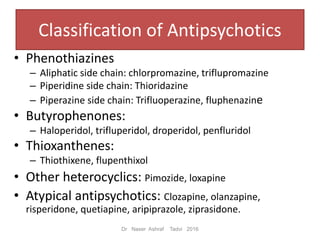
Classification of Antipsychotics
• Phenothiazines
– Aliphatic side chain: chlorpromazine, triflupromazine
– Piperidine side chain: Thioridazine
– Piperazine side chain: Trifluoperazine, fluphenazine
• Butyrophenones:
– Haloperidol, trifluperidol, droperidol, penfluridol
• Thioxanthenes:
– Thiothixene, flupenthixol
• Other heterocyclics: Pimozide, loxapine
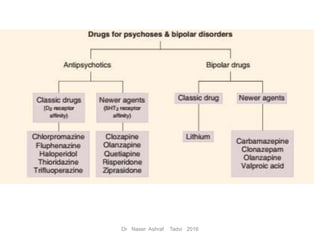
• Atypical antipsychotics: Clozapine, olanzapine,
risperidone, quetiapine, aripiprazole, ziprasidone.
Dr Naser Ashraf Tadvi 2016
Chlorpromazine
Pharmacological actions (CNS)
 In Normal individuals: Indifference to surrounding,
paucity of thought, psychomotor slowing, emotional
quietening , reduction in initiative, tendency to go off to
sleep from which pt is easily arousable. Spontaneous
movements are minimized. This is called neuroleptic
syndrome
 In psychotic patient: ↓ irrational behaviour,↓ agitation
& aggressiveness, relief of anxiety.
– Corrects disturbed thought & behaviour
– ↓ spontaneous movements(hyperactivity)
– Reduces delusions and hallucinations
Dr Naser Ashraf Tadvi 2016
• The aliphatic & piperidine side chain compounds :
low potency more sedation. Sedative effect develops
promptly but antipsychotic effect takes weeks to
develop.
• Chlorpromazine lowers seizure threshold can
precipitate seizures
• Hypothermia: temperature control is knocked off at
higher doses
• All neuroleptics except thioridazine have potent
antiemetic action
Chlorpromazine
Pharmacological actions (CNS)
Dr Naser Ashraf Tadvi 2016
Pharmacological actions
• ANS: α-adrenergic blocking & anticholinergic
property
• CVS: Postural hypotension, QT prolongation
• Local anaesthetic action
• Endocrine: ↑release of prolactin-
galactorrhoea and gynaecomastia
Dr Naser Ashraf Tadvi 2016
Tolerance & dependence
• Tolerance to sedative & hypotensive action
develops within days or weeks
• The antipsychotic, extra pyramidal & other
actions based on DA antagonism do not show
tolerance.
• Neuroleptics are pleasurably bland drugs
• Physical dependence is absent though some
withdrawal symptoms may be seen
• No drug seeking behaviour observed
Dr Naser Ashraf Tadvi 2016
Other typical antipsychotics
• Triflupromazine: more potent than CPZ, Antiemetic,
frequently produces acute muscular dystonias in children
• Thioridazine: low potency marked, central anticholinergic
action. Low incidence of Extra pyramidal reactions. Cardiac
arrhythmias & interference with male sexual dysfunction is
more common
• Trifluoperazine, fluphenazine: High potency,
minimum autonomic actions. Marked extrapyramidal
reactions
Dr Naser Ashraf Tadvi 2016
• Haloperidol: potent, few autonomic effects, less seizure
potential , doesn’t cause weight gain, rarely causes jaundice,
preferred agent for schizophrenia, acute mania, senile
psychoses, acute psychoses, huntingtons disease, tourette
syndrome.
• Penfluridol: exceptionally long acting neuroleptic,
recommended for chronic schizophrenia
• Pimozide : little adrenergic or cholinergic blocking
activity , longer Duration of action for several days. Good
for maintenance therapy. Low dystonic reactions , more
propensity for arrhythmia
Dr Naser Ashraf Tadvi 2016
Other typical antipsychotics
Atypical antipsychotics
• Newer second generation antipsychotics have
weak D2 but potent 5HT2 antagonist
properties.
• Extrapyramidal side effects are minimal, they
may improve impaired cognitive function in
psychotics
Dr Naser Ashraf Tadvi 2016
Clozapine & olanzapine
• Atypical antipsychotics
• Mainly block D4 receptors
• Have weak D2 blocking effect
• Also block 5 HT2 & alpha-1 receptors
• Have H1 blocking & anticholinergic
• Rarely cause EPS
• Cause sedation & hypotension
Dr Naser Ashraf Tadvi 2016
Side effects:
• Clozapine
• sedation, salivation, seizures, weight gain, hypotension.
• Dangerous side effect is agranulocytosis, hence regular monitoring of
blood counts is essential
– Olanzapine:
• Dry mouth , constipation , weight gain rarely EPS
• No agranulocytosis
• Uses:
– Clozapine is reserve drug for treatment of schizophrenia because of risk of
agranulocytosis .
– Olanzapine is used for treatment of schizophrenia & mania associated with
bipolar disorder. They supress both positive & negative symptoms of
schizophrenia
Dr Naser Ashraf Tadvi 2016
Clozapine & olanzapine
Risperidone
• Atypical antipsychotic
• Blocks D2,5 HT2, ALPHA1 adrenergic, & has
antihistaminic activity
• EPS are rare at low doses
• No anti-emetic effect
• Used for treatment of schizophrenia, & short term
treatment of mania associated with bipolar disorder
Dr Naser Ashraf Tadvi 2016
Adverse effects of antipsychotics
CNS(Extrapyramidal side effects)
1. Parkinsonism: (more common with haloperidol )
2. Dystonic Reactions: Bizarre muscle spasms, mostly involving linguo-
facial muscles (Grimacing, tongue thursting, torticollis, locked jaw)
3. Akathisia: Restlessness, feeling of discomfort, desire to move
4. Malignant neuroleptic syndrome: muscular rigidity, hyperpyrexia,
mental confusion & coma. Treated with IV dantrolene , anticholinergic are
of no help. Bromocriptine in large doses found to be useful
5. Tardive dyskinesia: characterized by involuntary & purposeless
movements of the mouth, tongue & upper limbs (chewing, pouting,
puffing of cheek, lip licking etc) It develops in about 20% of pts after
months or years of antipsychotic treatment . Treatment is usually
unsuccessful
Dr Naser Ashraf Tadvi 2016
Other CNS side effects
• Drowsiness, lethargy, mental confusion with low
potency agents
• Increase appetite, weight gain (not with haloperidol)
• Aggravation of seizures in epileptics, even non
epileptics may develop seizures with high doses of
clozapine, olanzapine
• Potent phenothiazines risperidone, quetiapine,
aripiprazole & ziprasidone low seizure threshold
Dr Naser Ashraf Tadvi 2016
Other adverse effects
• Postural hypotension, palpitation,
• Thioridazine
– Inhibition of ejaculation , QT prolongation, & cardiac arrhythmias
– Anticholinergic: Dry mouth, blurring of vision, constipation, urinary
hesitancy
– Blue pigmentation of exposed skin, corneal & lenticular opacities,
retinal degeneration
• Clozapine – hypersalivation
• Hyperprolactinemia
• Weight gain, ↑lipids &BSL
• Cholestatic jaundice : low potency
• Skin rashes, urticaria, contact dermatitis, photosensitivity
• Agranulocytosis
• Myocarditis: clozapine
Dr Naser Ashraf Tadvi 2016
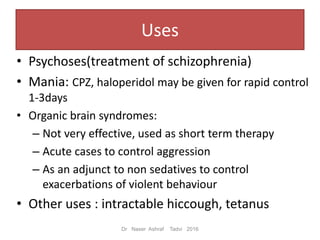
Uses
• Psychoses(treatment of schizophrenia)
• Mania: CPZ, haloperidol may be given for rapid control
1-3days
• Organic brain syndromes:
– Not very effective, used as short term therapy
– Acute cases to control aggression
– As an adjunct to non sedatives to control
exacerbations of violent behaviour
• Other uses : intractable hiccough, tetanus
Dr Naser Ashraf Tadvi 2016
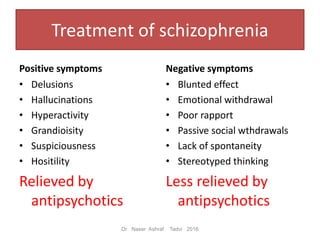
Treatment of schizophrenia
Positive symptoms
• Delusions
• Hallucinations
• Hyperactivity
• Grandioisity
• Suspiciousness
• Hositility
Relieved by
antipsychotics
Negative symptoms
• Blunted effect
• Emotional withdrawal
• Poor rapport
• Passive social wthdrawals
• Lack of spontaneity
• Stereotyped thinking
Less relieved by
antipsychotics
Dr Naser Ashraf Tadvi 2016
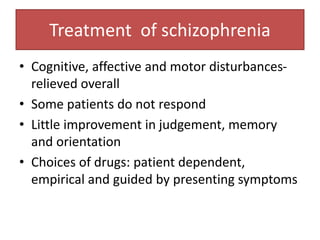
Treatment of schizophrenia
• Cognitive, affective and motor disturbances-
relieved overall
• Some patients do not respond
• Little improvement in judgement, memory
and orientation
• Choices of drugs: patient dependent,
empirical and guided by presenting symptoms
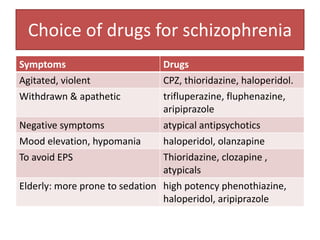
Choice of drugs for schizophrenia
DrugsSymptoms
CPZ, thioridazine, haloperidol.Agitated, violent
trifluperazine, fluphenazine,
aripiprazole
Withdrawn & apathetic
atypical antipsychoticsNegative symptoms
haloperidol, olanzapineMood elevation, hypomania
Thioridazine, clozapine ,
atypicals
To avoid EPS
high potency phenothiazine,
haloperidol, aripiprazole
Elderly: more prone to sedation
Mood stabilizers
• Control mood swings seen in bipolar mood
disorders
• Mood stabilizers
– Lithium
– Sodium valproate
– Carbamazepine
– Lamotrigine
– Gabapentine
Dr Naser Ashraf Tadvi 2016
Lithium
• Monovalent cation Li+
• prevents mood swings reduces both maniac
and depressive episodes
• In Acute mania supresses episodes over weeks
Dr Naser Ashraf Tadvi 2016
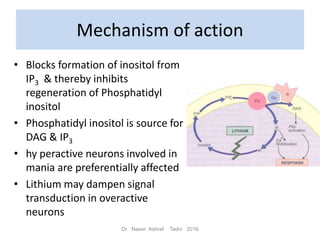
Mechanism of action
Dr Naser Ashraf Tadvi 2016
• Blocks formation of inositol from
IP3 & thereby inhibits
regeneration of Phosphatidyl
inositol
• Phosphatidyl inositol is source for
DAG & IP3
• hy peractive neurons involved in
mania are preferentially affected
• Lithium may dampen signal
transduction in overactive
neurons
• Pharmacokinetics:
– narrow margin of safety
– monitor 0.8-1.1 meq/l lithium
• Uses:
1.Acute maniac episodes
2.Bipolar disease.
3.Recurrent unipolar depression
• Adverse effects:
– CNS toxicity as tremors, giddiness ,ataxia,
delirium, twitchings, and convulsions.
• Contraindications:
– pregnancy- foetal goiter
Dr Naser Ashraf Tadvi 2016
Adverse effects of lithium
• Leukocytes Increased (Leukocytosis)
• Increased weight
• Tremors
• Hypothyroidism
• Increased Urine
• Moms Beware (teratogenic)
Dr Naser Ashraf Tadvi 2016
Lithium toxicity
• Lithium toxicity begins to occur when the serum
concentration exceeds 1.5 mmol/L. Symptoms
include drowsiness, nausea, vomiting, blurred vision,
a coarse tremor, ataxia and dysarthria
• Such symptoms progress to delirium and
convulsions, and coma and death can occur.
As a rule, lithium is not advised during pregnancy,
particularly in the first trimester, because of an
increased risk of fetal malformation (Ebstein’s
anomaly).
Dr Naser Ashraf Tadvi 2016
Management of mania/biplolar disorder
• Acute mania
– Atypical antipsychotic (olanzapine, quetiapine and
risperidone), sodium valproate or lithium.
– Severe mania is best treated with a combination
of valproic acid or lithium and a neuroleptic,
allowing the neuroleptic to be withdrawn after the
first 2 or 3 weeks.
– First attacks of mania usually require treatment
for up to 3 months.
Dr Naser Ashraf Tadvi 2016
Prevention in bipolar disorders
• Lithium, olanzapine, and valproic acid
• Screening prior to starting lithium:
■ Thyroid disease : Lithium can produce hypothyroidism.
■ Renal disease : Longterm treatment with lithium causes
nephrogenic diabetes insipidus (DI) and reduced glomerular
function
• The therapeutic range for prophylaxis is 0.5–1.0 mmol/L.
Lithium levels should be checked every 3 months, along with
regular thyroid (free T4 and TSH) and renal function tests.
• Patients should carry a lithium card with them at all times, be
advised to avoid dehydration, and be warned of drug
interactions, such as NSAIDs and diuretics.
Dr Naser Ashraf Tadvi 2016
References
• Basic and Clinical Pharmacology by Katzung
BG, 12TH Edition. Pg; 501-18.
• Clinical medicine by Kumar and clark 7th
edition page 1204-06, 1217-18.
• Essentials of Medical Pharmacology, KD
tripathi, 7th edition , Pg :435-51.
Dr Naser Ashraf Tadvi 2016

Antipsychotics

  • 1.
  • 2.
    Objectives • Classify antipsychoticdrugs • Explain mechanism of action, therapeutic uses and adverse effects of antipsychotic drugs • Describe management of schizophrenia • Describe mechanism of action and adverse effects of lithium • Enlist other alternatives to lithium in the treatment of mania • Describe management of mania and bipolar disorders Dr Naser Ashraf Tadvi 2016
  • 3.
    Classification of Antipsychotics •Phenothiazines – Aliphatic side chain: chlorpromazine, triflupromazine – Piperidine side chain: Thioridazine – Piperazine side chain: Trifluoperazine, fluphenazine • Butyrophenones: – Haloperidol, trifluperidol, droperidol, penfluridol • Thioxanthenes: – Thiothixene, flupenthixol • Other heterocyclics: Pimozide, loxapine • Atypical antipsychotics: Clozapine, olanzapine, risperidone, quetiapine, aripiprazole, ziprasidone. Dr Naser Ashraf Tadvi 2016
  • 4.
    Dr Naser AshrafTadvi 2016
  • 5.
    Chlorpromazine Pharmacological actions (CNS) In Normal individuals: Indifference to surrounding, paucity of thought, psychomotor slowing, emotional quietening , reduction in initiative, tendency to go off to sleep from which pt is easily arousable. Spontaneous movements are minimized. This is called neuroleptic syndrome  In psychotic patient: ↓ irrational behaviour,↓ agitation & aggressiveness, relief of anxiety. – Corrects disturbed thought & behaviour – ↓ spontaneous movements(hyperactivity) – Reduces delusions and hallucinations Dr Naser Ashraf Tadvi 2016
  • 6.
    • The aliphatic& piperidine side chain compounds : low potency more sedation. Sedative effect develops promptly but antipsychotic effect takes weeks to develop. • Chlorpromazine lowers seizure threshold can precipitate seizures • Hypothermia: temperature control is knocked off at higher doses • All neuroleptics except thioridazine have potent antiemetic action Chlorpromazine Pharmacological actions (CNS) Dr Naser Ashraf Tadvi 2016
  • 7.
    Pharmacological actions • ANS:α-adrenergic blocking & anticholinergic property • CVS: Postural hypotension, QT prolongation • Local anaesthetic action • Endocrine: ↑release of prolactin- galactorrhoea and gynaecomastia Dr Naser Ashraf Tadvi 2016
  • 8.
    Tolerance & dependence •Tolerance to sedative & hypotensive action develops within days or weeks • The antipsychotic, extra pyramidal & other actions based on DA antagonism do not show tolerance. • Neuroleptics are pleasurably bland drugs • Physical dependence is absent though some withdrawal symptoms may be seen • No drug seeking behaviour observed Dr Naser Ashraf Tadvi 2016
  • 9.
    Other typical antipsychotics •Triflupromazine: more potent than CPZ, Antiemetic, frequently produces acute muscular dystonias in children • Thioridazine: low potency marked, central anticholinergic action. Low incidence of Extra pyramidal reactions. Cardiac arrhythmias & interference with male sexual dysfunction is more common • Trifluoperazine, fluphenazine: High potency, minimum autonomic actions. Marked extrapyramidal reactions Dr Naser Ashraf Tadvi 2016
  • 10.
    • Haloperidol: potent,few autonomic effects, less seizure potential , doesn’t cause weight gain, rarely causes jaundice, preferred agent for schizophrenia, acute mania, senile psychoses, acute psychoses, huntingtons disease, tourette syndrome. • Penfluridol: exceptionally long acting neuroleptic, recommended for chronic schizophrenia • Pimozide : little adrenergic or cholinergic blocking activity , longer Duration of action for several days. Good for maintenance therapy. Low dystonic reactions , more propensity for arrhythmia Dr Naser Ashraf Tadvi 2016 Other typical antipsychotics
  • 11.
    Atypical antipsychotics • Newersecond generation antipsychotics have weak D2 but potent 5HT2 antagonist properties. • Extrapyramidal side effects are minimal, they may improve impaired cognitive function in psychotics Dr Naser Ashraf Tadvi 2016
  • 12.
    Clozapine & olanzapine •Atypical antipsychotics • Mainly block D4 receptors • Have weak D2 blocking effect • Also block 5 HT2 & alpha-1 receptors • Have H1 blocking & anticholinergic • Rarely cause EPS • Cause sedation & hypotension Dr Naser Ashraf Tadvi 2016
  • 13.
    Side effects: • Clozapine •sedation, salivation, seizures, weight gain, hypotension. • Dangerous side effect is agranulocytosis, hence regular monitoring of blood counts is essential – Olanzapine: • Dry mouth , constipation , weight gain rarely EPS • No agranulocytosis • Uses: – Clozapine is reserve drug for treatment of schizophrenia because of risk of agranulocytosis . – Olanzapine is used for treatment of schizophrenia & mania associated with bipolar disorder. They supress both positive & negative symptoms of schizophrenia Dr Naser Ashraf Tadvi 2016 Clozapine & olanzapine
  • 14.
    Risperidone • Atypical antipsychotic •Blocks D2,5 HT2, ALPHA1 adrenergic, & has antihistaminic activity • EPS are rare at low doses • No anti-emetic effect • Used for treatment of schizophrenia, & short term treatment of mania associated with bipolar disorder Dr Naser Ashraf Tadvi 2016
  • 15.
    Adverse effects ofantipsychotics CNS(Extrapyramidal side effects) 1. Parkinsonism: (more common with haloperidol ) 2. Dystonic Reactions: Bizarre muscle spasms, mostly involving linguo- facial muscles (Grimacing, tongue thursting, torticollis, locked jaw) 3. Akathisia: Restlessness, feeling of discomfort, desire to move 4. Malignant neuroleptic syndrome: muscular rigidity, hyperpyrexia, mental confusion & coma. Treated with IV dantrolene , anticholinergic are of no help. Bromocriptine in large doses found to be useful 5. Tardive dyskinesia: characterized by involuntary & purposeless movements of the mouth, tongue & upper limbs (chewing, pouting, puffing of cheek, lip licking etc) It develops in about 20% of pts after months or years of antipsychotic treatment . Treatment is usually unsuccessful Dr Naser Ashraf Tadvi 2016
  • 16.
    Other CNS sideeffects • Drowsiness, lethargy, mental confusion with low potency agents • Increase appetite, weight gain (not with haloperidol) • Aggravation of seizures in epileptics, even non epileptics may develop seizures with high doses of clozapine, olanzapine • Potent phenothiazines risperidone, quetiapine, aripiprazole & ziprasidone low seizure threshold Dr Naser Ashraf Tadvi 2016
  • 17.
    Other adverse effects •Postural hypotension, palpitation, • Thioridazine – Inhibition of ejaculation , QT prolongation, & cardiac arrhythmias – Anticholinergic: Dry mouth, blurring of vision, constipation, urinary hesitancy – Blue pigmentation of exposed skin, corneal & lenticular opacities, retinal degeneration • Clozapine – hypersalivation • Hyperprolactinemia • Weight gain, ↑lipids &BSL • Cholestatic jaundice : low potency • Skin rashes, urticaria, contact dermatitis, photosensitivity • Agranulocytosis • Myocarditis: clozapine Dr Naser Ashraf Tadvi 2016
  • 18.
    Uses • Psychoses(treatment ofschizophrenia) • Mania: CPZ, haloperidol may be given for rapid control 1-3days • Organic brain syndromes: – Not very effective, used as short term therapy – Acute cases to control aggression – As an adjunct to non sedatives to control exacerbations of violent behaviour • Other uses : intractable hiccough, tetanus Dr Naser Ashraf Tadvi 2016
  • 19.
    Treatment of schizophrenia Positivesymptoms • Delusions • Hallucinations • Hyperactivity • Grandioisity • Suspiciousness • Hositility Relieved by antipsychotics Negative symptoms • Blunted effect • Emotional withdrawal • Poor rapport • Passive social wthdrawals • Lack of spontaneity • Stereotyped thinking Less relieved by antipsychotics Dr Naser Ashraf Tadvi 2016
  • 20.
    Treatment of schizophrenia •Cognitive, affective and motor disturbances- relieved overall • Some patients do not respond • Little improvement in judgement, memory and orientation • Choices of drugs: patient dependent, empirical and guided by presenting symptoms
  • 21.
    Choice of drugsfor schizophrenia DrugsSymptoms CPZ, thioridazine, haloperidol.Agitated, violent trifluperazine, fluphenazine, aripiprazole Withdrawn & apathetic atypical antipsychoticsNegative symptoms haloperidol, olanzapineMood elevation, hypomania Thioridazine, clozapine , atypicals To avoid EPS high potency phenothiazine, haloperidol, aripiprazole Elderly: more prone to sedation
  • 22.
    Mood stabilizers • Controlmood swings seen in bipolar mood disorders • Mood stabilizers – Lithium – Sodium valproate – Carbamazepine – Lamotrigine – Gabapentine Dr Naser Ashraf Tadvi 2016
  • 23.
    Lithium • Monovalent cationLi+ • prevents mood swings reduces both maniac and depressive episodes • In Acute mania supresses episodes over weeks Dr Naser Ashraf Tadvi 2016
  • 24.
    Mechanism of action DrNaser Ashraf Tadvi 2016 • Blocks formation of inositol from IP3 & thereby inhibits regeneration of Phosphatidyl inositol • Phosphatidyl inositol is source for DAG & IP3 • hy peractive neurons involved in mania are preferentially affected • Lithium may dampen signal transduction in overactive neurons
  • 25.
    • Pharmacokinetics: – narrowmargin of safety – monitor 0.8-1.1 meq/l lithium • Uses: 1.Acute maniac episodes 2.Bipolar disease. 3.Recurrent unipolar depression • Adverse effects: – CNS toxicity as tremors, giddiness ,ataxia, delirium, twitchings, and convulsions. • Contraindications: – pregnancy- foetal goiter Dr Naser Ashraf Tadvi 2016
  • 26.
    Adverse effects oflithium • Leukocytes Increased (Leukocytosis) • Increased weight • Tremors • Hypothyroidism • Increased Urine • Moms Beware (teratogenic) Dr Naser Ashraf Tadvi 2016
  • 27.
    Lithium toxicity • Lithiumtoxicity begins to occur when the serum concentration exceeds 1.5 mmol/L. Symptoms include drowsiness, nausea, vomiting, blurred vision, a coarse tremor, ataxia and dysarthria • Such symptoms progress to delirium and convulsions, and coma and death can occur. As a rule, lithium is not advised during pregnancy, particularly in the first trimester, because of an increased risk of fetal malformation (Ebstein’s anomaly). Dr Naser Ashraf Tadvi 2016
  • 28.
    Management of mania/biplolardisorder • Acute mania – Atypical antipsychotic (olanzapine, quetiapine and risperidone), sodium valproate or lithium. – Severe mania is best treated with a combination of valproic acid or lithium and a neuroleptic, allowing the neuroleptic to be withdrawn after the first 2 or 3 weeks. – First attacks of mania usually require treatment for up to 3 months. Dr Naser Ashraf Tadvi 2016
  • 29.
    Prevention in bipolardisorders • Lithium, olanzapine, and valproic acid • Screening prior to starting lithium: ■ Thyroid disease : Lithium can produce hypothyroidism. ■ Renal disease : Longterm treatment with lithium causes nephrogenic diabetes insipidus (DI) and reduced glomerular function • The therapeutic range for prophylaxis is 0.5–1.0 mmol/L. Lithium levels should be checked every 3 months, along with regular thyroid (free T4 and TSH) and renal function tests. • Patients should carry a lithium card with them at all times, be advised to avoid dehydration, and be warned of drug interactions, such as NSAIDs and diuretics. Dr Naser Ashraf Tadvi 2016
  • 30.
    References • Basic andClinical Pharmacology by Katzung BG, 12TH Edition. Pg; 501-18. • Clinical medicine by Kumar and clark 7th edition page 1204-06, 1217-18. • Essentials of Medical Pharmacology, KD tripathi, 7th edition , Pg :435-51. Dr Naser Ashraf Tadvi 2016

Editor's Notes

  • #6 slurring of speech, ataxia or motor incoordination do not occur Does not effect intelligence but impairs vigilance All antipsychotics same efficacy but potency differs in terms of equi-effective doses
  • #7 Piperazine side chain trifluoperazine , fluphenazine low propensity for seizures Can cause hypothermia as it knocks off temperature control mechanism in the hypothalamus
  • #8 Postural hypotension, tachycardia , palpitations Cpz- triflupromazine >thiridazine>clozapine, fluphenazine
  • #9 Tolerance to sedative & hypotensive action develops within days or weeks but maintenance doses remain fairly unchanged over years, the antipsychotic, extrapyramidal & other actions based on DA antagonism do not show tolerance. Neuroleptics are pleasurably bland drugs (hedonically) Physical dependence is absent though some withdrawal symptoms may be seen No drug seeking behaviour observed Pharmacokinetics: CPZ , ORAL Absp is unpredictable, BA is low. More consistent effects on IM, IV admn . Highly bound to plasma as well as tissue proteins – brain conc more than plasma conc . Large vol of dist, 20 L/kg, metabolised in liver by CYP2D6. THE acute effects of single dose last 6-8 hrs , elimination t1/2 is variable but in range of 18 – 30 hrs. the drfug cumulates on chronic administration & it is possible to give total cmaintence dose Once a day. Some metabolites are probably active. The intensity of antipsychotic action is poorly corelated with plasma conc. The metabolites are excreted in urine & bile months after discontinuing the drug
  • #16 Parkinsonism: Rigidity, tremors, hypokinesia, mask like face, shuffling gait, rabbit syndrome (more common with haloperidol ) Dystonic Reactions: Bizarre muscle spasms, mostly involving linguo-facial muscles Grimacing, tongue thursting, torticollis, locked jaw Akathisia: Restlessness, feeling of discomfort, desire to move Anticholinergic or diazepam may be useful Malignant neuroleptic syndrome: Rare but serious complication characterized by muscular rigidity, hyperpyrexia, mental confusion & coma. Treated with IV dantrolene , anticholinergic are of no help. Bromocriptine in large doses found to be useful Tardive dyskinesia: Occurs late in therapy characterized by involuntary & purposeless movements of the mouth, tongue & upper limbs like constant chewing, pouting, puffing of cheek, lip licking , choreo-athetoid etc . It develops in about 20% of pts after months or years of antipsychotic treatment . Treatment is usually unsuccessful
  • #19 Organic brain syndromes: not very effective, may be used on short term basis Anxiety Antiemetic Intractable cough Tetanus: CPZ causes muscle relaxation Alcoholic haluucinosis, huntingtons Some times in anaesthesia
  • #22 : : : : ,
  • #23 Lithium has been used for several decades but several antiepileptics like carbamazepine, Valproic acid and gabapentin are now being tried
  • #24 On prophylactic use in bipolar mood disorder lithium acts as a mood stabilizer
  • #25 Other theories: lithium partly replaces body sodium and is nearly equally distributable outside and inside of cells (Contrast with Na+ & K+) this may affect ionic fluxes across the brain cells or modify the properties of cellular membranes lithium has been found to decrease the release of NA and DA in brain of treated animals without affecting 5 HT release, this may correct any imbalance in turnover of brain monoamines The above hypothesis cannot explain why lithium has no affect on people not suffering from mania
  • #27 Adverse effects: Nausea, vomiting, mild diarrhoea occur initially can be minimized by starting at lower doses Thirst and polyuria are experienced by most , some fluid retention occurs but clears later. Fine tremors and seizures are seen rarely even at therapeutic levels
  • #28 Polyuria, polydyspia
  • #29 Toxicity is more likely when the patient is dehydrated or with a drug interaction. Interactions 1. Diuretics (thiazide, furosemide) by causing Na+ loss promote proximal tubular reabsorption of Na+ as well as Li+ → plasma levels of lithium rise. Potassium sparing diuretics cause milder Li+ retention. 2. Tetracyclines, NSAIDs and ACE inhibitors can also cause lithium retention. 3. Lithium reduces pressor response to NA. 4. Lithium tends to enhance insulin/sulfonylurea induced hypoglycaemia. 5. Succinylcholine and pancuronium have produced prolonged paralysis in lithium treated patients. 6. Neuroleptics, including haloperidol, have been frequently used along with lithium without problem. However, sometimes, the combination of haloperidol and lithium produces marked tremor and rigidity. The neuroleptic action appears to be potentiated by lithium.
  • #30 First, stop any antidepressant being taken. Depression alternating with mania The behavioural excitement and overactivity are usually reduced within days, but elation, grandiosity
  • #31 Since bipolar illnesses tend to be relapsing and remitting, prevention of recurrence is the major therapeutic challenge in management. A patient who has experienced more than two episodes of affective disorder within a 5-year period is likely to benefit from preventative treatments. Valproic acid (as the semisodium salt) is recommended both in prophylaxis and treatment of manic states. Secondline treatments include carbamazepine and lamotrigine. Some patients who do not respond to lithium may respond to these anticonvulsants or a combination of both. Patients with rapid cycling illnesses show a better response to anticonvulsants than to lithium. For antimanic treatment, dosage in the initial stage of treatment will be 200 mg twice daily of carbamazepine, increasing to a normal dose of 800–1000 mg. Other drugs which appear to exercise a prophylactic moodstabilizing effect include olanzapine and risperidone. Both carbamazepine and valproate can be teratogenic (neural tube defects) and should be avoided in pregnancy.