Drugs affecting calcium
balance-1
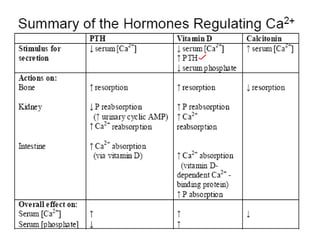
Calcium & PTH
Dr Naser Ashraf Tadvi
Associate Professor Pharmacology
Ayaan Institute of Medical Sciences
Objectives
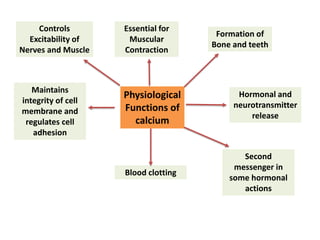
• Recall the physiological functions of calcium
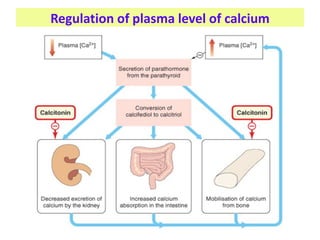
• Describe the regulation of plasma calcium
• Describe Pharmacokinetics of calcium
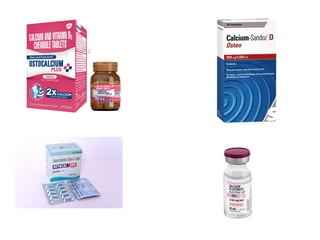
• Enlist the oral and parenteral preparations of
calcium
• Describe therapeutic uses of Calcium salts
• Explain the treatment of Hypercalcemia
• Discuss the Pharmacology of Parathyroid
hormone (MOA, actions, uses)
Case study
• A 28-year-old female presented to Medicine
OPD with complains of numbness and tingling
sensation in perioral area since past few days
• She also had muscle cramps in back and lower
extremities
• The casualty doctor elicited Trosseu`s and
Chvostek`s sign and found them to be positive
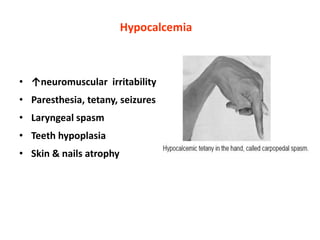
• ↑neuromuscular irritability
• Paresthesia, tetany, seizures
• Laryngeal spasm
• Teeth hypoplasia
• Skin & nails atrophy
Hypocalcemia
Calcium
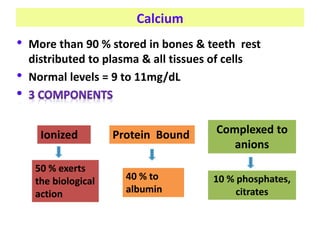
• More than 90 % stored in bones & teeth rest
distributed to plasma & all tissues of cells
• Normal levels = 9 to 11mg/dL
Ionized Protein Bound Complexed to
anions
50 % exerts
the biological
action
40 % to
albumin
10 % phosphates,
citrates
Physiological
Functions of
calcium
Controls
Excitability of
Nerves and Muscle
Essential for
Muscular
Contraction
Formation of
Bone and teeth
Hormonal and
neurotransmitter
release
Second
messenger in
some hormonal
actions
Blood clotting
Maintains
integrity of cell
membrane and
regulates cell
adhesion
Regulation of plasma level of calcium
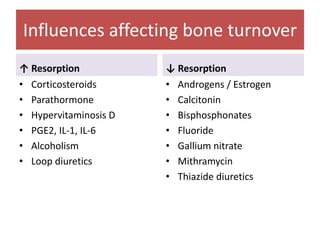
Influences affecting bone turnover
↑ Resorption
• Corticosteroids
• Parathormone
• Hypervitaminosis D
• PGE2, IL-1, IL-6
• Alcoholism
• Loop diuretics
↓ Resorption
• Androgens / Estrogen
• Calcitonin
• Bisphosphonates
• Fluoride
• Gallium nitrate
• Mithramycin
• Thiazide diuretics
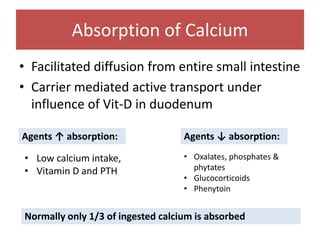
Absorption of Calcium
• Facilitated diffusion from entire small intestine
• Carrier mediated active transport under
influence of Vit-D in duodenum
• Low calcium intake,
• Vitamin D and PTH
• Oxalates, phosphates &
phytates
• Glucocorticoids
• Phenytoin
Agents ↑ absorption: Agents ↓ absorption:
Normally only 1/3 of ingested calcium is absorbed
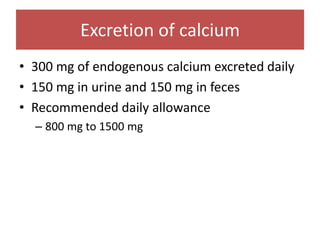
Excretion of calcium
• 300 mg of endogenous calcium excreted daily
• 150 mg in urine and 150 mg in feces
• Recommended daily allowance
– 800 mg to 1500 mg
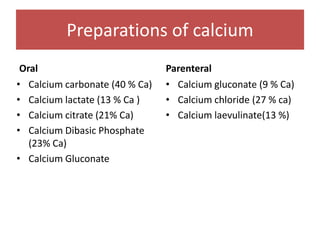
Preparations of calcium
Oral
• Calcium carbonate (40 % Ca)
• Calcium lactate (13 % Ca )
• Calcium citrate (21% Ca)
• Calcium Dibasic Phosphate
(23% Ca)
• Calcium Gluconate
Parenteral
• Calcium gluconate (9 % Ca)
• Calcium chloride (27 % ca)
• Calcium laevulinate(13 %)
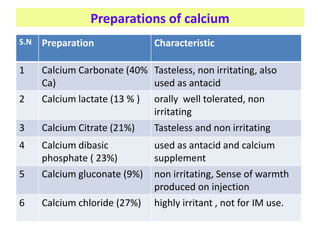
Preparations of calcium
S.N Preparation Characteristic
1 Calcium Carbonate (40%
Ca)
Tasteless, non irritating, also
used as antacid
2 Calcium lactate (13 % ) orally well tolerated, non
irritating
3 Calcium Citrate (21%) Tasteless and non irritating
4 Calcium dibasic
phosphate ( 23%)
used as antacid and calcium
supplement
5 Calcium gluconate (9%) non irritating, Sense of warmth
produced on injection
6 Calcium chloride (27%) highly irritant , not for IM use.
Uses of Calcium Preparations
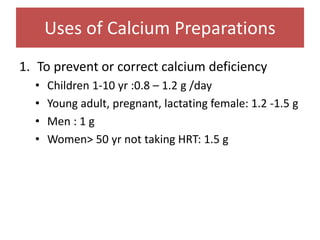
1. To prevent or correct calcium deficiency
• Children 1-10 yr :0.8 – 1.2 g /day
• Young adult, pregnant, lactating female: 1.2 -1.5 g
• Men : 1 g
• Women> 50 yr not taking HRT: 1.5 g
Uses of Calcium Preparations
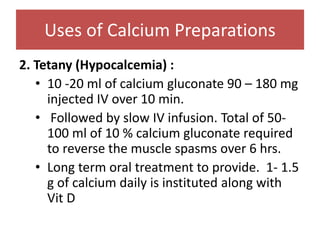
2. Tetany (Hypocalcemia) :
• 10 -20 ml of calcium gluconate 90 – 180 mg
injected IV over 10 min.
• Followed by slow IV infusion. Total of 50-
100 ml of 10 % calcium gluconate required
to reverse the muscle spasms over 6 hrs.
• Long term oral treatment to provide. 1- 1.5
g of calcium daily is instituted along with
Vit D
Other uses of calcium
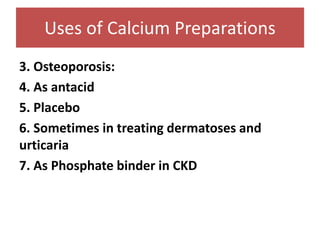
3. Osteoporosis:
4. As antacid
5. Placebo
6. Sometimes in treating dermatoses and
urticaria
7. As Phosphate binder in CKD
Uses of Calcium Preparations
Hypercalcemia
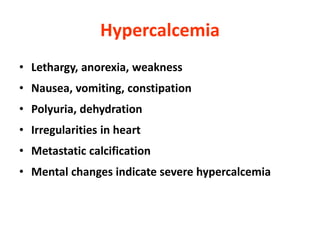
• Lethargy, anorexia, weakness
• Nausea, vomiting, constipation
• Polyuria, dehydration
• Irregularities in heart
• Metastatic calcification
• Mental changes indicate severe hypercalcemia
Treatment of hypercalcemia
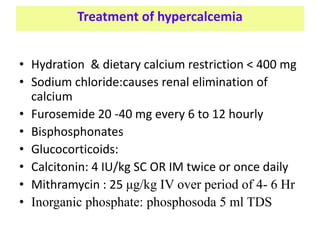
• Hydration & dietary calcium restriction < 400 mg
• Sodium chloride:causes renal elimination of
calcium
• Furosemide 20 -40 mg every 6 to 12 hourly
• Bisphosphonates
• Glucocorticoids:
• Calcitonin: 4 IU/kg SC OR IM twice or once daily
• Mithramycin : 25 μg/kg IV over period of 4- 6 Hr
• Inorganic phosphate: phosphosoda 5 ml TDS
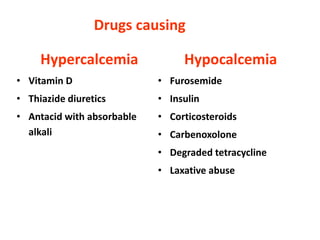
Hypercalcemia
• Vitamin D
• Thiazide diuretics
• Antacid with absorbable
alkali
Drugs causing
Hypocalcemia
• Furosemide
• Insulin
• Corticosteroids
• Carbenoxolone
• Degraded tetracycline
• Laxative abuse
Parathyroid Hormone (PTH)
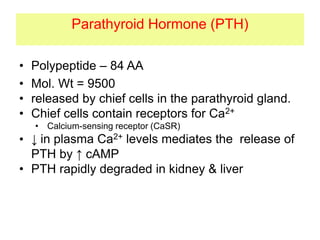
• Polypeptide – 84 AA
• Mol. Wt = 9500
• released by chief cells in the parathyroid gland.
• Chief cells contain receptors for Ca2+
• Calcium-sensing receptor (CaSR)
• ↓ in plasma Ca2+ levels mediates the release of
PTH by ↑ cAMP
• PTH rapidly degraded in kidney & liver
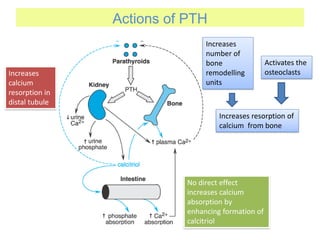
Actions of PTH
Increases resorption of
calcium from bone
Increases
number of
bone
remodelling
units
Activates the
osteoclastsIncreases
calcium
resorption in
distal tubule
No direct effect
increases calcium
absorption by
enhancing formation of
calcitriol
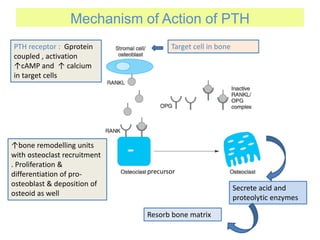
precursor
Mechanism of Action of PTH
PTH receptor : Gprotein
coupled , activation
↑cAMP and ↑ calcium
in target cells
Target cell in bone
↑bone remodelling units
with osteoclast recruitment
. Proliferation &
differentiation of pro-
osteoblast & deposition of
osteoid as well
Secrete acid and
proteolytic enzymes
Resorb bone matrix
Cinacalcet
• Activates CaSR in parathyroids and blocks PTH secretion
• Indicated in secondary hyperparathyroidism (due to renal
disease) & in parathyroid tumor
Uses of PTH
• Not used in hypoparathyroidism because Vitamin D can be
used more conveniently
Teriparatide
• Recombinant preparation 1-34 residues of AA, duplicates all
actions of PTH. Approved for severe osteoporosis
Summary
• Calcium
– Functions
– Preparations
– Uses
• Treatment of hypercalcemia
• PTH
– Actions
– Mechanism
– Uses
Drugs affecting calcium
balance-2
Calcitonin, Vitamin D
Dr Naser Ashraf Tadvi
Associate Professor Pharmacology
Ayaan Institute of Medical Sciences
Objectives
• Describe the pharmacological actions and
therapeutic uses of calcitonin
• Recall the steps in activation of Vitamin D, its
mechanism of action and Physiological actions
• Enlist Vit D preparations and describe their salient
pharmacokinetic features, ADR and Therapeutic uses
• Describe the mechanism of action, salient
pharmacokinetic features, ADR and therapeutic uses
of bisphosphonates
• Explain the management of osteoporosis
• A hypocalcemic hormone discovered by
Copp
• 32 AA, 3600 Mol.Wt
• Produced by C-cells
• Physiological effects are opposite to those
of PTH
• Plasma t ½ of calcitonin is 10 minutes but
its action last for several hours
Calcitonin
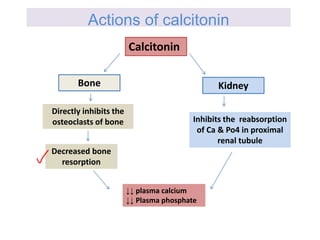
Calcitonin
Bone Kidney
Directly inhibits the
osteoclasts of bone
Decreased bone
resorption
↓↓ plasma calcium
↓↓ Plasma phosphate
Inhibits the reabsorption
of Ca & Po4 in proximal
renal tubule
Actions of calcitonin
Preparations of calcitonin
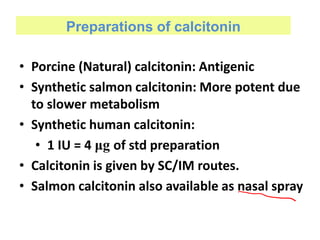
• Porcine (Natural) calcitonin: Antigenic
• Synthetic salmon calcitonin: More potent due
to slower metabolism
• Synthetic human calcitonin:
• 1 IU = 4 μg of std preparation
• Calcitonin is given by SC/IM routes.
• Salmon calcitonin also available as nasal spray
Uses of calcitonin
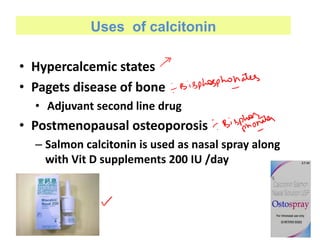
• Hypercalcemic states
• Pagets disease of bone
• Adjuvant second line drug
• Postmenopausal osteoporosis
– Salmon calcitonin is used as nasal spray along
with Vit D supplements 200 IU /day
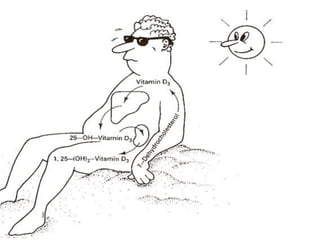
Vitamin D
• Vitamin D1:
– Mixture of antirachitic substances found in
the food- only of historic interest
• Vitamin D2:
– calciferol- present in irradiated food- yeasts,
fungi, bread, milk
• Vitamin D3:
– cholecalciferol- synthesized in skin under
influence of UV rays
Activation of Vit D
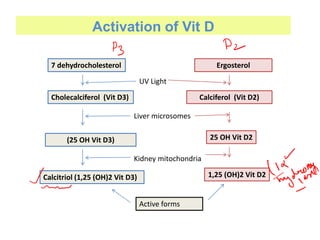
7 dehydrocholesterol Ergosterol
Cholecalciferol (Vit D3) Calciferol (Vit D2)
(25 OH Vit D3)
Calcitriol (1,25 (OH)2 Vit D3)
25 OH Vit D2
1,25 (OH)2 Vit D2
UV Light
Liver microsomes
Kidney mitochondria
Active forms
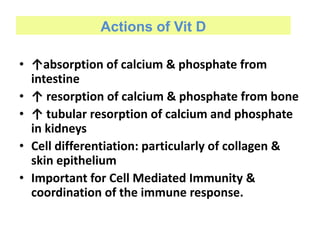
Actions of Vit D
• ↑absorption of calcium & phosphate from
intestine
• ↑ resorption of calcium & phosphate from bone
• ↑ tubular resorption of calcium and phosphate
in kidneys
• Cell differentiation: particularly of collagen &
skin epithelium
• Important for Cell Mediated Immunity &
coordination of the immune response.
Actions of Vit D
Groff & Gropper, 2000
• 1,25-(OH)2 D binds
to vitamin D
receptor (VDR) in
cytoplasm
• ↑ in calbindin
(Ca-binding protein)
• Net effect is ↑
absorption of
calcium &
phosphorus from
intestine
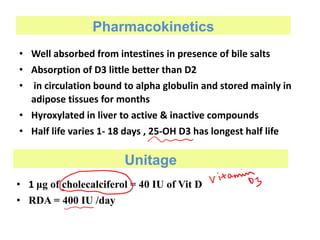
Pharmacokinetics
• Well absorbed from intestines in presence of bile salts
• Absorption of D3 little better than D2
• in circulation bound to alpha globulin and stored mainly in
adipose tissues for months
• Hyroxylated in liver to active & inactive compounds
• Half life varies 1- 18 days , 25-OH D3 has longest half life
Unitage
• 1 μg of cholecalciferol = 40 IU of Vit D
• RDA = 400 IU /day
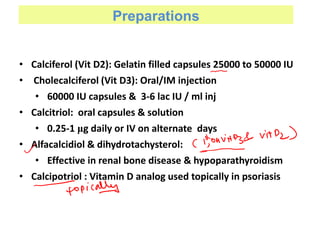
Preparations
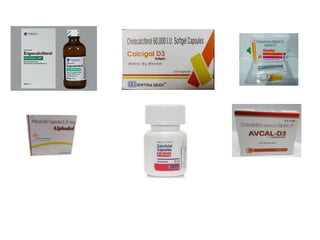
• Calciferol (Vit D2): Gelatin filled capsules 25000 to 50000 IU
• Cholecalciferol (Vit D3): Oral/IM injection
• 60000 IU capsules & 3-6 lac IU / ml inj
• Calcitriol: oral capsules & solution
• 0.25-1 μg daily or IV on alternate days
• Alfacalcidiol & dihydrotachysterol:
• Effective in renal bone disease & hypoparathyroidism
• Calcipotriol : Vitamin D analog used topically in psoriasis
Uses of Vitamin D
1. Prophylaxis and treatment of nutritional Vitamin D
deficiency
– For prevention or treatment of rickets in children and osteomalacia
in adults
– Prophylactic dose is 400 IU/ day, therapeutic dose is 3000 to 4000
IU/day
– Alternatively 3 lac to 6 lac IU can be given orally / IM once in 2 to 6
months
Uses of Vit D
2. Metabolic rickets :
3. Senile or post menopausal osteoporosis
4. Hypoparathyroidism : calcitriol or
alphacalcidiol are better
5. Fanconis syndrome:
– ↑es phosphate levels
6. Calcipotriol : Vitamin D analog used topically
in psoriasis
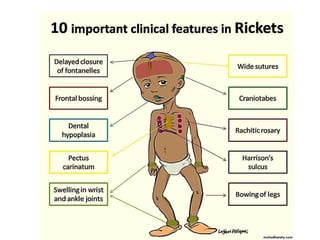
Vitamin D deficiency
•Deficiency of vitamin D leads to:
➢ Rickets in small children.
➢ Osteoporosis
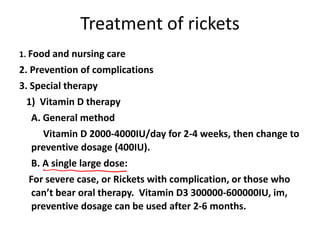
Treatment of rickets
1. Food and nursing care
2. Prevention of complications
3. Special therapy
1) Vitamin D therapy
A. General method
Vitamin D 2000-4000IU/day for 2-4 weeks, then change to
preventive dosage (400IU).
B. A single large dose:
For severe case, or Rickets with complication, or those who
can’t bear oral therapy. Vitamin D3 300000-600000IU, im,
preventive dosage can be used after 2-6 months.
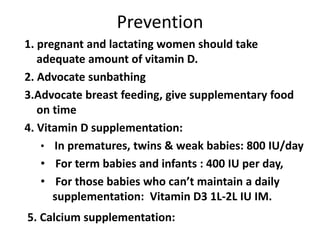
Prevention
1. pregnant and lactating women should take
adequate amount of vitamin D.
2. Advocate sunbathing
3.Advocate breast feeding, give supplementary food
on time
4. Vitamin D supplementation:
• In prematures, twins & weak babies: 800 IU/day
• For term babies and infants : 400 IU per day,
• For those babies who can’t maintain a daily
supplementation: Vitamin D3 1L-2L IU IM.
5. Calcium supplementation:
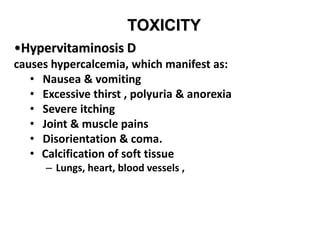
TOXICITY
•Hypervitaminosis D
causes hypercalcemia, which manifest as:
• Nausea & vomiting
• Excessive thirst , polyuria & anorexia
• Severe itching
• Joint & muscle pains
• Disorientation & coma.
• Calcification of soft tissue
– Lungs, heart, blood vessels ,
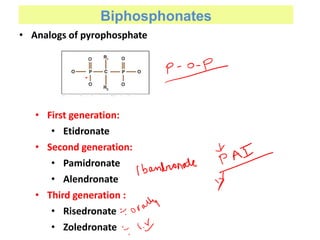
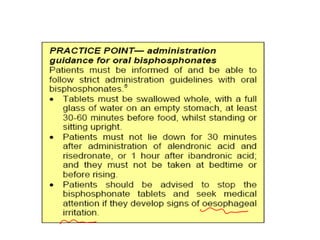
Biphosphonates
• Analogs of pyrophosphate
• First generation:
• Etidronate
• Second generation:
• Pamidronate
• Alendronate
• Third generation :
• Risedronate
• Zoledronate
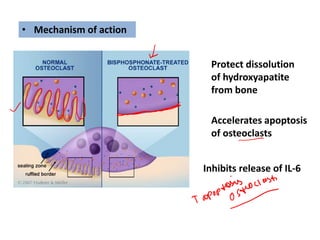
• Mechanism of action
Protect dissolution
of hydroxyapatite
from bone
Accelerates apoptosis
of osteoclasts
Inhibits release of IL-6
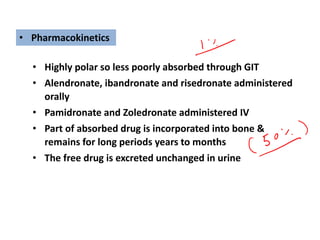
• Highly polar so less poorly absorbed through GIT
• Alendronate, ibandronate and risedronate administered
orally
• Pamidronate and Zoledronate administered IV
• Part of absorbed drug is incorporated into bone &
remains for long periods years to months
• The free drug is excreted unchanged in urine
• Pharmacokinetics
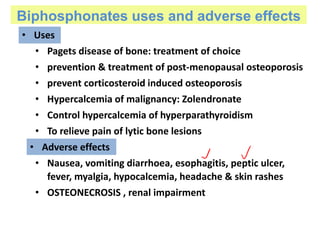
Biphosphonates uses and adverse effects
• Uses
• Pagets disease of bone: treatment of choice
• prevention & treatment of post-menopausal osteoporosis
• prevent corticosteroid induced osteoporosis
• Hypercalcemia of malignancy: Zolendronate
• Control hypercalcemia of hyperparathyroidism
• To relieve pain of lytic bone lesions
• Nausea, vomiting diarrhoea, esophagitis, peptic ulcer,
fever, myalgia, hypocalcemia, headache & skin rashes
• OSTEONECROSIS , renal impairment
• Adverse effects
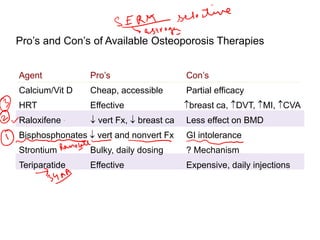
Pro’s and Con’s of Available Osteoporosis Therapies
Agent Pro’s Con’s
Calcium/Vit D Cheap, accessible Partial efficacy
HRT Effective breast ca, DVT, MI, CVA
Raloxifene  vert Fx,  breast ca Less effect on BMD
Bisphosphonates  vert and nonvert Fx GI intolerance
Strontium Bulky, daily dosing ? Mechanism
Teriparatide Effective Expensive, daily injections
Drugs affecting calcium balance