
MOOD STABILIZERS
Dr. Ashutosh Tiwari
III yr. PG Resident
Pharmacology Department
SAIMS, Indore
04/02/16
BIPOLAR DISORDER
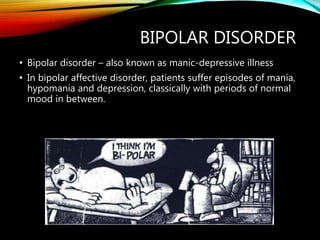
• Bipolar disorder – also known as manic-depressive illness
• In bipolar affective disorder, patients suffer episodes of mania,
hypomania and depression, classically with periods of normal
mood in between.
BIPOLAR
DISORDER
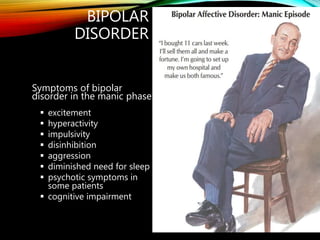
Symptoms of bipolar
disorder in the manic phase:
 excitement
 hyperactivity
 impulsivity
 disinhibition
 aggression
 diminished need for sleep
 psychotic symptoms in
some patients
 cognitive impairment
BIPOLAR
DISORDER
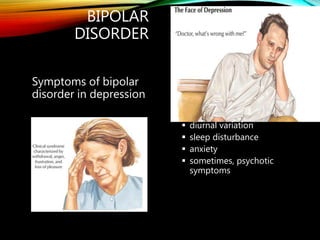
Symptoms of bipolar
disorder in depression
 depressed mood
 diurnal variation
 sleep disturbance
 anxiety
 sometimes, psychotic
symptoms
BIPOLAR DISORDER
• The cause of the mood swings:
 preponderance of catecholamine-related activity
 Drugs that increase this activity
 exacerbate mania
 Drugs that reduce activity of dopamine or norepinephrine
 relieve mania
 Acetylcholine or glutamate may also be involved
MOOD STABILIZER:
DEFINITION
• Any medication that is able to decrease vulnerability to
subsequent episodes of mania or depression; and not
exacerbate the current episode or maintenance phase of
treatment.
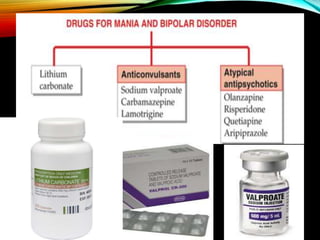
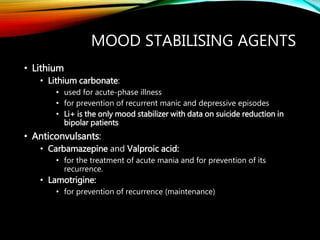
MOOD STABILISING AGENTS
• Lithium
• Lithium carbonate:
• used for acute-phase illness
• for prevention of recurrent manic and depressive episodes
• Li+ is the only mood stabilizer with data on suicide reduction in
bipolar patients
• Anticonvulsants:
• Carbamazepine and Valproic acid:
• for the treatment of acute mania and for prevention of its
recurrence.
• Lamotrigine:
• for prevention of recurrence (maintenance)
MOOD STABILISING
AGENTS
• Antipsychotics:
• Aripiprazole, chlorpromazine, olanzapine, quetiapine,
risperidone, and ziprasidone:
• for treatment of the manic phase of bipolar disorder.
• Olanzapine plus fluoxetine in combination and quetiapine:
• for treatment of bipolar depression.
LITHIUM - MOA
• acts by suppressing the formation of second messengers
involved in neurotransmitter signal transduction.
• Lithium reduces the formation of inositol triphosphate (IP3)
by inhibiting myoinositol-1-phosphatase, an enzyme in the
inositol phosphate pathway.
• This enzyme participates in the regeneration of inositol and
the inositol phosphate precursors to IP3.
LITHIUM –
MOA
• Lithium inhibits inositol monophosphatase (IMPase) and other important
enzymes in the normal recycling of membrane phosphoinositides,
including conversion of IP2 (inositol diphosphate) to IP1 (inositol
monophosphate) and the conversion of IP1 to inositol
• valproate & carbamazepine also decrease intracellular inositol
concentrations
Li inhibits inositol monophosphatase (IMPase)
↓ free inositol
↓phosphatidylinositol-4,5-bisphosphate (PIP2)
[the membrane precursor of IP3 & DAG]
depletion of the second-messenger source PIP2
causes reduced release of IP3 and DAG
decreased activity of PIP2 dependent pathways
(which are markedly increased during manic episode)
Mood Stabilising action
MECHANISM OF ACTION
LITHIUM –
THERAPEUTIC USES
• Bipolar Disorder : Treatment of acute mania and the prevention
of recurrences of bipolar illness
 Lithium has slow onset of action (5-7 days are required for clinical
effect) 
 antipsychotic drugs (chlorpromazine or haloperidol) with or without
potent benzodiazepines (lorazepam or clonazepam) is preferred.
 After mania is controlled, the antipsychotic drug may be stopped
and lithium continued as maintenance therapy
 Sodium valproate can provide rapid antimanic effects. Once
patients are stabilized and cooperative, Lithium can be
introduced for longer-term mood stabilization, or valproate may
be continued alone
LITHIUM –
THERAPEUTIC USES
 Now a days valproate, aripiprazole,
olanzapine, quetiapine, risperidone, and
ziprasidone are preferred over lithium
 Advantages of Sodium Valproate over
Lithium:
 Rapid action
 Wider therapeutic index
 Better tolerability
VALPROIC ACID
• now a first line in treatment of acute mania (as valproate acts
faster than lithium)
• an alternative to antipsychotic ± benzodiazepine.
• effective in patients not responding to lithium or not
tolerating it
• mixed states and rapid cycling forms of bipolar disorder may
be more responsive to valproate than to lithium
VALNOCTAMIDE
• Valproic acid is widely used to treat BP; however, its
teratogenicity limits its use in women of childbearing
potential.
• Valnoctamide is an analogue of valproic acid, but it does not
undergo biotransformation to the corresponding free acid.
• It also lacks key structural groups (eg, free carboxylic groups)
implicated in valproic acid’s teratogenicity.
• In preclinical studies, valnoctamide was markedly less
teratogenic than valproic acid.
CARBAMAZEPINE
• may be used to treat acute mania and also for prophylactic
therapy
• may be used alone or, in refractory patients, in combination
with lithium
LAMOTRIGINE
• used in the maintenance therapy of bipolar disorder
• effective in reducing the frequency of recurrent depressive
cycles and in the treatment of bipolar depression
• not effective in treating acute mania
• Lamotrigine can be combined with lithium to improve its
efficacy
ATYPICAL
ANTIPSYCHOTICS
• Olanzapine, risperidone, aripiprazole, quetiapine, with or
without a BZD, are now the first line drugs for control of acute
mania
• for urgent parenteral therapy, but older neuroleptics are still
the most effective.
• Aripiprazole has emerged as the favoured drug for treatment
of mania in bipolar disorder
• used both as monotherapy as well as adjuvant to lithium or
valproate
• prevents mania, but not depressive episodes
• Lack of metabolic effects, favours its long-term use
ATYPICAL
ANTIPSYCHOTICS
• Olanzapine is also approved for maintenance therapy of
bipolar disorder.
• both manic and depressive phases are suppressed
• not considered suitable for long-term therapy due to higher
risk of weight gain, hyperglycaemia, etc.
• Quetiapine is effective in bipolar depression.
• Combination of an atypical antipsychotic with valproate or
lithium has demonstrated high efficacy in acute phases as well
as for maintenance therapy of bipolar disorder.
ANTIDEPRESSANTS
• Depression that persists after lithium therapy is started may
respond to antidepressant drugs.
• The use of antidepressants especially TCAs in patients who
have bipolar disorder and are not taking lithium or another
mood-stabilizing drug can precipitate a manic response in
many patients.
• (switch phenomenon)
Novel targets for
treatment of Bipolar
disorder
GLYCOGEN SYNTHASE KINASE 3
(GSK-3) INHIBITION
• GSK-3 is a kinase involved in the regulation of cell apoptosis
and synaptic plasticity.
• Its inhibition influences gene transcription, with consequent
anti-apoptotic effect
• GSK-3 inhibition increases hippocampal levels of β-catenin, a
function implicated in mood stabilization
• Both Li+ and valproate treatment inhibit the activity of
glycogen synthase kinase-3β (GSK-3β)
PKC INHIBITION
• Excessive intracellular calcium influx results in increased apoptosis,
destruction of the cytoskeleton and intensification of the oxidative
stress.
• These disturbances in calcium mobilization are related in part to
hyperactivity of PKC, which has been demonstrated among
subjects with BD
• Therefore, drugs whose putative effects implicate PKC inhibition
may play a role in the treatment of BD
• Lithium and valproic acid inhibit PKC
• Tamoxifen, an estrogen antagonist (used in the treatment of
breast cancer) can cross BBB & has strong inhibitory effects on
PKC.
• Omega-3 fatty acids might represent a protective factor against
the development of BD
• Omega-3 Fatty acids act as antagonists of the PI-PKC signal
transduction pathway, ultimately inhibiting PKC activity
BRAIN-DERIVED NEUROTROPHIC
FACTOR (BDNF) MODULATION
• BDNF and other neurotrophic factors increase cell survival by
direct neurotrophic effect and apoptosis inhibition.
• There is evidence suggesting that chronic administration of
lithium and valproate may result in increased transcription of
those factors
ENHANCED BCL2 EXPRESSION
• Bcl2 is a protein with marked anti-apoptotic activity
• involved in neuronal protection and regeneration
• In rats, chronic administration of lithium and valproate is
associated with increased levels of Bcl2 in the prefrontal areas
• atypical antipsychotic olanzapine is associated with increased
expression of Bcl2 in the prefrontal cortex and hippocampus of
rodents
• Pramipexole is a dopamine agonist currently approved for
treatment of Parkinson’s disease and is associated with
increased expression of Bcl2 in the frontal cortex
EFFECTS ON OXIDATIVE STRESS
• increased oxidative stress contributes to cellular death in BD
patients.
• Lithium and olanzapine have demonstrated antioxidant
properties, which may be partially responsible for their
neuroprotective effects
MODULATION OF GLUTAMATERGIC
TRANSMISSION
• the effects of lithium on the glutamatergic system are
possibly related to its neuroprotective properties.
• Glutamate is the main excitatory neurotransmitter in the CNS
• involved in the regulation of several processes, including
neuronal and synaptic plasticity, memory consolidation and
information processing
• increases in the glutamatergic transmission in the CNS bring
about prolonged synaptic excitatory transmission, with
excitotoxicity and, ultimately, neuronal death.
• Lithium is believed to inhibit the calcium influx that results
from the stimulation of the NMDA glutamate receptors and
lamotrigine, a well-established mood stabilizer, blocks the
neuronal sodium channels, thus inhibiting the release of
glutamate
MODULATION OF GLUTAMATERGIC
TRANSMISSION
• drugs with demonstrated effect on the glutamatergic system
may be of particular interest in the management of the
depressive phase of BD.
• Memantine: low-affinity antagonist of the NMDA glutamate
receptor, currently FDA- approved for treatment of Alzheimer’s
disease.
• Amantadine: non- competitive antagonist of the NMDA
receptor currently approved for treatment of Parkinson’s
disease.
• Ketamine: an anesthetic, ketamine is a high-affinity NMDA
antagonist seems effective in the treatment of resistant
unipolar depression
• Riluzole: a potent glumatergic modulator, currently FDA-
approved for treatment of amiotrophic lateral sclerosis
RAMELTEON
• Ramelteon acts as a selective agonist of melatonin receptors
(MT1 & MT2) within the suprachiasmatic nucleus (SCN).
• Although approved to treat insomnia, Ramelteon is under
investigation as a treatment for bipolar disorder.
• It’s efficacy for bipolar maintenance and mania attenuation
may be because of its ability to regulate circadian rhythms.
• Regulation of circadian rhythms minimizes likelihood of
mood stability and prevents cycling to a manic and/or
depressive state.
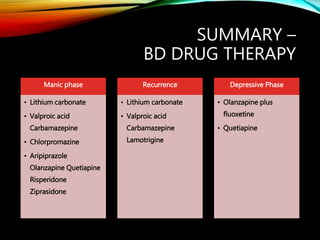
SUMMARY –
BD DRUG THERAPY
Manic phase
• Lithium carbonate
• Valproic acid
Carbamazepine
• Chlorpromazine
• Aripiprazole
Olanzapine Quetiapine
Risperidone
Ziprasidone
Recurrence
• Lithium carbonate
• Valproic acid
Carbamazepine
Lamotrigine
Depressive Phase
• Olanzapine plus
fluoxetine
• Quetiapine
SUMMARY –
NOVEL TARGETS FOR BD
• Inositol monophosphatase inhibition
• Glycogen synthase kinase 3 (GSK-3) inhibition
• Protein kinase C (PKC) inhibition
• Brain-derived neurotrophic factor (BDNF) modulation
• Enhanced Bcl2 expression
• Effects on oxidative stress
• Modulation of glutamatergic transmission
CONCLUSION
• During the last decade, significant progress in the knowledge
of BD has been achieved, mainly derived from the better
understanding of the molecular targets of mood stabilizing
drugs.
• These advances have led to identify a various novel targets
which will potentially result in improved therapeutics for BD
in the near future.
Mood Stabilisers (Antimanic drugs)

Mood Stabilisers (Antimanic drugs)

  • 1.
    MOOD STABILIZERS Dr. AshutoshTiwari III yr. PG Resident Pharmacology Department SAIMS, Indore 04/02/16
  • 2.
    BIPOLAR DISORDER • Bipolardisorder – also known as manic-depressive illness • In bipolar affective disorder, patients suffer episodes of mania, hypomania and depression, classically with periods of normal mood in between.
  • 3.
    BIPOLAR DISORDER Symptoms of bipolar disorderin the manic phase:  excitement  hyperactivity  impulsivity  disinhibition  aggression  diminished need for sleep  psychotic symptoms in some patients  cognitive impairment
  • 4.
    BIPOLAR DISORDER Symptoms of bipolar disorderin depression  depressed mood  diurnal variation  sleep disturbance  anxiety  sometimes, psychotic symptoms
  • 5.
    BIPOLAR DISORDER • Thecause of the mood swings:  preponderance of catecholamine-related activity  Drugs that increase this activity  exacerbate mania  Drugs that reduce activity of dopamine or norepinephrine  relieve mania  Acetylcholine or glutamate may also be involved
  • 6.
    MOOD STABILIZER: DEFINITION • Anymedication that is able to decrease vulnerability to subsequent episodes of mania or depression; and not exacerbate the current episode or maintenance phase of treatment.
  • 8.
    MOOD STABILISING AGENTS •Lithium • Lithium carbonate: • used for acute-phase illness • for prevention of recurrent manic and depressive episodes • Li+ is the only mood stabilizer with data on suicide reduction in bipolar patients • Anticonvulsants: • Carbamazepine and Valproic acid: • for the treatment of acute mania and for prevention of its recurrence. • Lamotrigine: • for prevention of recurrence (maintenance)
  • 9.
    MOOD STABILISING AGENTS • Antipsychotics: •Aripiprazole, chlorpromazine, olanzapine, quetiapine, risperidone, and ziprasidone: • for treatment of the manic phase of bipolar disorder. • Olanzapine plus fluoxetine in combination and quetiapine: • for treatment of bipolar depression.
  • 10.
    LITHIUM - MOA •acts by suppressing the formation of second messengers involved in neurotransmitter signal transduction. • Lithium reduces the formation of inositol triphosphate (IP3) by inhibiting myoinositol-1-phosphatase, an enzyme in the inositol phosphate pathway. • This enzyme participates in the regeneration of inositol and the inositol phosphate precursors to IP3.
  • 11.
    LITHIUM – MOA • Lithiuminhibits inositol monophosphatase (IMPase) and other important enzymes in the normal recycling of membrane phosphoinositides, including conversion of IP2 (inositol diphosphate) to IP1 (inositol monophosphate) and the conversion of IP1 to inositol • valproate & carbamazepine also decrease intracellular inositol concentrations
  • 12.
    Li inhibits inositolmonophosphatase (IMPase) ↓ free inositol ↓phosphatidylinositol-4,5-bisphosphate (PIP2) [the membrane precursor of IP3 & DAG] depletion of the second-messenger source PIP2 causes reduced release of IP3 and DAG decreased activity of PIP2 dependent pathways (which are markedly increased during manic episode) Mood Stabilising action MECHANISM OF ACTION
  • 13.
    LITHIUM – THERAPEUTIC USES •Bipolar Disorder : Treatment of acute mania and the prevention of recurrences of bipolar illness  Lithium has slow onset of action (5-7 days are required for clinical effect)   antipsychotic drugs (chlorpromazine or haloperidol) with or without potent benzodiazepines (lorazepam or clonazepam) is preferred.  After mania is controlled, the antipsychotic drug may be stopped and lithium continued as maintenance therapy  Sodium valproate can provide rapid antimanic effects. Once patients are stabilized and cooperative, Lithium can be introduced for longer-term mood stabilization, or valproate may be continued alone
  • 14.
    LITHIUM – THERAPEUTIC USES Now a days valproate, aripiprazole, olanzapine, quetiapine, risperidone, and ziprasidone are preferred over lithium  Advantages of Sodium Valproate over Lithium:  Rapid action  Wider therapeutic index  Better tolerability
  • 15.
    VALPROIC ACID • nowa first line in treatment of acute mania (as valproate acts faster than lithium) • an alternative to antipsychotic ± benzodiazepine. • effective in patients not responding to lithium or not tolerating it • mixed states and rapid cycling forms of bipolar disorder may be more responsive to valproate than to lithium
  • 16.
    VALNOCTAMIDE • Valproic acidis widely used to treat BP; however, its teratogenicity limits its use in women of childbearing potential. • Valnoctamide is an analogue of valproic acid, but it does not undergo biotransformation to the corresponding free acid. • It also lacks key structural groups (eg, free carboxylic groups) implicated in valproic acid’s teratogenicity. • In preclinical studies, valnoctamide was markedly less teratogenic than valproic acid.
  • 17.
    CARBAMAZEPINE • may beused to treat acute mania and also for prophylactic therapy • may be used alone or, in refractory patients, in combination with lithium
  • 18.
    LAMOTRIGINE • used inthe maintenance therapy of bipolar disorder • effective in reducing the frequency of recurrent depressive cycles and in the treatment of bipolar depression • not effective in treating acute mania • Lamotrigine can be combined with lithium to improve its efficacy
  • 19.
    ATYPICAL ANTIPSYCHOTICS • Olanzapine, risperidone,aripiprazole, quetiapine, with or without a BZD, are now the first line drugs for control of acute mania • for urgent parenteral therapy, but older neuroleptics are still the most effective. • Aripiprazole has emerged as the favoured drug for treatment of mania in bipolar disorder • used both as monotherapy as well as adjuvant to lithium or valproate • prevents mania, but not depressive episodes • Lack of metabolic effects, favours its long-term use
  • 20.
    ATYPICAL ANTIPSYCHOTICS • Olanzapine isalso approved for maintenance therapy of bipolar disorder. • both manic and depressive phases are suppressed • not considered suitable for long-term therapy due to higher risk of weight gain, hyperglycaemia, etc. • Quetiapine is effective in bipolar depression. • Combination of an atypical antipsychotic with valproate or lithium has demonstrated high efficacy in acute phases as well as for maintenance therapy of bipolar disorder.
  • 21.
    ANTIDEPRESSANTS • Depression thatpersists after lithium therapy is started may respond to antidepressant drugs. • The use of antidepressants especially TCAs in patients who have bipolar disorder and are not taking lithium or another mood-stabilizing drug can precipitate a manic response in many patients. • (switch phenomenon)
  • 22.
    Novel targets for treatmentof Bipolar disorder
  • 23.
    GLYCOGEN SYNTHASE KINASE3 (GSK-3) INHIBITION • GSK-3 is a kinase involved in the regulation of cell apoptosis and synaptic plasticity. • Its inhibition influences gene transcription, with consequent anti-apoptotic effect • GSK-3 inhibition increases hippocampal levels of β-catenin, a function implicated in mood stabilization • Both Li+ and valproate treatment inhibit the activity of glycogen synthase kinase-3β (GSK-3β)
  • 24.
    PKC INHIBITION • Excessiveintracellular calcium influx results in increased apoptosis, destruction of the cytoskeleton and intensification of the oxidative stress. • These disturbances in calcium mobilization are related in part to hyperactivity of PKC, which has been demonstrated among subjects with BD • Therefore, drugs whose putative effects implicate PKC inhibition may play a role in the treatment of BD • Lithium and valproic acid inhibit PKC • Tamoxifen, an estrogen antagonist (used in the treatment of breast cancer) can cross BBB & has strong inhibitory effects on PKC. • Omega-3 fatty acids might represent a protective factor against the development of BD • Omega-3 Fatty acids act as antagonists of the PI-PKC signal transduction pathway, ultimately inhibiting PKC activity
  • 25.
    BRAIN-DERIVED NEUROTROPHIC FACTOR (BDNF)MODULATION • BDNF and other neurotrophic factors increase cell survival by direct neurotrophic effect and apoptosis inhibition. • There is evidence suggesting that chronic administration of lithium and valproate may result in increased transcription of those factors
  • 26.
    ENHANCED BCL2 EXPRESSION •Bcl2 is a protein with marked anti-apoptotic activity • involved in neuronal protection and regeneration • In rats, chronic administration of lithium and valproate is associated with increased levels of Bcl2 in the prefrontal areas • atypical antipsychotic olanzapine is associated with increased expression of Bcl2 in the prefrontal cortex and hippocampus of rodents • Pramipexole is a dopamine agonist currently approved for treatment of Parkinson’s disease and is associated with increased expression of Bcl2 in the frontal cortex
  • 27.
    EFFECTS ON OXIDATIVESTRESS • increased oxidative stress contributes to cellular death in BD patients. • Lithium and olanzapine have demonstrated antioxidant properties, which may be partially responsible for their neuroprotective effects
  • 28.
    MODULATION OF GLUTAMATERGIC TRANSMISSION •the effects of lithium on the glutamatergic system are possibly related to its neuroprotective properties. • Glutamate is the main excitatory neurotransmitter in the CNS • involved in the regulation of several processes, including neuronal and synaptic plasticity, memory consolidation and information processing • increases in the glutamatergic transmission in the CNS bring about prolonged synaptic excitatory transmission, with excitotoxicity and, ultimately, neuronal death. • Lithium is believed to inhibit the calcium influx that results from the stimulation of the NMDA glutamate receptors and lamotrigine, a well-established mood stabilizer, blocks the neuronal sodium channels, thus inhibiting the release of glutamate
  • 29.
    MODULATION OF GLUTAMATERGIC TRANSMISSION •drugs with demonstrated effect on the glutamatergic system may be of particular interest in the management of the depressive phase of BD. • Memantine: low-affinity antagonist of the NMDA glutamate receptor, currently FDA- approved for treatment of Alzheimer’s disease. • Amantadine: non- competitive antagonist of the NMDA receptor currently approved for treatment of Parkinson’s disease. • Ketamine: an anesthetic, ketamine is a high-affinity NMDA antagonist seems effective in the treatment of resistant unipolar depression • Riluzole: a potent glumatergic modulator, currently FDA- approved for treatment of amiotrophic lateral sclerosis
  • 30.
    RAMELTEON • Ramelteon actsas a selective agonist of melatonin receptors (MT1 & MT2) within the suprachiasmatic nucleus (SCN). • Although approved to treat insomnia, Ramelteon is under investigation as a treatment for bipolar disorder. • It’s efficacy for bipolar maintenance and mania attenuation may be because of its ability to regulate circadian rhythms. • Regulation of circadian rhythms minimizes likelihood of mood stability and prevents cycling to a manic and/or depressive state.
  • 31.
    SUMMARY – BD DRUGTHERAPY Manic phase • Lithium carbonate • Valproic acid Carbamazepine • Chlorpromazine • Aripiprazole Olanzapine Quetiapine Risperidone Ziprasidone Recurrence • Lithium carbonate • Valproic acid Carbamazepine Lamotrigine Depressive Phase • Olanzapine plus fluoxetine • Quetiapine
  • 32.
    SUMMARY – NOVEL TARGETSFOR BD • Inositol monophosphatase inhibition • Glycogen synthase kinase 3 (GSK-3) inhibition • Protein kinase C (PKC) inhibition • Brain-derived neurotrophic factor (BDNF) modulation • Enhanced Bcl2 expression • Effects on oxidative stress • Modulation of glutamatergic transmission
  • 33.
    CONCLUSION • During thelast decade, significant progress in the knowledge of BD has been achieved, mainly derived from the better understanding of the molecular targets of mood stabilizing drugs. • These advances have led to identify a various novel targets which will potentially result in improved therapeutics for BD in the near future.