
ANTI-EPILEPTICS
Dr Mangala
MBBS, MD
EPILEPSY :
Group of disorders of CNS characterized by recurrent
seizures, with or without characteristic body
movements(convulsions) often accompanied by
episodes of unconsciousness and / or amnesia.
SEIZURES :
Transient alteration in behavior because of disordered
firing of groups of neurons in the brain.
Causes :
Idiopathic
Trauma during child birth
Head injury
Febrile seizures
Brain tumors
Meningitis
TYPES OF SEIZURES :
 Partial seizures: Unilateral localized origin in the
brain. (cortical/temporal lobe)
• Simple partial
• Complex partial
• Partial with secondarily generalized seizures
 Generalized seizures : Diffuse origin involving both
the hemispheres of the brain.
• Absence seizures
• Myoclonic seizures
• Atonic seizures
• Tonic- clonic seizures
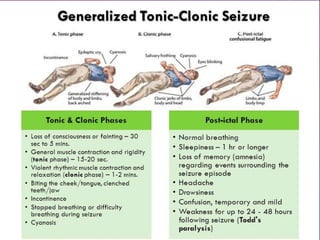
 GENERALIZED TONIC CLONIC SEIZURES :
• Also called Grand mal , GTCS, major
epilepsy.
• Usual sequence aura – cry –
unconsciousness and patient falls.
• Tonic spasm of all the body muscles,
clonic jerking followed by prolonged
sleep and depression of all CNS
functions.
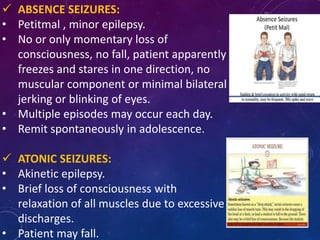
 ABSENCE SEIZURES:
• Petitmal , minor epilepsy.
• No or only momentary loss of
consciousness, no fall, patient apparently
freezes and stares in one direction, no
muscular component or minimal bilateral
jerking or blinking of eyes.
• Multiple episodes may occur each day.
• Remit spontaneously in adolescence.
 ATONIC SEIZURES:
• Akinetic epilepsy.
• Brief loss of consciousness with
relaxation of all muscles due to excessive
discharges.
• Patient may fall.
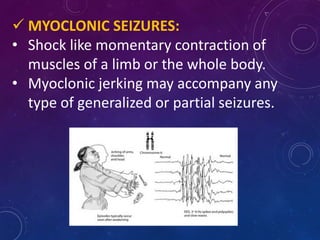
 MYOCLONIC SEIZURES:
• Shock like momentary contraction of
muscles of a limb or the whole body.
• Myoclonic jerking may accompany any
type of generalized or partial seizures.
PARTIAL SEIZURES :
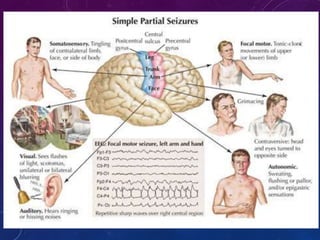
 SIMPLE PARTIAL SEIZURES:
• Sudden onset
• Unilateral clonic jerking of a group of muscles or a
limb lasting 30 -90 sec, or localized sensory
distrubances such as pin pricks, visual auditory
hallucinations, etc. depending on the area of the
cortex involved.
• Patient remains conscious and aware of the attack.
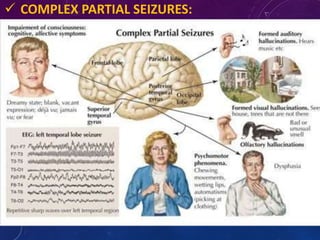
 COMPLEX PARTIAL SEIZURES:
• Attacks are bizarre and confused behaviour, dream
like state and purposeless movements, or even
walking unaware, emotional changes lasting 1- 2
mins along with impairment of consciousness.
• Patient cannot recollect the attack.
• An aura often precedes.
• Seizure focus – temporal lobe – Temporal lobe
epilepsy.
 SIMPLE PARTIAL OR COMPLEX PARTIAL
SEIZURES SECONDARILY GENERALIZED :
• Partial seizures occurs first and evolves
into generalized tonic clonic seizures with
loss of consciousness.
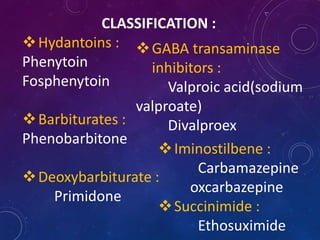
CLASSIFICATION :
Hydantoins :
Phenytoin
Fosphenytoin
Barbiturates :
Phenobarbitone
Deoxybarbiturate :
Primidone
GABA transaminase
inhibitors :
Valproic acid(sodium
valproate)
Divalproex
Iminostilbene :
Carbamazepine
oxcarbazepine
Succinimide :
Ethosuximide
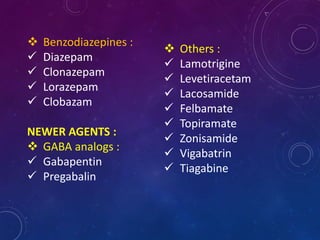
 Benzodiazepines :
 Diazepam
 Clonazepam
 Lorazepam
 Clobazam
NEWER AGENTS :
 GABA analogs :
 Gabapentin
 Pregabalin
 Others :
 Lamotrigine
 Levetiracetam
 Lacosamide
 Felbamate
 Topiramate
 Zonisamide
 Vigabatrin
 Tiagabine
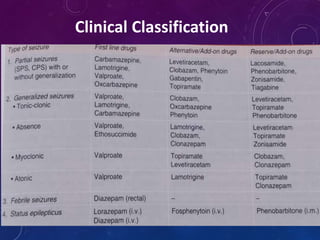
Clinical Classification
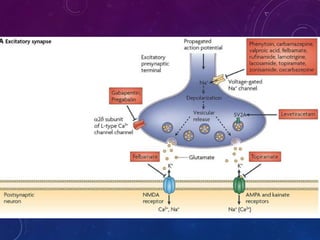
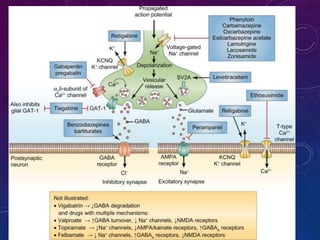
MECHANISM OF ACTION OF ANTI EPILEPTICS :
 Blockade of Sodium channel or prolongation of their
inactive state delaying the recovery.
E.g. : Phenytoin, Carbamazepine, Lamotrigine
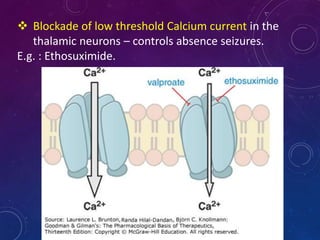
 Blockade of low threshold Calcium current in the
thalamic neurons – controls absence seizures.
E.g. : Ethosuximide.
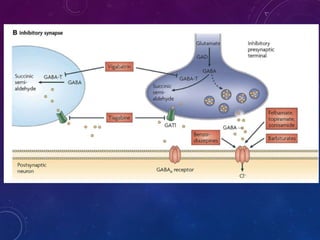
Enhancing GABA mediated inhibition :
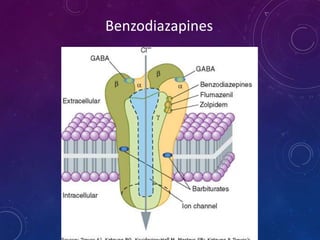
 Acting on GABA receptors :
Benzodiazepines, barbiturates
 Inhibiting GABA metabolism : Valproic
acid, vigabatrin
Blocking excitatory glutamate receptors :
Topiramate
Benzodiazapines
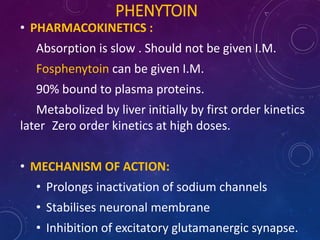
PHENYTOIN
• PHARMACOKINETICS :
Absorption is slow . Should not be given I.M.
Fosphenytoin can be given I.M.
90% bound to plasma proteins.
Metabolized by liver initially by first order kinetics
later Zero order kinetics at high doses.
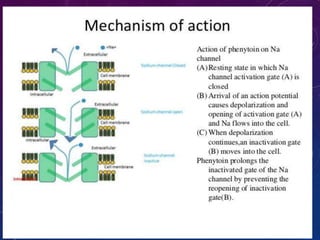
• MECHANISM OF ACTION:
• Prolongs inactivation of sodium channels
• Stabilises neuronal membrane
• Inhibition of excitatory glutamanergic synapse.
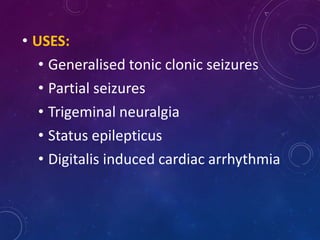
• USES:
• Generalised tonic clonic seizures
• Partial seizures
• Trigeminal neuralgia
• Status epilepticus
• Digitalis induced cardiac arrhythmia
PHENYTOIN INTERACTIONS:
• Phenytoin induces microsomal enzymes &
enhances the breakdown of OC pills, Vit D and
steroids thereby reducing the effectiveness of co-
administered drugs.
• Phenytoin – carbamazepine : mutual induction of
metabolism and reduced plasma conc. of both
drugs .
• Chloramphenicol, INH, warfarin – Phenytoin:
these drug inhibit metabolism of phenytoin 
increase in plasma conc. of phenytoin 
phenytoin toxicity.
PHENYTOIN
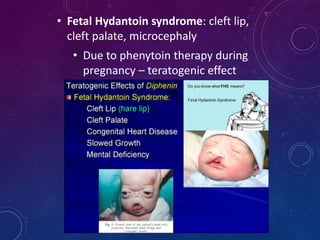
• ADVERSE EFFECTS:
• Gum hypertrophy
• Hirsutism
• Acne
• Hypersensitivity reactions
• Hyperglycaemia
• Megaloblastic anaemia
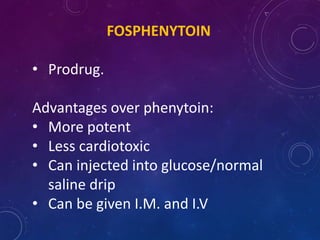
• Fetal Hydantoin syndrome: cleft lip,
cleft palate, microcephaly
• Due to phenytoin therapy during
pregnancy – teratogenic effect
FOSPHENYTOIN
• Prodrug.
Advantages over phenytoin:
• More potent
• Less cardiotoxic
• Can injected into glucose/normal
saline drip
• Can be given I.M. and I.V
PHENOBARBITONE
MECHANISM OF ACTION :
• Enhancing the activation of GABA A receptors
Facilitating the GABA mediated opening of
chloride ion channels.
• It is also an enzyme inducer.
USES :
• Generalized tonic clonic seizures.
• Partial seizures
CARBAMAZEPINE
• MECHANISM OF ACTION :
• Prolongs inactivation of voltage gated sodium
channels
• Stabilises neuronal membrane
• USES:
• GTCS
• Partial seizures
• Trigeminal neuralgia
• Acute mania & bipolar disorder
CARBAMAZEPINE
Drug interactions:
• Phenytoin, Phenobarbitone, sodium valproate,
OC pills – Carbamazepine induces the
metabolism & reduces the effects of these drugs.
• INH, Erythromycin – inhibit carbamazepine
metabolism leading to its toxicity.
CARBAMAZEPINE
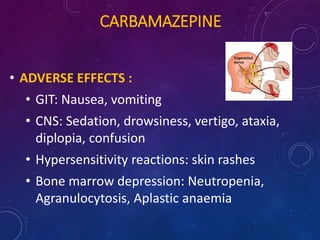
• ADVERSE EFFECTS :
• GIT: Nausea, vomiting
• CNS: Sedation, drowsiness, vertigo, ataxia,
diplopia, confusion
• Hypersensitivity reactions: skin rashes
• Bone marrow depression: Neutropenia,
Agranulocytosis, Aplastic anaemia
OXCARBAZEPINE :
Similar to carbamazepine.
Lesser side effects.
ETHOSUXIMIDE
• PHARMACOKINETICS : Absorption – oral route,
metabolized by liver.
• MECHANISM OF ACTION :
• Inhibits T-type of Calcium currents in thalamic neurons.
• USES :
• Drug of choice for Absence seizures
• ADVERSE EFFECTS :
• GIT: Nausea, vomiting
• Hypersensitivity reactions
• Bone marrow depression
SODIUM VALPROATE
• MECHANISM OF ACTION:
• Prolongs inactivation of voltage gated Na+
channels
• Inhibits T-type of Ca2+ currents in thalamic
neurons
• Increases the synthesis of GABA by increased
activity of GABA synthase.
• Decreases the metabolism of GABA
transaminase enzyme.
SODIUM VALPROATE
• USES:
• Absence seizures
• GTCS
• Partial seizures
• Mania and bipolar disorder
• Prophylaxis of migraine.
SODIUM VALPROATE
• ADVERSE EFFECTS :
• GIT: Nausea, vomiting
• CNS: sedation, ataxia, tremors
• Hypersensitivity reactions
• Alopecia
• Pancreatitis
• Fulminant hepatitis
• Neural tube defects
• Polycystic ovarian disease (PCOD) in young
girls.
SODIUM VALPROATE
• Sodium Valproate- Phenytoin: Phenytoin
toxicity due to displacement interaction.
• Valproate inhibits the degradation of
phenobarbitone & increases its conc.
• Valproate – Carbamazepine: when
administered simultaneously increased
incidence of teratogenicity.
GABAPENTIN
MECHANISM OF ACTION :
• Increases the activity of GABA in
brain by
• Increasing its synthesis
• Decreasing its metabolism
• USES:
• Simple & partial complex seizures
• Post herpetic neuralgia
• Bipolar disorder
• Diabetic neuropathy
• Prophylaxis of migraine
• ADVERSE EFFECTS :
Headache, sedation, ataxia, fatigue
LAMOTRIGINE
• MECHANISM OF ACTION :
• Prolongs inactivation of voltage gated sodium
channels
• USES:
• GTCS
• Simple & complex partial seizures
• Absence seizures
• Myoclonic seizures
• ADVERSE EFFECTS:
Nausea, vomiting, headache, ataxia, sedation, skin
rashes
• LEVETIRACETAM :
• Acts on synaptic vesicle glycoprotein 2A (SV2A)
• Effective against partial and secondarily
generalized seizures.
• Add on drug in refractory partial seizures.
• TOPIRAMATE :
• Monosaccharide
• Blocks the sodium channels, enhance GABA A
receptor currents.
• Partial and generalized seizures.
OTHER CLINICAL USES
• Several antiseizure drugs are effective in the
management of bipolar affective disorders
• Valproic acid used as a first-line drug
• Carbamazepine and lamotrigine also
used
• Carbamazepine and oxcarbazepine are the
drug of choice for trigeminal neuralgia
OTHER CLINICAL USES…..
• Gabapentin and Pregabalin in neuropathic
pain (e.g postherpetic neuralgia)
• Migraine Prophylaxis: Phenytoin,
Topiramate
• Children born of mothers taking
anticonvulsant drugs have an increased risk of
congenital malformations
• Valproic acid cause Neural tube defects (eg,
spina bifida)
• Carbamazepine cause craniofacial anomalies
and spina bifida
• Phenytoin cause fetal hydantoin syndrome
TERATOGENICITY
OVERDOSAGE TOXICITY
• CNS depressants, and respiratory
depression may occur with overdosage
• Flumazenil may be used in
benzodiazepine overdose
LIFE-THREATENING TOXICITY
• Fatal hepatotoxicity has occurred with
valproic acid (children younger than 2 yr
has high risk)
• Lamotrigine has caused skin rashes and
life-threatening Stevens-Johnson
syndrome or toxic epidermal necrolysis
• Zonisamide may also cause severe skin
reactions
WITHDRAWAL
• Abrupt withdrawal may increased
seizure frequency and severity
• Withdrawal should be gradual
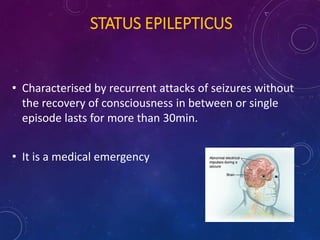
STATUS EPILEPTICUS
• Characterised by recurrent attacks of seizures without
the recovery of consciousness in between or single
episode lasts for more than 30min.
• It is a medical emergency
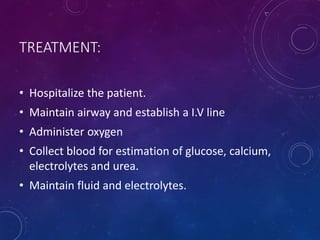
TREATMENT:
• Hospitalize the patient.
• Maintain airway and establish a I.V line
• Administer oxygen
• Collect blood for estimation of glucose, calcium,
electrolytes and urea.
• Maintain fluid and electrolytes.
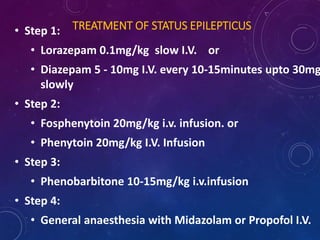
TREATMENT OF STATUS EPILEPTICUS• Step 1:
• Lorazepam 0.1mg/kg slow I.V. or
• Diazepam 5 - 10mg I.V. every 10-15minutes upto 30mg
slowly
• Step 2:
• Fosphenytoin 20mg/kg i.v. infusion. or
• Phenytoin 20mg/kg I.V. Infusion
• Step 3:
• Phenobarbitone 10-15mg/kg i.v.infusion
• Step 4:
• General anaesthesia with Midazolam or Propofol I.V.
Thank you