Atypical Antipsychotics
DR.MURUGAVEL.V
Junior resident
Institute of Mental Health
Chennai
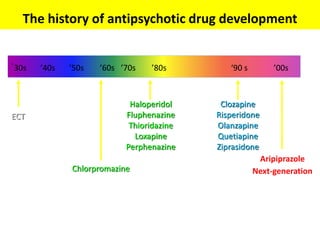
’30s ’40s ’50s ’60s ’70s ’80s ‘90 s ’00s
ECT
Chlorpromazine
Haloperidol
Fluphenazine
Thioridazine
Loxapine
Perphenazine
Second-generation
antipsychotics
Clozapine
Risperidone
Olanzapine
Quetiapine
Ziprasidone
Aripiprazole
Next-generation
The history of antipsychotic drug development
• Often based on chance findings that bear little relationship to
the intellectual background driving observation.
• In 1891, Paul Ehrlich observed the antimalarial effects of
methylene blue, a phenothiazine derivative.
• Later, the phenothiazines were developed for their
antihistaminergic properties.
• In 1951, Laborit and Huguenard administered the aliphatic
phenothiazine, chlorpromazine, to patients for its potential
anesthetic effects during surgery.
• thereafter, Hamon et al. and Delay et al. extended the use of
this treatment in psychiatric patients and serendipitously
uncovered its antipsychotic activity.
The history of antipsychotic drug development
• Between 1954 and 1975,
about 15 antipsychotic drugs
were introduced in the United
States and about 40
throughout the world.
• Thereafter, there was a hiatus
in the development of
antipsychotics until the
introduction of clozapine
treatment in the United States
in 1990 opened the era of
"atypical" antipsychotic drugs.
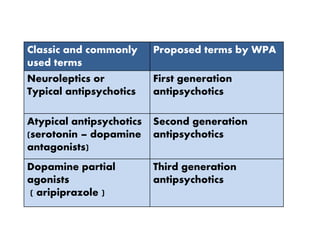
Classic and commonly
used terms
Proposed terms by WPA
Neuroleptics or
Typical antipsychotics
First generation
antipsychotics
Atypical antipsychotics
(serotonin – dopamine
antagonists)
Second generation
antipsychotics
Dopamine partial
agonists
( aripiprazole )
Third generation
antipsychotics
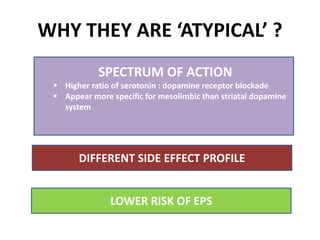
WHY THEY ARE ‘ATYPICAL’ ?
LOWER RISK OF EPS
SPECTRUM OF ACTION
 Higher ratio of serotonin : dopamine receptor blockade
 Appear more specific for mesolimbic than striatal dopamine
system
DIFFERENT SIDE EFFECT PROFILE
characteristics
• Low D2 receptor blocking effects
• Reduced risk of extrapyramidal side effects.
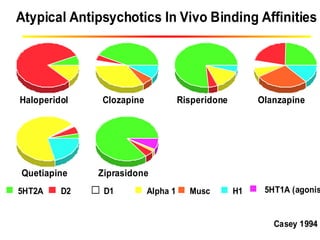
HaloperidolHaloperidol ClozapineClozapine RisperidoneRisperidone OlanzapineOlanzapine
QuetiapineQuetiapine ZiprasidoneZiprasidone
5HT2A D2 D1 Alpha 1 Musc H1 5HT1A (agonis
Casey 1994Casey 1994
Atypical Antipsychotics In Vivo Binding Affinities
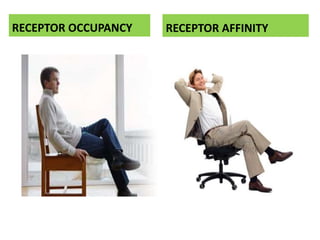
RECEPTOR OCCUPANCY RECEPTOR AFFINITY
Differences among Antipsychotic Drugs
• Clozapine
– binds more to D4, 5-HT2, α1, and histamine H1 receptors
than to either D2 or D1 receptors
• Risperidone
– about equally potent in blocking D2 and 5-HT2 receptors
• Olanzapine
– more potent as an antagonist of 5-HT2 receptors
– lesser potency at D1, D2, and α1 receptors
• Quetiapine
– lower-potency compound with relatively similar
antagonism of 5-HT2, D2, α1, and α2 receptors
Differences among Antipsychotic Drugs
• Clozapine, olanzapine and quetiapine
– potent inhibitors of H1 histamine receptors
– consistent with their sedative properties
• Aripiprazole
– partial agonist effects at D2 and 5-HT1A receptors
Classification
MARTA (multi acting receptor targeted agents)
• clozapine, olanzapine, quetiapine
SDA (serotonin-dopamine antagonists)
• risperidone, ziprasidone, sertindole
Selective D2/D3 antagonists
• sulpiride, amisulpiride
Available drugs (only 10 are FDA Approved)
 Amisulpride
 Aripiprazole
 Asenapine
 Blonanserin
 Clotiapine
 Clozapine
 Iloperidone
 Lurasidone
 Mosapramine
 Olanzapine
 Paliperidone
 Perospirone
 Quetiapine
 Remoxipride
 Risperidone
 Sertindole
 Sulpiride
 Ziprasidone
 Zotepine
Therapeutic indications
Schizophrenia and schizoaffective disorder – acute and
chronic psychoses- first line treatment all SGA’s except
clozapine
Mood disorders
 acute mania- all SGA’s except clozapine
 acute bipolar depression- quetiapine,fluoxetine
combination
 Maintanence therapy-
aripiprazole,olanzapine,quetiapine
 Adjunctive therapy in treatment depression-
olanzapine,fluoxetine combination
Other indications:
 Exhibits outwardly aggressive and violent behaviour
 Autistic spectrum disorder
 Tourettes syndrome
 Huntington’s disease
 Lesch Nyhan Syndrome
 Along with methylphenidate/dextroamphetamine in
children with ADHD.
 Psychosis secondary to head trauma, dementia,
treatment resistant
 Decreases the risk of suicide and water intoxication in
patients with schizophrenia
Common Side Effects
• Extra pyramidal symptoms
• Orthostatic hypotension
• Sedation
• Weight gain
• Metabolic syndrome
• QT prolongation
• Anti cholinergic side effects
• Hyper prolactinemia
• Sexual dysfunction
• Increased risk of Pneumonia
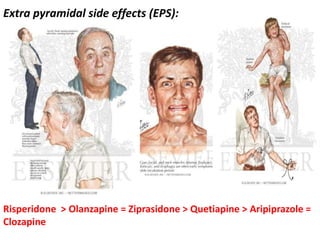
Extra pyramidal side effects (EPS):
Risperidone > Olanzapine = Ziprasidone > Quetiapine > Aripiprazole =
Clozapine
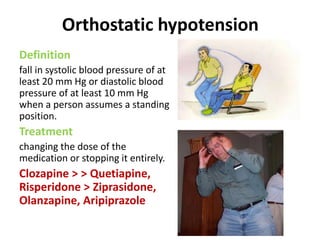
Orthostatic hypotension
Definition
fall in systolic blood pressure of at
least 20 mm Hg or diastolic blood
pressure of at least 10 mm Hg
when a person assumes a standing
position.
Treatment
changing the dose of the
medication or stopping it entirely.
Clozapine > > Quetiapine,
Risperidone > Ziprasidone,
Olanzapine, Aripiprazole
SEDATION
Due to histaminergic
receptor (H1) blockade in
CNS
Clozapine > > Olanzapine,
Quetiapine > Risperidone,
Ziprasidone, Aripiprazole
WEIGHT GAIN
Clozapine = Olanzapine > Quetiapine, Risperidone >
Ziprasidone, Aripiprazole
Suggested
mechanisms were
• 5 HT 2C antagonism,
• H 1 blockade
• Hyperprolactinemia
and
• Increased serum
leptin.
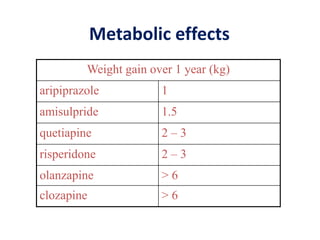
Metabolic effects
Weight gain over 1 year (kg)
aripiprazole 1
amisulpride 1.5
quetiapine 2 – 3
risperidone 2 – 3
olanzapine > 6
clozapine > 6
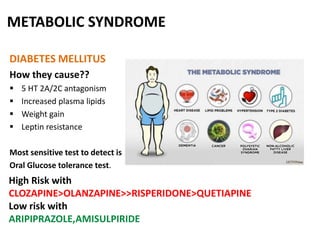
METABOLIC SYNDROME
DIABETES MELLITUS
How they cause??
 5 HT 2A/2C antagonism
 Increased plasma lipids
 Weight gain
 Leptin resistance
Most sensitive test to detect is
Oral Glucose tolerance test.
High Risk with
CLOZAPINE>OLANZAPINE>>RISPERIDONE>QUETIAPINE
Low risk with
ARIPIPRAZOLE,AMISULPIRIDE
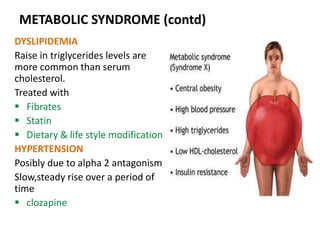
METABOLIC SYNDROME (contd)
DYSLIPIDEMIA
Raise in triglycerides levels are
more common than serum
cholesterol.
Treated with
 Fibrates
 Statin
 Dietary & life style modification
HYPERTENSION
Posibly due to alpha 2 antagonism
Slow,steady rise over a period of
time
 clozapine
Insulin resistance
• Prediabetes (impaired fasting glycaemia) has
~ 10% chance / year of converting to Type 2
diabetes
• Prediabetes plus olanzapine has a 6-fold
increased risk of conversion
• If olanzapine is stopped 70% will revert back
to prediabetes
Stroke in the elderly
• Risperidone and olanzapine associated with
increased risk of stroke when used for behavioural
control in dementia
• Risperidone 3.3% vs 1.2% for placebo
• Olanzapine 1.3% vs 0.4% for placebo
• However, large observational database studies
– Show no increased risk of stroke compared with typical
antipsychotics or untreated dementia patients
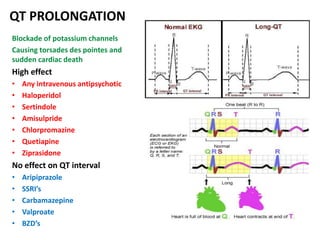
QT PROLONGATION
Blockade of potassium channels
Causing torsades des pointes and
sudden cardiac death
High effect
• Any intravenous antipsychotic
• Haloperidol
• Sertindole
• Amisulpride
• Chlorpromazine
• Quetiapine
• Ziprasidone
No effect on QT interval
• Aripiprazole
• SSRI’s
• Carbamazepine
• Valproate
• BZD’s
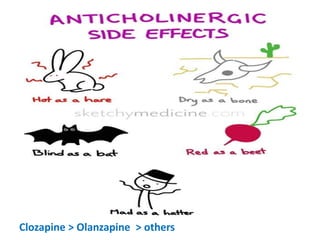
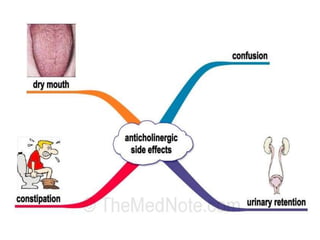
Clozapine > Olanzapine > others
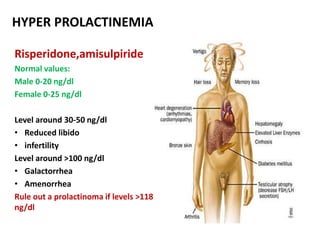
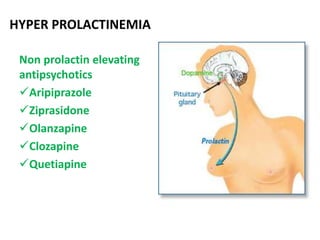
HYPER PROLACTINEMIA
Risperidone,amisulpiride
Normal values:
Male 0-20 ng/dl
Female 0-25 ng/dl
Level around 30-50 ng/dl
• Reduced libido
• infertility
Level around >100 ng/dl
• Galactorrhea
• Amenorrhea
Rule out a prolactinoma if levels >118
ng/dl
HYPER PROLACTINEMIA
Non prolactin elevating
antipsychotics
Aripiprazole
Ziprasidone
Olanzapine
Clozapine
Quetiapine
SEXUAL DYSFUNCTION
result from decreased dopaminergic activity centrally and alpha
adrenergic blockade peripherally.
Risperidone>olanzapine>quetiapine>aripiprazole
Increased susceptiblity to pneumonia
60% more risk in elderly population
Highest in the first week of treatment
Seen only with SGA’s
Possible mechanisms:
• Sedation
• Drymouth
• Effects on immune response
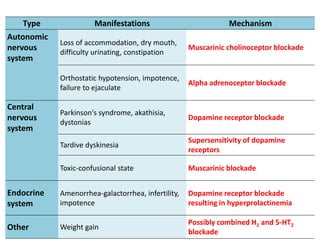
Type Manifestations Mechanism
Autonomic
nervous
system
Loss of accommodation, dry mouth,
difficulty urinating, constipation
Muscarinic cholinoceptor blockade
Orthostatic hypotension, impotence,
failure to ejaculate
Alpha adrenoceptor blockade
Central
nervous
system
Parkinson's syndrome, akathisia,
dystonias
Dopamine receptor blockade
Tardive dyskinesia
Supersensitivity of dopamine
receptors
Toxic-confusional state Muscarinic blockade
Endocrine
system
Amenorrhea-galactorrhea, infertility,
impotence
Dopamine receptor blockade
resulting in hyperprolactinemia
Other Weight gain
Possibly combined H1 and 5-HT2
blockade
RISPERIDONE
 Benzisoxazole
 Undergoes first pass metabolism
 Peak plasma level levels – 1 hr (parent compound) ,
3 hrs for metabolite
 Combined half life 20 hrs (once daily dosing)
 Antagonist of serotonin 5HT2A, dopamine D2, α1, α2
adrenergic histamine H1 receptors.
Side effects
 Weight gain
 Anxiety
 Nausea
 Dizziness, hyperkinesias, somnolence,
 Vomiting
 Rhinitis
 Erectile dysfunction
 Dosages – Initially 1-2 mg/day , raised to 4 mg/
day
 Only SDA available in depot formation IM
injection every 2 weeks (25mg,50mg or 75 mg)
 Drug interactions – Paroxetine and Fluoxetine
(blocks the formation of
RISPERIDONE’S active metabolite)
 RISPERIDONE + SSRI – significant elevation of
prolactin - galactorrohea and breast
enlargement
OLANZAPINE
 85% absorbed from the GI tract
 40% is inactivated by first pass metabolism
 Peak concentration - 5hrs
 Half life - 31 hrs
 5HT2A ,D1, D4, α1 ,5HT1A , muscarinic M1 through M5
and H1 receptors
SIDE EFFECTS
 Weight gain
 Somnolence
 Dry mouth
 Dizziness
 Constipation
 Dyspepsia
 Increased appetite
 Akathisia
 tremor
 Periodic assessment of “blood sugar” and
“transaminase”.
 Increased stroke among patients with dementia
 DOSAGES – initial dose for treatment of psychosis –
5-10 mg , acute mania- 10-15 mg.
 Start 5-10 mg , raise to 10 mg per day
 30-40 mg in treatment resistant cases.
• Drug interactions
– FLUVOXAMINE and CIMETIDINE – increases
– CARBAMAZEPINE and PHENYTOIN - decreases
QUETIAPINE
 DIBENZOTHIAZEPINE
 Rapidly absorbed from GI tracts
 Peak plasma concentration – 1-2 hrs
 Steady half life – 7 hrs (2- 3 dosing per day)
 lower-potency compound with relatively similar
antagonism of 5-HT2, D2, α1, and α2 receptors .
Side effects
 somnolence, postural hypotension and dizziness –
most common side effect.
 Least likely to cause extra pyramidal side effects. –
used in Parkinsonism who develop DOPAMINE
AGONIST induced psychosis.
 Moderate weight gain
 Small rise in heart rate , constipation and transient
rise in liver transaminases can occur.
• DOSAGES – available in 25, 50 and 200 mg.
• Schizophrenia – target of 400 mg/ day
• Mania & BPD – 800 & 300 mg respectively
• Insomnia – 25- 300 mg at night
ZIPRASIDONE
 BENZOTHIAZOLYL PIPERAZINE
 Peak plasma concentration- 2-6 hrs
 Terminal half life at steady state – 5-10 hrs
 Bioavailability doubles when taken along with food.
 Blocks 5HT2A and D2 receptors , antagonist 5HT1D,
5HT2C, D3,D4,α1 and H1 receptors.
Agonist activity at 5HT1A receptor
Serotonin reuptake inhibitor
Nor epinephrine reuptake inhibitor
SIDE EFFECTS:
 somnolence, headache, dizziness , nausea , light
headedness, prolongation of QTc interval.
 avoided in patients with cardiac arrythmias.
• Dosages – 20,40, 60 ,80 mg.
• IM comes single use daily 20mg/ml vial
• Oral ziprasidone initiated at 40 mg a day.
• Efficacy in the range of 80-160 mg/day.
• High as much as 240 mg are being used.
Clozapine
 DIBENZODIAZEPINE
 Rapidly absorbed
 Plasma level – 2 hrs
 Steady state – less than one week if twice daily
dosing is used.
 Half life – 12 hrs
 Antagonist of 5HT2A , D1,D3,D4 and α receptors.
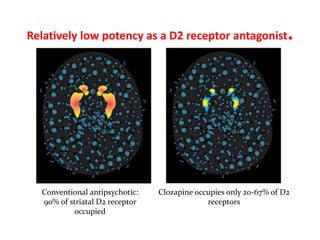
Conventional antipsychotic:
90% of striatal D2 receptor
occupied
Clozapine occupies only 20-67% of D2
receptors
Relatively low potency as a D2 receptor antagonist.
• Special indications
– patients with severe tardive dyskinesia.
– Patients prone to develop EPS
– Treatment resistant schizophrenia
– Severe treatment resistant mania
– Severe psychotic depression
– Idiopathic Parkinson’s disease
– Huntington’s disease
– Suicidal patients with schizophrenia and schizoaffective
disorder.
– Pervasive developmental disorder
– Autism of childhood
– OCD (rarely)
Side effects
– Sedation
– Dizziness
– Syncope
– Tachycardia
– Hypotension
– ECG changes
– Fatigue
– Weight gain
– constipation
– Anticholinergic
effects
– SIALORROHEA
– AGRANULOCYTOSIS
– SEIZURES
– MYOCARDITIS
Clozapine-associated seizures occur most often at
doses greater than 600 mg /day.
AGRANULOCYTOSIS
 Leucocyte and differential blood count normal before
starting
 Monitor counts every week for 6 months, then at least
2 weeks once for 1 year
 At least Q 4 weeks after count stable for 1 year (for 4
more weeks after discontinuation)
 If leucocyte count < 3000/mm3, or if ANC < 1500/mm3,
discontinue immediately and refer to hematologist
 Patient should report immediately symptoms of
infection, esp. flu-like illness (fever, sore throat)
Dosages
– Initial dosage is 25 mg one or 2 times daily
although conservative initial dosage is 12,5 mg
daily.
– Raised gradually to 25 mg a day for every 2-3 days
to 300 mg divided doses
– 900 mg can be used.
– Plasma conc greater than 350 ng/mL is likely hood
for better response.
Drug interactions
 Clozapine + (carbamazepine, phenytoin,
propulthiouracil, sulfonamides, captopril) causes
bone marrow suppression.
 Clozapine+ Lithium – increases the risk of
seizures, confusion and movement disorders.
 Clozapine+ Paroxetine – precipitate clozapine
associated neutropenia.
Amisulpiride
 Half life 12 hours
 Bioavailablity 48 %
 Primarily a D2,D3 antagonist
 Antidepressant effect due to 5HT7 blockade
 Used in treating schizophrenia,bipolar disorder
 Also in dysthymia
Side effects
 Extrapyramidal side effects
 Insomnia
 Hypersalivation
 Nausea
 Headache
 Hyperactivity
 Anxiety
 Vomiting
 Hyperprolactinaemia
Very less chances of causing
• sedation
• Tardive dyskinesia
• Blood dyscrasias
Amisulpride's use is contraindicated in
 Phaeochromocytoma
 Concomitant Prolactin dependent tumours e.g. Prolactinoma,
Breast cancer
 Movement disorders (e.g. Parkinson's disease and dementia with
lewy bodies)
 Lactation
 Children before the onset of puberty
 Amisulpride should not be used in conjunction with drugs that
prolong the QT interval and Torsades de Pointes is common in
overdose.
 TCAs are very dangerous
 Amisulpride is moderately dangerous
 SSRIs are modestly dangerous.
ARIPRIPAZOLE
 QUINOLONE DERIVATIVE
 Well absorbed reaching peak levels of 3- 5 hrs
 Half life is about 75 hrs
Other SDA’s
• Bifeprunox - partial dopamine agonist.
– Treatment of schizophrenia
– GI side effects are most common.
• Paliperidone – major active metabolite of
risperidone.
– Recommended dose of 6mg per day with 3-12
mg/day.
SGA vs FGA
NO EVIDENCE OF
BENEFIT OF SGA’S OVER
FGA’S IN
IMPROVEMENT OF
NEGATIVE SYMPTOMS
CLOZAPINE HAS SHOWN
CLEAR UTILITY IN
TREATMENT RESISTANT
SCHIZOPHRENIA
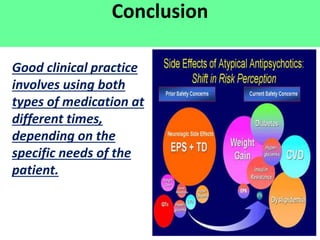
Conclusion
Good clinical practice
involves using both
types of medication at
different times,
depending on the
specific needs of the
patient.
THANK YOU

Atypical antipsychotics

  • 1.
  • 2.
    ’30s ’40s ’50s’60s ’70s ’80s ‘90 s ’00s ECT Chlorpromazine Haloperidol Fluphenazine Thioridazine Loxapine Perphenazine Second-generation antipsychotics Clozapine Risperidone Olanzapine Quetiapine Ziprasidone Aripiprazole Next-generation The history of antipsychotic drug development
  • 3.
    The history ofantipsychotic drug development • Often based on chance findings that bear little relationship to the intellectual background driving observation. • In 1891, Paul Ehrlich observed the antimalarial effects of methylene blue, a phenothiazine derivative. • Later, the phenothiazines were developed for their antihistaminergic properties. • In 1951, Laborit and Huguenard administered the aliphatic phenothiazine, chlorpromazine, to patients for its potential anesthetic effects during surgery. • thereafter, Hamon et al. and Delay et al. extended the use of this treatment in psychiatric patients and serendipitously uncovered its antipsychotic activity.
  • 4.
    The history ofantipsychotic drug development • Between 1954 and 1975, about 15 antipsychotic drugs were introduced in the United States and about 40 throughout the world. • Thereafter, there was a hiatus in the development of antipsychotics until the introduction of clozapine treatment in the United States in 1990 opened the era of "atypical" antipsychotic drugs.
  • 5.
    Classic and commonly usedterms Proposed terms by WPA Neuroleptics or Typical antipsychotics First generation antipsychotics Atypical antipsychotics (serotonin – dopamine antagonists) Second generation antipsychotics Dopamine partial agonists ( aripiprazole ) Third generation antipsychotics
  • 6.
    WHY THEY ARE‘ATYPICAL’ ? LOWER RISK OF EPS SPECTRUM OF ACTION  Higher ratio of serotonin : dopamine receptor blockade  Appear more specific for mesolimbic than striatal dopamine system DIFFERENT SIDE EFFECT PROFILE
  • 7.
    characteristics • Low D2receptor blocking effects • Reduced risk of extrapyramidal side effects. HaloperidolHaloperidol ClozapineClozapine RisperidoneRisperidone OlanzapineOlanzapine QuetiapineQuetiapine ZiprasidoneZiprasidone 5HT2A D2 D1 Alpha 1 Musc H1 5HT1A (agonis Casey 1994Casey 1994 Atypical Antipsychotics In Vivo Binding Affinities
  • 8.
  • 9.
    Differences among AntipsychoticDrugs • Clozapine – binds more to D4, 5-HT2, α1, and histamine H1 receptors than to either D2 or D1 receptors • Risperidone – about equally potent in blocking D2 and 5-HT2 receptors • Olanzapine – more potent as an antagonist of 5-HT2 receptors – lesser potency at D1, D2, and α1 receptors • Quetiapine – lower-potency compound with relatively similar antagonism of 5-HT2, D2, α1, and α2 receptors
  • 10.
    Differences among AntipsychoticDrugs • Clozapine, olanzapine and quetiapine – potent inhibitors of H1 histamine receptors – consistent with their sedative properties • Aripiprazole – partial agonist effects at D2 and 5-HT1A receptors
  • 11.
    Classification MARTA (multi actingreceptor targeted agents) • clozapine, olanzapine, quetiapine SDA (serotonin-dopamine antagonists) • risperidone, ziprasidone, sertindole Selective D2/D3 antagonists • sulpiride, amisulpiride
  • 12.
    Available drugs (only10 are FDA Approved)  Amisulpride  Aripiprazole  Asenapine  Blonanserin  Clotiapine  Clozapine  Iloperidone  Lurasidone  Mosapramine  Olanzapine  Paliperidone  Perospirone  Quetiapine  Remoxipride  Risperidone  Sertindole  Sulpiride  Ziprasidone  Zotepine
  • 13.
    Therapeutic indications Schizophrenia andschizoaffective disorder – acute and chronic psychoses- first line treatment all SGA’s except clozapine Mood disorders  acute mania- all SGA’s except clozapine  acute bipolar depression- quetiapine,fluoxetine combination  Maintanence therapy- aripiprazole,olanzapine,quetiapine  Adjunctive therapy in treatment depression- olanzapine,fluoxetine combination
  • 14.
    Other indications:  Exhibitsoutwardly aggressive and violent behaviour  Autistic spectrum disorder  Tourettes syndrome  Huntington’s disease  Lesch Nyhan Syndrome  Along with methylphenidate/dextroamphetamine in children with ADHD.  Psychosis secondary to head trauma, dementia, treatment resistant  Decreases the risk of suicide and water intoxication in patients with schizophrenia
  • 15.
    Common Side Effects •Extra pyramidal symptoms • Orthostatic hypotension • Sedation • Weight gain • Metabolic syndrome • QT prolongation • Anti cholinergic side effects • Hyper prolactinemia • Sexual dysfunction • Increased risk of Pneumonia
  • 16.
    Extra pyramidal sideeffects (EPS): Risperidone > Olanzapine = Ziprasidone > Quetiapine > Aripiprazole = Clozapine
  • 17.
    Orthostatic hypotension Definition fall insystolic blood pressure of at least 20 mm Hg or diastolic blood pressure of at least 10 mm Hg when a person assumes a standing position. Treatment changing the dose of the medication or stopping it entirely. Clozapine > > Quetiapine, Risperidone > Ziprasidone, Olanzapine, Aripiprazole
  • 18.
    SEDATION Due to histaminergic receptor(H1) blockade in CNS Clozapine > > Olanzapine, Quetiapine > Risperidone, Ziprasidone, Aripiprazole
  • 19.
    WEIGHT GAIN Clozapine =Olanzapine > Quetiapine, Risperidone > Ziprasidone, Aripiprazole Suggested mechanisms were • 5 HT 2C antagonism, • H 1 blockade • Hyperprolactinemia and • Increased serum leptin.
  • 20.
    Metabolic effects Weight gainover 1 year (kg) aripiprazole 1 amisulpride 1.5 quetiapine 2 – 3 risperidone 2 – 3 olanzapine > 6 clozapine > 6
  • 21.
    METABOLIC SYNDROME DIABETES MELLITUS Howthey cause??  5 HT 2A/2C antagonism  Increased plasma lipids  Weight gain  Leptin resistance Most sensitive test to detect is Oral Glucose tolerance test. High Risk with CLOZAPINE>OLANZAPINE>>RISPERIDONE>QUETIAPINE Low risk with ARIPIPRAZOLE,AMISULPIRIDE
  • 22.
    METABOLIC SYNDROME (contd) DYSLIPIDEMIA Raisein triglycerides levels are more common than serum cholesterol. Treated with  Fibrates  Statin  Dietary & life style modification HYPERTENSION Posibly due to alpha 2 antagonism Slow,steady rise over a period of time  clozapine
  • 23.
    Insulin resistance • Prediabetes(impaired fasting glycaemia) has ~ 10% chance / year of converting to Type 2 diabetes • Prediabetes plus olanzapine has a 6-fold increased risk of conversion • If olanzapine is stopped 70% will revert back to prediabetes
  • 24.
    Stroke in theelderly • Risperidone and olanzapine associated with increased risk of stroke when used for behavioural control in dementia • Risperidone 3.3% vs 1.2% for placebo • Olanzapine 1.3% vs 0.4% for placebo • However, large observational database studies – Show no increased risk of stroke compared with typical antipsychotics or untreated dementia patients
  • 25.
    QT PROLONGATION Blockade ofpotassium channels Causing torsades des pointes and sudden cardiac death High effect • Any intravenous antipsychotic • Haloperidol • Sertindole • Amisulpride • Chlorpromazine • Quetiapine • Ziprasidone No effect on QT interval • Aripiprazole • SSRI’s • Carbamazepine • Valproate • BZD’s
  • 26.
  • 28.
    HYPER PROLACTINEMIA Risperidone,amisulpiride Normal values: Male0-20 ng/dl Female 0-25 ng/dl Level around 30-50 ng/dl • Reduced libido • infertility Level around >100 ng/dl • Galactorrhea • Amenorrhea Rule out a prolactinoma if levels >118 ng/dl
  • 29.
    HYPER PROLACTINEMIA Non prolactinelevating antipsychotics Aripiprazole Ziprasidone Olanzapine Clozapine Quetiapine
  • 30.
    SEXUAL DYSFUNCTION result fromdecreased dopaminergic activity centrally and alpha adrenergic blockade peripherally. Risperidone>olanzapine>quetiapine>aripiprazole
  • 31.
    Increased susceptiblity topneumonia 60% more risk in elderly population Highest in the first week of treatment Seen only with SGA’s Possible mechanisms: • Sedation • Drymouth • Effects on immune response
  • 32.
    Type Manifestations Mechanism Autonomic nervous system Lossof accommodation, dry mouth, difficulty urinating, constipation Muscarinic cholinoceptor blockade Orthostatic hypotension, impotence, failure to ejaculate Alpha adrenoceptor blockade Central nervous system Parkinson's syndrome, akathisia, dystonias Dopamine receptor blockade Tardive dyskinesia Supersensitivity of dopamine receptors Toxic-confusional state Muscarinic blockade Endocrine system Amenorrhea-galactorrhea, infertility, impotence Dopamine receptor blockade resulting in hyperprolactinemia Other Weight gain Possibly combined H1 and 5-HT2 blockade
  • 33.
    RISPERIDONE  Benzisoxazole  Undergoesfirst pass metabolism  Peak plasma level levels – 1 hr (parent compound) , 3 hrs for metabolite  Combined half life 20 hrs (once daily dosing)  Antagonist of serotonin 5HT2A, dopamine D2, α1, α2 adrenergic histamine H1 receptors.
  • 34.
    Side effects  Weightgain  Anxiety  Nausea  Dizziness, hyperkinesias, somnolence,  Vomiting  Rhinitis  Erectile dysfunction
  • 35.
     Dosages –Initially 1-2 mg/day , raised to 4 mg/ day  Only SDA available in depot formation IM injection every 2 weeks (25mg,50mg or 75 mg)  Drug interactions – Paroxetine and Fluoxetine (blocks the formation of RISPERIDONE’S active metabolite)  RISPERIDONE + SSRI – significant elevation of prolactin - galactorrohea and breast enlargement
  • 36.
    OLANZAPINE  85% absorbedfrom the GI tract  40% is inactivated by first pass metabolism  Peak concentration - 5hrs  Half life - 31 hrs  5HT2A ,D1, D4, α1 ,5HT1A , muscarinic M1 through M5 and H1 receptors
  • 37.
    SIDE EFFECTS  Weightgain  Somnolence  Dry mouth  Dizziness  Constipation  Dyspepsia  Increased appetite  Akathisia  tremor
  • 38.
     Periodic assessmentof “blood sugar” and “transaminase”.  Increased stroke among patients with dementia  DOSAGES – initial dose for treatment of psychosis – 5-10 mg , acute mania- 10-15 mg.  Start 5-10 mg , raise to 10 mg per day  30-40 mg in treatment resistant cases.
  • 39.
    • Drug interactions –FLUVOXAMINE and CIMETIDINE – increases – CARBAMAZEPINE and PHENYTOIN - decreases
  • 40.
    QUETIAPINE  DIBENZOTHIAZEPINE  Rapidlyabsorbed from GI tracts  Peak plasma concentration – 1-2 hrs  Steady half life – 7 hrs (2- 3 dosing per day)  lower-potency compound with relatively similar antagonism of 5-HT2, D2, α1, and α2 receptors .
  • 41.
    Side effects  somnolence,postural hypotension and dizziness – most common side effect.  Least likely to cause extra pyramidal side effects. – used in Parkinsonism who develop DOPAMINE AGONIST induced psychosis.  Moderate weight gain  Small rise in heart rate , constipation and transient rise in liver transaminases can occur.
  • 42.
    • DOSAGES –available in 25, 50 and 200 mg. • Schizophrenia – target of 400 mg/ day • Mania & BPD – 800 & 300 mg respectively • Insomnia – 25- 300 mg at night
  • 43.
    ZIPRASIDONE  BENZOTHIAZOLYL PIPERAZINE Peak plasma concentration- 2-6 hrs  Terminal half life at steady state – 5-10 hrs  Bioavailability doubles when taken along with food.  Blocks 5HT2A and D2 receptors , antagonist 5HT1D, 5HT2C, D3,D4,α1 and H1 receptors.
  • 44.
    Agonist activity at5HT1A receptor Serotonin reuptake inhibitor Nor epinephrine reuptake inhibitor SIDE EFFECTS:  somnolence, headache, dizziness , nausea , light headedness, prolongation of QTc interval.  avoided in patients with cardiac arrythmias.
  • 45.
    • Dosages –20,40, 60 ,80 mg. • IM comes single use daily 20mg/ml vial • Oral ziprasidone initiated at 40 mg a day. • Efficacy in the range of 80-160 mg/day. • High as much as 240 mg are being used.
  • 46.
    Clozapine  DIBENZODIAZEPINE  Rapidlyabsorbed  Plasma level – 2 hrs  Steady state – less than one week if twice daily dosing is used.  Half life – 12 hrs  Antagonist of 5HT2A , D1,D3,D4 and α receptors.
  • 47.
    Conventional antipsychotic: 90% ofstriatal D2 receptor occupied Clozapine occupies only 20-67% of D2 receptors Relatively low potency as a D2 receptor antagonist.
  • 48.
    • Special indications –patients with severe tardive dyskinesia. – Patients prone to develop EPS – Treatment resistant schizophrenia – Severe treatment resistant mania – Severe psychotic depression – Idiopathic Parkinson’s disease – Huntington’s disease – Suicidal patients with schizophrenia and schizoaffective disorder. – Pervasive developmental disorder – Autism of childhood – OCD (rarely)
  • 49.
    Side effects – Sedation –Dizziness – Syncope – Tachycardia – Hypotension – ECG changes – Fatigue – Weight gain – constipation – Anticholinergic effects – SIALORROHEA – AGRANULOCYTOSIS – SEIZURES – MYOCARDITIS
  • 50.
    Clozapine-associated seizures occurmost often at doses greater than 600 mg /day.
  • 51.
    AGRANULOCYTOSIS  Leucocyte anddifferential blood count normal before starting  Monitor counts every week for 6 months, then at least 2 weeks once for 1 year  At least Q 4 weeks after count stable for 1 year (for 4 more weeks after discontinuation)  If leucocyte count < 3000/mm3, or if ANC < 1500/mm3, discontinue immediately and refer to hematologist  Patient should report immediately symptoms of infection, esp. flu-like illness (fever, sore throat)
  • 52.
    Dosages – Initial dosageis 25 mg one or 2 times daily although conservative initial dosage is 12,5 mg daily. – Raised gradually to 25 mg a day for every 2-3 days to 300 mg divided doses – 900 mg can be used. – Plasma conc greater than 350 ng/mL is likely hood for better response.
  • 53.
    Drug interactions  Clozapine+ (carbamazepine, phenytoin, propulthiouracil, sulfonamides, captopril) causes bone marrow suppression.  Clozapine+ Lithium – increases the risk of seizures, confusion and movement disorders.  Clozapine+ Paroxetine – precipitate clozapine associated neutropenia.
  • 54.
    Amisulpiride  Half life12 hours  Bioavailablity 48 %  Primarily a D2,D3 antagonist  Antidepressant effect due to 5HT7 blockade  Used in treating schizophrenia,bipolar disorder  Also in dysthymia
  • 55.
    Side effects  Extrapyramidalside effects  Insomnia  Hypersalivation  Nausea  Headache  Hyperactivity  Anxiety  Vomiting  Hyperprolactinaemia Very less chances of causing • sedation • Tardive dyskinesia • Blood dyscrasias
  • 56.
    Amisulpride's use iscontraindicated in  Phaeochromocytoma  Concomitant Prolactin dependent tumours e.g. Prolactinoma, Breast cancer  Movement disorders (e.g. Parkinson's disease and dementia with lewy bodies)  Lactation  Children before the onset of puberty  Amisulpride should not be used in conjunction with drugs that prolong the QT interval and Torsades de Pointes is common in overdose.  TCAs are very dangerous  Amisulpride is moderately dangerous  SSRIs are modestly dangerous.
  • 57.
    ARIPRIPAZOLE  QUINOLONE DERIVATIVE Well absorbed reaching peak levels of 3- 5 hrs  Half life is about 75 hrs
  • 58.
    Other SDA’s • Bifeprunox- partial dopamine agonist. – Treatment of schizophrenia – GI side effects are most common. • Paliperidone – major active metabolite of risperidone. – Recommended dose of 6mg per day with 3-12 mg/day.
  • 59.
    SGA vs FGA NOEVIDENCE OF BENEFIT OF SGA’S OVER FGA’S IN IMPROVEMENT OF NEGATIVE SYMPTOMS CLOZAPINE HAS SHOWN CLEAR UTILITY IN TREATMENT RESISTANT SCHIZOPHRENIA
  • 60.
    Conclusion Good clinical practice involvesusing both types of medication at different times, depending on the specific needs of the patient.
  • 61.