Antipsychotics/Major Tranqullizers/Neuroleptics
                      or
           Anti-schizophrenic drugs
  • Psychosis
     1.   Schizophrenia
     2.   Organic Psychosis
     3.   Affective disorders
     –    Depression
     –    Mania
     –    Manic depressive illness (bipolar
          depression)
• Etiology:
• Not known
• Strong but incomplete genetic pre-
  disposition
• (1st degree relatives – 10%)
• (2nd monozygotic twin – 50%)
• suicide is about 10% cases

• Symptoms:
• 1.Positive symptom: (result from
  Neurochemical Abnormality)
• Increase do paminergic transmission
  Respond well to Rx
• Delusions often paranoid in nature:
    cann’t be rectified by reasoning
• Hallucinations:

•   They may be
•   Visual
•   Auditory
•   Tactile (CD Canine bugs)
•
• c) Thought disorder
•    Wild train of thoughts
• Draw irrational conclusion with the feeling
  that thoughts are inserted or withdrawn by
  an outside agency.
• Usually not like to be interfered, flight of
  ideas from one thought to other thought.
• Broadcast of ideas.
• d) Abnormal stereotypical behavior,
• 2. Negative Symptoms:
•
• Result from brain atrophy
• Don’t respond / less responsive to R x
• Emotional blunting.
• Poor Socialization
• Cognitive deficit (Dementia)
• more irritable.
• Neurochemical Basis:
• 1) Dopamine Theory (Hypothesis by
  Carlson         awarded noble prize in
  year 2000)
•     Dopamine hyperactivity in mesolimbic
  and mesocortical pathway & amygdale
   positive symptoms of schizophrenia.
•    Proof:
• Dopamine agonists – produce these
  symptoms of schizophrenia e.g. central
• 2) Glutamate Theory
  – Glutamate and DA exert excitatory and
    inhibitory effects respectively on GABA ergic
    striatal neurons which project to thalamus and
    constitute “sensory Gate”
  – Glutamate or DA disables the gate and
    uninhibited sensory input reaches the cortex.
  – Glutamate NMDA (N-methyl deaspartate)
    recep antagonists:
• Phencyclidine
• 3) 5 – HT Theories:
• 5 – HT dysfxn
• LSD & 5-HT2 Receptors agonists produced
  schizophrenia like syndrome.
•
• Mostly of Anti-psychotics in addition to
  affect dopamine also back serotonin
  receptors.
• 4) Current views:
•    Combination of DA hyperactivity with 5-
  HT & glutamate dysfxn.
• 1) Nigrostriatal Pathway:
• 75% of dopamine in brain
• 2) Mesolimbic mesocortical pathway:
• Projects from neurons near S.N        to
  limbic system & Neocortex
• Behaviorial effects
• Hyperactivity leads to schizophrenia.
• 3) Tuberoinfundibular (Tubrohypophy
  Scal) Pathway:
• 4) Medullary Perventricular Pathway:
• From neurons of Motor Nucleus of Vagus
  ___ Periventricular nuclei
• Eating behavior
• Satiety center ____ Bolimia Nervosa
• Appetite Cetre _____ Anorexiz Nervosa
• 5) Incertohypothalamic Pathway:
• From medial zone incerta to
  hypothalamus & Amygdala.
• 5) Incertohypothalamic Pathway:
• From medial zone incerta to
  hypothalamus & Amygdala.
• Sexual drive, Microvasculatory function
  and temperature regulation.
• 6) Many local Dopaminergic Neurons in
  olfactory cortex & retina:
• 7) Dopaminergic transmission in
  periphery:
Classification of Antipsychotic
                          Drugs
A: Classical / Typical Antipsychotics.
I. Phenothiazine Derivatives
   a. Aliphatic compounds
            Chlorpromazine
            Promazine.
   b. Piperazine Compounds:
            Procholorperazine
            Perphenazine
           Fluphenazine
           Trifluperazine
   c. Piperidine Compounds:
            Thioridazine        
             Mesoridazine
• A) Classical Typical Nemoleptics:
• 1. Phenothiazines:
•            a) Aliphatic Comp
• (less potent,sedation & weight gain)
     • Chloropromazine (Largactil)
     • Promazine
     • Triflupromazine
• b) Piperidine Derivative:
    • Thioridazine (Melleril, less potent, Anti-Cholinergic)
    • Mesoridazine (metabolite of thioridazine)
• c) Piperazine Derivative:
         •   Fluphenazine (I/V preparation, slowly, release,
         •   Perphenazine
         •   Trifluperazine
         •   Prochlorperazine
         •   Thioperazine                  .
• 2. Thioxanthines: (also available as
  DEPOT preparation)
• Thiothixene
• Clopenthixol
• Flupenthixol
• Chlorprothixine
•   3. Butyrophenones:
•   Haloperiodol
•   Properidol
•   Benperidol
• B) Atypical Neuroleptics:
•    Their mechanism of action is different
  from anti-psychotics
• Loxapine
• Clozapoine (Clozanl) ___ A/E: Cause
  agranulocyctosis ___ Bone marrow
  depression
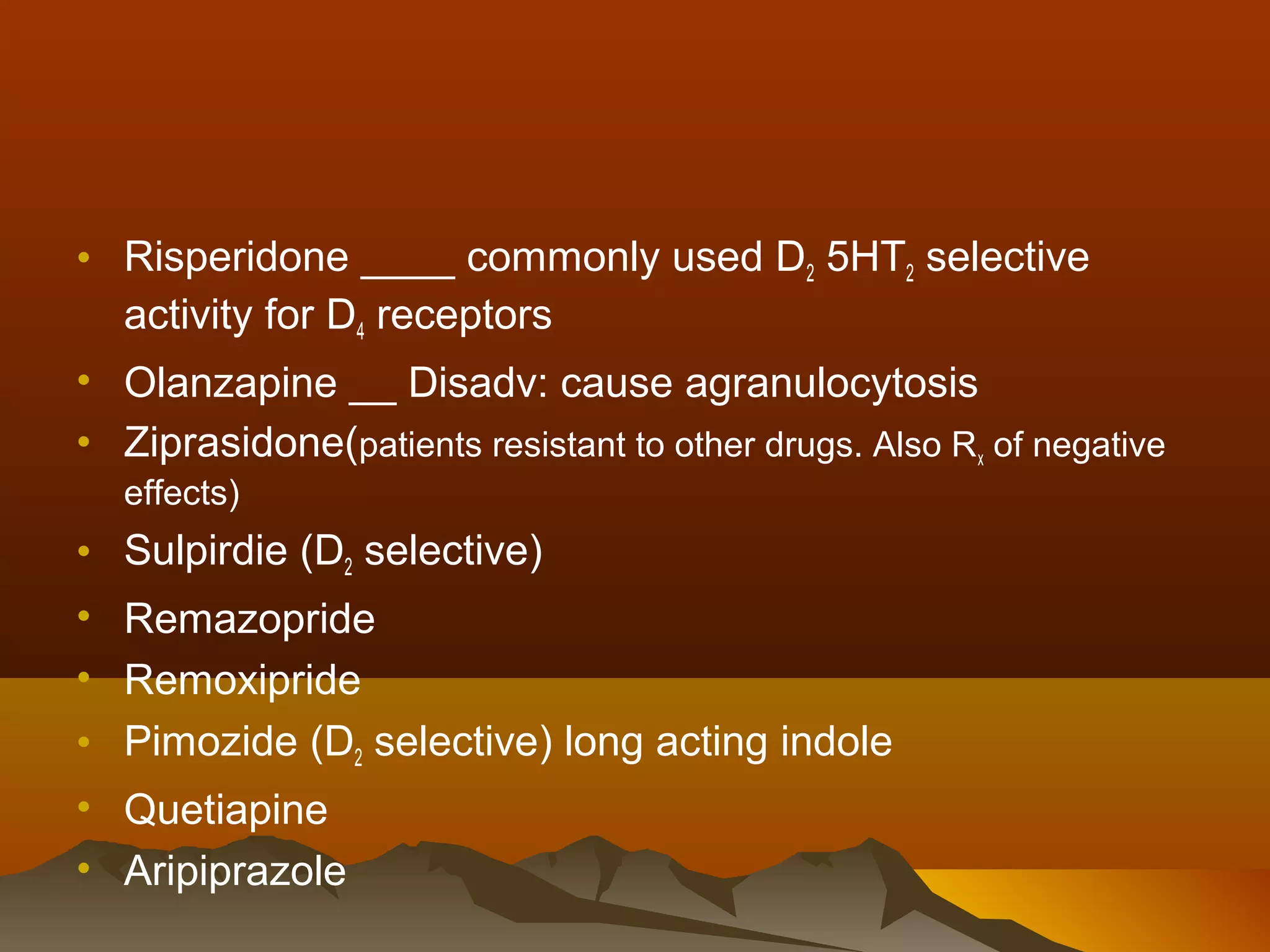
• Risperidone ____ commonly used D2 5HT2 selective
  activity for D4 receptors
• Olanzapine __ Disadv: cause agranulocytosis
• Ziprasidone(patients resistant to other drugs. Also Rx of negative
  effects)
• Sulpirdie (D2 selective)
• Remazopride
• Remoxipride
• Pimozide (D2 selective) long acting indole
• Quetiapine
• Aripiprazole
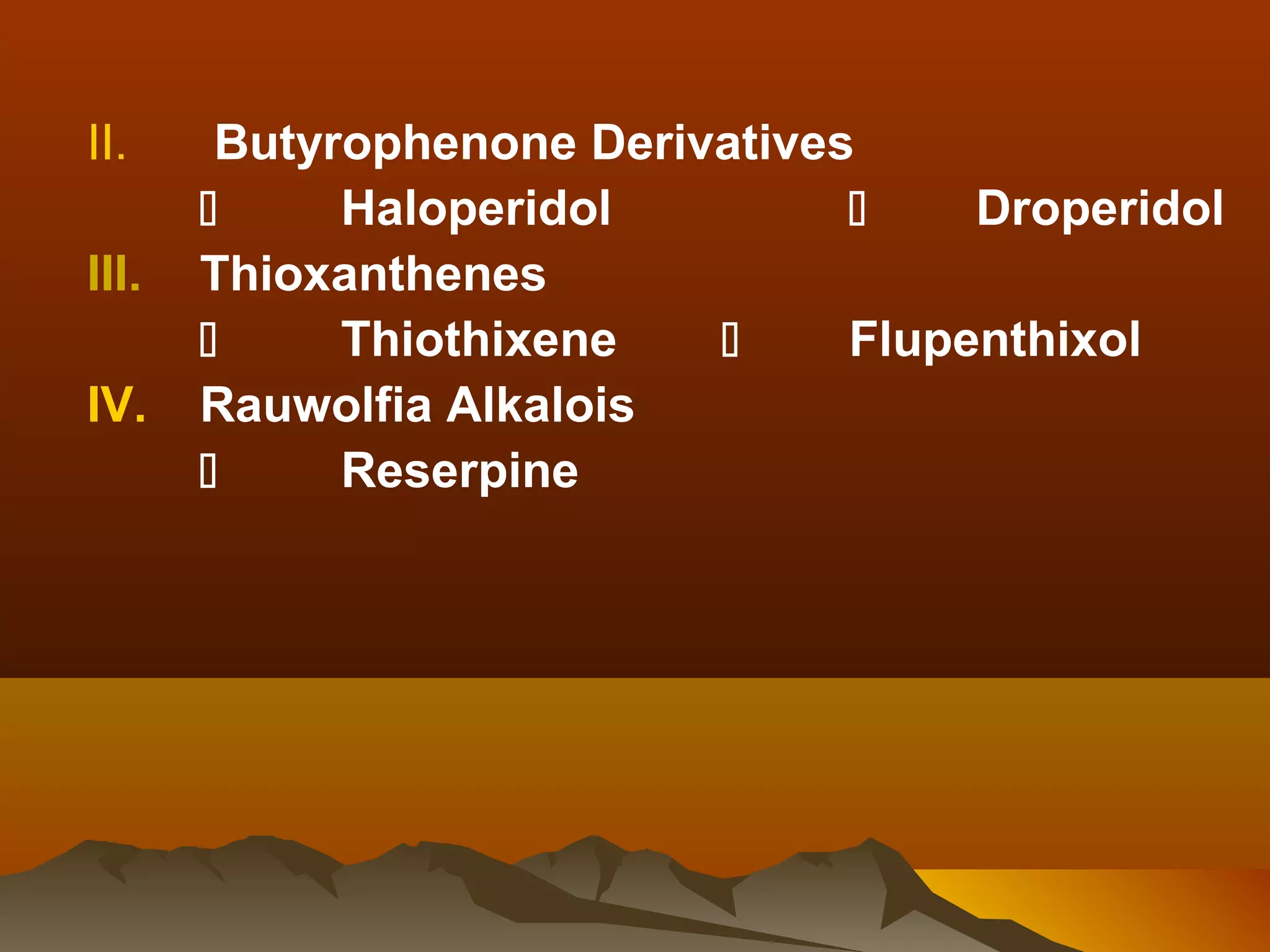
II.     Butyrophenone Derivatives
            Haloperidol             Droperidol
III.   Thioxanthenes
            Thiothixene        Flupenthixol
IV.    Rauwolfia Alkalois
            Reserpine
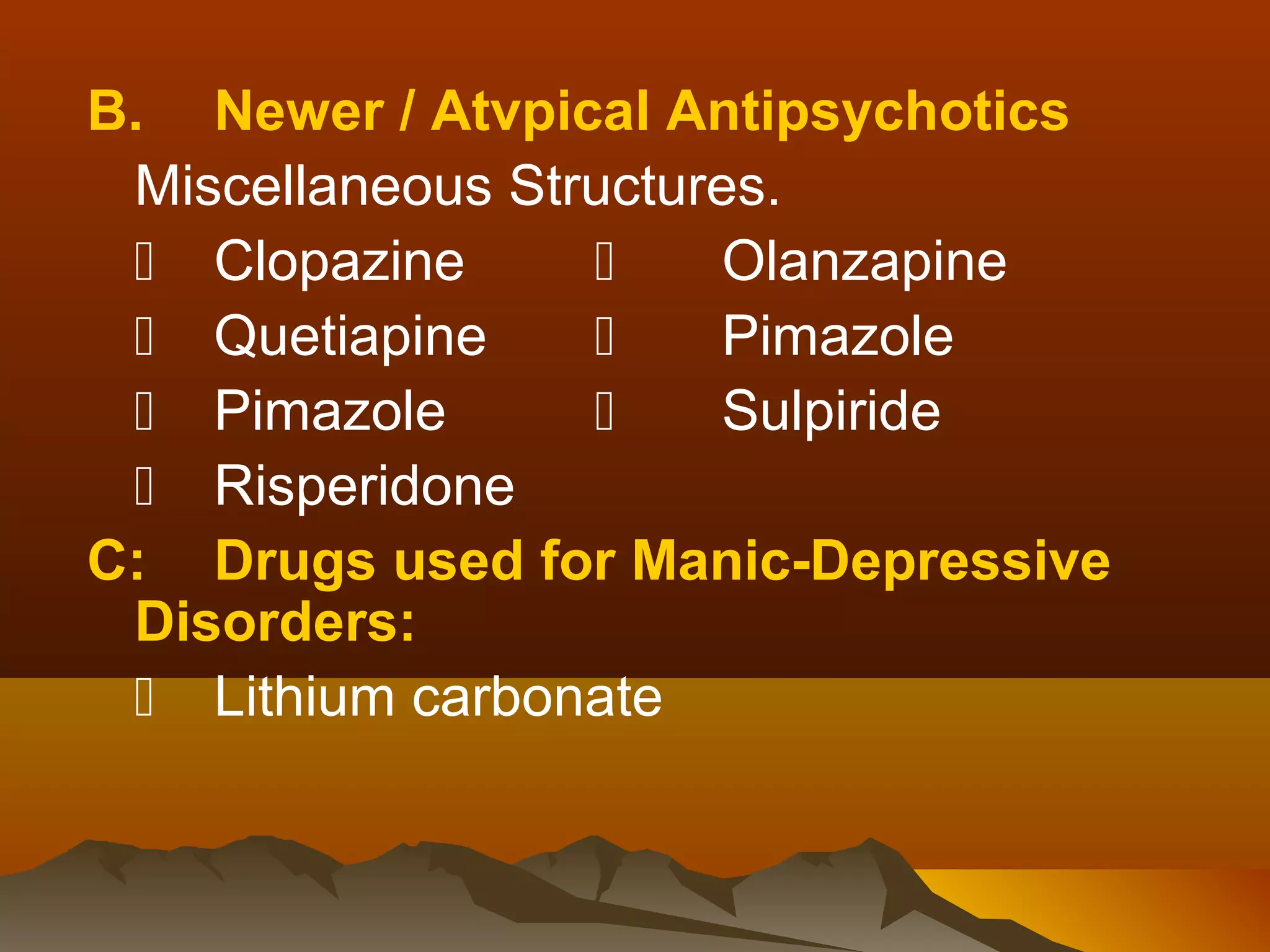
B. Newer / Atvpical Antipsychotics
 Miscellaneous Structures.
  Clopazine          Olanzapine
  Quetiapine         Pimazole
  Pimazole           Sulpiride
  Risperidone
C: Drugs used for Manic-Depressive
 Disorders:
  Lithium carbonate
Phenothiazines
• Chemistry & Structure


• Pharmacokinetics
MOA

Act on a variety of CNS & Peripheral receptors
– Post synaptic D2 receptor blockade
– 5 HT2 receptor blockade
– Muscarinic receptor blockade
– Ganglion blockade
– Quinidine like effects
– Alpha-1 adrenergic blockade
– Local anaesthetic like activity
MOA of Antipsychotic effect:-

Acts by blocking Post Synaptic D2 receptors
 in Dopaminergic pathways in CNS.
Three important Dopaminergic pathways
• Mesolimbic mesocortical pathway
• Nigrosticatad pathway
• Tuboinfundibuar pathway
Additional Pathways
• Medullary periventricular pathway
• Incertohypothalamic pathway
Dopamine Receptors
Ph. Actions
• a) PTS:
• No loss of intellectual functions and
  performance (clear sensorium)
• Alteration of deranged thought process
• Emotional quietening
• Psychomotor slowing
• Antagonism of behavior eff. of amphetamine
• Decreased paranoid idea
• Decrease initiative
• Decrease aggressiveness
• b) NORMAL (NON -PSYCHOTICS)
•      unpleasant feelings due to
• Sleepiness, restleseness
• Autonomic effects : b/c of muscarinic
  blockade
• unpleasant feelings due to
• Sleepiness, restleseness
• Autonomic effects : b/c of muscarinic
  blockade
2. Effect on motor activity
a. Decreased spontaneous activity
b.Extra Pyramidal symptoms
• Parkinsonism
• Acute dystonias
• Neuroleptic malignant syndrome
• Akathisia
• Tardive Dyskinesia
• Perioral tremor (Rabbit syndrome)
• ) DECREASE SEIZURE THRESHOLD:
• Convulsive potential
• High dose: cause convulsion cause
  seizure in patients of epilepsy
• Aggrevate epilepsy
• If anti-epilepsy is taken by epilepsy potent,
  he has to increase the dose
• Potentiate cause of seizure latent epilepsy
  patient
6. Effect on CTZ
7. Endocrinal Effects
8. Hypothermia/ Hyperthermia
• a) ANTICHOLINERGIC
• b) ADRENOCEPTORS BLOCKADE
• Orthostatic hypotension
• Less less with halo oeriod of flupenthixol
  and eluphenazine and other non
  phenothiazines except clozapine
• c) WEAK GANGLIONIC BLOCKADE:
• Both symp and P/symp ganglionic
  blockade . Non blockade cz transmission
B:         PERIPHERAL EFFECTS

1. Effect on ANS
 2. Effect on CVS
 3. Quinidine like anti-arrhythmic effect on heart
 4. Miscellaneous
   –   LA effect
   –   Renal effects
   –   Effect on Liver
   –   Antihistaminic action
   –   Skeletal muscle relaxant effect
• v) RESP. CONTROL:
• Depressant effect
• No permanent effect in N individual
• No prominent effect in psychotic pt having
  N respiration
• But if he suffers from resp. diseases such
  as Asthama them resp. depression
• vi) ENDOCRINE EFFECT:
• hyper prolactinemia and inflextility DA,
  control prolactin (check its release),if block
  hyper prolactinemia manifested by
  Gynecomastia in infertility in male and
  female
• ix) ANTIEMETIC ACTION:
• Because of DA recep blockade in CRTZ.
  Useful in drug induced vomiting and other
  vomiting except motion sickness and
• x) TEMP. REGULATION:
• Dopaminergic transmission to
  hypothalamus is blocked. Temperature
  regulation is lost person because
  poikelothermic
• xiii) SK.MUSCLES:
• in high doses themselves cause
  convulsion and spasm
• 2) CVS
• -ve isotropic effects more thioridazine
  cause death in young children
• Decrease stroke volume and decrease
  CO
• Decrease TPR and alpha adrenergic
Adverse effects
1.   Neurological side effects
•    Parkinsonism
•    Acute dystonias
•    Neuroleptic malignant syndrome
•    Akathisia
•    Tardive Dyskinesia
•    Perioral tremor (Rabbit syndrome)
2.   ANS effects
3.   ECG Changes
4.   Tolerance & Physical Dependence
5.   Reverse Tolerance or super sensitivity.
4.   Cholestatic Jaundice
5. Endocrinal effects
6. Hypothermia / Hyperthermia
7. Dermatitis
8. Opacities in lens and cornea
9. Blood Dyscrasias
10. Drug Interactions
Therapeutic Uses
A.   Treatment of Psychiatric patient
1.   Schizophrenia
2.   Organic Psychosis
3.   Bipolar depression
B.   Nausea & vomiting
C.   Alcoholic hallucinition
D.   Intractable Hiccough
• NEUROLEPTIC POISONING:
• Can be homicidal less common suicidal
  less chances occure in extreme of
  disease.
• Rarely fatal except thio & mesoridazine
  duer jto cacdio depressive neuro
  musculal, excitability. Convulsions.
• Pt. comatosed.
• Hypothermia, miosis, deep
• Tendon reflexes.
• Tachycacdia
• Thioridazine.
•   *Monitos vcital fxns.
•   * Gastric lavage with activated charcoal
•   *Saline catharsis (Na2SO4Mgo)
•   * Fluid replacement
•   * Pressor agents.
•   Diaqzepam for seizerres I/V.
•
• PIPERIDINE DERIVATIVE:
• THIORIDAZINE:
  – Block D2,x-1 & 5HT-2
  – More potent anti muscacinics
• Extrapyramidal (packinsonian) symptoms
  duer jto blockade of D2 and balance is
  disturbed, in this case balance is notr
  distubedf when cholinergicx activity es.
  – Sinilac B.A (2s-30%)
  – More cacdiotoxic
– More macked occulax eff.
• Deposit in retina browning of vision.
• Picture res emble that of retinitis
  pigmentosa pt.
• Potency—related to dose.
Newer/ Atypical anti-psychotics

9. antipsychotics

  • 1.
    Antipsychotics/Major Tranqullizers/Neuroleptics or Anti-schizophrenic drugs • Psychosis 1. Schizophrenia 2. Organic Psychosis 3. Affective disorders – Depression – Mania – Manic depressive illness (bipolar depression)
  • 2.
    • Etiology: • Notknown • Strong but incomplete genetic pre- disposition • (1st degree relatives – 10%) • (2nd monozygotic twin – 50%) • suicide is about 10% cases
  • 3.
    • Symptoms: • 1.Positivesymptom: (result from Neurochemical Abnormality) • Increase do paminergic transmission Respond well to Rx • Delusions often paranoid in nature: cann’t be rectified by reasoning
  • 4.
    • Hallucinations: • They may be • Visual • Auditory • Tactile (CD Canine bugs) •
  • 5.
    • c) Thoughtdisorder • Wild train of thoughts • Draw irrational conclusion with the feeling that thoughts are inserted or withdrawn by an outside agency. • Usually not like to be interfered, flight of ideas from one thought to other thought. • Broadcast of ideas. • d) Abnormal stereotypical behavior,
  • 6.
    • 2. NegativeSymptoms: • • Result from brain atrophy • Don’t respond / less responsive to R x • Emotional blunting. • Poor Socialization • Cognitive deficit (Dementia) • more irritable.
  • 7.
    • Neurochemical Basis: •1) Dopamine Theory (Hypothesis by Carlson awarded noble prize in year 2000) • Dopamine hyperactivity in mesolimbic and mesocortical pathway & amygdale positive symptoms of schizophrenia. • Proof: • Dopamine agonists – produce these symptoms of schizophrenia e.g. central
  • 8.
    • 2) GlutamateTheory – Glutamate and DA exert excitatory and inhibitory effects respectively on GABA ergic striatal neurons which project to thalamus and constitute “sensory Gate” – Glutamate or DA disables the gate and uninhibited sensory input reaches the cortex. – Glutamate NMDA (N-methyl deaspartate) recep antagonists: • Phencyclidine
  • 9.
    • 3) 5– HT Theories: • 5 – HT dysfxn • LSD & 5-HT2 Receptors agonists produced schizophrenia like syndrome. • • Mostly of Anti-psychotics in addition to affect dopamine also back serotonin receptors.
  • 10.
    • 4) Currentviews: • Combination of DA hyperactivity with 5- HT & glutamate dysfxn.
  • 11.
    • 1) NigrostriatalPathway: • 75% of dopamine in brain • 2) Mesolimbic mesocortical pathway: • Projects from neurons near S.N to limbic system & Neocortex • Behaviorial effects • Hyperactivity leads to schizophrenia. • 3) Tuberoinfundibular (Tubrohypophy Scal) Pathway:
  • 12.
    • 4) MedullaryPerventricular Pathway: • From neurons of Motor Nucleus of Vagus ___ Periventricular nuclei • Eating behavior • Satiety center ____ Bolimia Nervosa • Appetite Cetre _____ Anorexiz Nervosa • 5) Incertohypothalamic Pathway: • From medial zone incerta to hypothalamus & Amygdala.
  • 13.
    • 5) IncertohypothalamicPathway: • From medial zone incerta to hypothalamus & Amygdala. • Sexual drive, Microvasculatory function and temperature regulation. • 6) Many local Dopaminergic Neurons in olfactory cortex & retina: • 7) Dopaminergic transmission in periphery:
  • 14.
    Classification of Antipsychotic Drugs A: Classical / Typical Antipsychotics. I. Phenothiazine Derivatives a. Aliphatic compounds Chlorpromazine Promazine. b. Piperazine Compounds: Procholorperazine Perphenazine Fluphenazine Trifluperazine c. Piperidine Compounds: Thioridazine  Mesoridazine
  • 15.
    • A) ClassicalTypical Nemoleptics: • 1. Phenothiazines: • a) Aliphatic Comp • (less potent,sedation & weight gain) • Chloropromazine (Largactil) • Promazine • Triflupromazine
  • 16.
    • b) PiperidineDerivative: • Thioridazine (Melleril, less potent, Anti-Cholinergic) • Mesoridazine (metabolite of thioridazine)
  • 17.
    • c) PiperazineDerivative: • Fluphenazine (I/V preparation, slowly, release, • Perphenazine • Trifluperazine • Prochlorperazine • Thioperazine .
  • 18.
    • 2. Thioxanthines:(also available as DEPOT preparation) • Thiothixene • Clopenthixol • Flupenthixol • Chlorprothixine
  • 19.
    3. Butyrophenones: • Haloperiodol • Properidol • Benperidol
  • 20.
    • B) AtypicalNeuroleptics: • Their mechanism of action is different from anti-psychotics • Loxapine • Clozapoine (Clozanl) ___ A/E: Cause agranulocyctosis ___ Bone marrow depression
  • 21.
    • Risperidone ____commonly used D2 5HT2 selective activity for D4 receptors • Olanzapine __ Disadv: cause agranulocytosis • Ziprasidone(patients resistant to other drugs. Also Rx of negative effects) • Sulpirdie (D2 selective) • Remazopride • Remoxipride • Pimozide (D2 selective) long acting indole • Quetiapine • Aripiprazole
  • 22.
    II. Butyrophenone Derivatives  Haloperidol  Droperidol III. Thioxanthenes  Thiothixene  Flupenthixol IV. Rauwolfia Alkalois  Reserpine
  • 23.
    B. Newer /Atvpical Antipsychotics Miscellaneous Structures.  Clopazine  Olanzapine  Quetiapine  Pimazole  Pimazole  Sulpiride  Risperidone C: Drugs used for Manic-Depressive Disorders:  Lithium carbonate
  • 24.
    Phenothiazines • Chemistry &Structure • Pharmacokinetics
  • 25.
    MOA Act on avariety of CNS & Peripheral receptors – Post synaptic D2 receptor blockade – 5 HT2 receptor blockade – Muscarinic receptor blockade – Ganglion blockade – Quinidine like effects – Alpha-1 adrenergic blockade – Local anaesthetic like activity
  • 26.
    MOA of Antipsychoticeffect:- Acts by blocking Post Synaptic D2 receptors in Dopaminergic pathways in CNS. Three important Dopaminergic pathways • Mesolimbic mesocortical pathway • Nigrosticatad pathway • Tuboinfundibuar pathway Additional Pathways • Medullary periventricular pathway • Incertohypothalamic pathway
  • 27.
  • 28.
    Ph. Actions • a)PTS: • No loss of intellectual functions and performance (clear sensorium) • Alteration of deranged thought process • Emotional quietening • Psychomotor slowing • Antagonism of behavior eff. of amphetamine • Decreased paranoid idea • Decrease initiative • Decrease aggressiveness
  • 29.
    • b) NORMAL(NON -PSYCHOTICS) • unpleasant feelings due to • Sleepiness, restleseness • Autonomic effects : b/c of muscarinic blockade • unpleasant feelings due to • Sleepiness, restleseness • Autonomic effects : b/c of muscarinic blockade
  • 30.
    2. Effect onmotor activity a. Decreased spontaneous activity b.Extra Pyramidal symptoms • Parkinsonism • Acute dystonias • Neuroleptic malignant syndrome • Akathisia • Tardive Dyskinesia • Perioral tremor (Rabbit syndrome)
  • 31.
    • ) DECREASESEIZURE THRESHOLD: • Convulsive potential • High dose: cause convulsion cause seizure in patients of epilepsy • Aggrevate epilepsy • If anti-epilepsy is taken by epilepsy potent, he has to increase the dose • Potentiate cause of seizure latent epilepsy patient
  • 32.
    6. Effect onCTZ 7. Endocrinal Effects 8. Hypothermia/ Hyperthermia
  • 33.
    • a) ANTICHOLINERGIC •b) ADRENOCEPTORS BLOCKADE • Orthostatic hypotension • Less less with halo oeriod of flupenthixol and eluphenazine and other non phenothiazines except clozapine • c) WEAK GANGLIONIC BLOCKADE: • Both symp and P/symp ganglionic blockade . Non blockade cz transmission
  • 34.
    B: PERIPHERAL EFFECTS 1. Effect on ANS 2. Effect on CVS 3. Quinidine like anti-arrhythmic effect on heart 4. Miscellaneous – LA effect – Renal effects – Effect on Liver – Antihistaminic action – Skeletal muscle relaxant effect
  • 35.
    • v) RESP.CONTROL: • Depressant effect • No permanent effect in N individual • No prominent effect in psychotic pt having N respiration • But if he suffers from resp. diseases such as Asthama them resp. depression
  • 36.
    • vi) ENDOCRINEEFFECT: • hyper prolactinemia and inflextility DA, control prolactin (check its release),if block hyper prolactinemia manifested by Gynecomastia in infertility in male and female • ix) ANTIEMETIC ACTION: • Because of DA recep blockade in CRTZ. Useful in drug induced vomiting and other vomiting except motion sickness and
  • 37.
    • x) TEMP.REGULATION: • Dopaminergic transmission to hypothalamus is blocked. Temperature regulation is lost person because poikelothermic
  • 38.
    • xiii) SK.MUSCLES: •in high doses themselves cause convulsion and spasm • 2) CVS • -ve isotropic effects more thioridazine cause death in young children • Decrease stroke volume and decrease CO • Decrease TPR and alpha adrenergic
  • 40.
    Adverse effects 1. Neurological side effects • Parkinsonism • Acute dystonias • Neuroleptic malignant syndrome • Akathisia • Tardive Dyskinesia • Perioral tremor (Rabbit syndrome) 2. ANS effects 3. ECG Changes 4. Tolerance & Physical Dependence 5. Reverse Tolerance or super sensitivity. 4. Cholestatic Jaundice
  • 41.
    5. Endocrinal effects 6.Hypothermia / Hyperthermia 7. Dermatitis 8. Opacities in lens and cornea 9. Blood Dyscrasias 10. Drug Interactions
  • 42.
    Therapeutic Uses A. Treatment of Psychiatric patient 1. Schizophrenia 2. Organic Psychosis 3. Bipolar depression B. Nausea & vomiting C. Alcoholic hallucinition D. Intractable Hiccough
  • 43.
    • NEUROLEPTIC POISONING: •Can be homicidal less common suicidal less chances occure in extreme of disease. • Rarely fatal except thio & mesoridazine duer jto cacdio depressive neuro musculal, excitability. Convulsions. • Pt. comatosed. • Hypothermia, miosis, deep • Tendon reflexes. • Tachycacdia • Thioridazine.
  • 44.
    *Monitos vcital fxns. • * Gastric lavage with activated charcoal • *Saline catharsis (Na2SO4Mgo) • * Fluid replacement • * Pressor agents. • Diaqzepam for seizerres I/V. •
  • 45.
    • PIPERIDINE DERIVATIVE: •THIORIDAZINE: – Block D2,x-1 & 5HT-2 – More potent anti muscacinics • Extrapyramidal (packinsonian) symptoms duer jto blockade of D2 and balance is disturbed, in this case balance is notr distubedf when cholinergicx activity es. – Sinilac B.A (2s-30%) – More cacdiotoxic
  • 47.
    – More mackedocculax eff. • Deposit in retina browning of vision. • Picture res emble that of retinitis pigmentosa pt. • Potency—related to dose.
  • 56.