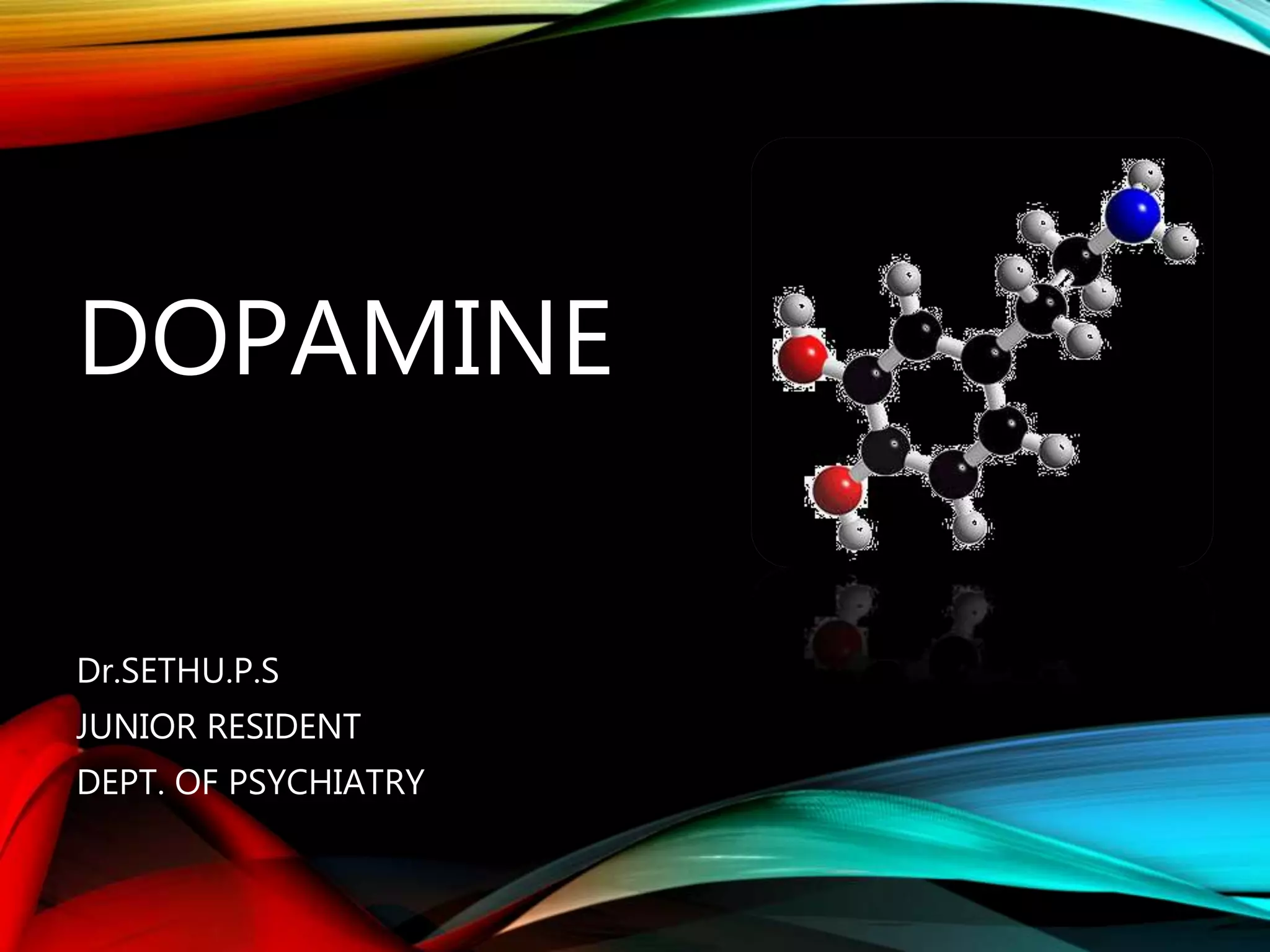
DOPAMINE
Dr.SETHU.P.S
JUNIOR RESIDENT
DEPT. OF PSYCHIATRY
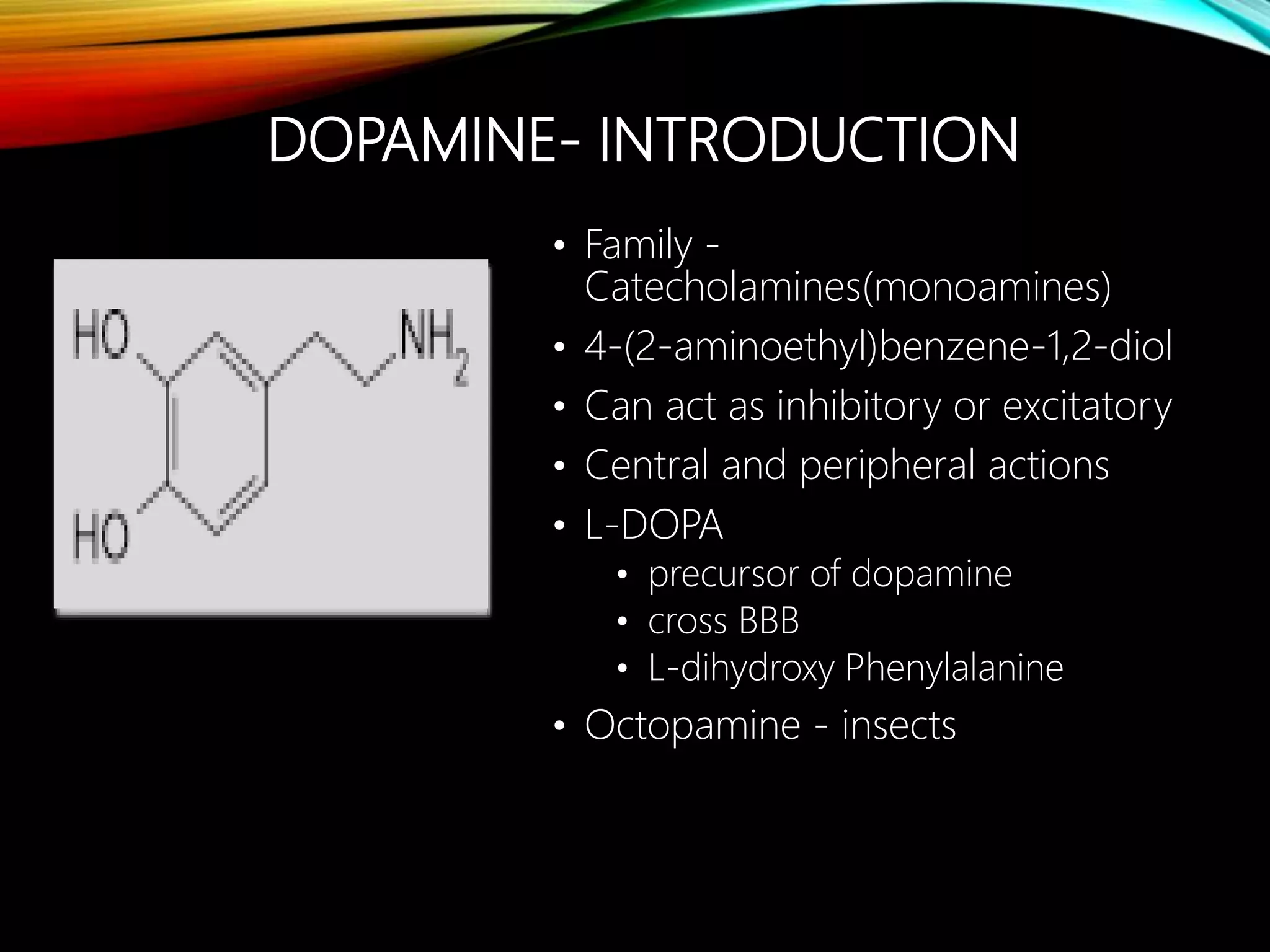
DOPAMINE- INTRODUCTION
• Family -
Catecholamines(monoamines)
• 4-(2-aminoethyl)benzene-1,2-diol
• Can act as inhibitory or excitatory
• Central and peripheral actions
• L-DOPA
• precursor of dopamine
• cross BBB
• L-dihydroxy Phenylalanine
• Octopamine - insects
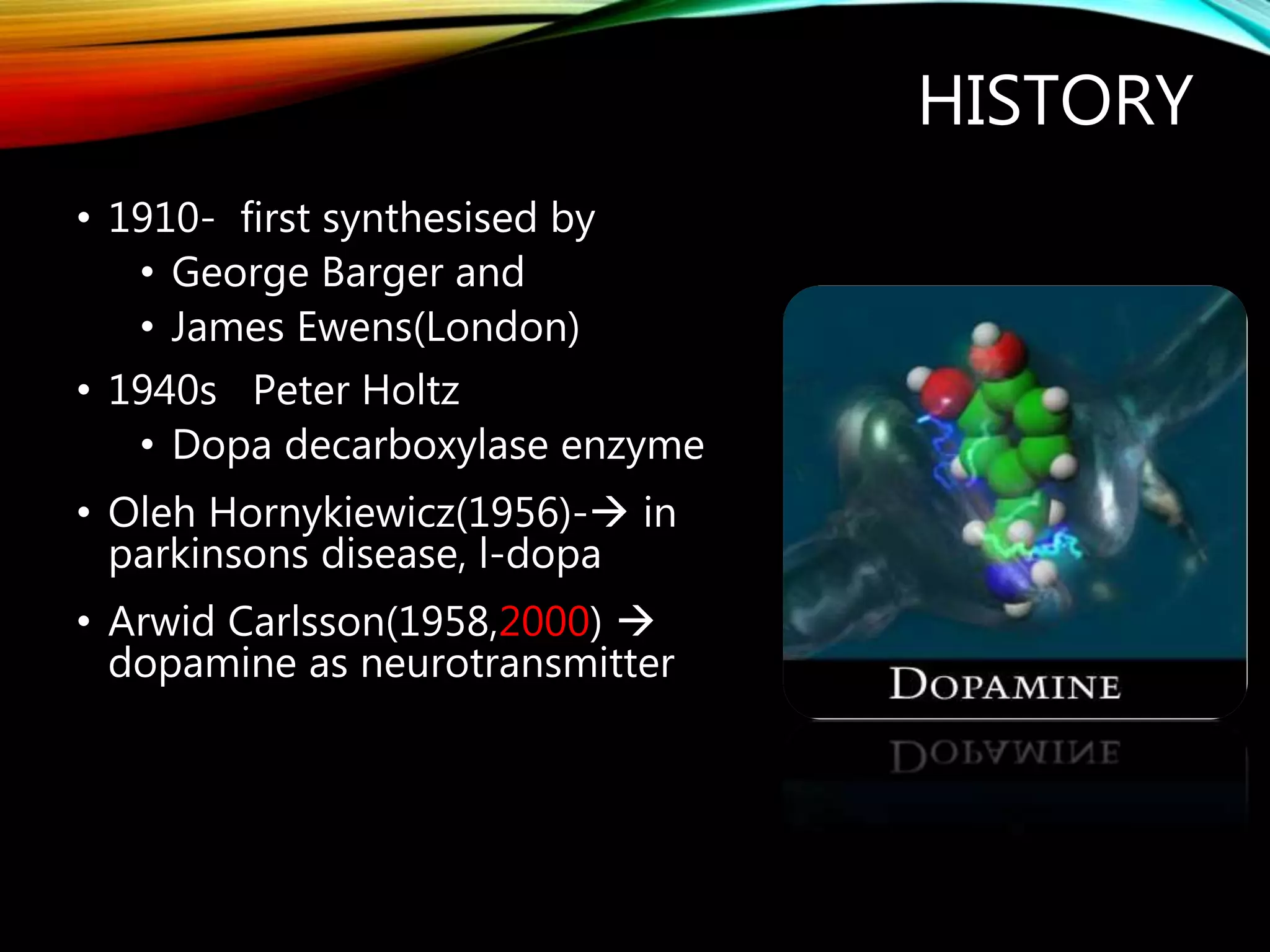
HISTORY
• 1910- first synthesised by
• George Barger and
• James Ewens(London)
• 1940s Peter Holtz
• Dopa decarboxylase enzyme
• Oleh Hornykiewicz(1956)- in
parkinsons disease, l-dopa
• Arwid Carlsson(1958,2000) 
dopamine as neurotransmitter
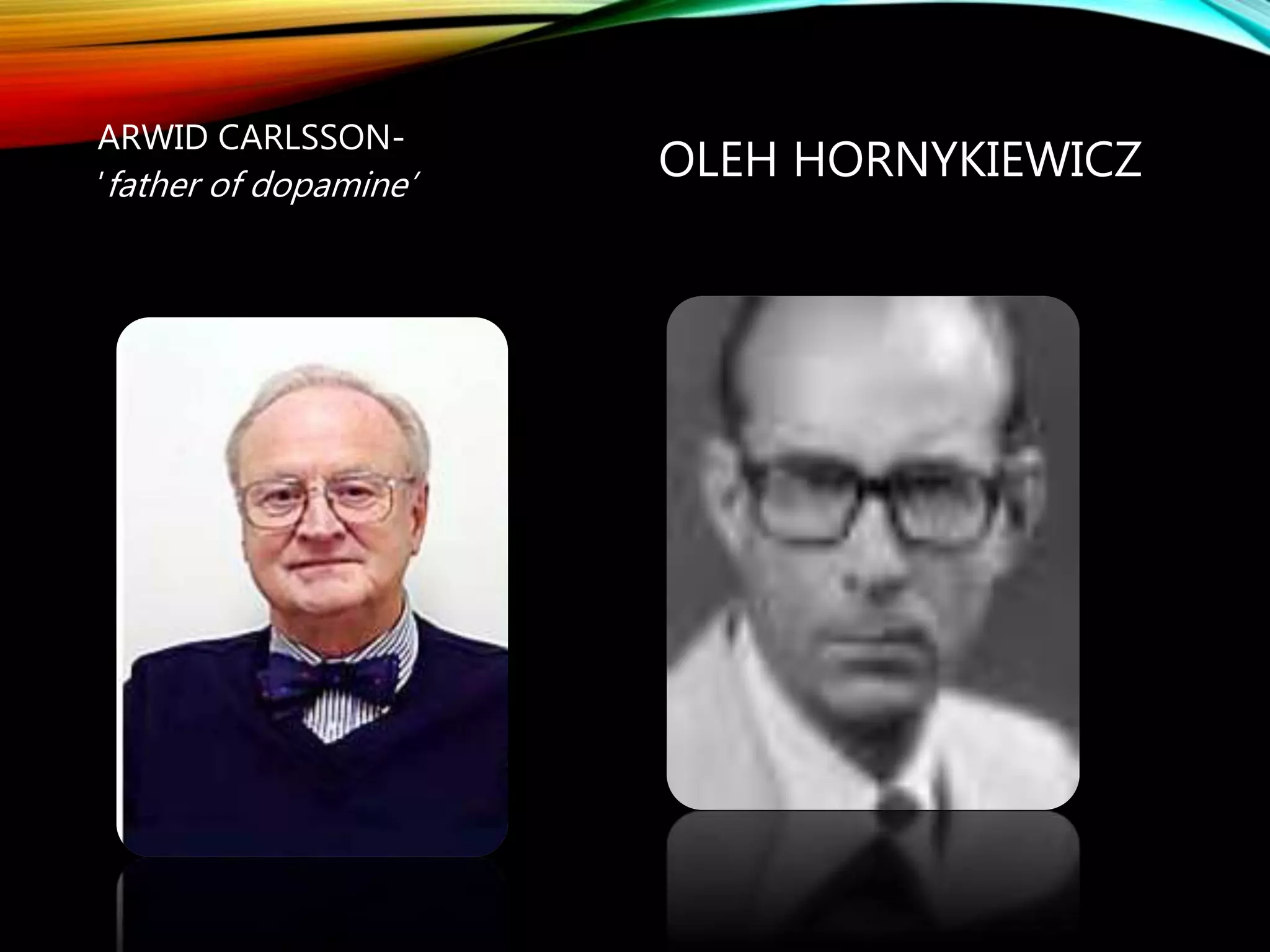
ARWID CARLSSON-
’father of dopamine’
OLEH HORNYKIEWICZ
SYNTHESIS
• Site of synthesis-
neural tissue
adrenal medulla
• From AA- tyrosine
• Rate limiting enzyme
Tyrosine Hydroxylase
• NA & Adrenaline formed in same
pathway
• HVA-Final metabolite
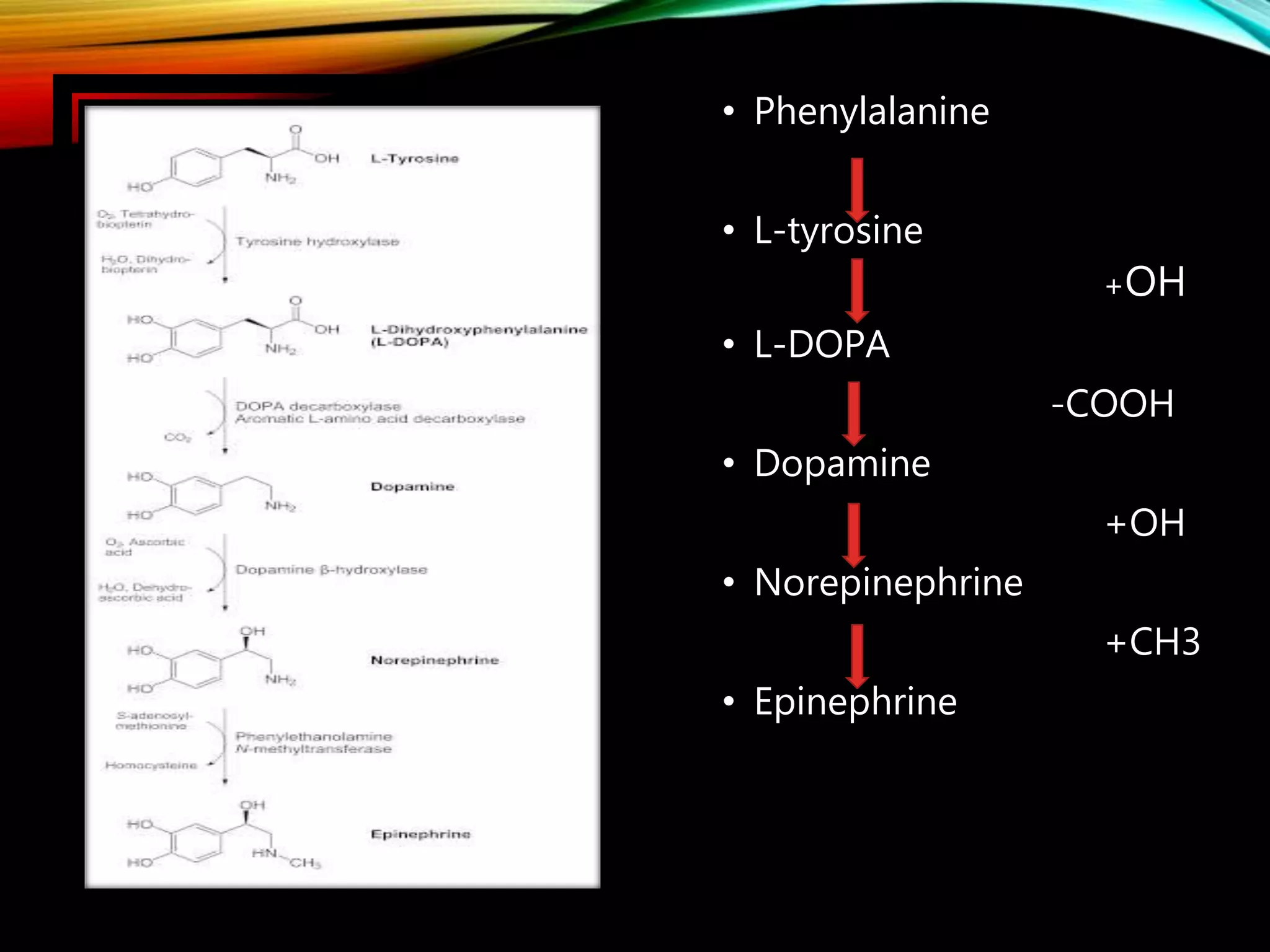
• Phenylalanine
• L-tyrosine
+OH
• L-DOPA
-COOH
• Dopamine
+OH
• Norepinephrine
+CH3
• Epinephrine
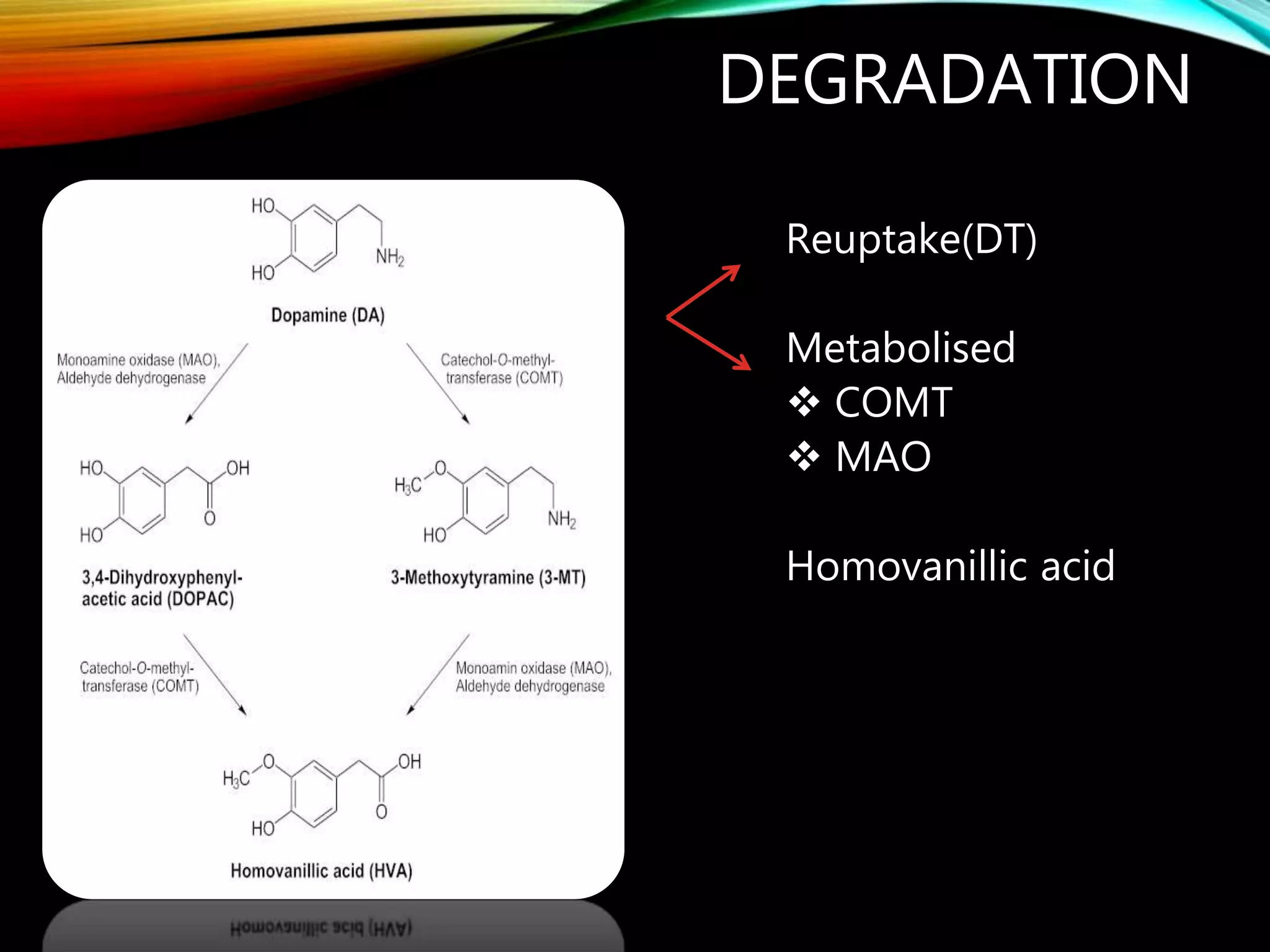
DEGRADATION
Reuptake(DT)
Metabolised
 COMT
 MAO
Homovanillic acid
SITES
• Midbrain
• Substantia nigra
• ventral tegmental area
• periaqueductal gray
• Hypothalamus
• olfactory bulb
• Retina
• In the periphery-kidney
(adr medulla)
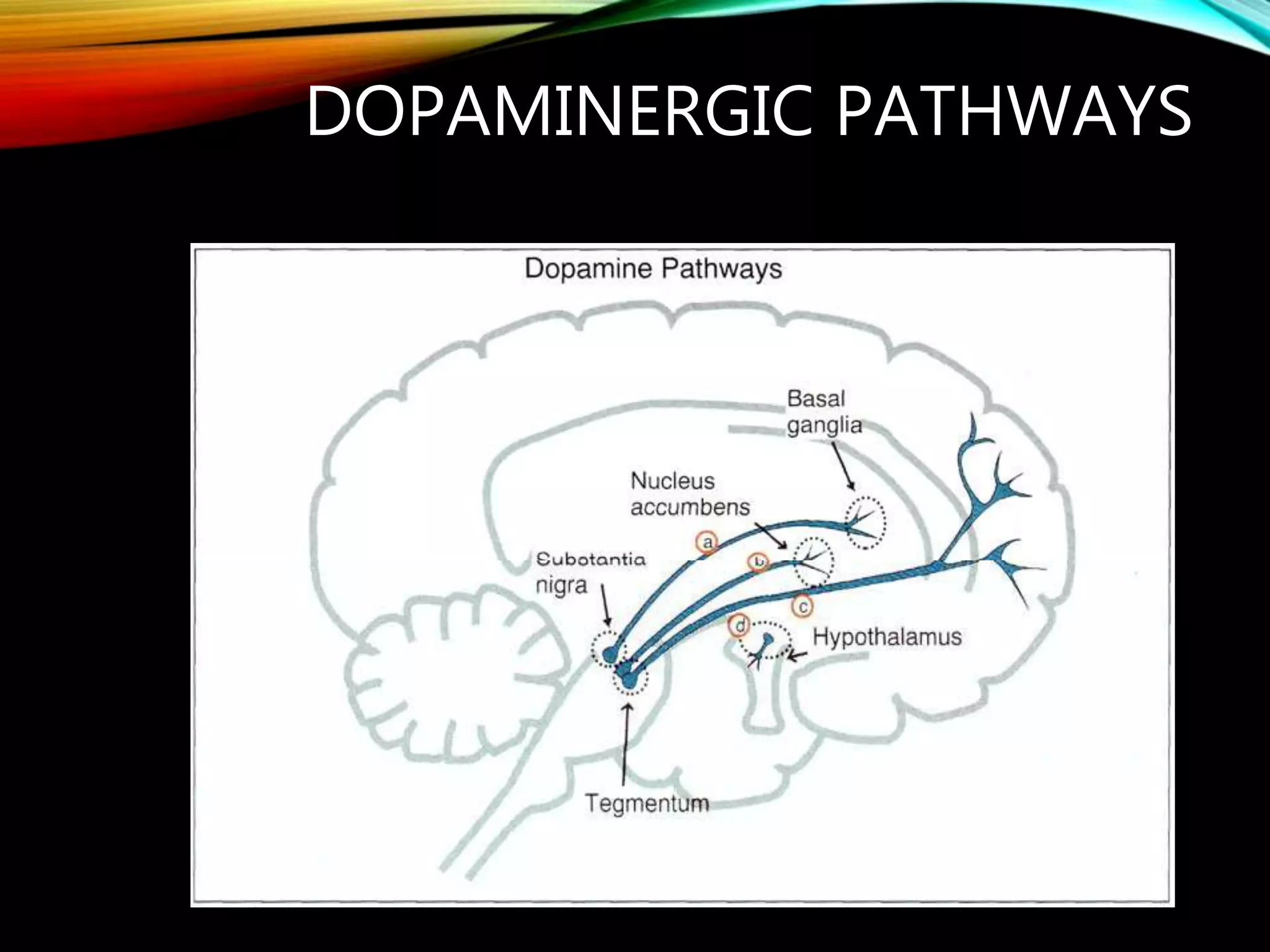
• Dopaminergic Pathways
1) nigrostriatal,
(2) mesocortical
(3)mesolimbic,
(4) tuberohypophyseal
DOPAMINERGIC RECEPTORS
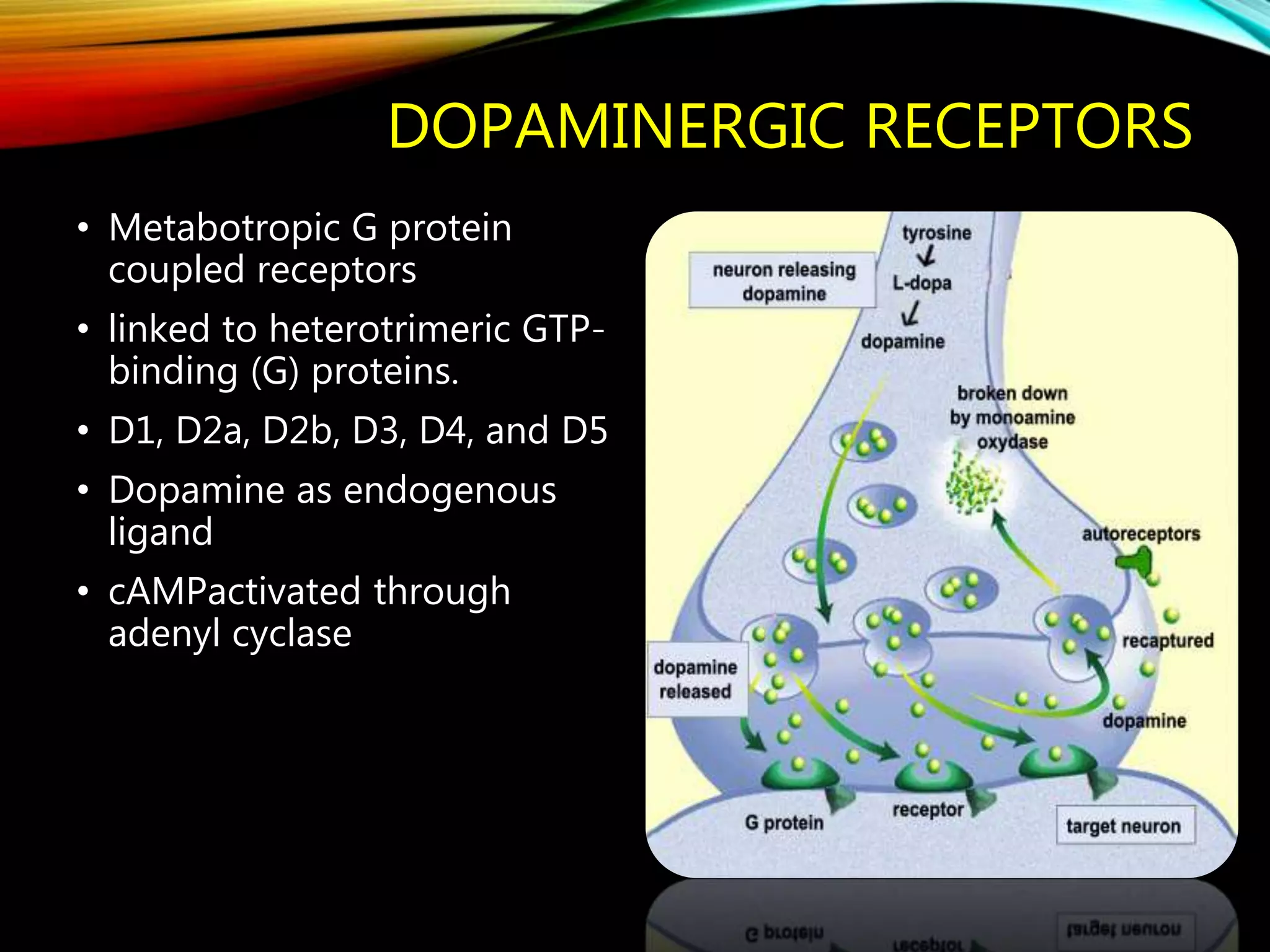
• Metabotropic G protein
coupled receptors
• linked to heterotrimeric GTP-
binding (G) proteins.
• D1, D2a, D2b, D3, D4, and D5
• Dopamine as endogenous
ligand
• cAMPactivated through
adenyl cyclase
DOPAMINE RECEPTORS
• D1-like family
• D1 and D5 receptors
• cAMP by activating the
stimulatory G protein, Gs.
• D2-like family
• D2, D3, and D4 receptors
• cAMP-by activating the
inhibitory G protein, Gi
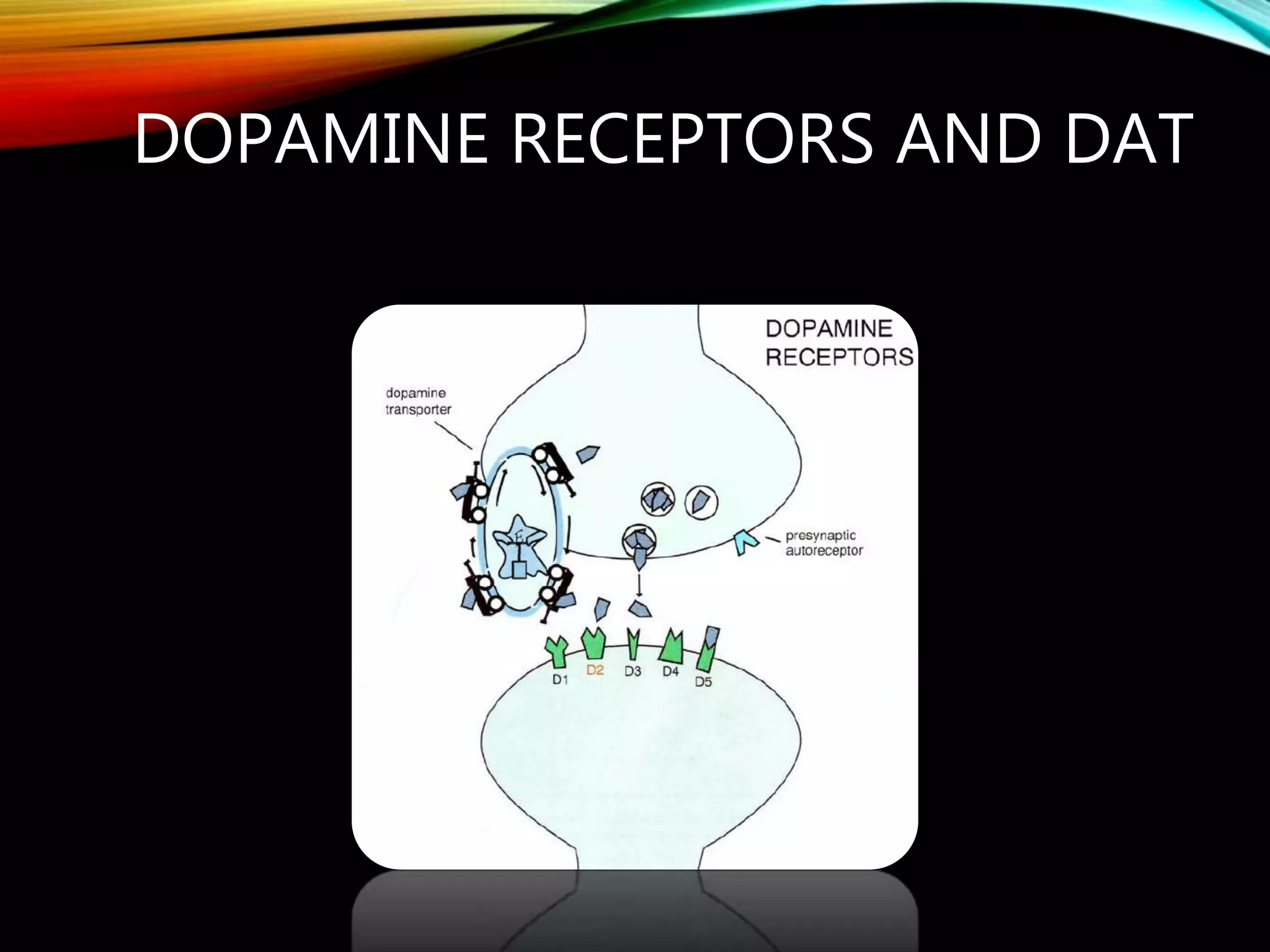
DOPAMINE RECEPTORS AND DAT
‘WHAT HAPPENS’
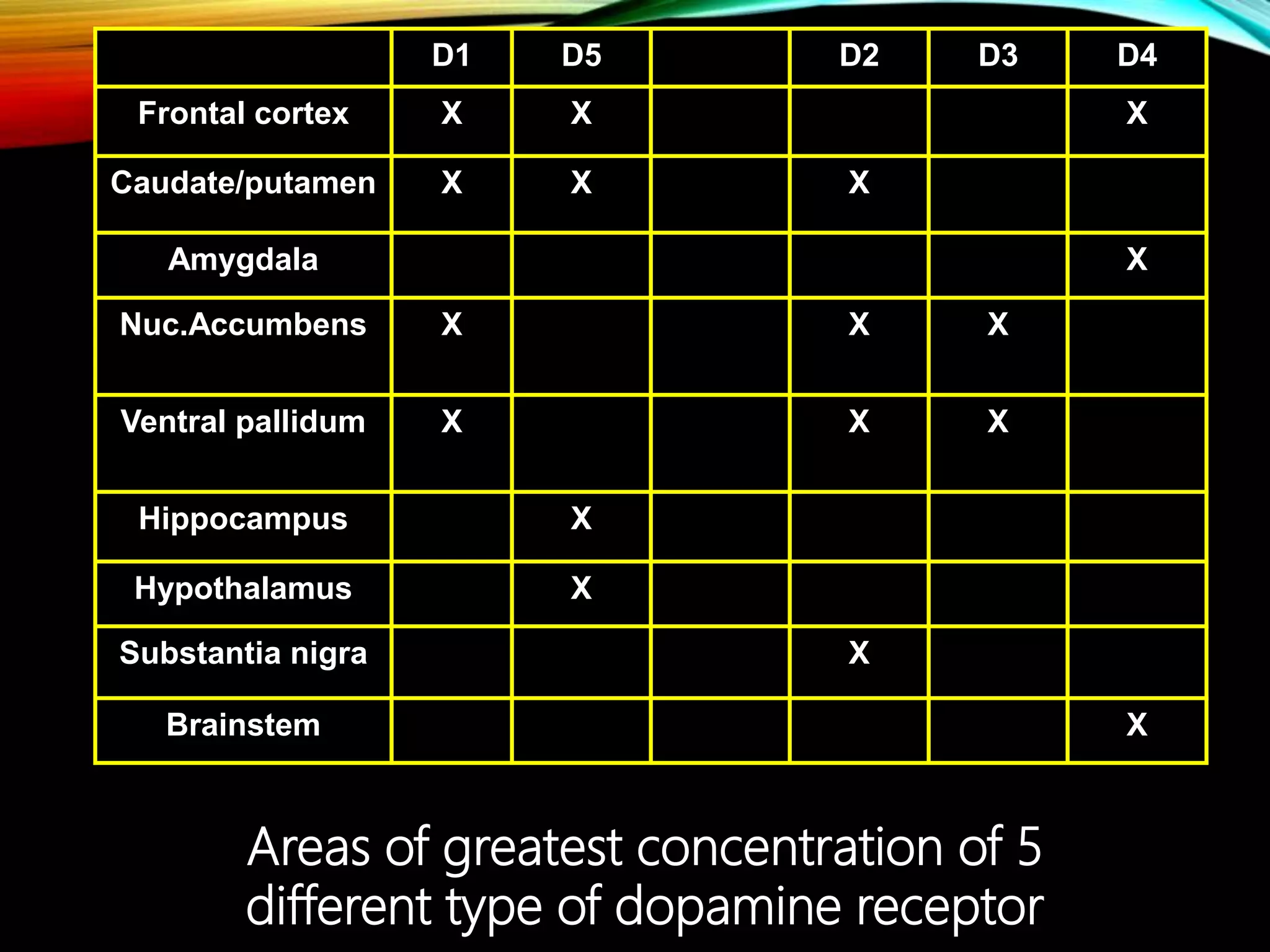
Areas of greatest concentration of 5
different type of dopamine receptor
D1 D5 D2 D3 D4
Frontal cortex X X X
Caudate/putamen X X X
Amygdala X
Nuc.Accumbens X X X
Ventral pallidum X X X
Hippocampus X
Hypothalamus X
Substantia nigra X
Brainstem X
Receptor
Subtype
D1 D5 D2 D3 D4
Gprotein Gs Gs Gi Gi Gi
localisation Caudate,
putamen,
nucleus
accumbens
olfactory
tubercle
Hippocam
us,
hypothala
mus
Caudate,
putamen,
nucleus
accumbens
olfactory
tubercle
Nucleus
accumbens
olfactory
tubercle,
islands of
Calleja
Frontal
cortex,
midbrain,
amygdala,
cardiovasc
lar system
Likely
Physiologic
al Role
Locomotio
n, reward,
reinforcem
ent,
learning
and
memory,
renin
secretion
Learning
and
memory
Locomotio
n, reward,
reinforcem
ent,
learning
and
memory
Locomotio
n, possible
role in
cognition
and
emotion
Mostly
unknown -
possible
role in
cognition
and
emotion,
hypertensi
n
FUNCTIONS
• Precursor
• NEEpinephrine
• Neurotransmitter
• Neurohormone
• prolactin
• Pleasure
• Reward
• emotion
• Memory
• Attention
• Learning
• Locomotion
• smooth and
• controlled muscular
movements
• Renal-
• vasodilation, diuresis, and
natriuresis
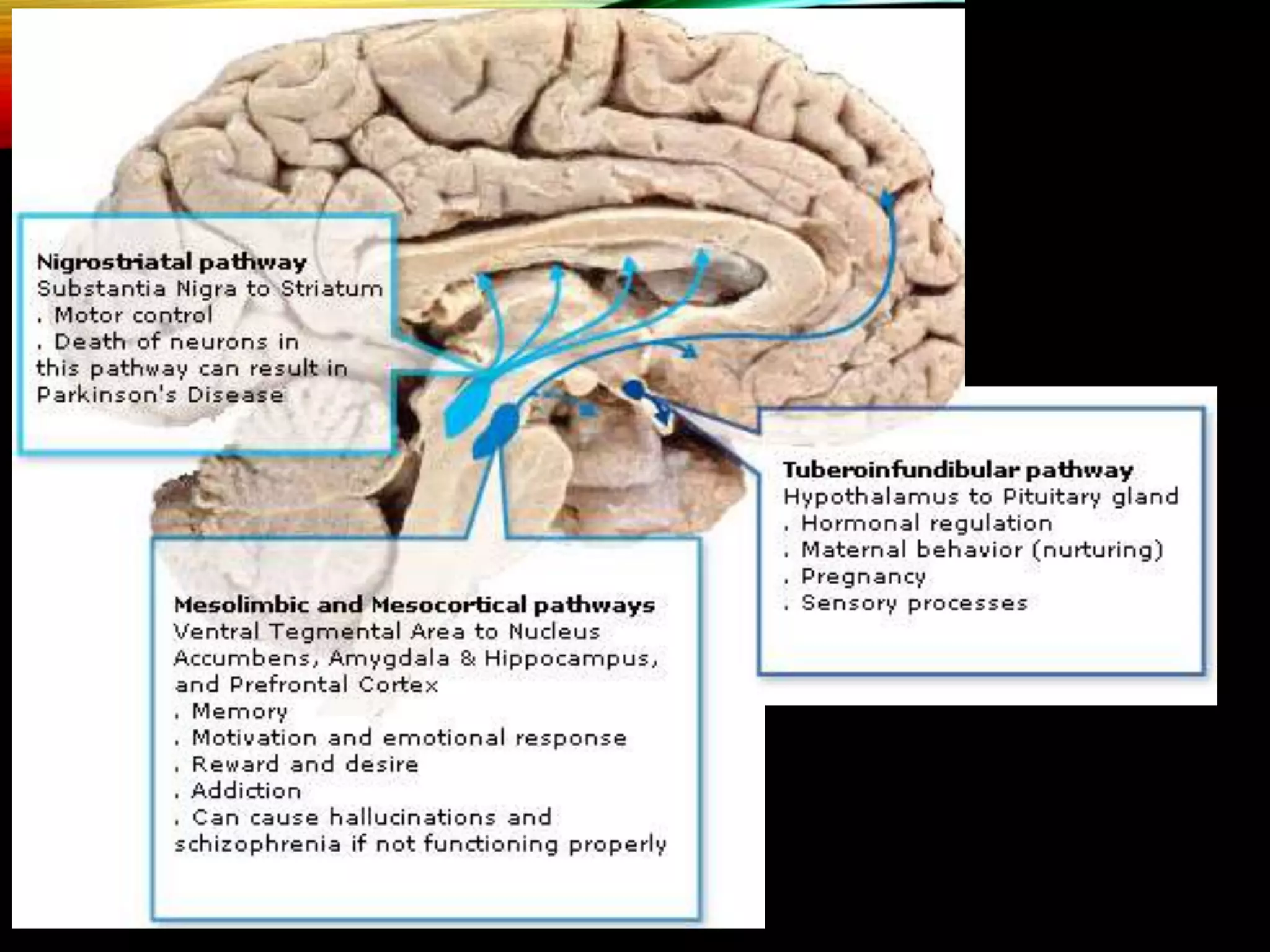
DOPAMINERGIC PATHWAYS
• Mesocortical
cognition
attention
memory
• Mesolimbic
emotion
reward(motivation,pleasure)
• Nigrostriatal
locomotion
• Tuberohypophyseal
prolactin
MESOCORTICAL
 Located in ventral tegmental area
of the ventral striatum
 Send Ascending Projections to
prefrontal cortex
 Involved in working memory
predominantly mediated by D1
receptors, attention, goal-
directed behavior, reward, and
learning
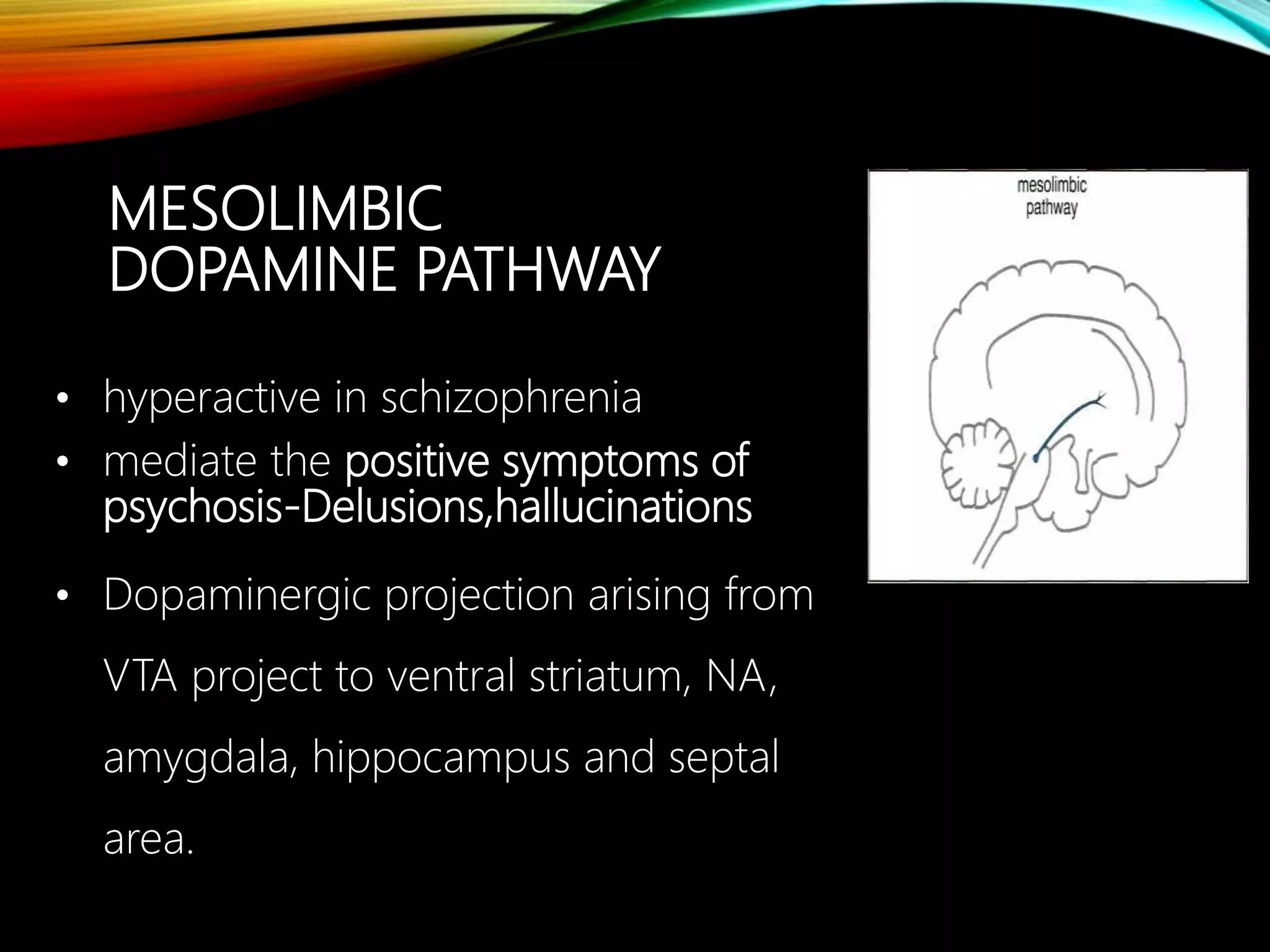
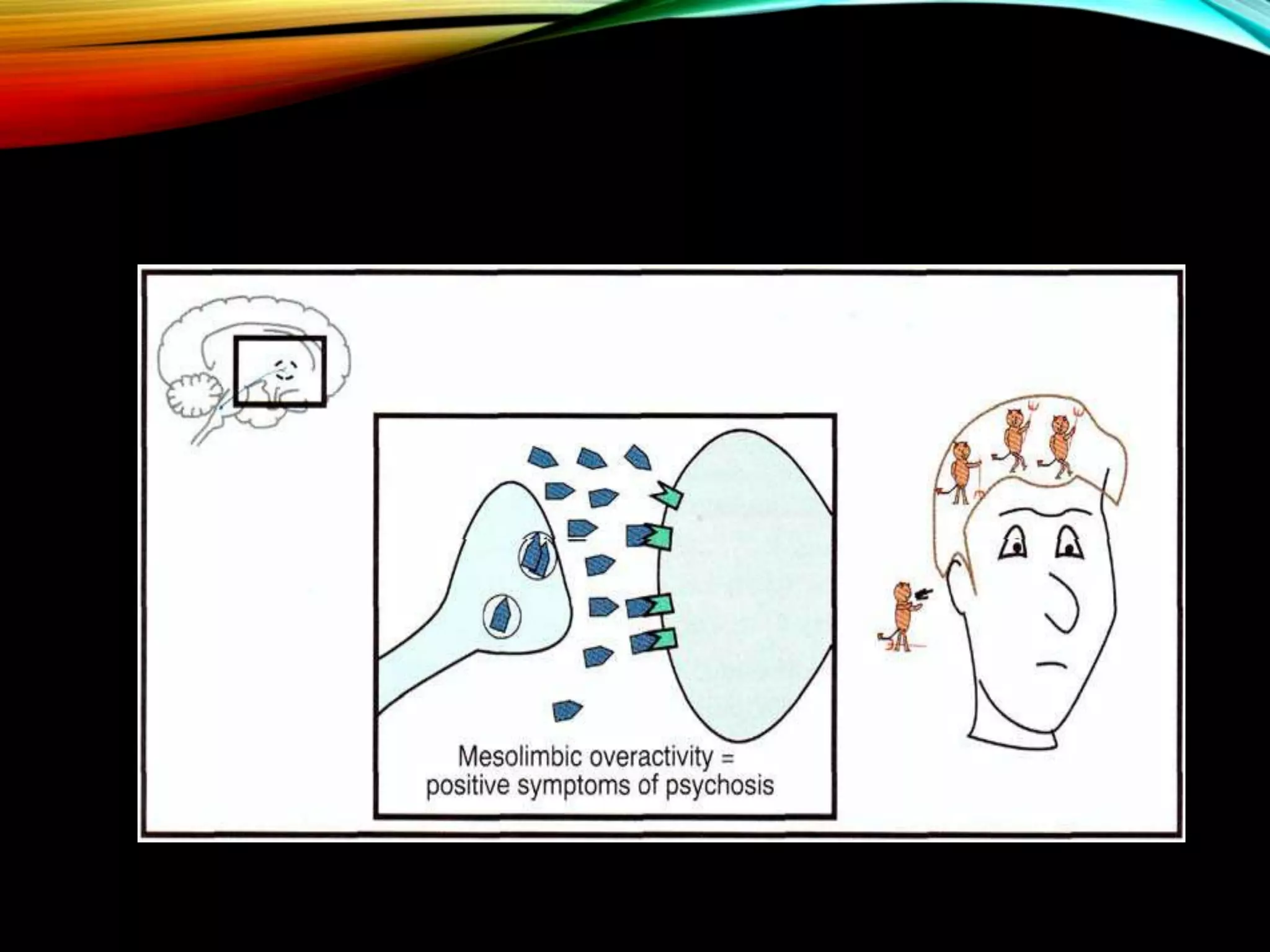
MESOLIMBIC
DOPAMINE PATHWAY
• hyperactive in schizophrenia
• mediate the positive symptoms of
psychosis-Delusions,hallucinations
• Dopaminergic projection arising from
VTA project to ventral striatum, NA,
amygdala, hippocampus and septal
area.
Nigrostriatal pathway
dopamine cell bodies → located in pars
compacta division of substantia nigra
send ascending projections to caudate and
putamen
modulate motor functions
blockade- extra pyramidal symptoms
adverse effect of anti psychotic drug
Tuberohypophyseal
dopamine neurons in
hypothalamic arcuate and peri
ventricular nuclei
projections to the pituitary gland
inhibitory regulation of prolactin
release
dopamine antagonist →
disinhibition of release →
galactorrhoea
STRIATO - FRONTAL CIRCUITS
• Intricate connectivity of striatum with the
prefrontal cortex and limbic system  cognition,
regulation of motivation and emotion
• Dopamine place a fundamental role
• Release of dopamine from the nigrostriatal
projections is considered to have a facilitative
effect in the direct pathway and inhibitory effect
in the indirect pathway
• Produce opposing effects on the thalamic targets
of basal ganglia outflow to respectively facilitate
or suppress cortically initiated activity
Pathways Dopamine
increase
disorders Dopamine
decrease
disorders
mesocortica
l
hyperattentivenes
s, racing
expansive
cognition,
overinterpretation
of sensory stimuli,
impaired ability to
self-monitor,
grandiosity,
euphoria.
mania,
psychostim
ulant abuse.
orbito-frontal
PFC to
caudate, with
concomitant
overactivity in
anterior
caudate,
from pre-
motor PFC to
putamen,
concomitant
dopaminergic
overactivity in
the putamen
and related
structures
obsessive-compulsive
disorder.
Tourette's syndrome.
mesolimbic emotional
hyper-
reactivity, loss
of contact
with reality
including
hallucinations
and delusions
(psychosis).
schizophrenia
,
psychostimula
nt abuse,
extreme
forms of
mood
disorders.
emotional
blunting, lack
of motivation,
and
anhedonia.
schizophrenia
, mood
disorders,
addictions
nigrostriatal dyskinetic
movements
tardive
dyskinesia
EPS-
rigidity,tremor,
,bradykinesia
parkinsonism
tuberoinfundi
bular
Decrease
prolactin
Increase
prolactin
galactorrhea
DOPAMINE
DA & SCHIZOPHRENIA
Mesolimbic +ve symptoms
Mesocortical
DLPFC- Cognitive and
negative symptoms
VLPFC- Cognitive and
affective symptoms
DOPAMINE HYPOTHESIS
DOPAMINE HYPOTHESIS
• The dopamine hypothesis for schizophrenia was posed some
40 years ago (Carlsson and Lindqvist 1963),
• evidence in living humans supporting this hypothesis has
been lacking until recently.
• Positron emission tomography (PET) and single photon
emission computerized tomography (SPECT) imaging
techniques
• amphetamine administration / reserpine that blocks
dopamine production.
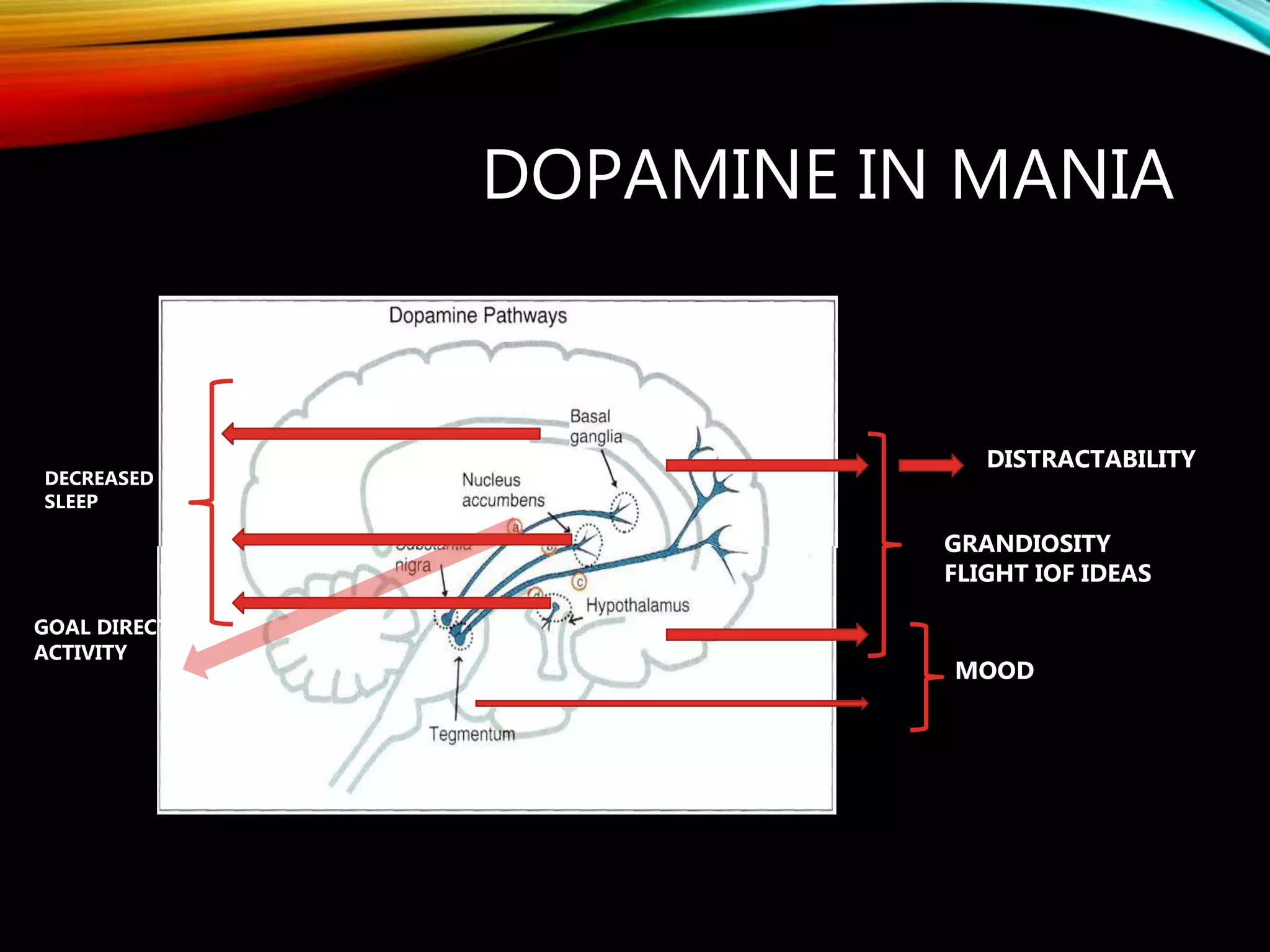
DOPAMINE IN MANIA
MOOD
GRANDIOSITY
FLIGHT IOF IDEAS
DISTRACTABILITY
DECREASED
SLEEP
GOAL DIRECTED
ACTIVITY
DEPRESSION
• Psychomotor retardation – NS system
• Emotional expression, learning and reinforcement, hedonic
capacity- ML system
• Motivation, Concentration, executive and Cognitive tasks-
MC system
• HP Axis dysfunction- TI system
• Monoamine hypothesis-NE,HT,DA
Decrease in dopamine
DA IN ANXIETY DISORDERS
• Acute stress DA release
• Activates DA release in mPFC
• Inhibits DA release in NA
• PTSD, Panic – increased plasma DA and HVA concentration
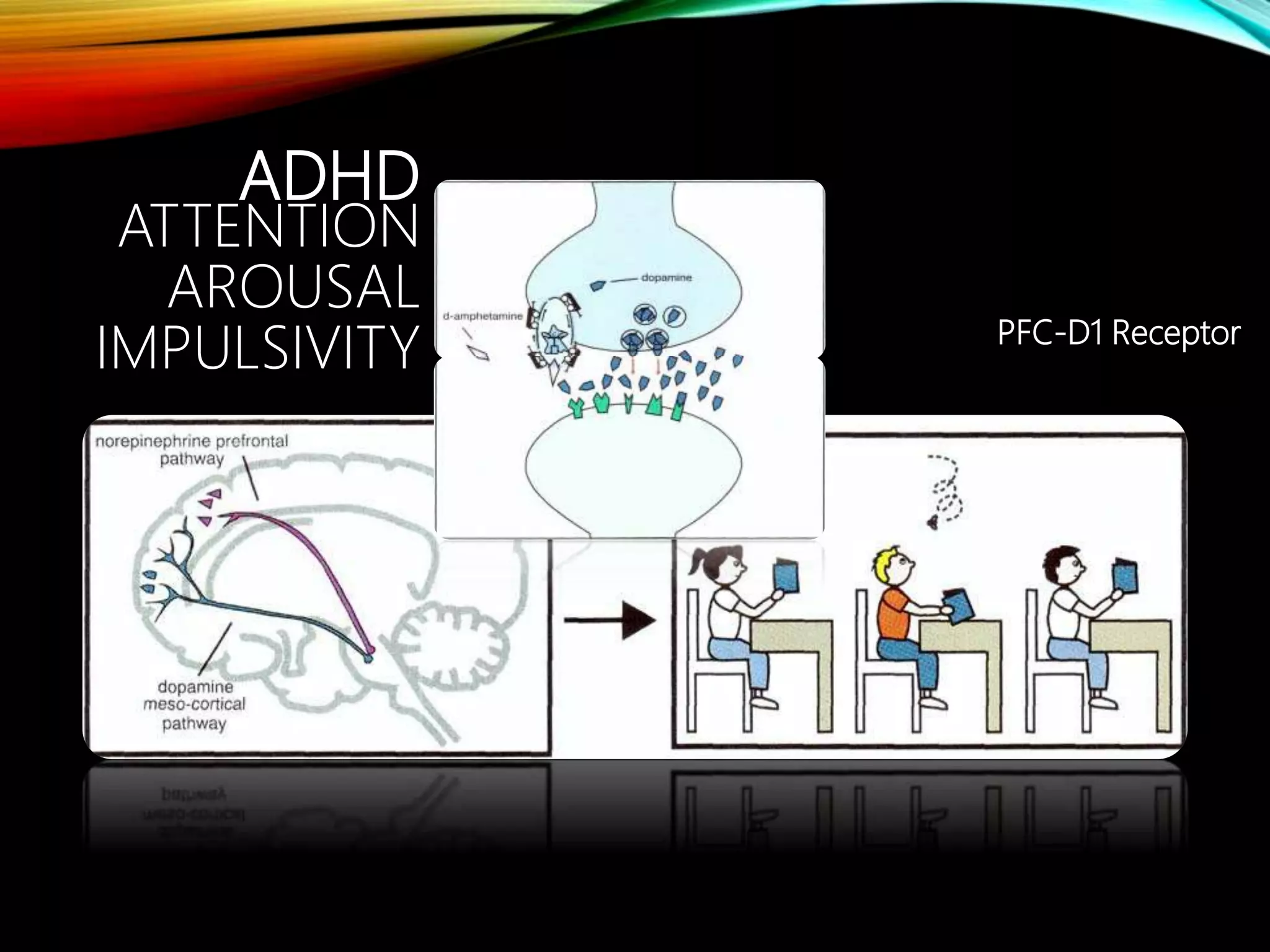
ADHD
ATTENTION
AROUSAL
IMPULSIVITY PFC-D1 Receptor
EATING DISORDERS
• Eating ,hunger and reward
circuits
• VTA-NA-A
• Dopamine projections to
mammillary body of
Hypothalamus->extend to NA
• Hunger and reward circuits are
interconnected
IMPULSE CONTROL
DISORDERS
• Linked to reward circuitry
• BPD
• Kleptomania
• Pyromania
• Sexual addictions
paraphilias
fetichism
pedophilia
PARKINSONISM
• Neuroleptic-induced Blokade of dopamine D-
2 receptors
• All antipsychotic can cause the symptoms
• Muscle rigidity,Shuffling gait,Stooped
posture,drooling,Tremor affecting lips-Rabbit
syndrome
• Treated with Anticholinergics
Benztropin,Amantadine etc
NMS
Acute dopamine antagonism (of
hypothalamo spinal tracts) by anti
psychotics may alter sympathetic
nervous system function
Manifestations include increased
muscle metabolism and tone (due to
increased intracellular [Ca2+]), which
elevate creatine phosphokinase
TARDIVE DYSKINESIA
Delayed effect of antipsychotic
Chewing& sucking ,Grimacing, Chorioathetoid
movements
• Supersensitivity to dopamine –Prolonged dopaminergic
blockade
Limiting long term antipsychotic treatment
Using atypical agents
DA AND ACH
EPS
DR
ANTAGONISTS
Dopamine and acetylcholine
DOPAMINE AND SEROTONIN-INVERSELY
PROPORTIONAL
 D2 receptor blockade is associated with
efficacy of antipsychotic drugs
 Longterm administration result in up
regulation in the number of receptor → tardive
dyskinesia.
 Serotonin Dopamine antagonist block 5HT.2
and lesser extend D2 receptors
→ decreased risk for parkinsonism
→ effective for +ve and –ve symptoms of
schizophrenia.
DOPAMINE AND DRUGS
 Amphetamine → release of dopamine
 Cocaine → Block uptake of dopamine
 Cocaine & methamphetamine → addicting
substance → Dopaminergic system is
involved in reward or pleasure seeking
system
 Dopamine transporter is required or
pharmacological effect of cocaine
DOPAMINE AND DRUGS
 Nicotine → Psychoactive ingredient
in cigarette
→ Stimulate release of
dopamine & glutamate
 Smokers - decreased risk of Parkinson
disease, Alzheimers disease,
ulcerativecolitis
 Dopamine transporter can be blocked by
Buproprion.
DOPAMINE AND DRUGS
 Used to treat adverse effect of
antipsychotic drugs
 Parkinsonism, EPS, akinesia, NMS, Focal
perioral tremors, hyperprolactinemia
galactorrhoea
 Bromocriptine, L Dopa & Carbi Dopa,
Rapinirole, pramipexole, pergolide,
apomorphine.,
DOPAMINE RECEPTOR AGONIST &
PRECURSORS
 Typical antipsychotics
 Phenothiazines → chlropromazine,
promazine, Triflupromazine
 Thioxanthines → chlorprothixene
 Butyrophenones → Haloperidol.
DOPAMINE RECEPTOR
ANTAGONIST
 Atypical antipsychotics
 2nd generation anti psychotics
 Rispiridone ; olanzapine ; quietiapine ; clozapine ;
ziprasidone
 Characteristics → Low D2 receptor blockade
→ Decreased EP side effect
→ Increased Efficacy in
schizophrenia & a / c Mania
SEROTONINE – DOPAMINE ANTAGONIST
REFERENCES
• COMPREHENSIVE TEXTBOOK OF PSYCHIATRY
• BRAIN AND BEHAVIOR
• STAHL’S ESSENTIAL PSYCHOPHARMACOLOGY
Dopamine

Dopamine

  • 1.
  • 2.
    DOPAMINE- INTRODUCTION • Family- Catecholamines(monoamines) • 4-(2-aminoethyl)benzene-1,2-diol • Can act as inhibitory or excitatory • Central and peripheral actions • L-DOPA • precursor of dopamine • cross BBB • L-dihydroxy Phenylalanine • Octopamine - insects
  • 3.
    HISTORY • 1910- firstsynthesised by • George Barger and • James Ewens(London) • 1940s Peter Holtz • Dopa decarboxylase enzyme • Oleh Hornykiewicz(1956)- in parkinsons disease, l-dopa • Arwid Carlsson(1958,2000)  dopamine as neurotransmitter
  • 4.
    ARWID CARLSSON- ’father ofdopamine’ OLEH HORNYKIEWICZ
  • 5.
    SYNTHESIS • Site ofsynthesis- neural tissue adrenal medulla • From AA- tyrosine • Rate limiting enzyme Tyrosine Hydroxylase • NA & Adrenaline formed in same pathway • HVA-Final metabolite
  • 6.
    • Phenylalanine • L-tyrosine +OH •L-DOPA -COOH • Dopamine +OH • Norepinephrine +CH3 • Epinephrine
  • 7.
  • 8.
    SITES • Midbrain • Substantianigra • ventral tegmental area • periaqueductal gray • Hypothalamus • olfactory bulb • Retina • In the periphery-kidney (adr medulla) • Dopaminergic Pathways 1) nigrostriatal, (2) mesocortical (3)mesolimbic, (4) tuberohypophyseal
  • 9.
    DOPAMINERGIC RECEPTORS • MetabotropicG protein coupled receptors • linked to heterotrimeric GTP- binding (G) proteins. • D1, D2a, D2b, D3, D4, and D5 • Dopamine as endogenous ligand • cAMPactivated through adenyl cyclase
  • 10.
    DOPAMINE RECEPTORS • D1-likefamily • D1 and D5 receptors • cAMP by activating the stimulatory G protein, Gs. • D2-like family • D2, D3, and D4 receptors • cAMP-by activating the inhibitory G protein, Gi
  • 11.
  • 12.
  • 14.
    Areas of greatestconcentration of 5 different type of dopamine receptor D1 D5 D2 D3 D4 Frontal cortex X X X Caudate/putamen X X X Amygdala X Nuc.Accumbens X X X Ventral pallidum X X X Hippocampus X Hypothalamus X Substantia nigra X Brainstem X
  • 15.
    Receptor Subtype D1 D5 D2D3 D4 Gprotein Gs Gs Gi Gi Gi localisation Caudate, putamen, nucleus accumbens olfactory tubercle Hippocam us, hypothala mus Caudate, putamen, nucleus accumbens olfactory tubercle Nucleus accumbens olfactory tubercle, islands of Calleja Frontal cortex, midbrain, amygdala, cardiovasc lar system Likely Physiologic al Role Locomotio n, reward, reinforcem ent, learning and memory, renin secretion Learning and memory Locomotio n, reward, reinforcem ent, learning and memory Locomotio n, possible role in cognition and emotion Mostly unknown - possible role in cognition and emotion, hypertensi n
  • 16.
    FUNCTIONS • Precursor • NEEpinephrine •Neurotransmitter • Neurohormone • prolactin • Pleasure • Reward • emotion • Memory • Attention • Learning • Locomotion • smooth and • controlled muscular movements • Renal- • vasodilation, diuresis, and natriuresis
  • 17.
  • 18.
  • 20.
    MESOCORTICAL  Located inventral tegmental area of the ventral striatum  Send Ascending Projections to prefrontal cortex  Involved in working memory predominantly mediated by D1 receptors, attention, goal- directed behavior, reward, and learning
  • 21.
    MESOLIMBIC DOPAMINE PATHWAY • hyperactivein schizophrenia • mediate the positive symptoms of psychosis-Delusions,hallucinations • Dopaminergic projection arising from VTA project to ventral striatum, NA, amygdala, hippocampus and septal area.
  • 23.
    Nigrostriatal pathway dopamine cellbodies → located in pars compacta division of substantia nigra send ascending projections to caudate and putamen modulate motor functions blockade- extra pyramidal symptoms adverse effect of anti psychotic drug
  • 24.
    Tuberohypophyseal dopamine neurons in hypothalamicarcuate and peri ventricular nuclei projections to the pituitary gland inhibitory regulation of prolactin release dopamine antagonist → disinhibition of release → galactorrhoea
  • 25.
    STRIATO - FRONTALCIRCUITS • Intricate connectivity of striatum with the prefrontal cortex and limbic system  cognition, regulation of motivation and emotion • Dopamine place a fundamental role • Release of dopamine from the nigrostriatal projections is considered to have a facilitative effect in the direct pathway and inhibitory effect in the indirect pathway • Produce opposing effects on the thalamic targets of basal ganglia outflow to respectively facilitate or suppress cortically initiated activity
  • 26.
    Pathways Dopamine increase disorders Dopamine decrease disorders mesocortica l hyperattentivenes s,racing expansive cognition, overinterpretation of sensory stimuli, impaired ability to self-monitor, grandiosity, euphoria. mania, psychostim ulant abuse. orbito-frontal PFC to caudate, with concomitant overactivity in anterior caudate, from pre- motor PFC to putamen, concomitant dopaminergic overactivity in the putamen and related structures obsessive-compulsive disorder. Tourette's syndrome.
  • 27.
    mesolimbic emotional hyper- reactivity, loss ofcontact with reality including hallucinations and delusions (psychosis). schizophrenia , psychostimula nt abuse, extreme forms of mood disorders. emotional blunting, lack of motivation, and anhedonia. schizophrenia , mood disorders, addictions nigrostriatal dyskinetic movements tardive dyskinesia EPS- rigidity,tremor, ,bradykinesia parkinsonism tuberoinfundi bular Decrease prolactin Increase prolactin galactorrhea DOPAMINE
  • 28.
    DA & SCHIZOPHRENIA Mesolimbic+ve symptoms Mesocortical DLPFC- Cognitive and negative symptoms VLPFC- Cognitive and affective symptoms DOPAMINE HYPOTHESIS
  • 29.
    DOPAMINE HYPOTHESIS • Thedopamine hypothesis for schizophrenia was posed some 40 years ago (Carlsson and Lindqvist 1963), • evidence in living humans supporting this hypothesis has been lacking until recently. • Positron emission tomography (PET) and single photon emission computerized tomography (SPECT) imaging techniques • amphetamine administration / reserpine that blocks dopamine production.
  • 30.
    DOPAMINE IN MANIA MOOD GRANDIOSITY FLIGHTIOF IDEAS DISTRACTABILITY DECREASED SLEEP GOAL DIRECTED ACTIVITY
  • 31.
    DEPRESSION • Psychomotor retardation– NS system • Emotional expression, learning and reinforcement, hedonic capacity- ML system • Motivation, Concentration, executive and Cognitive tasks- MC system • HP Axis dysfunction- TI system • Monoamine hypothesis-NE,HT,DA Decrease in dopamine
  • 32.
    DA IN ANXIETYDISORDERS • Acute stress DA release • Activates DA release in mPFC • Inhibits DA release in NA • PTSD, Panic – increased plasma DA and HVA concentration
  • 33.
  • 34.
    EATING DISORDERS • Eating,hunger and reward circuits • VTA-NA-A • Dopamine projections to mammillary body of Hypothalamus->extend to NA • Hunger and reward circuits are interconnected IMPULSE CONTROL DISORDERS • Linked to reward circuitry • BPD • Kleptomania • Pyromania • Sexual addictions paraphilias fetichism pedophilia
  • 35.
    PARKINSONISM • Neuroleptic-induced Blokadeof dopamine D- 2 receptors • All antipsychotic can cause the symptoms • Muscle rigidity,Shuffling gait,Stooped posture,drooling,Tremor affecting lips-Rabbit syndrome • Treated with Anticholinergics Benztropin,Amantadine etc
  • 36.
    NMS Acute dopamine antagonism(of hypothalamo spinal tracts) by anti psychotics may alter sympathetic nervous system function Manifestations include increased muscle metabolism and tone (due to increased intracellular [Ca2+]), which elevate creatine phosphokinase
  • 37.
    TARDIVE DYSKINESIA Delayed effectof antipsychotic Chewing& sucking ,Grimacing, Chorioathetoid movements • Supersensitivity to dopamine –Prolonged dopaminergic blockade Limiting long term antipsychotic treatment Using atypical agents
  • 38.
  • 39.
  • 40.
     D2 receptorblockade is associated with efficacy of antipsychotic drugs  Longterm administration result in up regulation in the number of receptor → tardive dyskinesia.  Serotonin Dopamine antagonist block 5HT.2 and lesser extend D2 receptors → decreased risk for parkinsonism → effective for +ve and –ve symptoms of schizophrenia. DOPAMINE AND DRUGS
  • 41.
     Amphetamine →release of dopamine  Cocaine → Block uptake of dopamine  Cocaine & methamphetamine → addicting substance → Dopaminergic system is involved in reward or pleasure seeking system  Dopamine transporter is required or pharmacological effect of cocaine DOPAMINE AND DRUGS
  • 42.
     Nicotine →Psychoactive ingredient in cigarette → Stimulate release of dopamine & glutamate  Smokers - decreased risk of Parkinson disease, Alzheimers disease, ulcerativecolitis  Dopamine transporter can be blocked by Buproprion. DOPAMINE AND DRUGS
  • 43.
     Used totreat adverse effect of antipsychotic drugs  Parkinsonism, EPS, akinesia, NMS, Focal perioral tremors, hyperprolactinemia galactorrhoea  Bromocriptine, L Dopa & Carbi Dopa, Rapinirole, pramipexole, pergolide, apomorphine., DOPAMINE RECEPTOR AGONIST & PRECURSORS
  • 44.
     Typical antipsychotics Phenothiazines → chlropromazine, promazine, Triflupromazine  Thioxanthines → chlorprothixene  Butyrophenones → Haloperidol. DOPAMINE RECEPTOR ANTAGONIST
  • 45.
     Atypical antipsychotics 2nd generation anti psychotics  Rispiridone ; olanzapine ; quietiapine ; clozapine ; ziprasidone  Characteristics → Low D2 receptor blockade → Decreased EP side effect → Increased Efficacy in schizophrenia & a / c Mania SEROTONINE – DOPAMINE ANTAGONIST
  • 46.
    REFERENCES • COMPREHENSIVE TEXTBOOKOF PSYCHIATRY • BRAIN AND BEHAVIOR • STAHL’S ESSENTIAL PSYCHOPHARMACOLOGY