Autacoids (Histamine &
Antihistamine)
Dr Naser Ashraf Tadvi
1
Case study
• A 24-year-old male, John develops a runny nose, itchy eyes,
and sneezing every winter.
• To relieve his symptoms, he takes an OTC antihistamine
• John is annoyed by the unpleasant effects that accompany his
allergy medication. Every time he takes this antihistamine, he
feels drowsy and his mouth feels dry.
• He makes an appointment with his doctor who, advises him to
take loratadine. Upon taking new allergy medication, his
symptoms are relieved, and he experiences no drowsiness or
other adverse effects.
Questions
• What Is Johns Problem
• Which OTC is probably John taking?
• What is the reason of drowsiness and
dryness of mouth in John ?
• What is loratadine?Why did Physician
prescribe it for John?
Objectives
• Describe the pharmacology of histamine &
enumerate its related drugs.
• Classify Histamine-1(H1) antagonists.
• Discuss the pharmacology of H1
Antihistaminics with emphasis on clinical
uses, adverse drug reactions & interactions
4
What are Autacoids
• Autos = self; Akos = remedy (Greek).
• Secreted locally to increase or decrease
the activity of nearby cells.
• Includes
– Amine autocoids: Histamine, Serotonin
– Lipid derived: Prostaglandins and Leukotrines
– Peptides: Bradykinin, angiotensin
– Others: Cytokines
5
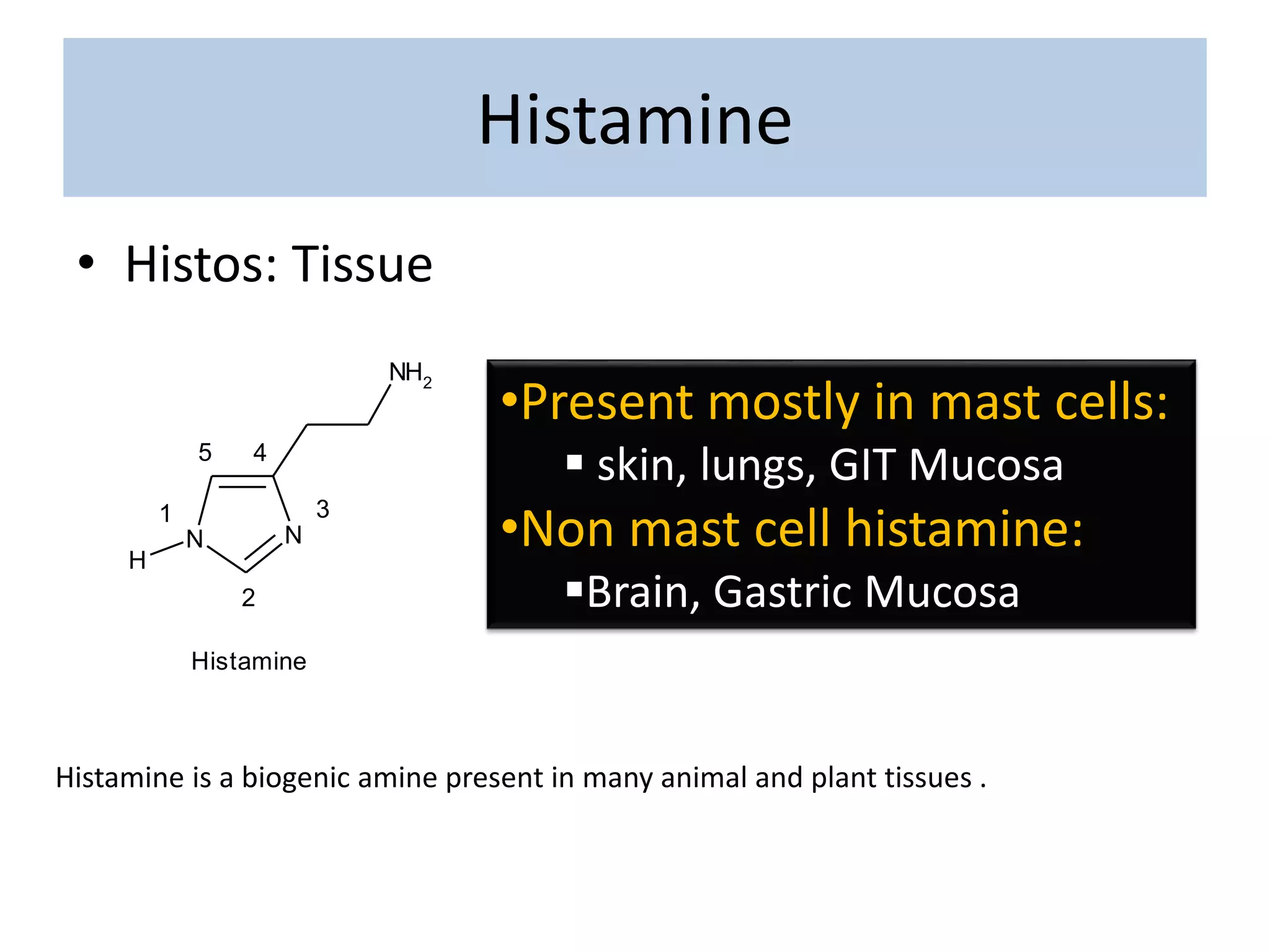
Histamine
• Histos: Tissue
N N
NH2
H
1
2
3
45
Histamine
•Present mostly in mast cells:
 skin, lungs, GIT Mucosa
•Non mast cell histamine:
Brain, Gastric Mucosa
Histamine is a biogenic amine present in many animal and plant tissues .
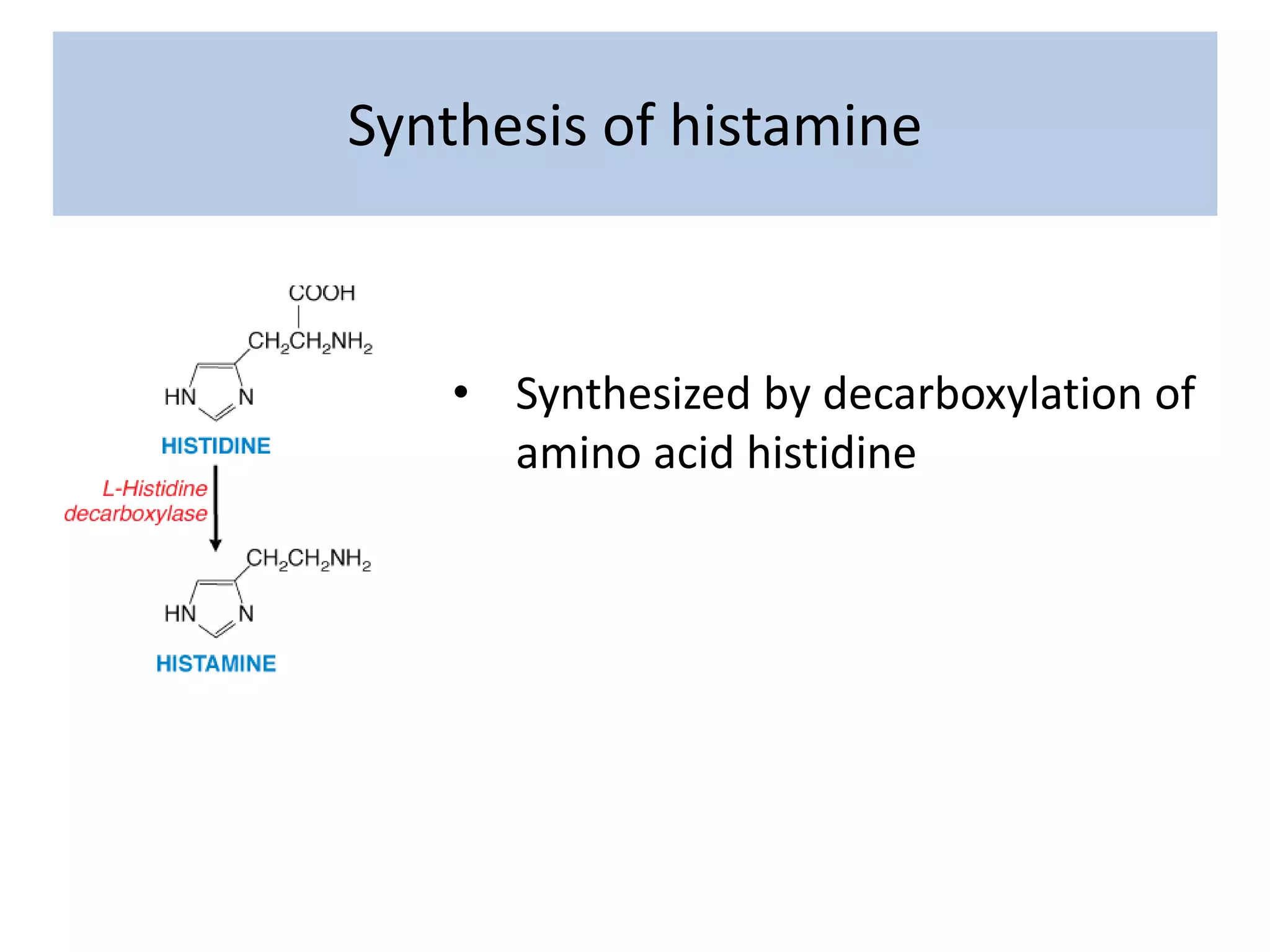
Synthesis of histamine
• Synthesized by decarboxylation of
amino acid histidine
Release of histamine
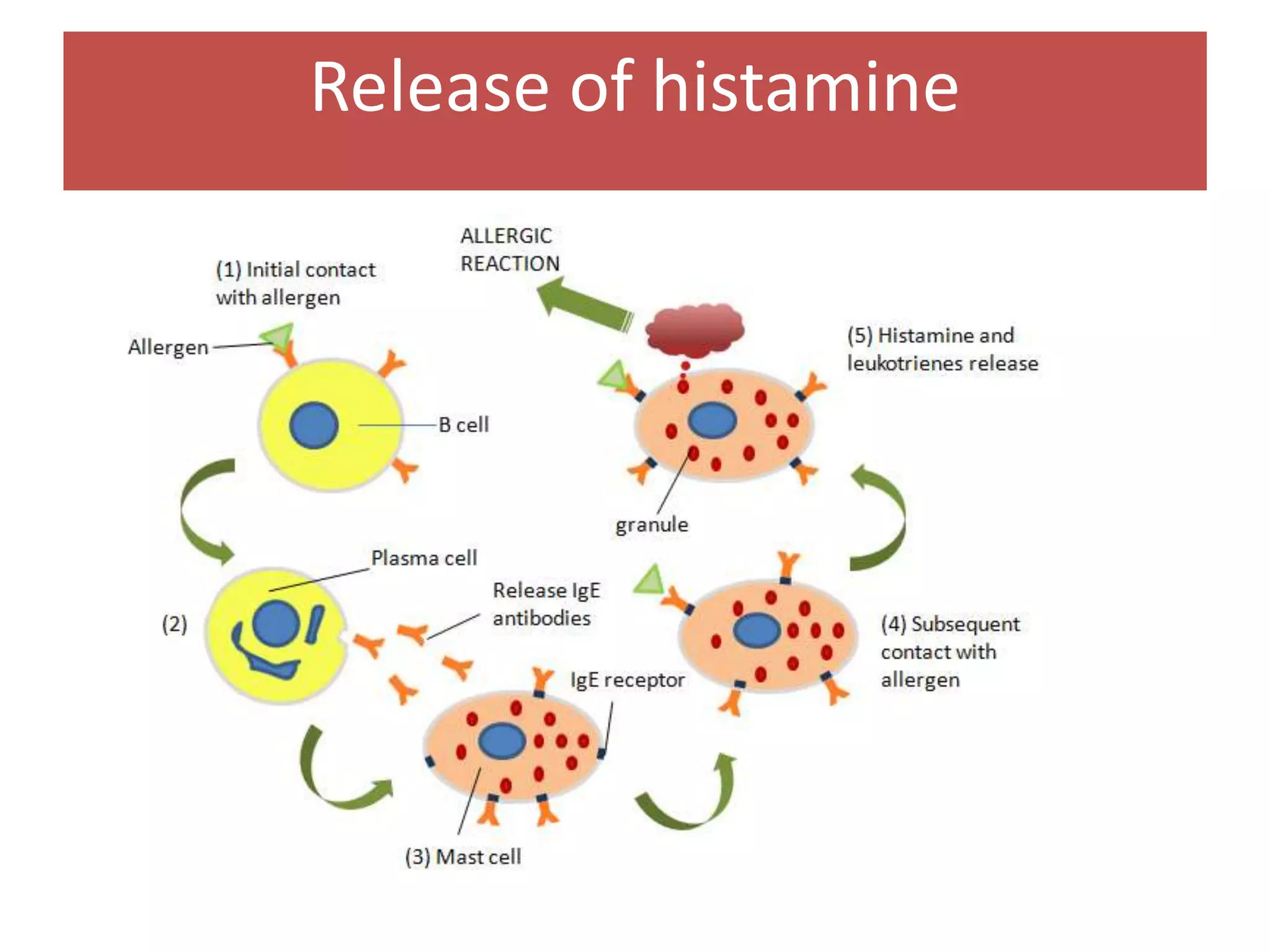
• Immunologic (Type 1 reaction)
• Chemical/ Mechanical release
– Morphine
– Succinylcholine
– D tubocurarine
– Dextran
9
Release of histamine
Histamine Receptors
Histamine
H1 Receptors H2 Receptors H3 Receptors
(presynaptic auto
receptors)
↑ Ca2+
Smooth muscle contraction
↑ capillary permeability
Vasodilation
Sensory nerve endings pain
& itching
↑ cAMP
↑ Gastric acid secretion
Blood vessels:
vasodilation
Increased capillary
permeability
↓ histamine release
↓secretion
Vasodilation
↓ cAMP
Smooth muscle,
vascular
endothelium, brain
Gastric parietal cells,
cardiac muscle,
Brain
Heart
CNS and some
peripheral nerves.
H4 Receptors
↓ cAMP
Hematopoietic
cells, gastric
mucosa.
Actions of histamine (H1)
Tissues Effects
Peripheral nerves Sensitization of afferent nerve terminals
Smooth muscles Bronchoconstriction
Intestine: contraction
Exocrine glands Increased secretions
Hypothalamus, mid brain Wakefulness
11
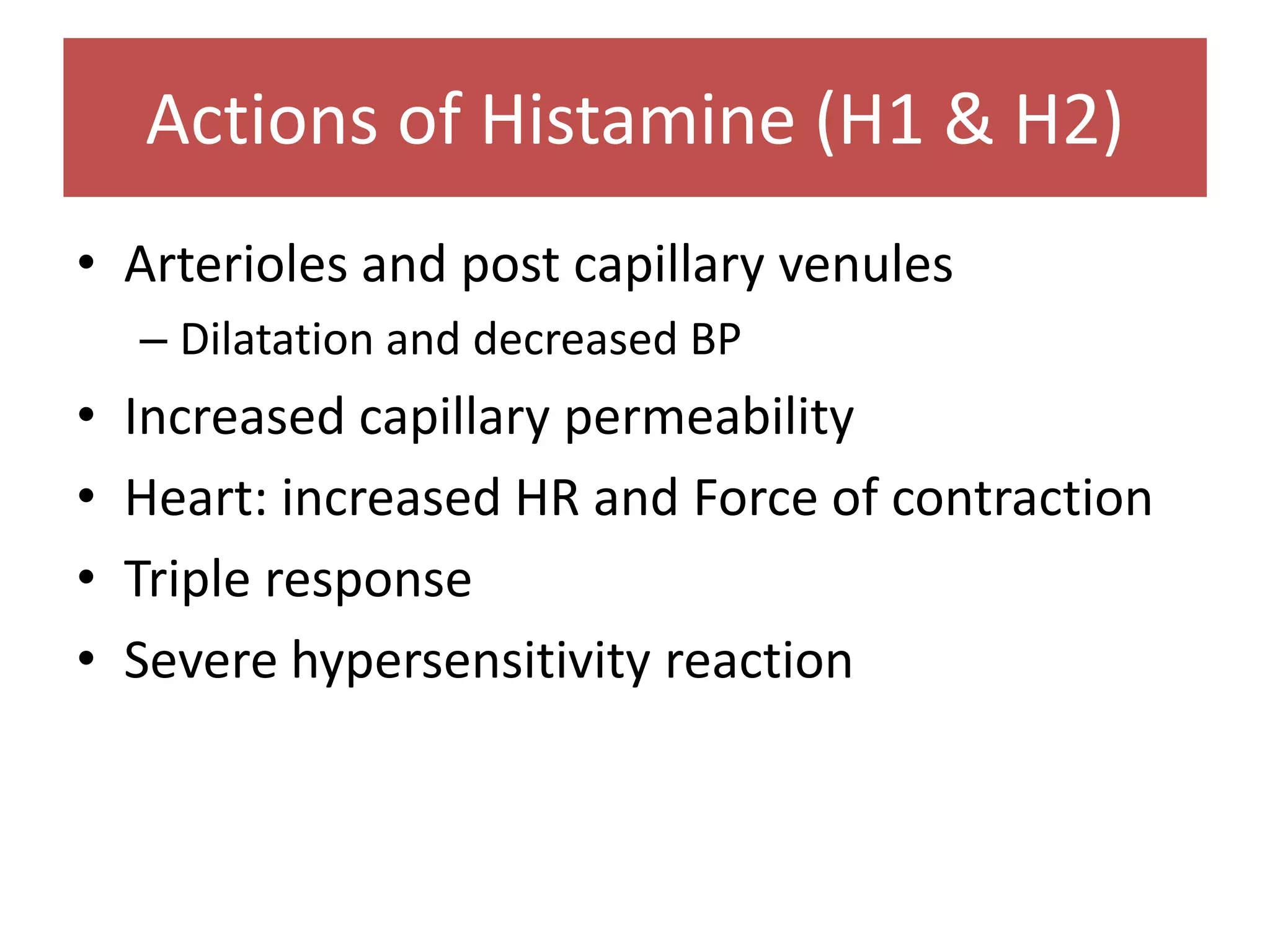
Actions of Histamine (H1 & H2)
• Arterioles and post capillary venules
– Dilatation and decreased BP
• Increased capillary permeability
• Heart: increased HR and Force of contraction
• Triple response
• Severe hypersensitivity reaction
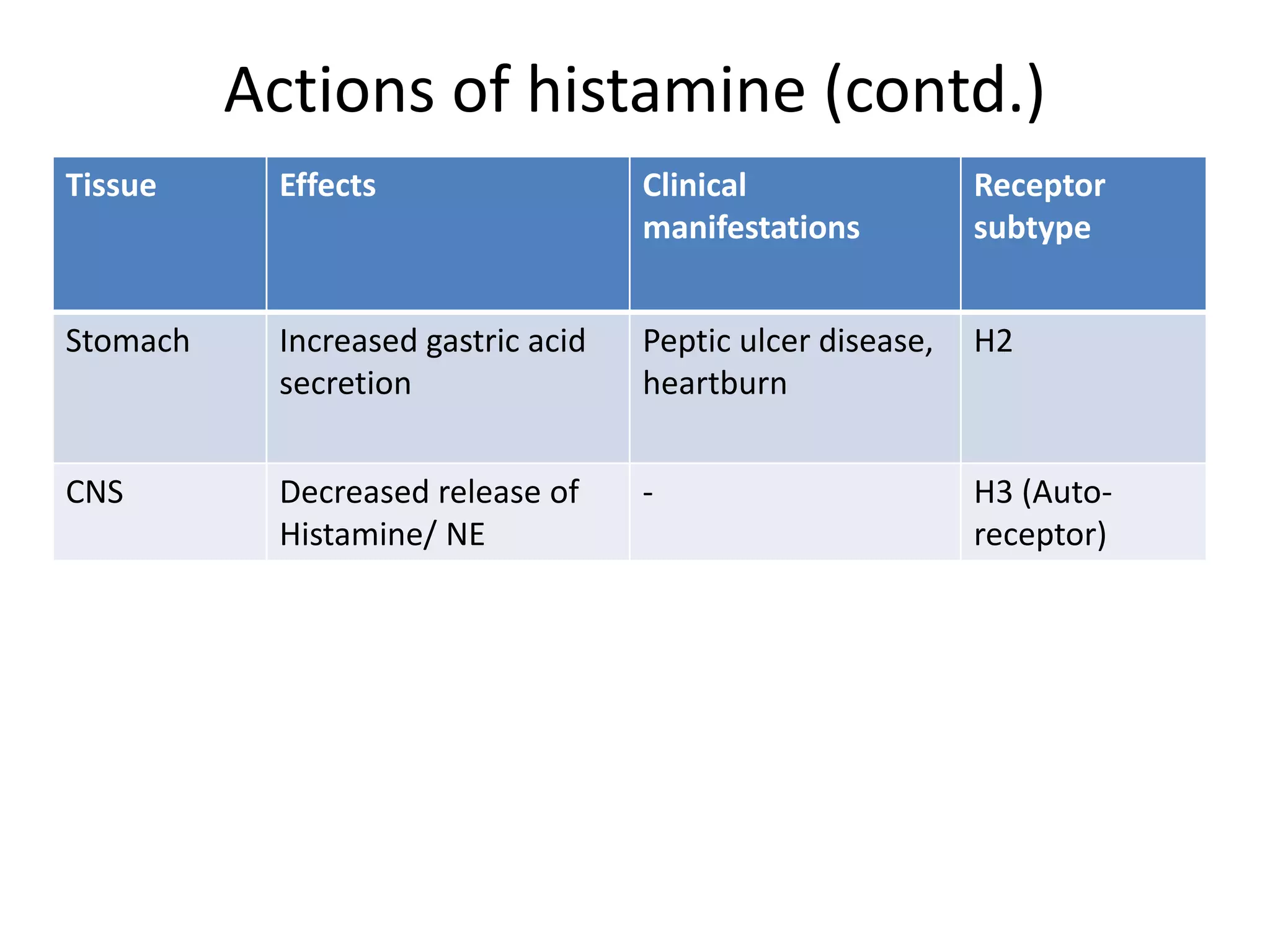
Actions of histamine (contd.)
Tissue Effects Clinical
manifestations
Receptor
subtype
Stomach Increased gastric acid
secretion
Peptic ulcer disease,
heartburn
H2
CNS Decreased release of
Histamine/ NE
- H3 (Auto-
receptor)
13
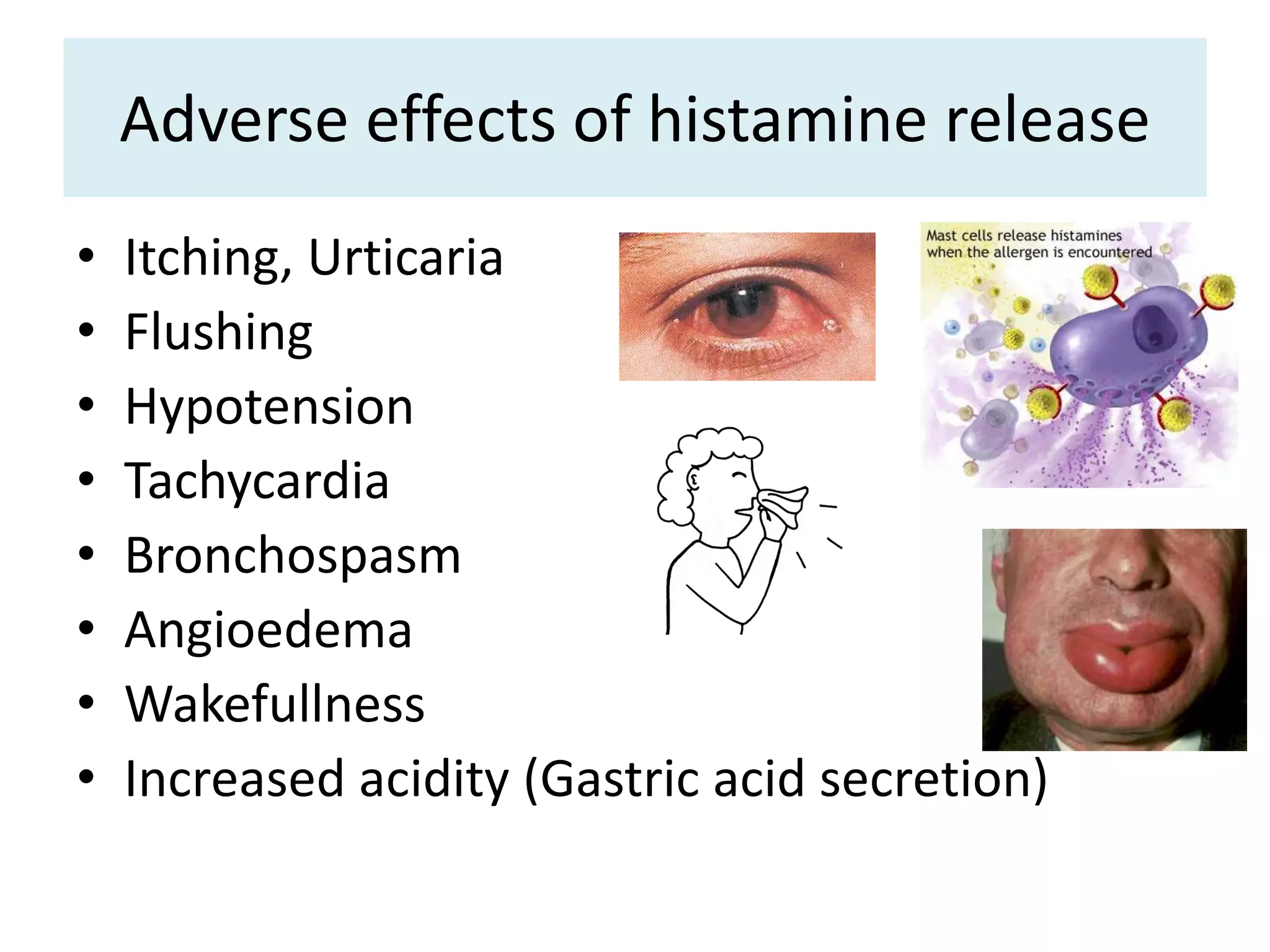
Adverse effects of histamine release
• Itching, Urticaria
• Flushing
• Hypotension
• Tachycardia
• Bronchospasm
• Angioedema
• Wakefullness
• Increased acidity (Gastric acid secretion)
Betahistine
• H1 Selective histamine analog
• Use:
– Vertigo of Meniere`s Disease
• Acts by Vasodilation in inner ear
• Contraindication
– Asthmatics
– Peptic Ulcer
Classification of antihistaminics
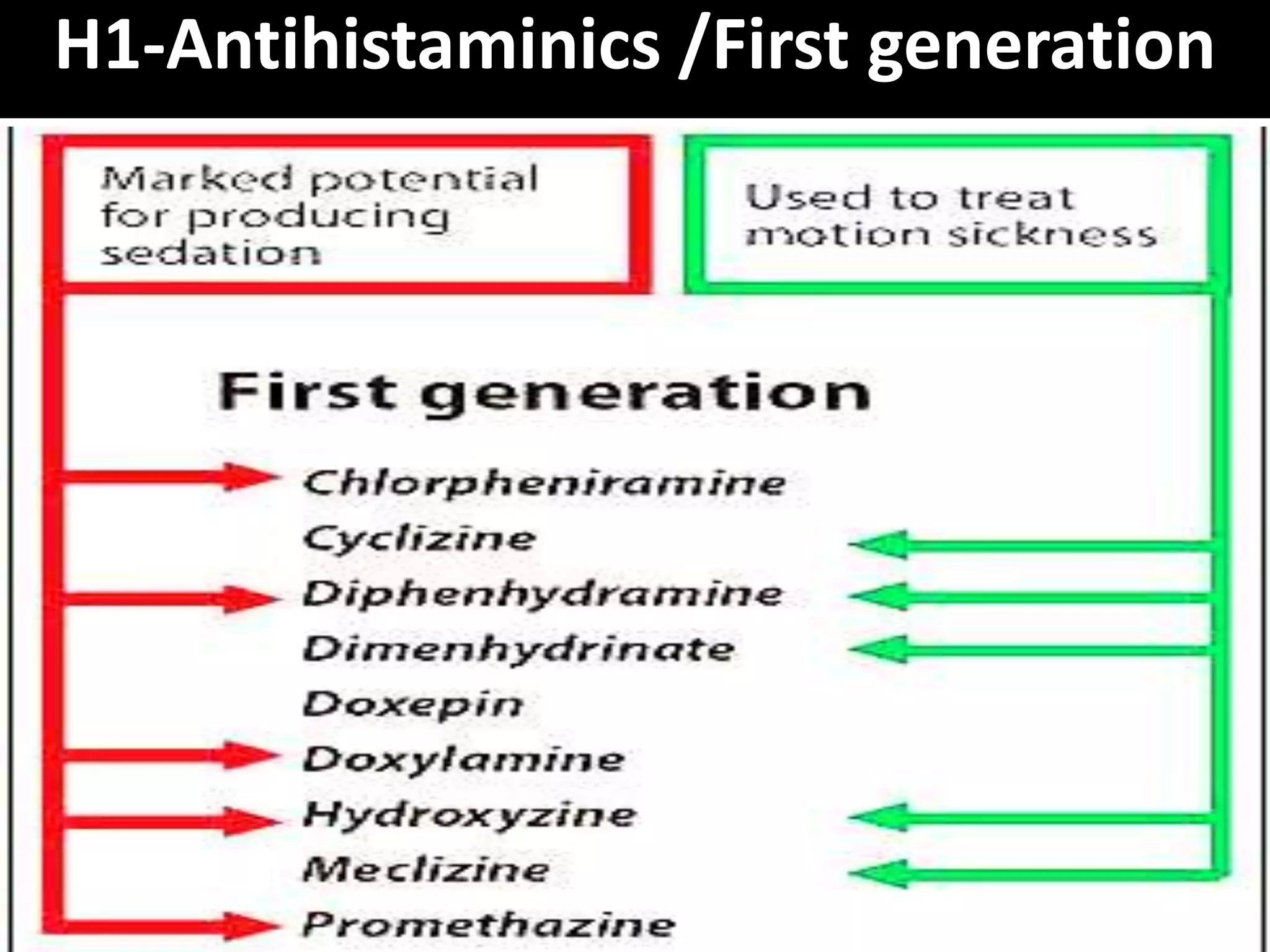
First Generation
• Diphenhydramine
• Dimenhydrinate
• Doxylamine
• Promethazine
• Hydroxyzine
• Pheniramine
• Cyroheptadine
• Meclizine
• Chlorpheniramine
• Dexchlorpheniramine
Second Generation
• Cetirizine
• Levocetirizine
• Fexofenadine
• Loratidine
• Desloratidine
• Ebastine
• Astemizole
• Acrivastine
H1-Antihistaminics /First generation
H1-Antinistaminics /second generation
Therapeutic uses
• Allergic diseases
– Rhinitis, urticaria, conjunctivitis.
– Atopic dermatitis
– Bronchial asthma
– Anaphylaxis
• Antiemetics, motion sickness, morning sickness
• Insomnia
• Preanaesthetic medication
• Cough
• Parkinsonism
• Vertigo
• Acute Muscle dystonia
19
• As Antiemetic: Hydroxyzine, promethazine
• Motion sickness and Vestibular disturbances
– first generation antihistamines like
• Diphenhydramine and Promethazine are useful
• Cyclizine and Meclizine- less sedative
• Morning sickness: Doxylamine
20
THERAPEUTIC USES
Uses: second Generation Antihistamines
• Allergies
Reduce symptoms of itching,
sneezing, rhinorrhea and allergic
conjunctivitis
21
Topical preparations-
Azelastine
Olopatadine
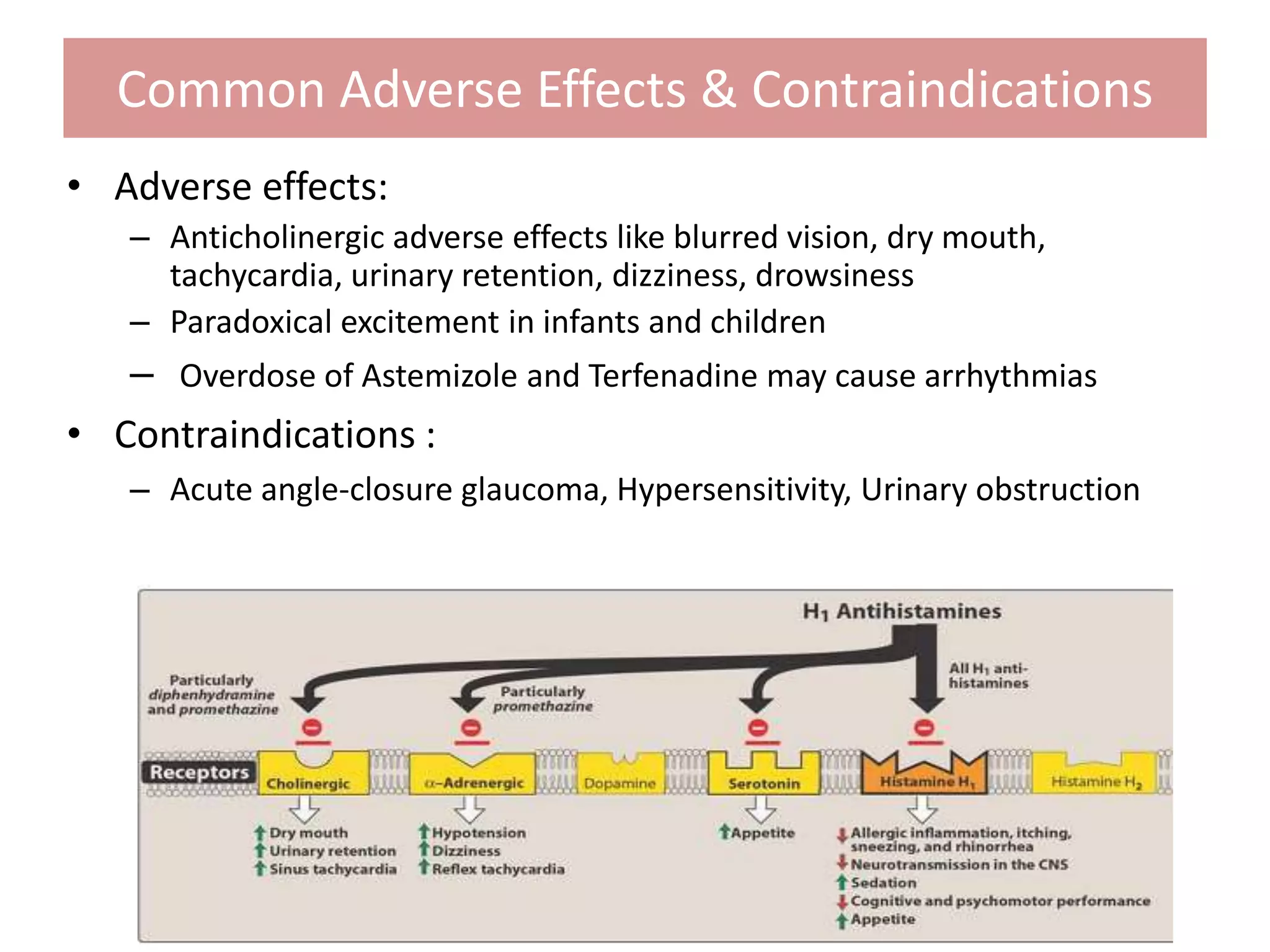
Common Adverse Effects & Contraindications
• Adverse effects:
– Anticholinergic adverse effects like blurred vision, dry mouth,
tachycardia, urinary retention, dizziness, drowsiness
– Paradoxical excitement in infants and children
– Overdose of Astemizole and Terfenadine may cause arrhythmias
• Contraindications :
– Acute angle-closure glaucoma, Hypersensitivity, Urinary obstruction
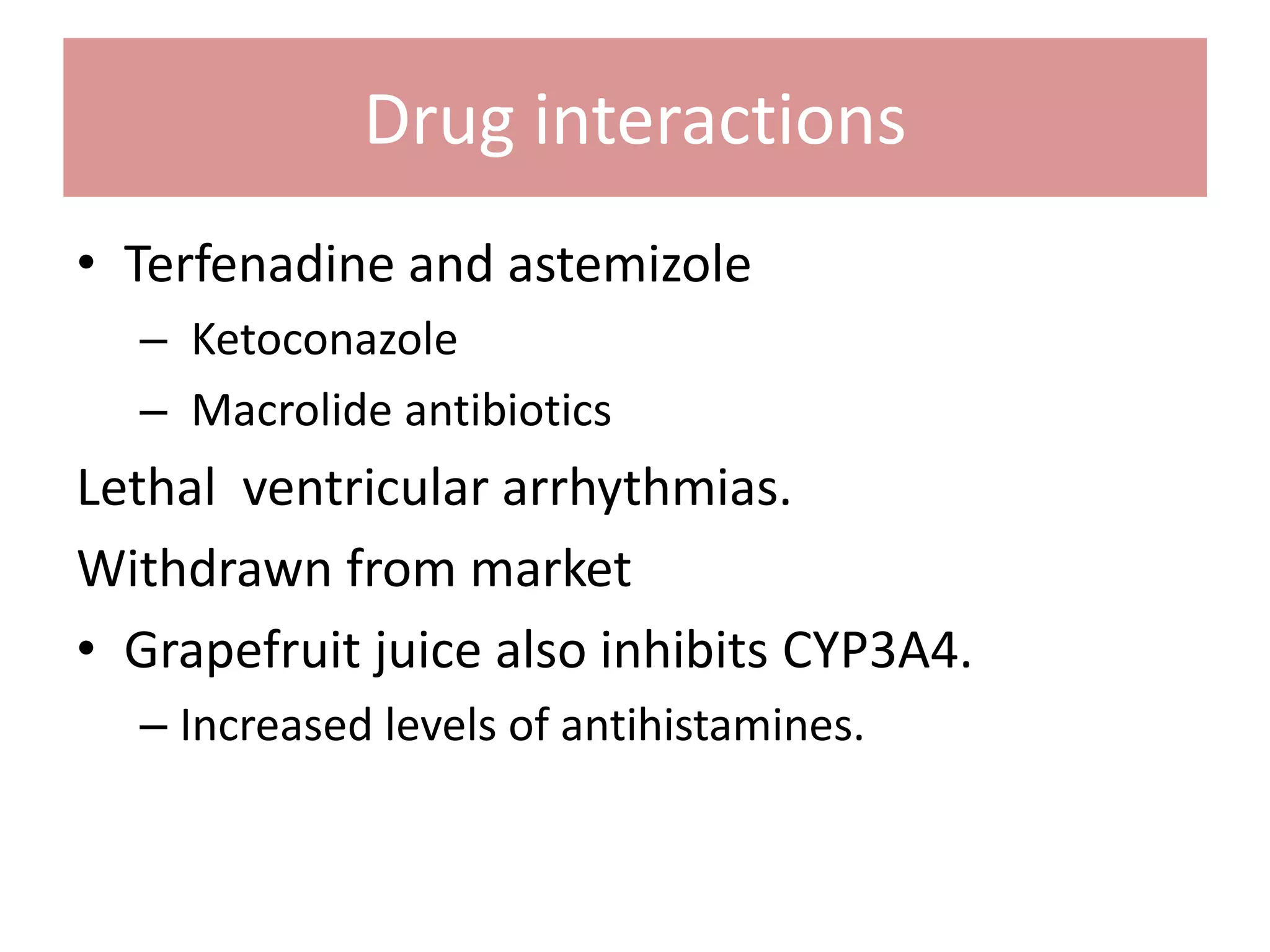
Drug interactions
• Terfenadine and astemizole
– Ketoconazole
– Macrolide antibiotics
Lethal ventricular arrhythmias.
Withdrawn from market
• Grapefruit juice also inhibits CYP3A4.
– Increased levels of antihistamines.
23
Mechanism of action
Competitive antagonism
Histamine General formula of H1 Blocker
Second generation H1 Blockers
(Non Sedative:Less anticholinergic property)
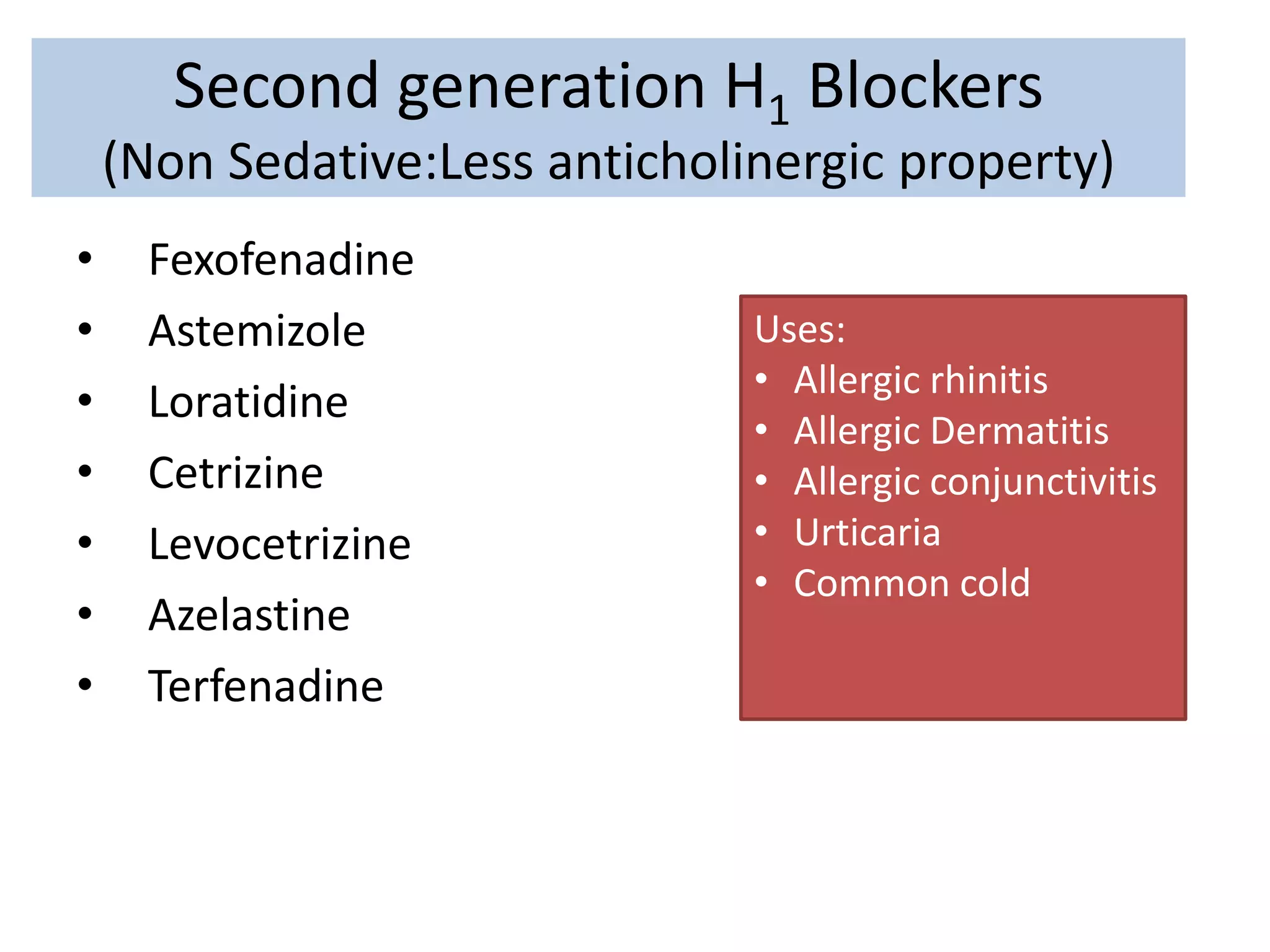
• Fexofenadine
• Astemizole
• Loratidine
• Cetrizine
• Levocetrizine
• Azelastine
• Terfenadine
Uses:
• Allergic rhinitis
• Allergic Dermatitis
• Allergic conjunctivitis
• Urticaria
• Common cold
Advantages of second generation
antihistaminics
• They have no anticholinergic side effects
• Do not cross blood brain barrier (BBB), hence
cause minimal or no drowsiness and sedation
• Do not impair Psychomotor performance
Summary
• Histamine
• Antihistaminics
– First generation
– Second generation

Histamine and antihistaminic

  • 1.
  • 2.
    Case study • A24-year-old male, John develops a runny nose, itchy eyes, and sneezing every winter. • To relieve his symptoms, he takes an OTC antihistamine • John is annoyed by the unpleasant effects that accompany his allergy medication. Every time he takes this antihistamine, he feels drowsy and his mouth feels dry. • He makes an appointment with his doctor who, advises him to take loratadine. Upon taking new allergy medication, his symptoms are relieved, and he experiences no drowsiness or other adverse effects.
  • 3.
    Questions • What IsJohns Problem • Which OTC is probably John taking? • What is the reason of drowsiness and dryness of mouth in John ? • What is loratadine?Why did Physician prescribe it for John?
  • 4.
    Objectives • Describe thepharmacology of histamine & enumerate its related drugs. • Classify Histamine-1(H1) antagonists. • Discuss the pharmacology of H1 Antihistaminics with emphasis on clinical uses, adverse drug reactions & interactions 4
  • 5.
    What are Autacoids •Autos = self; Akos = remedy (Greek). • Secreted locally to increase or decrease the activity of nearby cells. • Includes – Amine autocoids: Histamine, Serotonin – Lipid derived: Prostaglandins and Leukotrines – Peptides: Bradykinin, angiotensin – Others: Cytokines 5
  • 6.
    Histamine • Histos: Tissue NN NH2 H 1 2 3 45 Histamine •Present mostly in mast cells:  skin, lungs, GIT Mucosa •Non mast cell histamine: Brain, Gastric Mucosa Histamine is a biogenic amine present in many animal and plant tissues .
  • 7.
    Synthesis of histamine •Synthesized by decarboxylation of amino acid histidine
  • 8.
    Release of histamine •Immunologic (Type 1 reaction) • Chemical/ Mechanical release – Morphine – Succinylcholine – D tubocurarine – Dextran
  • 9.
  • 10.
    Histamine Receptors Histamine H1 ReceptorsH2 Receptors H3 Receptors (presynaptic auto receptors) ↑ Ca2+ Smooth muscle contraction ↑ capillary permeability Vasodilation Sensory nerve endings pain & itching ↑ cAMP ↑ Gastric acid secretion Blood vessels: vasodilation Increased capillary permeability ↓ histamine release ↓secretion Vasodilation ↓ cAMP Smooth muscle, vascular endothelium, brain Gastric parietal cells, cardiac muscle, Brain Heart CNS and some peripheral nerves. H4 Receptors ↓ cAMP Hematopoietic cells, gastric mucosa.
  • 11.
    Actions of histamine(H1) Tissues Effects Peripheral nerves Sensitization of afferent nerve terminals Smooth muscles Bronchoconstriction Intestine: contraction Exocrine glands Increased secretions Hypothalamus, mid brain Wakefulness 11
  • 12.
    Actions of Histamine(H1 & H2) • Arterioles and post capillary venules – Dilatation and decreased BP • Increased capillary permeability • Heart: increased HR and Force of contraction • Triple response • Severe hypersensitivity reaction
  • 13.
    Actions of histamine(contd.) Tissue Effects Clinical manifestations Receptor subtype Stomach Increased gastric acid secretion Peptic ulcer disease, heartburn H2 CNS Decreased release of Histamine/ NE - H3 (Auto- receptor) 13
  • 14.
    Adverse effects ofhistamine release • Itching, Urticaria • Flushing • Hypotension • Tachycardia • Bronchospasm • Angioedema • Wakefullness • Increased acidity (Gastric acid secretion)
  • 15.
    Betahistine • H1 Selectivehistamine analog • Use: – Vertigo of Meniere`s Disease • Acts by Vasodilation in inner ear • Contraindication – Asthmatics – Peptic Ulcer
  • 16.
    Classification of antihistaminics FirstGeneration • Diphenhydramine • Dimenhydrinate • Doxylamine • Promethazine • Hydroxyzine • Pheniramine • Cyroheptadine • Meclizine • Chlorpheniramine • Dexchlorpheniramine Second Generation • Cetirizine • Levocetirizine • Fexofenadine • Loratidine • Desloratidine • Ebastine • Astemizole • Acrivastine
  • 17.
  • 18.
  • 19.
    Therapeutic uses • Allergicdiseases – Rhinitis, urticaria, conjunctivitis. – Atopic dermatitis – Bronchial asthma – Anaphylaxis • Antiemetics, motion sickness, morning sickness • Insomnia • Preanaesthetic medication • Cough • Parkinsonism • Vertigo • Acute Muscle dystonia 19
  • 20.
    • As Antiemetic:Hydroxyzine, promethazine • Motion sickness and Vestibular disturbances – first generation antihistamines like • Diphenhydramine and Promethazine are useful • Cyclizine and Meclizine- less sedative • Morning sickness: Doxylamine 20 THERAPEUTIC USES
  • 21.
    Uses: second GenerationAntihistamines • Allergies Reduce symptoms of itching, sneezing, rhinorrhea and allergic conjunctivitis 21 Topical preparations- Azelastine Olopatadine
  • 22.
    Common Adverse Effects& Contraindications • Adverse effects: – Anticholinergic adverse effects like blurred vision, dry mouth, tachycardia, urinary retention, dizziness, drowsiness – Paradoxical excitement in infants and children – Overdose of Astemizole and Terfenadine may cause arrhythmias • Contraindications : – Acute angle-closure glaucoma, Hypersensitivity, Urinary obstruction
  • 23.
    Drug interactions • Terfenadineand astemizole – Ketoconazole – Macrolide antibiotics Lethal ventricular arrhythmias. Withdrawn from market • Grapefruit juice also inhibits CYP3A4. – Increased levels of antihistamines. 23
  • 24.
    Mechanism of action Competitiveantagonism Histamine General formula of H1 Blocker
  • 25.
    Second generation H1Blockers (Non Sedative:Less anticholinergic property) • Fexofenadine • Astemizole • Loratidine • Cetrizine • Levocetrizine • Azelastine • Terfenadine Uses: • Allergic rhinitis • Allergic Dermatitis • Allergic conjunctivitis • Urticaria • Common cold
  • 26.
    Advantages of secondgeneration antihistaminics • They have no anticholinergic side effects • Do not cross blood brain barrier (BBB), hence cause minimal or no drowsiness and sedation • Do not impair Psychomotor performance
  • 27.
    Summary • Histamine • Antihistaminics –First generation – Second generation

Editor's Notes

  • #6 Autocoids are local hormones produced by different tissues or endothelial cells. How do they differ from hormones: Non specific cells secrete them, act locally What Is the role of autocoids: Inflammation, injury, immunological reactions, neurotransmitters or modulators in brain
  • #7 Natural constituent of many mammalian tissues, hence the word ‘histamine’ is derived from the greek word ‘histos’ which means tissue Widely distributed. Present in bacteria, plants, animals and venoms and stinging fluids (stinging nettle, insect stings, bee venom). High amounts found in lung, skin and GI tract. In tissues, mast cells are the predominant site for storage & in blood, histamine is stored in basophils.
  • #8 Slowly turning over pool- in mast cells and basophils Release involves complete degranulation of cells. Several weeks required to replenish the stores. Rapidly turning over pool In gastric ECL cells and histaminergic CNS neurons. Synthesis and release depend on stimuli.
  • #9 VENOMS, STINGS, HEAT, COLD, SUNLIGHT
  • #10 Immunologic: Mast cells & basophils, if sensitized by IgE antibodies attached to their surface membranes Mediator in type I allergic reaction
  • #11 Four types of receptors- H1 , H2, H3 and H4. All are G-protein coupled receptors. Some wide actions are mediated by both (H1 and H2) receptors.
  • #15 Pathophysiological role of histamine: Gastric secretion Allergy Wakefulness Inflammation Tissue growth and repair Headache
  • #17 Cetirizine is active metabolite of hydroxyzine Fexofenadine is active metabolite of terfenadine
  • #26 Azelastine H1 blocker, also decrease histamine release, PAF & Leukotriene release Good topical activity T ½ = 24 hrs, also have active metabolite Nasal spray: 0.14 mg/puff/nasal spray, 2 puffs per day for seasonal and perennial allergic rhinitis