CEPHALOSPORINS
Dr Naser Ashraf Tadvi
Associate Professor
Department of
Pharmacology
Ayaan Institute of Medical
Sciences
CEPHALOSPORINS
•The cephalosporins are β-Lactam antibiotics
closely structurally and functionally to the
penicillins.
•Mechanism of action, mechanism of resistance
and some other properties of cephalosporins
are identical to penicillins)
•Cephalosporins are one of the most widely
used antibiotics and are equal in importance to
penicillin.
HISTORY OF CEPHALOSPORINS
•In 1945 Giuseppe Brotzu`s discovered that cultures
of Cephalosporium acremonium inhibited the growth
of a wide variety of Gram-positive and Gram-negative
bacteria.
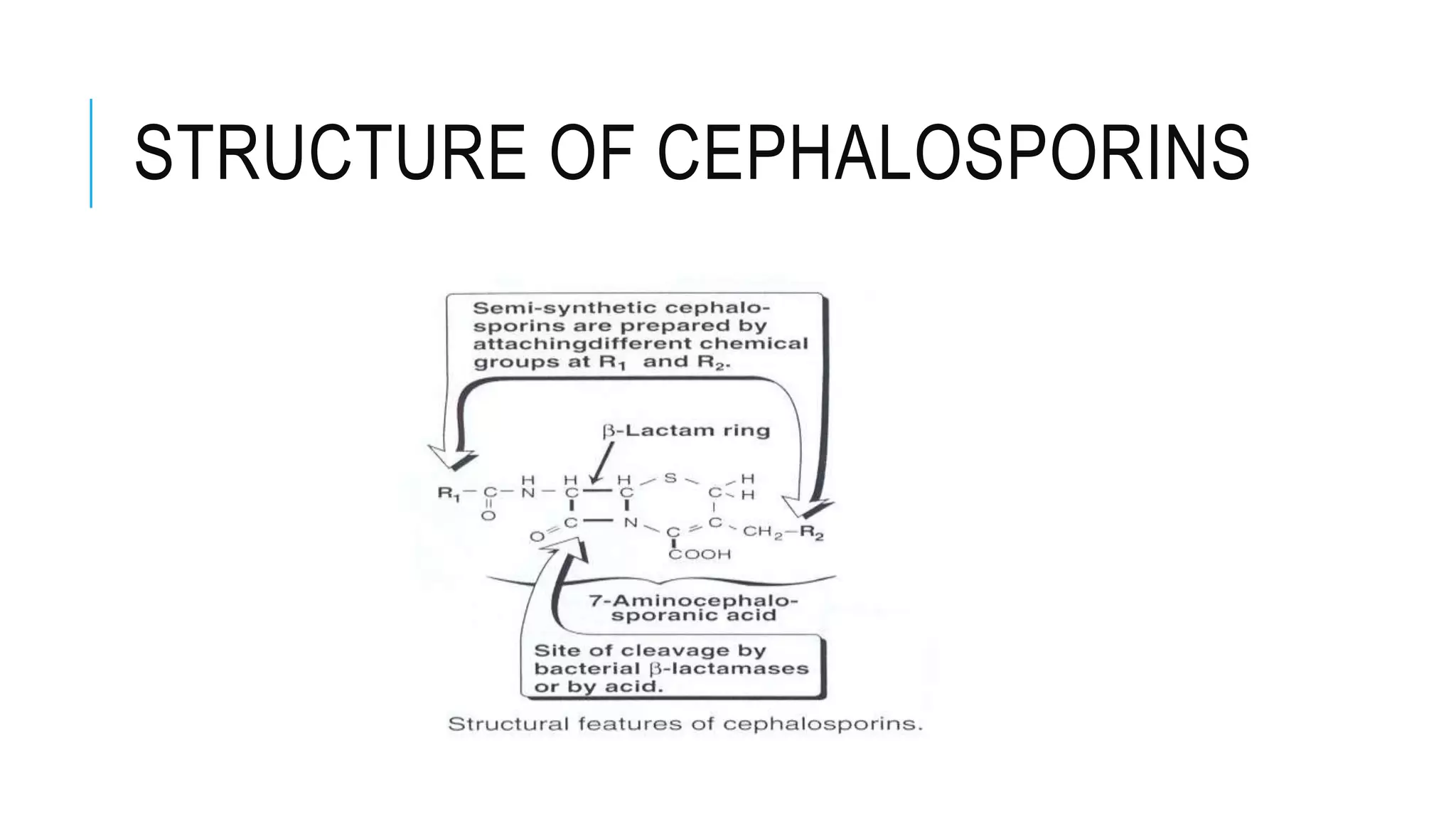
STRUCTURE OF CEPHALOSPORINS
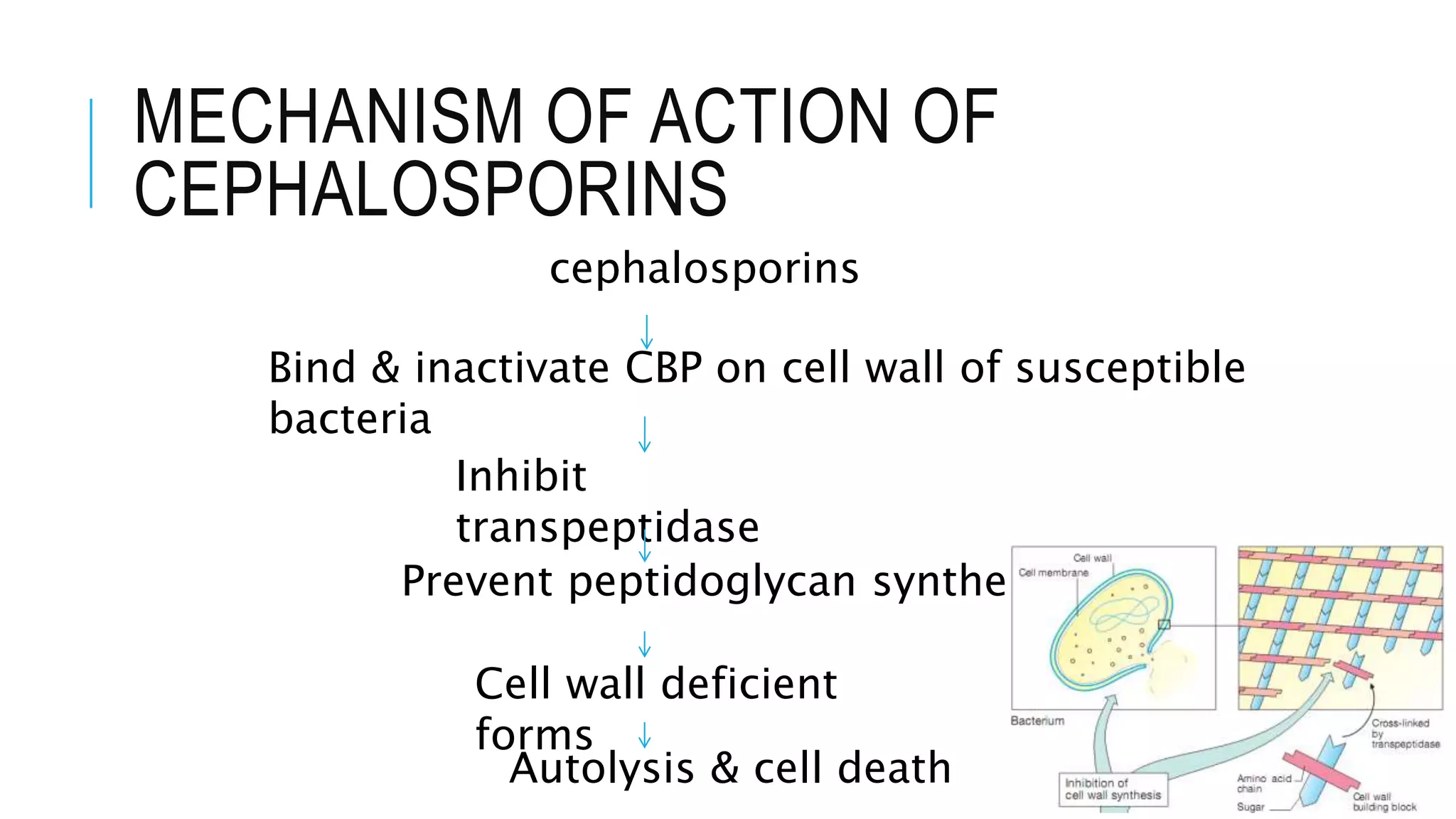
MECHANISM OF ACTION OF
CEPHALOSPORINS
cephalosporins
Bind & inactivate CBP on cell wall of susceptible
bacteria
Inhibit
transpeptidase
Autolysis & cell death
Prevent peptidoglycan synthesis
Cell wall deficient
forms
MECHANISMS OF RESISTANCE
•Alteration of binding site.
•Decrease permeability.
•Production of β–lactamase enzymes (enzymatic
inactivation)
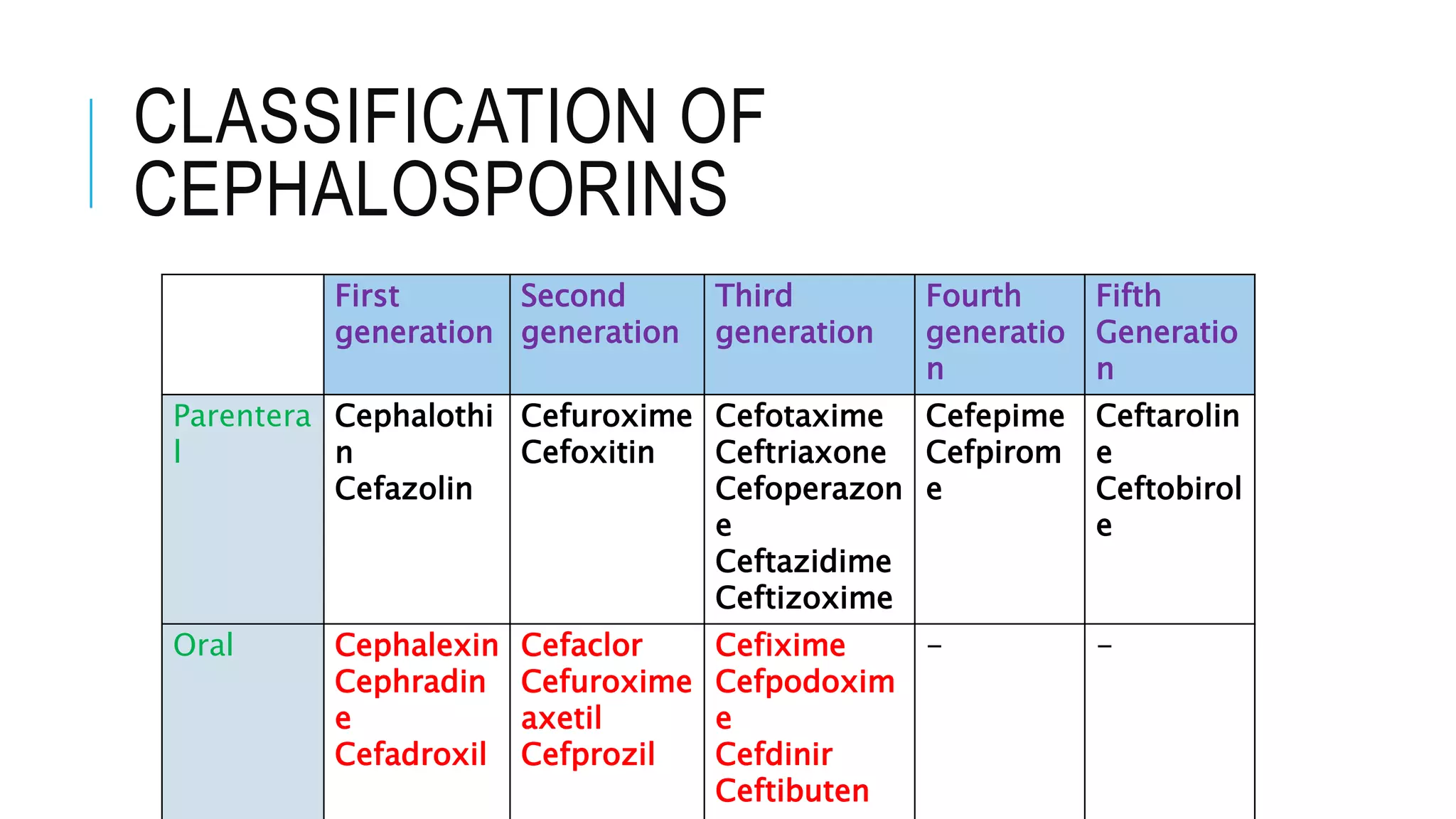
CLASSIFICATION OF
CEPHALOSPORINS
First
generation
Second
generation
Third
generation
Fourth
generatio
n
Fifth
Generatio
n
Parentera
l
Cephalothi
n
Cefazolin
Cefuroxime
Cefoxitin
Cefotaxime
Ceftriaxone
Cefoperazon
e
Ceftazidime
Ceftizoxime
Cefepime
Cefpirom
e
Ceftarolin
e
Ceftobirol
e
Oral Cephalexin
Cephradin
e
Cefadroxil
Cefaclor
Cefuroxime
axetil
Cefprozil
Cefixime
Cefpodoxim
e
Cefdinir
Ceftibuten
- -
FIRST GENERATION
CEPHALOSPORINS (SPECTRUM OF
ACTION)
+Cocc
i
-
Bacilli
>
Streptococ
ci
Pneumoco
cci
MSSA
Proteus
Ecoli
Klebsiella
Peptococci
PHARMACOKINETICS
• Oral cephalosporins are well absorbed
• Do not cross BBB
• Primarily excreted by the kidney
• Probenecid prolongs their half life
• All administered 6-8 hourly except cefadroxil which
is administered 12 hourly
INDICATIONS / USES
• Not used for serious infections and ineffective in
meningitis
• Minor staphylococcal infections
• Infections like cellulitis and soft tissue abscess
• Cefazolin has better penetration to tissues hence is
drug of choice for surgical prophylaxis before cardiac
surgery and orthopedic prosthesis procedures
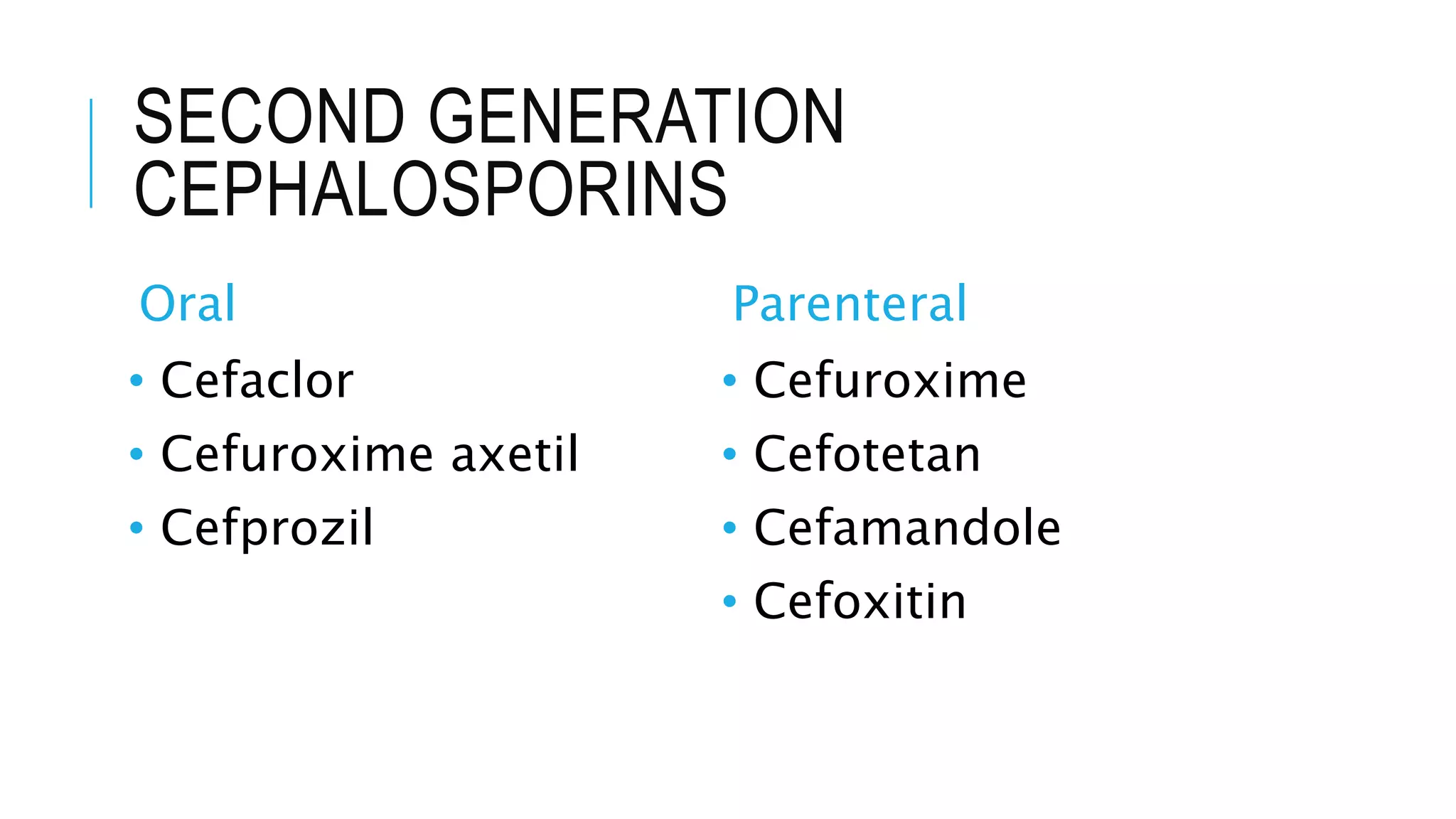
SECOND GENERATION
CEPHALOSPORINS
Oral
• Cefaclor
• Cefuroxime axetil
• Cefprozil
Parenteral
• Cefuroxime
• Cefotetan
• Cefamandole
• Cefoxitin
SECOND GENERATION
CEPHALOSPORINS (SPECTRUM OF
ACTION)
+Cocc
i-
Bacilli
-
Cocci >
Extended Gram -ve
coverage
H Influenzae
N. Gonorrhoeae
Proteus
E coli
Klebsiella
Less active
against gram
positive cocci
and bacilli
than 1st
Generation
S pneumoniae
S Pyogenes
PHARMACOKINETICS
• cefaclor, cefprozil, cefuroxime axetil good oral bioavailability
• Only cefuroxime crosses BBB & achieves therapeutic concentration in
CSF
• More stable to beta lactamases except cefaclor
• Intramuscular injections are painful
•Excreted unchanged in Kidney
INDICATIONS/ USES
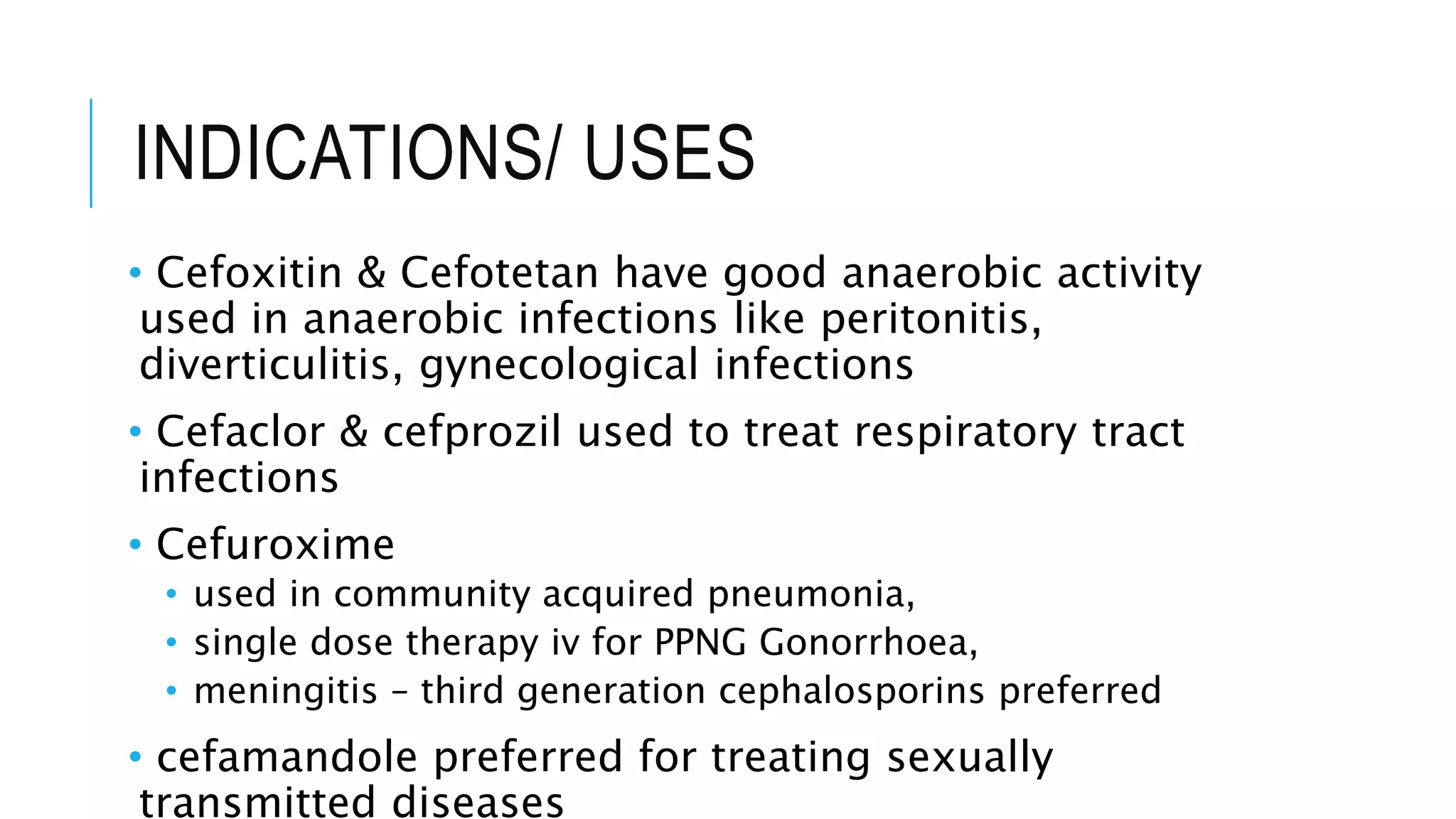
• Cefoxitin & Cefotetan have good anaerobic activity
used in anaerobic infections like peritonitis,
diverticulitis, gynecological infections
• Cefaclor & cefprozil used to treat respiratory tract
infections
• Cefuroxime
• used in community acquired pneumonia,
• single dose therapy iv for PPNG Gonorrhoea,
• meningitis – third generation cephalosporins preferred
• cefamandole preferred for treating sexually
transmitted diseases
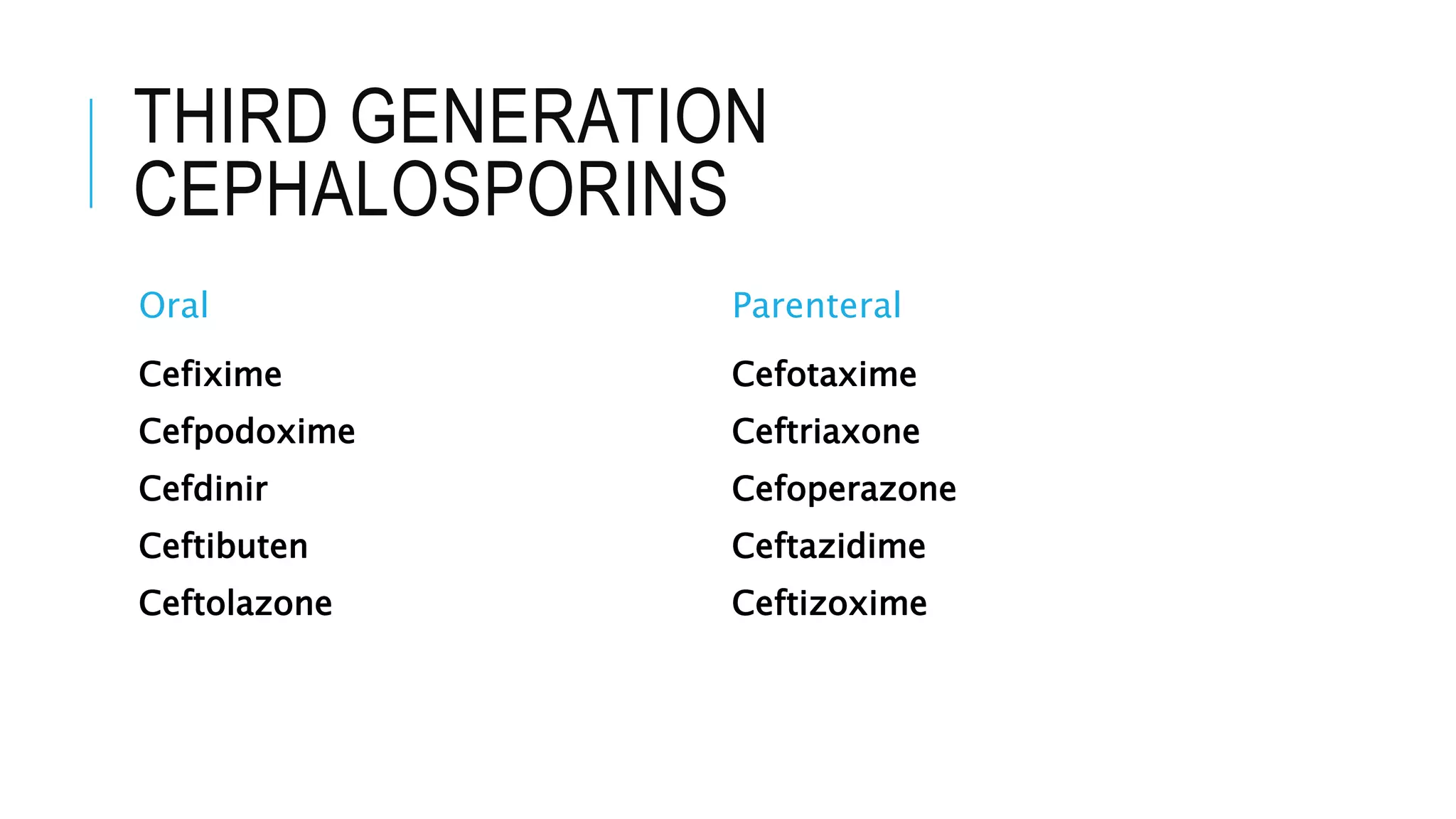
THIRD GENERATION
CEPHALOSPORINS
Oral
Cefixime
Cefpodoxime
Cefdinir
Ceftibuten
Ceftolazone
Parenteral
Cefotaxime
Ceftriaxone
Cefoperazone
Ceftazidime
Ceftizoxime
THIRD GENERATION
CEPHALOSPORINS (SPECTRUM OF
ACTION)
+Cocc
i-
Bacilli +
Bacilli
-
Cocci
>
Highly effective
H Influenzae
Enterobacter
N. Gonorrhoeae,
Meningitis
Proteus
E coli
Klebsiella
Less active
against gram
positive cocci
than 1st
GenerationAnaerobes
Cefoperazone and
Ceftazidime effective
against Pseudomonas
PHARMACOKINETICS
• All can cross BBB
• Ceftriaxone has t½ : 7-8 hours and high plasma protein
binding 90%
• Cefotaxime metabolized to active metabolite
• Cefoperazone and ceftriaxone excreted through bile
• All others major route of excretion is urinary
INDICATIONS/ USES
• Serious infections caused by: Klebsiella, Enterobacter,
Proteus, Haemophilus species.
• Gonorrhoea: Ceftriaxone DOC for all forms
• Meningitis :
 Cefotaxime= 1gm 6- 12 hrly , ceftriaxone = 4 gm then 2 gm IV daily OD
for 7to 10 days
Ceftazidime + aminoglycoside is the drug of choice for Pseudomonas
meningitis
•UTI: Cefixime, Cefpodoxime 200- 400 mg BD
INDICATIONS/ USES
•Respiratory tract infections:
Community acquired pneumonia, chronic bronchitis,
otitis media, sinusitis, pharyngitis.
• Typhoid:
ceftriaxone 4 gm IV daily for 2 days then 2 gm daily
till fever subsides
Oral cefixime 200 mg BD
FOURTH GENERATION
CEPHALOSPORINS
• cefipime, cefpirome, cefozopran
• Methicillin-sensitive Staphylococcus aureus
• Streptococcus
Gram +
• HENPEcK.
• Serratia
• Acinetobacter
• Pseudomonas aeruginosa
Gram -
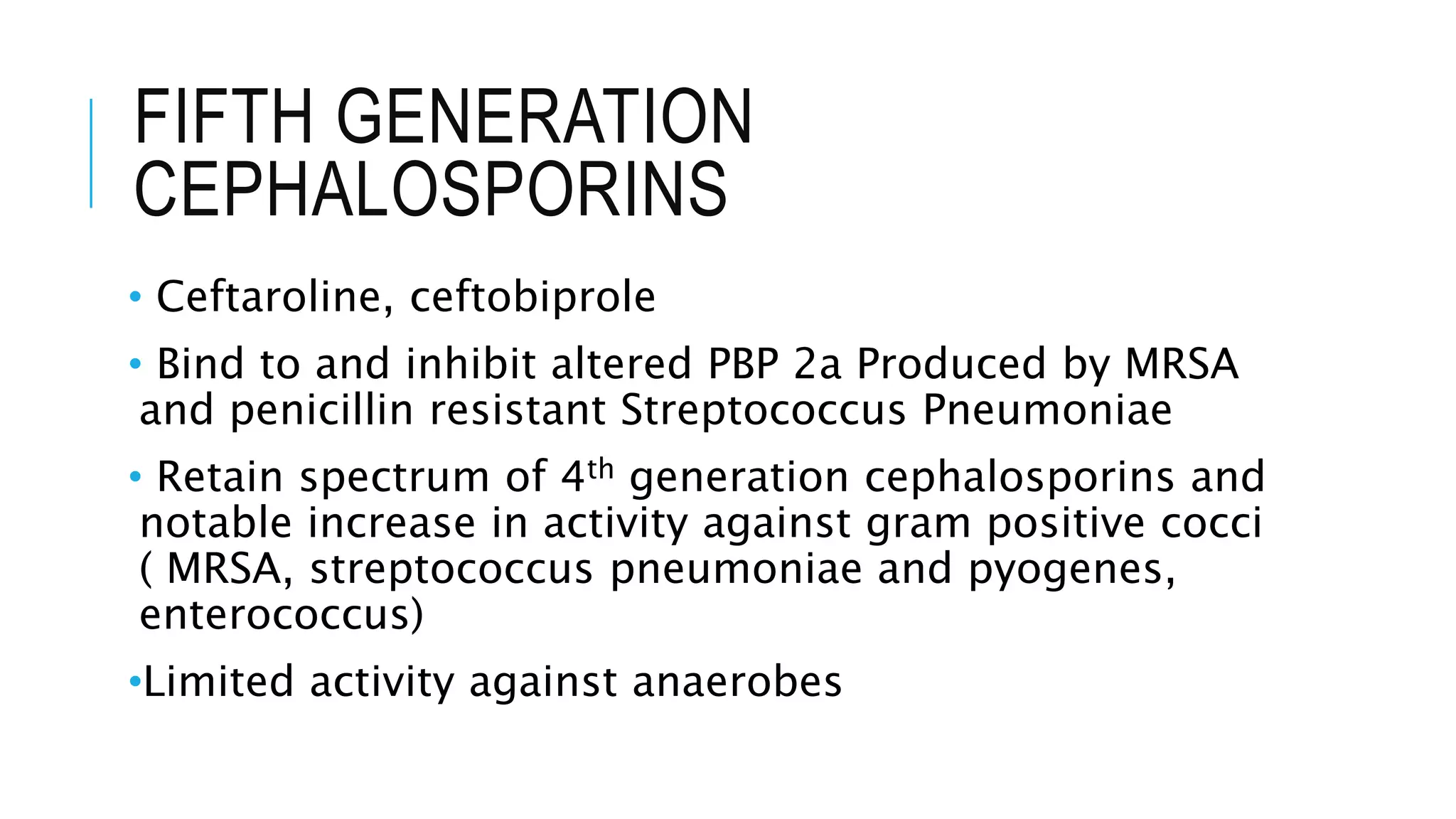
FIFTH GENERATION
CEPHALOSPORINS
• Ceftaroline, ceftobiprole
• Bind to and inhibit altered PBP 2a Produced by MRSA
and penicillin resistant Streptococcus Pneumoniae
• Retain spectrum of 4th generation cephalosporins and
notable increase in activity against gram positive cocci
( MRSA, streptococcus pneumoniae and pyogenes,
enterococcus)
•Limited activity against anaerobes
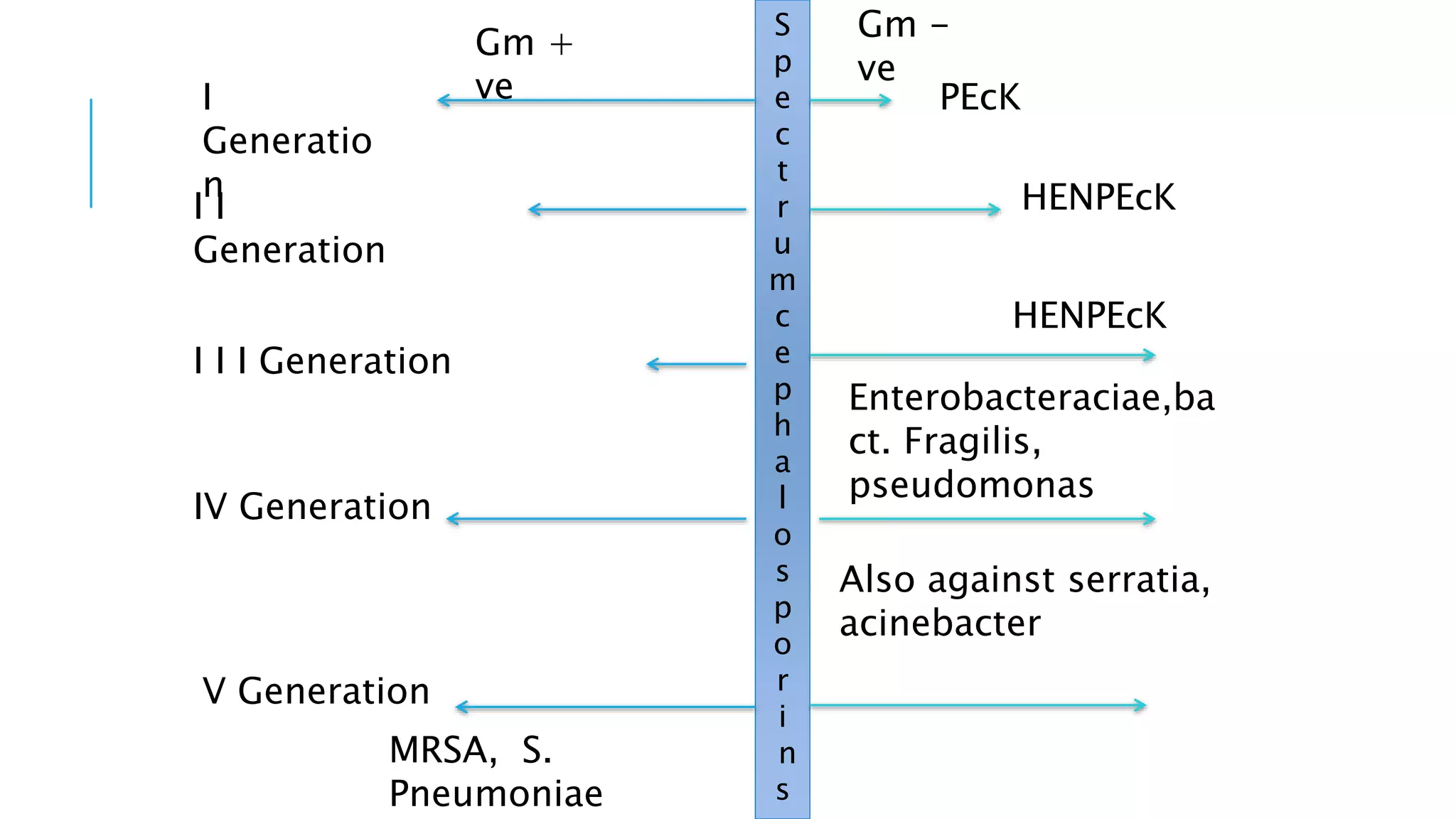
S
p
e
c
t
r
u
m
c
e
p
h
a
l
o
s
p
o
r
i
n
s
I
Generatio
n
Gm -
ve
PEcK
Gm +
ve
HENPEcK
HENPEcK
Enterobacteraciae,ba
ct. Fragilis,
pseudomonas
I I
Generation
I I I Generation
IV Generation
Also against serratia,
acinebacter
V Generation
MRSA, S.
Pneumoniae
ADVERSE EFFECTS
• Allergic and hypersensitivity reactions
• Disulfiram-like effect: cefamandole, cefaperazone
• Bleeding: cefamandole, & cefoperazone
• Nephrotoxicity: Cephalothine
• Ceftriaxone: pseudolithiasis
• Neutropenia & thrombocytopenia: ceftazidime
• Superinfection, pseudomembranous enterocolitis and diarrhoea :
• Pain at the injection site
OTHER B-LACTUM ANTIBIOTICS
Monobactums : Aztreonam
Monocyclic
Low affinity for PBP OF Staph, strepto & anaerobes
Spectrum:
 Aerobic Gm –ve , enteric bacilli & H-influenzae at low conc.
 Pseudomonas at moderate conc
 Klebsiella, proteus, citrobacter, yersinia, salmonella, shigella,
serratia, & neisseria
 Resistant to Gm – ve B-lactamases
AZTREONAM: CONTINUED
Uses:
 Gm –ve infections where aminoglycosides are to be avoided
 Hospital acquired infections: urinary, biliary , GIT, female
genital tract
Promising feature:
 Lack of cross sensitivity to other B-Lactum antibiotics
Pharmacokinetics: Not bioavailable, IM/IV
 Mainly excreted by kidneys 60 – 70 %
Side effects: Diarrhoea, skin rash, pain
CARBAPENEMS
Imipenem
Broad spectrum beta lactum effective against
 Gm + cocci, enterobacteraciae, pseudomonas, listeria, Bacteroides , cl
difficle
Rapid hydrolysis by dehydropeptidase I
Can be combined with cilastatin, a reversible inhibitor
of dehydropeptidase- I
Dose: 0.5 gm iv 6 hrly max 4 gm/day
Can cause seizures in high doses
CARBAPENEMS
Meropenem
 Not hydrolysed by dehydropeptidase
 Effective against
 both Gm + & Gm – bacteria, Aerobes as well as anaerobes
 Reserve drug for treatment of serious nosocomial infections
like septicaemia, febrile neutropenia
 Cephalosporin resistant Intra-abdominal and pelvic infections
 With aminoglycosides for pseudomonas infection
 Dose: 0.5 – 2 gm slow IV 8 hrly
FAROPENEM
Orally active against many Gm + & Gm – bacteria
including some anaerobes
Used mainly in respiratory tract infections
 Strep pneumoniae, H influenzae, moraxella
ENT, genitourinary infections
Dose: 200 -300 mg oral TDS
Other antibiotics inhibiting cell wall synthesis
Vancomycin, teicoplanin (Glycopeptides)
Daptomycin (lipopeptide)
Bacitracin ( polypeptide)
Fosfomycin & cycloserine (D-alanine analog)

Cephalosporins

Editor's Notes

  • #3 Except for first generation the rest are more resistant to beta lacatamase and have spectrum of action broader against gram negative organisms and anaerobes Less effective against Enterococcus fecalis, MRSA and Gram positive bacilli
  • #4 Cephalosporins are obtained from fungus cephalosporium acremonium , cephamycins are obtained from streptomyces lactamdurans
  • #5 Dihydrothiazine ring fused with a beta lactam ring containing appropriate side chains at position 7 and 3 many drugs in use today are synthetic or semisynthetic and are obtained by chemical modification at position 3 and 7 Cefamycins have 7 alpha methoxy structure (och3) examples of cephamycin os cefoxitin and cefotetan
  • #9 No activity against anaerobic gram negative bacteroides fragilis
  • #11 For impetigo : cefalothin is used Cellulitis ( cephalexin) 250 mg 6-8 hourly Prophylaxis of surgical wound infections (cefazolin) 0.25 gm 8 hrly IM/IV
  • #13 No activity against anaerobic gram negative bacteroides fragilis
  • #14 Cefuroxime axetil is ester prodrug form in which the ester is hydrolysed during passage through intestinal passage
  • #17 No activity against anaerobic gram negative bacteroides fragilis
  • #18 All are highly resistant to degradation by beta lactamases produced by gram negative bacteria
  • #21 Used against hospital acquired infections, pneumonia, bacteremia, septicaemia, slso useful in utis respiratory infections, empiric therapy for febrile neutropenia patients
  • #24  Disulfiram-like effect: cefamandole, cefotetan, cefaperazone Bleeding: cefamandole, & cefoperazone (containing an N-methyl-5-thiotetrazole moiety at the 3 position) b/c of antivitamin K effects, administration of the vitamin corrects the problem.
  • #25 Lacks cross sensitivity with other penicillins Dose: 0.5 – 2 gm IM/IV 6-12 Hrly
  • #28 More potent on gram negative aerobes but less potent on gm positive cocci