A PRESENTATION ON
AN OVERVIEW ON THE INVOLVMENT OF
SEROTONIN (5-HT) IN CENTRALLY AND
PERIPHERALLY MEDIATED
PHYISIOLOGICAL FUNCTIONS
BY JOSHUA K NWEKE
AMINU ABUBAKAR KENDE
KANISHK LUHACH
DEPT OF PHARMACY
IEC GROUP OF INSTITUTIONS.
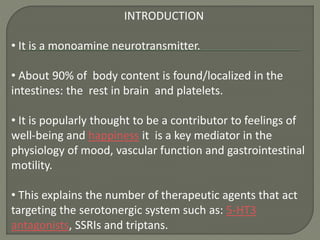
INTRODUCTION
• It is a monoamine neurotransmitter.
• About 90% of body content is found/localized in the
intestines: the rest in brain and platelets.
• It is popularly thought to be a contributor to feelings of
well-being and happiness it is a key mediator in the
physiology of mood, vascular function and gastrointestinal
motility.
• This explains the number of therapeutic agents that act
targeting the serotonergic system such as: 5-HT3
antagonists, SSRIs and triptans.
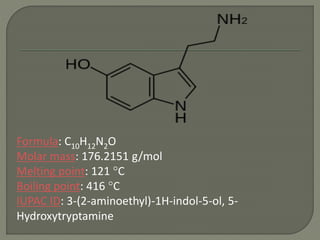
Formula: C10H12N2O
Molar mass: 176.2151 g/mol
Melting point: 121 °C
Boiling point: 416 °C
IUPAC ID: 3-(2-aminoethyl)-1H-indol-5-ol, 5-
Hydroxytryptamine
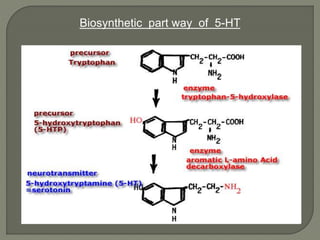
Biosynthetic part way of 5-HT
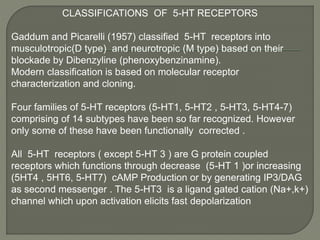
CLASSIFICATIONS OF 5-HT RECEPTORS
Gaddum and Picarelli (1957) classified 5-HT receptors into
musculotropic(D type) and neurotropic (M type) based on their
blockade by Dibenzyline (phenoxybenzinamine).
Modern classification is based on molecular receptor
characterization and cloning.
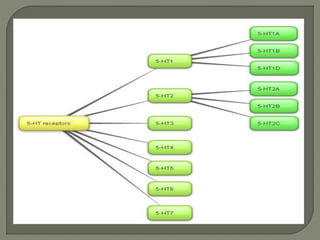
Four families of 5-HT receptors (5-HT1, 5-HT2 , 5-HT3, 5-HT4-7)
comprising of 14 subtypes have been so far recognized. However
only some of these have been functionally corrected .
All 5-HT receptors ( except 5-HT 3 ) are G protein coupled
receptors which functions through decrease (5-HT 1 )or increasing
(5HT4 , 5HT6, 5-HT7) cAMP Production or by generating IP3/DAG
as second messenger . The 5-HT3 is a ligand gated cation (Na+,k+)
channel which upon activation elicits fast depolarization
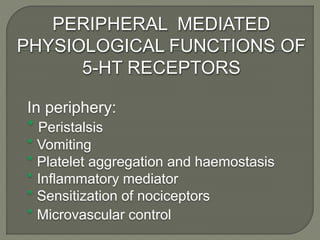
PERIPHERAL MEDIATED
PHYSIOLOGICAL FUNCTIONS OF
5-HT RECEPTORS
In periphery:
* Peristalsis
* Vomiting
* Platelet aggregation and haemostasis
* Inflammatory mediator
* Sensitization of nociceptors
* Microvascular control
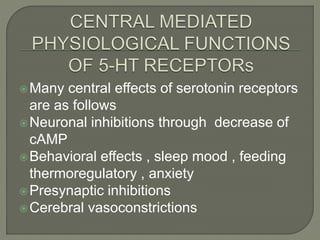
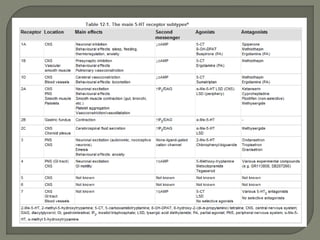
Many central effects of serotonin receptors
are as follows
Neuronal inhibitions through decrease of
cAMP
Behavioral effects , sleep mood , feeding
thermoregulatory , anxiety
Presynaptic inhibitions
Cerebral vasoconstrictions
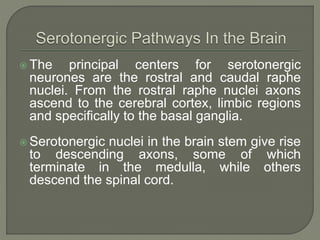
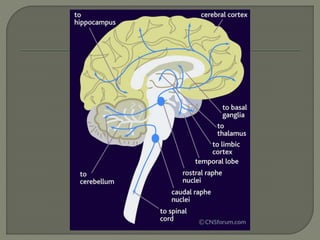
 The principal centers for serotonergic
neurones are the rostral and caudal raphe
nuclei. From the rostral raphe nuclei axons
ascend to the cerebral cortex, limbic regions
and specifically to the basal ganglia.
 Serotonergic nuclei in the brain stem give rise
to descending axons, some of which
terminate in the medulla, while others
descend the spinal cord.
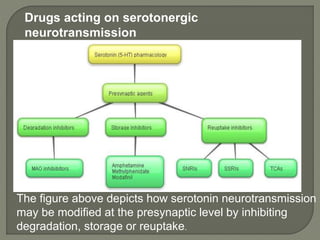
Drugs acting on serotonergic
neurotransmission
The figure above depicts how serotonin neurotransmission
may be modified at the presynaptic level by inhibiting
degradation, storage or reuptake.
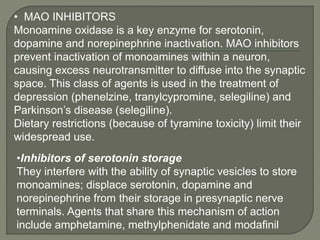
• MAO INHIBITORS
Monoamine oxidase is a key enzyme for serotonin,
dopamine and norepinephrine inactivation. MAO inhibitors
prevent inactivation of monoamines within a neuron,
causing excess neurotransmitter to diffuse into the synaptic
space. This class of agents is used in the treatment of
depression (phenelzine, tranylcypromine, selegiline) and
Parkinson’s disease (selegiline).
Dietary restrictions (because of tyramine toxicity) limit their
widespread use.
•Inhibitors of serotonin storage
They interfere with the ability of synaptic vesicles to store
monoamines; displace serotonin, dopamine and
norepinephrine from their storage in presynaptic nerve
terminals. Agents that share this mechanism of action
include amphetamine, methylphenidate and modafinil
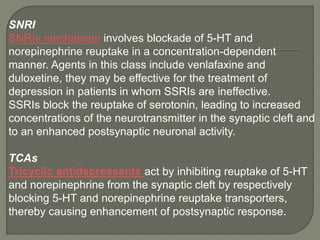
SNRI
SNRIs mechanism involves blockade of 5-HT and
norepinephrine reuptake in a concentration-dependent
manner. Agents in this class include venlafaxine and
duloxetine, they may be effective for the treatment of
depression in patients in whom SSRIs are ineffective.
SSRIs block the reuptake of serotonin, leading to increased
concentrations of the neurotransmitter in the synaptic cleft and
to an enhanced postsynaptic neuronal activity.
TCAs
Tricyclic antidepressants act by inhibiting reuptake of 5-HT
and norepinephrine from the synaptic cleft by respectively
blocking 5-HT and norepinephrine reuptake transporters,
thereby causing enhancement of postsynaptic response.
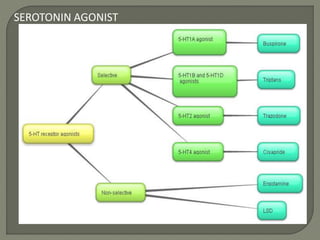
SEROTONIN AGONIST
Serotonin receptors agonists have wide clinical
applications, from treatment of depression to abortive
medications for migraine headache. According to the
receptor they activate, they can be divided into:
5-HT1A agonists
Buspirone is a partial 5-HT1A agonist used clinically for
the treatment of anxiety and depression.
5-HT1B and 5-HT1D agonists
The “triptans” are a drug class useful as abortive
medication for the treatment of acute migraine
headaches. They are very effective in causing cranial
vasoconstriction and decreased release of neuropeptides
involved in “sterile inflammation”.
5-HT2C agonist
Trazodone was previously believed to be a 5-HT2C receptor
antagonist. However, recent publications report that trazodone would
behave as a 5-HT2C agonist. This drug is used generally as
somnorific.
5-HT4 agonists
Cisapride is a serotonin and cholinergic agonist used as a prokinetic
drug, it was withdrawn from the U.S. market because of
cardiovascular toxicity.
Non-selective agonists
Ergotamine activates a more than one subtype of 5-HT receptor, it
binds to 5-HT1A, 5-HT1D, 5-HT1B, D2 and norepinephrine receptors.
Its vasoconstrictor effect makes it a suitable treatment for migraine
attacks.
LSD is a 5-HT1A, 5-HT2A, 5-HT2C, 5-HT5A, 5-HT5, 5-HT6 agonist
that has psychedelic properties.
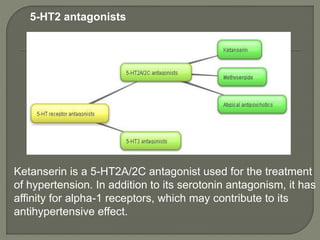
5-HT2 antagonists
Ketanserin is a 5-HT2A/2C antagonist used for the treatment
of hypertension. In addition to its serotonin antagonism, it has
affinity for alpha-1 receptors, which may contribute to its
antihypertensive effect.
Clozapine is an atypical antipsychotic drug that acts as
5-HT2A/2C receptor antagonist with high affinity for
dopamine receptors, the involvement of 5-HT has
possibly increased the chances of greater efficacy and
reduction in negative symptoms of schizophrenia.
Agomelatine is a new antidepressant with agonist
action at the melatonin receptor and antagonism at the
5-HT2C receptor.
5-HT3 antagonists
This class includes drugs such as ondansetron,
palonosetron and others. These agents are particularly
useful in the treatment of chemotherapy induced
nausea and vomiting .
1. Get morning sunlight, its more intense and this can boost your body’s
production melatonin.
2. Get plenty of exercise, researchers have found that exercise boost
serotonin
3. Reduce your stress (both physical and emotional), prolonged stress
produce adrenaline and cortisol which interfere with serotonin
4. Eating foods that are high in protein because of high percentage of
tryptophan
5. Also food containing carbohydrates as they produce insulin which
helps tryptophan go into the brain
CONCLUSION
•From the above presentations we can conclude the following
5-HT is one of the most important neurotransmitters in the CNS
and PNS as well
It also plays a major role in the maintenance of homeostasis ,
control of appetite, sleep, mood, hallucinations, stereotyped
behavior, pain perception and vomiting.
Looking into the drugs which acts on 5-HT receptors it becomes
very clear that for a effective and save management of any
neurological conditions use of drugs which affect serotonin is of
great importance .
Drugs which acts on serotonin are relatively safer than those
acting on dopamine and nor epinephrine
SEROTONIN (5-HT) NEUROTRANSMITTER �

SEROTONIN (5-HT) NEUROTRANSMITTER

  • 1.
    A PRESENTATION ON ANOVERVIEW ON THE INVOLVMENT OF SEROTONIN (5-HT) IN CENTRALLY AND PERIPHERALLY MEDIATED PHYISIOLOGICAL FUNCTIONS BY JOSHUA K NWEKE AMINU ABUBAKAR KENDE KANISHK LUHACH DEPT OF PHARMACY IEC GROUP OF INSTITUTIONS.
  • 2.
    INTRODUCTION • It isa monoamine neurotransmitter. • About 90% of body content is found/localized in the intestines: the rest in brain and platelets. • It is popularly thought to be a contributor to feelings of well-being and happiness it is a key mediator in the physiology of mood, vascular function and gastrointestinal motility. • This explains the number of therapeutic agents that act targeting the serotonergic system such as: 5-HT3 antagonists, SSRIs and triptans.
  • 3.
    Formula: C10H12N2O Molar mass:176.2151 g/mol Melting point: 121 °C Boiling point: 416 °C IUPAC ID: 3-(2-aminoethyl)-1H-indol-5-ol, 5- Hydroxytryptamine
  • 4.
  • 5.
    CLASSIFICATIONS OF 5-HTRECEPTORS Gaddum and Picarelli (1957) classified 5-HT receptors into musculotropic(D type) and neurotropic (M type) based on their blockade by Dibenzyline (phenoxybenzinamine). Modern classification is based on molecular receptor characterization and cloning. Four families of 5-HT receptors (5-HT1, 5-HT2 , 5-HT3, 5-HT4-7) comprising of 14 subtypes have been so far recognized. However only some of these have been functionally corrected . All 5-HT receptors ( except 5-HT 3 ) are G protein coupled receptors which functions through decrease (5-HT 1 )or increasing (5HT4 , 5HT6, 5-HT7) cAMP Production or by generating IP3/DAG as second messenger . The 5-HT3 is a ligand gated cation (Na+,k+) channel which upon activation elicits fast depolarization
  • 7.
    PERIPHERAL MEDIATED PHYSIOLOGICAL FUNCTIONSOF 5-HT RECEPTORS In periphery: * Peristalsis * Vomiting * Platelet aggregation and haemostasis * Inflammatory mediator * Sensitization of nociceptors * Microvascular control
  • 8.
    Many central effectsof serotonin receptors are as follows Neuronal inhibitions through decrease of cAMP Behavioral effects , sleep mood , feeding thermoregulatory , anxiety Presynaptic inhibitions Cerebral vasoconstrictions
  • 10.
     The principalcenters for serotonergic neurones are the rostral and caudal raphe nuclei. From the rostral raphe nuclei axons ascend to the cerebral cortex, limbic regions and specifically to the basal ganglia.  Serotonergic nuclei in the brain stem give rise to descending axons, some of which terminate in the medulla, while others descend the spinal cord.
  • 12.
    Drugs acting onserotonergic neurotransmission The figure above depicts how serotonin neurotransmission may be modified at the presynaptic level by inhibiting degradation, storage or reuptake.
  • 13.
    • MAO INHIBITORS Monoamineoxidase is a key enzyme for serotonin, dopamine and norepinephrine inactivation. MAO inhibitors prevent inactivation of monoamines within a neuron, causing excess neurotransmitter to diffuse into the synaptic space. This class of agents is used in the treatment of depression (phenelzine, tranylcypromine, selegiline) and Parkinson’s disease (selegiline). Dietary restrictions (because of tyramine toxicity) limit their widespread use. •Inhibitors of serotonin storage They interfere with the ability of synaptic vesicles to store monoamines; displace serotonin, dopamine and norepinephrine from their storage in presynaptic nerve terminals. Agents that share this mechanism of action include amphetamine, methylphenidate and modafinil
  • 14.
    SNRI SNRIs mechanism involvesblockade of 5-HT and norepinephrine reuptake in a concentration-dependent manner. Agents in this class include venlafaxine and duloxetine, they may be effective for the treatment of depression in patients in whom SSRIs are ineffective. SSRIs block the reuptake of serotonin, leading to increased concentrations of the neurotransmitter in the synaptic cleft and to an enhanced postsynaptic neuronal activity. TCAs Tricyclic antidepressants act by inhibiting reuptake of 5-HT and norepinephrine from the synaptic cleft by respectively blocking 5-HT and norepinephrine reuptake transporters, thereby causing enhancement of postsynaptic response.
  • 15.
  • 16.
    Serotonin receptors agonistshave wide clinical applications, from treatment of depression to abortive medications for migraine headache. According to the receptor they activate, they can be divided into: 5-HT1A agonists Buspirone is a partial 5-HT1A agonist used clinically for the treatment of anxiety and depression. 5-HT1B and 5-HT1D agonists The “triptans” are a drug class useful as abortive medication for the treatment of acute migraine headaches. They are very effective in causing cranial vasoconstriction and decreased release of neuropeptides involved in “sterile inflammation”.
  • 17.
    5-HT2C agonist Trazodone waspreviously believed to be a 5-HT2C receptor antagonist. However, recent publications report that trazodone would behave as a 5-HT2C agonist. This drug is used generally as somnorific. 5-HT4 agonists Cisapride is a serotonin and cholinergic agonist used as a prokinetic drug, it was withdrawn from the U.S. market because of cardiovascular toxicity. Non-selective agonists Ergotamine activates a more than one subtype of 5-HT receptor, it binds to 5-HT1A, 5-HT1D, 5-HT1B, D2 and norepinephrine receptors. Its vasoconstrictor effect makes it a suitable treatment for migraine attacks. LSD is a 5-HT1A, 5-HT2A, 5-HT2C, 5-HT5A, 5-HT5, 5-HT6 agonist that has psychedelic properties.
  • 18.
    5-HT2 antagonists Ketanserin isa 5-HT2A/2C antagonist used for the treatment of hypertension. In addition to its serotonin antagonism, it has affinity for alpha-1 receptors, which may contribute to its antihypertensive effect.
  • 19.
    Clozapine is anatypical antipsychotic drug that acts as 5-HT2A/2C receptor antagonist with high affinity for dopamine receptors, the involvement of 5-HT has possibly increased the chances of greater efficacy and reduction in negative symptoms of schizophrenia. Agomelatine is a new antidepressant with agonist action at the melatonin receptor and antagonism at the 5-HT2C receptor. 5-HT3 antagonists This class includes drugs such as ondansetron, palonosetron and others. These agents are particularly useful in the treatment of chemotherapy induced nausea and vomiting .
  • 20.
    1. Get morningsunlight, its more intense and this can boost your body’s production melatonin. 2. Get plenty of exercise, researchers have found that exercise boost serotonin 3. Reduce your stress (both physical and emotional), prolonged stress produce adrenaline and cortisol which interfere with serotonin 4. Eating foods that are high in protein because of high percentage of tryptophan 5. Also food containing carbohydrates as they produce insulin which helps tryptophan go into the brain
  • 21.
    CONCLUSION •From the abovepresentations we can conclude the following 5-HT is one of the most important neurotransmitters in the CNS and PNS as well It also plays a major role in the maintenance of homeostasis , control of appetite, sleep, mood, hallucinations, stereotyped behavior, pain perception and vomiting. Looking into the drugs which acts on 5-HT receptors it becomes very clear that for a effective and save management of any neurological conditions use of drugs which affect serotonin is of great importance . Drugs which acts on serotonin are relatively safer than those acting on dopamine and nor epinephrine