Dr Naser Ashraf Tadvi
Objectives
• Classify anti-leprosy drugs
• Discuss the Mechanism of action, relevant
pharmacokinetics, adverse effects and
contraindications of antileprosy drugs
• Describe the treatment of Paucibacillary and
multibacillary leprosy
• Describe the treatment of type 1 and 2 lepra
reaction
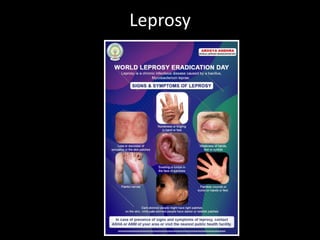
Leprosy
• Dapsone
SULFONES
• Clofazimine
PHENAZINE DERIVATIVES
• Rifampicin
ANTITUBERCULAR DRUGS
• FLUOROQUINOLONES : Ofloxacin, Moxifloxacin
• MACROLIDES : Clarithromycin
• TETRACYCLINES : Minocycline
OTHER ANTIBIOTICS :
• Chemically related to sulfonamides & shares a
common mechanism of action
• Leprostatic at very low concentration
• Not used for other pyogenic infections
• Not used alone always used with rifampicin and/or
clofazimine in MDT for leprosy
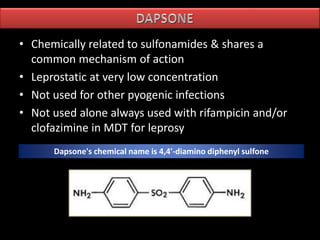
Dapsone's chemical name is 4,4'-diamino diphenyl sulfone
• Slowly and completely absorbed from GIT
• 70% plasma protein bound
• Produces ten times more concentration
in diseased skin than in normal skin
• t ½ - 24 hrs
• 70-80% excreted in urine
• Drug is excreted in milk
PharmacokineticsDAPSONE
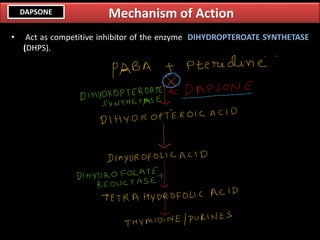
• Act as competitive inhibitor of the enzyme DIHYDROPTEROATE SYNTHETASE
(DHPS).
Mechanism of ActionDAPSONE
Mechanism of Action
• Folate is necessary for the cell to synthesize nucleic acids and
in its absence cells will be unable to divide.
• Hence the sulfonamide antibacterial exhibit a bacteriostatic
effect
• Folate is not synthesized in mammalian cells, but is instead a
dietary requirement. This explains the selective toxicity to
bacterial cells of these drugs.
DAPSONE
Resistance
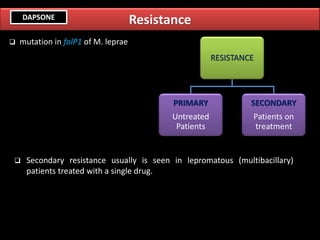
❑ Secondary resistance usually is seen in lepromatous (multibacillary)
patients treated with a single drug.
RESISTANCE
PRIMARY
Untreated
Patients
SECONDARY
Patients on
treatment
❑ mutation in folP1 of M. leprae
DAPSONE
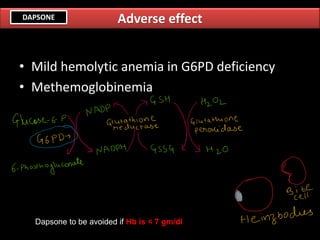
• Mild hemolytic anemia in G6PD deficiency
• Methemoglobinemia
Adverse effectDAPSONE
Dapsone to be avoided if Hb is < 7 gm/dl
• Gastric intolerance: nausea , vomiting
anorexia.
• Cutaneous reactions:
• Hepatitis & agranulocytosis
• CNS : headache parasthesia, tinnitus
• Fever
• Sulfone (Dapsone) syndrome
Adverse EffectsDAPSONE
• Severe anemia
• G6PD deficiency
• Hypersensitivity reactions
ContraindicationsDAPSONE
• Leprosy
• With pyrimethamine
– Resistant Falciparum malaria
– P Jirovecii Infection
– Toxoplasmosis
IndicationsDAPSONE
• Phenazine dye
• Leprostatic
• Anti-inflammatory action:
– Major advantage used in ENL
• BIOLOGICAL LAG 6-7 weeks
• Clinical improvement visible by 6th month
CLOFAZIMINE
Mechanism of ActionCLOFAZIMINE
• Preferentialy binds to mycobacterial DNA
• Interferes with template function of the DNA
• Alteration of membrane structure and
transport function
PharmacokineticsCLOFAZIMINE
▪ Absorption : 40-70%
▪ Lipophilic taken up by macrophages
▪ t 1/2 – 70 days
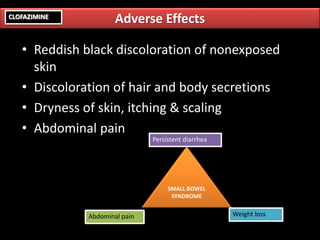
Adverse EffectsCLOFAZIMINE
• Reddish black discoloration of nonexposed
skin
• Discoloration of hair and body secretions
• Dryness of skin, itching & scaling
• Abdominal pain
SMALL BOWEL
SYNDROME
Persistent diarrhea
Abdominal pain Weight loss
1. Pregnancy
2. Liver and kidney disease
3. GI symptoms
ContraindicationsCLOFAZIMINE
• Most potent cidal drug for M Leprae
• Rifampicin kills 99.99 % of organisms in 3-7 days
• Free from cross resistance from other organisms.
• The drug has a particular effect in relieving nasal
symptoms and healing of foot ulcers
• Dose – 600 mg once a month
FLUOROQUINOLONES
• Ofloxacin, Pefloxacin, Sparfloxacin, Moxifloxacin
• BACTERICIDAL & highly effective
• 22 doses of Ofloxacin ( 400mg/day) - killed 99.99%
• Used as an alternate drug
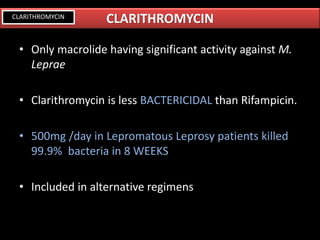
• Only macrolide having significant activity against M.
Leprae
• Clarithromycin is less BACTERICIDAL than Rifampicin.
• 500mg /day in Lepromatous Leprosy patients killed
99.9% bacteria in 8 WEEKS
• Included in alternative regimens
CLARITHROMYCINCLARITHROMYCIN
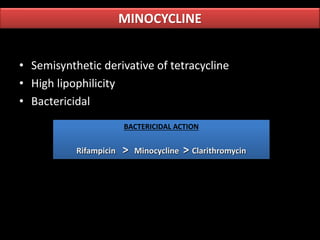
• Semisynthetic derivative of tetracycline
• High lipophilicity
• Bactericidal
MINOCYCLINE
BACTERICIDAL ACTION
Rifampicin > Minocycline > Clarithromycin
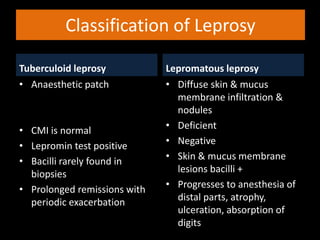
Classification of Leprosy
Tuberculoid leprosy
• Anaesthetic patch
• CMI is normal
• Lepromin test positive
• Bacilli rarely found in
biopsies
• Prolonged remissions with
periodic exacerbation
Lepromatous leprosy
• Diffuse skin & mucus
membrane infiltration &
nodules
• Deficient
• Negative
• Skin & mucus membrane
lesions bacilli +
• Progresses to anesthesia of
distal parts, atrophy,
ulceration, absorption of
digits
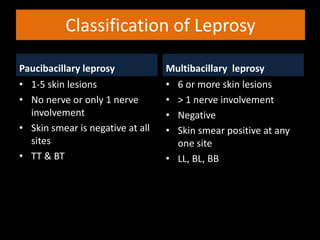
Classification of Leprosy
Paucibacillary leprosy
• 1-5 skin lesions
• No nerve or only 1 nerve
involvement
• Skin smear is negative at all
sites
• TT & BT
Multibacillary leprosy
• 6 or more skin lesions
• > 1 nerve involvement
• Negative
• Skin smear positive at any
one site
• LL, BL, BB
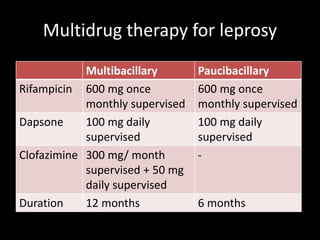
Multidrug therapy for leprosy
Multibacillary Paucibacillary
Rifampicin 600 mg once
monthly supervised
600 mg once
monthly supervised
Dapsone 100 mg daily
supervised
100 mg daily
supervised
Clofazimine 300 mg/ month
supervised + 50 mg
daily supervised
-
Duration 12 months 6 months
Alternative regimens for leprosy
• Intermittent ROM
• Intermittent RMMx
• Ofloxacin or minocycline can be used in place
of clofazimine (if pt refuses Clofazimine)
• 4 drug therapy
– Rifampicin 600 mg + sparfloxacin 200 mg +
clarithromycin 500 mg + Minocycline 100 mg daily
for 12 weeks
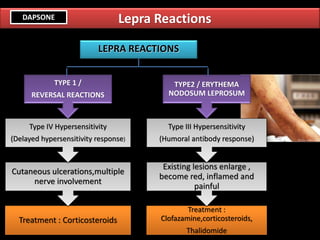
Treatment : Corticosteroids
Cutaneous ulcerations,multiple
nerve involvement
Type IV Hypersensitivity
(Delayed hypersensitivity response)
TYPE 1 /
REVERSAL REACTIONS
Treatment :
Clofazamine,corticosteroids,
Thalidomide
Existing lesions enlarge ,
become red, inflamed and
painful
Type III Hypersensitivity
(Humoral antibody response)
TYPE2 / ERYTHEMA
NODOSUM LEPROSUM
LEPRA REACTIONS
Lepra ReactionsDAPSONE
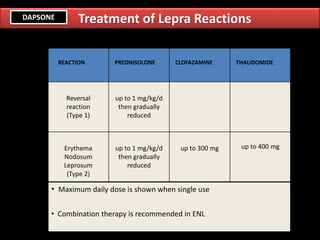
REACTION PREDNISOLONE CLOFAZAMINE THALIDOMIDE
Reversal
reaction
(Type 1)
up to 1 mg/kg/d
then gradually
reduced
Erythema
Nodosum
Leprosum
(Type 2)
up to 1 mg/kg/d
then gradually
reduced
up to 300 mg up to 400 mg
• Maximum daily dose is shown when single use
• Combination therapy is recommended in ENL
Treatment of Lepra ReactionsDAPSONE
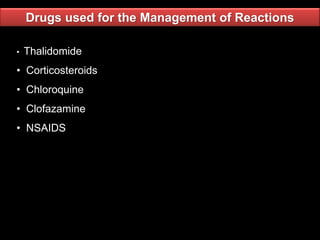
Drugs used for the Management of Reactions
• Thalidomide
• Corticosteroids
• Chloroquine
• Clofazamine
• NSAIDS
Summary
• Drugs for leprosy
• MDT for leprosy
• Type 1 lepra reaction
• Type 2 lepra reaction

Drugs for leprosy

  • 1.
  • 2.
    Objectives • Classify anti-leprosydrugs • Discuss the Mechanism of action, relevant pharmacokinetics, adverse effects and contraindications of antileprosy drugs • Describe the treatment of Paucibacillary and multibacillary leprosy • Describe the treatment of type 1 and 2 lepra reaction
  • 3.
  • 4.
    • Dapsone SULFONES • Clofazimine PHENAZINEDERIVATIVES • Rifampicin ANTITUBERCULAR DRUGS • FLUOROQUINOLONES : Ofloxacin, Moxifloxacin • MACROLIDES : Clarithromycin • TETRACYCLINES : Minocycline OTHER ANTIBIOTICS :
  • 5.
    • Chemically relatedto sulfonamides & shares a common mechanism of action • Leprostatic at very low concentration • Not used for other pyogenic infections • Not used alone always used with rifampicin and/or clofazimine in MDT for leprosy Dapsone's chemical name is 4,4'-diamino diphenyl sulfone
  • 6.
    • Slowly andcompletely absorbed from GIT • 70% plasma protein bound • Produces ten times more concentration in diseased skin than in normal skin • t ½ - 24 hrs • 70-80% excreted in urine • Drug is excreted in milk PharmacokineticsDAPSONE
  • 7.
    • Act ascompetitive inhibitor of the enzyme DIHYDROPTEROATE SYNTHETASE (DHPS). Mechanism of ActionDAPSONE
  • 8.
    Mechanism of Action •Folate is necessary for the cell to synthesize nucleic acids and in its absence cells will be unable to divide. • Hence the sulfonamide antibacterial exhibit a bacteriostatic effect • Folate is not synthesized in mammalian cells, but is instead a dietary requirement. This explains the selective toxicity to bacterial cells of these drugs. DAPSONE
  • 9.
    Resistance ❑ Secondary resistanceusually is seen in lepromatous (multibacillary) patients treated with a single drug. RESISTANCE PRIMARY Untreated Patients SECONDARY Patients on treatment ❑ mutation in folP1 of M. leprae DAPSONE
  • 10.
    • Mild hemolyticanemia in G6PD deficiency • Methemoglobinemia Adverse effectDAPSONE Dapsone to be avoided if Hb is < 7 gm/dl
  • 11.
    • Gastric intolerance:nausea , vomiting anorexia. • Cutaneous reactions: • Hepatitis & agranulocytosis • CNS : headache parasthesia, tinnitus • Fever • Sulfone (Dapsone) syndrome Adverse EffectsDAPSONE
  • 12.
    • Severe anemia •G6PD deficiency • Hypersensitivity reactions ContraindicationsDAPSONE
  • 13.
    • Leprosy • Withpyrimethamine – Resistant Falciparum malaria – P Jirovecii Infection – Toxoplasmosis IndicationsDAPSONE
  • 14.
    • Phenazine dye •Leprostatic • Anti-inflammatory action: – Major advantage used in ENL • BIOLOGICAL LAG 6-7 weeks • Clinical improvement visible by 6th month CLOFAZIMINE
  • 15.
    Mechanism of ActionCLOFAZIMINE •Preferentialy binds to mycobacterial DNA • Interferes with template function of the DNA • Alteration of membrane structure and transport function
  • 16.
    PharmacokineticsCLOFAZIMINE ▪ Absorption :40-70% ▪ Lipophilic taken up by macrophages ▪ t 1/2 – 70 days
  • 17.
    Adverse EffectsCLOFAZIMINE • Reddishblack discoloration of nonexposed skin • Discoloration of hair and body secretions • Dryness of skin, itching & scaling • Abdominal pain SMALL BOWEL SYNDROME Persistent diarrhea Abdominal pain Weight loss
  • 18.
    1. Pregnancy 2. Liverand kidney disease 3. GI symptoms ContraindicationsCLOFAZIMINE
  • 19.
    • Most potentcidal drug for M Leprae • Rifampicin kills 99.99 % of organisms in 3-7 days • Free from cross resistance from other organisms. • The drug has a particular effect in relieving nasal symptoms and healing of foot ulcers • Dose – 600 mg once a month
  • 20.
    FLUOROQUINOLONES • Ofloxacin, Pefloxacin,Sparfloxacin, Moxifloxacin • BACTERICIDAL & highly effective • 22 doses of Ofloxacin ( 400mg/day) - killed 99.99% • Used as an alternate drug
  • 21.
    • Only macrolidehaving significant activity against M. Leprae • Clarithromycin is less BACTERICIDAL than Rifampicin. • 500mg /day in Lepromatous Leprosy patients killed 99.9% bacteria in 8 WEEKS • Included in alternative regimens CLARITHROMYCINCLARITHROMYCIN
  • 22.
    • Semisynthetic derivativeof tetracycline • High lipophilicity • Bactericidal MINOCYCLINE BACTERICIDAL ACTION Rifampicin > Minocycline > Clarithromycin
  • 23.
    Classification of Leprosy Tuberculoidleprosy • Anaesthetic patch • CMI is normal • Lepromin test positive • Bacilli rarely found in biopsies • Prolonged remissions with periodic exacerbation Lepromatous leprosy • Diffuse skin & mucus membrane infiltration & nodules • Deficient • Negative • Skin & mucus membrane lesions bacilli + • Progresses to anesthesia of distal parts, atrophy, ulceration, absorption of digits
  • 24.
    Classification of Leprosy Paucibacillaryleprosy • 1-5 skin lesions • No nerve or only 1 nerve involvement • Skin smear is negative at all sites • TT & BT Multibacillary leprosy • 6 or more skin lesions • > 1 nerve involvement • Negative • Skin smear positive at any one site • LL, BL, BB
  • 25.
    Multidrug therapy forleprosy Multibacillary Paucibacillary Rifampicin 600 mg once monthly supervised 600 mg once monthly supervised Dapsone 100 mg daily supervised 100 mg daily supervised Clofazimine 300 mg/ month supervised + 50 mg daily supervised - Duration 12 months 6 months
  • 26.
    Alternative regimens forleprosy • Intermittent ROM • Intermittent RMMx • Ofloxacin or minocycline can be used in place of clofazimine (if pt refuses Clofazimine) • 4 drug therapy – Rifampicin 600 mg + sparfloxacin 200 mg + clarithromycin 500 mg + Minocycline 100 mg daily for 12 weeks
  • 27.
    Treatment : Corticosteroids Cutaneousulcerations,multiple nerve involvement Type IV Hypersensitivity (Delayed hypersensitivity response) TYPE 1 / REVERSAL REACTIONS Treatment : Clofazamine,corticosteroids, Thalidomide Existing lesions enlarge , become red, inflamed and painful Type III Hypersensitivity (Humoral antibody response) TYPE2 / ERYTHEMA NODOSUM LEPROSUM LEPRA REACTIONS Lepra ReactionsDAPSONE
  • 28.
    REACTION PREDNISOLONE CLOFAZAMINETHALIDOMIDE Reversal reaction (Type 1) up to 1 mg/kg/d then gradually reduced Erythema Nodosum Leprosum (Type 2) up to 1 mg/kg/d then gradually reduced up to 300 mg up to 400 mg • Maximum daily dose is shown when single use • Combination therapy is recommended in ENL Treatment of Lepra ReactionsDAPSONE
  • 29.
    Drugs used forthe Management of Reactions • Thalidomide • Corticosteroids • Chloroquine • Clofazamine • NSAIDS
  • 30.
    Summary • Drugs forleprosy • MDT for leprosy • Type 1 lepra reaction • Type 2 lepra reaction