Antiparkinsonian drugs
Dr Naser Tadvi
Parkinsonism
• Slowly progressive neurodegenerative disease
characterized by
– Akinesia
– Muscular rigidity
– Tremors
• With secondary symptoms like
– Postural instability, mask like face, sialorrhoea,
seborrhoea
Pathophysiology
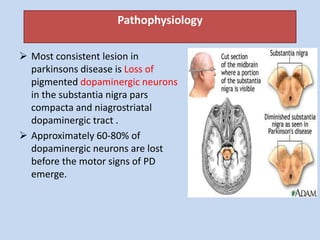
 Most consistent lesion in
parkinsons disease is Loss of
pigmented dopaminergic neurons
in the substantia nigra pars
compacta and niagrostriatal
dopaminergic tract .
 Approximately 60-80% of
dopaminergic neurons are lost
before the motor signs of PD
emerge.
Parkinsonism
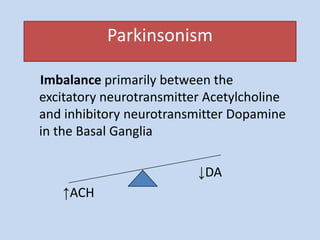
Imbalance primarily between the
excitatory neurotransmitter Acetylcholine
and inhibitory neurotransmitter Dopamine
in the Basal Ganglia
↓DA
↑ACH
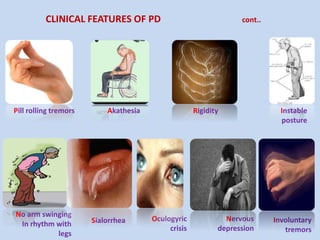
CLINICAL FEATURES OF PD cont..
Pill rolling tremors Akathesia Rigidity Instable
posture
No arm swinging
In rhythm with
legs
Sialorrhea Oculogyric
crisis
Nervous
depression
Involuntary
tremors
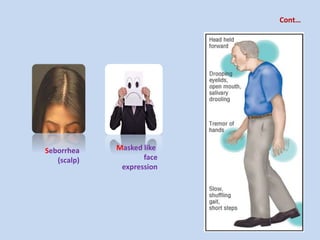
Masked like
face
expression
Seborrhea
(scalp)
Cont…
CLASSIFICATION OF
ANTIPARKINSONIAN DRUGS
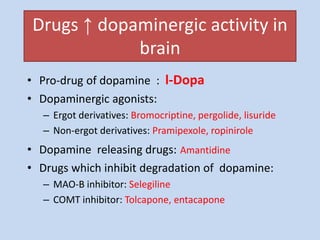
Drugs ↑ dopaminergic activity in
brain
• Pro-drug of dopamine : l-Dopa
• Dopaminergic agonists:
– Ergot derivatives: Bromocriptine, pergolide, lisuride
– Non-ergot derivatives: Pramipexole, ropinirole
• Dopamine releasing drugs: Amantidine
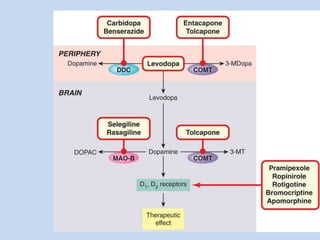
• Drugs which inhibit degradation of dopamine:
– MAO-B inhibitor: Selegiline
– COMT inhibitor: Tolcapone, entacapone
Drugs ↓central cholinergic activity
• Centrally acting anticholinergics:
– Trihexyphenidyl , benztropine, biperidene,
procyclidine
• Antihistaminics: (having anticholinergic action)
– Diphenhydramine, promethazine,
prphenadrine
LEVO-DOPA:Universal antiparkinson drug
• Metabolic precursor of dopamine: Prodrug
• Single most important drug
• Manages all major manifestations but not
progression of disease
Pharmacological actions
• CNS:
– Marked improvement in symptoms, Akinesia
first, then rigidity & tremors
– Other symptoms improve gradually
– General alerting response; ↑ excitability,
sexual activity, psychosis
Pharmacological actions: contd
• CVS:
– ↓BP (Postural hypotension)
– tachycardia
– Large doses: ↑ BP
• CTZ: stimulation
• Endocrine:
– Pitutary mammotrophs – inhibit prolactin release
& increase GH release
pharmacokinetics:
• T1/2: 1-3 hrs
• 95% peripheral decarboxylaton (GIT, liver,
other tissues)
• Less than 1 % reaches CNS
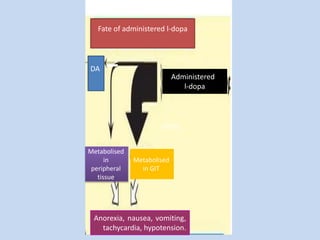
Administered
l-dopa
Fate of administered l-dopa
DA
Metabolised
in
peripheral
tissue
Metabolised
in GIT
Anorexia, nausea, vomiting,
tachycardia, hypotension.
>95%
Adverse effects
• GIT:
– Nausea, vomiting, alteration of taste
• Cardiovascular
– postural hypotension,
– palpitations
– Sinus tachycardia
– cardiac arrhythmias,
– exacerbation of angina
Early adverse effects
• Behavioural effect:
– Anxiety, nightmares, severe depression, mania,
hallucinations, mental confusion , psychosis
• CNS
– Abnormal movements; facial tics, grimacing,
tongue thursting etc
• Fluctuation in motor performance:
– On and off effect
Adverse effects
Late ADR`s
Drug interactions
• Pyridoxine
• Phenothiazines, metoclopramide : block DA
receptors
• Non selective MAO inhibitors: hypertensive
crisis
• Antihypertensives: postural hypotension is
accenuated
Peripheral Decarboxylase inhibitors
• Extra cerebral dopa decarboxylase inhibitors
inhibit conversion of l dopa to dopamine in
periphery
• Do not inhibit conversion of L dopa to
dopamine in the brain as they do not cross
BBB
Carbidopa , Benserazide
Advantages of L-dopa + carbidopa
• Dose of l dopa ↓ to ¼ , plasma t ½ ↑
• Less side effects: nausea, vomiting,
tachycardia
• Effect of this combination not antagonised
by pyridoxine
• On & off effect is minimized since cerebral
dopamine levels more sustained
• Enhanced efficacy e.g of potentiation
Disadvantages of this combination
• More chances of dyskinesia
• Behavioural abnormalities are more common
• Postural hypotension is not resolved
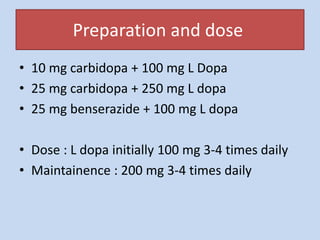
Preparation and dose
• 10 mg carbidopa + 100 mg L Dopa
• 25 mg carbidopa + 250 mg L dopa
• 25 mg benserazide + 100 mg L dopa
• Dose : L dopa initially 100 mg 3-4 times daily
• Maintainence : 200 mg 3-4 times daily
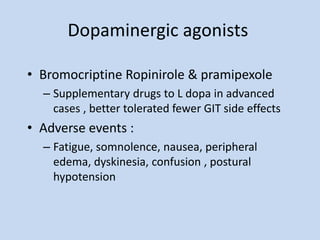
Dopaminergic agonists
• Bromocriptine Ropinirole & pramipexole
– Supplementary drugs to L dopa in advanced
cases , better tolerated fewer GIT side effects
• Adverse events :
– Fatigue, somnolence, nausea, peripheral
edema, dyskinesia, confusion , postural
hypotension
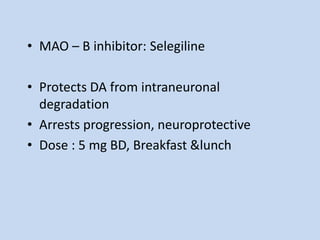
• MAO – B inhibitor: Selegiline
• Protects DA from intraneuronal
degradation
• Arrests progression, neuroprotective
• Dose : 5 mg BD, Breakfast &lunch
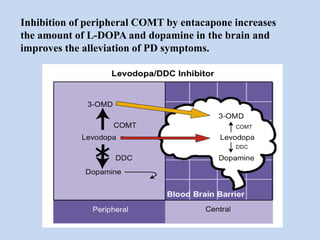
Inhibition of peripheral COMT by entacapone increases
the amount of L-DOPA and dopamine in the brain and
improves the alleviation of PD symptoms.
Dopamine releasing drugs: Amantidine
• Rapid but lower efficacy, tolerance
develops
• Increases synthesis & release by decreasing
reuptake, slight antimuscarinic
• Dose 100 mg BD, Adjuvant to L dopa in
acute exacerbation
• Well tolerated by young
Anticholinergic drugs:
• Higher central : peripheral anticholinergic action
• Block Ach receptors in CNS, partially redressing
imbalance created by decreased dopaminergic
activity
• 10 -25 % improvement in symptoms
• DOC FOR drug induced extrapyramidal toxicity
• Control, rigidity, tremors, sialorrhoea, less effect
on bradykinesia
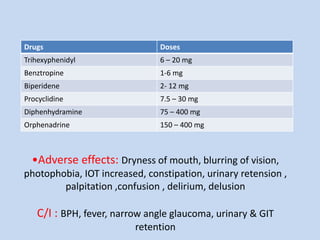
•Adverse effects: Dryness of mouth, blurring of vision,
photophobia, IOT increased, constipation, urinary retension ,
palpitation ,confusion , delirium, delusion
C/I : BPH, fever, narrow angle glaucoma, urinary & GIT
retention
Drugs Doses
Trihexyphenidyl 6 – 20 mg
Benztropine 1-6 mg
Biperidene 2- 12 mg
Procyclidine 7.5 – 30 mg
Diphenhydramine 75 – 400 mg
Orphenadrine 150 – 400 mg
Limitations of drug therapy
• Drugs do not cure disease, nor effect its
course
• Tolerance develops
• Anticholinergics: Glaucoma, BEP
• L dopa therapy expensive, has many adverse
events & needs regular supervision
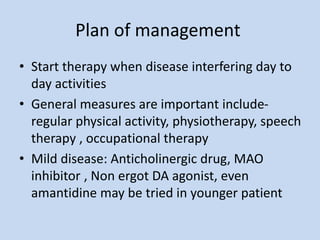
Plan of management
• Start therapy when disease interfering day to
day activities
• General measures are important include-
regular physical activity, physiotherapy, speech
therapy , occupational therapy
• Mild disease: Anticholinergic drug, MAO
inhibitor , Non ergot DA agonist, even
amantidine may be tried in younger patient
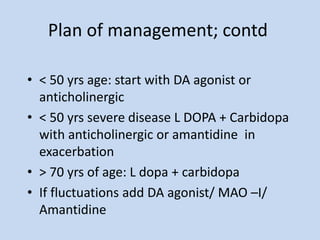
Plan of management; contd
• < 50 yrs age: start with DA agonist or
anticholinergic
• < 50 yrs severe disease L DOPA + Carbidopa
with anticholinergic or amantidine in
exacerbation
• > 70 yrs of age: L dopa + carbidopa
• If fluctuations add DA agonist/ MAO –I/
Amantidine
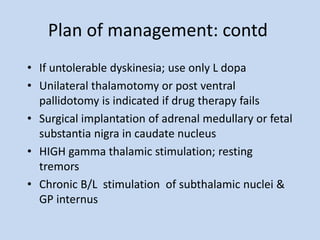
Plan of management: contd
• If untolerable dyskinesia; use only L dopa
• Unilateral thalamotomy or post ventral
pallidotomy is indicated if drug therapy fails
• Surgical implantation of adrenal medullary or fetal
substantia nigra in caudate nucleus
• HIGH gamma thalamic stimulation; resting
tremors
• Chronic B/L stimulation of subthalamic nuclei &
GP internus