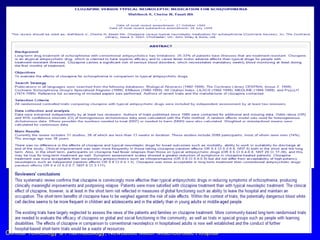
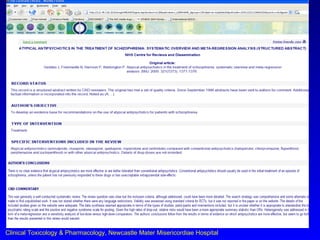
Antipsychotic drugs


Clinical Toxicology & Pharmacology, Newcastle Mater Misericordiae Hospital
CNS drugs
               Functionally, the CNS is the most
                complex part of the body, and
                understanding drug effects is difficult
               Understanding the effects of drugs on
                individual neurons does not predict
                the effect on the whole organ
               In part this is due to complex
                interactions mediated by different
                neurotransmitters

Clinical Toxicology & Pharmacology, Newcastle Mater Misericordiae Hospital
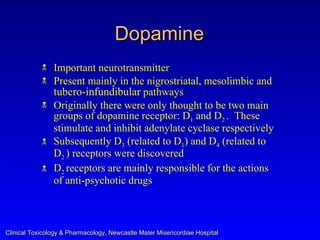
Dopamine
               Important neurotransmitter
               Present mainly in the nigrostriatal, mesolimbic and
                tubero-infundibular pathways
               Originally there were only thought to be two main
                groups of dopamine receptor: D1 and D2 . These
                stimulate and inhibit adenylate cyclase respectively
               Subsequently D3 (related to D1) and D4 (related to
                D2 ) receptors were discovered
               D2 receptors are mainly responsible for the actions
                of anti-psychotic drugs


Clinical Toxicology & Pharmacology, Newcastle Mater Misericordiae Hospital
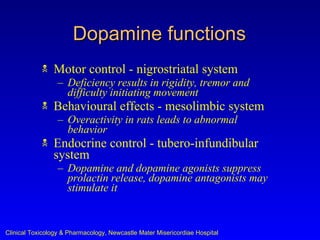
Dopamine functions
               Motor control - nigrostriatal system
                  – Deficiency results in rigidity, tremor and
                    difficulty initiating movement
               Behavioural effects - mesolimbic system
                  – Overactivity in rats leads to abnormal
                    behavior
               Endocrine control - tubero-infundibular
                system
                  – Dopamine and dopamine agonists suppress
                    prolactin release, dopamine antagonists may
                    stimulate it


Clinical Toxicology & Pharmacology, Newcastle Mater Misericordiae Hospital
Schizophrenia - dopamine
               Amphetamine (which releases dopamine) can
                produce a syndrome similar to the ‘positive’
                features of schizophrenia
               Levodopa may aggravate the condition
               Apomorphine and bromocriptine (D2 agonists)
                produce behavioral abnormalities in animals
               D2 receptor antagonists are effective in controlling
                the positive features of the disorder
               ? Increased D2 receptor binding in the brains of
                schizophrenic subjects. Evidence of genetic
                variation in the D4 receptor to which some anti-
                psychotic drugs have high affinity

Clinical Toxicology & Pharmacology, Newcastle Mater Misericordiae Hospital
Schizophrenia - serotonin
               LSD which has mixed
                agonist/antagonist serotonergic actions
                produces hallucinations and behavioral
                disturbance
               Some antipsychotic drugs also act at
                5-HT receptors (antagonists of 5HT2)
               5-HT has a modulatory effect on
                dopaminergic neurones

Clinical Toxicology & Pharmacology, Newcastle Mater Misericordiae Hospital
Modes of action
               All anti-psychotic drugs have inhibitory
                effects on the D2 receptor
               Some have actions against the D4 receptor
               All have other effects - to varying degrees
                  – Serotonin 5HT2 blockade (may improve
                    negative symptoms)
                  – Histamine H1 blockade (drowsiness)
                  – Alpha adrenoceptor blockade (postural
                    hypotension)


Clinical Toxicology & Pharmacology, Newcastle Mater Misericordiae Hospital
How do we know they work?
               Mostly “ by accident” for early drugs
                  – designing drugs to reduce anxiety in
                    surgical patients
               Clinical experience
               Clinical trials
                  – especially more recent drugs
               PET scanning showing blockade of
                central D2 receptors

Clinical Toxicology & Pharmacology, Newcastle Mater Misericordiae Hospital
Clinical effects
               Control the ‘positive’ features of the disease, but
                little effect on the ‘negative’ features
                  – clozapine may be superior in this regard
               The main side-effects are on the extrapyramidal
                motor system
                  – Akathisia (hours)
                  – Dystonias (hours to days)
                  – Parkinsonism (weeks to months)
                       q   rigidity, tremor, and loss of mobility
                  – Tardive dyskinesia (months to years)
                       q   Repetitive abnormal movements of face and upper limbs
                       q   Thought to be due to proliferation of D2 receptors in the
                           striatum


Clinical Toxicology & Pharmacology, Newcastle Mater Misericordiae Hospital
Clinical effects
               Newer ‘atypical’ anti-psychotic drugs
                are less inclined to produce these
                effects - possible due to their greater
                affinity for the mesolimbic over the
                striatal areas of the brain


Clinical Toxicology & Pharmacology, Newcastle Mater Misericordiae Hospital
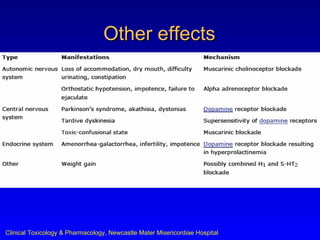
Other effects
               Some are effective anti-emetics
               Anti-muscarinic effects lead to dry mouth, blurred vision,
                difficulty with micturition
               α antagonist effects lead to postural hypotension
               Antihistamine effects (H1 receptor) lead to drowsiness
               Prolactin stimulation may lead to breast development
               Agranulocytosis is fairly common with an ‘atypical’ drug –
                clozapine which can also cause a myocarditis
               ‘Neuroleptic malignant syndrome’ is a rare but serious
                effect leading to extrapyramidal rigidity, autonomic
                instability and hyperthermia


Clinical Toxicology & Pharmacology, Newcastle Mater Misericordiae Hospital
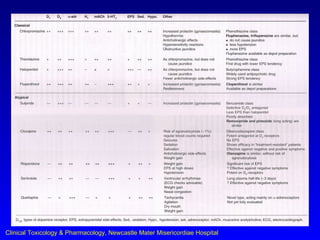
Other effects


Clinical Toxicology & Pharmacology, Newcastle Mater Misericordiae Hospital
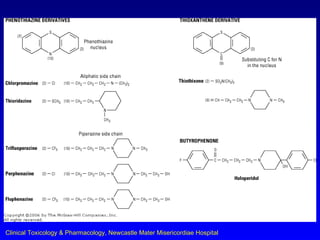
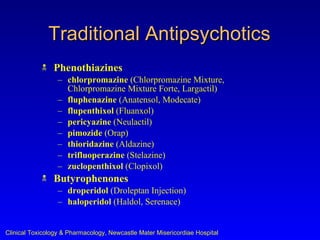
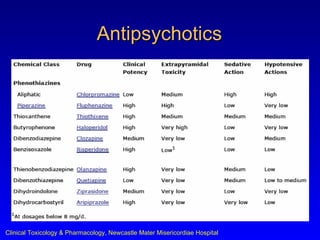
Traditional Antipsychotics
               Phenothiazines
                  – chlorpromazine (Chlorpromazine Mixture,
                    Chlorpromazine Mixture Forte, Largactil)
                  – fluphenazine (Anatensol, Modecate)
                  – flupenthixol (Fluanxol)
                  – pericyazine (Neulactil)
                  – pimozide (Orap)
                  – thioridazine (Aldazine)
                  – trifluoperazine (Stelazine)
                  – zuclopenthixol (Clopixol)
               Butyrophenones
                  – droperidol (Droleptan Injection)
                  – haloperidol (Haldol, Serenace)


Clinical Toxicology & Pharmacology, Newcastle Mater Misericordiae Hospital
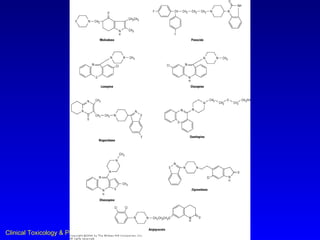
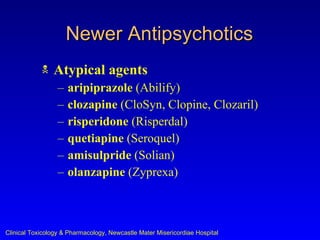
Newer Antipsychotics
               Atypical agents
                  –   aripiprazole (Abilify)
                  –   clozapine (CloSyn, Clopine, Clozaril)
                  –   risperidone (Risperdal)
                  –   quetiapine (Seroquel)
                  –   amisulpride (Solian)
                  –   olanzapine (Zyprexa)


Clinical Toxicology & Pharmacology, Newcastle Mater Misericordiae Hospital
Antipsychotics


Clinical Toxicology & Pharmacology, Newcastle Mater Misericordiae Hospital
Differences among
                          Antipsychotic Drugs
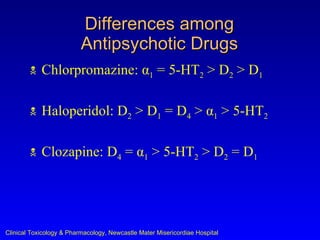
           Chlorpromazine: α1 = 5-HT2 > D2 > D1

           Haloperidol: D2 > D1 = D4 > α1 > 5-HT2

           Clozapine: D4 = α1 > 5-HT2 > D2 = D1


Clinical Toxicology & Pharmacology, Newcastle Mater Misericordiae Hospital
Atypical antipsychotics
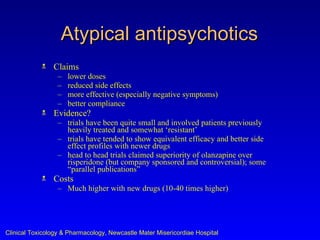
               Claims
                  –   lower doses
                  –   reduced side effects
                  –   more effective (especially negative symptoms)
                  –   better compliance
               Evidence?
                  – trials have been quite small and involved patients previously
                    heavily treated and somewhat ‘resistant’
                  – trials have tended to show equivalent efficacy and better side
                    effect profiles with newer drugs
                  – head to head trials claimed superiority of olanzapine over
                    risperidone (but company sponsored and controversial); some
                    “parallel publications”
               Costs
                  – Much higher with new drugs (10-40 times higher)


Clinical Toxicology & Pharmacology, Newcastle Mater Misericordiae Hospital
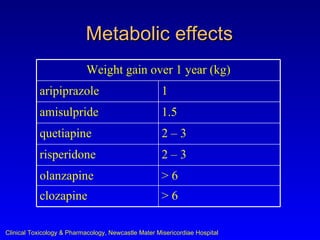
Metabolic effects
                            Weight gain over 1 year (kg)
           aripiprazole                               1
           amisulpride                                1.5
           quetiapine                                 2–3
           risperidone                                2–3
           olanzapine                                 >6
           clozapine                                  >6

Clinical Toxicology & Pharmacology, Newcastle Mater Misericordiae Hospital
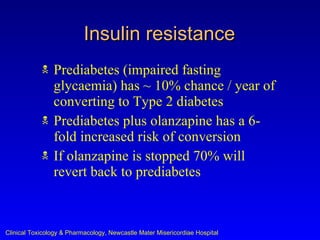
Insulin resistance
               Prediabetes (impaired fasting
                glycaemia) has ~ 10% chance / year of
                converting to Type 2 diabetes
               Prediabetes plus olanzapine has a 6-
                fold increased risk of conversion
               If olanzapine is stopped 70% will
                revert back to prediabetes


Clinical Toxicology & Pharmacology, Newcastle Mater Misericordiae Hospital
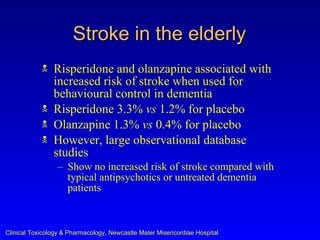
Stroke in the elderly
               Risperidone and olanzapine associated with
                increased risk of stroke when used for
                behavioural control in dementia
               Risperidone 3.3% vs 1.2% for placebo
               Olanzapine 1.3% vs 0.4% for placebo
               However, large observational database
                studies
                  – Show no increased risk of stroke compared with
                    typical antipsychotics or untreated dementia
                    patients


Clinical Toxicology & Pharmacology, Newcastle Mater Misericordiae Hospital
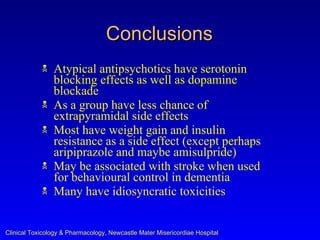
Conclusions
               Atypical antipsychotics have serotonin
                blocking effects as well as dopamine
                blockade
               As a group have less chance of
                extrapyramidal side effects
               Most have weight gain and insulin
                resistance as a side effect (except perhaps
                aripiprazole and maybe amisulpride)
               May be associated with stroke when used
                for behavioural control in dementia
               Many have idiosyncratic toxicities


Clinical Toxicology & Pharmacology, Newcastle Mater Misericordiae Hospital
Differences among
                          Antipsychotic Drugs
               All effective antipsychotic drugs block D2
                receptors
               Chlorpromazine and thioridazine
                  – block α1 adrenoceptors more potently than D2 receptors
                  – block serotonin 5-HT2 receptors relatively strongly
                  – affinity for D1 receptors is relatively weak
               Haloperidol
                  – acts mainly on D2 receptors
                  – some effect on 5-HT2 and α1 receptors
                  – negligible effects on D1 receptors
               Pimozide and amisulpride†
                  – act almost exclusively on D2 receptors

Clinical Toxicology & Pharmacology, Newcastle Mater Misericordiae Hospital
Differences among
                          Antipsychotic Drugs
               Clozapine
                  – binds more to D4, 5-HT2, α1, and histamine H1
                    receptors than to either D2 or D1 receptors
               Risperidone
                  – about equally potent in blocking D2 and 5-HT2
                    receptors
               Olanzapine
                  – more potent as an antagonist of 5-HT2 receptors
                  – lesser potency at D1, D2, and α1 receptors
               Quetiapine
                  – lower-potency compound with relatively similar
                    antagonism of 5-HT2, D2, α1, and α2 receptors

Clinical Toxicology & Pharmacology, Newcastle Mater Misericordiae Hospital
Differences among
                          Antipsychotic Drugs
               Clozapine, olanzapine and quetiapine
                  – potent inhibitors of H1 histamine
                    receptors
                  – consistent with their sedative properties
               Aripiprazole
                  – partial agonist effects at D2 and 5-HT1A
                    receptors


Clinical Toxicology & Pharmacology, Newcastle Mater Misericordiae Hospital

Antipsyc

  • 1.
    Antipsychotic drugs Clinical Toxicology& Pharmacology, Newcastle Mater Misericordiae Hospital
  • 2.
    CNS drugs  Functionally, the CNS is the most complex part of the body, and understanding drug effects is difficult  Understanding the effects of drugs on individual neurons does not predict the effect on the whole organ  In part this is due to complex interactions mediated by different neurotransmitters Clinical Toxicology & Pharmacology, Newcastle Mater Misericordiae Hospital
  • 3.
    Dopamine  Important neurotransmitter  Present mainly in the nigrostriatal, mesolimbic and tubero-infundibular pathways  Originally there were only thought to be two main groups of dopamine receptor: D1 and D2 . These stimulate and inhibit adenylate cyclase respectively  Subsequently D3 (related to D1) and D4 (related to D2 ) receptors were discovered  D2 receptors are mainly responsible for the actions of anti-psychotic drugs Clinical Toxicology & Pharmacology, Newcastle Mater Misericordiae Hospital
  • 4.
    Clinical Toxicology &Pharmacology, Newcastle Mater Misericordiae Hospital
  • 5.
    Dopamine functions  Motor control - nigrostriatal system – Deficiency results in rigidity, tremor and difficulty initiating movement  Behavioural effects - mesolimbic system – Overactivity in rats leads to abnormal behavior  Endocrine control - tubero-infundibular system – Dopamine and dopamine agonists suppress prolactin release, dopamine antagonists may stimulate it Clinical Toxicology & Pharmacology, Newcastle Mater Misericordiae Hospital
  • 6.
    Schizophrenia - dopamine  Amphetamine (which releases dopamine) can produce a syndrome similar to the ‘positive’ features of schizophrenia  Levodopa may aggravate the condition  Apomorphine and bromocriptine (D2 agonists) produce behavioral abnormalities in animals  D2 receptor antagonists are effective in controlling the positive features of the disorder  ? Increased D2 receptor binding in the brains of schizophrenic subjects. Evidence of genetic variation in the D4 receptor to which some anti- psychotic drugs have high affinity Clinical Toxicology & Pharmacology, Newcastle Mater Misericordiae Hospital
  • 7.
    Schizophrenia - serotonin  LSD which has mixed agonist/antagonist serotonergic actions produces hallucinations and behavioral disturbance  Some antipsychotic drugs also act at 5-HT receptors (antagonists of 5HT2)  5-HT has a modulatory effect on dopaminergic neurones Clinical Toxicology & Pharmacology, Newcastle Mater Misericordiae Hospital
  • 8.
    Modes of action  All anti-psychotic drugs have inhibitory effects on the D2 receptor  Some have actions against the D4 receptor  All have other effects - to varying degrees – Serotonin 5HT2 blockade (may improve negative symptoms) – Histamine H1 blockade (drowsiness) – Alpha adrenoceptor blockade (postural hypotension) Clinical Toxicology & Pharmacology, Newcastle Mater Misericordiae Hospital
  • 9.
    How do weknow they work?  Mostly “ by accident” for early drugs – designing drugs to reduce anxiety in surgical patients  Clinical experience  Clinical trials – especially more recent drugs  PET scanning showing blockade of central D2 receptors Clinical Toxicology & Pharmacology, Newcastle Mater Misericordiae Hospital
  • 10.
    Clinical effects  Control the ‘positive’ features of the disease, but little effect on the ‘negative’ features – clozapine may be superior in this regard  The main side-effects are on the extrapyramidal motor system – Akathisia (hours) – Dystonias (hours to days) – Parkinsonism (weeks to months) q rigidity, tremor, and loss of mobility – Tardive dyskinesia (months to years) q Repetitive abnormal movements of face and upper limbs q Thought to be due to proliferation of D2 receptors in the striatum Clinical Toxicology & Pharmacology, Newcastle Mater Misericordiae Hospital
  • 11.
    Clinical effects  Newer ‘atypical’ anti-psychotic drugs are less inclined to produce these effects - possible due to their greater affinity for the mesolimbic over the striatal areas of the brain Clinical Toxicology & Pharmacology, Newcastle Mater Misericordiae Hospital
  • 12.
    Other effects  Some are effective anti-emetics  Anti-muscarinic effects lead to dry mouth, blurred vision, difficulty with micturition  α antagonist effects lead to postural hypotension  Antihistamine effects (H1 receptor) lead to drowsiness  Prolactin stimulation may lead to breast development  Agranulocytosis is fairly common with an ‘atypical’ drug – clozapine which can also cause a myocarditis  ‘Neuroleptic malignant syndrome’ is a rare but serious effect leading to extrapyramidal rigidity, autonomic instability and hyperthermia Clinical Toxicology & Pharmacology, Newcastle Mater Misericordiae Hospital
  • 13.
    Other effects Clinical Toxicology& Pharmacology, Newcastle Mater Misericordiae Hospital
  • 14.
    Clinical Toxicology &Pharmacology, Newcastle Mater Misericordiae Hospital
  • 15.
    Traditional Antipsychotics  Phenothiazines – chlorpromazine (Chlorpromazine Mixture, Chlorpromazine Mixture Forte, Largactil) – fluphenazine (Anatensol, Modecate) – flupenthixol (Fluanxol) – pericyazine (Neulactil) – pimozide (Orap) – thioridazine (Aldazine) – trifluoperazine (Stelazine) – zuclopenthixol (Clopixol)  Butyrophenones – droperidol (Droleptan Injection) – haloperidol (Haldol, Serenace) Clinical Toxicology & Pharmacology, Newcastle Mater Misericordiae Hospital
  • 16.
    Clinical Toxicology &Pharmacology, Newcastle Mater Misericordiae Hospital
  • 17.
    Newer Antipsychotics  Atypical agents – aripiprazole (Abilify) – clozapine (CloSyn, Clopine, Clozaril) – risperidone (Risperdal) – quetiapine (Seroquel) – amisulpride (Solian) – olanzapine (Zyprexa) Clinical Toxicology & Pharmacology, Newcastle Mater Misericordiae Hospital
  • 18.
    Antipsychotics Clinical Toxicology &Pharmacology, Newcastle Mater Misericordiae Hospital
  • 19.
    Differences among Antipsychotic Drugs  Chlorpromazine: α1 = 5-HT2 > D2 > D1  Haloperidol: D2 > D1 = D4 > α1 > 5-HT2  Clozapine: D4 = α1 > 5-HT2 > D2 = D1 Clinical Toxicology & Pharmacology, Newcastle Mater Misericordiae Hospital
  • 20.
    Atypical antipsychotics  Claims – lower doses – reduced side effects – more effective (especially negative symptoms) – better compliance  Evidence? – trials have been quite small and involved patients previously heavily treated and somewhat ‘resistant’ – trials have tended to show equivalent efficacy and better side effect profiles with newer drugs – head to head trials claimed superiority of olanzapine over risperidone (but company sponsored and controversial); some “parallel publications”  Costs – Much higher with new drugs (10-40 times higher) Clinical Toxicology & Pharmacology, Newcastle Mater Misericordiae Hospital
  • 21.
    Metabolic effects Weight gain over 1 year (kg) aripiprazole 1 amisulpride 1.5 quetiapine 2–3 risperidone 2–3 olanzapine >6 clozapine >6 Clinical Toxicology & Pharmacology, Newcastle Mater Misericordiae Hospital
  • 22.
    Insulin resistance  Prediabetes (impaired fasting glycaemia) has ~ 10% chance / year of converting to Type 2 diabetes  Prediabetes plus olanzapine has a 6- fold increased risk of conversion  If olanzapine is stopped 70% will revert back to prediabetes Clinical Toxicology & Pharmacology, Newcastle Mater Misericordiae Hospital
  • 23.
    Stroke in theelderly  Risperidone and olanzapine associated with increased risk of stroke when used for behavioural control in dementia  Risperidone 3.3% vs 1.2% for placebo  Olanzapine 1.3% vs 0.4% for placebo  However, large observational database studies – Show no increased risk of stroke compared with typical antipsychotics or untreated dementia patients Clinical Toxicology & Pharmacology, Newcastle Mater Misericordiae Hospital
  • 24.
    Conclusions  Atypical antipsychotics have serotonin blocking effects as well as dopamine blockade  As a group have less chance of extrapyramidal side effects  Most have weight gain and insulin resistance as a side effect (except perhaps aripiprazole and maybe amisulpride)  May be associated with stroke when used for behavioural control in dementia  Many have idiosyncratic toxicities Clinical Toxicology & Pharmacology, Newcastle Mater Misericordiae Hospital
  • 25.
    Clinical Toxicology &Pharmacology, Newcastle Mater Misericordiae Hospital
  • 26.
    Clinical Toxicology &Pharmacology, Newcastle Mater Misericordiae Hospital
  • 27.
    Clinical Toxicology &Pharmacology, Newcastle Mater Misericordiae Hospital
  • 28.
    Differences among Antipsychotic Drugs  All effective antipsychotic drugs block D2 receptors  Chlorpromazine and thioridazine – block α1 adrenoceptors more potently than D2 receptors – block serotonin 5-HT2 receptors relatively strongly – affinity for D1 receptors is relatively weak  Haloperidol – acts mainly on D2 receptors – some effect on 5-HT2 and α1 receptors – negligible effects on D1 receptors  Pimozide and amisulpride† – act almost exclusively on D2 receptors Clinical Toxicology & Pharmacology, Newcastle Mater Misericordiae Hospital
  • 29.
    Differences among Antipsychotic Drugs  Clozapine – binds more to D4, 5-HT2, α1, and histamine H1 receptors than to either D2 or D1 receptors  Risperidone – about equally potent in blocking D2 and 5-HT2 receptors  Olanzapine – more potent as an antagonist of 5-HT2 receptors – lesser potency at D1, D2, and α1 receptors  Quetiapine – lower-potency compound with relatively similar antagonism of 5-HT2, D2, α1, and α2 receptors Clinical Toxicology & Pharmacology, Newcastle Mater Misericordiae Hospital
  • 30.
    Differences among Antipsychotic Drugs  Clozapine, olanzapine and quetiapine – potent inhibitors of H1 histamine receptors – consistent with their sedative properties  Aripiprazole – partial agonist effects at D2 and 5-HT1A receptors Clinical Toxicology & Pharmacology, Newcastle Mater Misericordiae Hospital