 Antipsychotic drugs = Neuroleptics= Major
tranquilizers
Drugs that are primarily used to treat schizophrenia
 They can also be used for other psychotic states
including manic states with psychotic symptoms
such as grandiosity, paranoia and hallucinations
 Use of antipsychotics involves benefits of
alleviating psychotic symptoms and the risk of
troubling adverse effects
 Antipsychotic drugs are not curative and do not
eliminate the chronic thought disorder
 Anitpsychotics decrease the intensity of
hallucinations and delusions and permit the
person with schizophrenia to function in a
supportive environment
 Psychosis: a mental disorder caused by brain
dysfunction
 Schizophrenia
◦ Type of psychosis characterized by:
 Delusions
 Hallucinations (often in the form of voices)
 Thinking or speech disturbances
◦ Schizophrenia is a chronic and disabling disorder
◦ Occurs in 1% of population
◦ It has a genetic component
◦ Biochemical abnormalities include dysfunction of
dopaminergic pathways
◦ Associated with D2 type of dopamine receptor
 At least two of the characteristic symptoms:
◦ Delusions
◦ Hallucinations
◦ Disorganized thoughts and speech
◦ Grossly disorganized behavior
◦ Negative symptoms (blunted affect, anhedonia,
apathy, social isolation, poor hygiene, poor memory,
impaired attention and poor cognition)
 Deterioration in function
 Duration at least 6 months
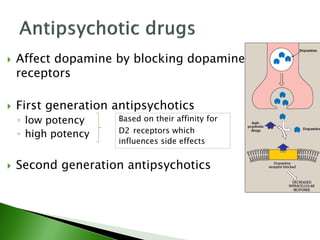
 Affect dopamine by blocking dopamine
receptors
 First generation antipsychotics
◦ low potency
◦ high potency
 Second generation antipsychotics
Based on their affinity for
D2 receptors which
influences side effects
 Low potency
◦ Chlorpromazine
◦ Prochlorperazine
◦ Thioridazine
 High potency
◦ Haloperidol (Haldol®)
◦ Fluphenazine
◦ Pimozide
◦ Thiothixene
◦ Loxapine
◦ Trifulperazine
 Also called conventional, typical or traditional
antipsychotics
 Competitive blockers of D2 receptors
 Associated with movement disorders, especially
the ones with stronger binding to dopamine
receptors
 No drug is clinically more effective than the other
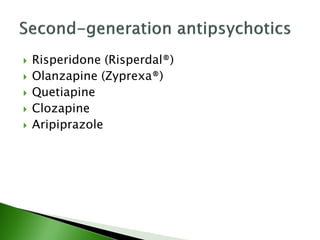
 Risperidone (Risperdal®)
 Olanzapine (Zyprexa®)
 Quetiapine
 Clozapine
 Aripiprazole
 Preferred to minimize the risk of debilitating
movement disorders associated with first generation
 Efficacy is equivalent to and occasionally exceeds, that
of the first-generation
 No differences in therapeutic efficacy among second-
generation drugs
 Individual patient response and comorbid conditions
must often be considered in drug selection
 Second-generation antipsychotics are not
interchangeable because patients may respond
differently to each drug
 20% of patients with schizophrenia will have an
insufficient response to all 1st and 2nd generation
antipsychotics and clozapine has shown to be
effective for these patients
 Clozapine use is limited to refractory patients
because of serious side effects:
◦ Bone marrow suppression
(frequent monitoring of white blood cell counts is required
due to risk of severe agranulocytosis)
◦ Seizures
◦ Cardiovascular side effects
 Also referred to as atypical antipsychotics
 Have fewer EPS than first generation drugs
 Associated with a higher risk of metabolic side
effects like diabetes, hypercholesterolemia and
weight gain
 Block both dopamine and serotonin receptors
Actions
 The antipsychotic actions are due to blockade at
dopamine and/or serotonin receptors
 Many of these agents also block cholinergic,
adrenergic, and histaminergic receptors causing
adverse effects
1. Antipsychotic actions
2. Extrapyramidal effects
3. Antiemetic effects
4. Anticholinergic effects
5. Other effects
Antipsychotic actions:
 Reduce the hallucinations and delusions associated with
schizophrenia (“positive” symptoms) by blocking dopamine
receptors in the mesolimbic system of the brain
 “Negative” symptoms, such as blunted affect, anhedonia,
apathy, impaired attention, and cognitive impairment are
not as responsive to therapy, particularly with 1st generation
 Many 2nd generation agents, such as clozapine, ameliorate
negative symptoms
 All of the drugs also have a calming effect and reduce
spontaneous physical movement without depressing the
intellectual functioning of the patient
 The antipsychotic effects take several days to weeks
Extrapyramidal effects:
 Dystonias (sustained contraction of muscles
leading to twisting, distorted postures)
 Parkinson-like symptoms
◦ Akathisia (motor restlessness)
◦ Tardive dyskinesia (involuntary movements of the tongue,
lips, neck, trunk, and limbs)
◦ Occur with chronic treatment due to blocking of dopamine
receptors in the nigrostriatal pathway
 The second-generation antipsychotics exhibit a
lower incidence of these symptoms
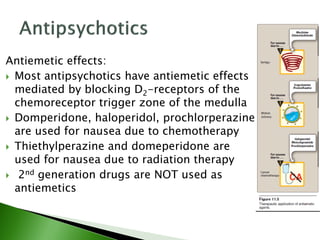
Antiemetic effects:
 Most antipsychotics have antiemetic effects
mediated by blocking D2-receptors of the
chemoreceptor trigger zone of the medulla
 Domperidone, haloperidol, prochlorperazine
are used for nausea due to chemotherapy
 Thiethylperazine and domeperidone are
used for nausea due to radiation therapy
 2nd generation drugs are NOT used as
antiemetics
Anticholinergic effects:
 Some antipsychotics particularly thioridazine,
chlorpromazine, clozapine, and olanzapine
produce anticholinergic effects
 This anticholinergic property may actually assist in
reducing the risk of EPS with these agents
 Clozapine is an exception, it increases salivation;
confusion; and inhibits gastrointestinal and urinary
tract smooth muscle, leading to constipation and
urinary retention
Other effects
 Blockade of α-adrenergic receptors causing orthostatic
hypotension
 In the pituitary, antipsychotics block D2 receptors,
leading to an increase in prolactin release
 2nd generation antipsychotics are less likely to produce
prolactin elevations
 Sedation occurs with drugs that are potent antagonists
of the H1-histamine receptor, including clozapine
chlorpromazine, olanzapine, quetiapine
 Sexual dysfunction may also occur
Therapeutic uses
1. Treatment of schizophrenia
2. Prevention of severe nausea and vomiting:
◦ Antipsychotics like prochlorperazine are useful in the treatment
of drug-induced emesis (e.g. chemotherapy)
3. Tranquilizers to manage agitated and disruptive
behavior secondary to other disorders
4. Used in combination with narcotic analgesics for
treatment of chronic pain with severe anxiety
5. Chlorpromazine is used to treat intractable hiccups
6. Risperidone and aripiprazole are now approved for
management of the disruptive behavior and irritability
secondary to autism
 Metabolized by the cytochrome P450 system in
the liver: CYP2D6, CYP1A2, and CYP3A4
 Some metabolites are active
Adverse effects
1. Extrapyramidal side effects: due to blockade of
dopamine receptors
◦ The risk of movement disorders is time and dose
dependent
◦ Administration of an anticholinergic drug, such as
benztropine minimizes EPS
2. Tardive dyskinesia:
◦ Due to long-term treatment with antipsychotics
◦ A prolonged holiday from antipsychotics may cause the
symptoms to diminish or disappear
◦ Can be irreversible
Adverse effects
3. Antipsychotic malignant syndrome:
◦ Potentially fatal
◦ Muscle rigidity, fever, altered mental status , unstable BP
◦ Treatment necessitates discontinuation of antipsychotic agent
and supportive therapy, administration of dantrolene or
bromocriptine may be helpful
4. Drowsiness occurs due to CNS depression and
antihistaminic effects
5. Antimuscarinic activity produces dry mouth, urinary
retention, constipation
6. Blocking α-adrenergic receptors results in orthostatic
hypotension
Adverse effects
7. The antipsychotics depress the
hypothalamus, affecting thermoregulation
and causing amenorrhea, galactorrhea,
gynecomastia, infertility, and impotence
8. Weight gain
9. Hyperglycemia and hypercholesterolemia
(second-generation atipsychotics)
◦ Glucose and lipid profiles should be monitored
10. Clozapine causes agranulocytosis
 Patients who have had ≥ 2 psychotic episodes,
secondary to schizophrenia, should receive
maintenance therapy for at least 5 years, and some
experts prefer indefinite therapy
 Low doses of antipsychotic drugs are not as
effective as higher-dose maintenance therapy in
preventing relapse
 The rate of relapse may be lower with second
generation drugs

Antipsychotics - Pharmacology

  • 2.
     Antipsychotic drugs= Neuroleptics= Major tranquilizers Drugs that are primarily used to treat schizophrenia  They can also be used for other psychotic states including manic states with psychotic symptoms such as grandiosity, paranoia and hallucinations
  • 3.
     Use ofantipsychotics involves benefits of alleviating psychotic symptoms and the risk of troubling adverse effects  Antipsychotic drugs are not curative and do not eliminate the chronic thought disorder  Anitpsychotics decrease the intensity of hallucinations and delusions and permit the person with schizophrenia to function in a supportive environment
  • 4.
     Psychosis: amental disorder caused by brain dysfunction  Schizophrenia ◦ Type of psychosis characterized by:  Delusions  Hallucinations (often in the form of voices)  Thinking or speech disturbances ◦ Schizophrenia is a chronic and disabling disorder ◦ Occurs in 1% of population ◦ It has a genetic component ◦ Biochemical abnormalities include dysfunction of dopaminergic pathways ◦ Associated with D2 type of dopamine receptor
  • 5.
     At leasttwo of the characteristic symptoms: ◦ Delusions ◦ Hallucinations ◦ Disorganized thoughts and speech ◦ Grossly disorganized behavior ◦ Negative symptoms (blunted affect, anhedonia, apathy, social isolation, poor hygiene, poor memory, impaired attention and poor cognition)  Deterioration in function  Duration at least 6 months
  • 6.
     Affect dopamineby blocking dopamine receptors  First generation antipsychotics ◦ low potency ◦ high potency  Second generation antipsychotics Based on their affinity for D2 receptors which influences side effects
  • 7.
     Low potency ◦Chlorpromazine ◦ Prochlorperazine ◦ Thioridazine  High potency ◦ Haloperidol (Haldol®) ◦ Fluphenazine ◦ Pimozide ◦ Thiothixene ◦ Loxapine ◦ Trifulperazine
  • 8.
     Also calledconventional, typical or traditional antipsychotics  Competitive blockers of D2 receptors  Associated with movement disorders, especially the ones with stronger binding to dopamine receptors  No drug is clinically more effective than the other
  • 9.
     Risperidone (Risperdal®) Olanzapine (Zyprexa®)  Quetiapine  Clozapine  Aripiprazole
  • 10.
     Preferred tominimize the risk of debilitating movement disorders associated with first generation  Efficacy is equivalent to and occasionally exceeds, that of the first-generation  No differences in therapeutic efficacy among second- generation drugs  Individual patient response and comorbid conditions must often be considered in drug selection  Second-generation antipsychotics are not interchangeable because patients may respond differently to each drug
  • 11.
     20% ofpatients with schizophrenia will have an insufficient response to all 1st and 2nd generation antipsychotics and clozapine has shown to be effective for these patients  Clozapine use is limited to refractory patients because of serious side effects: ◦ Bone marrow suppression (frequent monitoring of white blood cell counts is required due to risk of severe agranulocytosis) ◦ Seizures ◦ Cardiovascular side effects
  • 12.
     Also referredto as atypical antipsychotics  Have fewer EPS than first generation drugs  Associated with a higher risk of metabolic side effects like diabetes, hypercholesterolemia and weight gain  Block both dopamine and serotonin receptors
  • 13.
    Actions  The antipsychoticactions are due to blockade at dopamine and/or serotonin receptors  Many of these agents also block cholinergic, adrenergic, and histaminergic receptors causing adverse effects 1. Antipsychotic actions 2. Extrapyramidal effects 3. Antiemetic effects 4. Anticholinergic effects 5. Other effects
  • 14.
    Antipsychotic actions:  Reducethe hallucinations and delusions associated with schizophrenia (“positive” symptoms) by blocking dopamine receptors in the mesolimbic system of the brain  “Negative” symptoms, such as blunted affect, anhedonia, apathy, impaired attention, and cognitive impairment are not as responsive to therapy, particularly with 1st generation  Many 2nd generation agents, such as clozapine, ameliorate negative symptoms  All of the drugs also have a calming effect and reduce spontaneous physical movement without depressing the intellectual functioning of the patient  The antipsychotic effects take several days to weeks
  • 15.
    Extrapyramidal effects:  Dystonias(sustained contraction of muscles leading to twisting, distorted postures)  Parkinson-like symptoms ◦ Akathisia (motor restlessness) ◦ Tardive dyskinesia (involuntary movements of the tongue, lips, neck, trunk, and limbs) ◦ Occur with chronic treatment due to blocking of dopamine receptors in the nigrostriatal pathway  The second-generation antipsychotics exhibit a lower incidence of these symptoms
  • 16.
    Antiemetic effects:  Mostantipsychotics have antiemetic effects mediated by blocking D2-receptors of the chemoreceptor trigger zone of the medulla  Domperidone, haloperidol, prochlorperazine are used for nausea due to chemotherapy  Thiethylperazine and domeperidone are used for nausea due to radiation therapy  2nd generation drugs are NOT used as antiemetics
  • 17.
    Anticholinergic effects:  Someantipsychotics particularly thioridazine, chlorpromazine, clozapine, and olanzapine produce anticholinergic effects  This anticholinergic property may actually assist in reducing the risk of EPS with these agents  Clozapine is an exception, it increases salivation; confusion; and inhibits gastrointestinal and urinary tract smooth muscle, leading to constipation and urinary retention
  • 18.
    Other effects  Blockadeof α-adrenergic receptors causing orthostatic hypotension  In the pituitary, antipsychotics block D2 receptors, leading to an increase in prolactin release  2nd generation antipsychotics are less likely to produce prolactin elevations  Sedation occurs with drugs that are potent antagonists of the H1-histamine receptor, including clozapine chlorpromazine, olanzapine, quetiapine  Sexual dysfunction may also occur
  • 19.
    Therapeutic uses 1. Treatmentof schizophrenia 2. Prevention of severe nausea and vomiting: ◦ Antipsychotics like prochlorperazine are useful in the treatment of drug-induced emesis (e.g. chemotherapy) 3. Tranquilizers to manage agitated and disruptive behavior secondary to other disorders 4. Used in combination with narcotic analgesics for treatment of chronic pain with severe anxiety 5. Chlorpromazine is used to treat intractable hiccups 6. Risperidone and aripiprazole are now approved for management of the disruptive behavior and irritability secondary to autism
  • 20.
     Metabolized bythe cytochrome P450 system in the liver: CYP2D6, CYP1A2, and CYP3A4  Some metabolites are active
  • 21.
    Adverse effects 1. Extrapyramidalside effects: due to blockade of dopamine receptors ◦ The risk of movement disorders is time and dose dependent ◦ Administration of an anticholinergic drug, such as benztropine minimizes EPS 2. Tardive dyskinesia: ◦ Due to long-term treatment with antipsychotics ◦ A prolonged holiday from antipsychotics may cause the symptoms to diminish or disappear ◦ Can be irreversible
  • 22.
    Adverse effects 3. Antipsychoticmalignant syndrome: ◦ Potentially fatal ◦ Muscle rigidity, fever, altered mental status , unstable BP ◦ Treatment necessitates discontinuation of antipsychotic agent and supportive therapy, administration of dantrolene or bromocriptine may be helpful 4. Drowsiness occurs due to CNS depression and antihistaminic effects 5. Antimuscarinic activity produces dry mouth, urinary retention, constipation 6. Blocking α-adrenergic receptors results in orthostatic hypotension
  • 23.
    Adverse effects 7. Theantipsychotics depress the hypothalamus, affecting thermoregulation and causing amenorrhea, galactorrhea, gynecomastia, infertility, and impotence 8. Weight gain 9. Hyperglycemia and hypercholesterolemia (second-generation atipsychotics) ◦ Glucose and lipid profiles should be monitored 10. Clozapine causes agranulocytosis
  • 24.
     Patients whohave had ≥ 2 psychotic episodes, secondary to schizophrenia, should receive maintenance therapy for at least 5 years, and some experts prefer indefinite therapy  Low doses of antipsychotic drugs are not as effective as higher-dose maintenance therapy in preventing relapse  The rate of relapse may be lower with second generation drugs