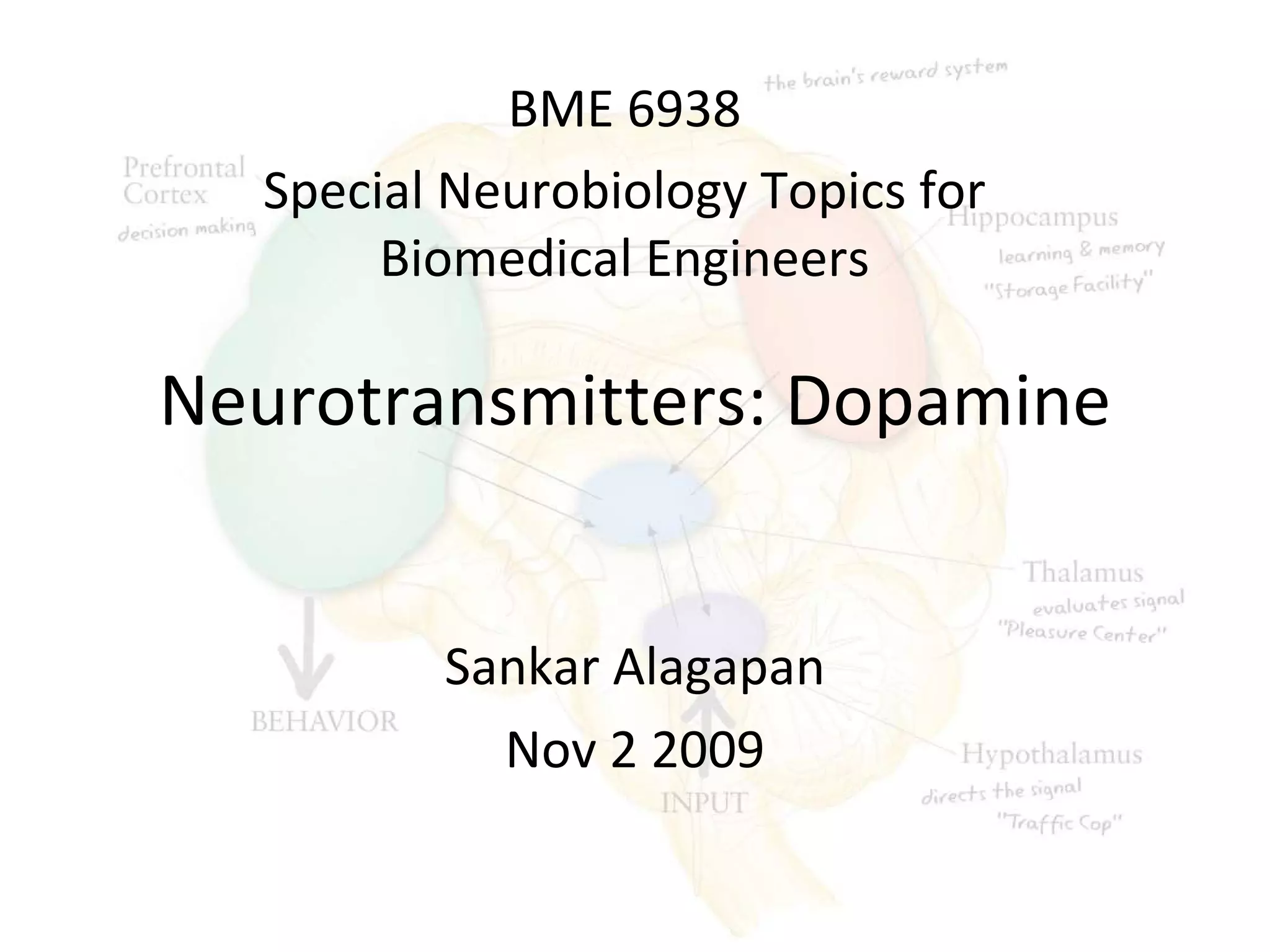
Neurotransmitters: Dopamine Sankar Alagapan Nov 2 2009 BME 6938 Special Neurobiology Topics for Biomedical Engineers
Overview Introduction Biochemistry Dopamine receptors Dopaminergic pathways Dopamine and Reward Signaling (Learning) Dopamine and Addiction Pathologies associated with dopamine system Summary
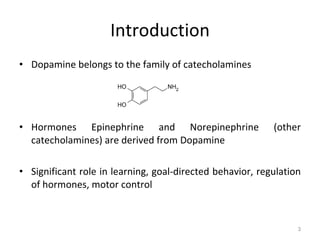
Introduction Dopamine belongs to the family of catecholamines Hormones Epinephrine and Norepinephrine (other catecholamines) are derived from Dopamine Significant role in learning, goal-directed behavior, regulation of hormones, motor control
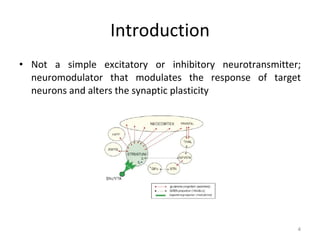
Introduction Not a simple excitatory or inhibitory neurotransmitter; neuromodulator that modulates the response of target neurons and alters the synaptic plasticity
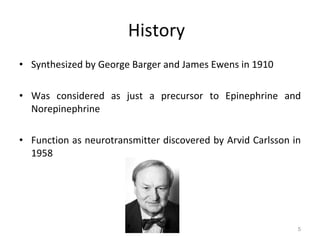
History Synthesized by George Barger and James Ewens in 1910 Was considered as just a precursor to Epinephrine and Norepinephrine Function as neurotransmitter discovered by Arvid Carlsson in 1958
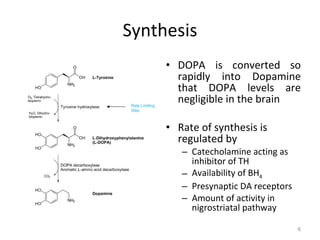
Synthesis DOPA is converted so rapidly into Dopamine that DOPA levels are negligible in the brain Rate of synthesis is regulated by Catecholamine acting as  inhibitor of TH Availability of BH 4 Presynaptic DA receptors Amount of activity in nigrostriatal pathway Rate Limiting Step
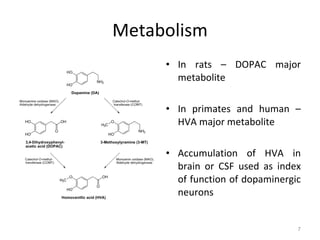
Metabolism In rats – DOPAC major metabolite In primates and human – HVA major metabolite Accumulation of HVA in brain or CSF used as index of function of dopaminergic neurons
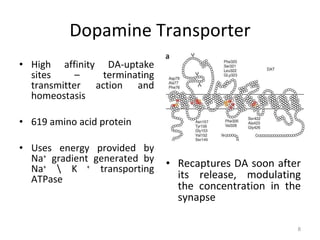
Dopamine Transporter High affinity DA-uptake sites – terminating transmitter action and homeostasis 619 amino acid protein Uses energy provided by Na +  gradient generated by Na +  \ K  +  transporting ATPase Recaptures DA soon after its release, modulating the concentration in the synapse
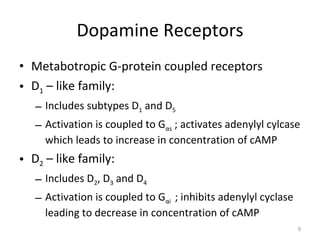
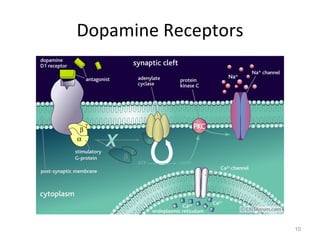
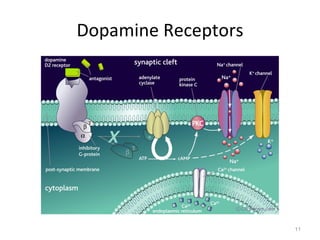
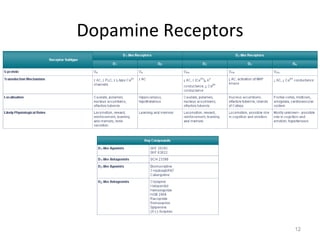
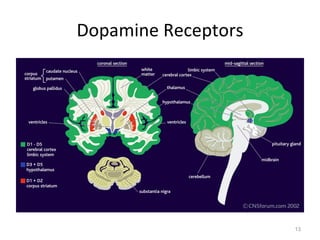
Dopamine Receptors Metabotropic G-protein coupled receptors D 1  – like family: Includes subtypes D 1  and D 5 Activation is coupled to G α s  ; activates adenylyl cylcase which leads to increase in concentration of cAMP D 2  – like family:  Includes D 2 , D 3  and D 4 Activation is coupled to G α i  ; inhibits adenylyl cyclase leading to decrease in concentration of cAMP
Dopamine Receptors
Dopamine Receptors
Dopamine Receptors
Dopamine Receptors
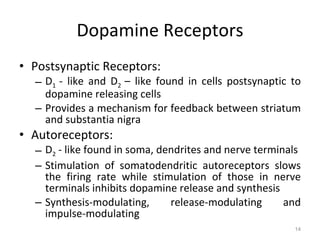
Dopamine Receptors Postsynaptic Receptors: D 1  - like and D 2  – like found in cells postsynaptic to dopamine releasing cells Provides a mechanism for feedback between striatum and substantia nigra Autoreceptors: D 2  - like found in soma, dendrites and nerve terminals Stimulation of somatodendritic autoreceptors slows the firing rate while stimulation of those in nerve terminals inhibits dopamine release and synthesis Synthesis-modulating, release-modulating and impulse-modulating
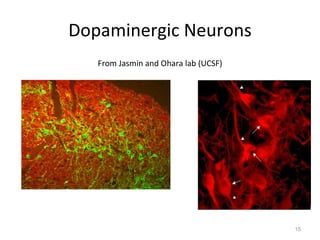
Dopaminergic Neurons From Jasmin and Ohara lab (UCSF)
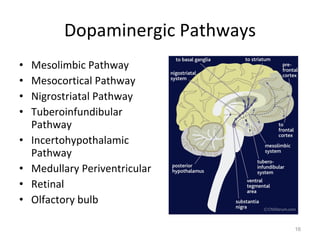
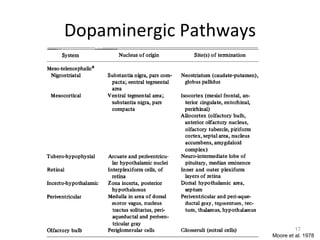
Dopaminergic Pathways Mesolimbic Pathway Mesocortical Pathway Nigrostriatal Pathway Tuberoinfundibular Pathway Incertohypothalamic Pathway Medullary Periventricular Retinal Olfactory bulb
Dopaminergic Pathways Moore et al. 1978
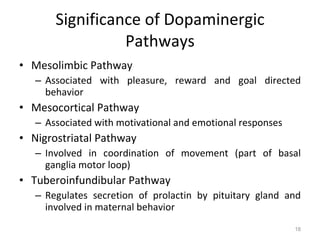
Significance of Dopaminergic Pathways Mesolimbic Pathway Associated with pleasure, reward and goal directed behavior Mesocortical Pathway Associated with motivational and emotional responses Nigrostriatal Pathway Involved in coordination of movement (part of basal ganglia motor loop) Tuberoinfundibular Pathway Regulates secretion of prolactin by pituitary gland and involved in maternal behavior
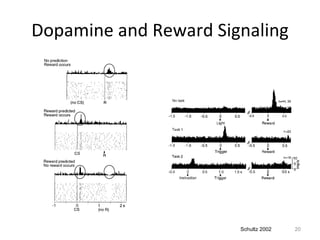
Dopamine and Reward Signaling Behavior studies show that dopamine projections to striatum and frontal cortex play important role in effect of rewards on learning Dopamine neurons in the basal ganglia show increase in activity when the animal receives an unexpected reward, or a cue that predicts a reward and a decrease in activity when an expected reward is not obtained
Dopamine and Reward Signaling Schultz 2002
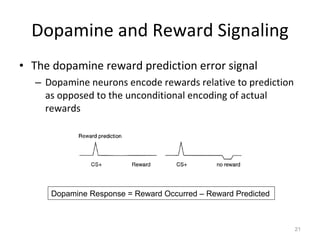
Dopamine and Reward Signaling The dopamine reward prediction error signal Dopamine neurons encode rewards relative to prediction as opposed to the unconditional encoding of actual rewards Dopamine Response = Reward Occurred – Reward Predicted
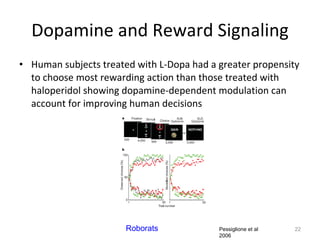
Dopamine and Reward Signaling Human subjects treated with L-Dopa had a greater propensity to choose most rewarding action than those treated with haloperidol showing dopamine-dependent modulation can account for improving human decisions  Pessiglione et al 2006 Roborats
Dopamine and Addiction The dopaminergic projection to ventral striatum has often been implicated in the mechanisms for addiction Increased locomotor activity and stereotypy caused due to psychostimulant involve dopamine release in striatum Psychostimulants such as Cocaine and Amphetamine are known to alter dopamine activity in brain
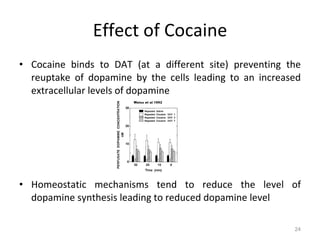
Cocaine binds to DAT (at a different site) preventing the reuptake of dopamine by the cells leading to an increased extracellular levels of dopamine Homeostatic mechanisms tend to reduce the level of dopamine synthesis leading to reduced dopamine level Effect of Cocaine
Effect of Cocaine Evidences also show that D 1 -antagonists prevent the behavioral response than D 2 - antagonists implicating cocaine affinity to D 1  receptor Suppresses the firing of Nucleus Accumbens neurons by enhancing extracellular dopamine concentration which alters the ion channels leading to less excitability
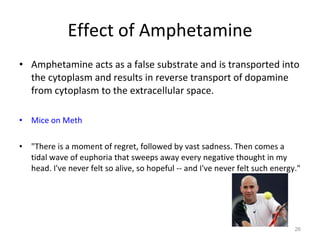
Effect of Amphetamine Amphetamine acts as a false substrate and is transported into the cytoplasm and results in reverse transport of dopamine from cytoplasm to the extracellular space. Mice on Meth "There is a moment of regret, followed by vast sadness. Then comes a tidal wave of euphoria that sweeps away every negative thought in my head. I've never felt so alive, so hopeful -- and I've never felt such energy."
Parkinson’s Disease Substantial loss of Dopamine in the striatum (70 – 80%)  Loss of dopamine neurons in other systems also (mesolimbic, mesocortical and hypothalamic systems) Treatment strategy includes increasing dopamine levels by administering L-Dopa, nerve grafting with dopamine containing cells and deep brain stimulation
Schizophrenia Defective dopamine neurotransmission – relative excess of central dopaminergic activity An increase in DA function in the mesolimbic system and a decreased function in the mesocortical DA systems Behavior similar to the behavioral effects of psychostimulants Antipsychotics such as chlorpromazine, bind to  D 2  dopamine receptors and reduced positive psychotic symptoms
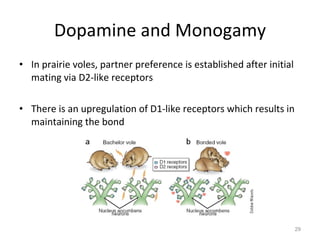
Dopamine and Monogamy In prairie voles, partner preference is established after initial mating via D2-like receptors There is an upregulation of D1-like receptors which results in maintaining the bond
Summary Neurotransmitter that acts as a modulator 2 family of receptors for dopamine 3 main pathways of action Involved in reward signaling providing a reward prediction error signal Implicated with addiction – psychostimulants act as agonists of dopamine

Neurotransmitter - Dopamine

  • 1.
    Neurotransmitters: Dopamine SankarAlagapan Nov 2 2009 BME 6938 Special Neurobiology Topics for Biomedical Engineers
  • 2.
    Overview Introduction BiochemistryDopamine receptors Dopaminergic pathways Dopamine and Reward Signaling (Learning) Dopamine and Addiction Pathologies associated with dopamine system Summary
  • 3.
    Introduction Dopamine belongsto the family of catecholamines Hormones Epinephrine and Norepinephrine (other catecholamines) are derived from Dopamine Significant role in learning, goal-directed behavior, regulation of hormones, motor control
  • 4.
    Introduction Not asimple excitatory or inhibitory neurotransmitter; neuromodulator that modulates the response of target neurons and alters the synaptic plasticity
  • 5.
    History Synthesized byGeorge Barger and James Ewens in 1910 Was considered as just a precursor to Epinephrine and Norepinephrine Function as neurotransmitter discovered by Arvid Carlsson in 1958
  • 6.
    Synthesis DOPA isconverted so rapidly into Dopamine that DOPA levels are negligible in the brain Rate of synthesis is regulated by Catecholamine acting as inhibitor of TH Availability of BH 4 Presynaptic DA receptors Amount of activity in nigrostriatal pathway Rate Limiting Step
  • 7.
    Metabolism In rats– DOPAC major metabolite In primates and human – HVA major metabolite Accumulation of HVA in brain or CSF used as index of function of dopaminergic neurons
  • 8.
    Dopamine Transporter Highaffinity DA-uptake sites – terminating transmitter action and homeostasis 619 amino acid protein Uses energy provided by Na + gradient generated by Na + \ K + transporting ATPase Recaptures DA soon after its release, modulating the concentration in the synapse
  • 9.
    Dopamine Receptors MetabotropicG-protein coupled receptors D 1 – like family: Includes subtypes D 1 and D 5 Activation is coupled to G α s ; activates adenylyl cylcase which leads to increase in concentration of cAMP D 2 – like family: Includes D 2 , D 3 and D 4 Activation is coupled to G α i ; inhibits adenylyl cyclase leading to decrease in concentration of cAMP
  • 10.
  • 11.
  • 12.
  • 13.
  • 14.
    Dopamine Receptors PostsynapticReceptors: D 1 - like and D 2 – like found in cells postsynaptic to dopamine releasing cells Provides a mechanism for feedback between striatum and substantia nigra Autoreceptors: D 2 - like found in soma, dendrites and nerve terminals Stimulation of somatodendritic autoreceptors slows the firing rate while stimulation of those in nerve terminals inhibits dopamine release and synthesis Synthesis-modulating, release-modulating and impulse-modulating
  • 15.
    Dopaminergic Neurons FromJasmin and Ohara lab (UCSF)
  • 16.
    Dopaminergic Pathways MesolimbicPathway Mesocortical Pathway Nigrostriatal Pathway Tuberoinfundibular Pathway Incertohypothalamic Pathway Medullary Periventricular Retinal Olfactory bulb
  • 17.
  • 18.
    Significance of DopaminergicPathways Mesolimbic Pathway Associated with pleasure, reward and goal directed behavior Mesocortical Pathway Associated with motivational and emotional responses Nigrostriatal Pathway Involved in coordination of movement (part of basal ganglia motor loop) Tuberoinfundibular Pathway Regulates secretion of prolactin by pituitary gland and involved in maternal behavior
  • 19.
    Dopamine and RewardSignaling Behavior studies show that dopamine projections to striatum and frontal cortex play important role in effect of rewards on learning Dopamine neurons in the basal ganglia show increase in activity when the animal receives an unexpected reward, or a cue that predicts a reward and a decrease in activity when an expected reward is not obtained
  • 20.
    Dopamine and RewardSignaling Schultz 2002
  • 21.
    Dopamine and RewardSignaling The dopamine reward prediction error signal Dopamine neurons encode rewards relative to prediction as opposed to the unconditional encoding of actual rewards Dopamine Response = Reward Occurred – Reward Predicted
  • 22.
    Dopamine and RewardSignaling Human subjects treated with L-Dopa had a greater propensity to choose most rewarding action than those treated with haloperidol showing dopamine-dependent modulation can account for improving human decisions Pessiglione et al 2006 Roborats
  • 23.
    Dopamine and AddictionThe dopaminergic projection to ventral striatum has often been implicated in the mechanisms for addiction Increased locomotor activity and stereotypy caused due to psychostimulant involve dopamine release in striatum Psychostimulants such as Cocaine and Amphetamine are known to alter dopamine activity in brain
  • 24.
    Cocaine binds toDAT (at a different site) preventing the reuptake of dopamine by the cells leading to an increased extracellular levels of dopamine Homeostatic mechanisms tend to reduce the level of dopamine synthesis leading to reduced dopamine level Effect of Cocaine
  • 25.
    Effect of CocaineEvidences also show that D 1 -antagonists prevent the behavioral response than D 2 - antagonists implicating cocaine affinity to D 1 receptor Suppresses the firing of Nucleus Accumbens neurons by enhancing extracellular dopamine concentration which alters the ion channels leading to less excitability
  • 26.
    Effect of AmphetamineAmphetamine acts as a false substrate and is transported into the cytoplasm and results in reverse transport of dopamine from cytoplasm to the extracellular space. Mice on Meth "There is a moment of regret, followed by vast sadness. Then comes a tidal wave of euphoria that sweeps away every negative thought in my head. I've never felt so alive, so hopeful -- and I've never felt such energy."
  • 27.
    Parkinson’s Disease Substantialloss of Dopamine in the striatum (70 – 80%) Loss of dopamine neurons in other systems also (mesolimbic, mesocortical and hypothalamic systems) Treatment strategy includes increasing dopamine levels by administering L-Dopa, nerve grafting with dopamine containing cells and deep brain stimulation
  • 28.
    Schizophrenia Defective dopamineneurotransmission – relative excess of central dopaminergic activity An increase in DA function in the mesolimbic system and a decreased function in the mesocortical DA systems Behavior similar to the behavioral effects of psychostimulants Antipsychotics such as chlorpromazine, bind to D 2 dopamine receptors and reduced positive psychotic symptoms
  • 29.
    Dopamine and MonogamyIn prairie voles, partner preference is established after initial mating via D2-like receptors There is an upregulation of D1-like receptors which results in maintaining the bond
  • 30.
    Summary Neurotransmitter thatacts as a modulator 2 family of receptors for dopamine 3 main pathways of action Involved in reward signaling providing a reward prediction error signal Implicated with addiction – psychostimulants act as agonists of dopamine