CHI-SQUARE TESTS
Chi- Square Statistic
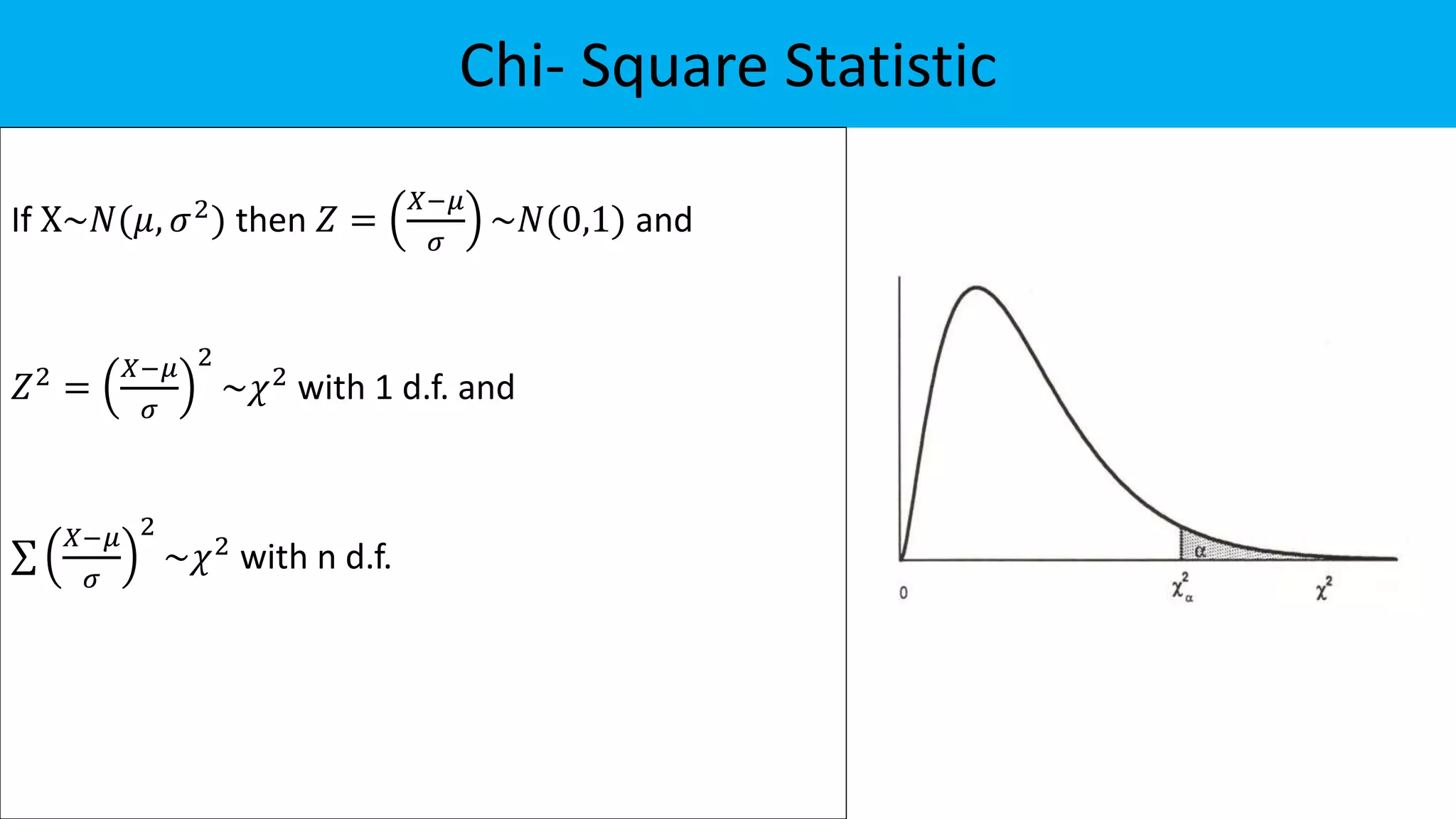
If X~𝑁(𝜇, 𝜎2) then 𝑍 =
𝑋−𝜇
𝜎
~𝑁(0,1) and
𝑍2
=
𝑋−𝜇
𝜎
2
~𝜒2
with 1 d.f. and
𝑋−𝜇
𝜎
2
~𝜒2
with n d.f.
Chi- Square
test
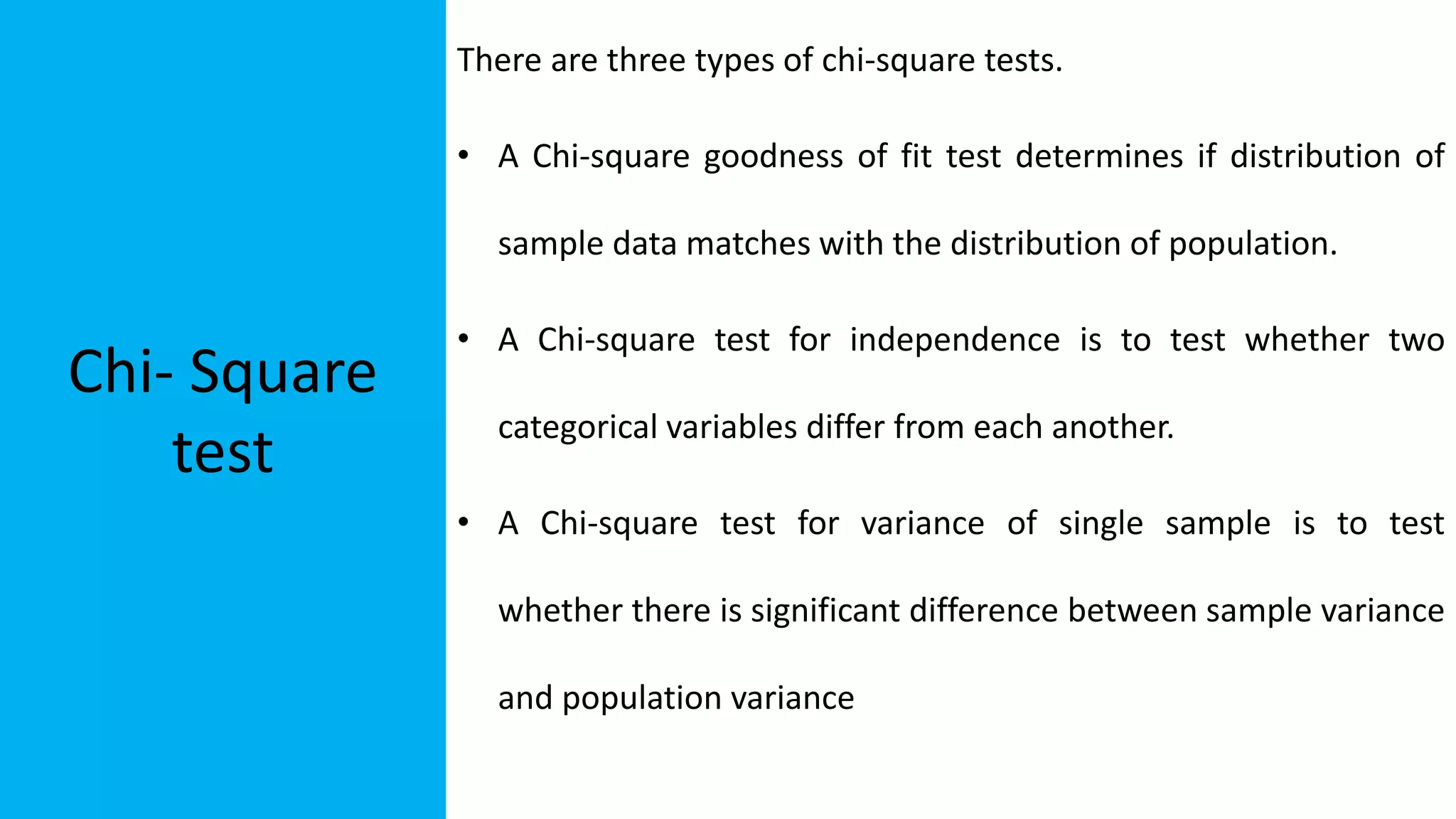
There are three types of chi-square tests.
• A Chi-square goodness of fit test determines if distribution of
sample data matches with the distribution of population.
• A Chi-square test for independence is to test whether two
categorical variables differ from each another.
• A Chi-square test for variance of single sample is to test
whether there is significant difference between sample variance
and population variance
Chi- Square test
– Independence of
Attributes
Chi-Square test is a statistical method to determine if
two categorical variables have a significant
correlation/association between them.
To test independence of attributes
Step 1: H0: Two attributes (categorical variables) are independent
Step 2: H1: Two attributes (categorical variables) are dependent
Step 3: Test statistics: χ2 =
(𝑂𝑖−𝐸𝑖)2
𝐸𝑖
where 𝐸𝑖 =
𝑅𝑜𝑤 𝑡𝑜𝑡𝑎𝑙 ∗𝐶𝑜𝑙𝑢𝑚𝑛 𝑡𝑜𝑡𝑎𝑙
𝐺𝑟𝑎𝑛𝑑 𝑡𝑜𝑡𝑎𝑙
Step 4: Conclusion
• If p ≤ Level of significance (∝), We Reject Null hypothesis
• If p > Level of significance (∝), We fail to Reject Null hypothesis
[Note: In 2*2 contingency table if expected is less than 5, use Yate’s correction i.e. Continuity
correction in the SPSS output]
Example
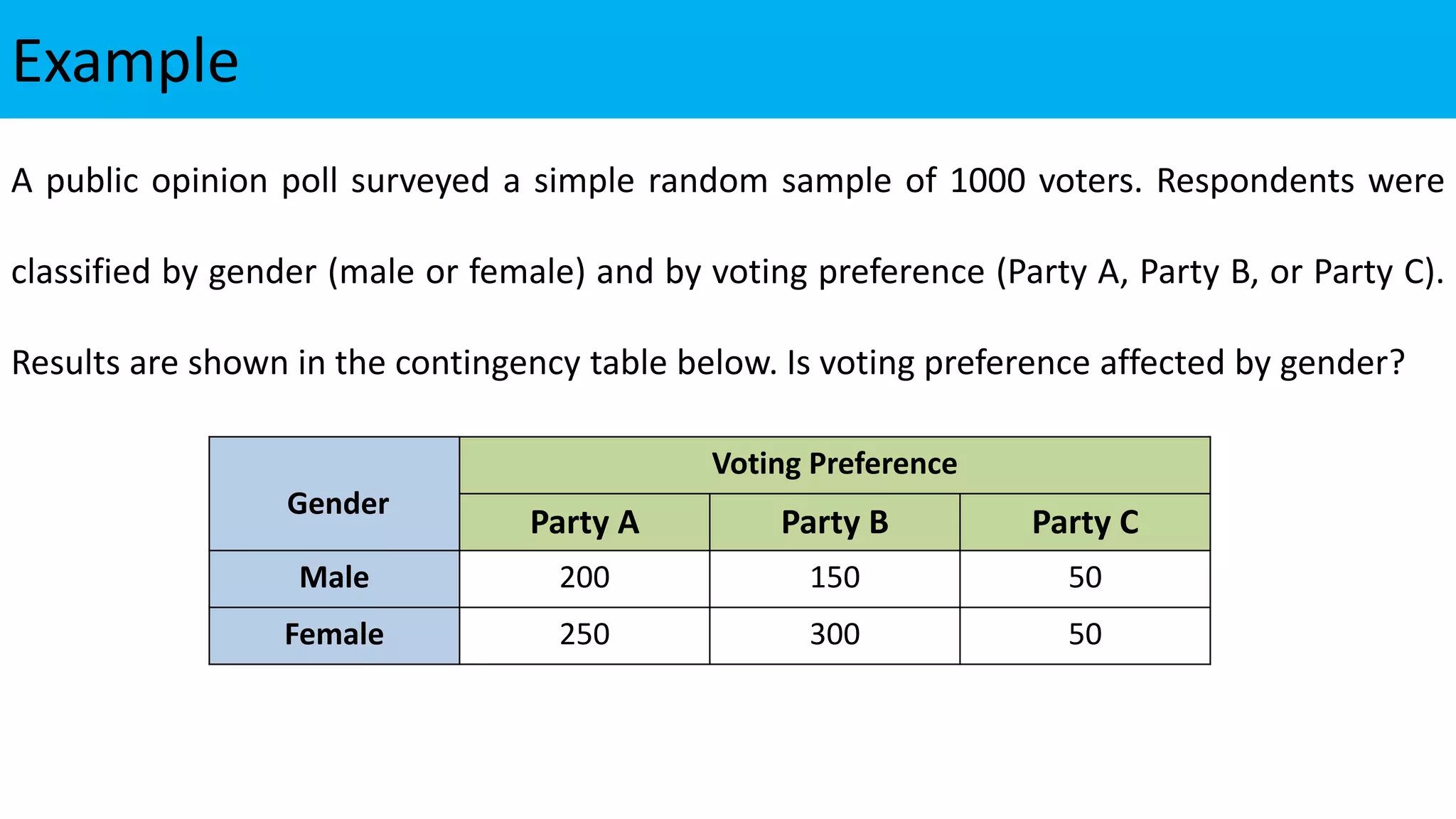
A public opinion poll surveyed a simple random sample of 1000 voters. Respondents were
classified by gender (male or female) and by voting preference (Party A, Party B, or Party C).
Results are shown in the contingency table below. Is voting preference affected by gender?
Gender
Voting Preference
Party A Party B Party C
Male 200 150 50
Female 250 300 50
Null & Alternative
Hypothesis
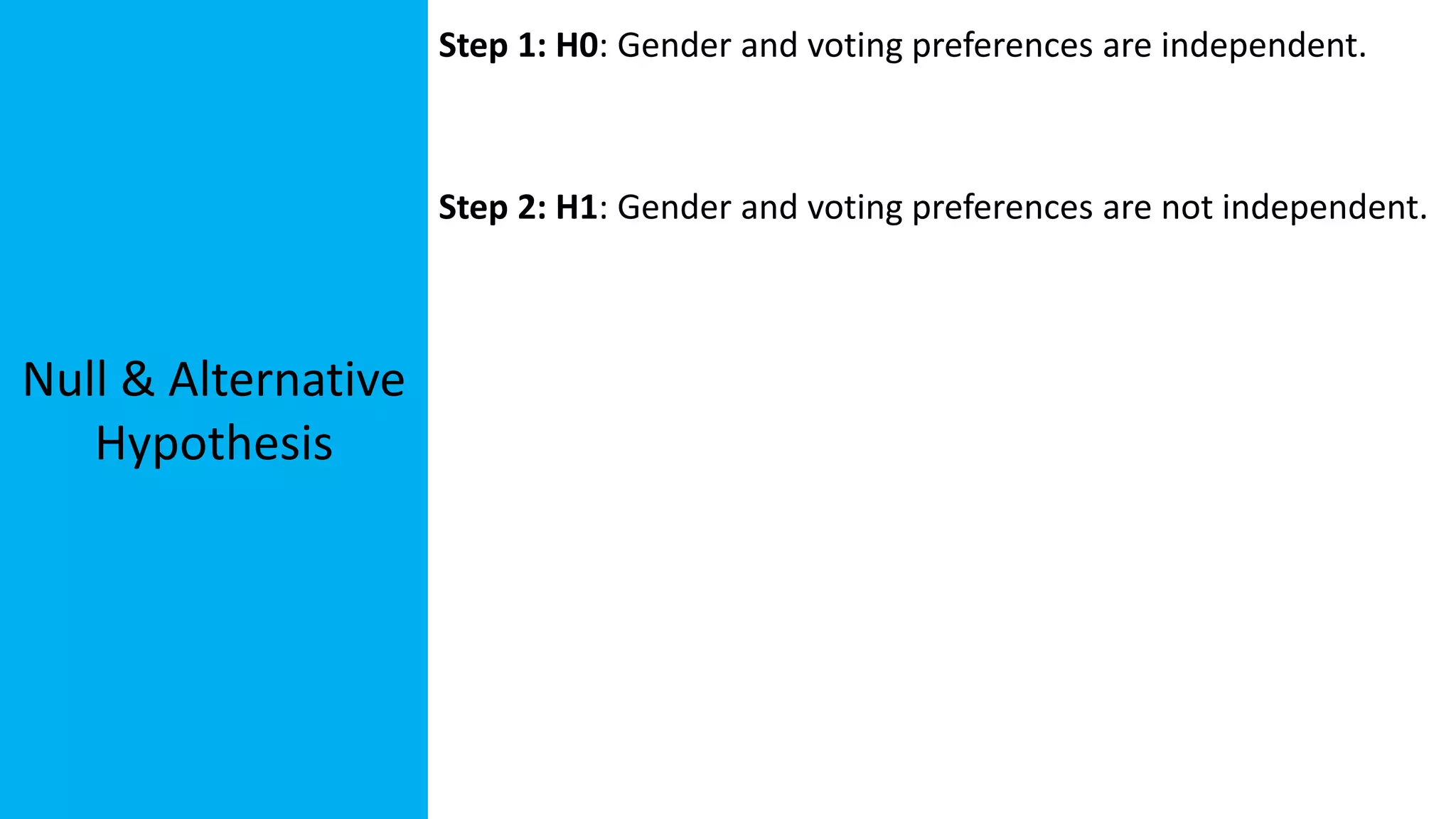
Step 1: H0: Gender and voting preferences are independent.
Step 2: H1: Gender and voting preferences are not independent.
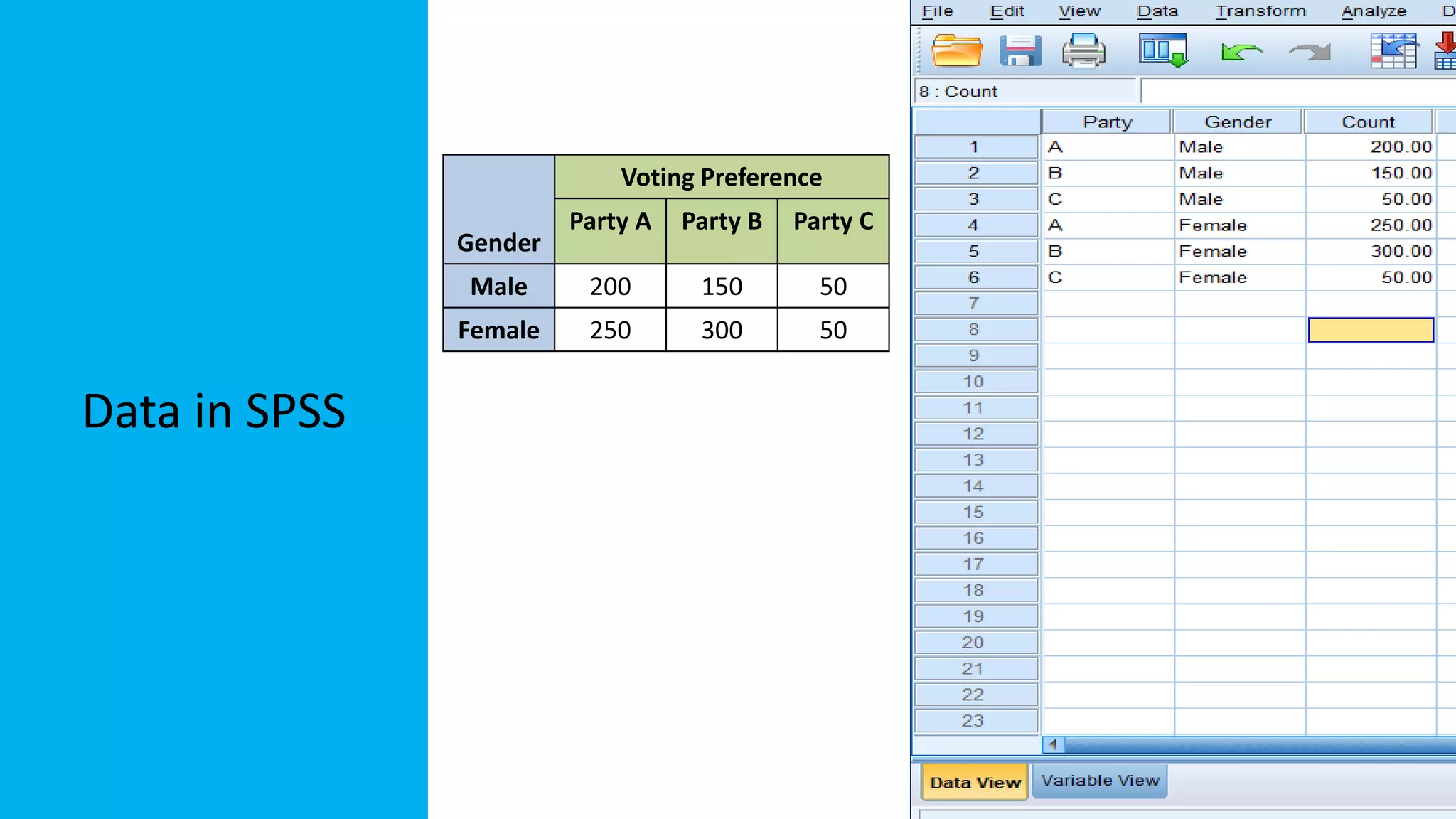
Data in SPSS
Gender
Voting Preference
Party A Party B Party C
Male 200 150 50
Female 250 300 50
Assigning weights
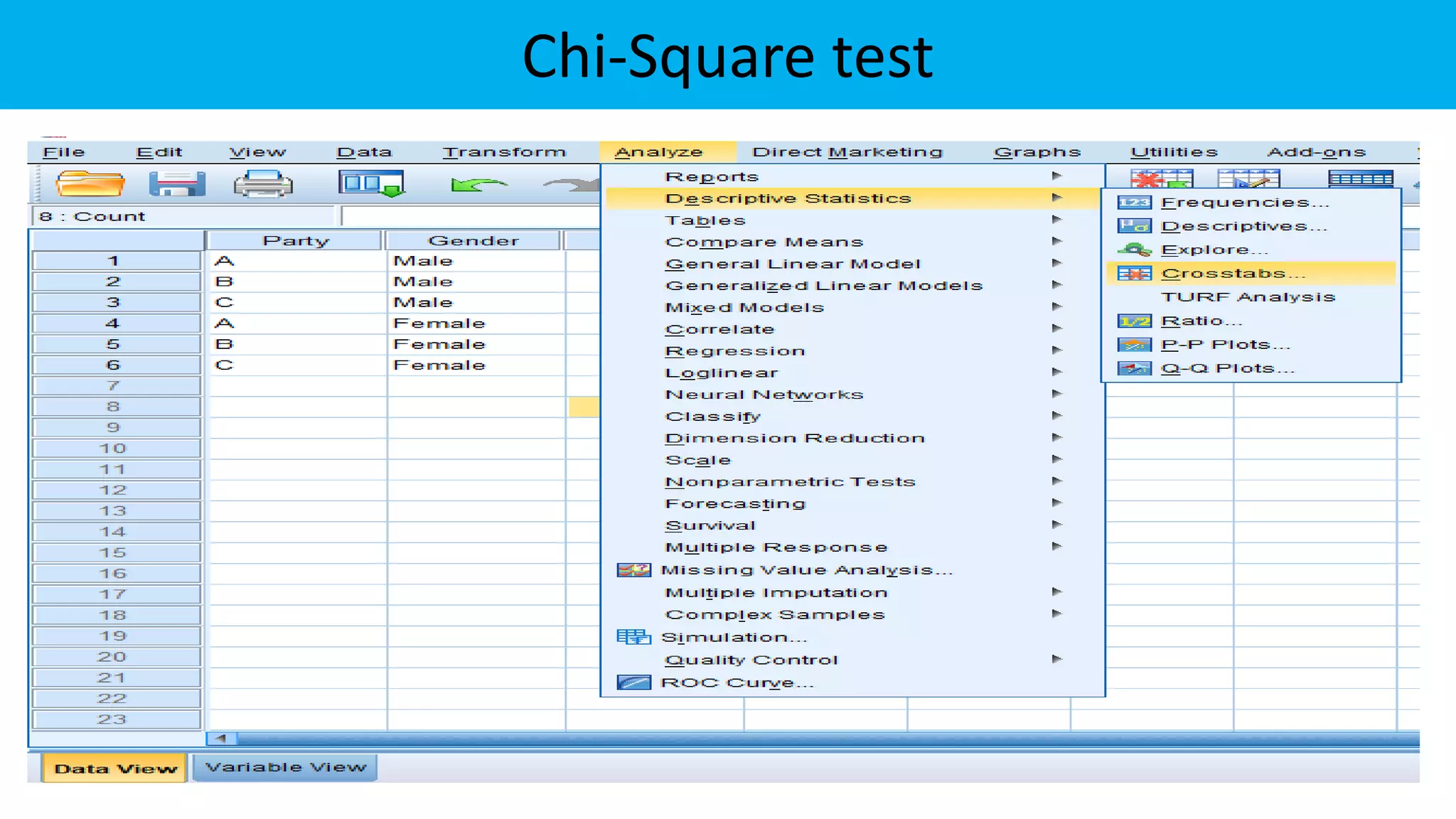
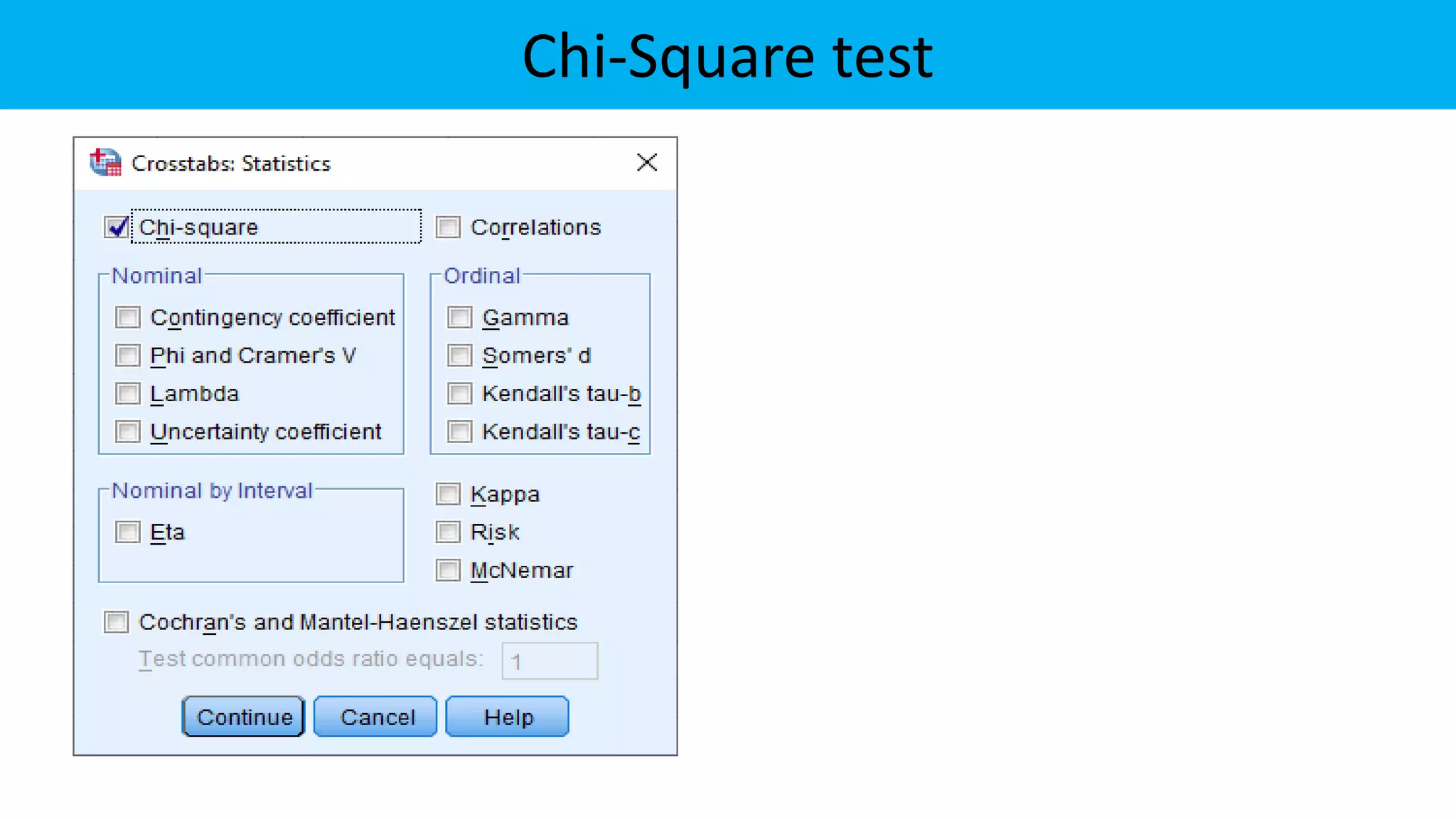
Chi-Square test
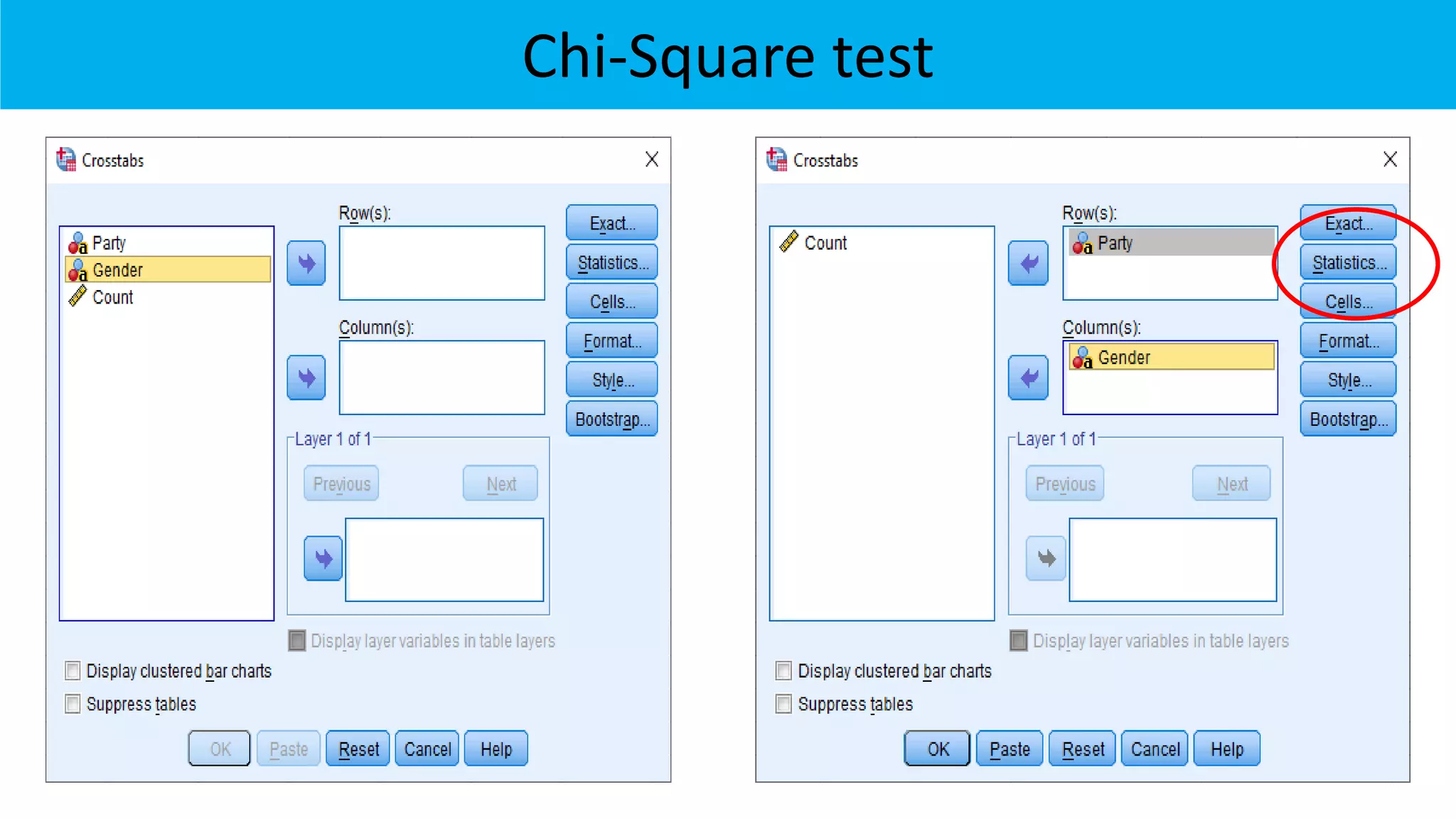
Chi-Square test
Chi-Square test
Output
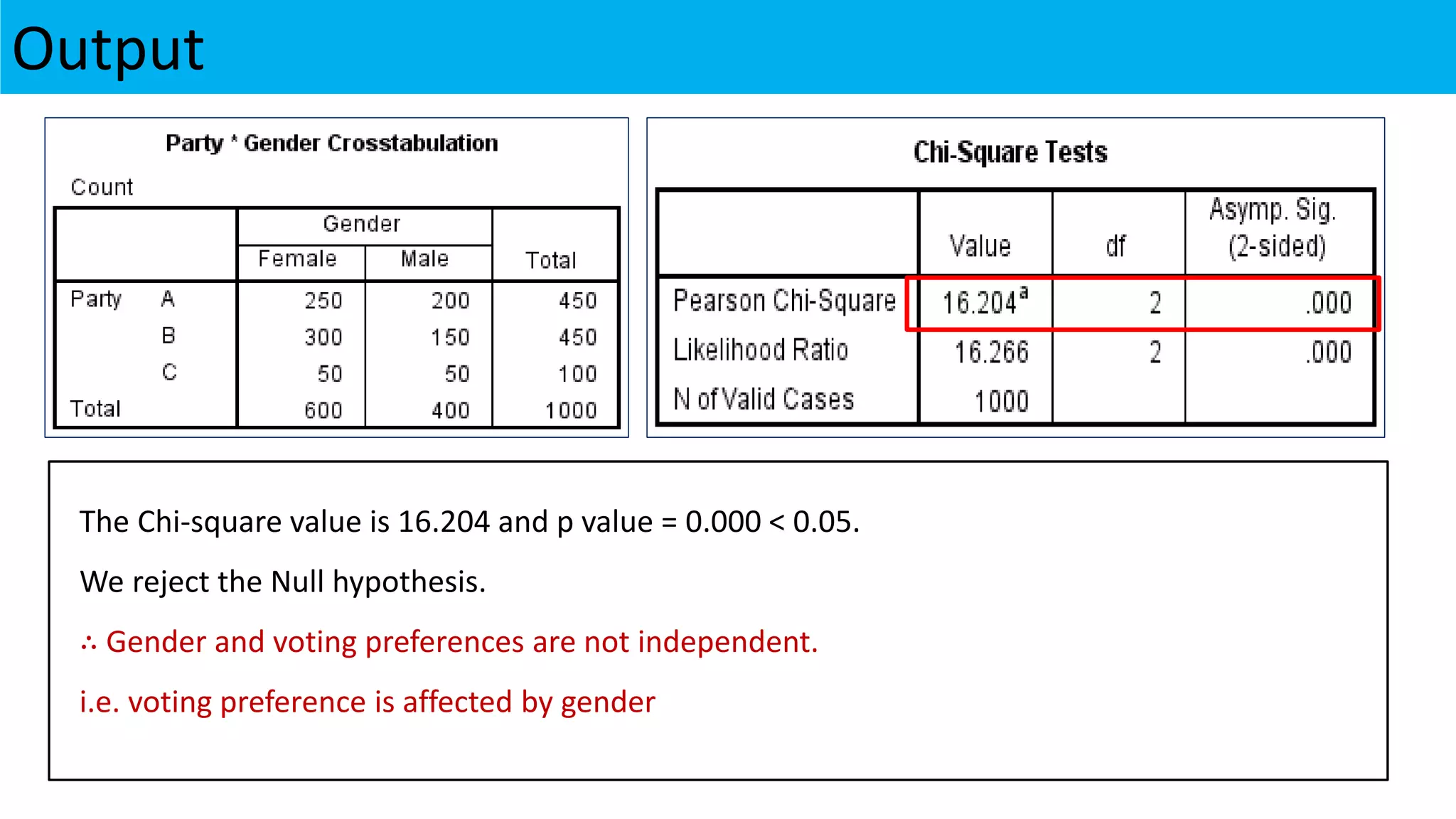
The Chi-square value is 16.204 and p value = 0.000 < 0.05.
We reject the Null hypothesis.
∴ Gender and voting preferences are not independent.
i.e. voting preference is affected by gender
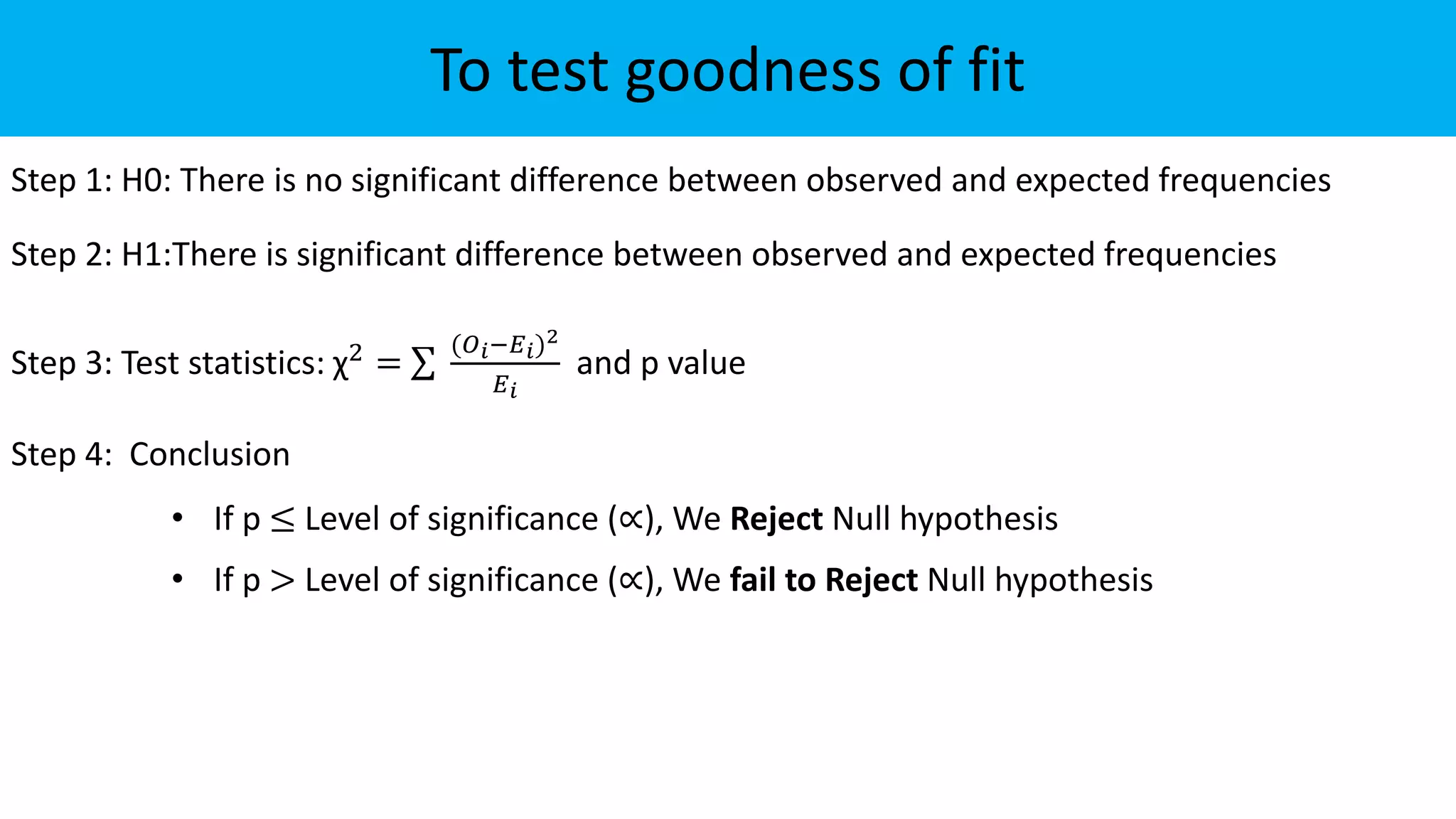
To test goodness of fit
Step 1: H0: There is no significant difference between observed and expected frequencies
Step 2: H1:There is significant difference between observed and expected frequencies
Step 3: Test statistics: χ2 =
(𝑂𝑖−𝐸𝑖)2
𝐸𝑖
and p value
Step 4: Conclusion
• If p ≤ Level of significance (∝), We Reject Null hypothesis
• If p > Level of significance (∝), We fail to Reject Null hypothesis
Example1
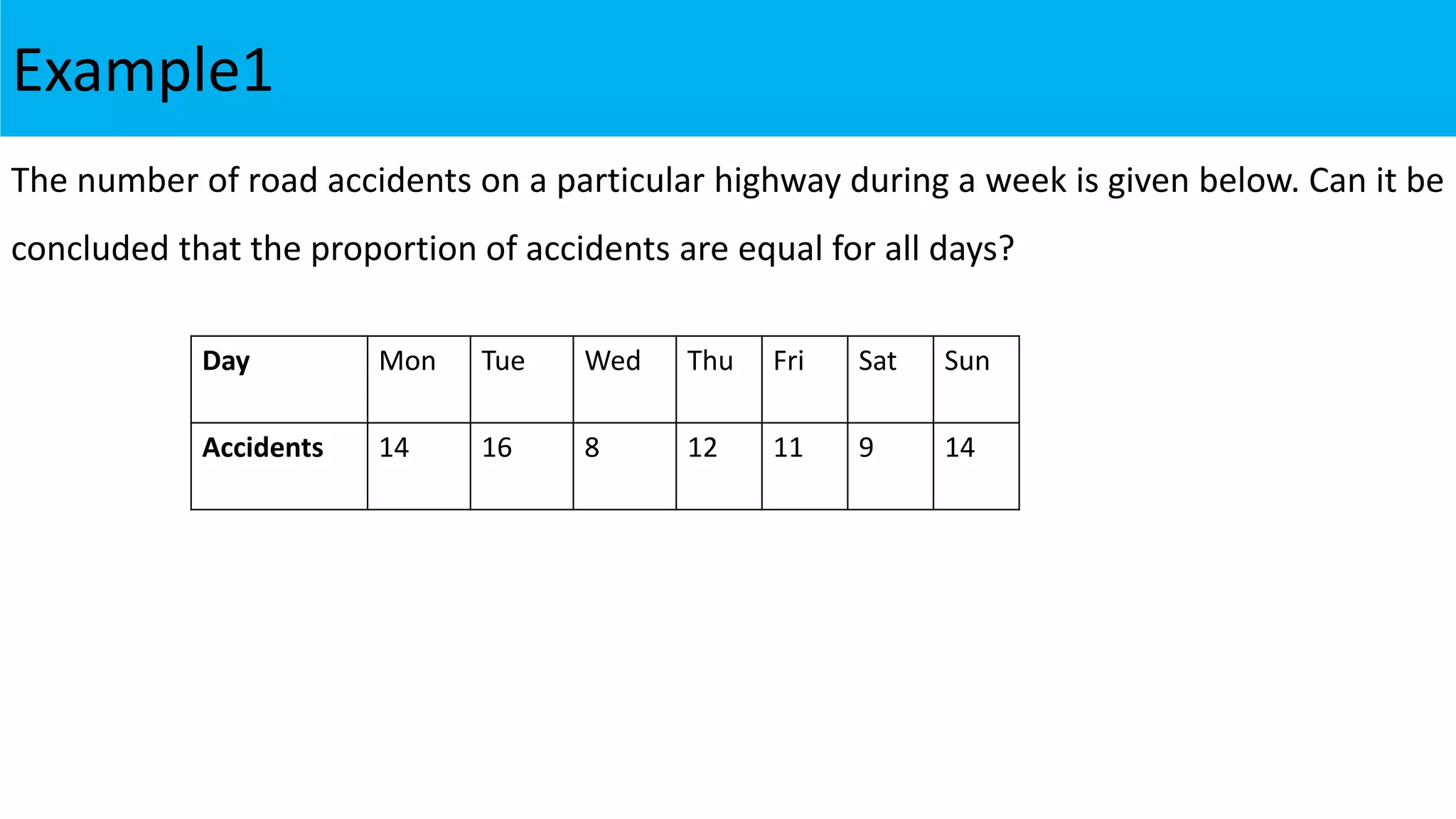
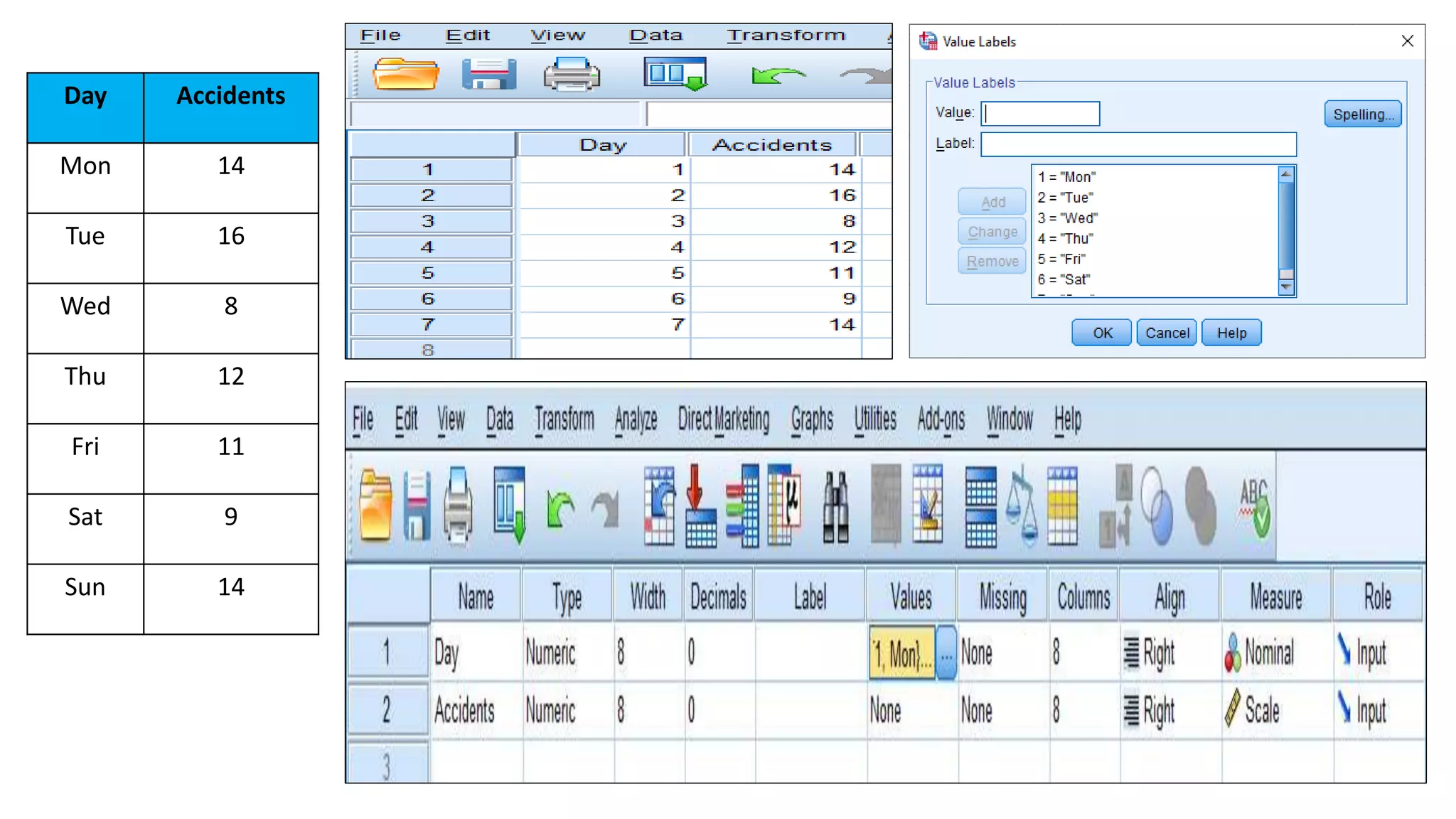
The number of road accidents on a particular highway during a week is given below. Can it be
concluded that the proportion of accidents are equal for all days?
Day Mon Tue Wed Thu Fri Sat Sun
Accidents 14 16 8 12 11 9 14
Hypothesis
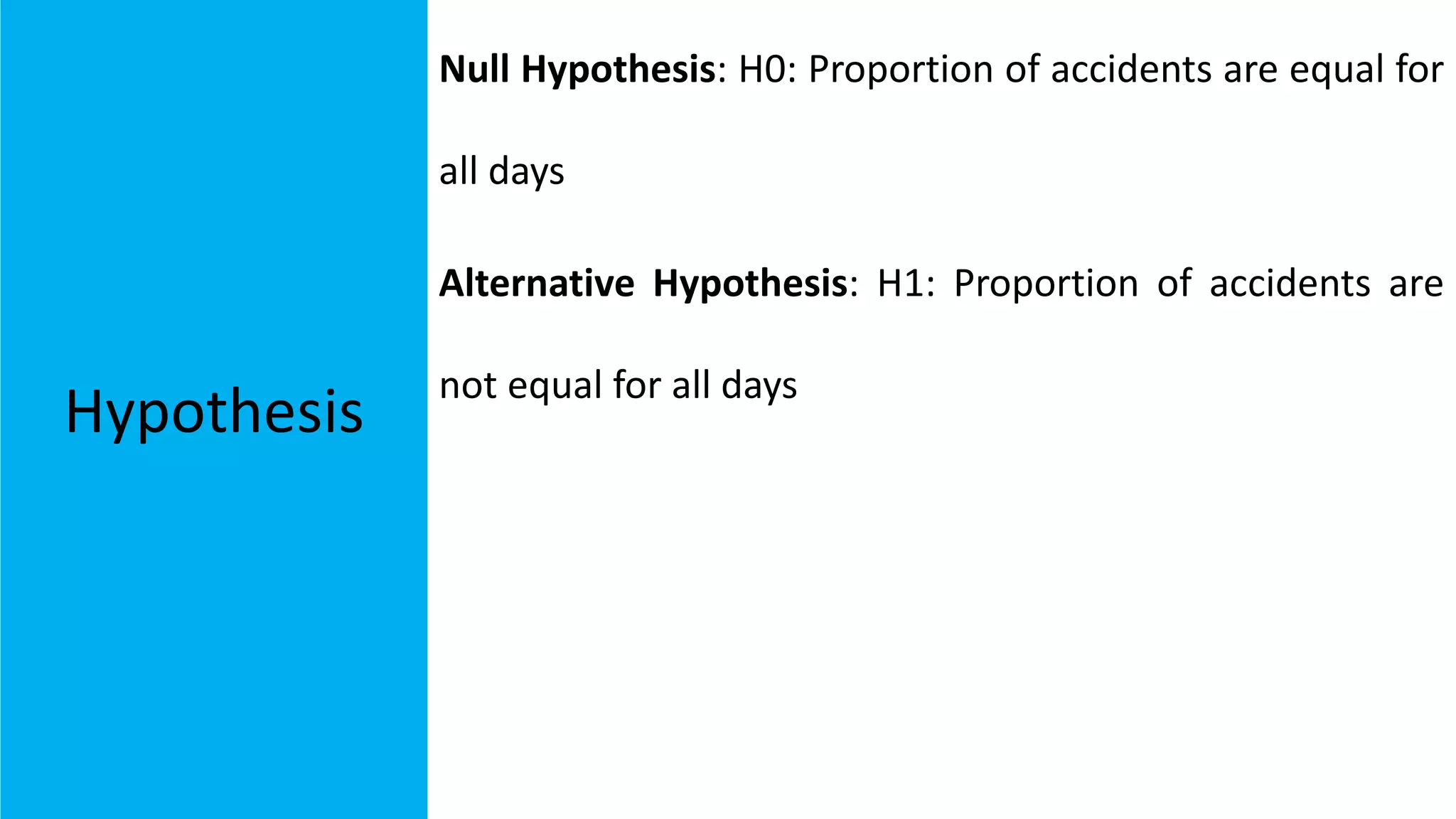
Null Hypothesis: H0: Proportion of accidents are equal for
all days
Alternative Hypothesis: H1: Proportion of accidents are
not equal for all days
Day Accidents
Mon 14
Tue 16
Wed 8
Thu 12
Fri 11
Sat 9
Sun 14
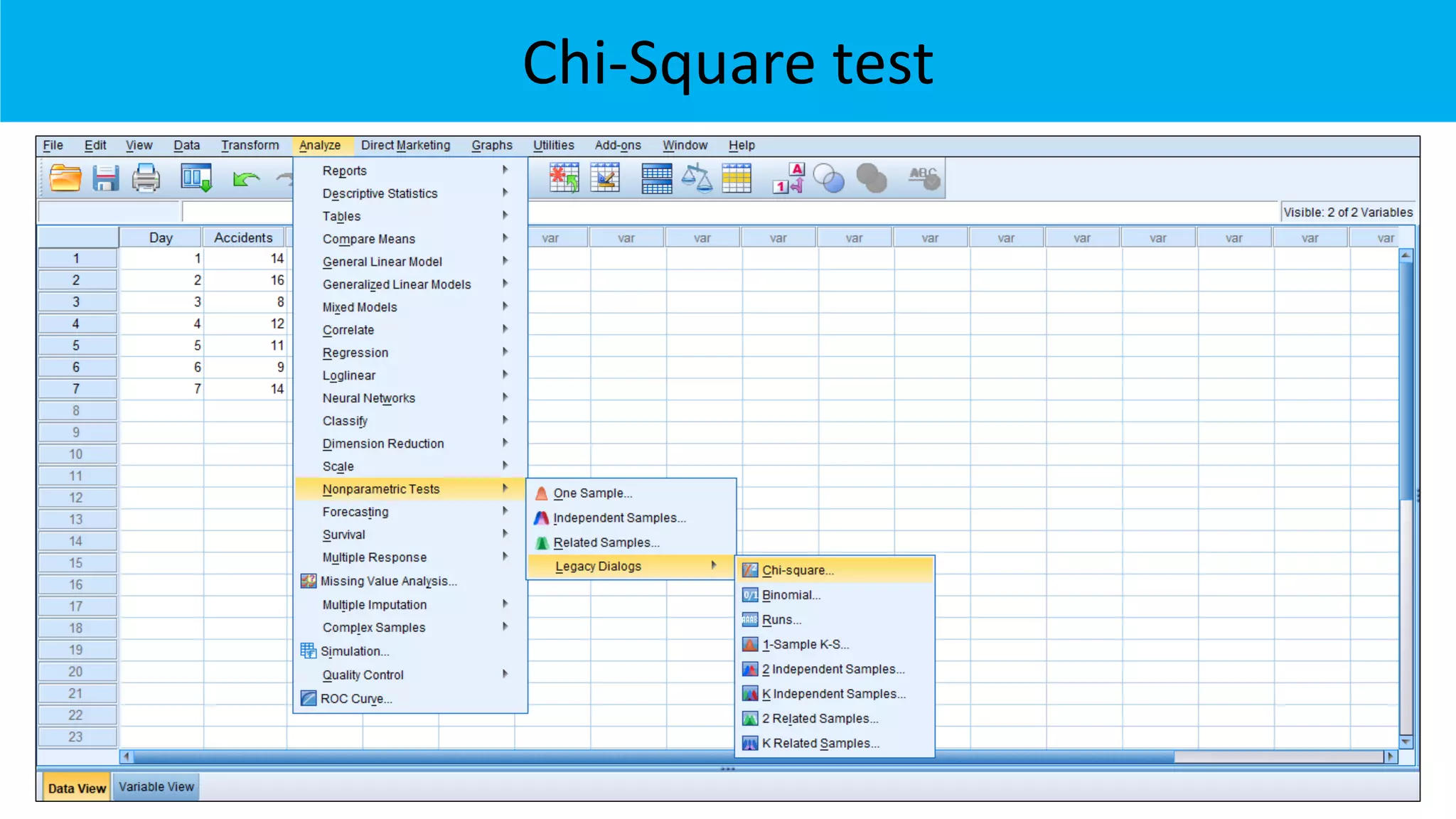
Chi-Square test
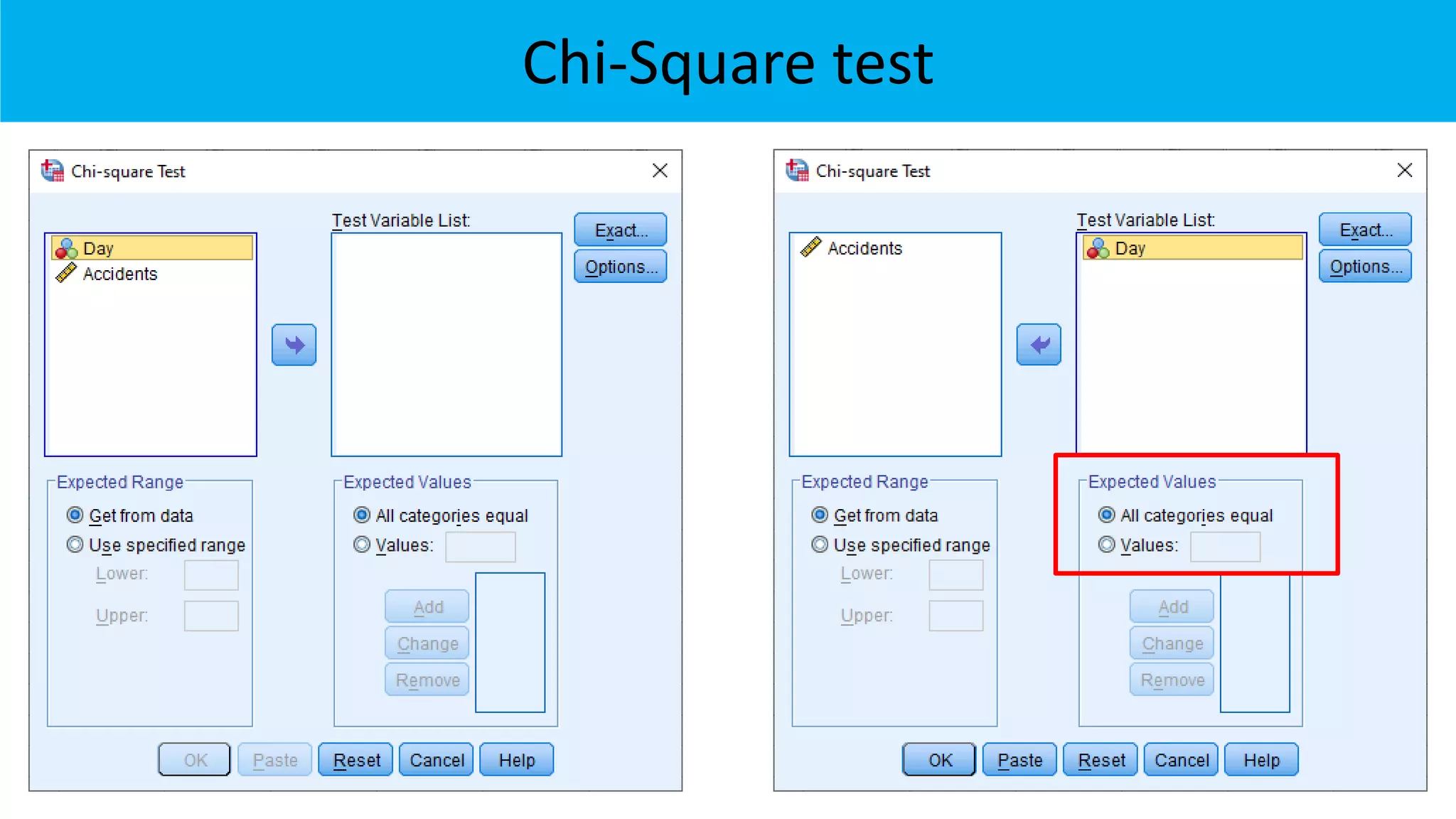
Chi-Square test
Output
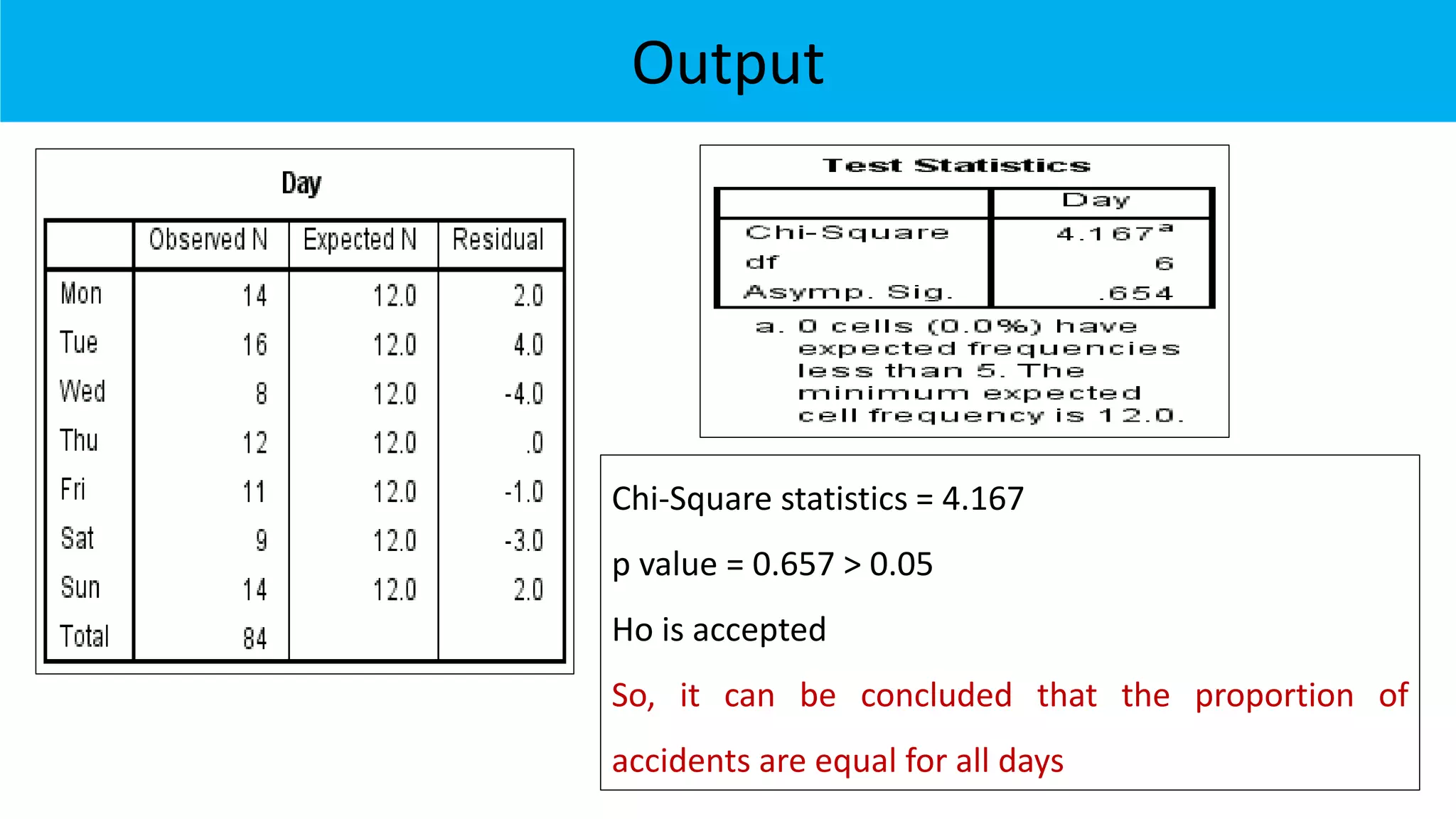
Chi-Square statistics = 4.167
p value = 0.657 > 0.05
Ho is accepted
So, it can be concluded that the proportion of
accidents are equal for all days
Example 2
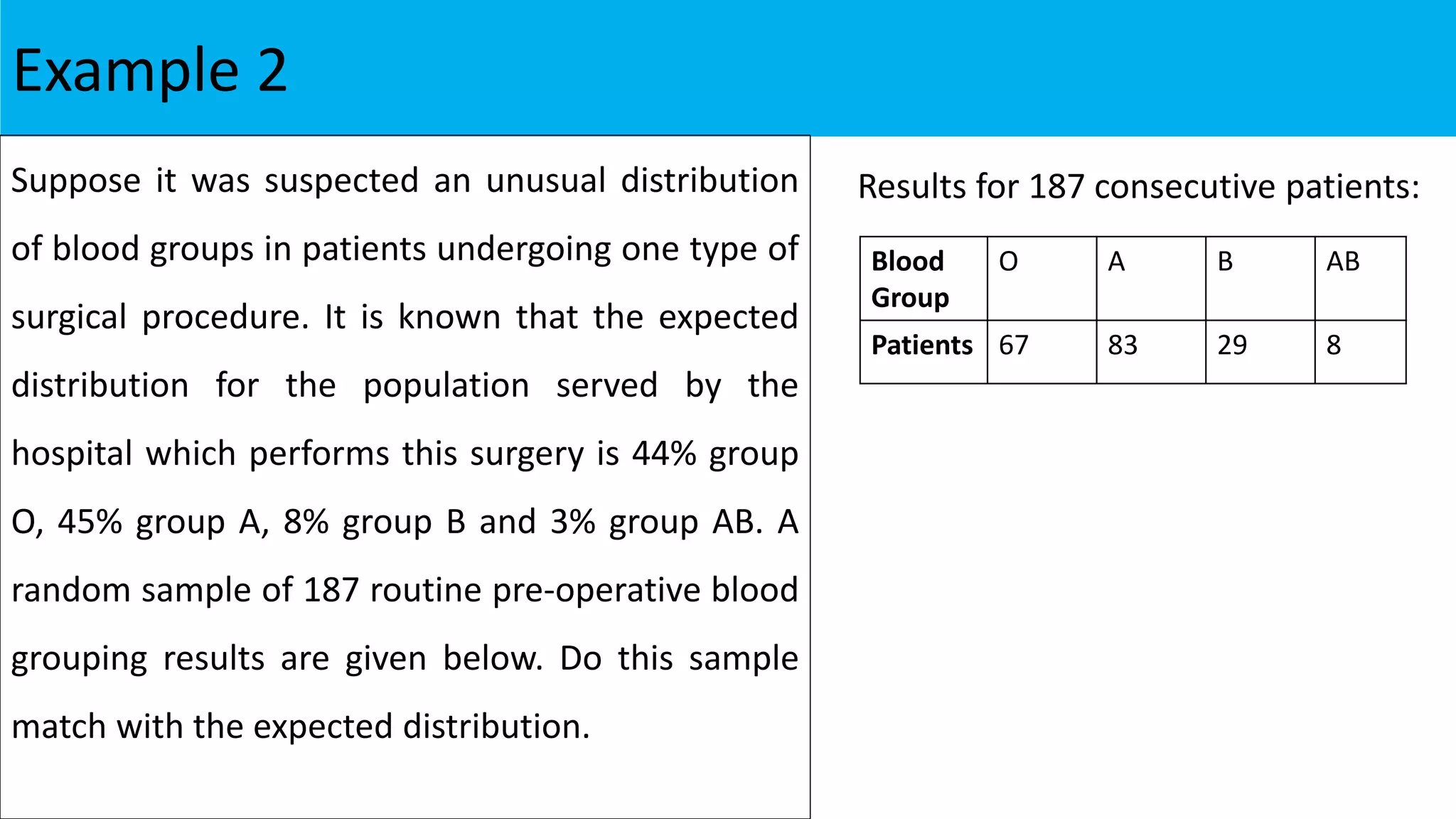
Suppose it was suspected an unusual distribution
of blood groups in patients undergoing one type of
surgical procedure. It is known that the expected
distribution for the population served by the
hospital which performs this surgery is 44% group
O, 45% group A, 8% group B and 3% group AB. A
random sample of 187 routine pre-operative blood
grouping results are given below. Do this sample
match with the expected distribution.
Blood
Group
O A B AB
Patients 67 83 29 8
Results for 187 consecutive patients:
Hypothesis
Null Hypothesis: H0: There is no significant difference
between observed and expected distribution of patients
with respect to blood group
[Sample follows expected distribution]
Alternative Hypothesis: H1: There is significant difference
between observed and expected distribution of patients
with respect to blood group
[Sample does not follows expected distribution]
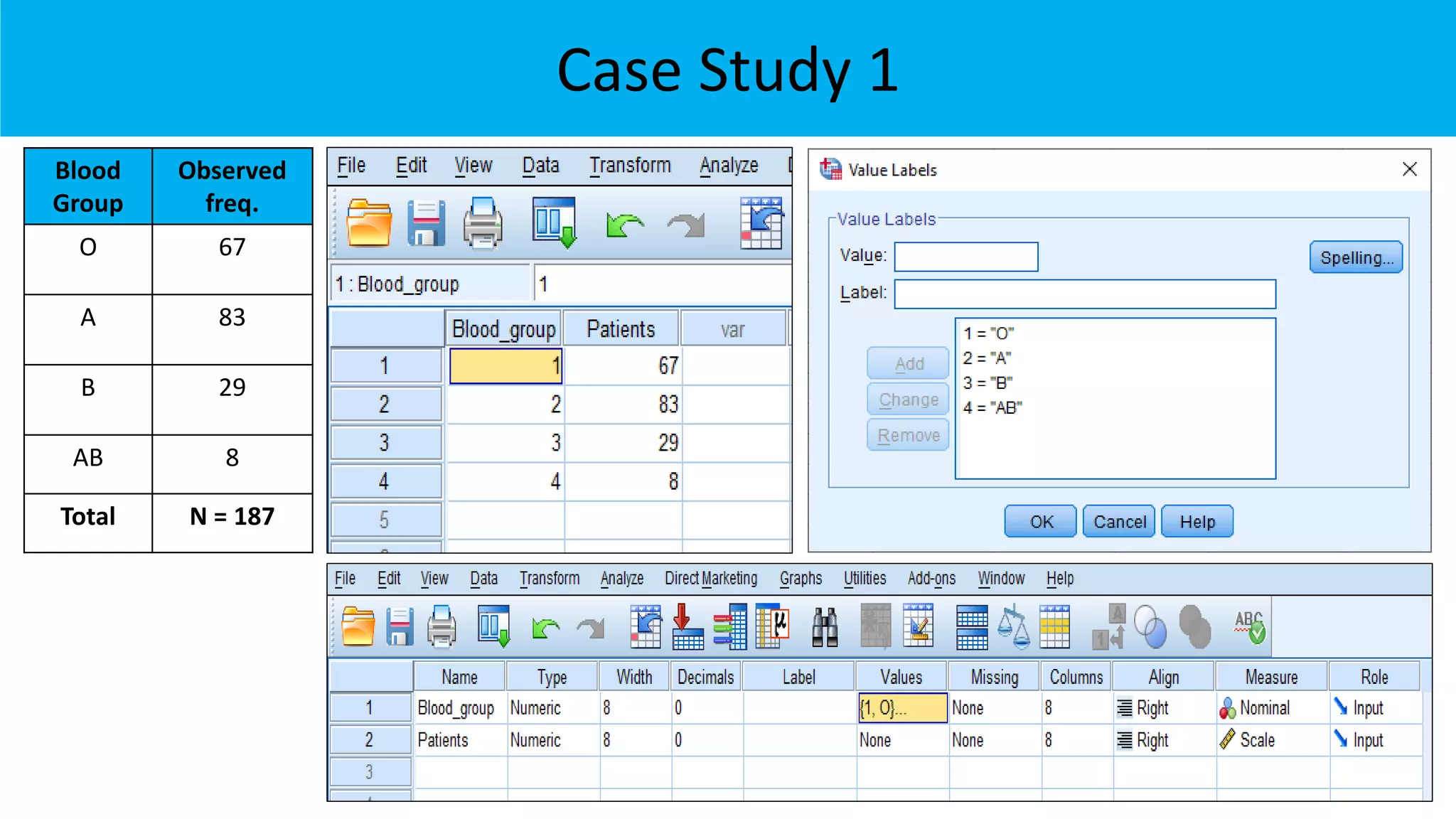
Case Study 1
Blood
Group
Observed
freq.
O 67
A 83
B 29
AB 8
Total N = 187
Case Study 1
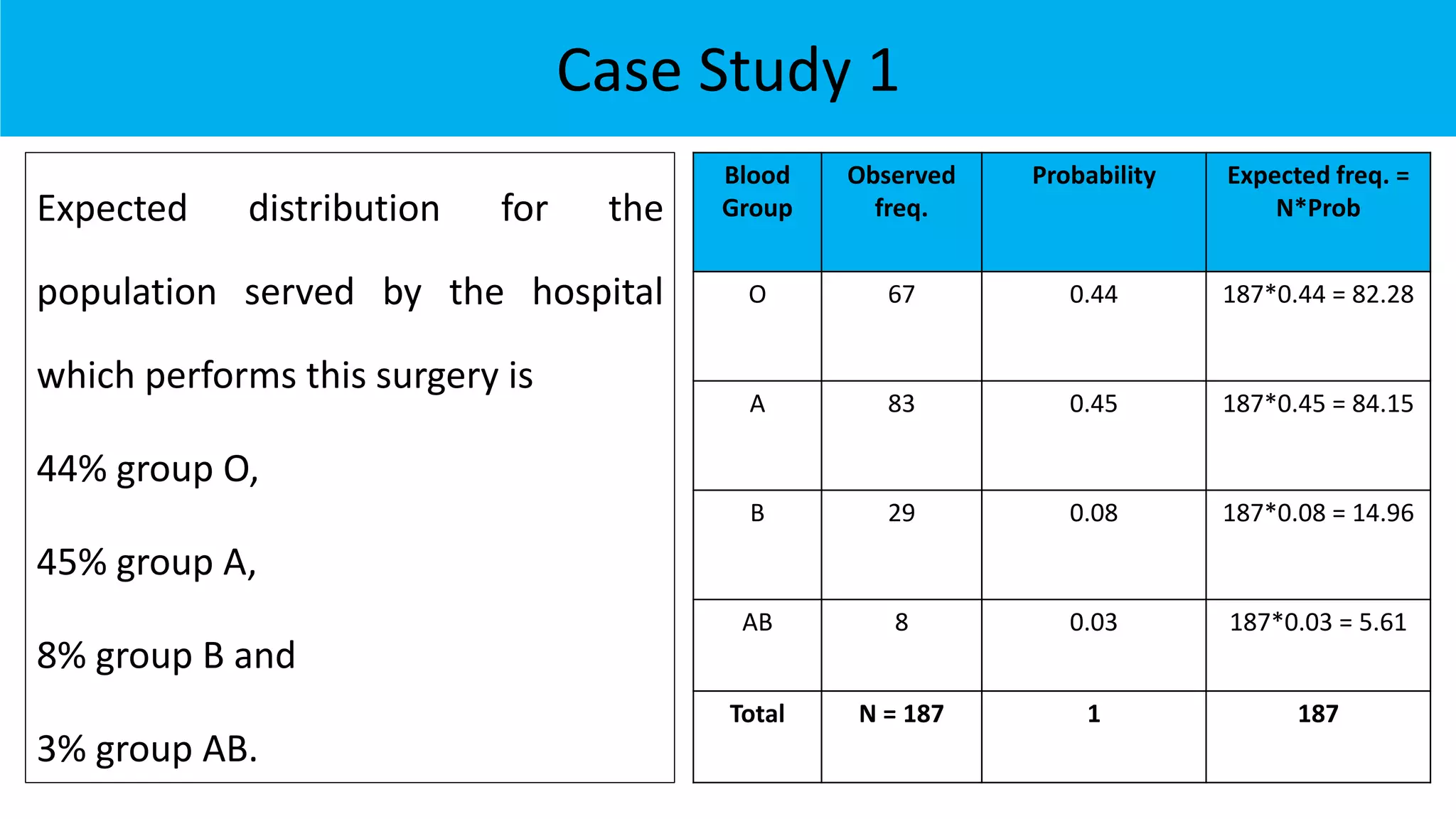
Expected distribution for the
population served by the hospital
which performs this surgery is
44% group O,
45% group A,
8% group B and
3% group AB.
Blood
Group
Observed
freq.
Probability Expected freq. =
N*Prob
O 67 0.44 187*0.44 = 82.28
A 83 0.45 187*0.45 = 84.15
B 29 0.08 187*0.08 = 14.96
AB 8 0.03 187*0.03 = 5.61
Total N = 187 1 187
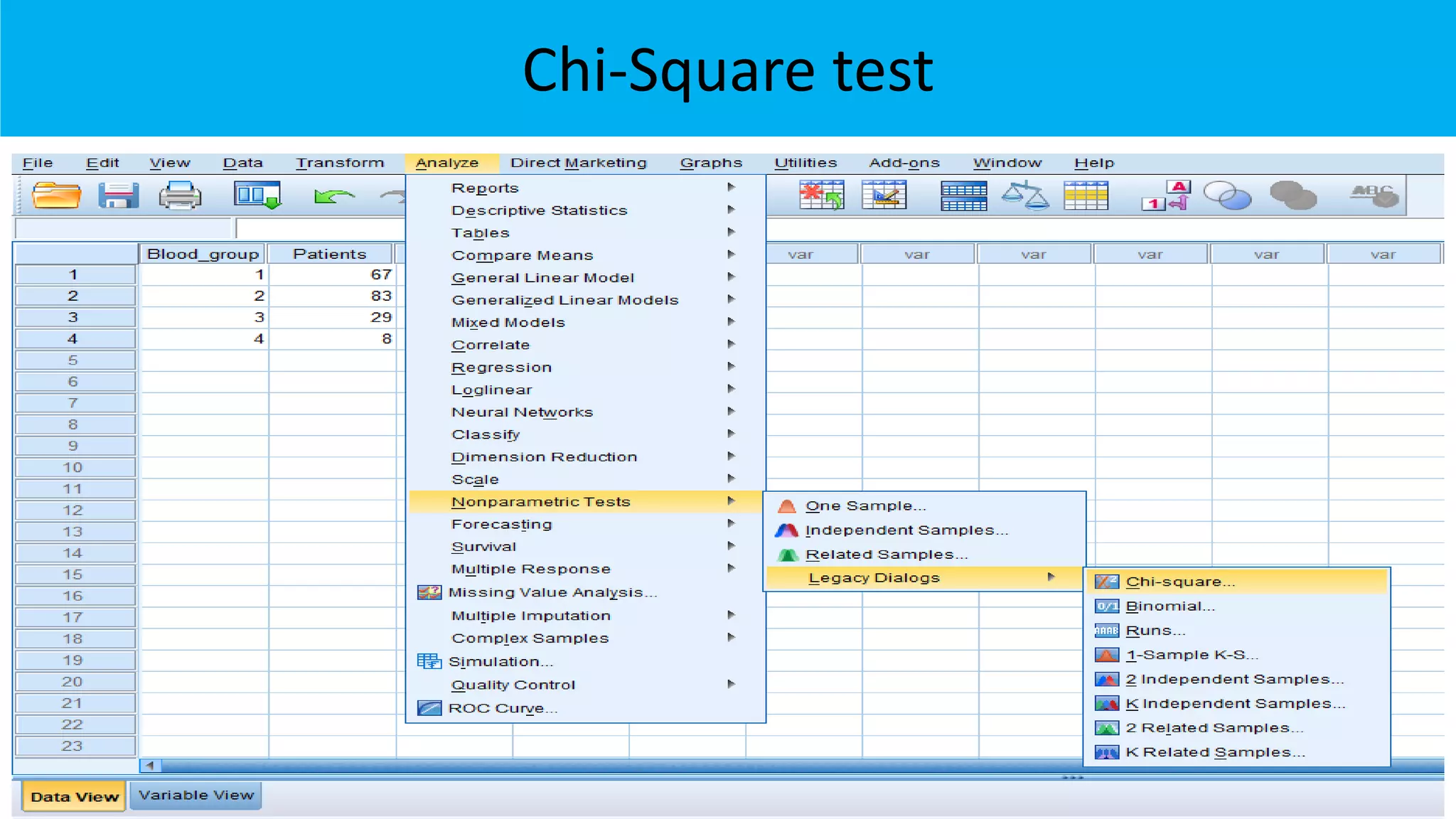
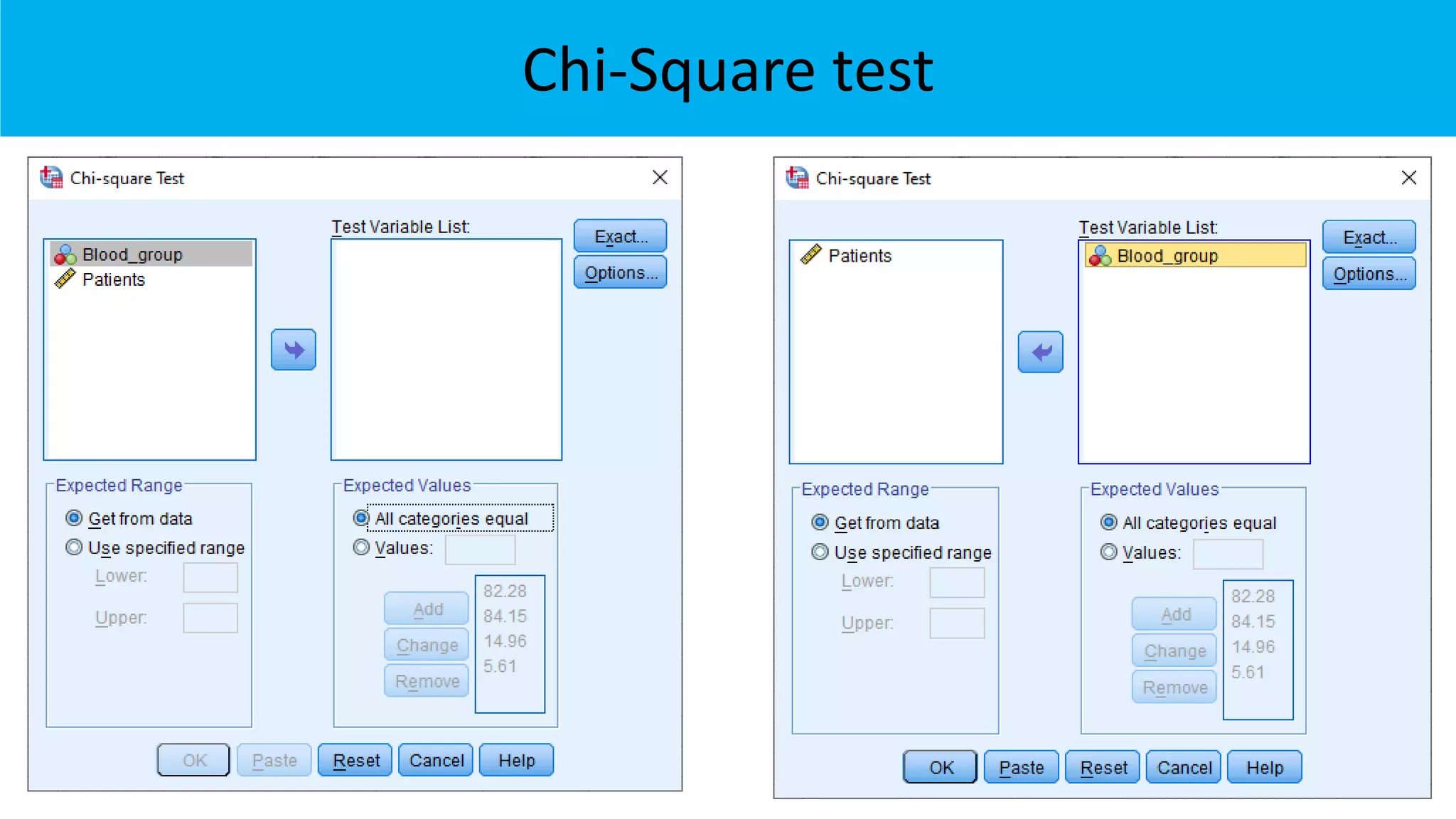
Chi-Square test
Chi-Square test
Chi-Square test
Blood
Group
Observed
freq.
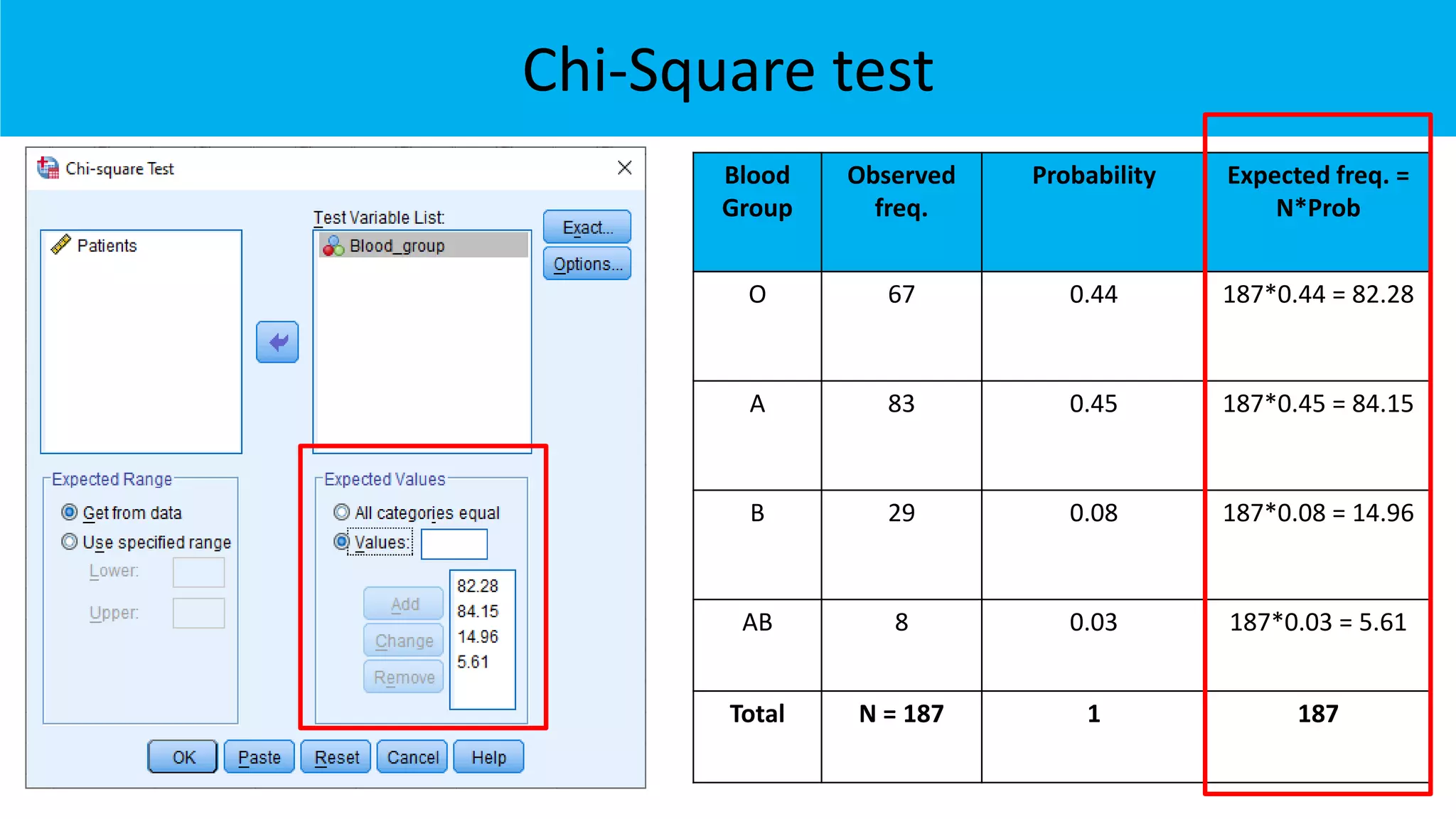
Probability Expected freq. =
N*Prob
O 67 0.44 187*0.44 = 82.28
A 83 0.45 187*0.45 = 84.15
B 29 0.08 187*0.08 = 14.96
AB 8 0.03 187*0.03 = 5.61
Total N = 187 1 187
Output
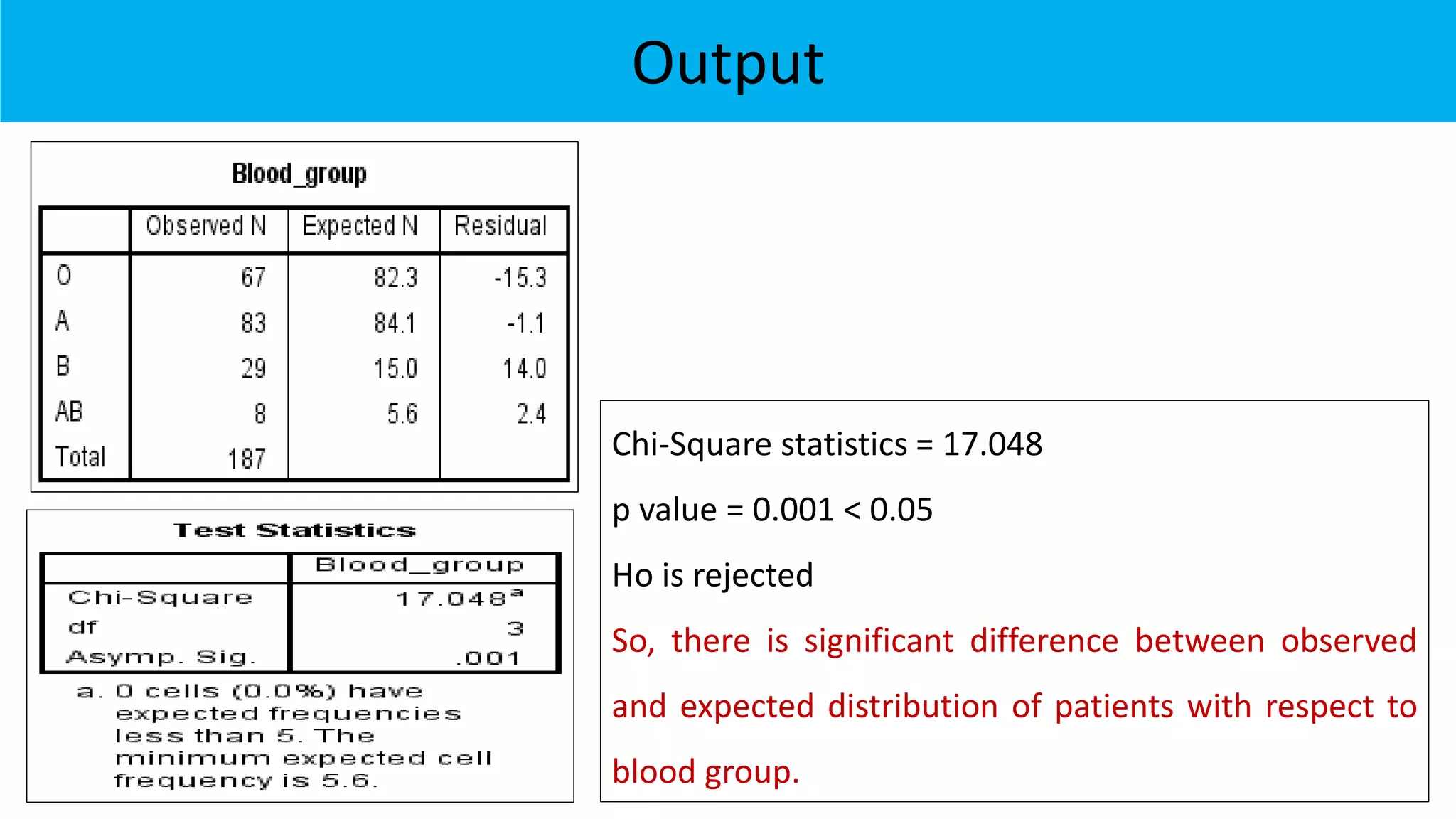
Chi-Square statistics = 17.048
p value = 0.001 < 0.05
Ho is rejected
So, there is significant difference between observed
and expected distribution of patients with respect to
blood group.
THANK YOU
Dr Parag Shah | M.Sc., M.Phil., Ph.D. ( Statistics)
pbshah@hlcollege.edu
www.paragstatistics.wordpress.com

Chi square tests using SPSS

  • 1.
  • 2.
    Chi- Square Statistic IfX~𝑁(𝜇, 𝜎2) then 𝑍 = 𝑋−𝜇 𝜎 ~𝑁(0,1) and 𝑍2 = 𝑋−𝜇 𝜎 2 ~𝜒2 with 1 d.f. and 𝑋−𝜇 𝜎 2 ~𝜒2 with n d.f.
  • 3.
    Chi- Square test There arethree types of chi-square tests. • A Chi-square goodness of fit test determines if distribution of sample data matches with the distribution of population. • A Chi-square test for independence is to test whether two categorical variables differ from each another. • A Chi-square test for variance of single sample is to test whether there is significant difference between sample variance and population variance
  • 4.
    Chi- Square test –Independence of Attributes Chi-Square test is a statistical method to determine if two categorical variables have a significant correlation/association between them.
  • 5.
    To test independenceof attributes Step 1: H0: Two attributes (categorical variables) are independent Step 2: H1: Two attributes (categorical variables) are dependent Step 3: Test statistics: χ2 = (𝑂𝑖−𝐸𝑖)2 𝐸𝑖 where 𝐸𝑖 = 𝑅𝑜𝑤 𝑡𝑜𝑡𝑎𝑙 ∗𝐶𝑜𝑙𝑢𝑚𝑛 𝑡𝑜𝑡𝑎𝑙 𝐺𝑟𝑎𝑛𝑑 𝑡𝑜𝑡𝑎𝑙 Step 4: Conclusion • If p ≤ Level of significance (∝), We Reject Null hypothesis • If p > Level of significance (∝), We fail to Reject Null hypothesis [Note: In 2*2 contingency table if expected is less than 5, use Yate’s correction i.e. Continuity correction in the SPSS output]
  • 6.
    Example A public opinionpoll surveyed a simple random sample of 1000 voters. Respondents were classified by gender (male or female) and by voting preference (Party A, Party B, or Party C). Results are shown in the contingency table below. Is voting preference affected by gender? Gender Voting Preference Party A Party B Party C Male 200 150 50 Female 250 300 50
  • 7.
    Null & Alternative Hypothesis Step1: H0: Gender and voting preferences are independent. Step 2: H1: Gender and voting preferences are not independent.
  • 8.
    Data in SPSS Gender VotingPreference Party A Party B Party C Male 200 150 50 Female 250 300 50
  • 9.
  • 10.
  • 11.
  • 12.
  • 13.
    Output The Chi-square valueis 16.204 and p value = 0.000 < 0.05. We reject the Null hypothesis. ∴ Gender and voting preferences are not independent. i.e. voting preference is affected by gender
  • 14.
    To test goodnessof fit Step 1: H0: There is no significant difference between observed and expected frequencies Step 2: H1:There is significant difference between observed and expected frequencies Step 3: Test statistics: χ2 = (𝑂𝑖−𝐸𝑖)2 𝐸𝑖 and p value Step 4: Conclusion • If p ≤ Level of significance (∝), We Reject Null hypothesis • If p > Level of significance (∝), We fail to Reject Null hypothesis
  • 15.
    Example1 The number ofroad accidents on a particular highway during a week is given below. Can it be concluded that the proportion of accidents are equal for all days? Day Mon Tue Wed Thu Fri Sat Sun Accidents 14 16 8 12 11 9 14
  • 16.
    Hypothesis Null Hypothesis: H0:Proportion of accidents are equal for all days Alternative Hypothesis: H1: Proportion of accidents are not equal for all days
  • 17.
    Day Accidents Mon 14 Tue16 Wed 8 Thu 12 Fri 11 Sat 9 Sun 14
  • 18.
  • 19.
  • 20.
    Output Chi-Square statistics =4.167 p value = 0.657 > 0.05 Ho is accepted So, it can be concluded that the proportion of accidents are equal for all days
  • 21.
    Example 2 Suppose itwas suspected an unusual distribution of blood groups in patients undergoing one type of surgical procedure. It is known that the expected distribution for the population served by the hospital which performs this surgery is 44% group O, 45% group A, 8% group B and 3% group AB. A random sample of 187 routine pre-operative blood grouping results are given below. Do this sample match with the expected distribution. Blood Group O A B AB Patients 67 83 29 8 Results for 187 consecutive patients:
  • 22.
    Hypothesis Null Hypothesis: H0:There is no significant difference between observed and expected distribution of patients with respect to blood group [Sample follows expected distribution] Alternative Hypothesis: H1: There is significant difference between observed and expected distribution of patients with respect to blood group [Sample does not follows expected distribution]
  • 23.
    Case Study 1 Blood Group Observed freq. O67 A 83 B 29 AB 8 Total N = 187
  • 24.
    Case Study 1 Expecteddistribution for the population served by the hospital which performs this surgery is 44% group O, 45% group A, 8% group B and 3% group AB. Blood Group Observed freq. Probability Expected freq. = N*Prob O 67 0.44 187*0.44 = 82.28 A 83 0.45 187*0.45 = 84.15 B 29 0.08 187*0.08 = 14.96 AB 8 0.03 187*0.03 = 5.61 Total N = 187 1 187
  • 25.
  • 26.
  • 27.
    Chi-Square test Blood Group Observed freq. Probability Expectedfreq. = N*Prob O 67 0.44 187*0.44 = 82.28 A 83 0.45 187*0.45 = 84.15 B 29 0.08 187*0.08 = 14.96 AB 8 0.03 187*0.03 = 5.61 Total N = 187 1 187
  • 28.
    Output Chi-Square statistics =17.048 p value = 0.001 < 0.05 Ho is rejected So, there is significant difference between observed and expected distribution of patients with respect to blood group.
  • 29.
    THANK YOU Dr ParagShah | M.Sc., M.Phil., Ph.D. ( Statistics) pbshah@hlcollege.edu www.paragstatistics.wordpress.com