Friedman Test 
The non-parametric analogue to the repeated 
measures ANOVA is the Friedman test.
First let’s review what a repeated measures ANOVA is.
First let’s review what a repeated measures ANOVA. 
A repeated measures ANOVA is used to determine if 
there is a statistically significant difference between the 
results of the same measure with the same group 
across multiple occasions.
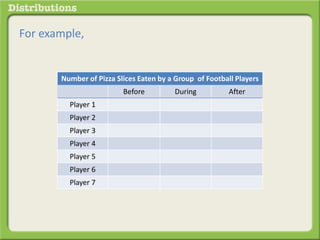
For example, 
Number of Pizza Slices Eaten by a Group of Football Players 
Before During After 
Player 1 
Player 2 
Player 3 
Player 4 
Player 5 
Player 6 
Player 7
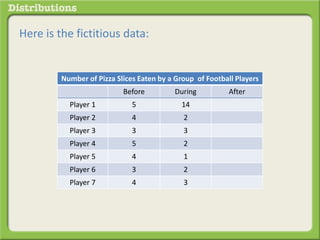
Here is the fictitious data: 
Number of Pizza Slices Eaten by a Group of Football Players 
Before During After 
Player 1 5 
Player 2 4 
Player 3 3 
Player 4 5 
Player 5 4 
Player 6 3 
Player 7 4
Here is the fictitious data: 
Number of Pizza Slices Eaten by a Group of Football Players 
Before During After 
Player 1 5 14 
Player 2 4 2 
Player 3 3 3 
Player 4 5 2 
Player 5 4 1 
Player 6 3 2 
Player 7 4 3
Here is the fictitious data: 
Number of Pizza Slices Eaten by a Group of Football Players 
Before During After 
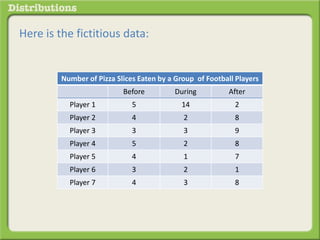
Player 1 5 14 2 
Player 2 4 2 8 
Player 3 3 3 9 
Player 4 5 2 8 
Player 5 4 1 7 
Player 6 3 2 1 
Player 7 4 3 8
Here is the fictitious data: 
Number of Pizza Slices Eaten by a Group of Football Players 
Before During After 
Player 1 5 14 2 
Player 2 4 2 8 
Player 3 3 3 9 
Player 4 5 2 8 
Player 5 4 1 7 
Player 6 3 2 1 
Player 7 4 3 8 
Mean 3.9 3.4 6.9
*Note 1: 
Remember that a Repeated Measures 
ANOVA does not pin point which pair is 
significantly different. It just let’s you 
know that there is a difference. Post hoc 
tests must be performed to determine 
which pair is different.
*Note 2: 
Because a pair-wise t-test is generally 
used to determine if there is a difference 
between two separate observation 
occasions, the Repeated Measures 
ANOVA is generally used with three or 
more occasions even though it could be 
used with just two.
The Friedman test is appropriate to use when the 
underlying measurement is on an ordinal scale or the 
distribution of a dependent variable is highly skewed. 
The Friedman test will estimate whether there are 
significant differences among distributions at multiple 
(more than two) observation periods.
The Friedman test is appropriate to use when the 
underlying measurement is on an ordinal scale or the 
distribution of a dependent variable is highly skewed. 
The Friedman test will estimate whether there are 
significant differences among distributions at multiple 
(more than two) observation periods. 
While the Repeated Measures ANOVA compares group 
means, the Friedman Test compares group medians. 
Remember that a Median is less resistant to outliers
So let’s go back to our pizza-eating football player 
example: 
Number of Pizza Slices Eaten by a Group of Football Players 
Before During After 
Player 1 5 14 2 
Player 2 4 2 8 
Player 3 3 3 9 
Player 4 5 2 8 
Player 5 4 1 7 
Player 6 3 2 1 
Player 7 4 3 8 
Mean 3.9 3.4 6.9
Notice that the highlighted numbers are outliers in 
each group which can skew the results for a Repeated 
Measures ANOVA. 
Number of Pizza Slices Eaten by a Group of Football Players 
Before During After 
Player 1 5 14 2 
Player 2 4 2 8 
Player 3 3 3 9 
Player 4 5 2 8 
Player 5 4 1 7 
Player 6 3 2 1 
Player 7 4 3 8 
Mean 3.9 3.4 6.9
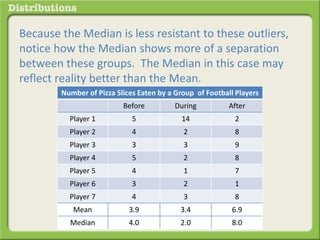
Because the Median is less resistant to these outliers, 
notice how the Median shows more of a separation 
between these groups. The Median in this case may 
reflect reality better than the Mean. 
Number of Pizza Slices Eaten by a Group of Football Players 
Before During After 
Player 1 5 14 2 
Player 2 4 2 8 
Player 3 3 3 9 
Player 4 5 2 8 
Player 5 4 1 7 
Player 6 3 2 1 
Player 7 4 3 8 
Mean 3.9 3.4 6.9 
Median 4.0 2.0 8.0
Friedman test is also used when the data is rank 
ordered or ordinal (no equal intervals).
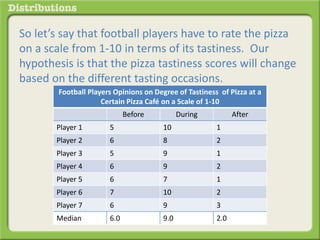
So let’s say that football players have to rate the pizza 
on a scale from 1-10 in terms of its tastiness. Our 
hypothesis is that the pizza tastiness scores will change 
based on the different tasting occasions.
So let’s say that football players have to rate the pizza 
on a scale from 1-10 in terms of its tastiness. Our 
hypothesis is that the pizza tastiness scores will change 
based on the different tasting occasions. 
Football Players Opinions on Degree of Tastiness of Pizza at a 
Certain Pizza Café on a Scale of 1-10 
Before During After 
Player 1 5 10 1 
Player 2 6 8 2 
Player 3 5 9 1 
Player 4 6 9 2 
Player 5 6 7 1 
Player 6 7 10 2 
Player 7 6 9 3 
Median 6.0 9.0 2.0
Once again the median is used here because on a scale 
of 1-10 there is not an agreed upon definition usually 
on how a 1 differs from a 2 compared to how a 7 differs 
from an 8. Rating pizza taste is more subjective in 
terms of how equal the intervals are compared to the 
number of pizza slices which is a more objective 
measure.
Once again the median is used here because on a scale 
of 1-10 there is not an agreed upon definition usually 
on how a 1 differs from a 2 compared to how a 7 differs 
from an 8. Rating pizza taste is more subjective in 
terms of how equal the intervals are compared to the 
number of pizza slices which is a more objective 
measure. 
That is why in this case we would use a Friedman Test

What is a Friedman Test?

  • 1.
    Friedman Test Thenon-parametric analogue to the repeated measures ANOVA is the Friedman test.
  • 2.
    First let’s reviewwhat a repeated measures ANOVA is.
  • 3.
    First let’s reviewwhat a repeated measures ANOVA. A repeated measures ANOVA is used to determine if there is a statistically significant difference between the results of the same measure with the same group across multiple occasions.
  • 4.
    For example, Numberof Pizza Slices Eaten by a Group of Football Players Before During After Player 1 Player 2 Player 3 Player 4 Player 5 Player 6 Player 7
  • 5.
    Here is thefictitious data: Number of Pizza Slices Eaten by a Group of Football Players Before During After Player 1 5 Player 2 4 Player 3 3 Player 4 5 Player 5 4 Player 6 3 Player 7 4
  • 6.
    Here is thefictitious data: Number of Pizza Slices Eaten by a Group of Football Players Before During After Player 1 5 14 Player 2 4 2 Player 3 3 3 Player 4 5 2 Player 5 4 1 Player 6 3 2 Player 7 4 3
  • 7.
    Here is thefictitious data: Number of Pizza Slices Eaten by a Group of Football Players Before During After Player 1 5 14 2 Player 2 4 2 8 Player 3 3 3 9 Player 4 5 2 8 Player 5 4 1 7 Player 6 3 2 1 Player 7 4 3 8
  • 8.
    Here is thefictitious data: Number of Pizza Slices Eaten by a Group of Football Players Before During After Player 1 5 14 2 Player 2 4 2 8 Player 3 3 3 9 Player 4 5 2 8 Player 5 4 1 7 Player 6 3 2 1 Player 7 4 3 8 Mean 3.9 3.4 6.9
  • 9.
    *Note 1: Rememberthat a Repeated Measures ANOVA does not pin point which pair is significantly different. It just let’s you know that there is a difference. Post hoc tests must be performed to determine which pair is different.
  • 10.
    *Note 2: Becausea pair-wise t-test is generally used to determine if there is a difference between two separate observation occasions, the Repeated Measures ANOVA is generally used with three or more occasions even though it could be used with just two.
  • 11.
    The Friedman testis appropriate to use when the underlying measurement is on an ordinal scale or the distribution of a dependent variable is highly skewed. The Friedman test will estimate whether there are significant differences among distributions at multiple (more than two) observation periods.
  • 12.
    The Friedman testis appropriate to use when the underlying measurement is on an ordinal scale or the distribution of a dependent variable is highly skewed. The Friedman test will estimate whether there are significant differences among distributions at multiple (more than two) observation periods. While the Repeated Measures ANOVA compares group means, the Friedman Test compares group medians. Remember that a Median is less resistant to outliers
  • 13.
    So let’s goback to our pizza-eating football player example: Number of Pizza Slices Eaten by a Group of Football Players Before During After Player 1 5 14 2 Player 2 4 2 8 Player 3 3 3 9 Player 4 5 2 8 Player 5 4 1 7 Player 6 3 2 1 Player 7 4 3 8 Mean 3.9 3.4 6.9
  • 14.
    Notice that thehighlighted numbers are outliers in each group which can skew the results for a Repeated Measures ANOVA. Number of Pizza Slices Eaten by a Group of Football Players Before During After Player 1 5 14 2 Player 2 4 2 8 Player 3 3 3 9 Player 4 5 2 8 Player 5 4 1 7 Player 6 3 2 1 Player 7 4 3 8 Mean 3.9 3.4 6.9
  • 15.
    Because the Medianis less resistant to these outliers, notice how the Median shows more of a separation between these groups. The Median in this case may reflect reality better than the Mean. Number of Pizza Slices Eaten by a Group of Football Players Before During After Player 1 5 14 2 Player 2 4 2 8 Player 3 3 3 9 Player 4 5 2 8 Player 5 4 1 7 Player 6 3 2 1 Player 7 4 3 8 Mean 3.9 3.4 6.9 Median 4.0 2.0 8.0
  • 16.
    Friedman test isalso used when the data is rank ordered or ordinal (no equal intervals).
  • 17.
    So let’s saythat football players have to rate the pizza on a scale from 1-10 in terms of its tastiness. Our hypothesis is that the pizza tastiness scores will change based on the different tasting occasions.
  • 18.
    So let’s saythat football players have to rate the pizza on a scale from 1-10 in terms of its tastiness. Our hypothesis is that the pizza tastiness scores will change based on the different tasting occasions. Football Players Opinions on Degree of Tastiness of Pizza at a Certain Pizza Café on a Scale of 1-10 Before During After Player 1 5 10 1 Player 2 6 8 2 Player 3 5 9 1 Player 4 6 9 2 Player 5 6 7 1 Player 6 7 10 2 Player 7 6 9 3 Median 6.0 9.0 2.0
  • 19.
    Once again themedian is used here because on a scale of 1-10 there is not an agreed upon definition usually on how a 1 differs from a 2 compared to how a 7 differs from an 8. Rating pizza taste is more subjective in terms of how equal the intervals are compared to the number of pizza slices which is a more objective measure.
  • 20.
    Once again themedian is used here because on a scale of 1-10 there is not an agreed upon definition usually on how a 1 differs from a 2 compared to how a 7 differs from an 8. Rating pizza taste is more subjective in terms of how equal the intervals are compared to the number of pizza slices which is a more objective measure. That is why in this case we would use a Friedman Test