1
Motivation & Emotion
Motivation in
historical perspective
Dr James Neill
Centre for Applied Psychology
University of Canberra
2016
Image source: https://commons.wikimedia.org/wiki/File:Olympic_schedule_(Competitions)_ancient_Pentathlon.svg
2
Motivation in
historical
perspective
Reading:
Reeve (2015), Ch 2, 28-50
3
Outline
Based on Reeve (2015, Ch 2, p. 28)
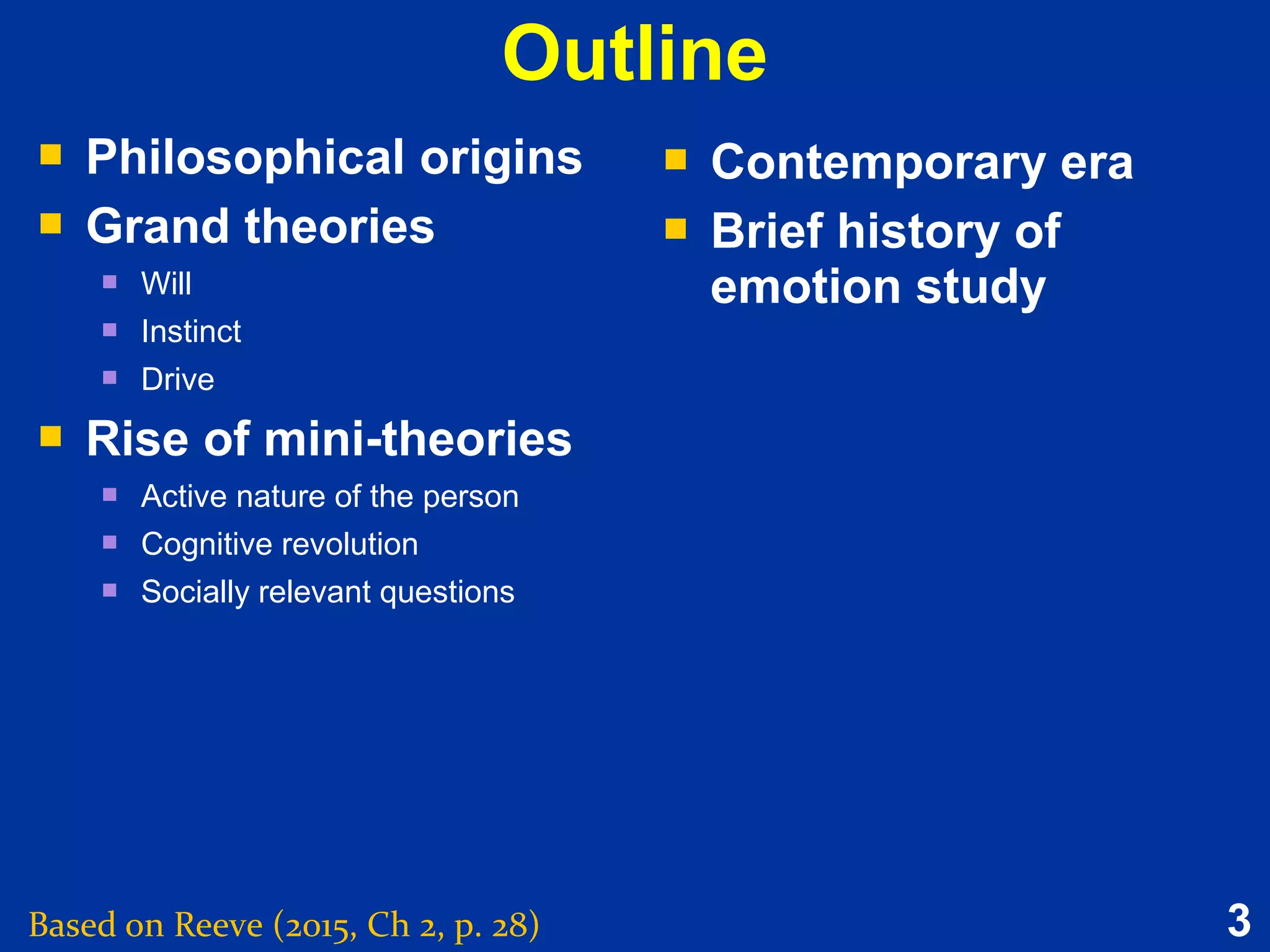
 Philosophical origins
 Grand theories
 Will
 Instinct
 Drive
 Rise of mini-theories
 Active nature of the person
 Cognitive revolution
 Socially relevant questions
 Contemporary era
 Brief history of
emotion study
4
Philosophical origins of
motivational perspectives
Based on Reeve (2015, Ch 2, pp. 29-30)
Ancient Greeks (Socrates, Plato, and Aristotle) suggested a
tripartite model:
• Appetitive (physiological)
• Competitive (social)
• Calculating (thinking)
Descartes:
• Passive (biological impulses)
• Active (will)
Dualistic model:
• Body (irrational, impulsive)
• Mind (rational, intelligent)
5
History of motivation
(Overview)
Based on Reeve (2016, Ch 2, pp. 28-46)
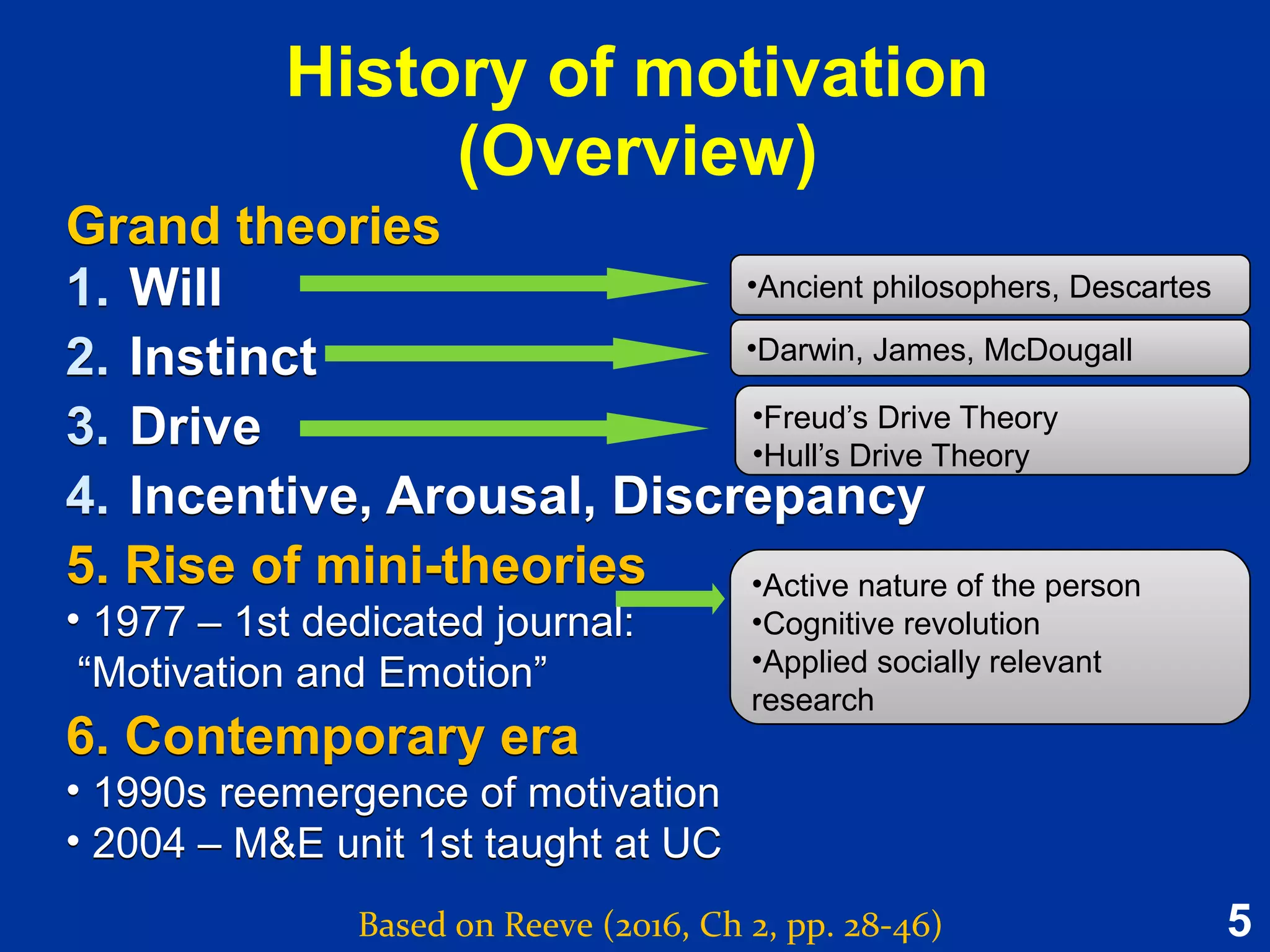
1. Will
2. Instinct
3. Drive
4. Incentive, Arousal, Discrepancy
5. Rise of mini-theories
• 1977 – 1st dedicated journal:
“Motivation and Emotion”
6. Contemporary era
• 1990s reemergence of motivation
• 2004 – M&E unit 1st taught at UC
1. Will
2. Instinct
3. Drive
4. Incentive, Arousal, Discrepancy
5. Rise of mini-theories
• 1977 – 1st dedicated journal:
“Motivation and Emotion”
6. Contemporary era
• 1990s reemergence of motivation
• 2004 – M&E unit 1st taught at UC
•Freud’s Drive Theory
•Hull’s Drive Theory
•Active nature of the person
•Cognitive revolution
•Applied socially relevant
research
•Darwin, James, McDougall
•Ancient philosophers, Descartes
Grand theoriesGrand theories
6
Grand theories of motivation
Based on Reeve (2015, Ch 2, pp. 30-36)
All-encompassing theories that seek to explain the full range of motivated
action - why we eat, drink, work, play, compete, fear certain things, read, fall in
love, and so on.
Ancient philosophers
understood motivation
within two themes:
Ø primitive, impulsive,
biological, and
reactive (i.e., bodily
desires).
Ø good, rational,
immaterial, and
active (i.e., the will)
Physiological analysis of
motivation by focusing on
the mechanistic.
The appeal of instinct
doctrine was its ability to
explain unlearned
behaviour that had energy
and purpose
(i.e., goal-directed
biological impulses).
Behaviour is motivated
to the extent that it
served the needs of the
organism and restores a
biological homeostasis.
Your body does not
want to be thirsty,
hungry, in pain, or horny
etc.
Will Instinct Drive
7
Freud's drive theory
Based on Reeve (2015, Ch 2, Figure 2.1, p. 34)
A bodily deficit
occurs
(e.g., blood
sugar drops & a
sense of hunger
emerges).
The intensity of
the bodily deficit
grows &
emerges into
consciousness
as a
psychological
discomfort,
which is anxiety.
Seeking to
reduce anxiety
& satisfy the
bodily deficit,
the person
searches out &
consumes a
need satisfying
environmental
object (e.g.,
food).
If the
environmental
object
successfully
satisfies the
bodily deficit,
satisfaction
occurs & quiets
anxiety, at least
for a period of
time.
Drive’s
Source
Drive’s
Impetus
Drive’s
Object
Drive’s
Aim
8
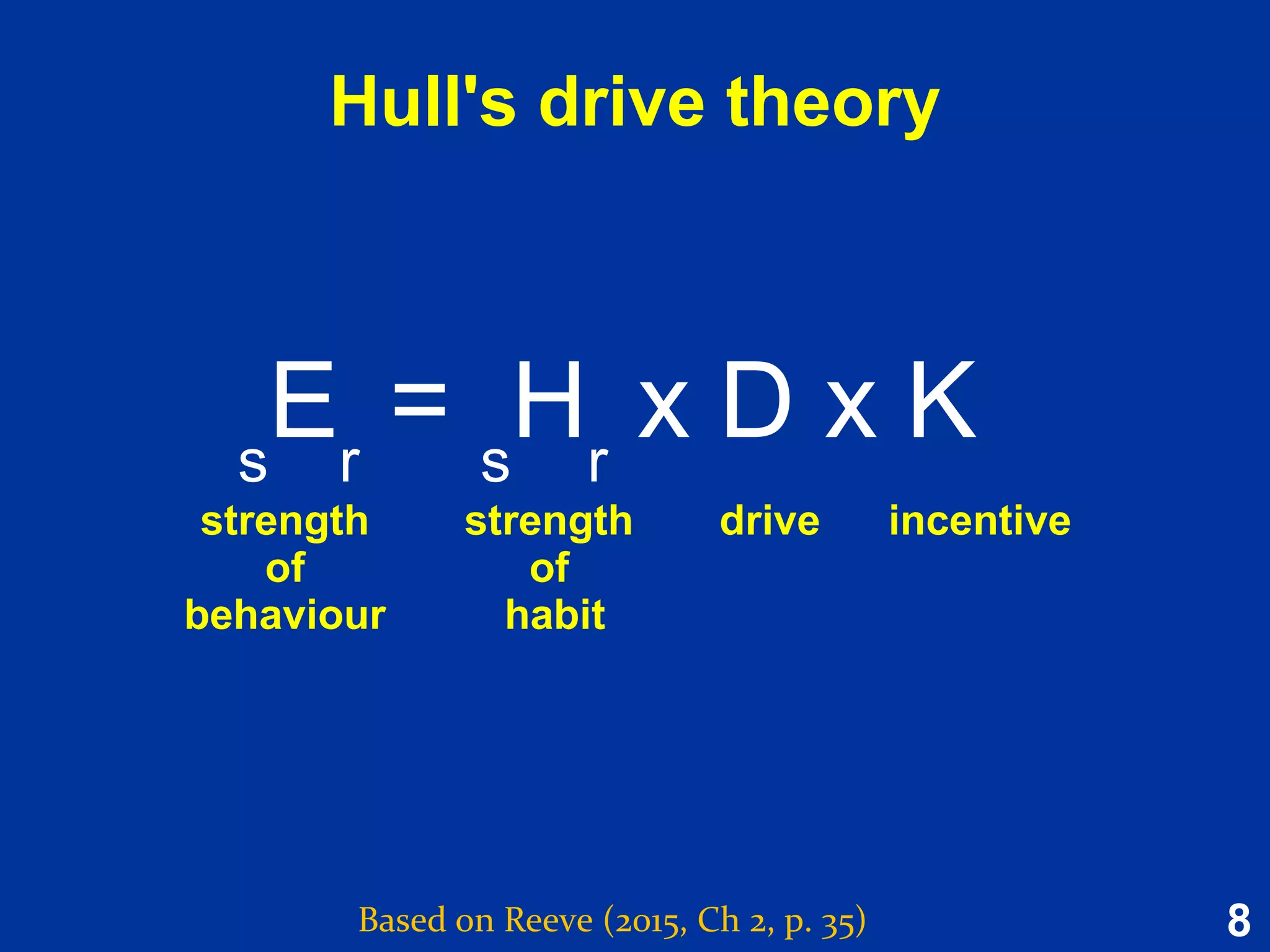
Hull's drive theory
s
Er
= s
Hr
x D x K
strength
of
behaviour
strength
of
habit
drive incentive
Based on Reeve (2015, Ch 2, p. 35)
9
Decline of grand theories of
motivation
Based on Reeve (2015, Ch 2, pp. 36-37)
Will Instinct Drive
The philosophical
study of the will
turned out to be a
dead end that
explained very little
about motivation; it
raised more
questions than it
answered.
The physiological
study of the instinct
proved to be an
intellectual dead
end as well; it
became clear that
“naming is not
explaining”.
Overly limited in scope.
With its rejection came
disillusionment with
grand theories in
general, though several
additional grand
motivational principles
emerged with some
success, including
incentive and arousal.
10
Post-drive theory years
Based on Reeve (2015, Ch 2, pp. 37-38)
Second,
motivation turned
decidedly
cognitive and
somewhat
humanistic.
First,
motivation study rejected
its commitment to a
passive view of human
nature and adopted a
more active portrayal of
human beings.
Third,
the field focused on
applied, socially
relevant problems.
11
Rise of the mini-theories
Based on Reeve (2015, Ch 2, p. 39)
1. Motivational phenomenon
(e.g.., achievement motivation, the flow experience)
2. Special motivational circumstances
(e.g., failure feedback, role models)
3. Theoretical questions
(e.g., what is the relationship btw cognition & emotion?)
Unlike grand
theories
that try to explain
the full range of
motivation,
mini-theories
limit
their attention:
12
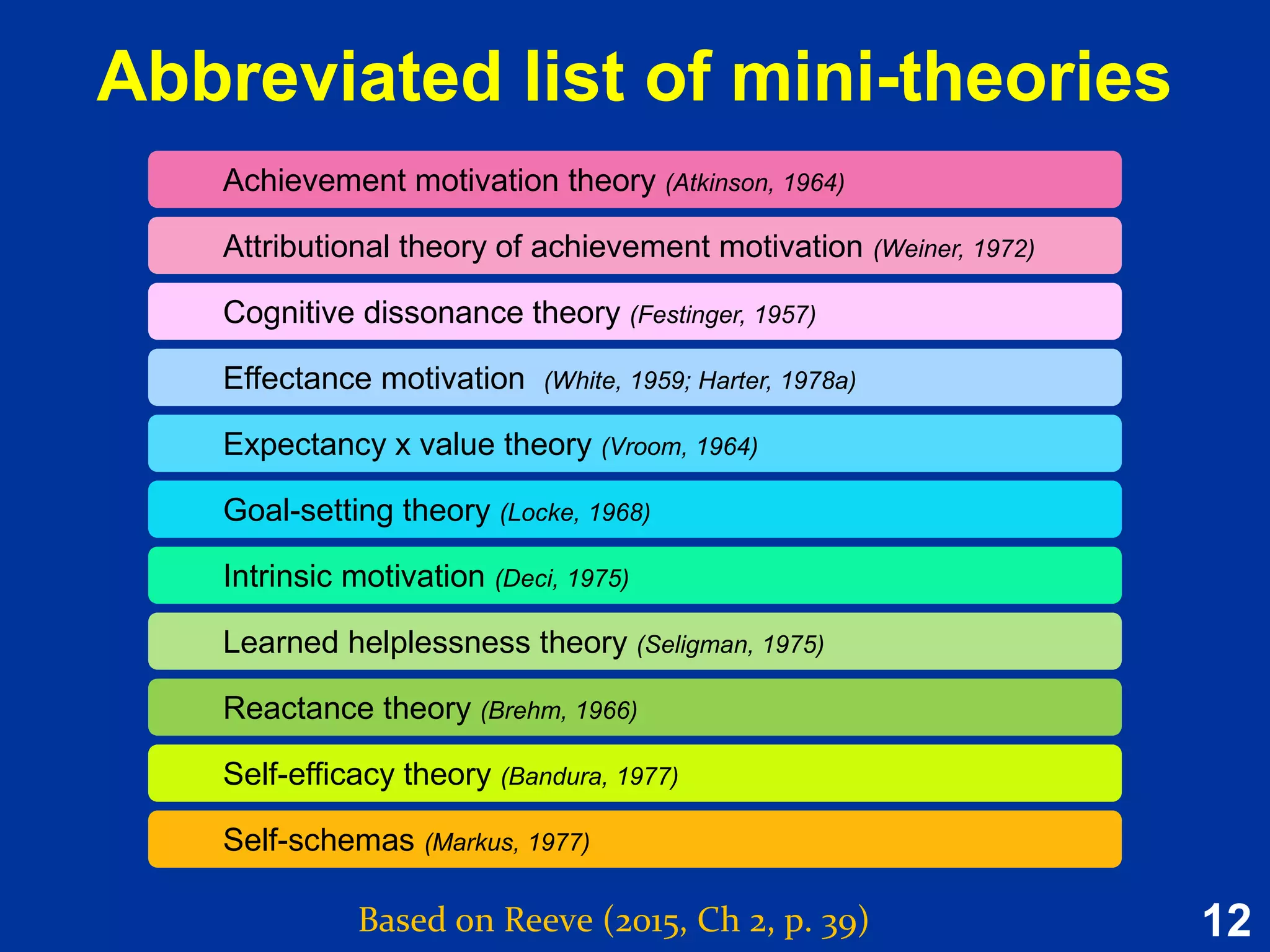
Abbreviated list of mini-theories
Achievement motivation theory (Atkinson, 1964)
Attributional theory of achievement motivation (Weiner, 1972)
Cognitive dissonance theory (Festinger, 1957)
Effectance motivation (White, 1959; Harter, 1978a)
Expectancy x value theory (Vroom, 1964)
Goal-setting theory (Locke, 1968)
Intrinsic motivation (Deci, 1975)
Learned helplessness theory (Seligman, 1975)
Reactance theory (Brehm, 1966)
Self-efficacy theory (Bandura, 1977)
Self-schemas (Markus, 1977)
Based on Reeve (2015, Ch 2, p. 39)
13
Relationship of motivation study to
psychology’s areas of specialisation
Based on Reeve (2015, Ch 2, Figure 2.3, p. 42)
Social
Industri
al/Organ
isational
Develop
-mental
Educat-
ional
Person-
ality
Cognit-
ive
Clinical
Physio-
logical
Health
Counsel
-ing
Domain-specific answers to
core questions:
§ What causes behaviour?
§ Why does behaviour vary
in its intensity?
Motivation
study in the
21st century is
populated by
multiple
perspectives
and multiple
voices, all of
which
contribute a
different piece
to the puzzle
of motivation
and emotion
study
14
The many voices in motivation study
Based on Reeve (2015, Ch 2, p. 46)
●
Behaviour is
energised and
directed by a
multitude of multi-
level and co-acting
influences.
●
Most motivational
states need to be)
understood at
multiple levels - from
a neurological level, a
cognitive level, a
social level, and so
on.
_________________________________________________________________________________________________________
Perspective: Motives emerge from…
_________________________________________________________________________________________________________
Behavioural Environmental incentives
Neurological Brain activations
Physiological Hormonal activity
Cognitive Mental events and thoughts
Social-cognitive Ways of thinking guided
by exposure to other people
Cultural Groups, organisations, and
nations
Evolutionary Genes and genetic
endowment
Humanistic Encouraging the human
potential
Psychoanalytical Unconscious mental life
_________________________________________________________________________________________________________
15
Summary
 The study of motivation has philosophical
origins dating to the Ancient Greeks.
 Mind-body dualism has guided philosophical
thinking about motivation, leading to grand
theories about Will, Instinct, and Drive.
 Limitations in grand theories lead to their
decline and gave rise of mini-theories
focusing on specific phenomena.
 Contemporary perspectives emphasise
multiple motivational influences, including
the active role of the person.
16
References
 Reeve, J. (2015). Understanding motivation
and emotion (6th ed.). Hoboken, NJ: Wiley.
 Reeve, J. (2015). Understanding motivation
and emotion (6th ed.). Hoboken, NJ: Wiley.
17
Open Office Impress
 This presentation was made using
Open Office Impress.
 Free and open source software.
 http://www.openoffice.org/product/impress.html
 This presentation was made using
Open Office Impress.
 Free and open source software.
 http://www.openoffice.org/product/impress.html
Motivation in historical perspective

Motivation in historical perspective

  • 1.
    1 Motivation & Emotion Motivationin historical perspective Dr James Neill Centre for Applied Psychology University of Canberra 2016 Image source: https://commons.wikimedia.org/wiki/File:Olympic_schedule_(Competitions)_ancient_Pentathlon.svg
  • 2.
  • 3.
    3 Outline Based on Reeve(2015, Ch 2, p. 28)  Philosophical origins  Grand theories  Will  Instinct  Drive  Rise of mini-theories  Active nature of the person  Cognitive revolution  Socially relevant questions  Contemporary era  Brief history of emotion study
  • 4.
    4 Philosophical origins of motivationalperspectives Based on Reeve (2015, Ch 2, pp. 29-30) Ancient Greeks (Socrates, Plato, and Aristotle) suggested a tripartite model: • Appetitive (physiological) • Competitive (social) • Calculating (thinking) Descartes: • Passive (biological impulses) • Active (will) Dualistic model: • Body (irrational, impulsive) • Mind (rational, intelligent)
  • 5.
    5 History of motivation (Overview) Basedon Reeve (2016, Ch 2, pp. 28-46) 1. Will 2. Instinct 3. Drive 4. Incentive, Arousal, Discrepancy 5. Rise of mini-theories • 1977 – 1st dedicated journal: “Motivation and Emotion” 6. Contemporary era • 1990s reemergence of motivation • 2004 – M&E unit 1st taught at UC 1. Will 2. Instinct 3. Drive 4. Incentive, Arousal, Discrepancy 5. Rise of mini-theories • 1977 – 1st dedicated journal: “Motivation and Emotion” 6. Contemporary era • 1990s reemergence of motivation • 2004 – M&E unit 1st taught at UC •Freud’s Drive Theory •Hull’s Drive Theory •Active nature of the person •Cognitive revolution •Applied socially relevant research •Darwin, James, McDougall •Ancient philosophers, Descartes Grand theoriesGrand theories
  • 6.
    6 Grand theories ofmotivation Based on Reeve (2015, Ch 2, pp. 30-36) All-encompassing theories that seek to explain the full range of motivated action - why we eat, drink, work, play, compete, fear certain things, read, fall in love, and so on. Ancient philosophers understood motivation within two themes: Ø primitive, impulsive, biological, and reactive (i.e., bodily desires). Ø good, rational, immaterial, and active (i.e., the will) Physiological analysis of motivation by focusing on the mechanistic. The appeal of instinct doctrine was its ability to explain unlearned behaviour that had energy and purpose (i.e., goal-directed biological impulses). Behaviour is motivated to the extent that it served the needs of the organism and restores a biological homeostasis. Your body does not want to be thirsty, hungry, in pain, or horny etc. Will Instinct Drive
  • 7.
    7 Freud's drive theory Basedon Reeve (2015, Ch 2, Figure 2.1, p. 34) A bodily deficit occurs (e.g., blood sugar drops & a sense of hunger emerges). The intensity of the bodily deficit grows & emerges into consciousness as a psychological discomfort, which is anxiety. Seeking to reduce anxiety & satisfy the bodily deficit, the person searches out & consumes a need satisfying environmental object (e.g., food). If the environmental object successfully satisfies the bodily deficit, satisfaction occurs & quiets anxiety, at least for a period of time. Drive’s Source Drive’s Impetus Drive’s Object Drive’s Aim
  • 8.
    8 Hull's drive theory s Er =s Hr x D x K strength of behaviour strength of habit drive incentive Based on Reeve (2015, Ch 2, p. 35)
  • 9.
    9 Decline of grandtheories of motivation Based on Reeve (2015, Ch 2, pp. 36-37) Will Instinct Drive The philosophical study of the will turned out to be a dead end that explained very little about motivation; it raised more questions than it answered. The physiological study of the instinct proved to be an intellectual dead end as well; it became clear that “naming is not explaining”. Overly limited in scope. With its rejection came disillusionment with grand theories in general, though several additional grand motivational principles emerged with some success, including incentive and arousal.
  • 10.
    10 Post-drive theory years Basedon Reeve (2015, Ch 2, pp. 37-38) Second, motivation turned decidedly cognitive and somewhat humanistic. First, motivation study rejected its commitment to a passive view of human nature and adopted a more active portrayal of human beings. Third, the field focused on applied, socially relevant problems.
  • 11.
    11 Rise of themini-theories Based on Reeve (2015, Ch 2, p. 39) 1. Motivational phenomenon (e.g.., achievement motivation, the flow experience) 2. Special motivational circumstances (e.g., failure feedback, role models) 3. Theoretical questions (e.g., what is the relationship btw cognition & emotion?) Unlike grand theories that try to explain the full range of motivation, mini-theories limit their attention:
  • 12.
    12 Abbreviated list ofmini-theories Achievement motivation theory (Atkinson, 1964) Attributional theory of achievement motivation (Weiner, 1972) Cognitive dissonance theory (Festinger, 1957) Effectance motivation (White, 1959; Harter, 1978a) Expectancy x value theory (Vroom, 1964) Goal-setting theory (Locke, 1968) Intrinsic motivation (Deci, 1975) Learned helplessness theory (Seligman, 1975) Reactance theory (Brehm, 1966) Self-efficacy theory (Bandura, 1977) Self-schemas (Markus, 1977) Based on Reeve (2015, Ch 2, p. 39)
  • 13.
    13 Relationship of motivationstudy to psychology’s areas of specialisation Based on Reeve (2015, Ch 2, Figure 2.3, p. 42) Social Industri al/Organ isational Develop -mental Educat- ional Person- ality Cognit- ive Clinical Physio- logical Health Counsel -ing Domain-specific answers to core questions: § What causes behaviour? § Why does behaviour vary in its intensity? Motivation study in the 21st century is populated by multiple perspectives and multiple voices, all of which contribute a different piece to the puzzle of motivation and emotion study
  • 14.
    14 The many voicesin motivation study Based on Reeve (2015, Ch 2, p. 46) ● Behaviour is energised and directed by a multitude of multi- level and co-acting influences. ● Most motivational states need to be) understood at multiple levels - from a neurological level, a cognitive level, a social level, and so on. _________________________________________________________________________________________________________ Perspective: Motives emerge from… _________________________________________________________________________________________________________ Behavioural Environmental incentives Neurological Brain activations Physiological Hormonal activity Cognitive Mental events and thoughts Social-cognitive Ways of thinking guided by exposure to other people Cultural Groups, organisations, and nations Evolutionary Genes and genetic endowment Humanistic Encouraging the human potential Psychoanalytical Unconscious mental life _________________________________________________________________________________________________________
  • 15.
    15 Summary  The studyof motivation has philosophical origins dating to the Ancient Greeks.  Mind-body dualism has guided philosophical thinking about motivation, leading to grand theories about Will, Instinct, and Drive.  Limitations in grand theories lead to their decline and gave rise of mini-theories focusing on specific phenomena.  Contemporary perspectives emphasise multiple motivational influences, including the active role of the person.
  • 16.
    16 References  Reeve, J.(2015). Understanding motivation and emotion (6th ed.). Hoboken, NJ: Wiley.  Reeve, J. (2015). Understanding motivation and emotion (6th ed.). Hoboken, NJ: Wiley.
  • 17.
    17 Open Office Impress This presentation was made using Open Office Impress.  Free and open source software.  http://www.openoffice.org/product/impress.html  This presentation was made using Open Office Impress.  Free and open source software.  http://www.openoffice.org/product/impress.html

Editor's Notes

  • #2 Image source: https://commons.wikimedia.org/wiki/File:Olympic_schedule_(Competitions)_ancient_Pentathlon.svg Image by: Francois-Pier, https://commons.wikimedia.org/wiki/User:Francois-Pier Image license: CC-SA 3.0, https://creativecommons.org/licenses/by-sa/3.0/deed.en Acknowledgements: This lecture is based in part on Reeve (2009, 2015) . Wednesday 16 August, 2017, 13:30-15:30, 12B2 7124-6665 Motivation and Emotion / G Centre for Applied Psychology Faculty of Health University of Canberra Bruce, ACT 2601, Australia ph: +61 2 6201 2536 [email_address] http://en.wikiversity.org/wiki/Motivation_and_emotion
  • #5 Watch 1:30 to 3:39 mins
  • #6 Image source: http://commons.wikimedia.org/wiki/File:Motivation_and_Emotion_Scrabble.jpg
  • #9 Ancient Greeks – Socrates and Plato – tripartite model similar to Freud's Id, Ego, Superego Will – Decartes Instinct - Darwin
  • #19 Image source: http://commons.wikimedia.org/wiki/File:One_hand_handstand.jpg Image by: AR22, http://commons.wikimedia.org/wiki/User:AR22 Image license: CC-by-SA 3.0, http://creativecommons.org/licenses/by-sa/3.0/deed.en