Analysis of Covariance
David Markham
djmarkham@bsu.edu
Analysis of Covariance
 Analysis of Covariance (ANCOVA) is a
statistical test related to ANOVA
 It tests whether there is a significant
difference between groups after controlling
for variance explained by a covariate
 A covariate is a continuous variable that
correlates with the dependent variable
So, what does all that mean?
 This means that you can, in effect, “partial
out” a continuous variable and run an
ANOVA on the results
 This is one way that you can run a
statistical test with both categorical and
continuous independent variables
Hypotheses for ANCOVA
 H0 and H1 need to be stated slightly
differently for an ANCOVA than a regular
ANOVA
 H0: the group means are equal after
controlling for the covariate
 H1: the group means are not equal after
controlling for the covariate
Assumptions for ANCOVA
ANOVA assumptions:
 Variance is normally distributed
 Variance is equal between groups
 All measurements are independent
Also, for ANCOVA:
 Relationship between DV and covariate is
linear
 The relationship between the DV and
covariate is the same for all groups
How does ANCOVA work?
 ANCOVA works by adjusting the total SS,
group SS, and error SS of the independent
variable to remove the influence of the
covariate
 However, the sums of squares must also
be calculated for the covariate. For this
reason, SSdv will be used for SS scores for
the dependent variable, and SScv will be
used for the covariate
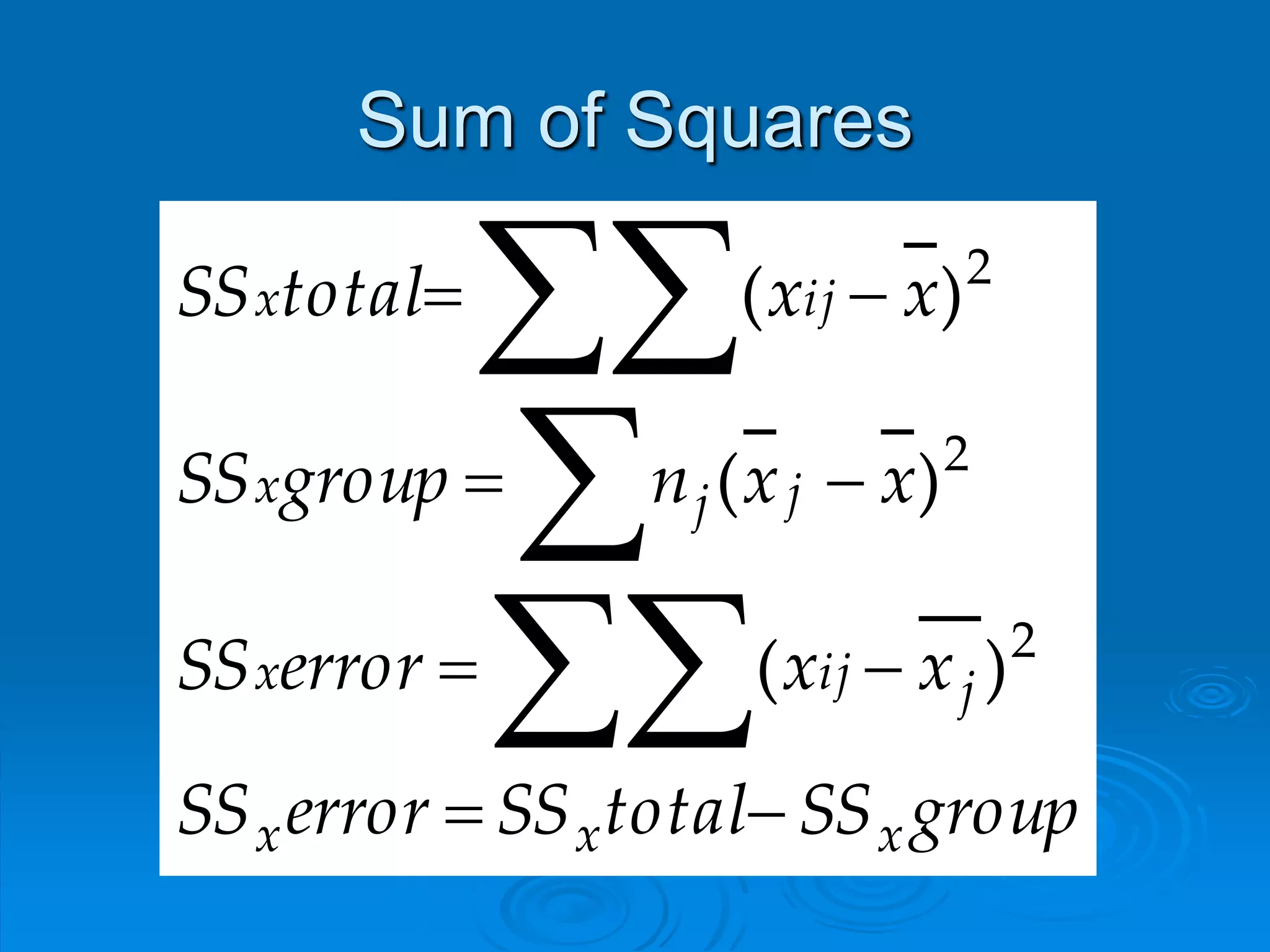
Sum of Squares
groupSStotalSSerrorSS
xxerrorSS
xxngroupSS
xxtotalSS
xxx
jijx
jjx
ijx







2
2
2
)(
)(
)(
Sum of Products
 To control for the covariate, the sum of products
(SP) for the DV and covariate must also be
used
 This is the sum of the products of the residuals
for both the DV and the covariate
 In the following slides, x is the covariate, and y
is the DV. i is the individual subject, and j is the
group.
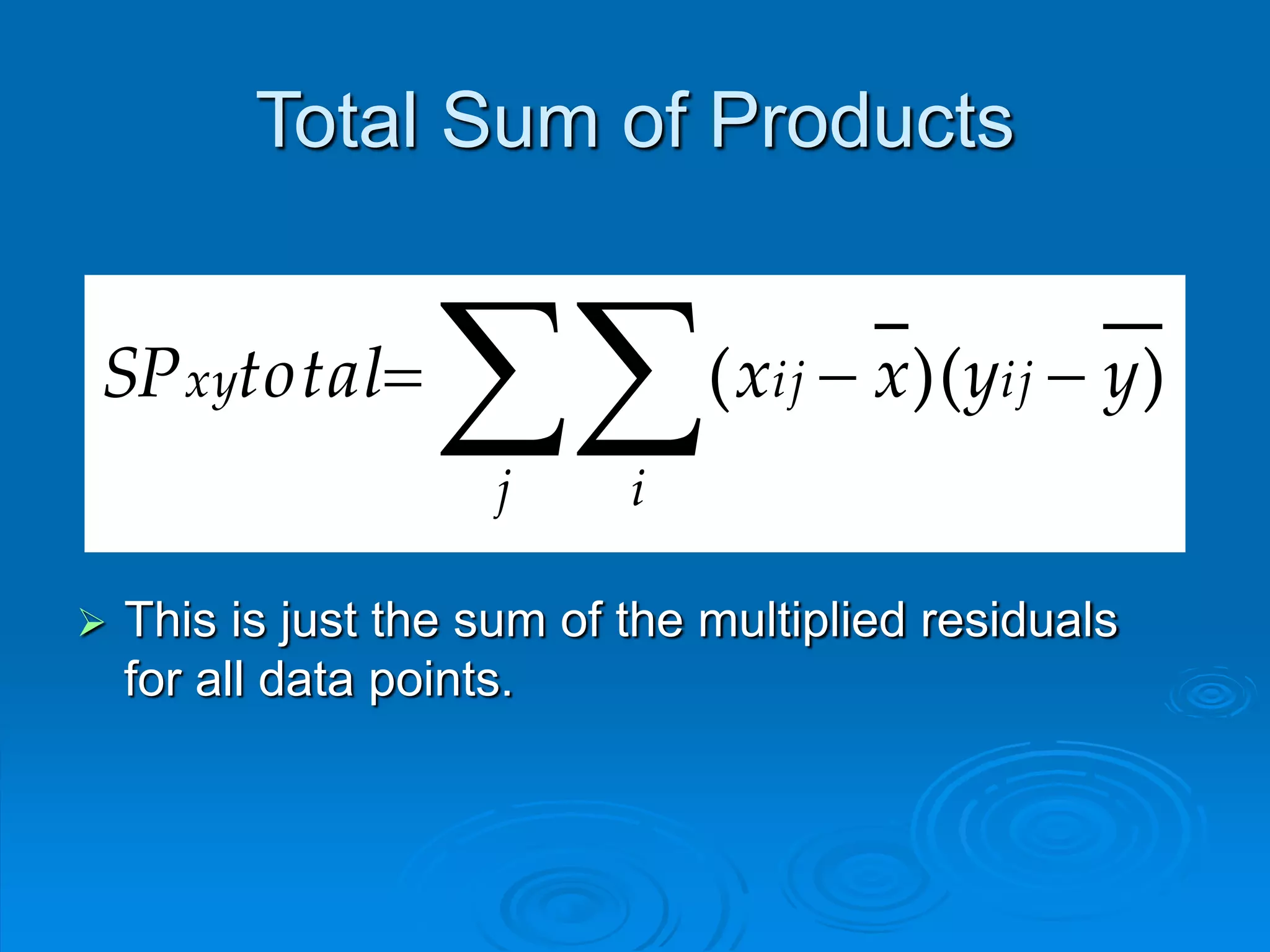
Total Sum of Products
))(( yyxxtotalSP ij
j i
ijxy 

 This is just the sum of the multiplied residuals
for all data points.
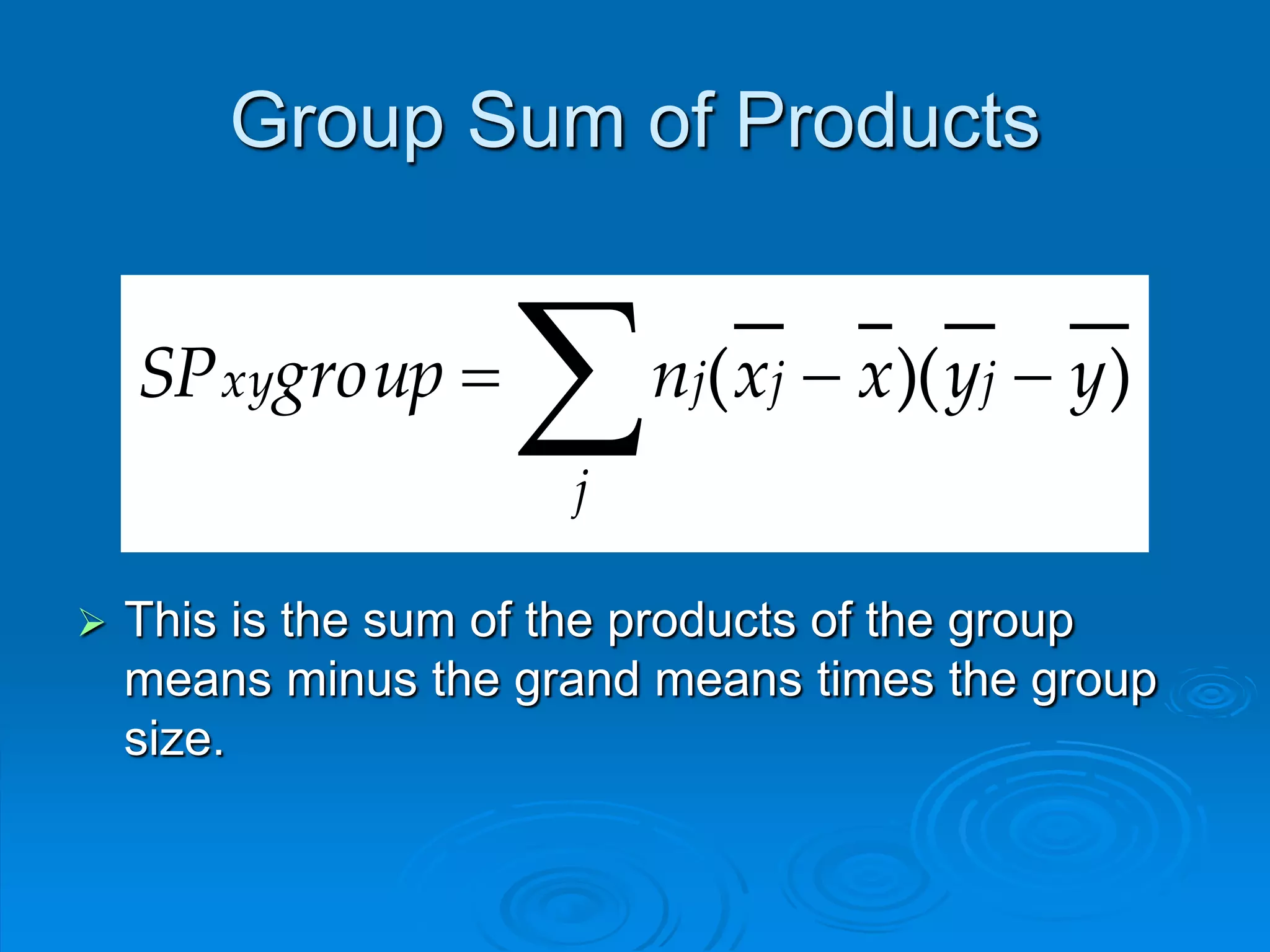
Group Sum of Products
)()( yyxxngroupSP j
j
jjxy 

 This is the sum of the products of the group
means minus the grand means times the group
size.
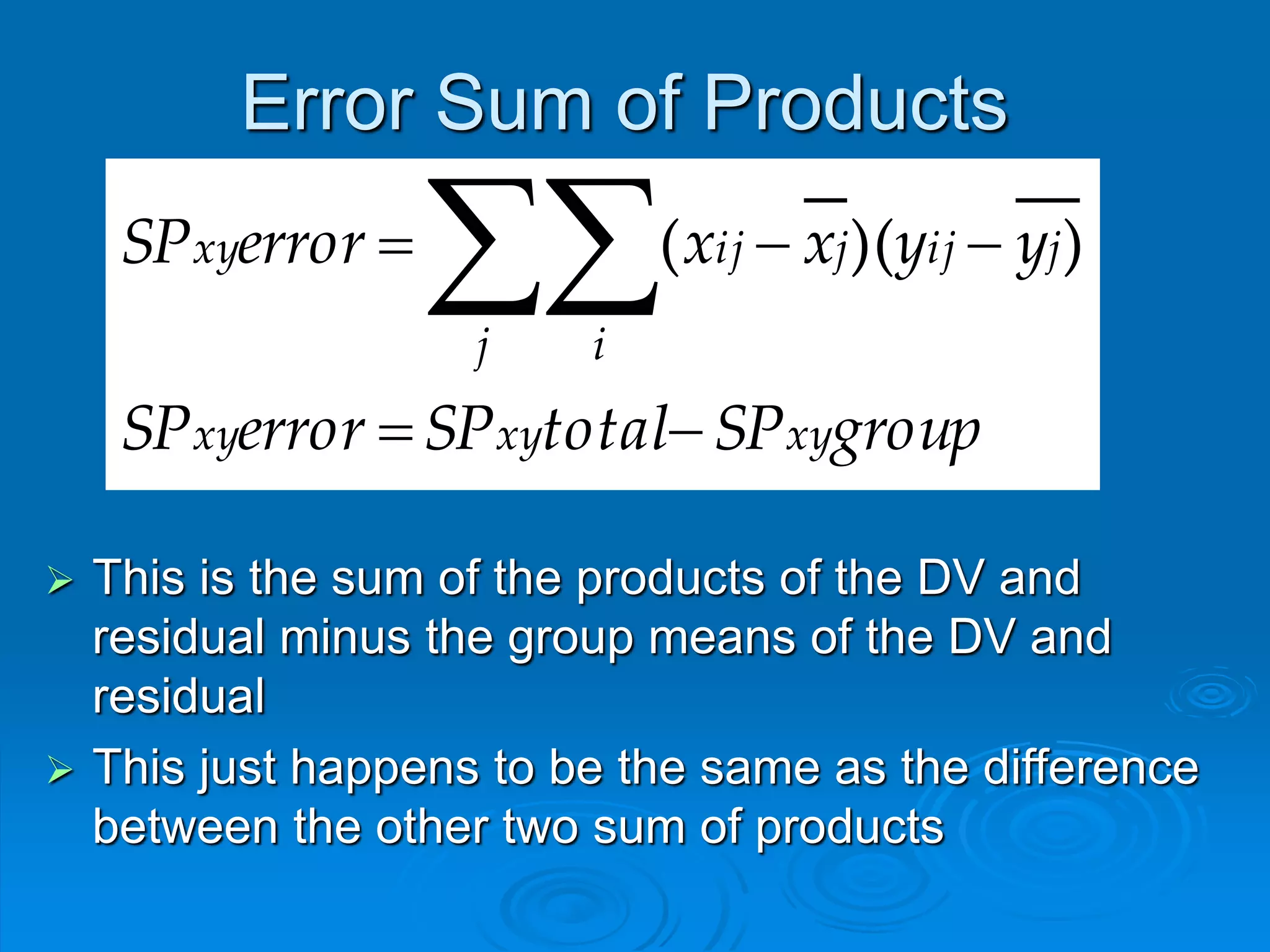
Error Sum of Products
groupSPtotalSPerrorSP
yyxxerrorSP
xyxyxy
jij
j i
jijxy


 ))((
 This is the sum of the products of the DV and
residual minus the group means of the DV and
residual
 This just happens to be the same as the difference
between the other two sum of products
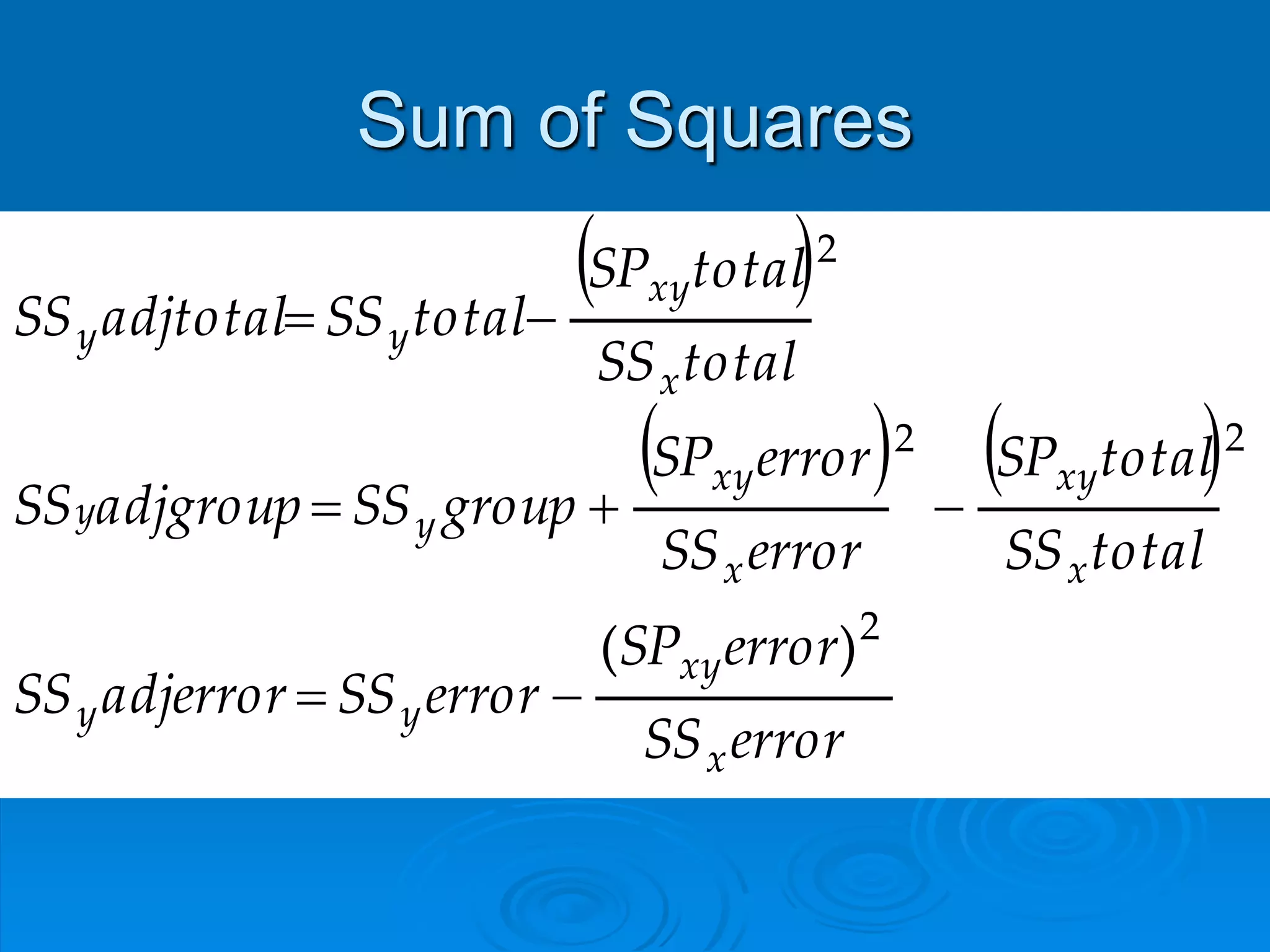
Adjusting the Sum of Squares
 Using the SS’s for the covariate and the
DV, and the SP’s, we can adjust the SS’s
for the DV
Sum of Squares
 
   
errorSS
errorSP
errorSSadjerrorSS
totalSS
totalSP
errorSS
errorSP
groupSSadjgroupSS
totalSS
totalSP
totalSSadjtotalSS
x
xy
yy
x
xy
x
xy
yy
x
xy
yy
2
22
2
)(



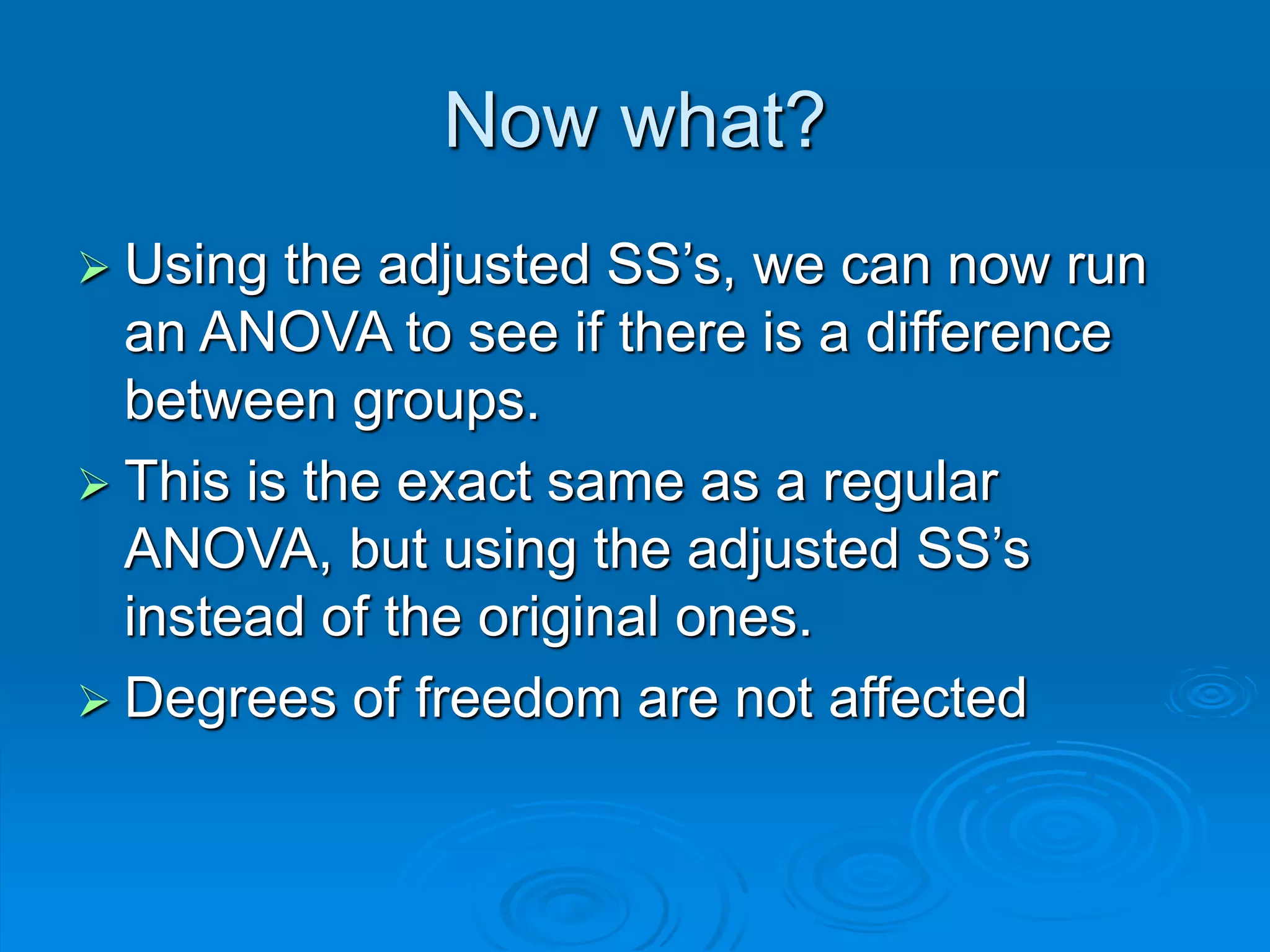
Now what?
 Using the adjusted SS’s, we can now run
an ANOVA to see if there is a difference
between groups.
 This is the exact same as a regular
ANOVA, but using the adjusted SS’s
instead of the original ones.
 Degrees of freedom are not affected
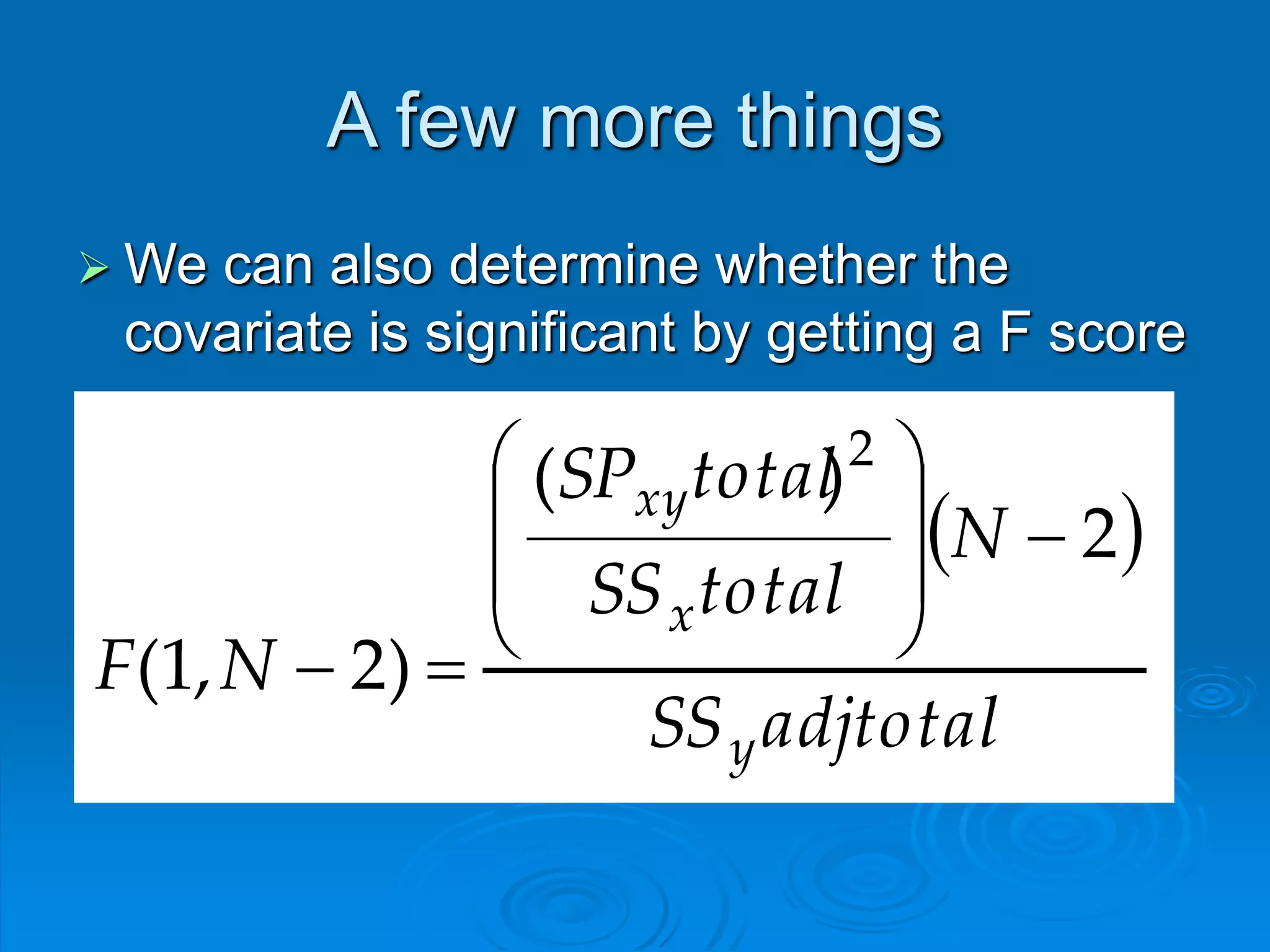
A few more things
 We can also determine whether the
covariate is significant by getting a F score
 
adjtotalSS
N
totalSS
totalSP
NF
y
x
xy
2
)(
)2,1(
2










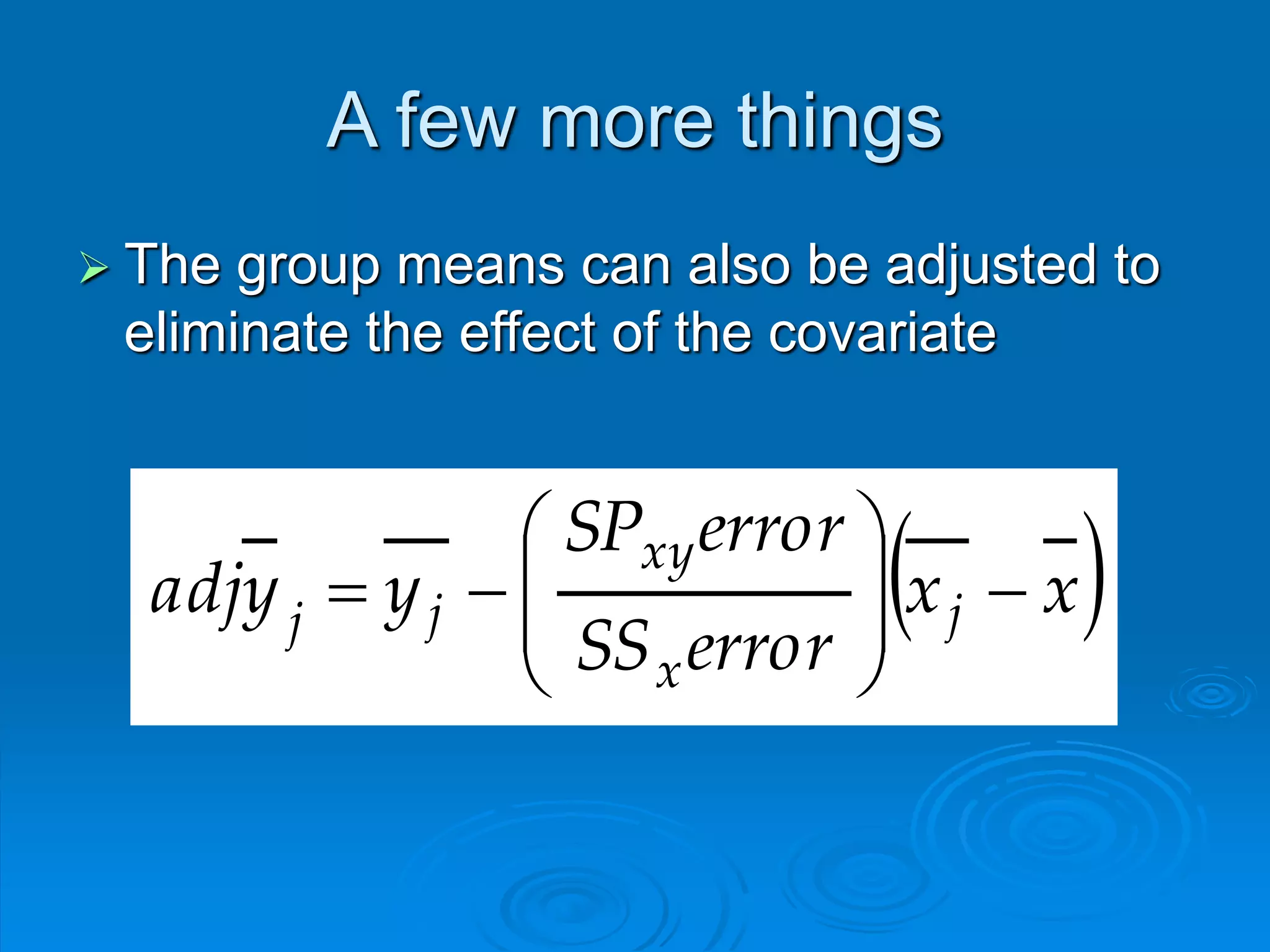
A few more things
 The group means can also be adjusted to
eliminate the effect of the covariate
 xx
errorSS
errorSP
yyadj j
x
xy
jj









Post-hocs for ANCOVA
 Post-hoc tests can be done using the
adjusted means for ANCOVA, including
LSD and Bonferroni
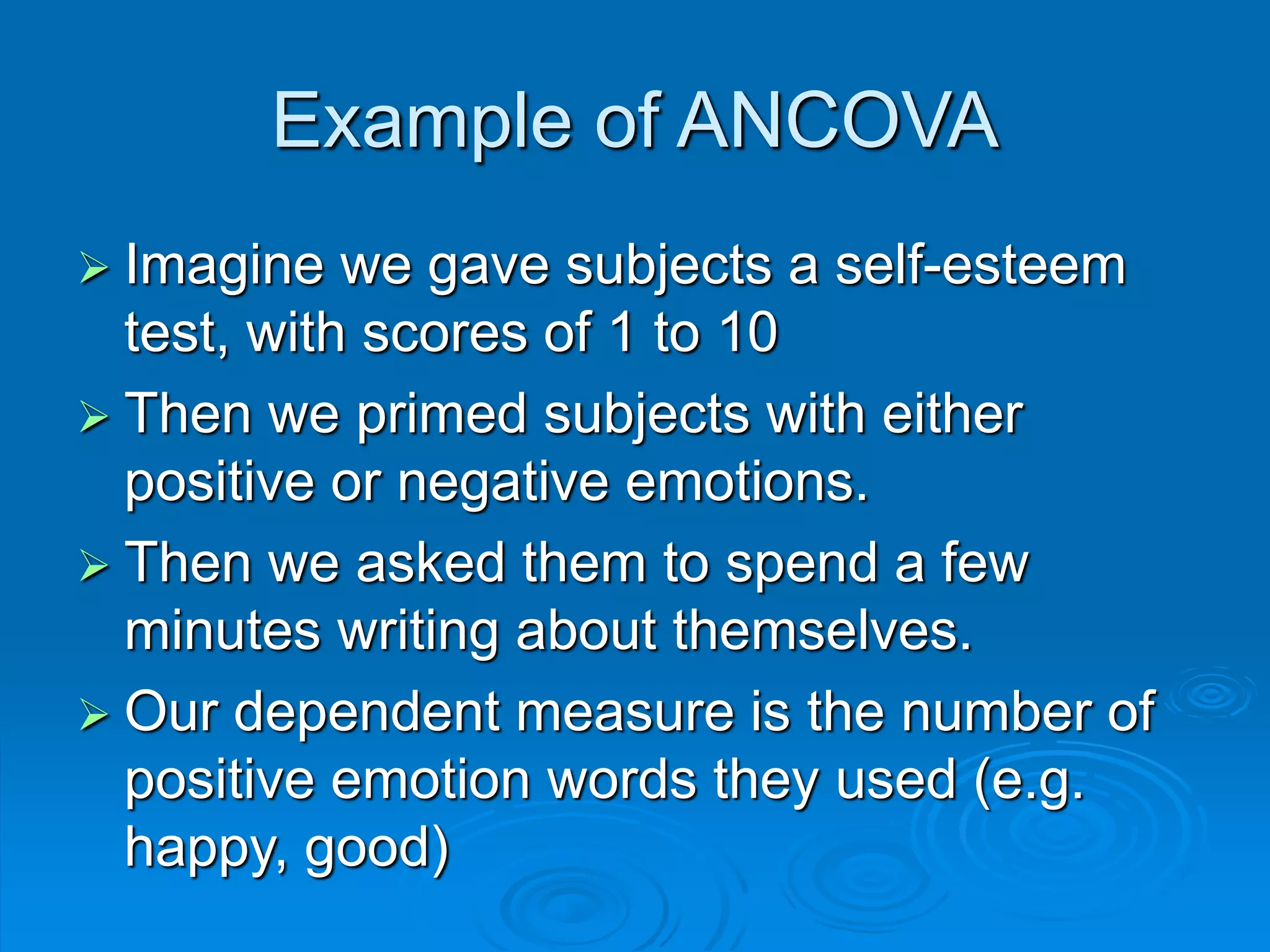
Example of ANCOVA
 Imagine we gave subjects a self-esteem
test, with scores of 1 to 10
 Then we primed subjects with either
positive or negative emotions.
 Then we asked them to spend a few
minutes writing about themselves.
 Our dependent measure is the number of
positive emotion words they used (e.g.
happy, good)
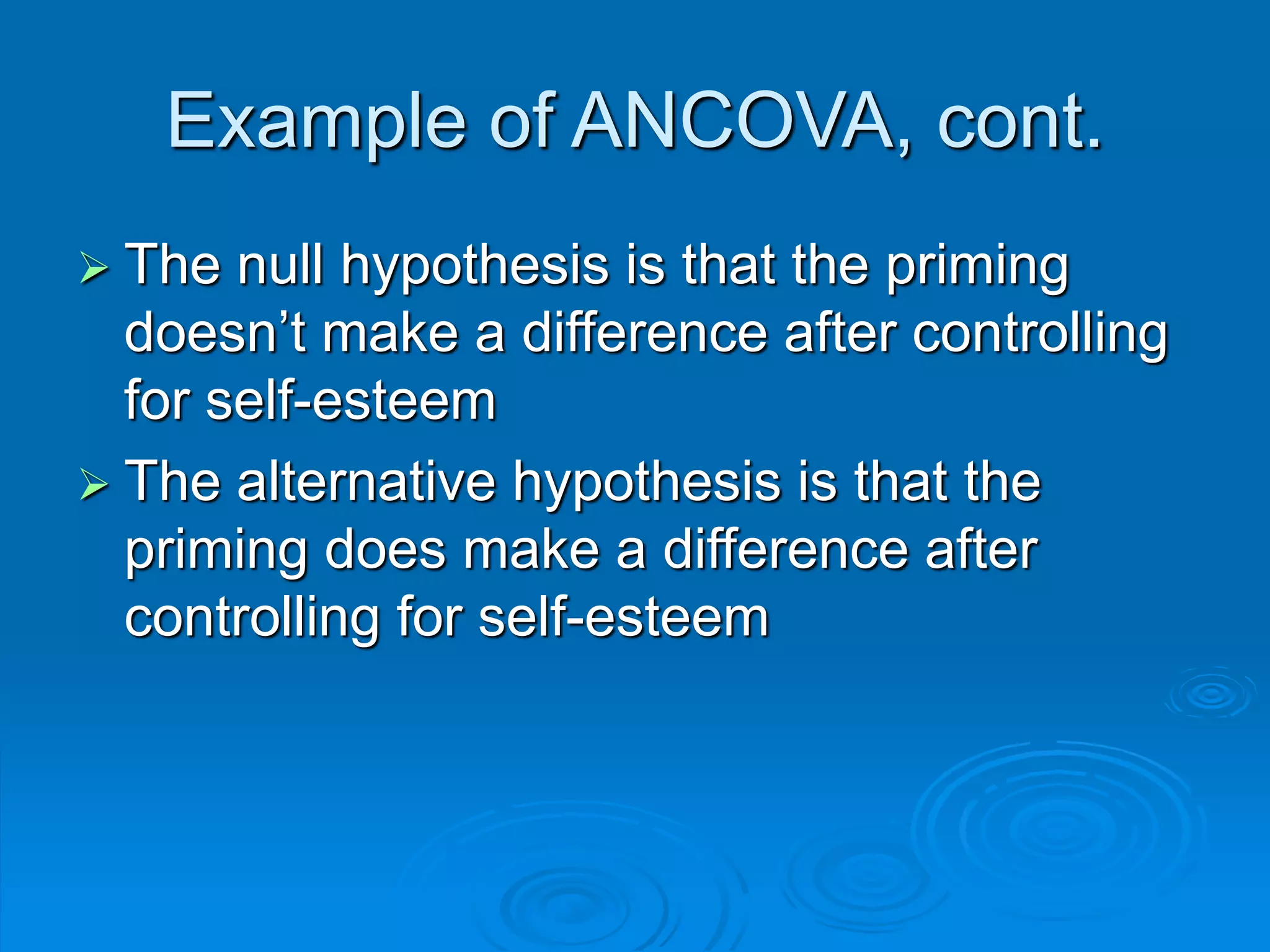
 The null hypothesis is that the priming
doesn’t make a difference after controlling
for self-esteem
 The alternative hypothesis is that the
priming does make a difference after
controlling for self-esteem
Example of ANCOVA, cont.
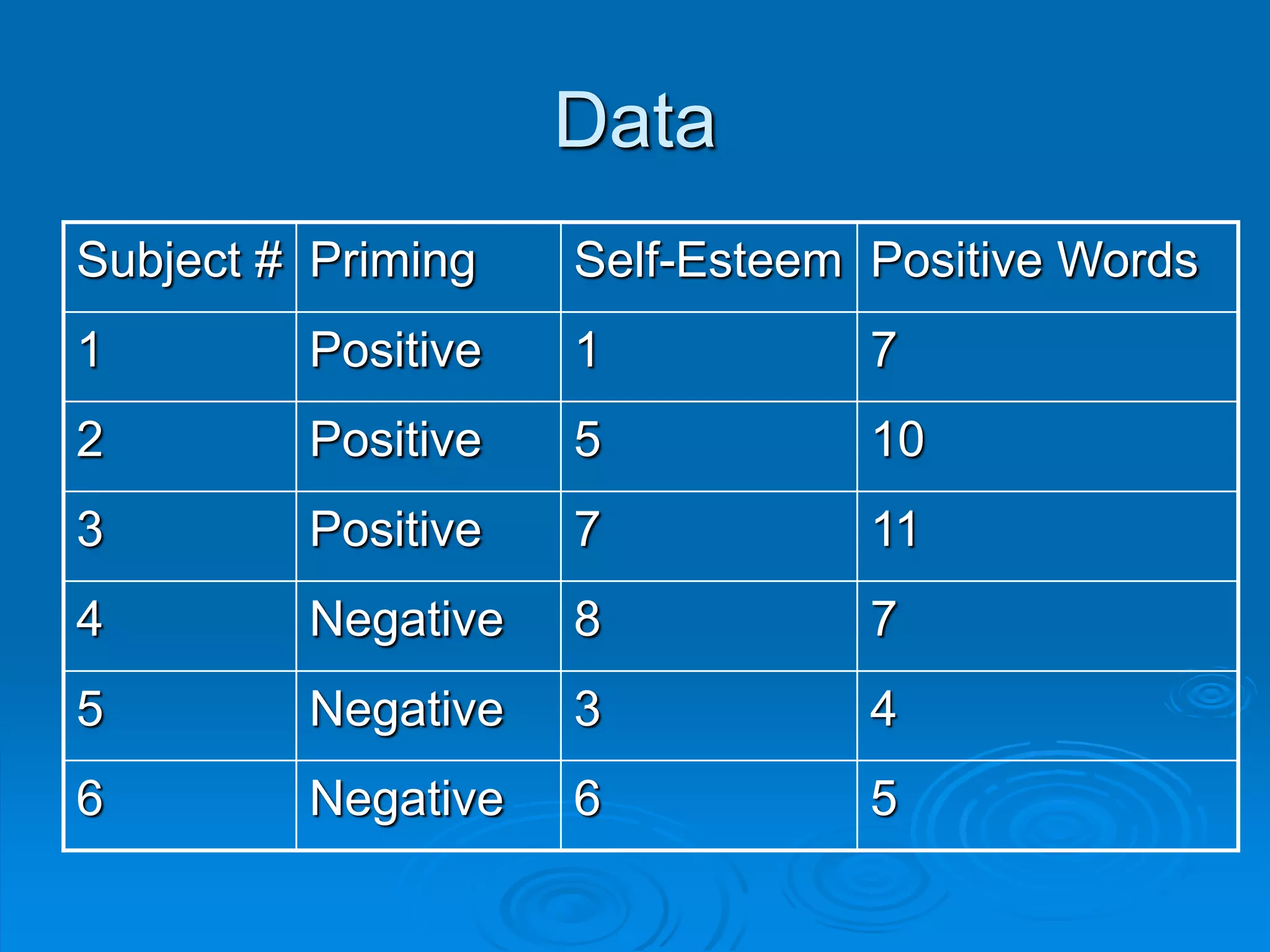
Data
Subject # Priming Self-Esteem Positive Words
1 Positive 1 7
2 Positive 5 10
3 Positive 7 11
4 Negative 8 7
5 Negative 3 4
6 Negative 6 5
ANCOVA in SPSS
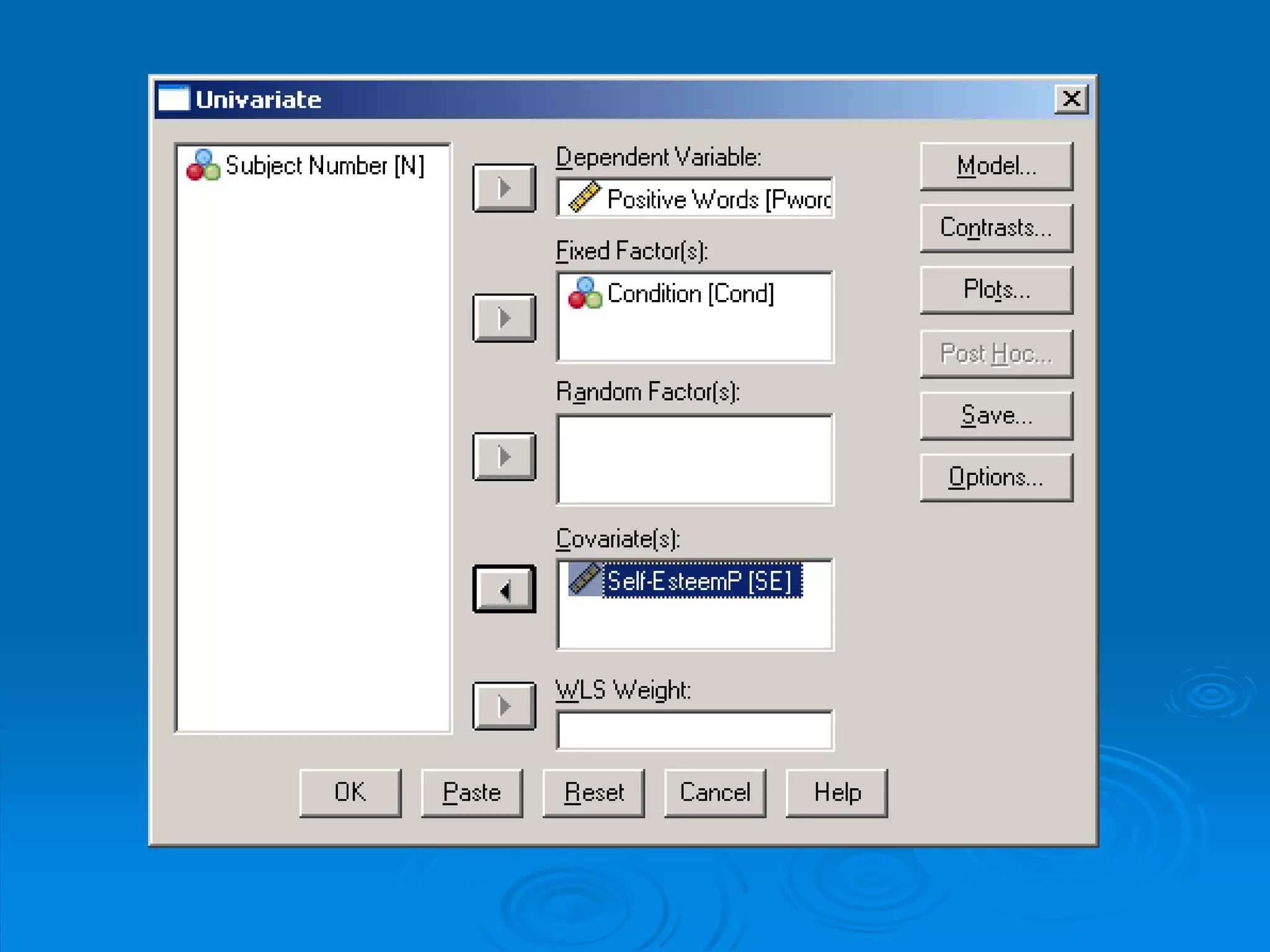
 To do ANCOVA in SPSS, all you need to
do is add your covariate to the “covariate”
box in the “univariate” menu
 Everything else is the exact same as it is
for ANOVA
Analysis of covariance

Analysis of covariance

  • 1.
    Analysis of Covariance DavidMarkham djmarkham@bsu.edu
  • 2.
    Analysis of Covariance Analysis of Covariance (ANCOVA) is a statistical test related to ANOVA  It tests whether there is a significant difference between groups after controlling for variance explained by a covariate  A covariate is a continuous variable that correlates with the dependent variable
  • 3.
    So, what doesall that mean?  This means that you can, in effect, “partial out” a continuous variable and run an ANOVA on the results  This is one way that you can run a statistical test with both categorical and continuous independent variables
  • 4.
    Hypotheses for ANCOVA H0 and H1 need to be stated slightly differently for an ANCOVA than a regular ANOVA  H0: the group means are equal after controlling for the covariate  H1: the group means are not equal after controlling for the covariate
  • 5.
    Assumptions for ANCOVA ANOVAassumptions:  Variance is normally distributed  Variance is equal between groups  All measurements are independent Also, for ANCOVA:  Relationship between DV and covariate is linear  The relationship between the DV and covariate is the same for all groups
  • 6.
    How does ANCOVAwork?  ANCOVA works by adjusting the total SS, group SS, and error SS of the independent variable to remove the influence of the covariate  However, the sums of squares must also be calculated for the covariate. For this reason, SSdv will be used for SS scores for the dependent variable, and SScv will be used for the covariate
  • 7.
  • 8.
    Sum of Products To control for the covariate, the sum of products (SP) for the DV and covariate must also be used  This is the sum of the products of the residuals for both the DV and the covariate  In the following slides, x is the covariate, and y is the DV. i is the individual subject, and j is the group.
  • 9.
    Total Sum ofProducts ))(( yyxxtotalSP ij j i ijxy    This is just the sum of the multiplied residuals for all data points.
  • 10.
    Group Sum ofProducts )()( yyxxngroupSP j j jjxy    This is the sum of the products of the group means minus the grand means times the group size.
  • 11.
    Error Sum ofProducts groupSPtotalSPerrorSP yyxxerrorSP xyxyxy jij j i jijxy    ))((  This is the sum of the products of the DV and residual minus the group means of the DV and residual  This just happens to be the same as the difference between the other two sum of products
  • 12.
    Adjusting the Sumof Squares  Using the SS’s for the covariate and the DV, and the SP’s, we can adjust the SS’s for the DV
  • 13.
    Sum of Squares      errorSS errorSP errorSSadjerrorSS totalSS totalSP errorSS errorSP groupSSadjgroupSS totalSS totalSP totalSSadjtotalSS x xy yy x xy x xy yy x xy yy 2 22 2 )(   
  • 14.
    Now what?  Usingthe adjusted SS’s, we can now run an ANOVA to see if there is a difference between groups.  This is the exact same as a regular ANOVA, but using the adjusted SS’s instead of the original ones.  Degrees of freedom are not affected
  • 15.
    A few morethings  We can also determine whether the covariate is significant by getting a F score   adjtotalSS N totalSS totalSP NF y x xy 2 )( )2,1( 2          
  • 16.
    A few morethings  The group means can also be adjusted to eliminate the effect of the covariate  xx errorSS errorSP yyadj j x xy jj         
  • 17.
    Post-hocs for ANCOVA Post-hoc tests can be done using the adjusted means for ANCOVA, including LSD and Bonferroni
  • 18.
    Example of ANCOVA Imagine we gave subjects a self-esteem test, with scores of 1 to 10  Then we primed subjects with either positive or negative emotions.  Then we asked them to spend a few minutes writing about themselves.  Our dependent measure is the number of positive emotion words they used (e.g. happy, good)
  • 19.
     The nullhypothesis is that the priming doesn’t make a difference after controlling for self-esteem  The alternative hypothesis is that the priming does make a difference after controlling for self-esteem Example of ANCOVA, cont.
  • 20.
    Data Subject # PrimingSelf-Esteem Positive Words 1 Positive 1 7 2 Positive 5 10 3 Positive 7 11 4 Negative 8 7 5 Negative 3 4 6 Negative 6 5
  • 21.
    ANCOVA in SPSS To do ANCOVA in SPSS, all you need to do is add your covariate to the “covariate” box in the “univariate” menu  Everything else is the exact same as it is for ANOVA