1
Motivation & Emotion
James Neill
Centre for Applied Psychology
University of Canberra
2017
The self and its strivings
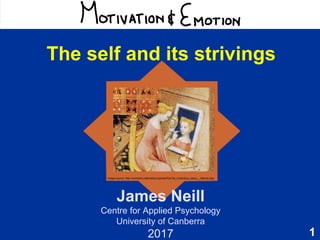
Image source: http://commons.wikimedia.org/wiki/File:De_mulieribus_claris_-_Marcia.png
2
The self &
its strivings
Reading:
Reeve (2015)
Ch 11
(pp. 303-334)
3
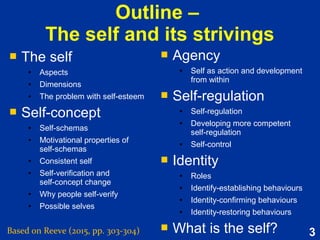
Outline –
The self and its strivings
Based on Reeve (2015, pp. 303-304)
 The self
● Aspects
● Dimensions
● The problem with self-esteem
 Self-concept
● Self-schemas
● Motivational properties of
self-schemas
● Consistent self
● Self-verification and
self-concept change
● Why people self-verify
● Possible selves
 The self
● Aspects
● Dimensions
● The problem with self-esteem
 Self-concept
● Self-schemas
● Motivational properties of
self-schemas
● Consistent self
● Self-verification and
self-concept change
● Why people self-verify
● Possible selves
 Agency
● Self as action and development
from within
 Self-regulation
● Self-regulation
● Developing more competent
self-regulation
● Self-control
 Identity
● Roles
● Identify-establishing behaviours
● Identity-confirming behaviours
● Identity-restoring behaviours
 What is the self?
 Agency
● Self as action and development
from within
 Self-regulation
● Self-regulation
● Developing more competent
self-regulation
● Self-control
 Identity
● Roles
● Identify-establishing behaviours
● Identity-confirming behaviours
● Identity-restoring behaviours
 What is the self?
4
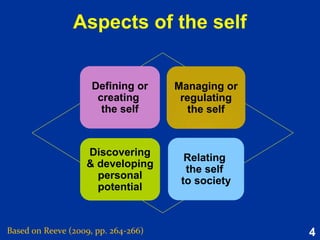
Aspects of the self
Based on Reeve (2009, pp. 264-266)
Defining or
creating
the self
Relating
the self
to society
Discovering
& developing
personal
potential
Managing or
regulating
the self
5
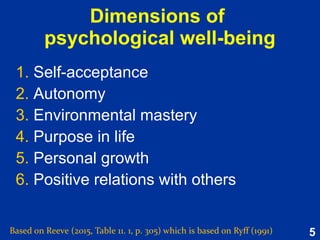
Dimensions of
psychological well-being
1. Self-acceptance
2. Autonomy
3. Environmental mastery
4. Purpose in life
5. Personal growth
6. Positive relations with others
1. Self-acceptance
2. Autonomy
3. Environmental mastery
4. Purpose in life
5. Personal growth
6. Positive relations with others
Based on Reeve (2015, Table 11. 1, p. 305) which is based on Ryff (1991)
6
Self-esteem
Based on Reeve (2015, pp. 306-307)
 Myth: Boosting self-esteem boosts motivation
and other desirable outcomes.
 Instead, self-esteem provides a “dashboard”
indicator of how one's life is going i.e., it is an
outcome of having one's needs fulfilled.
 Artificially inflating self-esteem is not the
answer to low self-esteem - and can even
make problems, such as narcissism, worse.
 See Baumeister for further critique.
 Myth: Boosting self-esteem boosts motivation
and other desirable outcomes.
 Instead, self-esteem provides a “dashboard”
indicator of how one's life is going i.e., it is an
outcome of having one's needs fulfilled.
 Artificially inflating self-esteem is not the
answer to low self-esteem - and can even
make problems, such as narcissism, worse.
 See Baumeister for further critique.
7
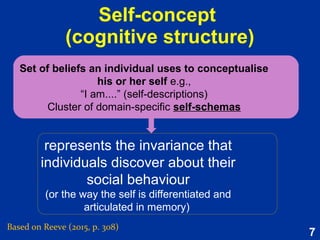
Self-concept
(cognitive structure)
Based on Reeve (2015, p. 308)
represents the invariance that
individuals discover about their
social behaviour
(or the way the self is differentiated and
articulated in memory)
Set of beliefs an individual uses to conceptualise
his or her self e.g.,
“I am....” (self-descriptions)
Cluster of domain-specific self-schemas
8
Benefits of well-developed self-schema
Based on Reeve (2009, pp. 268-270)
Process information about
the self with relative ease.
Confidently predict own
future behaviour in the
domain.
Quickly retrieve self-
related behavioural
evidence from the domain.
Resist counter-schematic
information about one's
self.
Benefits of
well-developed
self-schema
9
Motivational properties of
self-schemas
Based on Reeve (2015, pp. 310-311)
Self-schemas direct behaviour to confirm the self-view
and to prevent episodes that generate feedback that
might disconfirm that self-view.
Consistent
self
Self-schemas generate motivation to move the present
self toward a desired future self.
Possible
self
Processes underlying self-verification
and self-concept change
Based on Reeve (2009, Figure 10.1, p. 272)
11
Possible selves
Based on Reeve (2015, pp. 313-315)
An important piece of the puzzle
in understanding how the self develops
Mostly social in origin,
as the individual observes the selves modeled by others.
The possible self’s motivational role
is to link the present self with ways to become the possible (ideal) self.
Representations of attributes, characteristics, and
abilities that the self does not yet possess.
Portraying the self as a dynamic entity
with a past, present, and future.
12
Agency
Based on Reeve (2009, pp. 281-282)
Human beings possess
a core self, energised
by innate motivation
and directed by the
inherent developmental
processes of
differentiation,
internalisation, and
integration.
Not all self-structures
are equally authentic;
while some reflect the
core self, others reflect
and reproduce the
society.
Self as action and development from within,
(innate processes and motivations)
Self as action and development from within,
(innate processes and motivations)
13
Self-concordance
Based on Reeve (2015, Figure 11.3, p. 318) Self-Concordance Model
People pursue goals that are
congruent or “concordant” with their core self
Cyclical path model for the Self-concordance Model illustrates
developmental gains in well-being and self-concordance
Based on Reeve (2015, Figure 11.5, p. 320)
The self-concordance model illustrates the motivational and developmental
benefits of pursuing life goals that emanate out of the integrated or core self.
Diagrammatic illustration of self-
integrated and non-integrated action
Figure 10. 4Based on Reeve (2015, Figure 11.2, p. 318)
Cyclical phases of self-regulation
Based on Reeve (2015, Figure 11.5, p. 322)
Self-regulation involves the person’s
meta-cognitive monitoring of how his or her
goal-setting progress is going.
17
Developing more competent self-regulation:
Summary of the social learning process
to acquire self-regulation skill
Based on Reeve (2015, Figure 11.6, p. 323)
Acquiring a greater capacity for more effective self-regulation
increases the self’s capacity
to carry out the goal-setting process on one’s own.
Acquisition of
competent
self-regulation
skill
Able to self-regulate
one's goals, behaviours,
and standards in the
domain.
Lack of
self-
regulation
skill
Unable to regulate
one's goals,
implementation
intentions, and
coping strategies in
a new domain.
Social learning
process
1. Observe expert model
2. Imitation, social guidance,
feedback
3. Internalisation of standards
4. Self-regulatory process,
including self-monitoring,
self-evaluating
18
Self-control
 Achievement of long-term goals requires the
goal striver to exercise control (will power)
over impulsive desires to gratify distracting
shorter-term goals
 Self-control is the capacity to suppress,
restrain, or override an impulsive desire,
urge, or behaviour.
 Use of the capacity for self-control causes
depletion and it then needs replenishment.
 Self-control can be enhanced through
practice.
 Achievement of long-term goals requires the
goal striver to exercise control (will power)
over impulsive desires to gratify distracting
shorter-term goals
 Self-control is the capacity to suppress,
restrain, or override an impulsive desire,
urge, or behaviour.
 Use of the capacity for self-control causes
depletion and it then needs replenishment.
 Self-control can be enhanced through
practice.
Based on Reeve (2015, pp. 324-329)
19
Don't eat the marshmallow!
Joachim de Posada, 2009
TED Talk (6 mins)
http://www.ted.com/talks/joachim_de_posada_says_don_t_eat_the_marshmallow_yet
TED Talk (6 mins)
http://www.ted.com/talks/joachim_de_posada_says_don_t_eat_the_marshmallow_yet
20
Identity (social relationship)
Based on Reeve (2015, p. 329-331)
The identity directs the person to pursue some
behaviours (identity-confirming behaviours) and to avoid
other behaviours (identity-disconfirming behaviours).
Once people assume social roles (e.g., mother, bully),
their identities direct their behaviors in ways that express
the role-identity’s cultural value.
Identity is the means by which the self relates to society,
and it captures the essence of who the self is within a
cultural context.
21
Nature of emotion
(Ch 12)
Next lecture
22
References
 Reeve, J. (2015). Understanding motivation
and emotion (6th ed.). Hoboken, NJ: Wiley.
 Ryff, C. D. (1991). A tale of shifting
horizons. Psychology and Aging, 6, 286-
295.
 Reeve, J. (2015). Understanding motivation
and emotion (6th ed.). Hoboken, NJ: Wiley.
 Ryff, C. D. (1991). A tale of shifting
horizons. Psychology and Aging, 6, 286-
295.
Note: Image credits are in the slide notes
23
Open Office Impress
 This presentation was made using
Open Office Impress.
 Free and open source software.
 http://www.openoffice.org/product/impress.html
 This presentation was made using
Open Office Impress.
 Free and open source software.
 http://www.openoffice.org/product/impress.html

Self

  • 1.
    1 Motivation & Emotion JamesNeill Centre for Applied Psychology University of Canberra 2017 The self and its strivings Image source: http://commons.wikimedia.org/wiki/File:De_mulieribus_claris_-_Marcia.png
  • 2.
    2 The self & itsstrivings Reading: Reeve (2015) Ch 11 (pp. 303-334)
  • 3.
    3 Outline – The selfand its strivings Based on Reeve (2015, pp. 303-304)  The self ● Aspects ● Dimensions ● The problem with self-esteem  Self-concept ● Self-schemas ● Motivational properties of self-schemas ● Consistent self ● Self-verification and self-concept change ● Why people self-verify ● Possible selves  The self ● Aspects ● Dimensions ● The problem with self-esteem  Self-concept ● Self-schemas ● Motivational properties of self-schemas ● Consistent self ● Self-verification and self-concept change ● Why people self-verify ● Possible selves  Agency ● Self as action and development from within  Self-regulation ● Self-regulation ● Developing more competent self-regulation ● Self-control  Identity ● Roles ● Identify-establishing behaviours ● Identity-confirming behaviours ● Identity-restoring behaviours  What is the self?  Agency ● Self as action and development from within  Self-regulation ● Self-regulation ● Developing more competent self-regulation ● Self-control  Identity ● Roles ● Identify-establishing behaviours ● Identity-confirming behaviours ● Identity-restoring behaviours  What is the self?
  • 4.
    4 Aspects of theself Based on Reeve (2009, pp. 264-266) Defining or creating the self Relating the self to society Discovering & developing personal potential Managing or regulating the self
  • 5.
    5 Dimensions of psychological well-being 1.Self-acceptance 2. Autonomy 3. Environmental mastery 4. Purpose in life 5. Personal growth 6. Positive relations with others 1. Self-acceptance 2. Autonomy 3. Environmental mastery 4. Purpose in life 5. Personal growth 6. Positive relations with others Based on Reeve (2015, Table 11. 1, p. 305) which is based on Ryff (1991)
  • 6.
    6 Self-esteem Based on Reeve(2015, pp. 306-307)  Myth: Boosting self-esteem boosts motivation and other desirable outcomes.  Instead, self-esteem provides a “dashboard” indicator of how one's life is going i.e., it is an outcome of having one's needs fulfilled.  Artificially inflating self-esteem is not the answer to low self-esteem - and can even make problems, such as narcissism, worse.  See Baumeister for further critique.  Myth: Boosting self-esteem boosts motivation and other desirable outcomes.  Instead, self-esteem provides a “dashboard” indicator of how one's life is going i.e., it is an outcome of having one's needs fulfilled.  Artificially inflating self-esteem is not the answer to low self-esteem - and can even make problems, such as narcissism, worse.  See Baumeister for further critique.
  • 7.
    7 Self-concept (cognitive structure) Based onReeve (2015, p. 308) represents the invariance that individuals discover about their social behaviour (or the way the self is differentiated and articulated in memory) Set of beliefs an individual uses to conceptualise his or her self e.g., “I am....” (self-descriptions) Cluster of domain-specific self-schemas
  • 8.
    8 Benefits of well-developedself-schema Based on Reeve (2009, pp. 268-270) Process information about the self with relative ease. Confidently predict own future behaviour in the domain. Quickly retrieve self- related behavioural evidence from the domain. Resist counter-schematic information about one's self. Benefits of well-developed self-schema
  • 9.
    9 Motivational properties of self-schemas Basedon Reeve (2015, pp. 310-311) Self-schemas direct behaviour to confirm the self-view and to prevent episodes that generate feedback that might disconfirm that self-view. Consistent self Self-schemas generate motivation to move the present self toward a desired future self. Possible self
  • 10.
    Processes underlying self-verification andself-concept change Based on Reeve (2009, Figure 10.1, p. 272)
  • 11.
    11 Possible selves Based onReeve (2015, pp. 313-315) An important piece of the puzzle in understanding how the self develops Mostly social in origin, as the individual observes the selves modeled by others. The possible self’s motivational role is to link the present self with ways to become the possible (ideal) self. Representations of attributes, characteristics, and abilities that the self does not yet possess. Portraying the self as a dynamic entity with a past, present, and future.
  • 12.
    12 Agency Based on Reeve(2009, pp. 281-282) Human beings possess a core self, energised by innate motivation and directed by the inherent developmental processes of differentiation, internalisation, and integration. Not all self-structures are equally authentic; while some reflect the core self, others reflect and reproduce the society. Self as action and development from within, (innate processes and motivations) Self as action and development from within, (innate processes and motivations)
  • 13.
    13 Self-concordance Based on Reeve(2015, Figure 11.3, p. 318) Self-Concordance Model People pursue goals that are congruent or “concordant” with their core self
  • 14.
    Cyclical path modelfor the Self-concordance Model illustrates developmental gains in well-being and self-concordance Based on Reeve (2015, Figure 11.5, p. 320) The self-concordance model illustrates the motivational and developmental benefits of pursuing life goals that emanate out of the integrated or core self.
  • 15.
    Diagrammatic illustration ofself- integrated and non-integrated action Figure 10. 4Based on Reeve (2015, Figure 11.2, p. 318)
  • 16.
    Cyclical phases ofself-regulation Based on Reeve (2015, Figure 11.5, p. 322) Self-regulation involves the person’s meta-cognitive monitoring of how his or her goal-setting progress is going.
  • 17.
    17 Developing more competentself-regulation: Summary of the social learning process to acquire self-regulation skill Based on Reeve (2015, Figure 11.6, p. 323) Acquiring a greater capacity for more effective self-regulation increases the self’s capacity to carry out the goal-setting process on one’s own. Acquisition of competent self-regulation skill Able to self-regulate one's goals, behaviours, and standards in the domain. Lack of self- regulation skill Unable to regulate one's goals, implementation intentions, and coping strategies in a new domain. Social learning process 1. Observe expert model 2. Imitation, social guidance, feedback 3. Internalisation of standards 4. Self-regulatory process, including self-monitoring, self-evaluating
  • 18.
    18 Self-control  Achievement oflong-term goals requires the goal striver to exercise control (will power) over impulsive desires to gratify distracting shorter-term goals  Self-control is the capacity to suppress, restrain, or override an impulsive desire, urge, or behaviour.  Use of the capacity for self-control causes depletion and it then needs replenishment.  Self-control can be enhanced through practice.  Achievement of long-term goals requires the goal striver to exercise control (will power) over impulsive desires to gratify distracting shorter-term goals  Self-control is the capacity to suppress, restrain, or override an impulsive desire, urge, or behaviour.  Use of the capacity for self-control causes depletion and it then needs replenishment.  Self-control can be enhanced through practice. Based on Reeve (2015, pp. 324-329)
  • 19.
    19 Don't eat themarshmallow! Joachim de Posada, 2009 TED Talk (6 mins) http://www.ted.com/talks/joachim_de_posada_says_don_t_eat_the_marshmallow_yet TED Talk (6 mins) http://www.ted.com/talks/joachim_de_posada_says_don_t_eat_the_marshmallow_yet
  • 20.
    20 Identity (social relationship) Basedon Reeve (2015, p. 329-331) The identity directs the person to pursue some behaviours (identity-confirming behaviours) and to avoid other behaviours (identity-disconfirming behaviours). Once people assume social roles (e.g., mother, bully), their identities direct their behaviors in ways that express the role-identity’s cultural value. Identity is the means by which the self relates to society, and it captures the essence of who the self is within a cultural context.
  • 21.
    21 Nature of emotion (Ch12) Next lecture
  • 22.
    22 References  Reeve, J.(2015). Understanding motivation and emotion (6th ed.). Hoboken, NJ: Wiley.  Ryff, C. D. (1991). A tale of shifting horizons. Psychology and Aging, 6, 286- 295.  Reeve, J. (2015). Understanding motivation and emotion (6th ed.). Hoboken, NJ: Wiley.  Ryff, C. D. (1991). A tale of shifting horizons. Psychology and Aging, 6, 286- 295. Note: Image credits are in the slide notes
  • 23.
    23 Open Office Impress This presentation was made using Open Office Impress.  Free and open source software.  http://www.openoffice.org/product/impress.html  This presentation was made using Open Office Impress.  Free and open source software.  http://www.openoffice.org/product/impress.html

Editor's Notes

  • #2 Image source: http://commons.wikimedia.org/wiki/File:De_mulieribus_claris_-_Marcia.png Image by: Anonymous Image license: Public domain Acknowledgements: This lecture is based in part on instructor resource slides from Wiley. Wednesday 13 September, 2017, 13:30-15:30, 12B2 7124-6665 Motivation and Emotion / G Centre for Applied Psychology Faculty of Health University of Canberra Bruce, ACT 2601, Australia ph: +61 2 6201 2536 [email_address] http://en.wikiversity.org/wiki/Motivation_and_emotion
  • #3 Image source: http://commons.wikimedia.org/wiki/File:De_mulieribus_claris_-_Marcia.png Image by: Anonymous Image license: Public domain
  • #14 Convert to text
  • #18 It takes 10,000 hours to become an expert (Gladwell, 2005)
  • #22 Image source: http://commons.wikimedia.org/wiki/File:Information_icon4.svg License: Public domain Image source: http://commons.wikimedia.org/wiki/File:Autoroute_icone.svg License: CC-BY-A 2.5 Author: http://commons.wikimedia.org/wiki/User:Doodledoo