MECKEL’S DIVERTICULUM
AN OVERVIEW
Dr.B.Selvaraj MS;Mch;FICS;
Professor of Surgery
Melaka Manipal Medical College
Melaka 75150 Malaysia
Learning Outcomes
• To understand the embryological origin of Meckel’s
diverticulum
•To be familiar with its clinical presentation and
methods of investigation
•To be aware of management options
PLAN
• Introduction
• Epidemiology & Etiology
• History & Physical
• Workup
• Differential Diagnosis
• Treatment
Introduction
• Meckel’s diverticulum is a true diverticulum arising
from the antimesenteric border of the distal ileum
• It is the remnant of the vestigial vitello-intestinal
duct or omphalo-mesenteric duct or yolk stalk
• The ‘rule of 2s’ is often used for Meckel’s
diverticulum: within 2 feet of the ileocaecal valve, 2
inches in length, occurring in about 2% of the
population, two times more symptomatic in males,
symptomatic by 2 years of age and potentially
containing 2 heterotopic tissues, gastric and
pancreatic.
Epidemiology & Etiology
• The first known description of Meckel’s
diverticulum was made in 1598 by Hildanus.
• In 1809, the anatomist and physician Johann
Friedrich Meckel identified the origin of the
diverticulum as the vitellointestinal duct.
• Heterotopic pancreatic tissue in the diverticulum
was identified in 1861 by Zenker and gastric
mucosa in 1904 by Salzer.
• Meckel’s diverticulum is the most common vitelline
duct abnormality and the most common congenital
anomaly of the gastrointestinal tract.
Epidemiology & Etiology
• The fetal midgut is attached to the yolk sac via the
vitellointestinal duct, also known as the
omphalomesenteric duct or yolk stalk.
• This duct normally obliterates between 5 and 8
weeks’ gestation. Meckel’s diverticulum results from
failure of the proximal duct to obliterate.
History & Physical
• Meckel’s diverticulum has been called the ‘great
imitator’ because of its varied manifestations.
• The common presenting problems of a Meckel’s
diverticulum are bleeding, obstruction, pain
(inflammation) and umbilical discharge
• Bleeding accounts for > 50% of all instances of
lower gastrointestinal bleeding in children, usually
occurring in infants and toddlers.
• The bleeding is due to ulcer formation from the acid
secreted from the ectopic gastric mucosa and can be
severe.
History & Physical
• Meckel’s diverticulum can cause intestinal
obstruction by one of the several mechanisms:
-Meckel’s band
-Intussusception
-Volvulus
-Internal herniation
-Prolapse through a patent vitellointestinal duct
• Pain(Inflammation): Mimic like Acute Appendicitis
• Umbilical discharge: When complete patency of
V.I. duct
History & Physical
History & Physical
Timing of various
presentations
WORKUP
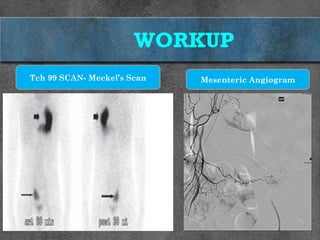
• Technetium-99m pertechnetate scintigraphy
(Meckel’s scan) is the investigation of choice.
• It is used to detect heterotopic gastric mucosa.
Pentagastrin, histamine blockers and glucagon may
enhance the accuracy of diagnosis.
• Mesenteric Angiography in patients with severe
active bleeding
WORKUP
Tch 99 SCAN- Meckel’s Scan Mesenteric Angiogram
Differential Diagnosis
• Malrotation
• Acute appendicitis
• Gastroenteritis
• Peptic ulcer disease
• Intestinal duplication
• Cow’s milk protein intolerance/allergy
TREATMENT
• In incidentally discovered diverticulum, no need for
surgical excision. However, if there is thickening of
diverticulum suggestive of heterotopic mucosa
elective resection can be done
• The bleeding child should be placed nil by mouth
and appropriately resuscitated.
• In symptomatic patients, the diverticulum is
removed using a laparoscopic, laparoscopic-assisted
or open technique.
TREATMENT
• In incidentally discovered diverticulum, no need for
surgical excision. However, if there is thickening of
diverticulum suggestive of heterotopic mucosa
elective resection can be done
• The bleeding child should be placed nil by mouth
and appropriately resuscitated.
• In symptomatic patients, the diverticulum is
removed using a laparoscopic, laparoscopic-assisted
or open technique.
TREATMENT
• The technique comprises either a simple resection of
the diverticulum-wedge resection- and transverse
closure across the base or resection of a short
segment of ileum, containing the diverticulum,
followed by end-to-end ileal anastomosis.
• The latter technique is recommended in bleeding
patients because it deals with any ulcer which may
be present in the adjoining 5 cm of distal ileum
• The feeding diverticular artery on the surface of the
ileum should be clearly identified and ligated.
TREATMENT
TREATMENT
TREATMENT
Meckel's Diverticulum - Pediatric Surgery

Meckel's Diverticulum - Pediatric Surgery

  • 1.
    MECKEL’S DIVERTICULUM AN OVERVIEW Dr.B.SelvarajMS;Mch;FICS; Professor of Surgery Melaka Manipal Medical College Melaka 75150 Malaysia
  • 2.
    Learning Outcomes • Tounderstand the embryological origin of Meckel’s diverticulum •To be familiar with its clinical presentation and methods of investigation •To be aware of management options
  • 3.
    PLAN • Introduction • Epidemiology& Etiology • History & Physical • Workup • Differential Diagnosis • Treatment
  • 4.
    Introduction • Meckel’s diverticulumis a true diverticulum arising from the antimesenteric border of the distal ileum • It is the remnant of the vestigial vitello-intestinal duct or omphalo-mesenteric duct or yolk stalk • The ‘rule of 2s’ is often used for Meckel’s diverticulum: within 2 feet of the ileocaecal valve, 2 inches in length, occurring in about 2% of the population, two times more symptomatic in males, symptomatic by 2 years of age and potentially containing 2 heterotopic tissues, gastric and pancreatic.
  • 5.
    Epidemiology & Etiology •The first known description of Meckel’s diverticulum was made in 1598 by Hildanus. • In 1809, the anatomist and physician Johann Friedrich Meckel identified the origin of the diverticulum as the vitellointestinal duct. • Heterotopic pancreatic tissue in the diverticulum was identified in 1861 by Zenker and gastric mucosa in 1904 by Salzer. • Meckel’s diverticulum is the most common vitelline duct abnormality and the most common congenital anomaly of the gastrointestinal tract.
  • 6.
    Epidemiology & Etiology •The fetal midgut is attached to the yolk sac via the vitellointestinal duct, also known as the omphalomesenteric duct or yolk stalk. • This duct normally obliterates between 5 and 8 weeks’ gestation. Meckel’s diverticulum results from failure of the proximal duct to obliterate.
  • 7.
    History & Physical •Meckel’s diverticulum has been called the ‘great imitator’ because of its varied manifestations. • The common presenting problems of a Meckel’s diverticulum are bleeding, obstruction, pain (inflammation) and umbilical discharge • Bleeding accounts for > 50% of all instances of lower gastrointestinal bleeding in children, usually occurring in infants and toddlers. • The bleeding is due to ulcer formation from the acid secreted from the ectopic gastric mucosa and can be severe.
  • 8.
    History & Physical •Meckel’s diverticulum can cause intestinal obstruction by one of the several mechanisms: -Meckel’s band -Intussusception -Volvulus -Internal herniation -Prolapse through a patent vitellointestinal duct • Pain(Inflammation): Mimic like Acute Appendicitis • Umbilical discharge: When complete patency of V.I. duct
  • 9.
  • 10.
  • 11.
  • 12.
    WORKUP • Technetium-99m pertechnetatescintigraphy (Meckel’s scan) is the investigation of choice. • It is used to detect heterotopic gastric mucosa. Pentagastrin, histamine blockers and glucagon may enhance the accuracy of diagnosis. • Mesenteric Angiography in patients with severe active bleeding
  • 13.
    WORKUP Tch 99 SCAN-Meckel’s Scan Mesenteric Angiogram
  • 14.
    Differential Diagnosis • Malrotation •Acute appendicitis • Gastroenteritis • Peptic ulcer disease • Intestinal duplication • Cow’s milk protein intolerance/allergy
  • 15.
    TREATMENT • In incidentallydiscovered diverticulum, no need for surgical excision. However, if there is thickening of diverticulum suggestive of heterotopic mucosa elective resection can be done • The bleeding child should be placed nil by mouth and appropriately resuscitated. • In symptomatic patients, the diverticulum is removed using a laparoscopic, laparoscopic-assisted or open technique.
  • 16.
    TREATMENT • In incidentallydiscovered diverticulum, no need for surgical excision. However, if there is thickening of diverticulum suggestive of heterotopic mucosa elective resection can be done • The bleeding child should be placed nil by mouth and appropriately resuscitated. • In symptomatic patients, the diverticulum is removed using a laparoscopic, laparoscopic-assisted or open technique.
  • 17.
    TREATMENT • The techniquecomprises either a simple resection of the diverticulum-wedge resection- and transverse closure across the base or resection of a short segment of ileum, containing the diverticulum, followed by end-to-end ileal anastomosis. • The latter technique is recommended in bleeding patients because it deals with any ulcer which may be present in the adjoining 5 cm of distal ileum • The feeding diverticular artery on the surface of the ileum should be clearly identified and ligated.
  • 18.
  • 19.
  • 20.