Unit 3 Notes: 
The Small Intestine
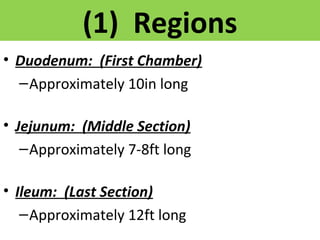
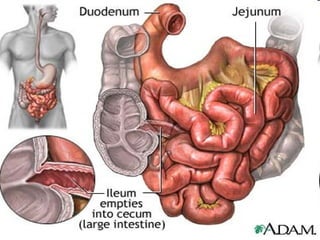
(1) Regions 
• Duodenum: (First Chamber) 
–Approximately 10in long 
• Jejunum: (Middle Section) 
–Approximately 7-8ft long 
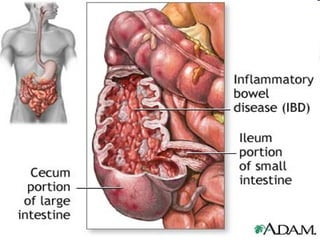
• Ileum: (Last Section) 
–Approximately 12ft long
(2) Inside the Duodenum 
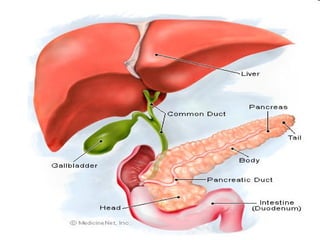
• Secretes Bile, Pancreatic Juice & Bicarbonate: 
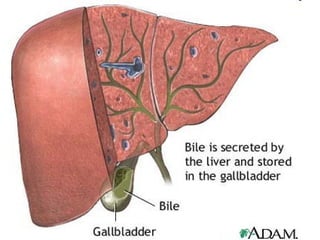
–Bile = Yellow-green solution produced by 
the liver, stored in the gallbladder. 
–Pancreatic Juice = Solution produced by the 
pancreas, stored in the pancreas. 
–Bicarbonate = pH balancing compound 
found in the blood. 
• Metabolize all remaining proteins and lipids.
(3) About Bile… 
• Produced by liver, Stored by Gallbladder. 
• Contains: 
–Bile Salts 
–Waste Pigments (bilirubin) 
–Cholesterol & Phospholipids 
• Function: Emulsify lipids so that they are 
dispersed throughout water, and can be easily 
absorbed.
(4) About Pancreatic Juice… 
• Produced by pancreas. 
• Contains: 
– Carboxypeptidase (Protein Enzyme) 
– Chymotrypsin (Protein Enzyme) 
– Amylase (Carbohydrate Enzyme) 
– Lipases (Lipid Enzymes) 
– Nucleases (Nucleic Acid Enzymes) 
• Function: Metabolize all remaining biomolecules.
(5) Releasing Bile & Pancreatic Juice 
• The presence of Lipids & Proteins  
Release of CCK (cholecystokinin) into 
bloodstream. 
• CCK stimulates the release of bile + pancreatic 
juice out Sphincter of Oddi.
(6) About Bicarbonate… 
• Used to maintain pH balance within cells 
(and water systems). 
–Neutralizes acidity of chyme coming 
from stomach 
• Secreted from Brunner’s Glands along 
Duodenum Walls.
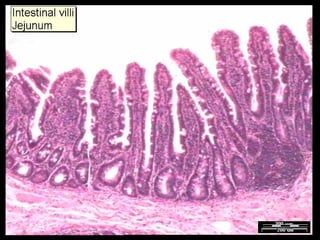
(7) In The Jejunum & Ileum 
• Smooth Muscle with millions of microvilli: 
– Microvilli Absorb Nutrients. 
– Nutrients directly deposited in blood stream. 
– Folds in between are called “Crypts of Lieberkuhn”. 
• Crypts of Lieberkuhn: 
– Secrete Lysozymes to eliminate any foreign bacterial 
cells. 
– Secrete Muccin to lubricate and dissolve remaining food 
stuff.
Anatomy Unit 3 Notes:  The Small Intestine

Anatomy Unit 3 Notes: The Small Intestine

  • 1.
    Unit 3 Notes: The Small Intestine
  • 3.
    (1) Regions •Duodenum: (First Chamber) –Approximately 10in long • Jejunum: (Middle Section) –Approximately 7-8ft long • Ileum: (Last Section) –Approximately 12ft long
  • 5.
    (2) Inside theDuodenum • Secretes Bile, Pancreatic Juice & Bicarbonate: –Bile = Yellow-green solution produced by the liver, stored in the gallbladder. –Pancreatic Juice = Solution produced by the pancreas, stored in the pancreas. –Bicarbonate = pH balancing compound found in the blood. • Metabolize all remaining proteins and lipids.
  • 6.
    (3) About Bile… • Produced by liver, Stored by Gallbladder. • Contains: –Bile Salts –Waste Pigments (bilirubin) –Cholesterol & Phospholipids • Function: Emulsify lipids so that they are dispersed throughout water, and can be easily absorbed.
  • 8.
    (4) About PancreaticJuice… • Produced by pancreas. • Contains: – Carboxypeptidase (Protein Enzyme) – Chymotrypsin (Protein Enzyme) – Amylase (Carbohydrate Enzyme) – Lipases (Lipid Enzymes) – Nucleases (Nucleic Acid Enzymes) • Function: Metabolize all remaining biomolecules.
  • 9.
    (5) Releasing Bile& Pancreatic Juice • The presence of Lipids & Proteins  Release of CCK (cholecystokinin) into bloodstream. • CCK stimulates the release of bile + pancreatic juice out Sphincter of Oddi.
  • 11.
    (6) About Bicarbonate… • Used to maintain pH balance within cells (and water systems). –Neutralizes acidity of chyme coming from stomach • Secreted from Brunner’s Glands along Duodenum Walls.
  • 12.
    (7) In TheJejunum & Ileum • Smooth Muscle with millions of microvilli: – Microvilli Absorb Nutrients. – Nutrients directly deposited in blood stream. – Folds in between are called “Crypts of Lieberkuhn”. • Crypts of Lieberkuhn: – Secrete Lysozymes to eliminate any foreign bacterial cells. – Secrete Muccin to lubricate and dissolve remaining food stuff.