Created by: Kristen Benish,
Anastacia Arabie, Gloria Lopez
And Victoria Herbin
Dr. Glothfelty
A&P 1 AM Class
Large Intestine

                      The shape and place:
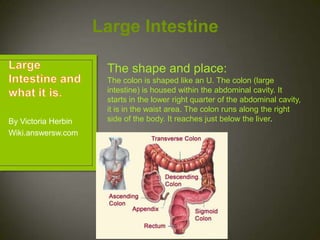
                      The colon is shaped like an U. The colon (large
                      intestine) is housed within the abdominal cavity. It
                      starts in the lower right quarter of the abdominal cavity,
                      it is in the waist area. The colon runs along the right
By Victoria Herbin    side of the body. It reaches just below the liver.
Wiki.answersw.com
The Part of the colon

   The function and purpose:
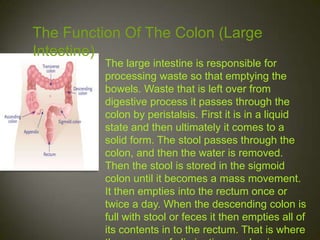
   The colon is also called the large
   intestine is a 6ft muscular tube.
   This tube is connected to the
   small intestine. There are four
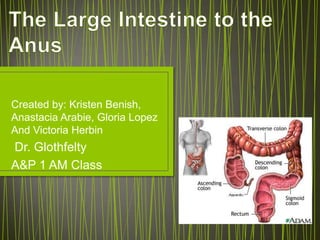
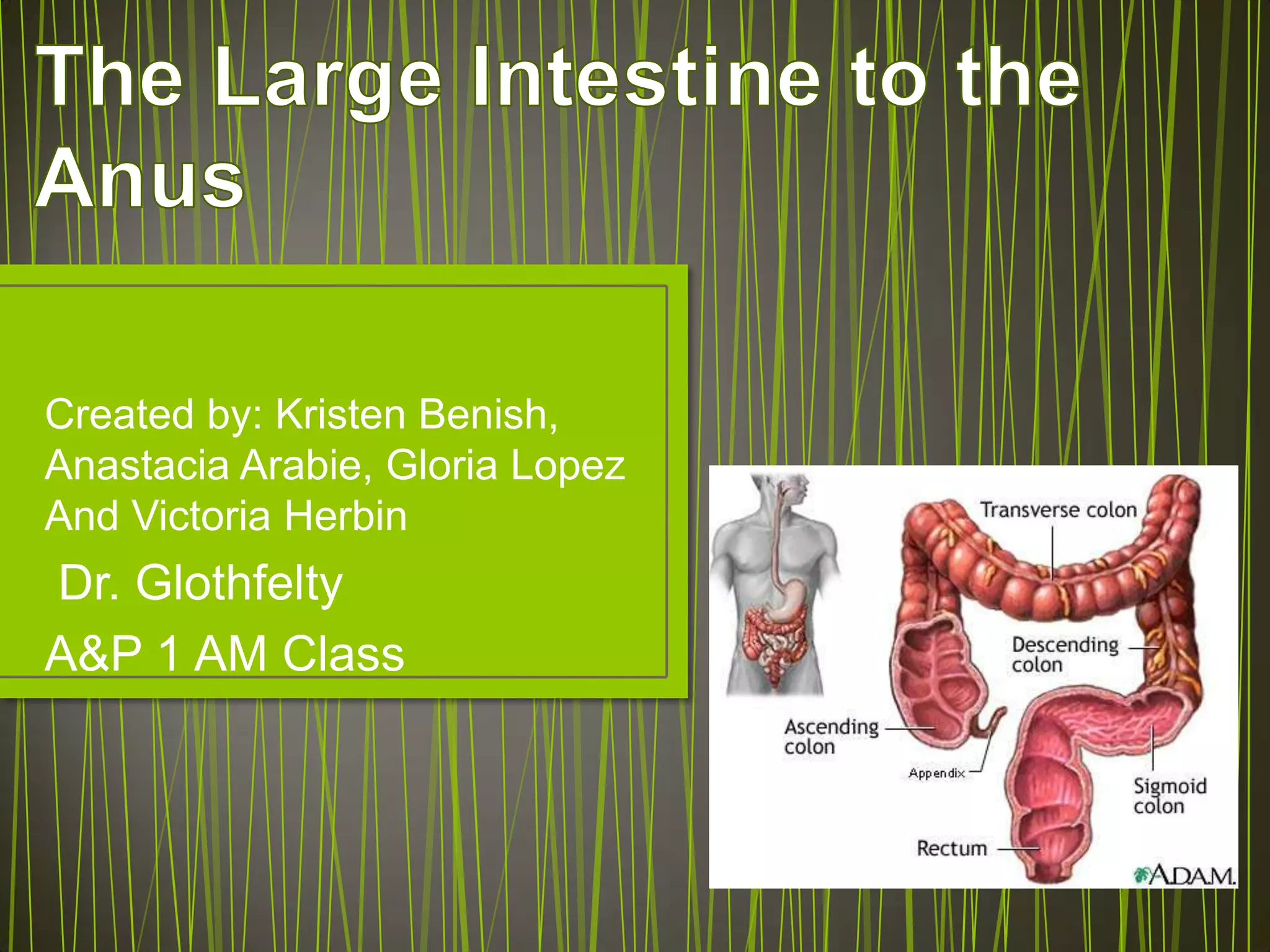
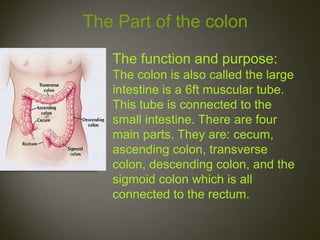
   main parts. They are: cecum,
   ascending colon, transverse
   colon, descending colon, and the
   sigmoid colon which is all
   connected to the rectum.
The Function Of The Colon (Large
Intestine)
          The large intestine is responsible for
          processing waste so that emptying the
          bowels. Waste that is left over from
          digestive process it passes through the
          colon by peristalsis. First it is in a liquid
          state and then ultimately it comes to a
          solid form. The stool passes through the
          colon, and then the water is removed.
          Then the stool is stored in the sigmoid
          colon until it becomes a mass movement.
          It then empties into the rectum once or
          twice a day. When the descending colon is
          full with stool or feces it then empties all of
          its contents in to the rectum. That is where
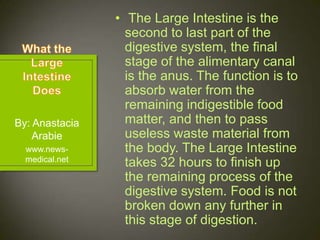
• The Large Intestine is the
                  second to last part of the
                  digestive system, the final
                  stage of the alimentary canal
                  is the anus. The function is to
                  absorb water from the
                  remaining indigestible food
By: Anastacia     matter, and then to pass
    Arabie        useless waste material from
  www.news-       the body. The Large Intestine
  medical.net
                  takes 32 hours to finish up
                  the remaining process of the
                  digestive system. Food is not
                  broken down any further in
                  this stage of digestion.
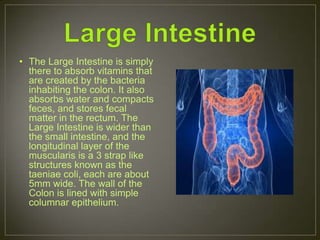
• The Large Intestine is simply
  there to absorb vitamins that
  are created by the bacteria
  inhabiting the colon. It also
  absorbs water and compacts
  feces, and stores fecal
  matter in the rectum. The
  Large Intestine is wider than
  the small intestine, and the
  longitudinal layer of the
  muscularis is a 3 strap like
  structures known as the
  taeniae coli, each are about
  5mm wide. The wall of the
  Colon is lined with simple
  columnar epithelium.
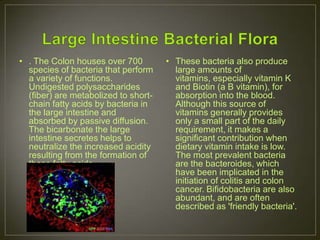
• . The Colon houses over 700         • These bacteria also produce
  species of bacteria that perform      large amounts of
  a variety of functions.               vitamins, especially vitamin K
  Undigested polysaccharides            and Biotin (a B vitamin), for
  (fiber) are metabolized to short-     absorption into the blood.
  chain fatty acids by bacteria in      Although this source of
  the large intestine and               vitamins generally provides
  absorbed by passive diffusion.        only a small part of the daily
  The bicarbonate the large             requirement, it makes a
  intestine secretes helps to           significant contribution when
  neutralize the increased acidity      dietary vitamin intake is low.
  resulting from the formation of       The most prevalent bacteria
  these fatty acids.                    are the bacteroides, which
                                        have been implicated in the
                                        initiation of colitis and colon
                                        cancer. Bifidobacteria are also
                                        abundant, and are often
                                        described as 'friendly bacteria'.
• Parts of the large intestine    • Locations along the colon
  are:                              are:
• Cecum – the first part of the   • The ascending colon
  large intestine                 • The right colic flexure
• Taeniae coli – three bands of     (hepatic)
  smooth muscle                   • The transverse colon
• Haustra – bulges caused by      • The transverse mesocolon
  contraction of taeniae coli     • The left colic flexure
• Epiploic appendages – small       (splenic)
  fat accumulations on the        • The descending colon
  viscera
                                  • The sigmoid colon – the v-
                                    shaped region of the large
                                    intestine
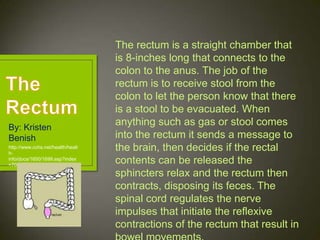
The rectum is a straight chamber that
                                   is 8-inches long that connects to the
                                   colon to the anus. The job of the
                                   rectum is to receive stool from the
                                   colon to let the person know that there
                                   is a stool to be evacuated. When
By: Kristen
                                   anything such as gas or stool comes
Benish                             into the rectum it sends a message to
http://www.cchs.net/health/healt
h-
                                   the brain, then decides if the rectal
info/docs/1600/1699.asp?index
=7041
                                   contents can be released the
                                   sphincters relax and the rectum then
                                   contracts, disposing its feces. The
                                   spinal cord regulates the nerve
                                   impulses that initiate the reflexive
                                   contractions of the rectum that result in
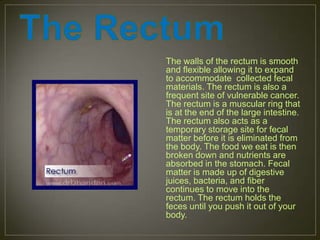
The walls of the rectum is smooth
and flexible allowing it to expand
to accommodate collected fecal
materials. The rectum is also a
frequent site of vulnerable cancer.
The rectum is a muscular ring that
is at the end of the large intestine.
The rectum also acts as a
temporary storage site for fecal
matter before it is eliminated from
the body. The food we eat is then
broken down and nutrients are
absorbed in the stomach. Fecal
matter is made up of digestive
juices, bacteria, and fiber
continues to move into the
rectum. The rectum holds the
feces until you push it out of your
body.
• The anus controls the
                     expulsion of the feces. The
                     flow of feces through the
                     anus is controlled by the
By: Gloria Lopez
www.webmd.com        anal sphincter muscle. The
                     internal and external
                     sphincter muscle relax,
                     allowing the feces to be
                     passed by muscles and
                     pulling the anus up over the
                     exiting feces.
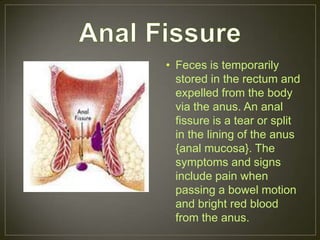
• Feces is temporarily
  stored in the rectum and
  expelled from the body
  via the anus. An anal
  fissure is a tear or split
  in the lining of the anus
  {anal mucosa}. The
  symptoms and signs
  include pain when
  passing a bowel motion
  and bright red blood
  from the anus.
• The problem is common      • Around half of cases
  in children younger than     heal by themselves with
  one year, and affects        proper self-care and
  around eight out of ten      avoidance of
  babies. A person’s           constipation. However
  susceptibility to anal       healing can be a
  fissures tend to decline     problem if the pressure
  with age. Common             of passing bowel motion
  causes in adults include     constantly reopens the
  constipation and trauma      fissure. Treatment
  to the anus {such as         options include surgery.
  difficult childbirth}.
•   Anal pain
•   Pain when passing a motion and for some time afterward
•   Bright red blood from the anus
•   Blood on the surface of the stool
•   Blood smears on the toilet paper

The large intestine to the anus

  • 1.
    Created by: KristenBenish, Anastacia Arabie, Gloria Lopez And Victoria Herbin Dr. Glothfelty A&P 1 AM Class
  • 2.
    Large Intestine The shape and place: The colon is shaped like an U. The colon (large intestine) is housed within the abdominal cavity. It starts in the lower right quarter of the abdominal cavity, it is in the waist area. The colon runs along the right By Victoria Herbin side of the body. It reaches just below the liver. Wiki.answersw.com
  • 3.
    The Part ofthe colon The function and purpose: The colon is also called the large intestine is a 6ft muscular tube. This tube is connected to the small intestine. There are four main parts. They are: cecum, ascending colon, transverse colon, descending colon, and the sigmoid colon which is all connected to the rectum.
  • 4.
    The Function OfThe Colon (Large Intestine) The large intestine is responsible for processing waste so that emptying the bowels. Waste that is left over from digestive process it passes through the colon by peristalsis. First it is in a liquid state and then ultimately it comes to a solid form. The stool passes through the colon, and then the water is removed. Then the stool is stored in the sigmoid colon until it becomes a mass movement. It then empties into the rectum once or twice a day. When the descending colon is full with stool or feces it then empties all of its contents in to the rectum. That is where
  • 5.
    • The LargeIntestine is the second to last part of the digestive system, the final stage of the alimentary canal is the anus. The function is to absorb water from the remaining indigestible food By: Anastacia matter, and then to pass Arabie useless waste material from www.news- the body. The Large Intestine medical.net takes 32 hours to finish up the remaining process of the digestive system. Food is not broken down any further in this stage of digestion.
  • 6.
    • The LargeIntestine is simply there to absorb vitamins that are created by the bacteria inhabiting the colon. It also absorbs water and compacts feces, and stores fecal matter in the rectum. The Large Intestine is wider than the small intestine, and the longitudinal layer of the muscularis is a 3 strap like structures known as the taeniae coli, each are about 5mm wide. The wall of the Colon is lined with simple columnar epithelium.
  • 7.
    • . TheColon houses over 700 • These bacteria also produce species of bacteria that perform large amounts of a variety of functions. vitamins, especially vitamin K Undigested polysaccharides and Biotin (a B vitamin), for (fiber) are metabolized to short- absorption into the blood. chain fatty acids by bacteria in Although this source of the large intestine and vitamins generally provides absorbed by passive diffusion. only a small part of the daily The bicarbonate the large requirement, it makes a intestine secretes helps to significant contribution when neutralize the increased acidity dietary vitamin intake is low. resulting from the formation of The most prevalent bacteria these fatty acids. are the bacteroides, which have been implicated in the initiation of colitis and colon cancer. Bifidobacteria are also abundant, and are often described as 'friendly bacteria'.
  • 8.
    • Parts ofthe large intestine • Locations along the colon are: are: • Cecum – the first part of the • The ascending colon large intestine • The right colic flexure • Taeniae coli – three bands of (hepatic) smooth muscle • The transverse colon • Haustra – bulges caused by • The transverse mesocolon contraction of taeniae coli • The left colic flexure • Epiploic appendages – small (splenic) fat accumulations on the • The descending colon viscera • The sigmoid colon – the v- shaped region of the large intestine
  • 9.
    The rectum isa straight chamber that is 8-inches long that connects to the colon to the anus. The job of the rectum is to receive stool from the colon to let the person know that there is a stool to be evacuated. When By: Kristen anything such as gas or stool comes Benish into the rectum it sends a message to http://www.cchs.net/health/healt h- the brain, then decides if the rectal info/docs/1600/1699.asp?index =7041 contents can be released the sphincters relax and the rectum then contracts, disposing its feces. The spinal cord regulates the nerve impulses that initiate the reflexive contractions of the rectum that result in
  • 10.
    The walls ofthe rectum is smooth and flexible allowing it to expand to accommodate collected fecal materials. The rectum is also a frequent site of vulnerable cancer. The rectum is a muscular ring that is at the end of the large intestine. The rectum also acts as a temporary storage site for fecal matter before it is eliminated from the body. The food we eat is then broken down and nutrients are absorbed in the stomach. Fecal matter is made up of digestive juices, bacteria, and fiber continues to move into the rectum. The rectum holds the feces until you push it out of your body.
  • 11.
    • The anuscontrols the expulsion of the feces. The flow of feces through the anus is controlled by the By: Gloria Lopez www.webmd.com anal sphincter muscle. The internal and external sphincter muscle relax, allowing the feces to be passed by muscles and pulling the anus up over the exiting feces.
  • 12.
    • Feces istemporarily stored in the rectum and expelled from the body via the anus. An anal fissure is a tear or split in the lining of the anus {anal mucosa}. The symptoms and signs include pain when passing a bowel motion and bright red blood from the anus.
  • 13.
    • The problemis common • Around half of cases in children younger than heal by themselves with one year, and affects proper self-care and around eight out of ten avoidance of babies. A person’s constipation. However susceptibility to anal healing can be a fissures tend to decline problem if the pressure with age. Common of passing bowel motion causes in adults include constantly reopens the constipation and trauma fissure. Treatment to the anus {such as options include surgery. difficult childbirth}.
  • 14.
    Anal pain • Pain when passing a motion and for some time afterward • Bright red blood from the anus • Blood on the surface of the stool • Blood smears on the toilet paper