









Tips on using my ppt.
1. You can freely download, edit, modify and put your
name etc.
2. Don’t be concerned about number of slides. Half the
slides are blanks except for the title.
3. First show the blank slides (eg. Aetiology ) > Ask
students what they already know about ethology of
today's topic. > Then show next slide which enumerates
aetiologies.
4. At the end rerun the show – show blank> ask questions >
show next slide.
5. This will be an ACTIVE LEARNING SESSION x
three revisions.
6. Good for self study also.
7. See notes for bibliography.
Learning Objectives
Learning Objectives
1. Introduction & History
2. Relevant Anatomy, Physiology
3. Aetiology
4. Pathophysiology
5. Pathology
6. Classification
7. Clinical Features
8. Investigations
9. Management
10. Prevention
11. Guidelines
12. Take home messages
Introduction & History.
•
Introduction & History.
• The penile shaft is composed of 3 erectile
columns
– 2 corpora cavernosa
– corpus spongiosum,
• enveloping fascial layers, nerves,
lymphatics, and blood vessels, all covered
by skin
• The 2 suspensory ligaments, composed of
primarily elastic fibers, support the penis at
its base
Parts
• Base,
• Shaft
• Glans
• foreskin (Prepuce).
Aetiology
Aetiology
• Idiopathic
• Congenital/ Genetic
• Nutritional Deficiency/excess
• Traumatic
• Infections /Infestation
• Autoimmune
• Neoplastic (Benign/Malignant)
• Degenerative / lifestyle
• Iatrogenic
• Psychosomatic
• Poisoning/ Toxins/ Drug induced
Embryology
• THE MALE AND FEMALE EXTERNAL
GENITALIA are similar until week 9.
• development and differentiation are evident
beginning at month 3 and are related to the
action of androgens produced by the testes
• THE GENITAL TUBERCLE, initially seen
in week 4, elongates by week 7 to form
a phallus, which in turn will form the future
penis.
Embryology
• THE GENITAL FOLDS, which
circumscribe the median urethral
(urogenital) groove, fuse along the ventral
(under) side of the penis, from behind
forward, at about 3 months, changing the
groove into a duct, the definitive penile
urethra
Embryology
• DURING MONTH 4, THE EPITHELIUM at the
end of the penis forms 2 invaginations
1. At the tip of the glans, an ectodermal ingrowth
forms a cellular cord, the glandular epithelial
plate. Splitting of this plate forms a groove,
the glandular urethra, Closure of the groove in
the glans moves the urethral opening to the tip of
the glans and joins the 2 urethral parts
2. The second invagination is circular and is called
the preputial epithelial plate. Cleavage of this
plate before birth separates the glans penis from
the prepuce
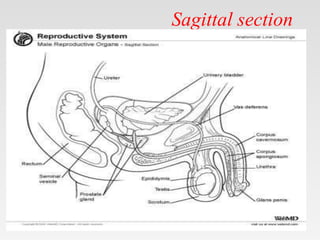
Sagittal section
•
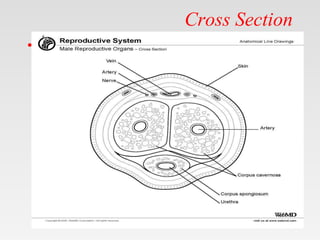
Cross Section
•
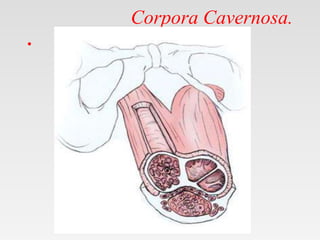
Corpora Cavernosa.
Corpora Cavernosa.
• The paired corpora cavernosa contain erectile
tissue and are each surrounded by the tunica
albuginea, a dense fibrous sheath of connective
tissue
• The tunica albuginea consists of 2 layers, the outer
longitudinal and the inner circular
• The erectile tissue within the corpora contains
arteries, nerves, muscle fibers, and venous sinuses
• The cut surface of the corpora cavernosa looks
like a sponge.
• There is a thin layer of areolar tissue that separates
this tissue from the tunica albuginea.
Corpora Cavernosa.
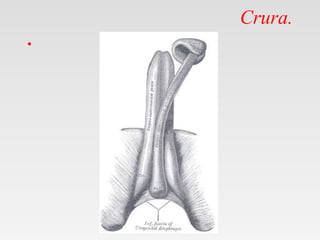
• For their anterior three-fourths the corpora
cavernosa penis lie in intimate apposition with one
another, but behind they diverge in the form of
two tapering processes, known as the crura,
which are firmly connected to the ischial rami. .
• Just before it meets its fellow it presents a slight
enlargement, bulb of the corpus cavernosum
penis
Crura.
•
Corpora Cavernosa.
•
Corpus spongiosum
• The single corpus spongiosum lies in the ventral
groove between the 2 corpora cavernosa.
• The urethra passes through the corpus
spongiosum.
• The corpus spongiosum possesses a much thinner
and more elastic tunica albuginea
• Behind, it is expanded to form the urethral bulb,
and lies in apposition with the inferior fascia of
the urogenital diaphragm, from which it receives a
fibrous investment.
Corpus spongiosum
• The distal extension of the spongiosum, the glans
penis, covers the tips of the corpora cavernosa to
provide a cushioning effect.
• The urethral meatus is positioned just slightly on
the ventral surface of the glans and is slitlike.
• The edge of the glans overhangs the shaft of the
penis, forming a rim called the corona.
Fascias.
Fascias.
The 3 erectile bodies are surrounded by -
1. Deep penile (Buck) fascia
2. Dartos fascia
3. Penile skin.
• On the dorsal aspect of the corpora
cavernosa lie the deep dorsal vein and
paired dorsal arteries and branches of the
dorsal nerves
Deep penile (Buck) fascia
• A strong, deep, fascial layer that is immediately
superficial to the tunica albuginea.
• It is continuous with the deep fascia of the
muscles covering the crura
• It splits to surround the corpus spongiosum,
• Extends into the perineum as the deep fascia of the
ischiocavernosus and bulbospongiosus muscles.
• Encloses these muscles and each crus of the
corpora cavernosa and the bulb of the corpus
spongiosum, adhering these structures to the
pubis, ischium, and the urogenital diaphragm.
Dartos fascia,
• The subcutaneous connective tissue of the
penis and scrotum has abundant smooth
muscle and is called the dartos fascia
• It continues into the perineum and fuses
with the superficial perineal (Colle) fascia.
• In the penis, the dartos fascia is loosely
attached to the skin and deep penile (Buck)
fascia
• It contains the superficial arteries, veins,
and nerves of the penis.
Arterial Supply
Arterial Supply
• Blood supply to the skin of the penis is from the
left and right superficial external pudendal
arteries, which arise from the femoral artery.
• The blood supply to the ventral penile skin is
based on the posterior scrotal artery, a superficial
branch of the deep internal pudendal artery.
Arterial Supply
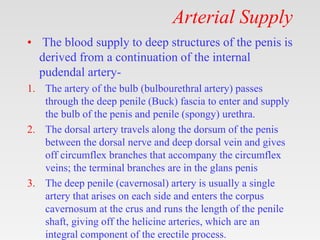
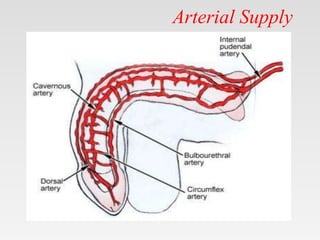
• The blood supply to deep structures of the penis is
derived from a continuation of the internal
pudendal artery-
1. The artery of the bulb (bulbourethral artery) passes
through the deep penile (Buck) fascia to enter and supply
the bulb of the penis and penile (spongy) urethra.
2. The dorsal artery travels along the dorsum of the penis
between the dorsal nerve and deep dorsal vein and gives
off circumflex branches that accompany the circumflex
veins; the terminal branches are in the glans penis
3. The deep penile (cavernosal) artery is usually a single
artery that arises on each side and enters the corpus
cavernosum at the crus and runs the length of the penile
shaft, giving off the helicine arteries, which are an
integral component of the erectile process.
Arterial Supply
•
Venous Drainage
Venous Drainage
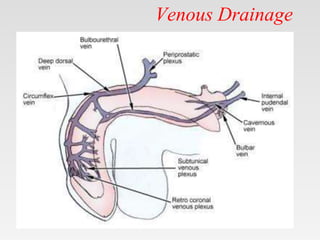
The penis is drained by 3 venous systems-
1. Superficial
2. Intermediate
3. Deep.
Venous Drainage
Venous Drainage: Superficial system
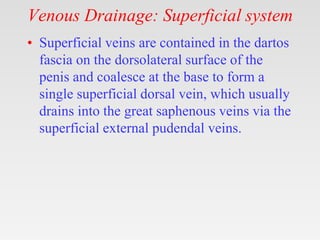
• Superficial veins are contained in the dartos
fascia on the dorsolateral surface of the
penis and coalesce at the base to form a
single superficial dorsal vein, which usually
drains into the great saphenous veins via the
superficial external pudendal veins.
Venous Drainage:Intermediate system
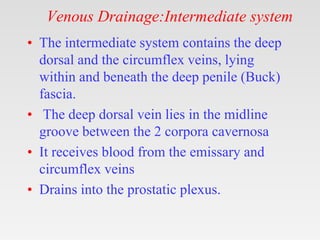
• The intermediate system contains the deep
dorsal and the circumflex veins, lying
within and beneath the deep penile (Buck)
fascia.
• The deep dorsal vein lies in the midline
groove between the 2 corpora cavernosa
• It receives blood from the emissary and
circumflex veins
• Drains into the prostatic plexus.
Venous Drainage:Deep system
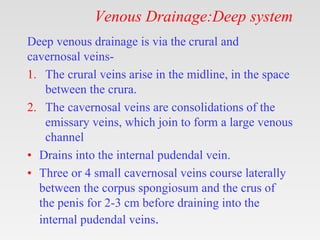
Deep venous drainage is via the crural and
cavernosal veins-
1. The crural veins arise in the midline, in the space
between the crura.
2. The cavernosal veins are consolidations of the
emissary veins, which join to form a large venous
channel
• Drains into the internal pudendal vein.
• Three or 4 small cavernosal veins course laterally
between the corpus spongiosum and the crus of
the penis for 2-3 cm before draining into the
internal pudendal veins.
Lymphatic Drainage
Lymphatic Drainage
1. Deep inguinal nodes
2. Presymphyseal lymph nodes
3. Lateral lymph nodes of the external iliac
group.
Nerve Supply
Nerve Supply
1. Pudendal nerves supply somatic motor and
sensory innervation
2. The cavernous nerves are a combination of
parasympathetic and visceral afferent
fibers and provide the nerve supply to the
erectile tissue.
Microscopic Anatomy
Microscopic Anatomy
• The corpora cavernosa are 2 spongy
cylinders. Within the tunica albuginea are
the interconnected sinusoids separated by
smooth muscle trabeculae and surrounded
by elastic fibers, collagen, and loose areolar
tissue.
• The structure of the corpus spongiosum is
similar to that of the corpora cavernosa,
except that the sinusoids are larger and a
much thinner outer layer of the tunica
albuginea is present.
• The glans has no tunical covering.
Applied Anatomy
Erectile tissue vessels-
• The helicine arteries, branches of the deep penile
artery, supply the trabecular tissue and sinusoids.
They are contracted and tortuous in the flaccid
state and dilated and straight in the erect state
• The venous drainage from the erectile tissue
originates in the venules starting at the peripheral
sinusoids beneath the tunica albuginea. They
travel in the trabeculae between the tunica and the
peripheral sinusoids, forming the subtunical
venular plexus before exiting as the emissary
veins.
Physiology
Physiology
• Nitric oxide (NO) appears to be the principal
neurotransmitter causing penile erection.
• Nonadrenergic, noncholinergic (NANC) neurons
release NO.
• The release of NO increases the production of
cyclic guanosine monophosphate (cGMP), which
relaxes cavernosal smooth muscle.
• Other neurotransmitters, including vasoactive
intestinal peptide (VIP), calcitonin gene-related
peptide (CGRP), prostaglandins, and other
peptides, may also be involved in the erectile
process.
Physiology
1. With relaxation of the smooth muscles in the trabeculae
and the arterial wall, Arterial inflow increases as a result
of dilatation of the arterioles and arteries.
2. The sinusoids within the corpora cavernosa distend with
blood
3. Subtunical venular plexuses are compressed between the
tunica albuginea and the distended sinusoids, leading to
decreased venous outflow.
4. The tunica albuginea is stretched to its capacity,
compressing emissary veins and thus further decreasing
venous outflow; as a result, intracavernous pressure
increases and is further increased by contraction of the
ischiocavernous and bulbospongiosus muscles, resulting
in full rigidity
Physiology
• The function of the corpus spongiosum in
erection is to prevent the urethra from
pinching closed, thereby maintaining the
urethra as a viable channel for ejaculation.
To do this, the corpus spongiosum remains
pliable during erection while the corpora
cavernosa penis become engorged with
blood.
Congenital Anomalies
• Hypospadias
• Epispadias
• Penile agenesis
• Penile duplication
• Microphallus
• Penile torsion
• Webbed penis
• Buried penis
• Absence of the corpora cavernosa and corpora
cavernosa plus corpus spongiosum
• Curvature of the penis
Get this ppt in mobile
1. Download Microsoft
PowerPoint from play
store.
2. Open Google assistant
3. Open Google lens.
4. Scan qr code from
next slide.
Get this ppt in mobile
Get my ppt collection
• https://www.slideshare.net/drpradeeppande/
edit_my_uploads
• https://www.dropbox.com/sh/x600md3cvj8
5woy/AACVMHuQtvHvl_K8ehc3ltkEa?dl
=0
• https://www.facebook.com/doctorpradeeppa
nde/?ref=pages_you_manage

Anatomy penis.pptx

  • 1.
    Tips on usingmy ppt. 1. You can freely download, edit, modify and put your name etc. 2. Don’t be concerned about number of slides. Half the slides are blanks except for the title. 3. First show the blank slides (eg. Aetiology ) > Ask students what they already know about ethology of today's topic. > Then show next slide which enumerates aetiologies. 4. At the end rerun the show – show blank> ask questions > show next slide. 5. This will be an ACTIVE LEARNING SESSION x three revisions. 6. Good for self study also. 7. See notes for bibliography.
  • 2.
  • 3.
    Learning Objectives 1. Introduction& History 2. Relevant Anatomy, Physiology 3. Aetiology 4. Pathophysiology 5. Pathology 6. Classification 7. Clinical Features 8. Investigations 9. Management 10. Prevention 11. Guidelines 12. Take home messages
  • 4.
  • 5.
    Introduction & History. •The penile shaft is composed of 3 erectile columns – 2 corpora cavernosa – corpus spongiosum, • enveloping fascial layers, nerves, lymphatics, and blood vessels, all covered by skin • The 2 suspensory ligaments, composed of primarily elastic fibers, support the penis at its base
  • 6.
    Parts • Base, • Shaft •Glans • foreskin (Prepuce).
  • 7.
  • 8.
    Aetiology • Idiopathic • Congenital/Genetic • Nutritional Deficiency/excess • Traumatic • Infections /Infestation • Autoimmune • Neoplastic (Benign/Malignant) • Degenerative / lifestyle • Iatrogenic • Psychosomatic • Poisoning/ Toxins/ Drug induced
  • 9.
    Embryology • THE MALEAND FEMALE EXTERNAL GENITALIA are similar until week 9. • development and differentiation are evident beginning at month 3 and are related to the action of androgens produced by the testes • THE GENITAL TUBERCLE, initially seen in week 4, elongates by week 7 to form a phallus, which in turn will form the future penis.
  • 10.
    Embryology • THE GENITALFOLDS, which circumscribe the median urethral (urogenital) groove, fuse along the ventral (under) side of the penis, from behind forward, at about 3 months, changing the groove into a duct, the definitive penile urethra
  • 11.
    Embryology • DURING MONTH4, THE EPITHELIUM at the end of the penis forms 2 invaginations 1. At the tip of the glans, an ectodermal ingrowth forms a cellular cord, the glandular epithelial plate. Splitting of this plate forms a groove, the glandular urethra, Closure of the groove in the glans moves the urethral opening to the tip of the glans and joins the 2 urethral parts 2. The second invagination is circular and is called the preputial epithelial plate. Cleavage of this plate before birth separates the glans penis from the prepuce
  • 12.
  • 13.
  • 14.
  • 15.
    Corpora Cavernosa. • Thepaired corpora cavernosa contain erectile tissue and are each surrounded by the tunica albuginea, a dense fibrous sheath of connective tissue • The tunica albuginea consists of 2 layers, the outer longitudinal and the inner circular • The erectile tissue within the corpora contains arteries, nerves, muscle fibers, and venous sinuses • The cut surface of the corpora cavernosa looks like a sponge. • There is a thin layer of areolar tissue that separates this tissue from the tunica albuginea.
  • 16.
    Corpora Cavernosa. • Fortheir anterior three-fourths the corpora cavernosa penis lie in intimate apposition with one another, but behind they diverge in the form of two tapering processes, known as the crura, which are firmly connected to the ischial rami. . • Just before it meets its fellow it presents a slight enlargement, bulb of the corpus cavernosum penis
  • 17.
  • 18.
  • 19.
    Corpus spongiosum • Thesingle corpus spongiosum lies in the ventral groove between the 2 corpora cavernosa. • The urethra passes through the corpus spongiosum. • The corpus spongiosum possesses a much thinner and more elastic tunica albuginea • Behind, it is expanded to form the urethral bulb, and lies in apposition with the inferior fascia of the urogenital diaphragm, from which it receives a fibrous investment.
  • 20.
    Corpus spongiosum • Thedistal extension of the spongiosum, the glans penis, covers the tips of the corpora cavernosa to provide a cushioning effect. • The urethral meatus is positioned just slightly on the ventral surface of the glans and is slitlike. • The edge of the glans overhangs the shaft of the penis, forming a rim called the corona.
  • 21.
  • 22.
    Fascias. The 3 erectilebodies are surrounded by - 1. Deep penile (Buck) fascia 2. Dartos fascia 3. Penile skin. • On the dorsal aspect of the corpora cavernosa lie the deep dorsal vein and paired dorsal arteries and branches of the dorsal nerves
  • 23.
    Deep penile (Buck)fascia • A strong, deep, fascial layer that is immediately superficial to the tunica albuginea. • It is continuous with the deep fascia of the muscles covering the crura • It splits to surround the corpus spongiosum, • Extends into the perineum as the deep fascia of the ischiocavernosus and bulbospongiosus muscles. • Encloses these muscles and each crus of the corpora cavernosa and the bulb of the corpus spongiosum, adhering these structures to the pubis, ischium, and the urogenital diaphragm.
  • 24.
    Dartos fascia, • Thesubcutaneous connective tissue of the penis and scrotum has abundant smooth muscle and is called the dartos fascia • It continues into the perineum and fuses with the superficial perineal (Colle) fascia. • In the penis, the dartos fascia is loosely attached to the skin and deep penile (Buck) fascia • It contains the superficial arteries, veins, and nerves of the penis.
  • 25.
  • 26.
    Arterial Supply • Bloodsupply to the skin of the penis is from the left and right superficial external pudendal arteries, which arise from the femoral artery. • The blood supply to the ventral penile skin is based on the posterior scrotal artery, a superficial branch of the deep internal pudendal artery.
  • 27.
    Arterial Supply • Theblood supply to deep structures of the penis is derived from a continuation of the internal pudendal artery- 1. The artery of the bulb (bulbourethral artery) passes through the deep penile (Buck) fascia to enter and supply the bulb of the penis and penile (spongy) urethra. 2. The dorsal artery travels along the dorsum of the penis between the dorsal nerve and deep dorsal vein and gives off circumflex branches that accompany the circumflex veins; the terminal branches are in the glans penis 3. The deep penile (cavernosal) artery is usually a single artery that arises on each side and enters the corpus cavernosum at the crus and runs the length of the penile shaft, giving off the helicine arteries, which are an integral component of the erectile process.
  • 28.
  • 29.
  • 30.
    Venous Drainage The penisis drained by 3 venous systems- 1. Superficial 2. Intermediate 3. Deep.
  • 31.
  • 32.
    Venous Drainage: Superficialsystem • Superficial veins are contained in the dartos fascia on the dorsolateral surface of the penis and coalesce at the base to form a single superficial dorsal vein, which usually drains into the great saphenous veins via the superficial external pudendal veins.
  • 33.
    Venous Drainage:Intermediate system •The intermediate system contains the deep dorsal and the circumflex veins, lying within and beneath the deep penile (Buck) fascia. • The deep dorsal vein lies in the midline groove between the 2 corpora cavernosa • It receives blood from the emissary and circumflex veins • Drains into the prostatic plexus.
  • 34.
    Venous Drainage:Deep system Deepvenous drainage is via the crural and cavernosal veins- 1. The crural veins arise in the midline, in the space between the crura. 2. The cavernosal veins are consolidations of the emissary veins, which join to form a large venous channel • Drains into the internal pudendal vein. • Three or 4 small cavernosal veins course laterally between the corpus spongiosum and the crus of the penis for 2-3 cm before draining into the internal pudendal veins.
  • 35.
  • 36.
    Lymphatic Drainage 1. Deepinguinal nodes 2. Presymphyseal lymph nodes 3. Lateral lymph nodes of the external iliac group.
  • 37.
  • 38.
    Nerve Supply 1. Pudendalnerves supply somatic motor and sensory innervation 2. The cavernous nerves are a combination of parasympathetic and visceral afferent fibers and provide the nerve supply to the erectile tissue.
  • 39.
  • 40.
    Microscopic Anatomy • Thecorpora cavernosa are 2 spongy cylinders. Within the tunica albuginea are the interconnected sinusoids separated by smooth muscle trabeculae and surrounded by elastic fibers, collagen, and loose areolar tissue. • The structure of the corpus spongiosum is similar to that of the corpora cavernosa, except that the sinusoids are larger and a much thinner outer layer of the tunica albuginea is present. • The glans has no tunical covering.
  • 41.
    Applied Anatomy Erectile tissuevessels- • The helicine arteries, branches of the deep penile artery, supply the trabecular tissue and sinusoids. They are contracted and tortuous in the flaccid state and dilated and straight in the erect state • The venous drainage from the erectile tissue originates in the venules starting at the peripheral sinusoids beneath the tunica albuginea. They travel in the trabeculae between the tunica and the peripheral sinusoids, forming the subtunical venular plexus before exiting as the emissary veins.
  • 42.
  • 43.
    Physiology • Nitric oxide(NO) appears to be the principal neurotransmitter causing penile erection. • Nonadrenergic, noncholinergic (NANC) neurons release NO. • The release of NO increases the production of cyclic guanosine monophosphate (cGMP), which relaxes cavernosal smooth muscle. • Other neurotransmitters, including vasoactive intestinal peptide (VIP), calcitonin gene-related peptide (CGRP), prostaglandins, and other peptides, may also be involved in the erectile process.
  • 44.
    Physiology 1. With relaxationof the smooth muscles in the trabeculae and the arterial wall, Arterial inflow increases as a result of dilatation of the arterioles and arteries. 2. The sinusoids within the corpora cavernosa distend with blood 3. Subtunical venular plexuses are compressed between the tunica albuginea and the distended sinusoids, leading to decreased venous outflow. 4. The tunica albuginea is stretched to its capacity, compressing emissary veins and thus further decreasing venous outflow; as a result, intracavernous pressure increases and is further increased by contraction of the ischiocavernous and bulbospongiosus muscles, resulting in full rigidity
  • 45.
    Physiology • The functionof the corpus spongiosum in erection is to prevent the urethra from pinching closed, thereby maintaining the urethra as a viable channel for ejaculation. To do this, the corpus spongiosum remains pliable during erection while the corpora cavernosa penis become engorged with blood.
  • 46.
  • 47.
    Congenital Anomalies • Hypospadias •Epispadias • Penile agenesis • Penile duplication • Microphallus • Penile torsion • Webbed penis • Buried penis • Absence of the corpora cavernosa and corpora cavernosa plus corpus spongiosum • Curvature of the penis
  • 48.
    Get this pptin mobile 1. Download Microsoft PowerPoint from play store. 2. Open Google assistant 3. Open Google lens. 4. Scan qr code from next slide.
  • 49.
    Get this pptin mobile
  • 50.
    Get my pptcollection • https://www.slideshare.net/drpradeeppande/ edit_my_uploads • https://www.dropbox.com/sh/x600md3cvj8 5woy/AACVMHuQtvHvl_K8ehc3ltkEa?dl =0 • https://www.facebook.com/doctorpradeeppa nde/?ref=pages_you_manage

Editor's Notes

  • #2 drpradeeppande@gmail.com 7697305442
  • #6 https://emedicine.medscape.com/article/1949325-overview
  • #13 https://emedicine.medscape.com/article/1949325-overview
  • #14 https://emedicine.medscape.com/article/1949325-overview
  • #15 https://emedicine.medscape.com/article/1949325-overview
  • #16 https://emedicine.medscape.com/article/1949325-overview
  • #17 https://emedicine.medscape.com/article/1949325-overview
  • #18 https://emedicine.medscape.com/article/1949325-overview
  • #19 https://emedicine.medscape.com/article/1949325-overview
  • #20 https://emedicine.medscape.com/article/1949325-overview
  • #21 https://emedicine.medscape.com/article/1949325-overview
  • #22 https://emedicine.medscape.com/article/1949325-overview
  • #23 https://emedicine.medscape.com/article/1949325-overview
  • #24 https://emedicine.medscape.com/article/1949325-overview
  • #25 https://emedicine.medscape.com/article/1949325-overview