SPLEEN
DR.SUPRITI
DEMONSTRATOR
ANATOMY DEPTT
TMMC&RC
INTRODUCTION
• It is a haemo-lymph organ and belongs to reticulo-endothelial system.
• 2nd lymphoid organ
• Pleural cavity separates spleen and diaphragm from the rib.
FUNCTIONS
•Spleen forms parts of the reticuloendotelial system.
•Main function is hematopoiesis in fetal life and in adults
with reutilization of iron from hemoglobin of destroyed red
blood cells.
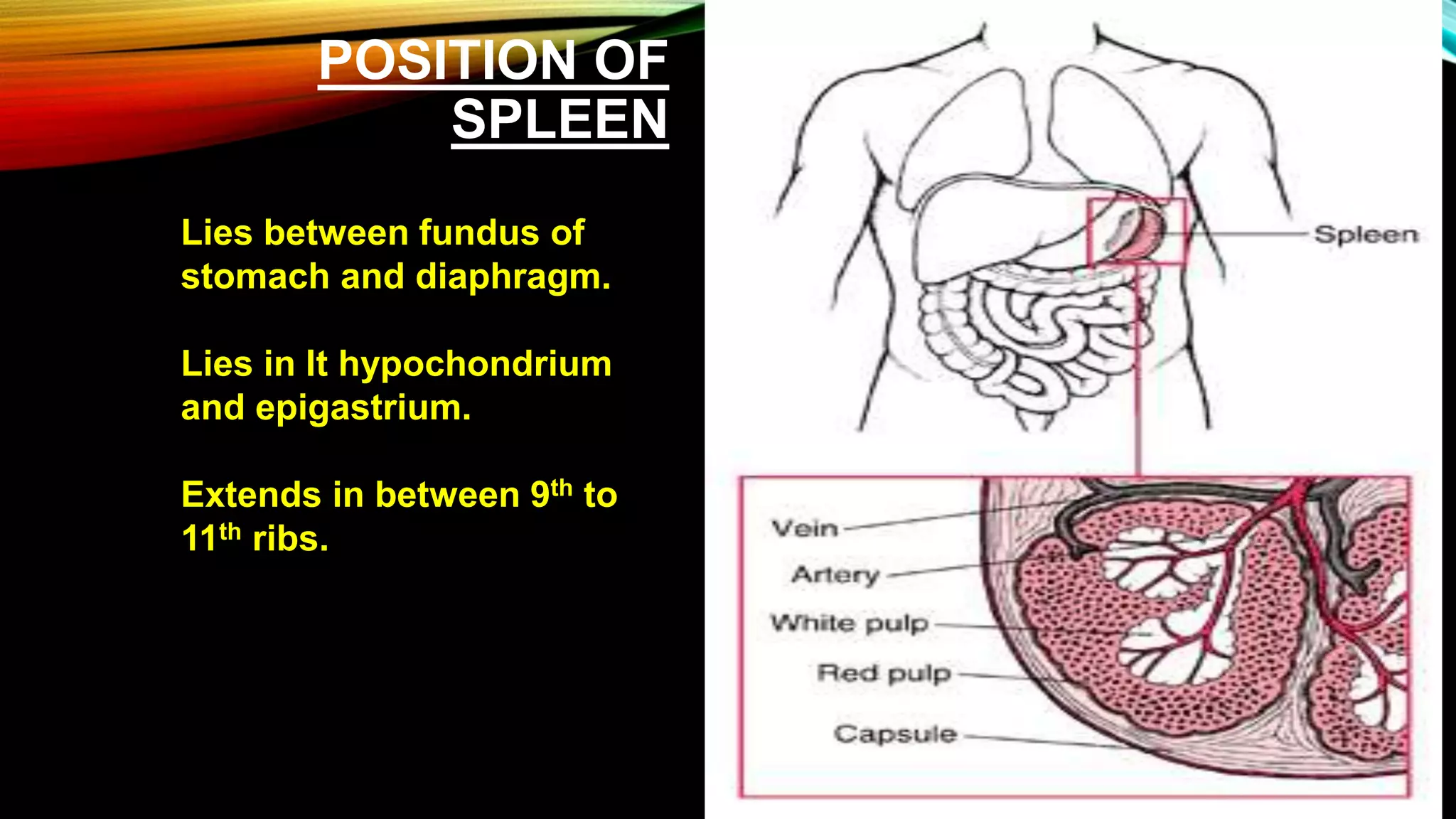
•Its has red and the white pulp, which are separated by
the marginal sinus.
•Red pulp composed sinuses, splenic cord and
marginal zone and main function to filter red
blood cells and reserve monocytes.
•White pulp is composed of malpighian
corpuscles and help in active immune response.
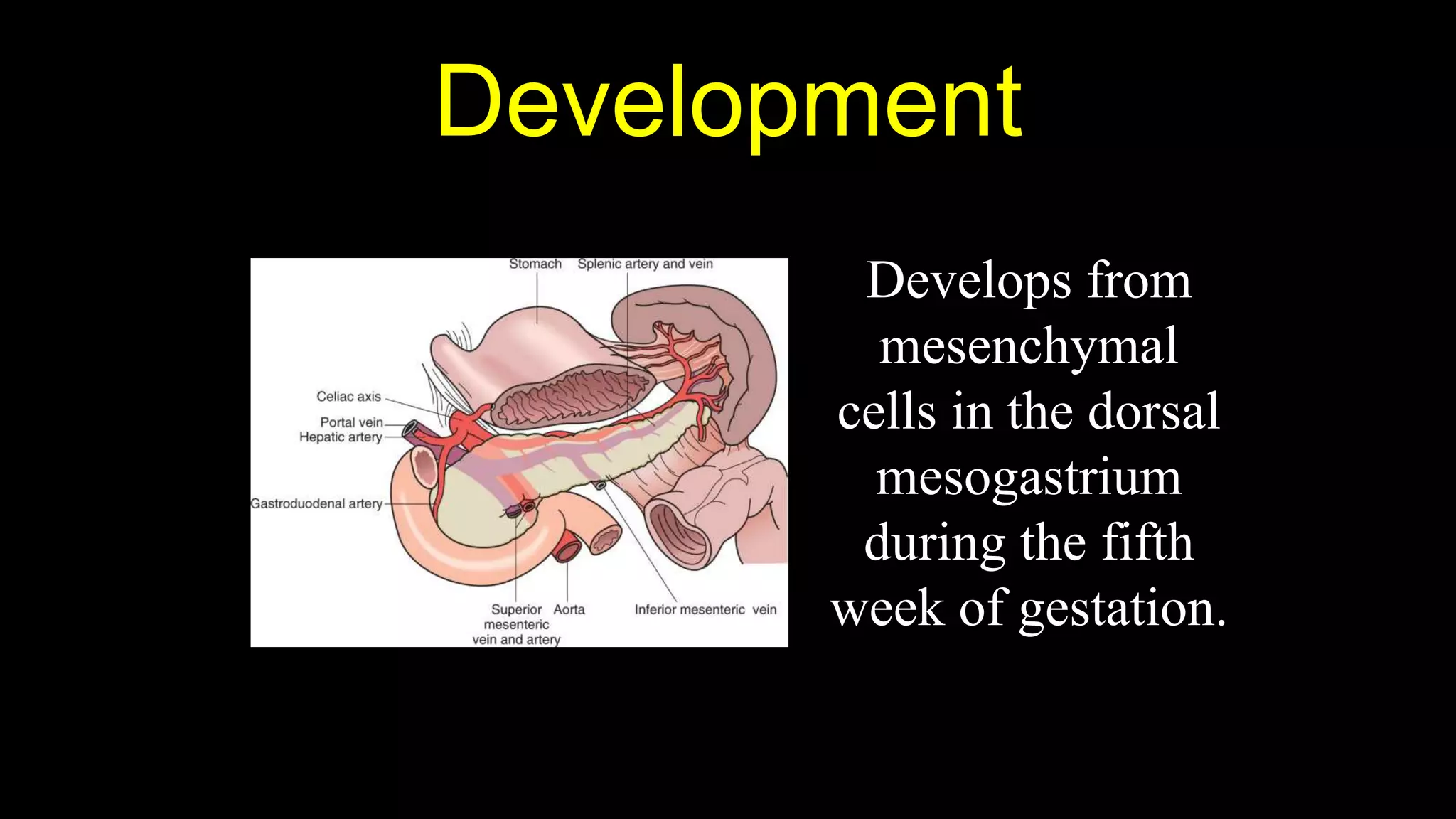
Development
Develops from
mesenchymal
cells in the dorsal
mesogastrium
during the fifth
week of gestation.
• Number of nodules develop which soon fuse to form a
lobulated spleen.
• Notching of superior border of adult spleen is evidence of its
multiple origin.
• These nodules which fail to fuse,form accessory spleens.
ACCESSORY SPLEENS/ SPLENUNCULI
• These may be found:-
• In derivatives of dorsal mesogastrium.
• In broad ligament of uterus.
• In the spermatic cord.
POSITION OF
SPLEEN
Lies between fundus of
stomach and diaphragm.
Lies in lt hypochondrium
and epigastrium.
Extends in between 9th to
11th ribs.
Axis of spleen is directed
downwards, forwards and
laterally.
Axis lies along the 10th rib.
MEASURMENTS OF SPLEEN
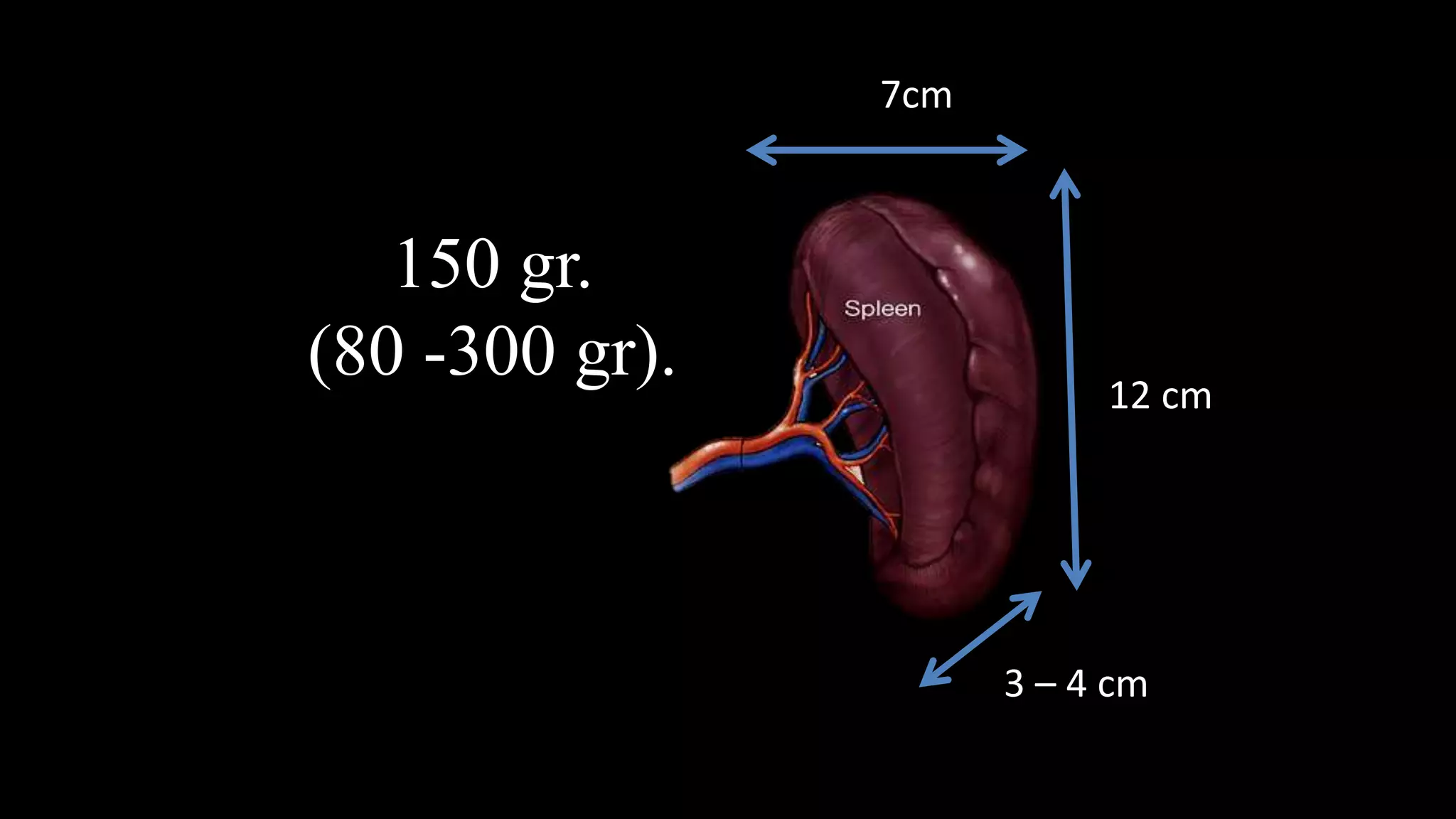
• Length-12 cm(5 inch)
• Breadth-7cm(3 inch)
• Thickness-3cm (1inch)
• Weight-150gm(7 oz)
• HARRIR’S DICTUM OF ODD NUMBERS ON
SPLEEN:1,3,5,7,9,11
• 1inches in thikness,3 inches in breadth,5 inches in length,7oz in
weight,9-11 ribs of left side against which spleen rest.
7cm
12 cm
3 – 4 cm
150 gr.
(80 -300 gr).
The
peritoneum
covering the
spleen, except in
the hilum.
EXTERNAL FEATURES
• The spleen has :-
• Two ends
• Three borders
• Two surfaces
• Two angles
• Hilum
TWO ENDS
The anterior or lateral end:-it is expanded or more like a border.it is
directed downwards ,forwards and reaches mid axillary line.
• The posterior or medial end:- it is rounded and directed upwards
backwards, medially,and rest on upper pole of left kidney.
TWO BORDERS
• Superior border :- presents one or two notches near anterior end.
• Notches indicate spleen is lobulated in development.
• Inferior border:- it is rounded
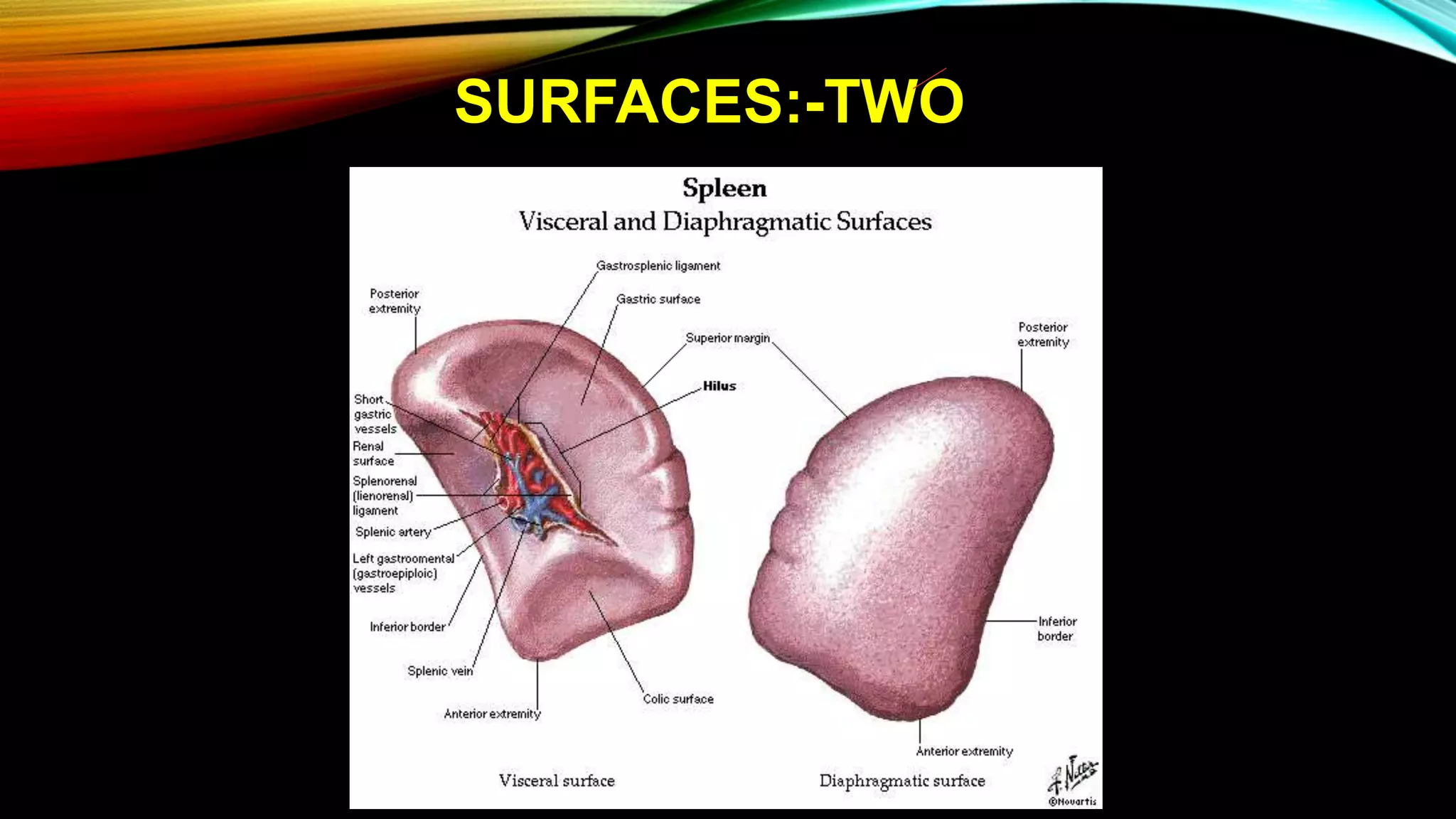
SURFACES:-TWO
SURFACES
• DIAPHRAGMATIC :- This surface is convex and smooth.
• IT IS RELATED TO:-
• A) Diaphragm
• B) Lt lung & lts pleura
• C) Costodiaphragmatic recess
• d) 9th, 10th & 11th ribs of left side.
• VISCERAL SURFACE:- It is concave and irregular.
• IT IS RELATED TO:-
• FUNDUS OF STOMACH
• ANTERIOR SURFACE OF LEFT KIDNEY
• THE SPLENIC FLEXURE OF COLON
• TAIL OF PANCREAS
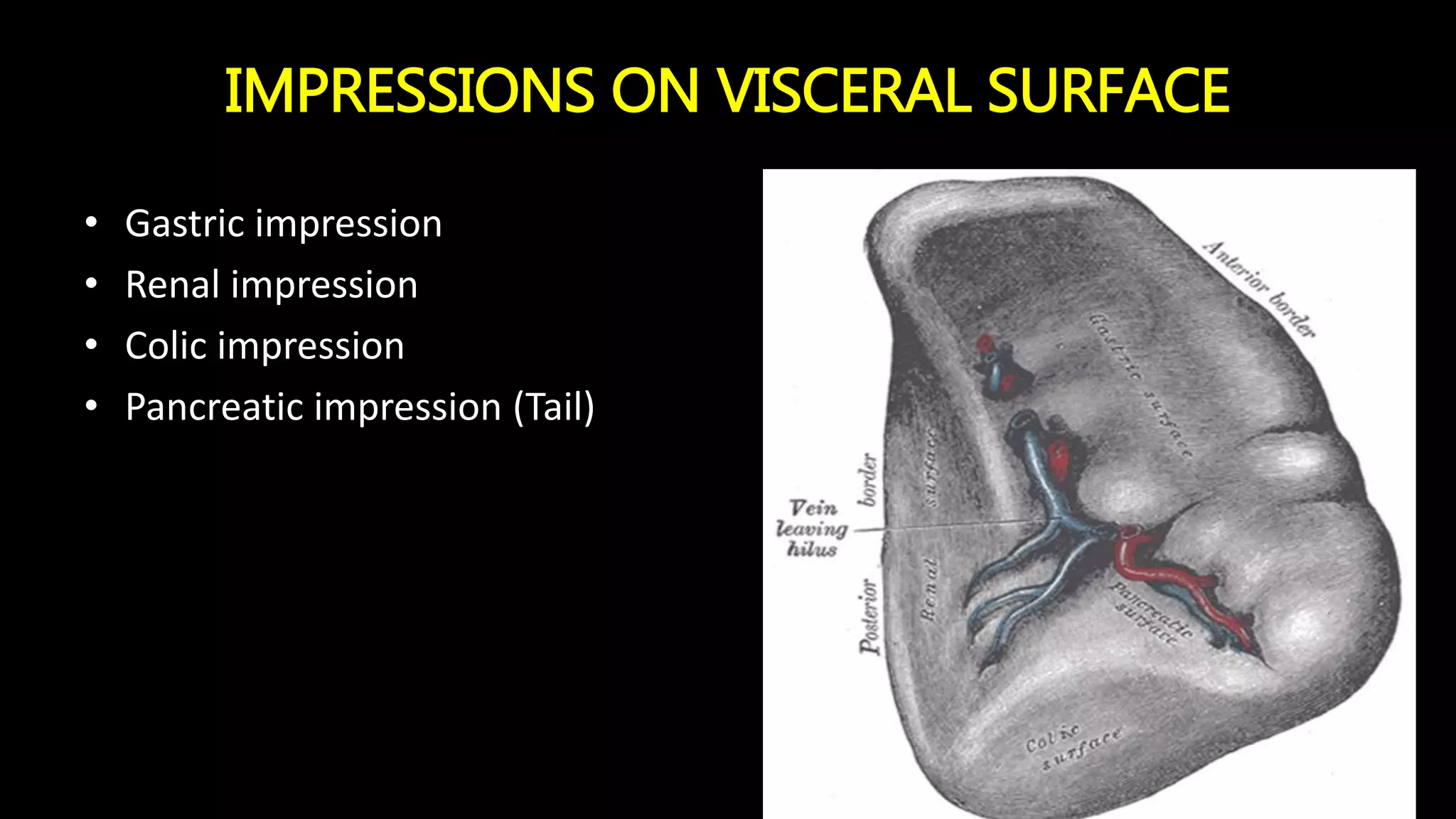
IMPRESSIONS ON VISCERAL SURFACE
• Gastric impression
• Renal impression
• Colic impression
• Pancreatic impression (Tail)
ANGLES
• ANTEROBASAL
• POSTEROBASAL
CLINICAL ANGLE OF SPLEEN
• Anterior basal angle:
Junction of superior border with lateral end.
Lies in 9th intercostal space behind left mid-axillary line.
First palpable in splenomegaly.
• POSTEROBASAL ANGLE:-Lies at junction of inferior border with
lateral or anterior end of spleen.
Ligaments
• Lieno-phrenic
• Phrenico-colic
• Gastro-splenic
• Lieno-renal
LIGAMENTS
• A) Gastro-splenic: Connects fundus of stomach to anterior lip
of hilum of spleen
Contains short gastric & lt gastro-epiploic vessels.
• B) Lienorenal: Connects ant surface of lt kidney with posterior
lip of hilum of spleen
Contains tail of pancrease, splenic vessels & nerve.
LIGAMENTS
• Lieno-phrenic: Suspensory ligament of spleen
• Phrenico-colic: Sustentaculum lienis(supports the spleen from
below).
Peritoneal fold extending from lt colic flexure to
diaphragm
Blood Supply
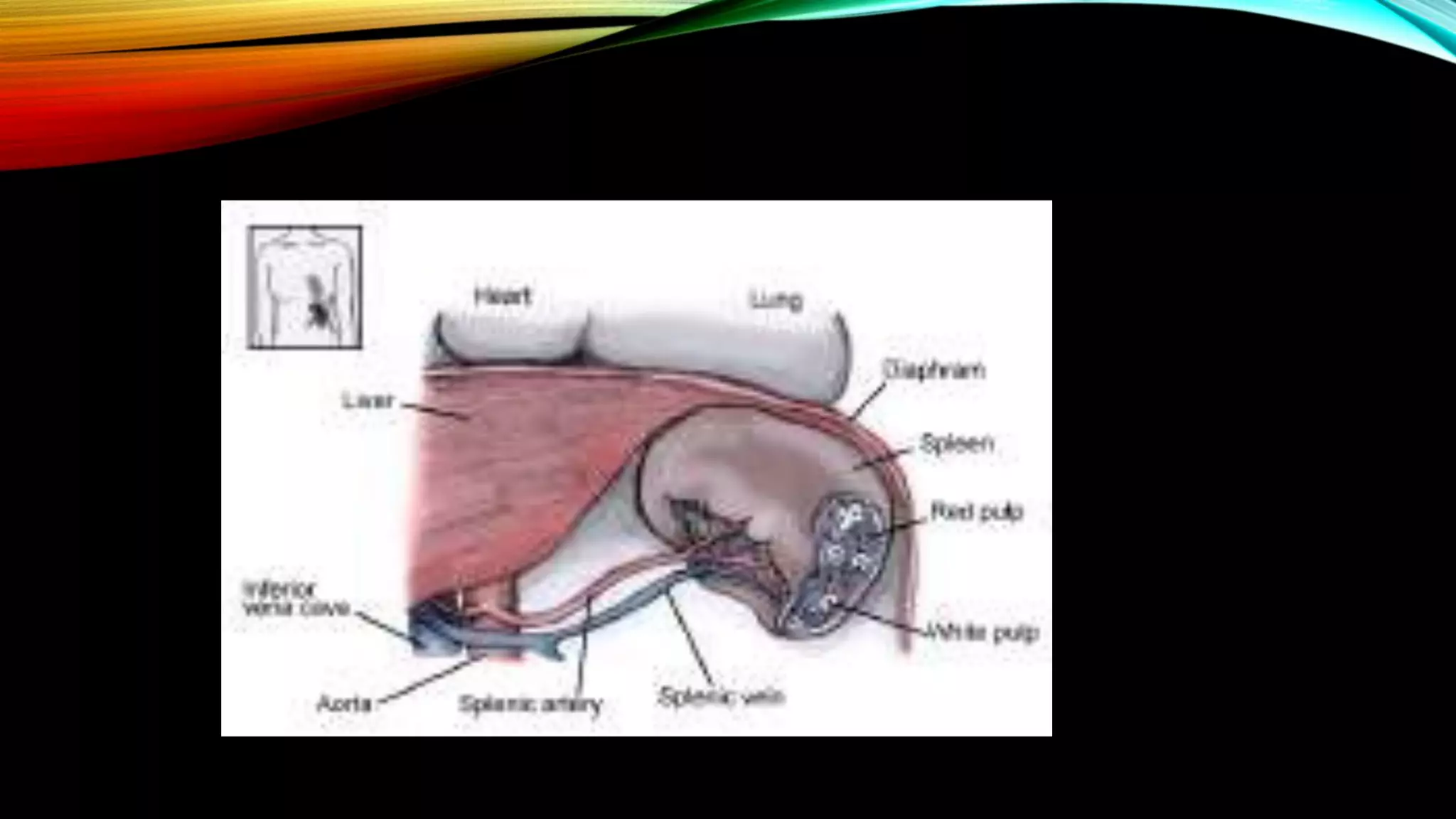
• The tortuous splenic artery arises from the coeliac trunk
and runs along the upper border of the body and tail of
the pancreas, to which it gives small branches.
• The short gastric and left gastroepiploic branches pass
between the layers of the gastrosplenic ligament.
• The main splenic artery generally divides into superior
and inferior branches, which, in turn, subdivide into
several segmental branches.
VENOUS DRAINAGE
• Splenic Vein: Drains into portal vein.
NERVE SUPPLY
• It is predominentaly supplied by the sympathetics from
coeliac plexus.The fibers supply the blood vessels and
smooth muscle of trabeculae
CLINICAL IMPORTANCE
•Spleen is undercover of thoracic cage and is not palpable
• Splenomegaly : enlarged spleen due to cancer,
specifically blood-based leukemia.
• Asplenia : where the spleen is not present.
•Hyposplenia: reduce splenic functions..
SPLENECTOMY
•Spleen is particularly liable to rupture in falls and
automobile accidents and bleeding from it is difficult to
control and Splenectomy should be done.
• A splenectomy is a surgical procedure that partially or
completely removes the spleen.
THANK YOU !

anatomy of spleen

  • 1.
  • 2.
    INTRODUCTION • It isa haemo-lymph organ and belongs to reticulo-endothelial system. • 2nd lymphoid organ • Pleural cavity separates spleen and diaphragm from the rib.
  • 3.
    FUNCTIONS •Spleen forms partsof the reticuloendotelial system. •Main function is hematopoiesis in fetal life and in adults with reutilization of iron from hemoglobin of destroyed red blood cells. •Its has red and the white pulp, which are separated by the marginal sinus.
  • 4.
    •Red pulp composedsinuses, splenic cord and marginal zone and main function to filter red blood cells and reserve monocytes. •White pulp is composed of malpighian corpuscles and help in active immune response.
  • 5.
    Development Develops from mesenchymal cells inthe dorsal mesogastrium during the fifth week of gestation.
  • 6.
    • Number ofnodules develop which soon fuse to form a lobulated spleen. • Notching of superior border of adult spleen is evidence of its multiple origin. • These nodules which fail to fuse,form accessory spleens.
  • 7.
    ACCESSORY SPLEENS/ SPLENUNCULI •These may be found:- • In derivatives of dorsal mesogastrium. • In broad ligament of uterus. • In the spermatic cord.
  • 8.
    POSITION OF SPLEEN Lies betweenfundus of stomach and diaphragm. Lies in lt hypochondrium and epigastrium. Extends in between 9th to 11th ribs.
  • 9.
    Axis of spleenis directed downwards, forwards and laterally. Axis lies along the 10th rib.
  • 10.
    MEASURMENTS OF SPLEEN •Length-12 cm(5 inch) • Breadth-7cm(3 inch) • Thickness-3cm (1inch) • Weight-150gm(7 oz) • HARRIR’S DICTUM OF ODD NUMBERS ON SPLEEN:1,3,5,7,9,11 • 1inches in thikness,3 inches in breadth,5 inches in length,7oz in weight,9-11 ribs of left side against which spleen rest.
  • 11.
    7cm 12 cm 3 –4 cm 150 gr. (80 -300 gr).
  • 12.
  • 13.
    EXTERNAL FEATURES • Thespleen has :- • Two ends • Three borders • Two surfaces • Two angles • Hilum
  • 14.
    TWO ENDS The anterioror lateral end:-it is expanded or more like a border.it is directed downwards ,forwards and reaches mid axillary line. • The posterior or medial end:- it is rounded and directed upwards backwards, medially,and rest on upper pole of left kidney.
  • 15.
    TWO BORDERS • Superiorborder :- presents one or two notches near anterior end. • Notches indicate spleen is lobulated in development. • Inferior border:- it is rounded
  • 16.
  • 17.
    SURFACES • DIAPHRAGMATIC :-This surface is convex and smooth. • IT IS RELATED TO:- • A) Diaphragm • B) Lt lung & lts pleura • C) Costodiaphragmatic recess • d) 9th, 10th & 11th ribs of left side.
  • 18.
    • VISCERAL SURFACE:-It is concave and irregular. • IT IS RELATED TO:- • FUNDUS OF STOMACH • ANTERIOR SURFACE OF LEFT KIDNEY • THE SPLENIC FLEXURE OF COLON • TAIL OF PANCREAS
  • 19.
    IMPRESSIONS ON VISCERALSURFACE • Gastric impression • Renal impression • Colic impression • Pancreatic impression (Tail)
  • 20.
  • 21.
    CLINICAL ANGLE OFSPLEEN • Anterior basal angle: Junction of superior border with lateral end. Lies in 9th intercostal space behind left mid-axillary line. First palpable in splenomegaly.
  • 22.
    • POSTEROBASAL ANGLE:-Liesat junction of inferior border with lateral or anterior end of spleen.
  • 23.
  • 25.
    LIGAMENTS • A) Gastro-splenic:Connects fundus of stomach to anterior lip of hilum of spleen Contains short gastric & lt gastro-epiploic vessels. • B) Lienorenal: Connects ant surface of lt kidney with posterior lip of hilum of spleen Contains tail of pancrease, splenic vessels & nerve.
  • 26.
    LIGAMENTS • Lieno-phrenic: Suspensoryligament of spleen • Phrenico-colic: Sustentaculum lienis(supports the spleen from below). Peritoneal fold extending from lt colic flexure to diaphragm
  • 27.
    Blood Supply • Thetortuous splenic artery arises from the coeliac trunk and runs along the upper border of the body and tail of the pancreas, to which it gives small branches. • The short gastric and left gastroepiploic branches pass between the layers of the gastrosplenic ligament. • The main splenic artery generally divides into superior and inferior branches, which, in turn, subdivide into several segmental branches.
  • 29.
    VENOUS DRAINAGE • SplenicVein: Drains into portal vein.
  • 31.
    NERVE SUPPLY • Itis predominentaly supplied by the sympathetics from coeliac plexus.The fibers supply the blood vessels and smooth muscle of trabeculae
  • 32.
    CLINICAL IMPORTANCE •Spleen isundercover of thoracic cage and is not palpable • Splenomegaly : enlarged spleen due to cancer, specifically blood-based leukemia. • Asplenia : where the spleen is not present. •Hyposplenia: reduce splenic functions..
  • 34.
    SPLENECTOMY •Spleen is particularlyliable to rupture in falls and automobile accidents and bleeding from it is difficult to control and Splenectomy should be done. • A splenectomy is a surgical procedure that partially or completely removes the spleen.
  • 35.