Nutrition in Mammals
Lesson Objectives: Holozoic nutrition Introduction to the human digestive system Digestion in the  - mouth - stomach - small intestine  Absorption in the intestines (small and large intestines)
Holozoic nutrition  (feeding on ready made complex organic matter) Digestion : process where large food molecules are broken down into soluble and diffusible molecules that can be absorbed into the body cells Absorption : process whereby digested food materials are taken into the body cells Assimilation : process whereby some of the absorbed food materials are converted into new protoplasm or used to provide energy
Study tips: Always try to relate the structure of an organ with its function This serves as an easy way of  remembering digestion facts! Picture the organ in your mind  Identify the structures present  Function of organ derived from structures present
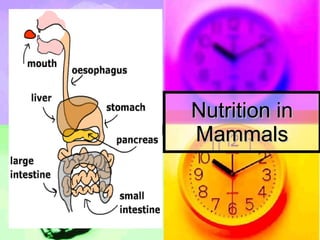
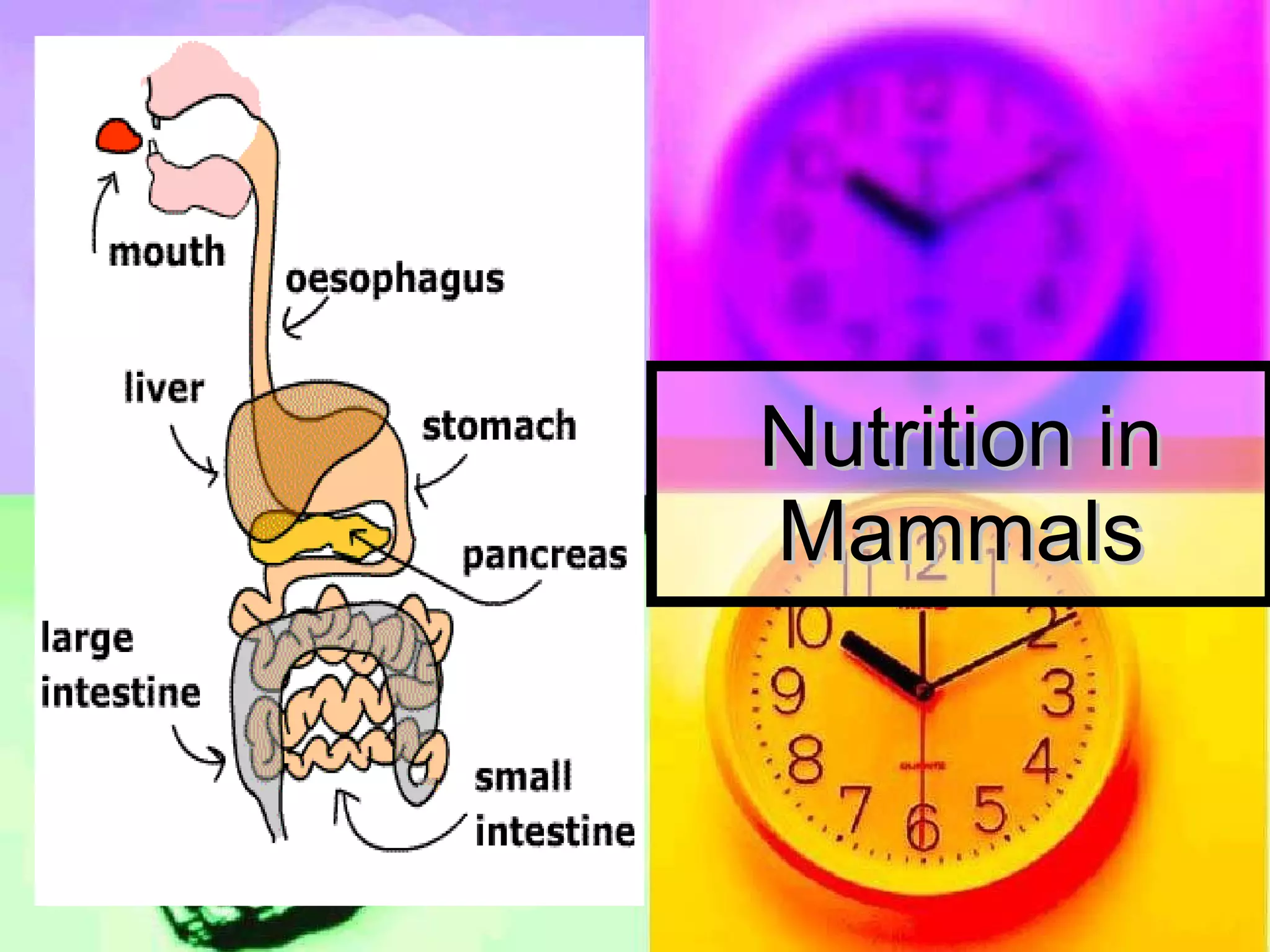
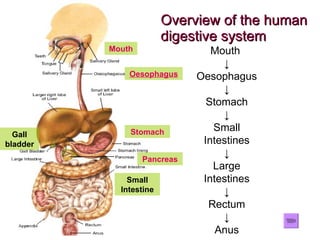
Overview of the human digestive system Mouth  ↓ Oesophagus ↓ Stomach ↓ Small Intestines ↓ Large Intestines ↓ Rectum ↓ Anus Mouth Stomach Small Intestine Pancreas Gall bladder Oesophagus
Types of digestion Mechanical digestion Break down particles into smaller pieces so as to increase the surface area for the action of enzymes. Chemical digestion Involves  enzymatic reactions  which digest the food into simpler chemical forms.
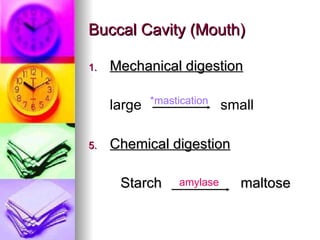
Buccal Cavity (Mouth)  Mechanical digestion large  small Chemical digestion Starch  maltose amylase *mastication
 
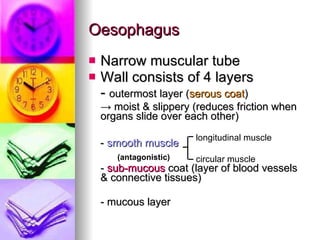
Oesophagus Narrow muscular tube Wall consists of 4 layers -  outermost layer  ( serous coat )  ->  moist & slippery (reduces friction when organs slide over each other) -  smooth muscle -  sub-mucous  coat (layer of blood vessels & connective tissues) - mucous layer longitudinal muscle circular muscle (antagonistic)
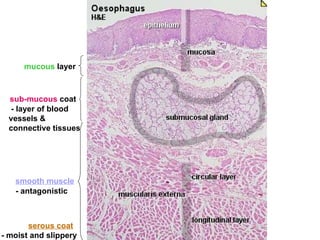
serous coat - moist and slippery - layer of blood vessels & connective tissues - antagonistic smooth muscle sub-mucous  coat mucous  layer
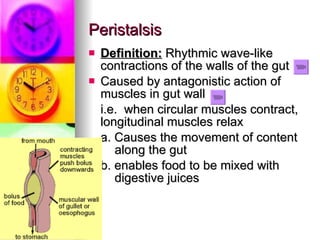
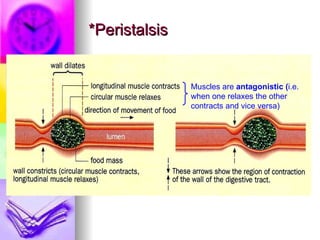
Peristalsis Definition:  Rhythmic wave-like contractions of the walls of the gut Caused by antagonistic action of muscles in gut wall i.e.  when circular muscles contract, longitudinal muscles relax  a. Causes the movement of content  along the gut b. enables food to be mixed with  digestive juices
*Peristalsis Muscles are  antagonistic ( i.e. when one relaxes the other contracts and vice versa)
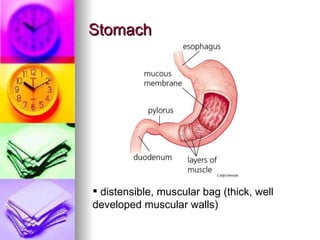
Stomach distensible, muscular bag (thick, well developed muscular walls)
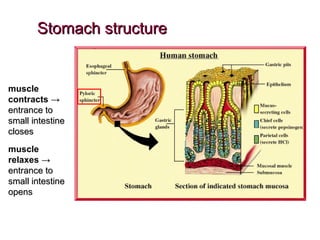
Stomach structure muscle contracts   -> entrance to small intestine closes   muscle relaxes   -> entrance to small intestine opens
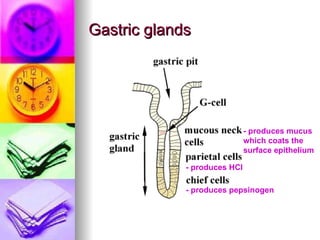
Gastric glands - produces mucus which coats the surface epithelium  - produces pepsinogen   - produces HCl
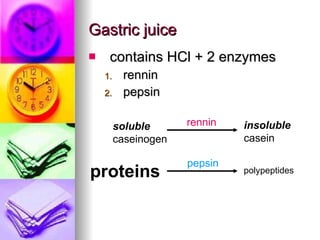
Gastric juice contains HCl + 2 enzymes rennin pepsin  soluble  caseinogen insoluble  casein rennin proteins polypeptides pepsin
Question to ponder: Do you think the enzymes in the stomach are produced in an active or inactive state?
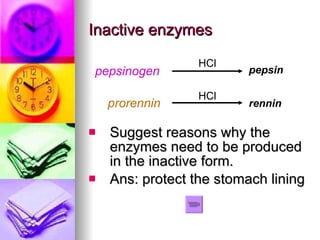
Inactive enzymes Suggest reasons why the enzymes need to be produced in the inactive form. Ans: protect the stomach lining pepsinogen pepsin prorennin rennin HCl HCl
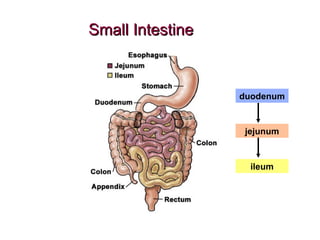
Small Intestine duodenum jejunum ileum
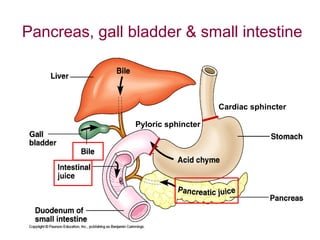
Pancreas, gall bladder & small intestine Cardiac sphincter Pyloric sphincter
Gall bladder  yellowish green bag stores bile produced by the liver releases  bile  when it contracts via  bile duct QUESTION:  Can bile digest food? ANSWER: Bile is  not an enzyme , so it cannot digest food but it  aids in digestion of fats   (by  emulsifying  fats)
Emulsification It is the process whereby large globules of fat are broken down into smaller globules  How? Bile  lowers the  surface tension  of fats  i.e. reduce the attractive forces between the fat molecules This  causes the fats to break into tiny fat droplets suspended in water , forming an emulsion (physical digestion) Purpose of emulsification ->  increases s.a.:volume ratio  ->  speeds up digestion by lipase to f.a. + glycerol
Pancreas Connected to duodenum by  pancreatic duct Secretes  pancreatic juice   (digestive function)   insulin  (controls blood glucose conc. & carbohydrate utilization)
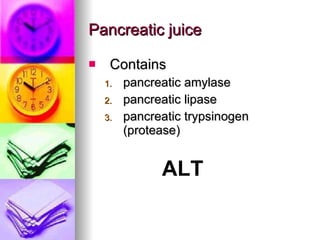
Pancreatic juice Contains  pancreatic amylase pancreatic lipase pancreatic trypsinogen (protease) ALT
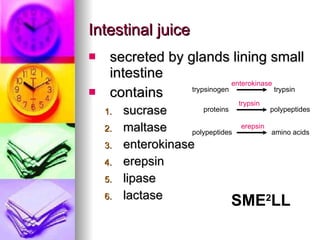
Intestinal juice secreted by glands lining small intestine contains sucrase maltase enterokinase erepsin lipase lactase SME 2 LL polypeptides amino acids erepsin trypsinogen trypsin enterokinase proteins polypeptides trypsin
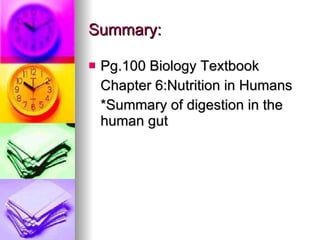
Summary: Pg.100 Biology Textbook Chapter 6:Nutrition in Humans *Summary of digestion in the human gut

Chapter 6 Nutrition in Humans Lesson 1 - The Need for Digestion

  • 1.
  • 2.
    Lesson Objectives: Holozoicnutrition Introduction to the human digestive system Digestion in the - mouth - stomach - small intestine Absorption in the intestines (small and large intestines)
  • 3.
    Holozoic nutrition (feeding on ready made complex organic matter) Digestion : process where large food molecules are broken down into soluble and diffusible molecules that can be absorbed into the body cells Absorption : process whereby digested food materials are taken into the body cells Assimilation : process whereby some of the absorbed food materials are converted into new protoplasm or used to provide energy
  • 4.
    Study tips: Alwaystry to relate the structure of an organ with its function This serves as an easy way of remembering digestion facts! Picture the organ in your mind Identify the structures present Function of organ derived from structures present
  • 5.
    Overview of thehuman digestive system Mouth ↓ Oesophagus ↓ Stomach ↓ Small Intestines ↓ Large Intestines ↓ Rectum ↓ Anus Mouth Stomach Small Intestine Pancreas Gall bladder Oesophagus
  • 6.
    Types of digestionMechanical digestion Break down particles into smaller pieces so as to increase the surface area for the action of enzymes. Chemical digestion Involves enzymatic reactions which digest the food into simpler chemical forms.
  • 7.
    Buccal Cavity (Mouth) Mechanical digestion large small Chemical digestion Starch maltose amylase *mastication
  • 8.
  • 9.
    Oesophagus Narrow musculartube Wall consists of 4 layers - outermost layer ( serous coat ) -> moist & slippery (reduces friction when organs slide over each other) - smooth muscle - sub-mucous coat (layer of blood vessels & connective tissues) - mucous layer longitudinal muscle circular muscle (antagonistic)
  • 10.
    serous coat -moist and slippery - layer of blood vessels & connective tissues - antagonistic smooth muscle sub-mucous coat mucous layer
  • 11.
    Peristalsis Definition: Rhythmic wave-like contractions of the walls of the gut Caused by antagonistic action of muscles in gut wall i.e. when circular muscles contract, longitudinal muscles relax a. Causes the movement of content along the gut b. enables food to be mixed with digestive juices
  • 12.
    *Peristalsis Muscles are antagonistic ( i.e. when one relaxes the other contracts and vice versa)
  • 13.
    Stomach distensible, muscularbag (thick, well developed muscular walls)
  • 14.
    Stomach structure musclecontracts -> entrance to small intestine closes muscle relaxes -> entrance to small intestine opens
  • 15.
    Gastric glands -produces mucus which coats the surface epithelium - produces pepsinogen - produces HCl
  • 16.
    Gastric juice containsHCl + 2 enzymes rennin pepsin soluble caseinogen insoluble casein rennin proteins polypeptides pepsin
  • 17.
    Question to ponder:Do you think the enzymes in the stomach are produced in an active or inactive state?
  • 18.
    Inactive enzymes Suggestreasons why the enzymes need to be produced in the inactive form. Ans: protect the stomach lining pepsinogen pepsin prorennin rennin HCl HCl
  • 19.
  • 20.
    Pancreas, gall bladder& small intestine Cardiac sphincter Pyloric sphincter
  • 21.
    Gall bladder yellowish green bag stores bile produced by the liver releases bile when it contracts via bile duct QUESTION: Can bile digest food? ANSWER: Bile is not an enzyme , so it cannot digest food but it aids in digestion of fats (by emulsifying fats)
  • 22.
    Emulsification It isthe process whereby large globules of fat are broken down into smaller globules How? Bile lowers the surface tension of fats i.e. reduce the attractive forces between the fat molecules This causes the fats to break into tiny fat droplets suspended in water , forming an emulsion (physical digestion) Purpose of emulsification -> increases s.a.:volume ratio -> speeds up digestion by lipase to f.a. + glycerol
  • 23.
    Pancreas Connected toduodenum by pancreatic duct Secretes pancreatic juice (digestive function) insulin (controls blood glucose conc. & carbohydrate utilization)
  • 24.
    Pancreatic juice Contains pancreatic amylase pancreatic lipase pancreatic trypsinogen (protease) ALT
  • 25.
    Intestinal juice secretedby glands lining small intestine contains sucrase maltase enterokinase erepsin lipase lactase SME 2 LL polypeptides amino acids erepsin trypsinogen trypsin enterokinase proteins polypeptides trypsin
  • 26.
    Summary: Pg.100 BiologyTextbook Chapter 6:Nutrition in Humans *Summary of digestion in the human gut