Digestion
Done by: Ooi huiying
Digestion
 The  process whereby large food
  molecules are broken down into smaller,
  soluble, diffusible, simpler forms that can
  be absorbed into our body.
 Physical-Mechanical breakdown of food
  into smaller particle
 Chemical- Enzymatic hydrolysis of food
  substances
Mouth & Buccal Cavity
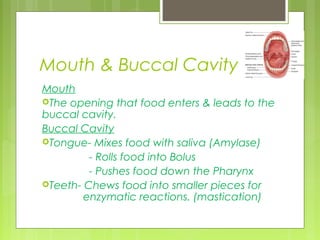
Mouth
The opening that food enters & leads to the
buccal cavity.
Buccal Cavity
Tongue- Mixes food with saliva (Amylase)
         - Rolls food into Bolus
         - Pushes food down the Pharynx
Teeth- Chews food into smaller pieces for
        enzymatic reactions. (mastication)
Oesophagus ( gullet)
 Consist  of the inner circular muscles and outer
  longitudinal muscles.
 Does not digest food.
 It is a muscular tube that pushes food down
  the body through peristalsis.
 Peristalsis is the strong and rhythmic
  movement.
   The inner circular muscles relaxes and the outer longitudinal muscles contracts, the
    lumen widens for food to enter.
   When the inner circular muscles contracts and the outer longitudinal muscles relaxes,
    the food is pushed forward.
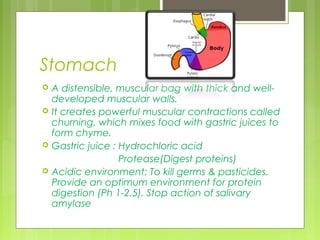
Stomach
   A distensible, muscular bag with thick and well-
    developed muscular walls.
   It creates powerful muscular contractions called
    churning, which mixes food with gastric juices to
    form chyme.
   Gastric juice : Hydrochloric acid
                    Protease(Digest proteins)
   Acidic environment: To kill germs & pasticides.
    Provide an optimum environment for protein
    digestion (Ph 1-2.5). Stop action of salivary
    amylase
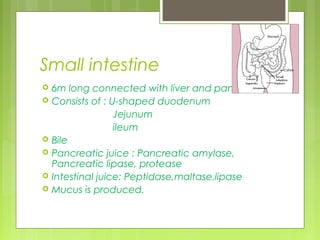
Small intestine
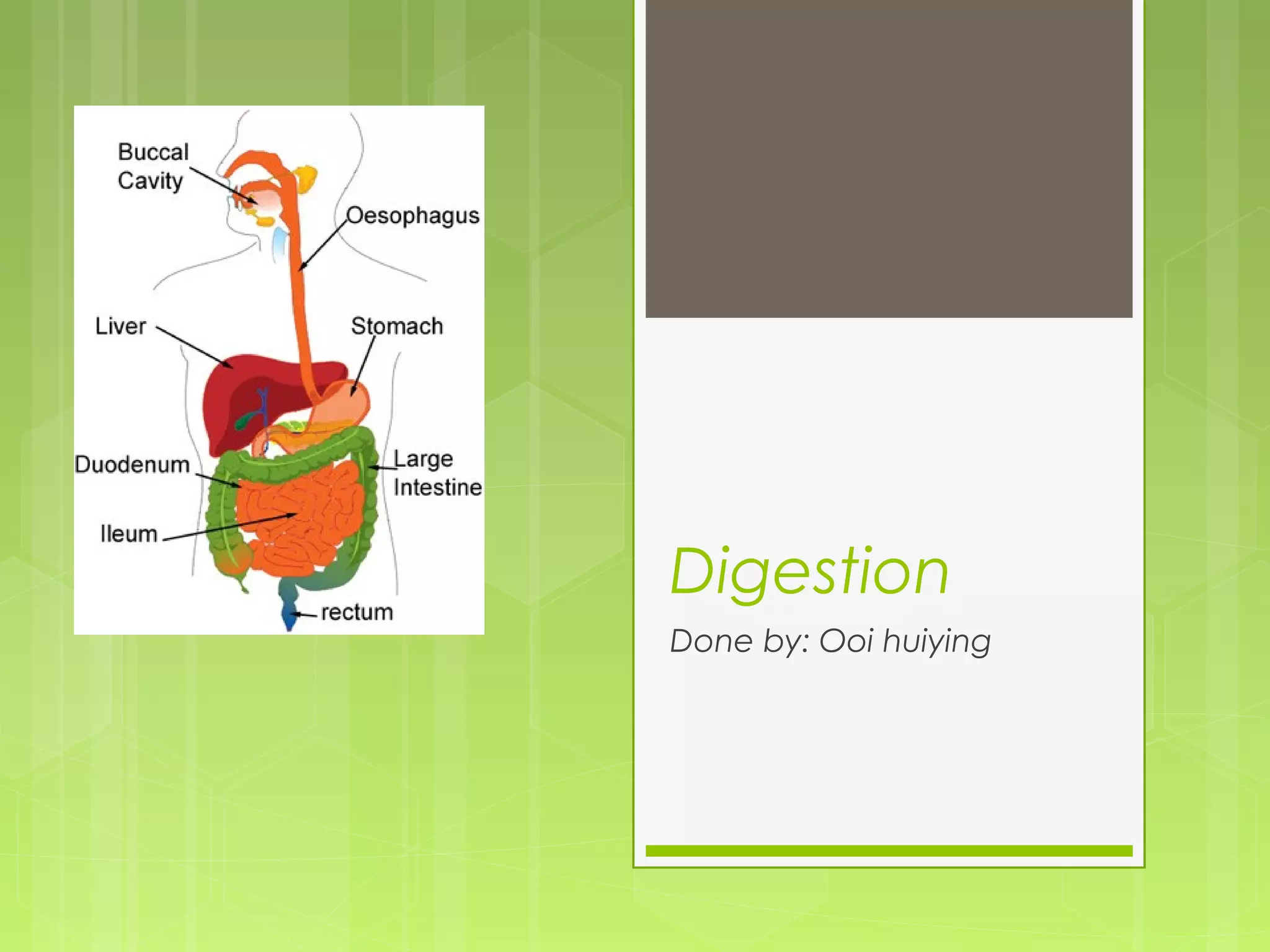
   6m long connected with liver and pancreas.
   Consists of : U-shaped duodenum
                   Jejunum
                   ileum
   Bile
   Pancreatic juice : Pancreatic amylase,
    Pancreatic lipase, protease
   Intestinal juice: Peptidase,maltase,lipase
   Mucus is produced.
Villus
 Finger-like
            structures which increases
  surface area for digestion
Liver
 Produces   a yellowish-green fluid called
  bile.
 Bile does not contain enzymes but helps in
  fat digestions through the process of
  emulsification.
 Emulsification is the breaking down of fats
  molecules into smaller droplets to increase
  surface area for fat digestion.
 Bile is temporarily stored in gall bladder.
Pancreas
 Situated   between stomach and small
  intestine.
 Secretes pancreatic juice (alkaline)
  containing amylase, protease.
 Alkaline juice neutralizes the acid in the
  food from stomach.
Large intestine
 About  1.5 m long
 Absorbs remaining water and minerals
  salts.
Rectum
 Near
     solid waste called Faeces is
 temporarily stored in the rectum.
Anus
 Faeces  is forced out of the gut through
  anus. (Egestion)
 Faeces contains mainly digested food
  and unabsorbed material.
 Faeces contains dead bacterial,
  cellulose, mucus, cholestrol,water.
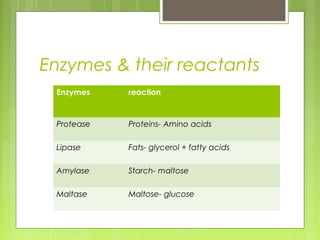
Enzymes & their reactants
 Enzymes    reaction


 Protease   Proteins- Amino acids

 Lipase     Fats- glycerol + fatty acids

 Amylase    Starch- maltose

 Maltase    Maltose- glucose
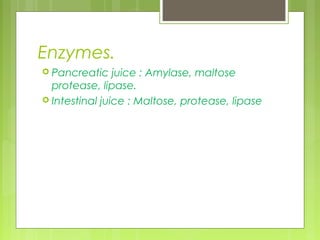
Enzymes.
 Pancreatic    juice : Amylase, maltose
  protease, lipase.
 Intestinal juice : Maltose, protease, lipase
Digestion.ppt my own slides

Digestion.ppt my own slides

  • 1.
  • 2.
    Digestion  The process whereby large food molecules are broken down into smaller, soluble, diffusible, simpler forms that can be absorbed into our body.  Physical-Mechanical breakdown of food into smaller particle  Chemical- Enzymatic hydrolysis of food substances
  • 3.
    Mouth & BuccalCavity Mouth The opening that food enters & leads to the buccal cavity. Buccal Cavity Tongue- Mixes food with saliva (Amylase) - Rolls food into Bolus - Pushes food down the Pharynx Teeth- Chews food into smaller pieces for enzymatic reactions. (mastication)
  • 4.
    Oesophagus ( gullet) Consist of the inner circular muscles and outer longitudinal muscles.  Does not digest food.  It is a muscular tube that pushes food down the body through peristalsis.  Peristalsis is the strong and rhythmic movement.  The inner circular muscles relaxes and the outer longitudinal muscles contracts, the lumen widens for food to enter.  When the inner circular muscles contracts and the outer longitudinal muscles relaxes, the food is pushed forward.
  • 5.
    Stomach  A distensible, muscular bag with thick and well- developed muscular walls.  It creates powerful muscular contractions called churning, which mixes food with gastric juices to form chyme.  Gastric juice : Hydrochloric acid Protease(Digest proteins)  Acidic environment: To kill germs & pasticides. Provide an optimum environment for protein digestion (Ph 1-2.5). Stop action of salivary amylase
  • 6.
    Small intestine  6m long connected with liver and pancreas.  Consists of : U-shaped duodenum Jejunum ileum  Bile  Pancreatic juice : Pancreatic amylase, Pancreatic lipase, protease  Intestinal juice: Peptidase,maltase,lipase  Mucus is produced.
  • 7.
    Villus  Finger-like structures which increases surface area for digestion
  • 8.
    Liver  Produces a yellowish-green fluid called bile.  Bile does not contain enzymes but helps in fat digestions through the process of emulsification.  Emulsification is the breaking down of fats molecules into smaller droplets to increase surface area for fat digestion.  Bile is temporarily stored in gall bladder.
  • 9.
    Pancreas  Situated between stomach and small intestine.  Secretes pancreatic juice (alkaline) containing amylase, protease.  Alkaline juice neutralizes the acid in the food from stomach.
  • 10.
    Large intestine  About 1.5 m long  Absorbs remaining water and minerals salts.
  • 11.
    Rectum  Near solid waste called Faeces is temporarily stored in the rectum.
  • 12.
    Anus  Faeces is forced out of the gut through anus. (Egestion)  Faeces contains mainly digested food and unabsorbed material.  Faeces contains dead bacterial, cellulose, mucus, cholestrol,water.
  • 13.
    Enzymes & theirreactants Enzymes reaction Protease Proteins- Amino acids Lipase Fats- glycerol + fatty acids Amylase Starch- maltose Maltase Maltose- glucose
  • 14.
    Enzymes.  Pancreatic juice : Amylase, maltose protease, lipase.  Intestinal juice : Maltose, protease, lipase