Parvovirus
Dr Sumitha J
Associate Professor
JBAS College for Women,Chennai-18
Viral Life Cycle and Blood Group P Receptor
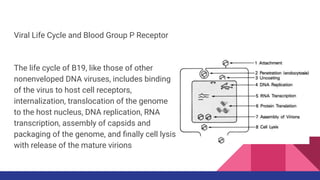
The life cycle of B19, like those of other
nonenveloped DNA viruses, includes binding
of the virus to host cell receptors,
internalization, translocation of the genome
to the host nucleus, DNA replication, RNA
transcription, assembly of capsids and
packaging of the genome, and finally cell lysis
with release of the mature virions
Pathogenesis and Immune Response
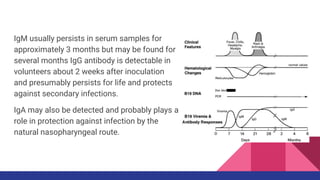
Specific immunoglobulin M (IgM) and IgG antibodies are produced following
experimental and natural B19 infection Infection leads to a biphasic clinical course:
One week after intranasal inoculation with B19 in healthy adult volunteers viremia was
detected in seronegative individuals accompanied by a mild illness with pyrexia, malaise,
myalgia, itching, and excretion of virus from the respiratory tract.
About 17 to18 days after infection, a second phase of symptoms commenced and was
characterized by rash, itching, or arthralgia. Recovery involves production of IgM antibody
10 to 12 days postinfection, coinciding with a peak in virus level.
IgM usually persists in serum samples for
approximately 3 months but may be found for
several months IgG antibody is detectable in
volunteers about 2 weeks after inoculation
and presumably persists for life and protects
against secondary infections.
IgA may also be detected and probably plays a
role in protection against infection by the
natural nasopharyngeal route.
During viremia reticulocyte numbers fall to undetectable levels, recovering 7 to 10
days later, resulting in a temporary drop in hemoglobin of 1 g/dl (0.6 mmol/liter) in
a healthy person Clinically nonsignificant lymphopenia, neutropenia, and
thrombocytopenia occur 6 to 10 days after inoculation.
The pattern of clinical disease is strongly influenced by the hematologic and
immunologic status of the host. In the healthy host, B19 infection may cause a
self-limiting subclinical erythroid aplasia, followed by rash or arthralgia mediated
by the immune response.
In patients suffering from diminished production or increased destruction of
erythrocytes, infection can result in a dramatic decrease of hemoglobin, leading to
aplastic crisis whereas immunocompromised individuals might fail to eradicate
virus, thereby generating a state of chronic anemia
Clinical Presentation
The spectrum of disease linked to B19 primarily involves infection in the healthy
host manifested as erythema infectiosum, arthralgia, and hydrops, as well as a
number of hematologic symptoms in predisposed individuals
Asymptomatic infection.
Subclinical B19 infection is a common finding in both children and adults. One
study revealed 25% of infected persons had no recollection of specific symptoms ,
and fewer than half of IgM-positive women show signs of rash or arthralgia
Asymptomatic seroconversion following recent transfusion in patients with
hemolytic anemia suggests that symptoms may be masked by transfusion of
erythrocytes with a longer lifetime than the defective erythrocytes of the host.
In some cases nonspecific symptoms indistinguishable from the common flu may
be noted.
Erythema infectiosum.
Erythema infectiosum, also referred to as “slapped cheek” disease or fifth disease,
is the most prevalent manifestation of infection in children .
Prodromal symptoms often go unnoticed but may include fever, coryza, headache,
and nausea. Erythema infectiosum is characterized by a facial erythema of
medium intensity involving the cheeks, but with relative circumoral pallor (slapped
cheek appearance) beginning 18 days after infection.
A second stage consisting of a rash involving the trunk and limbs occurs 1 to 4
days later. The rash is frequently lacy or reticular and consists of pink maculae
that usually undergo a central fading, which causes the rash to take on a
festooned appearance. The rash may be transient or recurrent, and fluctuations of
intensity can be linked to environmental factors such as exposure to sunlight and
heat.. Other symptoms include itching, vesicles, and scaly dermatitis
Thrombocytopenia. In children, unlike in adults, most cases of idiopathic
thrombocytopenic purpura (ITP) are of acute onset and are often preceded by a
specific viral infection
TEC and neutropenia. Transient erythroblastopenia of childhood (TEC) is a
disorder of young children, ages 3 to 4 years, characterized by anemia,
reticulocytopenia, and decreased red blood cell precursors in the BM aspirate. TEC
is the most common single cause of red cell aplasia in immunocompetent
children, and other cytopenias are increasingly being recognized in these patients
Neurologic disease:The mechanism for the neurological symptoms is unknown,
but frequently rash or arthralgia is also present, suggesting that the neuropathy
may be immune mediated.
Myocarditis. Histologic examination and the finding of specific DNA in the nuclei
of fetal myocytes demonstrate the cardiac tropism of B19
Hepatitis. The role of B19 in hepatitis remains unclear. Although transient
elevation of liver transaminases is not uncommon in B19 infection, and B19 was
originally identified in a sample sent for hepatitis testing, frank hepatitis
associated with B19 infection has only rarely been reported
Diagnostic Cytopathology
Although the presence of giant pronormoblasts in either BM or peripheral blood is
suggestive of B19 infection, their presence or absence should not be used alone to
make a diagnosis of B19 infection. These cells are often absent in patients with
human immunodeficiency virus (HIV) infection or other chronic infections.
Detection of B19 Virus
Although B19 can be detected in serum by EM, B19 antigen enzyme-linked
immunosorbent assays, and even hemagglutination, B19 virus is usually detected
by isolation of viral DNA by direct hybridization or PCR.
Direct hybridization, usually as a slot blot or dot blot format, generally employs an
almost-full-length viral DNA probe labeled with 32P, digoxigenin, or biotin to bind to
DNA in clinical specimens.
Results of the hybridization assay are readily quantifiable, with a detection limit of
∼105 genome copies/ml, and the hybridization assay will detect all known variants
of B19, including V9
IgM capture assays will reliably detect a current or recent infection in
immunocompetent persons and these antibodies will remain detectable for 2 to 3
months following infection.
For detection of IgG both capture assays and indirect assays may be used. Two
weeks following infection IgG is usually present and persists for life.

Parvovirus-Pathogenicity and Clinical presentation

  • 1.
    Parvovirus Dr Sumitha J AssociateProfessor JBAS College for Women,Chennai-18
  • 2.
    Viral Life Cycleand Blood Group P Receptor The life cycle of B19, like those of other nonenveloped DNA viruses, includes binding of the virus to host cell receptors, internalization, translocation of the genome to the host nucleus, DNA replication, RNA transcription, assembly of capsids and packaging of the genome, and finally cell lysis with release of the mature virions
  • 3.
    Pathogenesis and ImmuneResponse Specific immunoglobulin M (IgM) and IgG antibodies are produced following experimental and natural B19 infection Infection leads to a biphasic clinical course: One week after intranasal inoculation with B19 in healthy adult volunteers viremia was detected in seronegative individuals accompanied by a mild illness with pyrexia, malaise, myalgia, itching, and excretion of virus from the respiratory tract. About 17 to18 days after infection, a second phase of symptoms commenced and was characterized by rash, itching, or arthralgia. Recovery involves production of IgM antibody 10 to 12 days postinfection, coinciding with a peak in virus level.
  • 4.
    IgM usually persistsin serum samples for approximately 3 months but may be found for several months IgG antibody is detectable in volunteers about 2 weeks after inoculation and presumably persists for life and protects against secondary infections. IgA may also be detected and probably plays a role in protection against infection by the natural nasopharyngeal route.
  • 5.
    During viremia reticulocytenumbers fall to undetectable levels, recovering 7 to 10 days later, resulting in a temporary drop in hemoglobin of 1 g/dl (0.6 mmol/liter) in a healthy person Clinically nonsignificant lymphopenia, neutropenia, and thrombocytopenia occur 6 to 10 days after inoculation. The pattern of clinical disease is strongly influenced by the hematologic and immunologic status of the host. In the healthy host, B19 infection may cause a self-limiting subclinical erythroid aplasia, followed by rash or arthralgia mediated by the immune response. In patients suffering from diminished production or increased destruction of erythrocytes, infection can result in a dramatic decrease of hemoglobin, leading to aplastic crisis whereas immunocompromised individuals might fail to eradicate virus, thereby generating a state of chronic anemia
  • 6.
    Clinical Presentation The spectrumof disease linked to B19 primarily involves infection in the healthy host manifested as erythema infectiosum, arthralgia, and hydrops, as well as a number of hematologic symptoms in predisposed individuals
  • 7.
    Asymptomatic infection. Subclinical B19infection is a common finding in both children and adults. One study revealed 25% of infected persons had no recollection of specific symptoms , and fewer than half of IgM-positive women show signs of rash or arthralgia Asymptomatic seroconversion following recent transfusion in patients with hemolytic anemia suggests that symptoms may be masked by transfusion of erythrocytes with a longer lifetime than the defective erythrocytes of the host. In some cases nonspecific symptoms indistinguishable from the common flu may be noted.
  • 8.
    Erythema infectiosum. Erythema infectiosum,also referred to as “slapped cheek” disease or fifth disease, is the most prevalent manifestation of infection in children . Prodromal symptoms often go unnoticed but may include fever, coryza, headache, and nausea. Erythema infectiosum is characterized by a facial erythema of medium intensity involving the cheeks, but with relative circumoral pallor (slapped cheek appearance) beginning 18 days after infection. A second stage consisting of a rash involving the trunk and limbs occurs 1 to 4 days later. The rash is frequently lacy or reticular and consists of pink maculae that usually undergo a central fading, which causes the rash to take on a festooned appearance. The rash may be transient or recurrent, and fluctuations of intensity can be linked to environmental factors such as exposure to sunlight and heat.. Other symptoms include itching, vesicles, and scaly dermatitis
  • 9.
    Thrombocytopenia. In children,unlike in adults, most cases of idiopathic thrombocytopenic purpura (ITP) are of acute onset and are often preceded by a specific viral infection TEC and neutropenia. Transient erythroblastopenia of childhood (TEC) is a disorder of young children, ages 3 to 4 years, characterized by anemia, reticulocytopenia, and decreased red blood cell precursors in the BM aspirate. TEC is the most common single cause of red cell aplasia in immunocompetent children, and other cytopenias are increasingly being recognized in these patients
  • 10.
    Neurologic disease:The mechanismfor the neurological symptoms is unknown, but frequently rash or arthralgia is also present, suggesting that the neuropathy may be immune mediated. Myocarditis. Histologic examination and the finding of specific DNA in the nuclei of fetal myocytes demonstrate the cardiac tropism of B19 Hepatitis. The role of B19 in hepatitis remains unclear. Although transient elevation of liver transaminases is not uncommon in B19 infection, and B19 was originally identified in a sample sent for hepatitis testing, frank hepatitis associated with B19 infection has only rarely been reported
  • 11.
    Diagnostic Cytopathology Although thepresence of giant pronormoblasts in either BM or peripheral blood is suggestive of B19 infection, their presence or absence should not be used alone to make a diagnosis of B19 infection. These cells are often absent in patients with human immunodeficiency virus (HIV) infection or other chronic infections.
  • 12.
    Detection of B19Virus Although B19 can be detected in serum by EM, B19 antigen enzyme-linked immunosorbent assays, and even hemagglutination, B19 virus is usually detected by isolation of viral DNA by direct hybridization or PCR. Direct hybridization, usually as a slot blot or dot blot format, generally employs an almost-full-length viral DNA probe labeled with 32P, digoxigenin, or biotin to bind to DNA in clinical specimens. Results of the hybridization assay are readily quantifiable, with a detection limit of ∼105 genome copies/ml, and the hybridization assay will detect all known variants of B19, including V9
  • 13.
    IgM capture assayswill reliably detect a current or recent infection in immunocompetent persons and these antibodies will remain detectable for 2 to 3 months following infection. For detection of IgG both capture assays and indirect assays may be used. Two weeks following infection IgG is usually present and persists for life.