Parvovirus B19
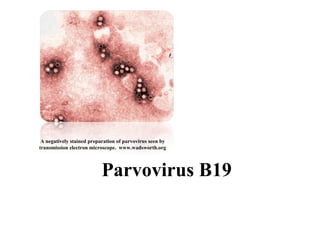
A negatively stained preparation of parvovirus seen by
transmission electron microscope. www.wadsworth.org
Parvovirus B19
• Family: Parvoviridae
– Latin parvus means small
• ~20 nm in diameter
– (0.02 µm)
• Single-stranded DNA virus
• Icosahedral capsid
• No envelope
• Only known human parvovirus
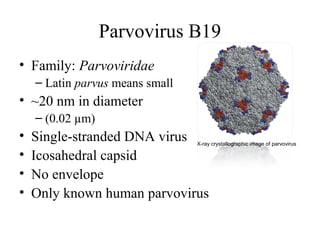
X-ray crystallographic image of parvovirus
Body source & Transmission
• Replication in human cells restricted to
erythroid progenitor cells
– Adult bone marrow
– Fetal liver
• Transmission by close contact
– Airborne droplets
– 50% of a household may become infected
– 10-60% of students in school outbreaks
Environmental Habitat
• Wide distribution among warm-blooded
animals
• B19 is only known HUMAN parvovirus
Pathogenicity
• Fifth disease
– Erythema infectiosum
• Aplastic crisis
– Patients with hemoglobinopathies
– Immunosuppressed, immunodeficient,
immunocompromised
• Congenital parvovirus
– Hydrops fetalis
Pathogenicity
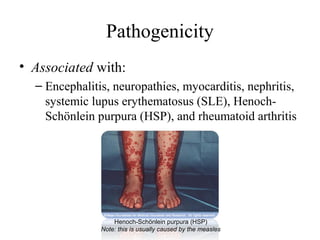
• Associated with:
– Encephalitis, neuropathies, myocarditis, nephritis,
systemic lupus erythematosus (SLE), Henoch-
Schönlein purpura (HSP), and rheumatoid arthritis
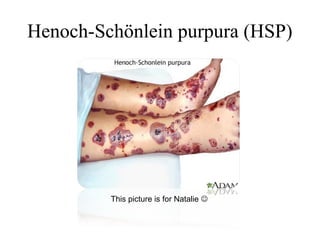
Henoch-Schönlein purpura (HSP)
Note: this is usually caused by the measles
Fifth Disease
 Six separate childhood exanthems were defined from
what was once called the “measles” (Early 20th
Century)
1st
Measles (rubeola) Morbillivirus
2nd
Scarlet fever (Streptococcus pyogenes )
3rd
Rubella (German measles)
4th
Atypical scarlet fever Duke Filatow's disease staph
5th
Erythema infectiosum
6th
Roseola herpesviruses (HHV-6 and HHV-7)
 Exanthem = rash
 Fifth disease is the only one still called by this name
Symptoms – Fifth Disease
• Incubation 7-10 days
• Lasts 5-7 days
• Three Phases
– First phase –peak level of virus and RBC
destruction
• Fever
• Malaise
• Chills
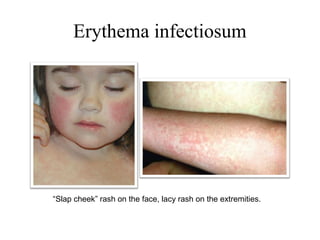
• Bright red, raised “slap cheek” rash
Symptoms – Fifth Disease
Second phase – rash and arthralgia
○ Virus has disappeared – no longer infectious
○ Caused by immune complexes in the capillaries of the
skin
○ Appears at presence of parvovirus IgM
○ Erythematous maculopapular rash on arms and trunk
○ Fades into a lace-like reticular pattern
Third phase
○ Frequent clearing and recurrences for weeks
○ Due to stimuli such as exercise, irritation, or overheating
of skin from bathing or sunlight.
Erythema infectiosum
“Slap cheek” rash on the face, lacy rash on the extremities.
Symptoms – Aplastic Crisis
 Anemic patients
Pallor, fatigue, drop in
hemoglobin >1g/dL
Destroys infected red blood
cells
No reticulocytes to replace
aging or damaged
erythrocytes
This normally happens in
disease but is symptomatic
in anemic patients
 Thrombocytopenic patients
Bruising
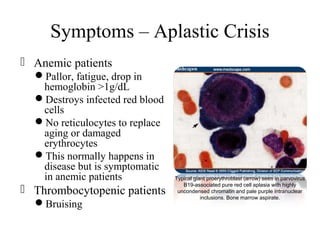
Typical giant proerythroblast (arrow) seen in parvovirus
B19-associated pure red cell aplasia with highly
uncondensed chromatin and pale purple intranuclear
inclusions. Bone marrow aspirate.
Symptoms – Hydrops Fetalis
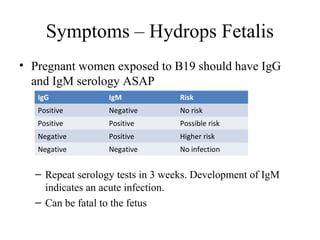
• Pregnant women exposed to B19 should have IgG
and IgM serology ASAP
– Repeat serology tests in 3 weeks. Development of IgM
indicates an acute infection.
– Can be fatal to the fetus
IgG IgM Risk
Positive Negative No risk
Positive Positive Possible risk
Negative Positive Higher risk
Negative Negative No infection
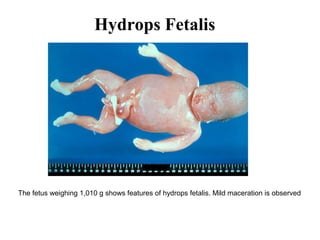
Hydrops Fetalis
The fetus weighing 1,010 g shows features of hydrops fetalis. Mild maceration is observed
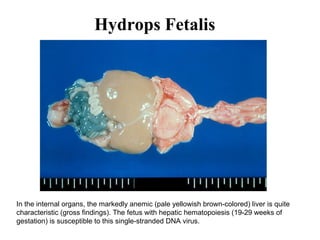
Hydrops Fetalis
In the internal organs, the markedly anemic (pale yellowish brown-colored) liver is quite
characteristic (gross findings). The fetus with hepatic hematopoiesis (19-29 weeks of
gestation) is susceptible to this single-stranded DNA virus.
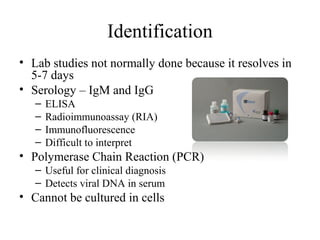
Identification
• Lab studies not normally done because it resolves in
5-7 days
• Serology – IgM and IgG
– ELISA
– Radioimmunoassay (RIA)
– Immunofluorescence
– Difficult to interpret
• Polymerase Chain Reaction (PCR)
– Useful for clinical diagnosis
– Detects viral DNA in serum
• Cannot be cultured in cells
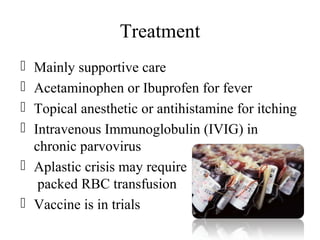
Treatment
 Mainly supportive care
 Acetaminophen or Ibuprofen for fever
 Topical anesthetic or antihistamine for itching
 Intravenous Immunoglobulin (IVIG) in
chronic parvovirus
 Aplastic crisis may require
packed RBC transfusion
 Vaccine is in trials
Henoch-Schönlein purpura (HSP)
This picture is for Natalie 

Parvovirus b19

  • 1.
    Parvovirus B19 A negativelystained preparation of parvovirus seen by transmission electron microscope. www.wadsworth.org
  • 2.
    Parvovirus B19 • Family:Parvoviridae – Latin parvus means small • ~20 nm in diameter – (0.02 µm) • Single-stranded DNA virus • Icosahedral capsid • No envelope • Only known human parvovirus X-ray crystallographic image of parvovirus
  • 3.
    Body source &Transmission • Replication in human cells restricted to erythroid progenitor cells – Adult bone marrow – Fetal liver • Transmission by close contact – Airborne droplets – 50% of a household may become infected – 10-60% of students in school outbreaks
  • 4.
    Environmental Habitat • Widedistribution among warm-blooded animals • B19 is only known HUMAN parvovirus
  • 5.
    Pathogenicity • Fifth disease –Erythema infectiosum • Aplastic crisis – Patients with hemoglobinopathies – Immunosuppressed, immunodeficient, immunocompromised • Congenital parvovirus – Hydrops fetalis
  • 6.
    Pathogenicity • Associated with: –Encephalitis, neuropathies, myocarditis, nephritis, systemic lupus erythematosus (SLE), Henoch- Schönlein purpura (HSP), and rheumatoid arthritis Henoch-Schönlein purpura (HSP) Note: this is usually caused by the measles
  • 7.
    Fifth Disease  Sixseparate childhood exanthems were defined from what was once called the “measles” (Early 20th Century) 1st Measles (rubeola) Morbillivirus 2nd Scarlet fever (Streptococcus pyogenes ) 3rd Rubella (German measles) 4th Atypical scarlet fever Duke Filatow's disease staph 5th Erythema infectiosum 6th Roseola herpesviruses (HHV-6 and HHV-7)  Exanthem = rash  Fifth disease is the only one still called by this name
  • 8.
    Symptoms – FifthDisease • Incubation 7-10 days • Lasts 5-7 days • Three Phases – First phase –peak level of virus and RBC destruction • Fever • Malaise • Chills • Bright red, raised “slap cheek” rash
  • 9.
    Symptoms – FifthDisease Second phase – rash and arthralgia ○ Virus has disappeared – no longer infectious ○ Caused by immune complexes in the capillaries of the skin ○ Appears at presence of parvovirus IgM ○ Erythematous maculopapular rash on arms and trunk ○ Fades into a lace-like reticular pattern Third phase ○ Frequent clearing and recurrences for weeks ○ Due to stimuli such as exercise, irritation, or overheating of skin from bathing or sunlight.
  • 10.
    Erythema infectiosum “Slap cheek”rash on the face, lacy rash on the extremities.
  • 11.
    Symptoms – AplasticCrisis  Anemic patients Pallor, fatigue, drop in hemoglobin >1g/dL Destroys infected red blood cells No reticulocytes to replace aging or damaged erythrocytes This normally happens in disease but is symptomatic in anemic patients  Thrombocytopenic patients Bruising Typical giant proerythroblast (arrow) seen in parvovirus B19-associated pure red cell aplasia with highly uncondensed chromatin and pale purple intranuclear inclusions. Bone marrow aspirate.
  • 12.
    Symptoms – HydropsFetalis • Pregnant women exposed to B19 should have IgG and IgM serology ASAP – Repeat serology tests in 3 weeks. Development of IgM indicates an acute infection. – Can be fatal to the fetus IgG IgM Risk Positive Negative No risk Positive Positive Possible risk Negative Positive Higher risk Negative Negative No infection
  • 13.
    Hydrops Fetalis The fetusweighing 1,010 g shows features of hydrops fetalis. Mild maceration is observed
  • 14.
    Hydrops Fetalis In theinternal organs, the markedly anemic (pale yellowish brown-colored) liver is quite characteristic (gross findings). The fetus with hepatic hematopoiesis (19-29 weeks of gestation) is susceptible to this single-stranded DNA virus.
  • 15.
    Identification • Lab studiesnot normally done because it resolves in 5-7 days • Serology – IgM and IgG – ELISA – Radioimmunoassay (RIA) – Immunofluorescence – Difficult to interpret • Polymerase Chain Reaction (PCR) – Useful for clinical diagnosis – Detects viral DNA in serum • Cannot be cultured in cells
  • 16.
    Treatment  Mainly supportivecare  Acetaminophen or Ibuprofen for fever  Topical anesthetic or antihistamine for itching  Intravenous Immunoglobulin (IVIG) in chronic parvovirus  Aplastic crisis may require packed RBC transfusion  Vaccine is in trials
  • 17.
    Henoch-Schönlein purpura (HSP) Thispicture is for Natalie 