GROUP 11
NAMES REG
MANDREW WILLIAM VU-BPC-2209-0697-DAY
MAHORO AZARIAH VU-BPC-2209-1137-DAY
MAGEMBE DENIS MAASA VU-BPC-2301-1205-DAY
MAATO ROBERT VU-BPC-2301-0070-DAY
GROUP 11
Explain the pathogenesis of Parvovirus B19, focusing on how the virus causes
erythema infectiosum (fifth disease).
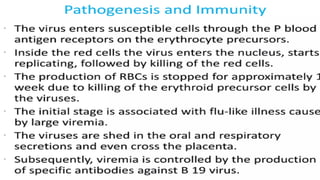
• B19 virus replicates only when a cell is in S phase, which explains why the
virus replicates in red cell precursors destroying them but not in mature
red cells.
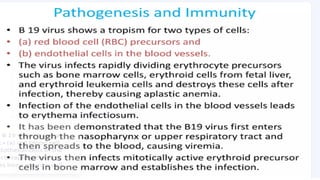
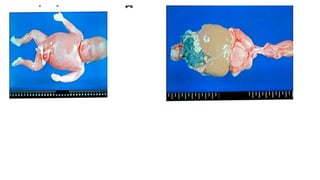
• B19 virus infects primarily two types of cells: red blood cell precursors
(erythroblasts) in the bone marrow, which accounts for the aplastic
anemia, and endothelial cells in the blood vessels, which accounts, in
part, for the rash associated with erythema infectiosum.
What is the role of the immune response in controlling Parvovirus B19 infection, and
how does this response contribute to the clinical symptoms?
The immune response to parvovirus B19 plays a crucial role in controlling
the infection but also contributes to the clinical symptoms seen in the
disease.
1: Innate Immune Response: The body initially responds with innate
immunity, including interferon production and activation of macrophages.
However, parvovirus B19 directly infects erythroid progenitor cells,
reducing red blood cell production. This causes anemia in susceptible
individuals, especially those with chronic hemolytic conditions.
2: Adaptive Immune Response: The adaptive response involves:
• Humoral immunity: Antibodies (IgM first, followed by IgG) neutralize the
virus, clearing the viremia. Antibody production coincides with the
resolution of symptoms in immunocompetent individuals.
• Cell-mediated immunity: CD8+ T cells target infected cells, promoting viral
clearance but contributing to inflammation and tissue damage.
Clinical Symptoms:
• Erythema infectiosum ("fifth disease"): The "slapped cheek" rash seen in
children is partly due to immune complex deposition in the skin, triggered
by immune responses to the viral particles.
• Arthralgia/arthritis: In adults, immune complexes can deposit in joints,
leading to pain and swelling (arthritis or arthralgia).
Describe the effects of Parvovirus B19 on erythroid progenitor cells and how
this leads to conditions such as transient aplastic crisis in certain patients
• The virus causes lysis of the cells by producing ns1 and vp1 proteins which
disrupt the cell membrane and interfere with transcription factors and
inhibit DNA synthesis and replication
• Children with chronic anemia, such as sickle cell anemia, thalassemia, and
spherocytosis, can have transient but severe aplastic anemia (aplastic
crisis) when infected with B19 virus. People with normal red blood cells do
not have clinically apparent anemia, although their red blood cell
precursors are infected.
• Parvovirus B19 primarily targets erythroid progenitor cells in the bone
marrow, which are crucial for red blood cell (RBC) production. The virus
binds to the P antigen (globoside), a surface receptor on these cells, and
then enters the cells, halting their maturation and proliferation. This direct
cytotoxic effect causes cell lysis and suppresses erythropoiesis (RBC
production).
Effects on Erythroid Progenitor Cells:
• Inhibition of erythropoiesis: Parvovirus B19 blocks the development
of erythroid precursors at the proerythroblast stage, leading to a
sharp drop in new red blood cell formation.
• Cell lysis: Infected cells undergo apoptosis (programmed cell death),
further reducing the bone marrow’s ability to produce RBCs
Pathophysiology of Transient Aplastic Crisis:
In healthy individuals, the temporary suppression of
erythropoiesis lasts for about 1-2 weeks, but their normal RBC
lifespan (about 120 days) allows them to maintain sufficient
oxygen-carrying capacity during this time. However, in
patients with pre-existing conditions that lead to shortened
RBC survival, such as:
• Chronic hemolytic anemia (e.g., sickle cell disease, hereditary
spherocytosis)
• Autoimmune hemolytic anemia
• Thalassemia
These individuals depend heavily on continuous erythropoiesis to
maintain adequate RBC levels. When parvovirus B19 infects these
patients, the transient halt in RBC production results in a rapid and
severe drop in hemoglobin levels. This leads to transient aplastic crisis
(TAC), characterized by:
• Severe anemia: Due to the sudden lack of new RBCs, hemoglobin levels
plummet.
• Reticulocytopenia: A significant drop in reticulocytes (immature RBCs),
as the bone marrow cannot produce them.
• Pallor, fatigue, and weakness: Symptoms are due to the rapid decline in
oxygen-carrying capacity.
Therefore, without intervention (such as blood transfusion), TAC can be
life-threatening, especially in patients with chronic hemolytic disorders.
However, once the infection resolves, erythropoiesis resumes, and the
condition improves.
CONT
• Aplastic crisis: In patients with underlying hemolytic disorders,
parvovirus B19 suppresses erythropoiesis, causing a temporary halt in
red blood cell production, leading to severe anemia.
• In immunocompromised individuals, the lack of an adequate immune
response can result in chronic viremia and persistent infection
How does Parvovirus B19 infection lead to hydrops fetalis, and what are
the risks to the developing fetus during maternal infection
• If a woman is infected with B19 virus during the first or second
trimester of pregnancy, the virus may cross the placenta and infect
the fetus. Infection during the first trimester is associated with fetal
death, whereas infection during the second trimester leads to
hydrops fetalis. Third-trimester infections do not result in important
clinical findings. B19 virus is not a common cause of congenital
abnormalities probably because the fetus dies when infected early
in pregnancy.
• Hydrops fetalis manifests as massive edema of the fetus. This is
secondary to congestive heart failure precipitated by severe anemia
caused by the death of parvovirus B19–infected erythroblasts in the
fetus
Parvovirus B19 infection can cause different clinical manifestations
in children and adults. :
IN CHILDREN
• 1. Fifth Disease (Erythema Infectiosum):
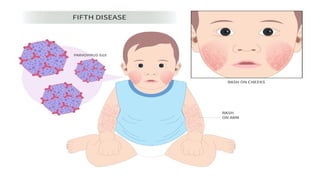
• Rash: A classic "slapped cheek" rash that appears first on the face and can spread
to the trunk and limbs.
• Mild Fever: Often low-grade and may not be prominent.
• Malaise: General feelings of discomfort or fatigue.
• Joint Pain: Generally less common in young children but can occur.
• Cold-like Symptoms: Such as a runny nose or mild cough preceding the rash.
• 2. Aplastic Crisis:
• In children with underlying hemolytic anemia (e.g., sickle cell disease), B19 can
cause a significant drop in red blood cells, leading to an aplastic crisis.
Significance of Parvovirusnb19 in immunocompromised
patients
1. Increased Risk of Severe Illness:
.Immunocompromised individuals (e.g., those undergoing chemotherapy, organ
transplant recipients, or individuals with HIV) are at a higher risk for severe
manifestations of parvovirus B19 infection due to their impaired immune response.
• 2. Aplastic Crisis:
• In these patients, parvovirus B19 can lead to a rapid and severe drop in red blood
cell production. This is particularly concerning for those with underlying bone
marrow suppression or hematological malignancies, potentially resulting in severe
anemia requiring transfusion.
• 3. Persistent Infection:
• Parvovirus B19 can cause chronic infection in immunocompromised patients,
leading to prolonged symptoms and the possibility of recurrent anemia, which may
complicate management.
IN ADULTS
• Joint Pain: Adults often experience arthralgia (joint pain) and arthritis,
especially women, which can be more severe and prolonged than in
children.
• Rash: The rash may not be as prominent or typical as in children and
may vary widely.
• Flu-like Symptoms: - Adults might present with more pronounced
systemic symptoms like fever, headache, and myalgias.
• Aplastic Anemia : - Similar to children, adults with certain underlying
conditions can experience aplastic anemia due to the virus.
Explain the clinical significance of Parvovirus B19 infection in
immunocompromised patients and individuals with chronic hemolytic
disorders (e.g., sickle cell disease).
• People with immunodeficiencies, especially HIV-infected,
chemotherapy, or transplant patients, can have chronic
anemia, leukopenia, or thrombocytopenia as a result of
chronic B19 infection.
• Immunocompromised individuals are at an increased risk of
severe manifestations of Parvovirus B19 infections due to
their impaired immune response.
Individuals with Chronic Hemolytic Disorders (e.g., Sickle Cell
Disease)
• 1. Aplastic Crisis:
• - Patients with chronic hemolytic disorders, such as sickle cell disease, have an
increased risk of aplastic crisis when infected with parvovirus B19. The virus
targets erythroid progenitor cells in the bone marrow, leading to a sudden
decrease in red blood cell production. This can precipitate a severe anemia crisis,
exacerbating existing complications of their condition.
• 2. Complications from Anemia:
• The sudden drop in hemoglobin levels can lead to significant morbidity, including
fatigue, pallor, tachycardia, and increased risk of stroke or other vascular
complications in sickle cell patients, who are already at risk due to their disease.
• 3. Monitoring and Management:
• Patients with sickle cell disease are often monitored closely for signs of infection,
and immediate management may include blood transfusions or supportive care if
an aplastic crisis occurs.
What are the key differences between asymptomatic Parvovirus B19
infections and symptomatic cases, such as erythema infectiosum or
arthropathy?
• In asymptomatic there are no signs, the virus is killed by the
immune but maybe present in the bloodstream for a while
• In symptomatic , symptoms of red cheeks in erythema
infectiosum, arthritis in elderly women, aplastic anemia, fetal
death in severe situations and leukopenia, or
thrombocytopenia in patients will occur.
Discuss the potential long term complications of
parvovirusB19 infection, including its association with chronic
anemia and autoimmune conditions
• Two key complications of Parvovirus B19 infection include chronic anemia and autoimmune
disorders.
• 1. Chronic Anemia
• Parvovirus B19 targets and infects erythroid progenitor cells (precursor cells in the bone
marrow responsible for red blood cell production).
• By halting the production of red blood cells, the virus can lead to anemia. Which can be
categorized as follows:
• Persistent Anemia in Immunocompromised Patients
• Immunocompromised individuals, such as those with HIV/AIDS, organ transplant recipients,
or those undergoing chemotherapy, may be unable to clear the virus. As a result, parvovirus
B19 infection can persist and lead to chronic anemia. These patients may experience long-
term or recurring symptoms of fatigue, weakness, and pallor due to ongoing suppression of
red blood cell production.
cont’n
• Aplastic Crisis
• In people with underlying hemolytic disorders (e.g., sickle cell disease,
thalassemia, hereditary spherocytosis), where red blood cells are already being
destroyed faster than they are made, parvovirus B19 infection can cause a sudden
and severe drop in hemoglobin levels. This leads to an aplastic crisis—a condition
in which red blood cell production is critically low.
• Pure Red Cell Aplasia (PRCA)
• In some cases, parvovirus B19 can cause pure red cell aplasia (PRCA), a rare
condition in which the bone marrow fails to produce red blood cells, leading to
severe anemia. PRCA can be chronic in immunocompromised individuals, and
long-term treatment may require immunoglobulin therapy to manage the
infection.
Cont’
• 2. Autoimmune Conditions
• Parvovirus B19 has been associated with the development
of various autoimmune conditions. These could be due to:
• Triggering of autoimmune responses due to molecular
mimicry (where viral proteins resemble host proteins) or
• Persistent immune activation.
• Some autoimmune diseases associated with parvovirus
B19 include
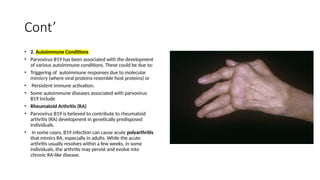
• Rheumatoid Arthritis (RA)
• Parvovirus B19 is believed to contribute to rheumatoid
arthritis (RA) development in genetically predisposed
individuals.
• In some cases, B19 infection can cause acute polyarthritis
that mimics RA, especially in adults. While the acute
arthritis usually resolves within a few weeks, in some
individuals, the arthritis may persist and evolve into
chronic RA-like disease.
Cont’n
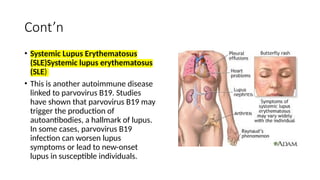
• Systemic Lupus Erythematosus
(SLE)Systemic lupus erythematosus
(SLE)
• This is another autoimmune disease
linked to parvovirus B19. Studies
have shown that parvovirus B19 may
trigger the production of
autoantibodies, a hallmark of lupus.
In some cases, parvovirus B19
infection can worsen lupus
symptoms or lead to new-onset
lupus in susceptible individuals.
Cont’n
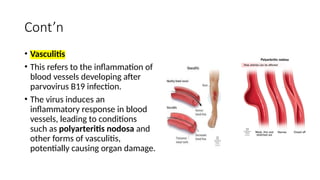
• Vasculitis
• This refers to the inflammation of
blood vessels developing after
parvovirus B19 infection.
• The virus induces an
inflammatory response in blood
vessels, leading to conditions
such as polyarteritis nodosa and
other forms of vasculitis,
potentially causing organ damage.
Cont’n
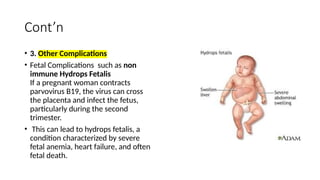
• 3. Other Complications
• Fetal Complications such as non
immune Hydrops Fetalis
If a pregnant woman contracts
parvovirus B19, the virus can cross
the placenta and infect the fetus,
particularly during the second
trimester.
• This can lead to hydrops fetalis, a
condition characterized by severe
fetal anemia, heart failure, and often
fetal death.
Cont’n
THANK YOU

Group presentation for microbiology ppt

  • 1.
    GROUP 11 NAMES REG MANDREWWILLIAM VU-BPC-2209-0697-DAY MAHORO AZARIAH VU-BPC-2209-1137-DAY MAGEMBE DENIS MAASA VU-BPC-2301-1205-DAY MAATO ROBERT VU-BPC-2301-0070-DAY GROUP 11
  • 2.
    Explain the pathogenesisof Parvovirus B19, focusing on how the virus causes erythema infectiosum (fifth disease). • B19 virus replicates only when a cell is in S phase, which explains why the virus replicates in red cell precursors destroying them but not in mature red cells. • B19 virus infects primarily two types of cells: red blood cell precursors (erythroblasts) in the bone marrow, which accounts for the aplastic anemia, and endothelial cells in the blood vessels, which accounts, in part, for the rash associated with erythema infectiosum.
  • 5.
    What is therole of the immune response in controlling Parvovirus B19 infection, and how does this response contribute to the clinical symptoms? The immune response to parvovirus B19 plays a crucial role in controlling the infection but also contributes to the clinical symptoms seen in the disease. 1: Innate Immune Response: The body initially responds with innate immunity, including interferon production and activation of macrophages. However, parvovirus B19 directly infects erythroid progenitor cells, reducing red blood cell production. This causes anemia in susceptible individuals, especially those with chronic hemolytic conditions.
  • 6.
    2: Adaptive ImmuneResponse: The adaptive response involves: • Humoral immunity: Antibodies (IgM first, followed by IgG) neutralize the virus, clearing the viremia. Antibody production coincides with the resolution of symptoms in immunocompetent individuals. • Cell-mediated immunity: CD8+ T cells target infected cells, promoting viral clearance but contributing to inflammation and tissue damage. Clinical Symptoms: • Erythema infectiosum ("fifth disease"): The "slapped cheek" rash seen in children is partly due to immune complex deposition in the skin, triggered by immune responses to the viral particles. • Arthralgia/arthritis: In adults, immune complexes can deposit in joints, leading to pain and swelling (arthritis or arthralgia).
  • 7.
    Describe the effectsof Parvovirus B19 on erythroid progenitor cells and how this leads to conditions such as transient aplastic crisis in certain patients • The virus causes lysis of the cells by producing ns1 and vp1 proteins which disrupt the cell membrane and interfere with transcription factors and inhibit DNA synthesis and replication • Children with chronic anemia, such as sickle cell anemia, thalassemia, and spherocytosis, can have transient but severe aplastic anemia (aplastic crisis) when infected with B19 virus. People with normal red blood cells do not have clinically apparent anemia, although their red blood cell precursors are infected. • Parvovirus B19 primarily targets erythroid progenitor cells in the bone marrow, which are crucial for red blood cell (RBC) production. The virus binds to the P antigen (globoside), a surface receptor on these cells, and then enters the cells, halting their maturation and proliferation. This direct cytotoxic effect causes cell lysis and suppresses erythropoiesis (RBC production).
  • 8.
    Effects on ErythroidProgenitor Cells: • Inhibition of erythropoiesis: Parvovirus B19 blocks the development of erythroid precursors at the proerythroblast stage, leading to a sharp drop in new red blood cell formation. • Cell lysis: Infected cells undergo apoptosis (programmed cell death), further reducing the bone marrow’s ability to produce RBCs
  • 9.
    Pathophysiology of TransientAplastic Crisis: In healthy individuals, the temporary suppression of erythropoiesis lasts for about 1-2 weeks, but their normal RBC lifespan (about 120 days) allows them to maintain sufficient oxygen-carrying capacity during this time. However, in patients with pre-existing conditions that lead to shortened RBC survival, such as: • Chronic hemolytic anemia (e.g., sickle cell disease, hereditary spherocytosis) • Autoimmune hemolytic anemia • Thalassemia
  • 10.
    These individuals dependheavily on continuous erythropoiesis to maintain adequate RBC levels. When parvovirus B19 infects these patients, the transient halt in RBC production results in a rapid and severe drop in hemoglobin levels. This leads to transient aplastic crisis (TAC), characterized by: • Severe anemia: Due to the sudden lack of new RBCs, hemoglobin levels plummet. • Reticulocytopenia: A significant drop in reticulocytes (immature RBCs), as the bone marrow cannot produce them. • Pallor, fatigue, and weakness: Symptoms are due to the rapid decline in oxygen-carrying capacity. Therefore, without intervention (such as blood transfusion), TAC can be life-threatening, especially in patients with chronic hemolytic disorders. However, once the infection resolves, erythropoiesis resumes, and the condition improves.
  • 11.
    CONT • Aplastic crisis:In patients with underlying hemolytic disorders, parvovirus B19 suppresses erythropoiesis, causing a temporary halt in red blood cell production, leading to severe anemia. • In immunocompromised individuals, the lack of an adequate immune response can result in chronic viremia and persistent infection
  • 12.
    How does ParvovirusB19 infection lead to hydrops fetalis, and what are the risks to the developing fetus during maternal infection • If a woman is infected with B19 virus during the first or second trimester of pregnancy, the virus may cross the placenta and infect the fetus. Infection during the first trimester is associated with fetal death, whereas infection during the second trimester leads to hydrops fetalis. Third-trimester infections do not result in important clinical findings. B19 virus is not a common cause of congenital abnormalities probably because the fetus dies when infected early in pregnancy. • Hydrops fetalis manifests as massive edema of the fetus. This is secondary to congestive heart failure precipitated by severe anemia caused by the death of parvovirus B19–infected erythroblasts in the fetus
  • 14.
    Parvovirus B19 infectioncan cause different clinical manifestations in children and adults. : IN CHILDREN • 1. Fifth Disease (Erythema Infectiosum): • Rash: A classic "slapped cheek" rash that appears first on the face and can spread to the trunk and limbs. • Mild Fever: Often low-grade and may not be prominent. • Malaise: General feelings of discomfort or fatigue. • Joint Pain: Generally less common in young children but can occur. • Cold-like Symptoms: Such as a runny nose or mild cough preceding the rash. • 2. Aplastic Crisis: • In children with underlying hemolytic anemia (e.g., sickle cell disease), B19 can cause a significant drop in red blood cells, leading to an aplastic crisis.
  • 16.
    Significance of Parvovirusnb19in immunocompromised patients 1. Increased Risk of Severe Illness: .Immunocompromised individuals (e.g., those undergoing chemotherapy, organ transplant recipients, or individuals with HIV) are at a higher risk for severe manifestations of parvovirus B19 infection due to their impaired immune response. • 2. Aplastic Crisis: • In these patients, parvovirus B19 can lead to a rapid and severe drop in red blood cell production. This is particularly concerning for those with underlying bone marrow suppression or hematological malignancies, potentially resulting in severe anemia requiring transfusion. • 3. Persistent Infection: • Parvovirus B19 can cause chronic infection in immunocompromised patients, leading to prolonged symptoms and the possibility of recurrent anemia, which may complicate management.
  • 17.
    IN ADULTS • JointPain: Adults often experience arthralgia (joint pain) and arthritis, especially women, which can be more severe and prolonged than in children. • Rash: The rash may not be as prominent or typical as in children and may vary widely. • Flu-like Symptoms: - Adults might present with more pronounced systemic symptoms like fever, headache, and myalgias. • Aplastic Anemia : - Similar to children, adults with certain underlying conditions can experience aplastic anemia due to the virus.
  • 18.
    Explain the clinicalsignificance of Parvovirus B19 infection in immunocompromised patients and individuals with chronic hemolytic disorders (e.g., sickle cell disease). • People with immunodeficiencies, especially HIV-infected, chemotherapy, or transplant patients, can have chronic anemia, leukopenia, or thrombocytopenia as a result of chronic B19 infection. • Immunocompromised individuals are at an increased risk of severe manifestations of Parvovirus B19 infections due to their impaired immune response.
  • 19.
    Individuals with ChronicHemolytic Disorders (e.g., Sickle Cell Disease) • 1. Aplastic Crisis: • - Patients with chronic hemolytic disorders, such as sickle cell disease, have an increased risk of aplastic crisis when infected with parvovirus B19. The virus targets erythroid progenitor cells in the bone marrow, leading to a sudden decrease in red blood cell production. This can precipitate a severe anemia crisis, exacerbating existing complications of their condition. • 2. Complications from Anemia: • The sudden drop in hemoglobin levels can lead to significant morbidity, including fatigue, pallor, tachycardia, and increased risk of stroke or other vascular complications in sickle cell patients, who are already at risk due to their disease. • 3. Monitoring and Management: • Patients with sickle cell disease are often monitored closely for signs of infection, and immediate management may include blood transfusions or supportive care if an aplastic crisis occurs.
  • 20.
    What are thekey differences between asymptomatic Parvovirus B19 infections and symptomatic cases, such as erythema infectiosum or arthropathy? • In asymptomatic there are no signs, the virus is killed by the immune but maybe present in the bloodstream for a while • In symptomatic , symptoms of red cheeks in erythema infectiosum, arthritis in elderly women, aplastic anemia, fetal death in severe situations and leukopenia, or thrombocytopenia in patients will occur.
  • 21.
    Discuss the potentiallong term complications of parvovirusB19 infection, including its association with chronic anemia and autoimmune conditions • Two key complications of Parvovirus B19 infection include chronic anemia and autoimmune disorders. • 1. Chronic Anemia • Parvovirus B19 targets and infects erythroid progenitor cells (precursor cells in the bone marrow responsible for red blood cell production). • By halting the production of red blood cells, the virus can lead to anemia. Which can be categorized as follows: • Persistent Anemia in Immunocompromised Patients • Immunocompromised individuals, such as those with HIV/AIDS, organ transplant recipients, or those undergoing chemotherapy, may be unable to clear the virus. As a result, parvovirus B19 infection can persist and lead to chronic anemia. These patients may experience long- term or recurring symptoms of fatigue, weakness, and pallor due to ongoing suppression of red blood cell production.
  • 22.
    cont’n • Aplastic Crisis •In people with underlying hemolytic disorders (e.g., sickle cell disease, thalassemia, hereditary spherocytosis), where red blood cells are already being destroyed faster than they are made, parvovirus B19 infection can cause a sudden and severe drop in hemoglobin levels. This leads to an aplastic crisis—a condition in which red blood cell production is critically low. • Pure Red Cell Aplasia (PRCA) • In some cases, parvovirus B19 can cause pure red cell aplasia (PRCA), a rare condition in which the bone marrow fails to produce red blood cells, leading to severe anemia. PRCA can be chronic in immunocompromised individuals, and long-term treatment may require immunoglobulin therapy to manage the infection.
  • 23.
    Cont’ • 2. AutoimmuneConditions • Parvovirus B19 has been associated with the development of various autoimmune conditions. These could be due to: • Triggering of autoimmune responses due to molecular mimicry (where viral proteins resemble host proteins) or • Persistent immune activation. • Some autoimmune diseases associated with parvovirus B19 include • Rheumatoid Arthritis (RA) • Parvovirus B19 is believed to contribute to rheumatoid arthritis (RA) development in genetically predisposed individuals. • In some cases, B19 infection can cause acute polyarthritis that mimics RA, especially in adults. While the acute arthritis usually resolves within a few weeks, in some individuals, the arthritis may persist and evolve into chronic RA-like disease.
  • 24.
    Cont’n • Systemic LupusErythematosus (SLE)Systemic lupus erythematosus (SLE) • This is another autoimmune disease linked to parvovirus B19. Studies have shown that parvovirus B19 may trigger the production of autoantibodies, a hallmark of lupus. In some cases, parvovirus B19 infection can worsen lupus symptoms or lead to new-onset lupus in susceptible individuals.
  • 25.
    Cont’n • Vasculitis • Thisrefers to the inflammation of blood vessels developing after parvovirus B19 infection. • The virus induces an inflammatory response in blood vessels, leading to conditions such as polyarteritis nodosa and other forms of vasculitis, potentially causing organ damage.
  • 26.
    Cont’n • 3. OtherComplications • Fetal Complications such as non immune Hydrops Fetalis If a pregnant woman contracts parvovirus B19, the virus can cross the placenta and infect the fetus, particularly during the second trimester. • This can lead to hydrops fetalis, a condition characterized by severe fetal anemia, heart failure, and often fetal death.
  • 27.