NEPHELOMETRY AND
TURBIDIMETRIC ANALYSIS
By
Ganesh Kumar
Rani Chennamma college of Pharmacy
Belagavi
kumarganesh1357@gmail.com
Nephelometry and Turbidimetry
GENERAL PRINCIPLE
When light is allow to pass through a suspention,the part
of the incident light or radient energy is dissipated by
absorption , reflection , and refraction while the remaining
is transmitted.
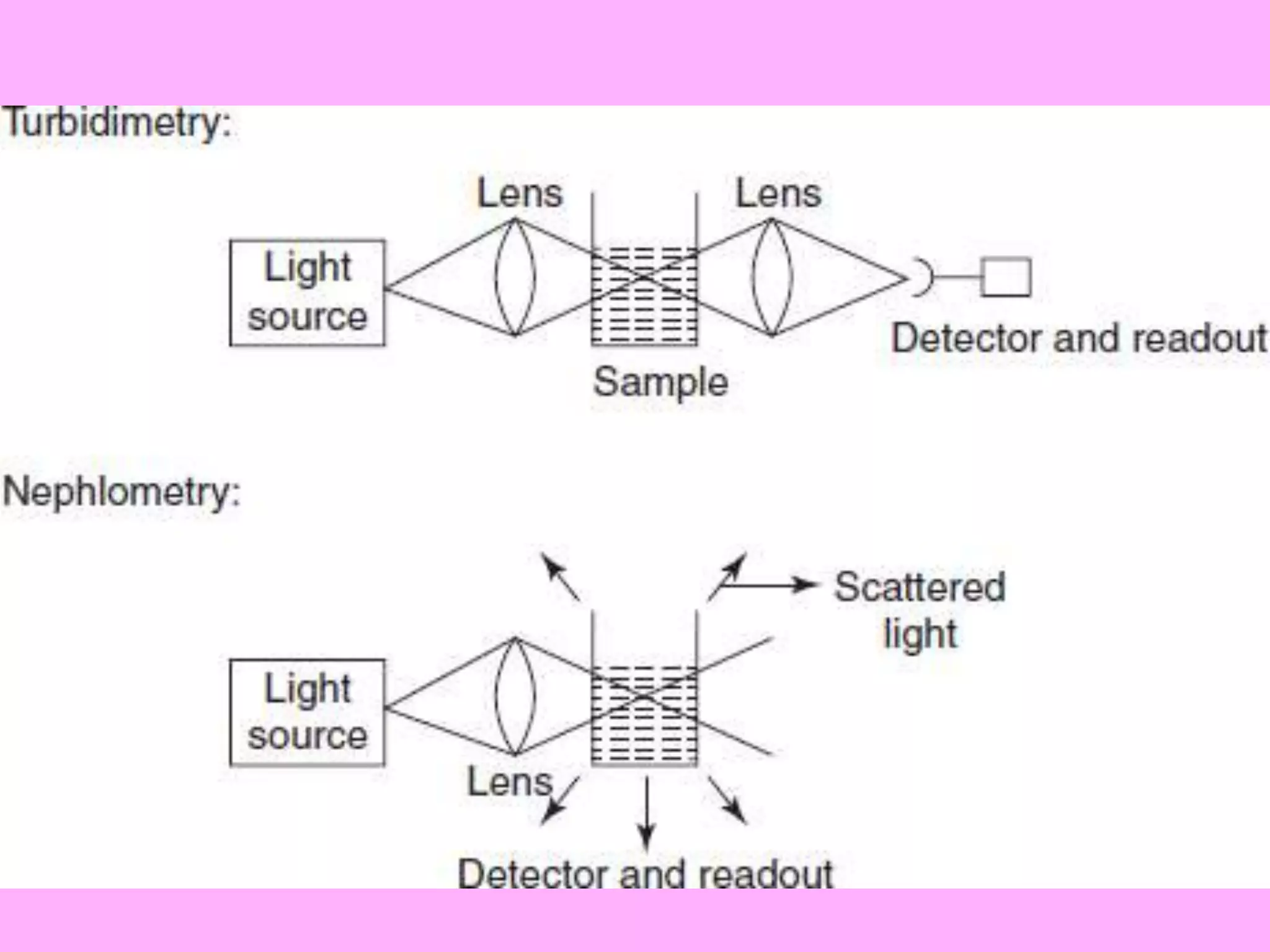
Measurement of the intensity of the transmitted light as a
function of the concentration of the suspended particles
forms the basis of turbidimetric analysis.
are technique of analysis
of suspended particles in liquid or gases.
In Nephelometry the measurement of the intensity of the
scattered light as a function of the concentration of the
dispersed phase forms the basis of nephelometric analysis.
Turbidimetry is much similar to colorimetry because both
involve measurement of the intensity of light transmitted
through a medium.
Nephelometry is much similar to fluorimetric method
because both involve the measurement of scattered light.
Choice between Nephelometry and Turbidimetry
It depends upon the amount of light scattered by
suspended particles present in the solution. Turbidimetry is
satisfactory for determining relatively high concentration
of suspended particles because the scattering is quite
extensive due to the presence of many particles.
On the other hand nephelometry is most suited for the
suspension is less dense and decrease in power of the
incident beam is small.
THEORY
1)Reflection VS. Scattering
Both reflection and scattering phenomenon are very
important in turbidimetric and nephelometry. If light is
passed through the solution having the suspended
particles,reflection will take place if the dimention of
suspended particles are larger than the wavelength of
incident light.
On the other hand ,scattering will take place if the
dimention of suspended particles are of the same order of
magnitude or smaller than the incident wavelength.
In nephelometry measurement , the suspended particles
should be small with respect to the wavelength used .This
is required so that the scattering is predominates over
reflection.
In turbidimetry measurements,particles are larger than the
wavelength of light do not pose much problem because
measurement depends upon the total radiation removed
from the primary beam.
2) Factor affecting measurement
The amount of radiation removed or deviated from the
primary radiation depends on the following factors:
a)Concentration:In turbidimetry transmittance is
inversely proportional to the concentration of particles.
In nephelometry concentration is not important because ,in
nephelometry scattering intensity is depends upon a number
of complicated factor like the properties of the scattering
suspension and the angle and the geometry of measuring
instrument.
b)Particle geometry
In both turbidimetry and nephelometry analysis, the most
critical factor is the control of particle size and shape.
c)Wavelength of incident light
The general practice is to select such a wavelength where
the sample solution does not absorb strongly.
d)Refractory index difference
Best results are obtain when there is an appreciable
refractive index difference between the particles and its
surrounding medium.
INSTRUMENTATION
1)Sources
One may use white light in nephelometers but it is
advantageous to use monochromatic radiation.Similarly
,monochromatic radiation is used in turbidimeter to
minimize absorption.
A mercury arc or a laser, with appropriate filter
combinations for isolating one of its emission lines,is
undoubtedly the most convenient source.
2)Detectors
In nephelometers photomultiplier tubes should be used as
detectors because the intensity of scattering radiation is
very small.
In turbidimeters, ordinary detectors such as phototubes
may be used.
Photomultiplier tube
3)Cells
We can use cylindrical cells,they must have flat faces
where the entering and existing beams are to be
passed.This is to minimize the reflections and multiple
scatterings from the cell wall.
4)Turbidimeters
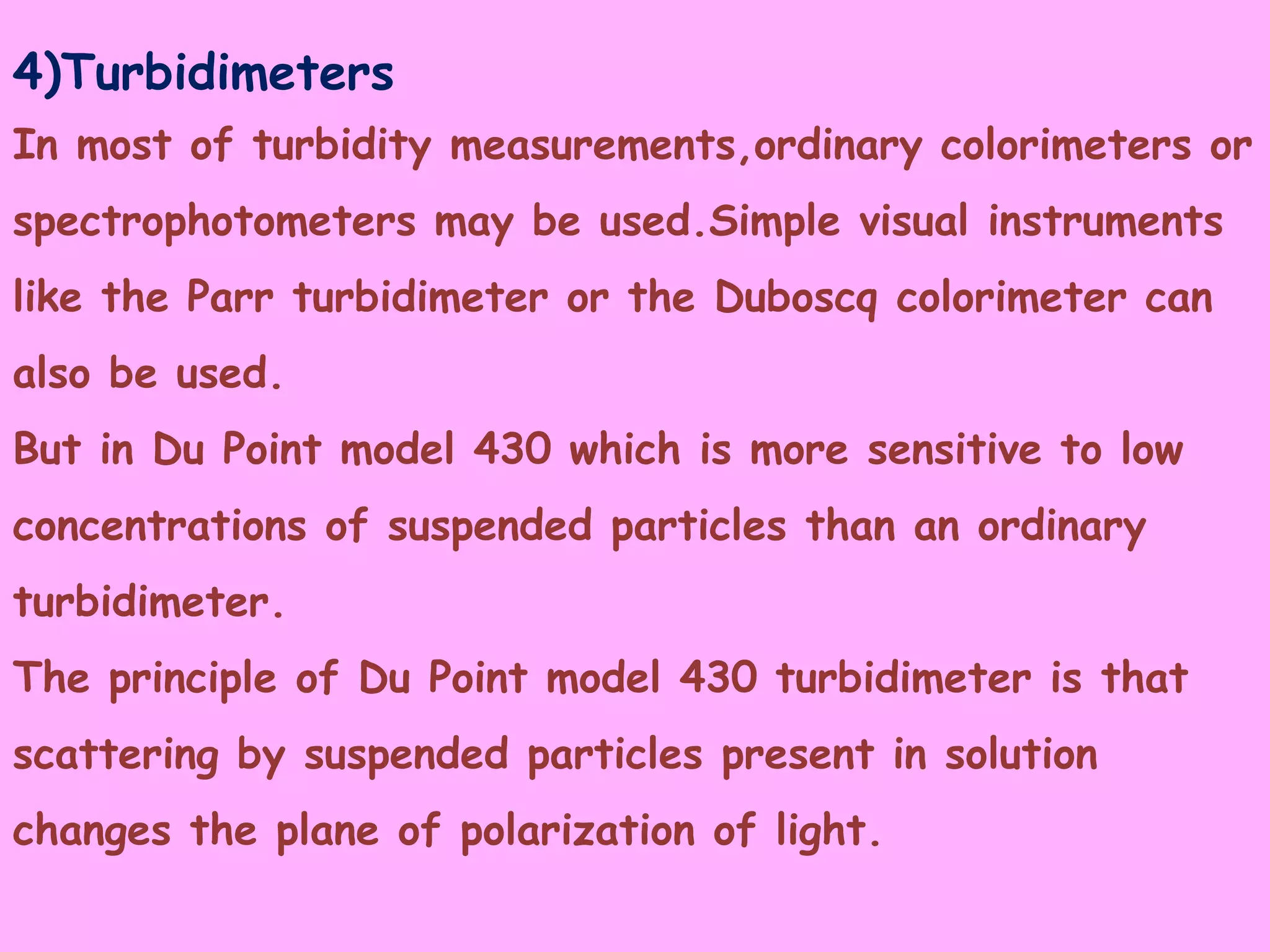
In most of turbidity measurements,ordinary colorimeters or
spectrophotometers may be used.Simple visual instruments
like the Parr turbidimeter or the Duboscq colorimeter can
also be used.
But in Du Point model 430 which is more sensitive to low
concentrations of suspended particles than an ordinary
turbidimeter.
The principle of Du Point model 430 turbidimeter is that
scattering by suspended particles present in solution
changes the plane of polarization of light.
Du Pont model 430 Turbidimeter
The beam of light obtained from the lamp is allowed to pass
through the primary polarizer. This causes the incident
beam to be plane polarized. Then the plane polarized light
is passed through the sample. After passing through the
sample ,the beam gets splitted up into two parts with the
half silvered mirror and then detected with two
separate,photocells.
When sample solution is not having suspended particles
photocell A shows maximum response whereas photocells B
shows minimum or zero response for the sample solutions
having suspended particles.
The ratio of signal B to signal A is considered to be a
measure of the concentration of suspended particles.
Thus the ratio of two signals is a sensitive measure of
turbidity.
Nephelometer
Ordinary fluorimeters are generally used for nephelometric
measurements.In some cases spectrophotometers can be
employed as nephelometers.
The multiplier phototube used as a receiver is mounted on a
turnable and may be positioned at any desired angles from
0 to 180 to the exit beam. But for the most of
nephelometric measurements it is generally positioned at 45
or 90 to the primary beam.
The nephelometer can be used for the determination of
particle size,shape and molecular weight in addition to
nephelometric measurements.
APPLICATIONS
Turbidimetry and nephelometry can be used on
gaseous,liquid or even transparent solid samples in greatly
varying proportions.The various applications of both these
techniques are as follows
1]Inorganic Analysis
2]Organic Analysis
3]Biochemical Analysis
4]Air and Water Pollution
5]TurbidimetricTitration
6]Determination of Molecular weights of High
polymers
7]Atmosphoric pollution
1]Inorganic Analysis
The important uses of nephelomery and turbidimetry are
the determination of sulphate as BaSO4,carbonate as
BaCO3,chloride as AgCl,fluoride as CaF2,cyanide as
AgCN,calciumas oxalate.
Out of these,sulphate determination is a particular
importance and serves for the routine determination of
total sulphur in coke,coal,oils,rubbers,plastics etc
Another important application of nephelometry and
turbiditimetry is the determination of carbon dioxide.
2]Organic Analysis
In food and bevarages,turbidimeter is used for analysis of
turbidity in sugar products,and clarity of citrus
juices.Another intresting application is the determination of
benzene in alcohol by dilution with water to make an
immiscible suspension.
3]Biochemical Analysis
An important application of turbidimetry is to measure the
amount of growth of a test bacterium in a liquid nutrient
medium.It is also used to find out the amount of amino
acid, vitamins and antibiotics.
Nephelometry has been used for the determination of
protein and the determination of yeast,glycogen and of
beta and gamma globulin in blood serum and plasma.
4]Air and Water Pollution
Turbidimetry and nephelometry are used for the continuous
monitoring of air and water pollution.
In air,dust and smoke are monitored whereas in
water,turbidity is monitored.
5]TurbidimetricTitration
These titration may be carried out in a manner analogous
to photometric titrations. In these titrations, the
absorbance is to be plotted against the volume of titrant
added.With the increase in the volume of titrant,the
concentration of precipitate increases and hence the
absorbance increases.When all the substances get
precipitated,the absorbance become constant.
6]Determination of Molecular weights of High
polymers
In order to determine molecular weight of polymer
turbidity is measured at different concentrations of its
solution in a suitable medium.
7]Atmospheric pollution
Smoke and fogs are visible largely due to light scattering
effects.
Thus these effects are useful in monitoring atmospheric
pollution.
ANY QUESTIONS
?
Thank You

Nephelometry and Turbidimetry

  • 1.
    NEPHELOMETRY AND TURBIDIMETRIC ANALYSIS By GaneshKumar Rani Chennamma college of Pharmacy Belagavi kumarganesh1357@gmail.com
  • 2.
    Nephelometry and Turbidimetry GENERALPRINCIPLE When light is allow to pass through a suspention,the part of the incident light or radient energy is dissipated by absorption , reflection , and refraction while the remaining is transmitted. Measurement of the intensity of the transmitted light as a function of the concentration of the suspended particles forms the basis of turbidimetric analysis. are technique of analysis of suspended particles in liquid or gases.
  • 4.
    In Nephelometry themeasurement of the intensity of the scattered light as a function of the concentration of the dispersed phase forms the basis of nephelometric analysis. Turbidimetry is much similar to colorimetry because both involve measurement of the intensity of light transmitted through a medium. Nephelometry is much similar to fluorimetric method because both involve the measurement of scattered light.
  • 5.
    Choice between Nephelometryand Turbidimetry It depends upon the amount of light scattered by suspended particles present in the solution. Turbidimetry is satisfactory for determining relatively high concentration of suspended particles because the scattering is quite extensive due to the presence of many particles. On the other hand nephelometry is most suited for the suspension is less dense and decrease in power of the incident beam is small.
  • 6.
    THEORY 1)Reflection VS. Scattering Bothreflection and scattering phenomenon are very important in turbidimetric and nephelometry. If light is passed through the solution having the suspended particles,reflection will take place if the dimention of suspended particles are larger than the wavelength of incident light. On the other hand ,scattering will take place if the dimention of suspended particles are of the same order of magnitude or smaller than the incident wavelength.
  • 7.
    In nephelometry measurement, the suspended particles should be small with respect to the wavelength used .This is required so that the scattering is predominates over reflection. In turbidimetry measurements,particles are larger than the wavelength of light do not pose much problem because measurement depends upon the total radiation removed from the primary beam.
  • 8.
    2) Factor affectingmeasurement The amount of radiation removed or deviated from the primary radiation depends on the following factors: a)Concentration:In turbidimetry transmittance is inversely proportional to the concentration of particles. In nephelometry concentration is not important because ,in nephelometry scattering intensity is depends upon a number of complicated factor like the properties of the scattering suspension and the angle and the geometry of measuring instrument.
  • 9.
    b)Particle geometry In bothturbidimetry and nephelometry analysis, the most critical factor is the control of particle size and shape. c)Wavelength of incident light The general practice is to select such a wavelength where the sample solution does not absorb strongly. d)Refractory index difference Best results are obtain when there is an appreciable refractive index difference between the particles and its surrounding medium.
  • 10.
    INSTRUMENTATION 1)Sources One may usewhite light in nephelometers but it is advantageous to use monochromatic radiation.Similarly ,monochromatic radiation is used in turbidimeter to minimize absorption. A mercury arc or a laser, with appropriate filter combinations for isolating one of its emission lines,is undoubtedly the most convenient source.
  • 12.
    2)Detectors In nephelometers photomultipliertubes should be used as detectors because the intensity of scattering radiation is very small. In turbidimeters, ordinary detectors such as phototubes may be used.
  • 13.
  • 14.
    3)Cells We can usecylindrical cells,they must have flat faces where the entering and existing beams are to be passed.This is to minimize the reflections and multiple scatterings from the cell wall.
  • 16.
    4)Turbidimeters In most ofturbidity measurements,ordinary colorimeters or spectrophotometers may be used.Simple visual instruments like the Parr turbidimeter or the Duboscq colorimeter can also be used. But in Du Point model 430 which is more sensitive to low concentrations of suspended particles than an ordinary turbidimeter. The principle of Du Point model 430 turbidimeter is that scattering by suspended particles present in solution changes the plane of polarization of light.
  • 17.
    Du Pont model430 Turbidimeter
  • 18.
    The beam oflight obtained from the lamp is allowed to pass through the primary polarizer. This causes the incident beam to be plane polarized. Then the plane polarized light is passed through the sample. After passing through the sample ,the beam gets splitted up into two parts with the half silvered mirror and then detected with two separate,photocells. When sample solution is not having suspended particles photocell A shows maximum response whereas photocells B shows minimum or zero response for the sample solutions having suspended particles.
  • 19.
    The ratio ofsignal B to signal A is considered to be a measure of the concentration of suspended particles. Thus the ratio of two signals is a sensitive measure of turbidity.
  • 20.
    Nephelometer Ordinary fluorimeters aregenerally used for nephelometric measurements.In some cases spectrophotometers can be employed as nephelometers. The multiplier phototube used as a receiver is mounted on a turnable and may be positioned at any desired angles from 0 to 180 to the exit beam. But for the most of nephelometric measurements it is generally positioned at 45 or 90 to the primary beam. The nephelometer can be used for the determination of particle size,shape and molecular weight in addition to nephelometric measurements.
  • 22.
    APPLICATIONS Turbidimetry and nephelometrycan be used on gaseous,liquid or even transparent solid samples in greatly varying proportions.The various applications of both these techniques are as follows 1]Inorganic Analysis 2]Organic Analysis 3]Biochemical Analysis 4]Air and Water Pollution 5]TurbidimetricTitration 6]Determination of Molecular weights of High polymers 7]Atmosphoric pollution
  • 23.
    1]Inorganic Analysis The importantuses of nephelomery and turbidimetry are the determination of sulphate as BaSO4,carbonate as BaCO3,chloride as AgCl,fluoride as CaF2,cyanide as AgCN,calciumas oxalate. Out of these,sulphate determination is a particular importance and serves for the routine determination of total sulphur in coke,coal,oils,rubbers,plastics etc Another important application of nephelometry and turbiditimetry is the determination of carbon dioxide.
  • 24.
    2]Organic Analysis In foodand bevarages,turbidimeter is used for analysis of turbidity in sugar products,and clarity of citrus juices.Another intresting application is the determination of benzene in alcohol by dilution with water to make an immiscible suspension. 3]Biochemical Analysis An important application of turbidimetry is to measure the amount of growth of a test bacterium in a liquid nutrient medium.It is also used to find out the amount of amino acid, vitamins and antibiotics. Nephelometry has been used for the determination of protein and the determination of yeast,glycogen and of beta and gamma globulin in blood serum and plasma.
  • 25.
    4]Air and WaterPollution Turbidimetry and nephelometry are used for the continuous monitoring of air and water pollution. In air,dust and smoke are monitored whereas in water,turbidity is monitored. 5]TurbidimetricTitration These titration may be carried out in a manner analogous to photometric titrations. In these titrations, the absorbance is to be plotted against the volume of titrant added.With the increase in the volume of titrant,the concentration of precipitate increases and hence the absorbance increases.When all the substances get precipitated,the absorbance become constant.
  • 26.
    6]Determination of Molecularweights of High polymers In order to determine molecular weight of polymer turbidity is measured at different concentrations of its solution in a suitable medium. 7]Atmospheric pollution Smoke and fogs are visible largely due to light scattering effects. Thus these effects are useful in monitoring atmospheric pollution.
  • 27.
  • 28.