• Powerful analytical technique used to characterize organic
molecules by identifying carbon-hydrogen frameworks within
molecules.
• Two common types of NMR spectroscopy are used to
characterize organic structure:
• 1. 1H NMR is used to determine the type and number of H atoms
in a molecule;
• 2. 13C NMR is used to determine the type of carbon atoms in the
molecule.
• The source of energy- radio waves which have long wavelengths,
and thus low energy and frequency.
• When low-energy radio waves interact with a molecule, they can
change the nuclear spins of some elements, including 1H and 13C.
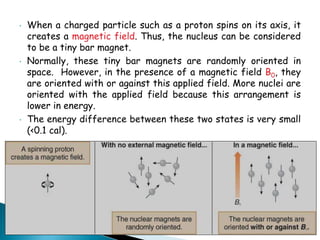
• When a charged particle such as a proton spins on its axis, it
creates a magnetic field. Thus, the nucleus can be considered
to be a tiny bar magnet.
• Normally, these tiny bar magnets are randomly oriented in
space. However, in the presence of a magnetic field B0, they
are oriented with or against this applied field. More nuclei are
oriented with the applied field because this arrangement is
lower in energy.
• The energy difference between these two states is very small
(<0.1 cal).
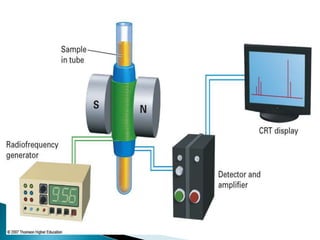
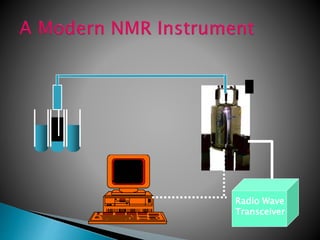
 The most important parts of an NMR instrument
are:
 The magnet,
 The RF generator,
 The sample chamber or probe,
 (which not only houses the sample but also the
RF transmission and detection coils).
 In addition, the instrument requires:
 A pulse generator
 An RF receiver,
 Lots of electronics, and a computer for data
processing.
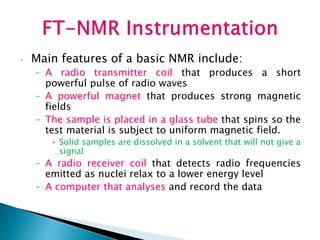
• Main features of a basic NMR include:
– A radio transmitter coil that produces a short
powerful pulse of radio waves
– A powerful magnet that produces strong magnetic
fields
– The sample is placed in a glass tube that spins so the
test material is subject to uniform magnetic field.
• Solid samples are dissolved in a solvent that will not give a
signal
– A radio receiver coil that detects radio frequencies
emitted as nuclei relax to a lower energy level
– A computer that analyses and record the data
Radio Wave
Transceiver
 The sample holder in NMR is normally tube-shaped and
is therefore called the sample tube.
 The tube must be transparent to RF radiation, durable,
and chemically inert.
 Glass or Pyrex tubes are commonly used.
 These are sturdy, practical, and cheap.
 They are usually about 6–7 in. long and ~1/8 in. in
diameter, with a plastic cap to contain thes ample.
 This type of tube is used for obtaining spectra of bulk
samples and solutions.
 Sample tubes range in size from this “standard” size
down to tubes designed to hold 40 L of sample, such
as the Nano.
 Flow-through cells are used for hyphenated techniques
such as HPLC-NMR and on-line analysis.
 The sample chamber into which the sample holder is placed is called the
probe in an NMR spectrometer.
 The probe holds the sample fixed in the magnetic field, contains an air
turbine to spin the sample holder while the spectrum is collected and
houses the coil(s) for transmitting and detecting NMR signals.
 The probe is the heart of the NMR system.
 The most essential component is the RF transmitting and receiving coil,
which is arranged to surround the sample holder and is tuned to the
precession frequency of the nucleus to be measured.
 Modern NMR probes use a single wire coil to both excite the sample and
detect the signal.
 The coil transmits a strong RF pulse to the sample; the pulse is stopped and
the same coil picks up the FID signal from the relaxing nuclei
 For maximum sensitivity, a fixed frequency probe is needed.
 This means that a separate probe is required for each nucleus to be
studied: 1H, 13C, 19F, and so on.
 The magnet in an NMR spectrometer must be
strong, stable, and produce a homogeneous field.
 Homogeneous in this context means that the field
does not vary in strength or direction from point to
point over the space occupied by the sample.
 The field must be homogeneous to a few ppb within
the sample area.
 It is common to express the magnetic field
strength in terms of the equivalent proton
frequency from the Larmor equation.
 Commercial magnets range from the now obsolete
60 MHz (1.4 T) to 700 MHz (16.4 T) and higher.
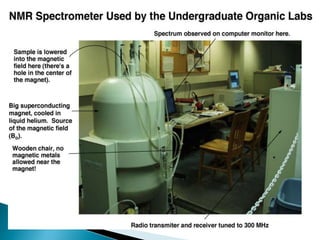
 The magnet is so large that this instrument comes
with its own staircas. so that the analyst can insert
and remove the sample tube from the top of the
probe.
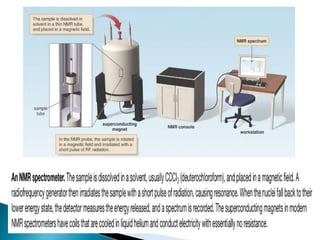
• Modern NMR spectrometers use superconducting solenoid magnets,
• The magnet consists of a main field coil made of superconducting
Nb/Sn or Nb/Ti wire with a dozen or more superconducting shim coils
wound around the main coil to improve field homogeneity.
• The superconducting coils must be submerged in liquid helium.
• The magnet and liquid helium reservoir are encased in a liquid nitrogen
reservoir to decrease the evaporative loss of the more expensive liquid
helium.
• The sample probe is mounted in the bore along with a set of room
temperature shim coils.
• These coils are adjusted with every new sample placed in the probe to
compensate for sample composition, volume, and temperature.
 The RF radiation is generated by using an RF crystal oscillator.
 The output of the oscillator is amplified, mixed, and filtered to
produce essentially monochromatic RF radiation for an NMR
instrument.
 The RF radiation delivered to the sample is pulsed.
 A simple pulse might be a rectangular pulse of 500 MHz
frequency for a 10 s duration.
 The process of pulsing actually widens the RF band, providing a
range of frequencies that is able to excite all nuclei whose
resonances occur within the band of frequencies.
 All resonances within the band are excited simultaneously.
 A 10 s, 500 MHz rectangular pulse leads to a power distribution
around the 500 MHz frequency as shown.
 All signals are collected simultaneously. The RF pulse delivered is
generally on the order of watts while the NMR signal collected is
on the order of microwatts.
 The FID signal in the time domain must be converted to a
frequency domain spectrum by application of a Fourier
transformation or other mathematical transformation
 All NMR spectrometers are equipped with a signal
integrator to measure the area of peaks.
 The area often appears on the NMR spectrum as a
step function superimposed on the spectrum, and
also printed out in a data report as well.
 All NMR spectrometers require a computer to
process the data and much of the instrument is
under computer control.
 Computer control of the room temperature shim
currents that control the field homogeneity, of
sample spinning rates, autosamplers, pulse
sequences, and many other aspects of the
instrument operation is a necessity.

NMR SPECTROSCOPY

  • 2.
    • Powerful analyticaltechnique used to characterize organic molecules by identifying carbon-hydrogen frameworks within molecules. • Two common types of NMR spectroscopy are used to characterize organic structure: • 1. 1H NMR is used to determine the type and number of H atoms in a molecule; • 2. 13C NMR is used to determine the type of carbon atoms in the molecule. • The source of energy- radio waves which have long wavelengths, and thus low energy and frequency. • When low-energy radio waves interact with a molecule, they can change the nuclear spins of some elements, including 1H and 13C.
  • 3.
    • When acharged particle such as a proton spins on its axis, it creates a magnetic field. Thus, the nucleus can be considered to be a tiny bar magnet. • Normally, these tiny bar magnets are randomly oriented in space. However, in the presence of a magnetic field B0, they are oriented with or against this applied field. More nuclei are oriented with the applied field because this arrangement is lower in energy. • The energy difference between these two states is very small (<0.1 cal).
  • 4.
     The mostimportant parts of an NMR instrument are:  The magnet,  The RF generator,  The sample chamber or probe,  (which not only houses the sample but also the RF transmission and detection coils).  In addition, the instrument requires:  A pulse generator  An RF receiver,  Lots of electronics, and a computer for data processing.
  • 8.
    • Main featuresof a basic NMR include: – A radio transmitter coil that produces a short powerful pulse of radio waves – A powerful magnet that produces strong magnetic fields – The sample is placed in a glass tube that spins so the test material is subject to uniform magnetic field. • Solid samples are dissolved in a solvent that will not give a signal – A radio receiver coil that detects radio frequencies emitted as nuclei relax to a lower energy level – A computer that analyses and record the data
  • 9.
  • 10.
     The sampleholder in NMR is normally tube-shaped and is therefore called the sample tube.  The tube must be transparent to RF radiation, durable, and chemically inert.  Glass or Pyrex tubes are commonly used.  These are sturdy, practical, and cheap.  They are usually about 6–7 in. long and ~1/8 in. in diameter, with a plastic cap to contain thes ample.  This type of tube is used for obtaining spectra of bulk samples and solutions.  Sample tubes range in size from this “standard” size down to tubes designed to hold 40 L of sample, such as the Nano.  Flow-through cells are used for hyphenated techniques such as HPLC-NMR and on-line analysis.
  • 11.
     The samplechamber into which the sample holder is placed is called the probe in an NMR spectrometer.  The probe holds the sample fixed in the magnetic field, contains an air turbine to spin the sample holder while the spectrum is collected and houses the coil(s) for transmitting and detecting NMR signals.  The probe is the heart of the NMR system.  The most essential component is the RF transmitting and receiving coil, which is arranged to surround the sample holder and is tuned to the precession frequency of the nucleus to be measured.  Modern NMR probes use a single wire coil to both excite the sample and detect the signal.  The coil transmits a strong RF pulse to the sample; the pulse is stopped and the same coil picks up the FID signal from the relaxing nuclei  For maximum sensitivity, a fixed frequency probe is needed.  This means that a separate probe is required for each nucleus to be studied: 1H, 13C, 19F, and so on.
  • 12.
     The magnetin an NMR spectrometer must be strong, stable, and produce a homogeneous field.  Homogeneous in this context means that the field does not vary in strength or direction from point to point over the space occupied by the sample.  The field must be homogeneous to a few ppb within the sample area.  It is common to express the magnetic field strength in terms of the equivalent proton frequency from the Larmor equation.  Commercial magnets range from the now obsolete 60 MHz (1.4 T) to 700 MHz (16.4 T) and higher.  The magnet is so large that this instrument comes with its own staircas. so that the analyst can insert and remove the sample tube from the top of the probe.
  • 13.
    • Modern NMRspectrometers use superconducting solenoid magnets, • The magnet consists of a main field coil made of superconducting Nb/Sn or Nb/Ti wire with a dozen or more superconducting shim coils wound around the main coil to improve field homogeneity. • The superconducting coils must be submerged in liquid helium. • The magnet and liquid helium reservoir are encased in a liquid nitrogen reservoir to decrease the evaporative loss of the more expensive liquid helium. • The sample probe is mounted in the bore along with a set of room temperature shim coils. • These coils are adjusted with every new sample placed in the probe to compensate for sample composition, volume, and temperature.
  • 14.
     The RFradiation is generated by using an RF crystal oscillator.  The output of the oscillator is amplified, mixed, and filtered to produce essentially monochromatic RF radiation for an NMR instrument.  The RF radiation delivered to the sample is pulsed.  A simple pulse might be a rectangular pulse of 500 MHz frequency for a 10 s duration.  The process of pulsing actually widens the RF band, providing a range of frequencies that is able to excite all nuclei whose resonances occur within the band of frequencies.  All resonances within the band are excited simultaneously.  A 10 s, 500 MHz rectangular pulse leads to a power distribution around the 500 MHz frequency as shown.  All signals are collected simultaneously. The RF pulse delivered is generally on the order of watts while the NMR signal collected is on the order of microwatts.  The FID signal in the time domain must be converted to a frequency domain spectrum by application of a Fourier transformation or other mathematical transformation
  • 15.
     All NMRspectrometers are equipped with a signal integrator to measure the area of peaks.  The area often appears on the NMR spectrum as a step function superimposed on the spectrum, and also printed out in a data report as well.  All NMR spectrometers require a computer to process the data and much of the instrument is under computer control.  Computer control of the room temperature shim currents that control the field homogeneity, of sample spinning rates, autosamplers, pulse sequences, and many other aspects of the instrument operation is a necessity.