Introduction:
What is REFRACTION?
Refraction is the change in direction of a wave passing from
one medium to another or from a gradual change in the
medium. Refraction of light is the most commonly observed
phenomenon, but other waves such as sound
waves and water waves also experience refraction.
What Is REFRACTOMETRY?
Refractometry is the method of measuring substances
refractive index (one of their fundamental physical properties)
for example, assess their composition or purity.
What Is REFRACTIVE INDEX?
The refractive index or index of refraction of a material is a
dimensionless number that describes how fast light travels
through the material.
It is defined as-
Where,
C-speed of light in vacuum
V-is the phase velocity of light in the medium.
What Is REFRACTOMETOMETER?
A Refractometer is a laboratory or field device for the
measurement of an index of refraction
(refractometry). Which is calculated from Snell's law.
Instrumentation:
1. Abbes refractometers.
2. Traditional handheld refractometers.
3. Digital handheld refractometers.
4. Inline process refractometers.
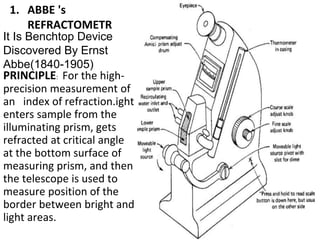
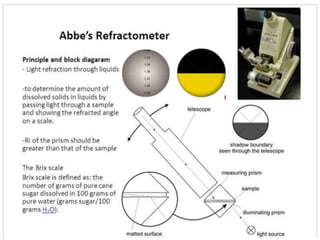
1. ABBE 's
REFRACTOMETR
PRINCIPLE: For the high-
precision measurement of
an index of refraction.ight
enters sample from the
illuminating prism, gets
refracted at critical angle
at the bottom surface of
measuring prism, and then
the telescope is used to
measure position of the
border between bright and
light areas.
It Is Benchtop Device
Discovered By Ernst
Abbe(1840-1905)
:
Working:
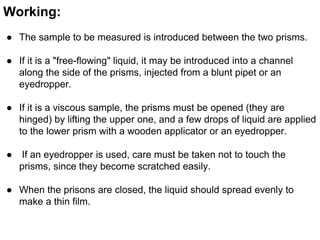
● The sample to be measured is introduced between the two prisms.
● If it is a "free-flowing" liquid, it may be introduced into a channel
along the side of the prisms, injected from a blunt pipet or an
eyedropper.
● If it is a viscous sample, the prisms must be opened (they are
hinged) by lifting the upper one, and a few drops of liquid are applied
to the lower prism with a wooden applicator or an eyedropper.
● If an eyedropper is used, care must be taken not to touch the
prisms, since they become scratched easily.
● When the prisons are closed, the liquid should spread evenly to
make a thin film.
Applications:
1. The most versatile refractometer for laboratory use
2. Abbé Refractometer provides a quick and easy way to determine the refractive
index and dispersion of liquids and solids.
3. Abbé refractometers are used in chemical industry,
4. Use in Food Industry
5. Useful medical laboratories.
Advantages:
1. Abbe’s Refractometer Is Useful For Measuring RI of Solids As Well As Liquids.
2. Just Small Sample is Required
3. Prisms Can Be A Temperature Controllled
4. ABBE’s refractometers can Be Interface With Computers ,Printers And Data
Processing Equipment To Further Analyze Redings.
Disadvantages:
1. Difficult To Analyse Materials With Lower RI Than That of Prism.
2. One Must Bring A Possibly Hazardous Material Close To The Eyes To Read Han
held Refractometers.
2)Traditional Handheld Refractometer.
A traditional handheld refractometer is an analog
instrument for measuring a liquid's refractive index This
design was invented by Emanuel Goldberg.
PRINCIPLE- It works on the critical angle principle
by which lenses and prisms project a shadow line
onto a small glass reticle inside the instrument,
which is then viewed by the user through a
magnifying eyepiece.
Working:
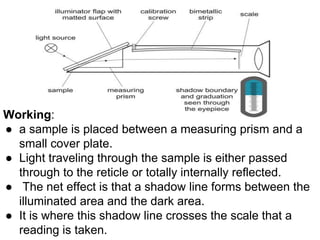
● a sample is placed between a measuring prism and a
small cover plate.
● Light traveling through the sample is either passed
through to the reticle or totally internally reflected.
● The net effect is that a shadow line forms between the
illuminated area and the dark area.
● It is where this shadow line crosses the scale that a
reading is taken.
● Because refractive index is very temperature
dependent, it is important to use a refractometer with
automatic temperature compensation.
● Compensation is accomplished through the use of a
small bi-metallic strip that moves a lens or prism in
response to temperature changes.
1. used to determine the index of refraction of liquid sample
2. to measure fluid concentrations, such as blood protein
concentration, sugar content, and
3. For Measuring Salinity.
Application:
Advantages
Disadvantages:
● Convenient.
● Easily Carried
● Difficult to analyze materials with lower refractive
index than that of the prism.
● One must bring a possibly hazardous material close
to the eyes to read hand held refractometers.
3)Digital Handheld Refractometer
A digital handheld refractometer is an instrument for
measuring the Refractive Index of materials.
PRINCIPLE:
Most operate on the same general critical angle principle
as a traditional handheld refractometer.
The difference is that light from an LED light source is
focused on the underside or a prism element.
Working:
1)When a liquid sample is applied to the measuring
surface of the prism, some of the light is transmitted
through the solution and lost, while the remaining light is
reflected onto a linear array of photodiodes creating a
shadow line.
2)The refractive index is directly related to the position of
the shadow line on the photodiodes.
3)Once the position of the shadow line has been
automatically determined by the instrument, the internal
software will correlate the position to refractive index, or to
another unit of measure related to refractive index, and
display a digital readout on an LCD or LED scale.
Application
Digital handheld refractometers are generally
more precise than traditional handheld
refractometers, but less precise than most
benchtop refractometers
There are some digital handheld
refractometers that are IP65 (IP Code) water-
resistant, and thus washable under a running
faucet.

Abbe'S Instrumentation

  • 2.
    Introduction: What is REFRACTION? Refractionis the change in direction of a wave passing from one medium to another or from a gradual change in the medium. Refraction of light is the most commonly observed phenomenon, but other waves such as sound waves and water waves also experience refraction. What Is REFRACTOMETRY? Refractometry is the method of measuring substances refractive index (one of their fundamental physical properties) for example, assess their composition or purity.
  • 3.
    What Is REFRACTIVEINDEX? The refractive index or index of refraction of a material is a dimensionless number that describes how fast light travels through the material. It is defined as- Where, C-speed of light in vacuum V-is the phase velocity of light in the medium.
  • 4.
    What Is REFRACTOMETOMETER? ARefractometer is a laboratory or field device for the measurement of an index of refraction (refractometry). Which is calculated from Snell's law.
  • 5.
    Instrumentation: 1. Abbes refractometers. 2.Traditional handheld refractometers. 3. Digital handheld refractometers. 4. Inline process refractometers.
  • 6.
    1. ABBE 's REFRACTOMETR PRINCIPLE:For the high- precision measurement of an index of refraction.ight enters sample from the illuminating prism, gets refracted at critical angle at the bottom surface of measuring prism, and then the telescope is used to measure position of the border between bright and light areas. It Is Benchtop Device Discovered By Ernst Abbe(1840-1905)
  • 7.
  • 8.
    Working: ● The sampleto be measured is introduced between the two prisms. ● If it is a "free-flowing" liquid, it may be introduced into a channel along the side of the prisms, injected from a blunt pipet or an eyedropper. ● If it is a viscous sample, the prisms must be opened (they are hinged) by lifting the upper one, and a few drops of liquid are applied to the lower prism with a wooden applicator or an eyedropper. ● If an eyedropper is used, care must be taken not to touch the prisms, since they become scratched easily. ● When the prisons are closed, the liquid should spread evenly to make a thin film.
  • 9.
    Applications: 1. The mostversatile refractometer for laboratory use 2. Abbé Refractometer provides a quick and easy way to determine the refractive index and dispersion of liquids and solids. 3. Abbé refractometers are used in chemical industry, 4. Use in Food Industry 5. Useful medical laboratories. Advantages: 1. Abbe’s Refractometer Is Useful For Measuring RI of Solids As Well As Liquids. 2. Just Small Sample is Required 3. Prisms Can Be A Temperature Controllled 4. ABBE’s refractometers can Be Interface With Computers ,Printers And Data Processing Equipment To Further Analyze Redings. Disadvantages: 1. Difficult To Analyse Materials With Lower RI Than That of Prism. 2. One Must Bring A Possibly Hazardous Material Close To The Eyes To Read Han held Refractometers.
  • 10.
    2)Traditional Handheld Refractometer. Atraditional handheld refractometer is an analog instrument for measuring a liquid's refractive index This design was invented by Emanuel Goldberg. PRINCIPLE- It works on the critical angle principle by which lenses and prisms project a shadow line onto a small glass reticle inside the instrument, which is then viewed by the user through a magnifying eyepiece.
  • 11.
    Working: ● a sampleis placed between a measuring prism and a small cover plate. ● Light traveling through the sample is either passed through to the reticle or totally internally reflected. ● The net effect is that a shadow line forms between the illuminated area and the dark area. ● It is where this shadow line crosses the scale that a reading is taken.
  • 12.
    ● Because refractiveindex is very temperature dependent, it is important to use a refractometer with automatic temperature compensation. ● Compensation is accomplished through the use of a small bi-metallic strip that moves a lens or prism in response to temperature changes.
  • 13.
    1. used todetermine the index of refraction of liquid sample 2. to measure fluid concentrations, such as blood protein concentration, sugar content, and 3. For Measuring Salinity. Application: Advantages Disadvantages: ● Convenient. ● Easily Carried ● Difficult to analyze materials with lower refractive index than that of the prism. ● One must bring a possibly hazardous material close to the eyes to read hand held refractometers.
  • 14.
    3)Digital Handheld Refractometer Adigital handheld refractometer is an instrument for measuring the Refractive Index of materials. PRINCIPLE: Most operate on the same general critical angle principle as a traditional handheld refractometer. The difference is that light from an LED light source is focused on the underside or a prism element.
  • 16.
    Working: 1)When a liquidsample is applied to the measuring surface of the prism, some of the light is transmitted through the solution and lost, while the remaining light is reflected onto a linear array of photodiodes creating a shadow line. 2)The refractive index is directly related to the position of the shadow line on the photodiodes. 3)Once the position of the shadow line has been automatically determined by the instrument, the internal software will correlate the position to refractive index, or to another unit of measure related to refractive index, and display a digital readout on an LCD or LED scale.
  • 17.
    Application Digital handheld refractometersare generally more precise than traditional handheld refractometers, but less precise than most benchtop refractometers There are some digital handheld refractometers that are IP65 (IP Code) water- resistant, and thus washable under a running faucet.