Dr. Y. S. THAKARE
M.Sc. (CHE) Ph D, NET, SET
Assistant Professor in Chemistry,
Shri Shivaji Science College, Amravati
Email: yogitathakare_2007@rediffmail.com
SEM-III
PAPER-X
ANALYTICAL CHEMISTRY –I
THERMAL AND ELECTROANALYTICAL METHOD
UNIT- IV
Electroanalytical Technique
Structure, Uses and Limitation of Dropping Mercury Electrode
1
Unit IV Electroanalytical Techniques
Polarography: Theory, Basic principle of polarography, apparatus.
Dropping mercury electrode. Supporting electrolyte, effect of supporting
electrolyte on limiting electrode. Diffusion coefficient and its evolution.
Ilkovic equation, its derivation and its applications, Ilkovic equation-
diffusion current constant and capillary characteristics determination,
Half wave potential. Polarographic maxima. Interpretation of
polarographic curve. Role of temperature on diffusion current. Reversible,
quasi reversible and irreversible electrode reaction and evaluation of
parameter using various reaction derivative polarography, modified
polarographic techniques, AC polarography, limitations of polarography,
pulse polarography. Method of quantitative analysis: Absolute,
comparative. The PILOT ION and kinetic methods.
Voltammetry: Basic, Principles, Instrumentation, Cyclic voltammetry-
Principle, Instrumentation and applications, Voltammogram, Stripping
technique, Anodic and Cathodic voltammetry, and their applications in the
determination of metal ions and biologically important compounds.
Enzyme catalyzed reaction and applications of voltammetry in monitoring
such reaction.
Related Techniques: Amperometric titration and Chronopotentiometry,
Principle methodology, and their application in qualitative and
quantitative analysis.
Electrode – The metal rod dipped in its salt solution 2
Dr. Yogita Sahebrao Thakare
Content
 What is DME ?
 Structure of DME
 Working OF DME
 Types of Mercury Electrode
 Advantages of DME
 Disadvantages of DME
 Precautions can be taken while using DME
What is DME?
The dropping mercury electrode
(DME) is a working electrode
arrangement for polarography in
which mercury continuously drops
from a reservoir through a capillary
tube into the solution. The optimum
interval between drops for most
analyses is between 1-5 sec. The
unique advantage to the use of DME is
that the constant renewal of the
electrode surface , exposed to the test
solution eliminates the effects of
electrode poisoning.
1] Mercury reservoir
 It consist of mercury reservoir bulb
about 100 ml capacity.
 The reservoir is clamped in vertical
position.
 It connected by flexible tubing to a
glass capillary tube.
 The mercury reservoir is raised to
appropriate height on the stand and its
position is marked.
 The position / height of the reservoir
should be kept the same throughout
the experiment to get reproducible
results.
Structure of DME
2] Capillary tube
 The glass tube is ≈7 cm in length and 0.5 mm
in diameter.
 One end of the capillary tube is attached to
the flexible tube and clamped. The other end
of the capillary tube dips under the surface of
the solution to be analysed(electrolyte).
 The drops of mercury come out from the
capillary continuously.
 The drops of mercury are identical with
diameters of ≈0.5 to 1mm.
 The life time of an individual drop is 3 to 6
seconds.
 The DME is here shown as the cathode
 The DME is called as the working electrode
or microelectrode or the indicator
electrode.
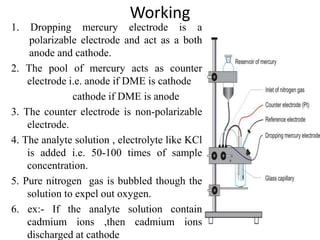
Working
1. Dropping mercury electrode is a
polarizable electrode and act as a both
anode and cathode.
2. The pool of mercury acts as counter
electrode i.e. anode if DME is cathode
cathode if DME is anode
3. The counter electrode is non-polarizable
electrode.
4. The analyte solution , electrolyte like KCl
is added i.e. 50-100 times of sample
concentration.
5. Pure nitrogen gas is bubbled though the
solution to expel out oxygen.
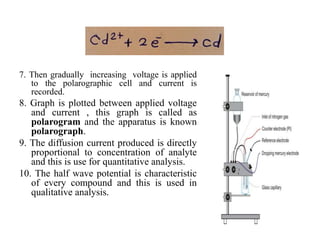
6. ex:- If the analyte solution contain
cadmium ions ,then cadmium ions
discharged at cathode
7. Then gradually increasing voltage is applied
to the polarographic cell and current is
recorded.
8. Graph is plotted between applied voltage
and current , this graph is called as
polarogram and the apparatus is known
polarograph.
9. The diffusion current produced is directly
proportional to concentration of analyte
and this is use for quantitative analysis.
10. The half wave potential is characteristic
of every compound and this is used in
qualitative analysis.
Types of Mercury electrode
1] DME(dropping mercury electrode)
The mercury drop forms at the end of the
capillary through gravity. It grows
continuously as the mercury flows the
reservoir and has a finite lifetime of several
seconds. It is then dislodged and replaced by
a new drop.
2] SMDE (Static Mercury Drop Electrode)
This electrode uses a solenoid plunger to
control the flow of mercury. Activation of the
solenoid momentarily lifts the plunger ,
allowing mercury to flow through the
capillary forming a single hanging Hg-drop.
3] HDME (Hanging Mercury
drop electrode)
The drop of mercury is extended by rotating a
micrometer screw that pulses the mercury
from a reservoir through a narrow capillary.
Advantages DME
• The surface of mercury drop is smooth, continuously
renewed and surface area is reproducible. This
eliminates passivity and poisoning effect.
• Mercury forms amalgam with many metals.
• The surface area can be calculated from the weight of
the drops. Since the electrolyte is continuously
renewed, series of scan be estimated in the given
solution.
• The diffusion current assumes a steady value
immediately after each change of the applied potential,
and is reproducible.
• It can be over the range of +o.4 to -2.0 volt with
reference to the saturated calomel electrode.
Disadvantages DME
• Capillary is very small and thus can be easily blocked.
• Mercury is very toxic.
• Surface area of each drop of mercury is never constant.
• It cannot be used at higher positive potential due to
oxidation of mercury.
• The area of microelectrode is constantly changing as the
size of the drops changes.
• Mercury may be easily oxidized and that DME can be used
only for the analysis of reducible or very easily oxidisible
substances.
• The electrode generate some small currents like ,residual
and migration current ,which causes error in the current
measurement.
Precaution to be taken while using DME
• Pure and triple distilled mercury should be used in
DME.
• Tip of DME should be always immersed in water when
not in use.
• Tip of DME should be cleaned by dipping in nitric acid.
• The DME assembly should be mounted vertical on a
heavy stand to be free from vibrations.
• It is essential to use clean and dust free tubing while
setting the DME.
• There should be sufficient mercury in reservoir so that
the pressure changes are negligible.

Lect. 2 DMG structure-uses-Advantages-limitation

  • 1.
    Dr. Y. S.THAKARE M.Sc. (CHE) Ph D, NET, SET Assistant Professor in Chemistry, Shri Shivaji Science College, Amravati Email: yogitathakare_2007@rediffmail.com SEM-III PAPER-X ANALYTICAL CHEMISTRY –I THERMAL AND ELECTROANALYTICAL METHOD UNIT- IV Electroanalytical Technique Structure, Uses and Limitation of Dropping Mercury Electrode 1
  • 2.
    Unit IV ElectroanalyticalTechniques Polarography: Theory, Basic principle of polarography, apparatus. Dropping mercury electrode. Supporting electrolyte, effect of supporting electrolyte on limiting electrode. Diffusion coefficient and its evolution. Ilkovic equation, its derivation and its applications, Ilkovic equation- diffusion current constant and capillary characteristics determination, Half wave potential. Polarographic maxima. Interpretation of polarographic curve. Role of temperature on diffusion current. Reversible, quasi reversible and irreversible electrode reaction and evaluation of parameter using various reaction derivative polarography, modified polarographic techniques, AC polarography, limitations of polarography, pulse polarography. Method of quantitative analysis: Absolute, comparative. The PILOT ION and kinetic methods. Voltammetry: Basic, Principles, Instrumentation, Cyclic voltammetry- Principle, Instrumentation and applications, Voltammogram, Stripping technique, Anodic and Cathodic voltammetry, and their applications in the determination of metal ions and biologically important compounds. Enzyme catalyzed reaction and applications of voltammetry in monitoring such reaction. Related Techniques: Amperometric titration and Chronopotentiometry, Principle methodology, and their application in qualitative and quantitative analysis. Electrode – The metal rod dipped in its salt solution 2 Dr. Yogita Sahebrao Thakare
  • 3.
    Content  What isDME ?  Structure of DME  Working OF DME  Types of Mercury Electrode  Advantages of DME  Disadvantages of DME  Precautions can be taken while using DME
  • 4.
    What is DME? Thedropping mercury electrode (DME) is a working electrode arrangement for polarography in which mercury continuously drops from a reservoir through a capillary tube into the solution. The optimum interval between drops for most analyses is between 1-5 sec. The unique advantage to the use of DME is that the constant renewal of the electrode surface , exposed to the test solution eliminates the effects of electrode poisoning.
  • 5.
    1] Mercury reservoir It consist of mercury reservoir bulb about 100 ml capacity.  The reservoir is clamped in vertical position.  It connected by flexible tubing to a glass capillary tube.  The mercury reservoir is raised to appropriate height on the stand and its position is marked.  The position / height of the reservoir should be kept the same throughout the experiment to get reproducible results. Structure of DME
  • 6.
    2] Capillary tube The glass tube is ≈7 cm in length and 0.5 mm in diameter.  One end of the capillary tube is attached to the flexible tube and clamped. The other end of the capillary tube dips under the surface of the solution to be analysed(electrolyte).  The drops of mercury come out from the capillary continuously.  The drops of mercury are identical with diameters of ≈0.5 to 1mm.  The life time of an individual drop is 3 to 6 seconds.  The DME is here shown as the cathode  The DME is called as the working electrode or microelectrode or the indicator electrode.
  • 7.
    Working 1. Dropping mercuryelectrode is a polarizable electrode and act as a both anode and cathode. 2. The pool of mercury acts as counter electrode i.e. anode if DME is cathode cathode if DME is anode 3. The counter electrode is non-polarizable electrode. 4. The analyte solution , electrolyte like KCl is added i.e. 50-100 times of sample concentration. 5. Pure nitrogen gas is bubbled though the solution to expel out oxygen. 6. ex:- If the analyte solution contain cadmium ions ,then cadmium ions discharged at cathode
  • 8.
    7. Then graduallyincreasing voltage is applied to the polarographic cell and current is recorded. 8. Graph is plotted between applied voltage and current , this graph is called as polarogram and the apparatus is known polarograph. 9. The diffusion current produced is directly proportional to concentration of analyte and this is use for quantitative analysis. 10. The half wave potential is characteristic of every compound and this is used in qualitative analysis.
  • 9.
    Types of Mercuryelectrode 1] DME(dropping mercury electrode) The mercury drop forms at the end of the capillary through gravity. It grows continuously as the mercury flows the reservoir and has a finite lifetime of several seconds. It is then dislodged and replaced by a new drop. 2] SMDE (Static Mercury Drop Electrode) This electrode uses a solenoid plunger to control the flow of mercury. Activation of the solenoid momentarily lifts the plunger , allowing mercury to flow through the capillary forming a single hanging Hg-drop. 3] HDME (Hanging Mercury drop electrode) The drop of mercury is extended by rotating a micrometer screw that pulses the mercury from a reservoir through a narrow capillary.
  • 10.
    Advantages DME • Thesurface of mercury drop is smooth, continuously renewed and surface area is reproducible. This eliminates passivity and poisoning effect. • Mercury forms amalgam with many metals. • The surface area can be calculated from the weight of the drops. Since the electrolyte is continuously renewed, series of scan be estimated in the given solution. • The diffusion current assumes a steady value immediately after each change of the applied potential, and is reproducible. • It can be over the range of +o.4 to -2.0 volt with reference to the saturated calomel electrode.
  • 11.
    Disadvantages DME • Capillaryis very small and thus can be easily blocked. • Mercury is very toxic. • Surface area of each drop of mercury is never constant. • It cannot be used at higher positive potential due to oxidation of mercury. • The area of microelectrode is constantly changing as the size of the drops changes. • Mercury may be easily oxidized and that DME can be used only for the analysis of reducible or very easily oxidisible substances. • The electrode generate some small currents like ,residual and migration current ,which causes error in the current measurement.
  • 12.
    Precaution to betaken while using DME • Pure and triple distilled mercury should be used in DME. • Tip of DME should be always immersed in water when not in use. • Tip of DME should be cleaned by dipping in nitric acid. • The DME assembly should be mounted vertical on a heavy stand to be free from vibrations. • It is essential to use clean and dust free tubing while setting the DME. • There should be sufficient mercury in reservoir so that the pressure changes are negligible.