ALL ABOUT STATIC AND CURRENT ELECTRICITY 06/06/09   07:49 PM www.sciencetutors.zoomshare.com  PHYSICS 1
ELECTRIC CIRCUITS CONTENTS OF SLIDE Understanding basic concept of Static electricity Concept of electric charge and how moving charges results in electric current Circuit Behaviour and Electric circuit  Understanding basic concepts in current electricity- Electric current, Voltage and Resistance Energy transfers in circuits Generation and Distribution of Electricity www.sciencetutors.zoomshare.com   06/06/09   07:49 PM
What is static electricity? Students to use the next three minutes to discuss and write down what they already know about static electricity 06/06/09   07:49 PM www.sciencetutors.zoomshare.com
What is static Electricity? Developing charges by rubbing Insulators  are materials that  hold their   electrons very tightly  as these electrons are not allowed to move. Good examples of  insulators  are – glass, plastic, cloth and dry hair. 06/06/09   07:49 PM www.sciencetutors.zoomshare.com
How do electrons move in insulators? Hint: It is important to recall that one of the  reasons conductors conduct electricity is because  they allow the flow/movement of electrons across it.  Perhaps another reason could be because  they have free electrons or electron cloud.  However this is obviously not the case for INSULATORS. So the question again is:  How do electrons move in insulators? 06/06/09   07:49 PM Copyright  www.sciencetutors.zoomshare.com
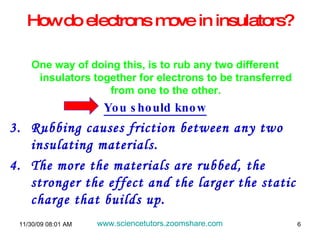
How do electrons move in insulators? One way of doing this, is to rub any two different insulators together for electrons to be transferred from one to the other. You should know Rubbing causes friction between any two insulating materials. The more the materials are rubbed, the stronger the effect and the larger the static charge that builds up. 06/06/09   07:49 PM www.sciencetutors.zoomshare.com
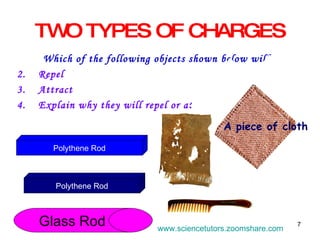
TWO TYPES OF CHARGES Which of the following objects shown below will  Repel Attract  Explain why they will repel or attract 06/06/09   07:49 PM Polythene Rod Polythene Rod A piece of cloth Glass Rod www.sciencetutors.zoomshare.com
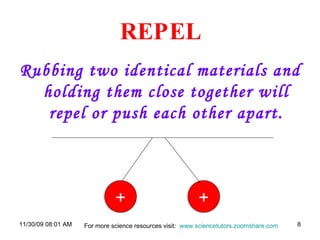
REPEL Rubbing two identical materials and holding them close together will repel or push each other apart. 06/06/09   07:49 PM + + For more science resources visit:  www.sciencetutors.zoomshare.com
ATTRACT However if the two rods are made of different materials, the pair will attract. You should Know Materials will repel if they have the same type of charge. They will attract if they have charges of different types. The charges are not made but moved around when two object are rubbed together as a result of the friction between them Rubbing does not make charge, it actually separates existing charges that were there all along. 06/06/09   07:49 PM www.sciencetutors.zoomshare.com
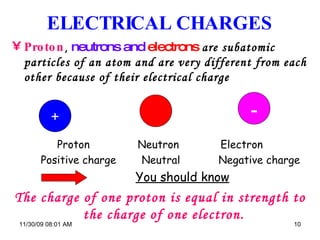
ELECTRICAL CHARGES Proton ,  neutrons and  electrons   are subatomic particles of an atom and are very different from each other because of their electrical charge Proton  Neutron  Electron Positive charge  Neutral  Negative charge You should know   The charge of one proton is equal in strength to the charge of one electron.  06/06/09   07:49 PM + -
How to Charge Something Most materials have  equal numbers  of  positive and negative charges , this makes them  electrically neutral. What happens to these neutral materials when electrons are removed or added to them? 06/06/09   07:49 PM Visit : www.sciencetutors.zoomshare.com
ELECTRIC CURRENT Class Task (3 minutes) What is electric current?  How is current electricity different from static electricity 06/06/09   07:49 PM Visit:  www.sciencetutors.zoomshare.com
ELECTRIC CURRENT You should know Electric current  is simply defined as the flow of  electric  charge.  The flowing electric charge which moves round a complete circuit may be either electrons or ions.   In current electricity free electrons are responsible for the passage of current in a complete circuit 06/06/09   07:49 PM
SIMPLE CIRCUITS Go to  www.sciencetutors.zoomshare.com   For  Simple circuits and concepts Circuits calculations Quiz questions on circuits Class Task/Activities on electrical circuits and static electricity 06/06/09   07:49 PM
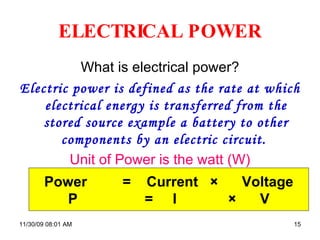
ELECTRICAL POWER What is electrical power? Electric power is defined as the rate at which electrical energy is transferred from the stored source example a battery to other components by an electric circuit.  Unit of Power is the watt (W) 06/06/09   07:49 PM Power  =  Current  ×  Voltage P  =  I  ×  V
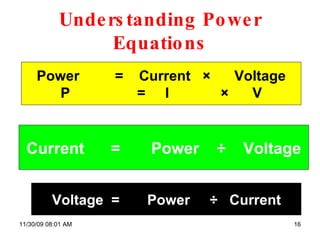
Understanding Power Equations 06/06/09   07:49 PM Power  =  Current  ×  Voltage P  =  I  ×  V Current  =  Power  ÷  Voltage Voltage  =  Power  ÷  Current
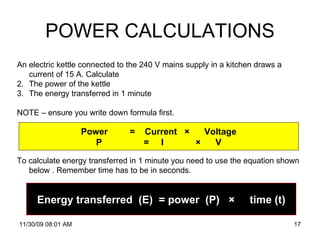
POWER CALCULATIONS 06/06/09   07:49 PM An electric kettle connected to the 240 V mains supply in a kitchen draws a current of 15 A. Calculate  The power of the kettle The energy transferred in 1 minute NOTE – ensure you write down formula first. To calculate energy transferred in 1 minute you need to use the equation shown below . Remember time has to be in seconds.  Power  =  Current  ×  Voltage P  =  I  ×  V Energy transferred  (E)  = power  (P)  ×  time (t) (t)
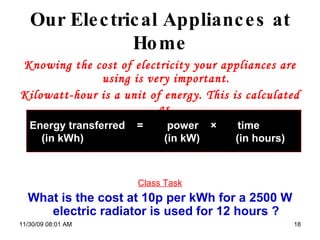
Our Electrical Appliances at Home Knowing the cost of electricity your appliances are using is very important. Kilowatt-hour is a unit of energy. This is calculated as  Class Task What is the cost at 10p per kWh for a 2500 W electric radiator is used for 12 hours ? 06/06/09   07:49 PM Energy transferred  =  power  ×  time (in kWh)  (in kW)  (in hours)
Our Electrical Appliances at Home Class Task (6 minutes) A 3kWh fire, a 240W TV and three 120 W lamps are all switched on from 5p.m to 11p.m. What is the cost at 10p per kWh?  Nikki bought a new vacuum cleaner labelled 250 V 600 W. How much current does it take when connected to a 250 V supply  06/06/09   07:49 PM
Hints for Calculation A 3kWh fire, a 240W TV and three 120 W lamps are all switched on from 5p.m to 11p.m. What is the cost at 10p per kWh?  If 1kW = 1000W  what is 240 W and 120W? common sense calculation 1 hour = 3600 seconds again common sense how many hours are there between 5p.m and 11p.m Well done work it out. 06/06/09   07:49 PM Energy transferred  =  power  ×  time (in kWh)  (in kW)  (in hours) www.sciencetutors.zoomshare.com
Distributing Electricity Class Task  (Discuss with the person next to you and write down answers to the following) What is a TRANSFORMER Write down or draw any two types of transformer you know or have studied 06/06/09   07:49 PM
TRANSFORMERS A transformer is simply an electrical device that either raises or lowers the voltage of electricity in distribution. You should know The behaviour of a transformer depends on the number of turns of wire on the primary or secondary coils of the transformer. 06/06/09   07:49 PM
Transformer - Induced Voltage Induced voltage – this is the voltage generated or induced in the secondary coil of a transformer by the changing current in the primary coil 06/06/09   07:49 PM
Transformer – Applied Voltage Go to  www.sciencetutors.zoomshare.com   for   Transformer concepts Transformer calculations Quiz questions Class Task/Activities on electrical circuits and static electricity 06/06/09   07:49 PM
STEP UP AND STEP DOWN You will need to understand the following concept before looking at how to step up or step down a transformer. 06/06/09   07:49 PM

ALL ABOUT ELECTRIC CIRCUITS AND STATIC ELECTRICITY

  • 1.
    ALL ABOUT STATICAND CURRENT ELECTRICITY 06/06/09 07:49 PM www.sciencetutors.zoomshare.com PHYSICS 1
  • 2.
    ELECTRIC CIRCUITS CONTENTSOF SLIDE Understanding basic concept of Static electricity Concept of electric charge and how moving charges results in electric current Circuit Behaviour and Electric circuit Understanding basic concepts in current electricity- Electric current, Voltage and Resistance Energy transfers in circuits Generation and Distribution of Electricity www.sciencetutors.zoomshare.com 06/06/09 07:49 PM
  • 3.
    What is staticelectricity? Students to use the next three minutes to discuss and write down what they already know about static electricity 06/06/09 07:49 PM www.sciencetutors.zoomshare.com
  • 4.
    What is staticElectricity? Developing charges by rubbing Insulators are materials that hold their electrons very tightly as these electrons are not allowed to move. Good examples of insulators are – glass, plastic, cloth and dry hair. 06/06/09 07:49 PM www.sciencetutors.zoomshare.com
  • 5.
    How do electronsmove in insulators? Hint: It is important to recall that one of the reasons conductors conduct electricity is because they allow the flow/movement of electrons across it. Perhaps another reason could be because they have free electrons or electron cloud. However this is obviously not the case for INSULATORS. So the question again is: How do electrons move in insulators? 06/06/09 07:49 PM Copyright www.sciencetutors.zoomshare.com
  • 6.
    How do electronsmove in insulators? One way of doing this, is to rub any two different insulators together for electrons to be transferred from one to the other. You should know Rubbing causes friction between any two insulating materials. The more the materials are rubbed, the stronger the effect and the larger the static charge that builds up. 06/06/09 07:49 PM www.sciencetutors.zoomshare.com
  • 7.
    TWO TYPES OFCHARGES Which of the following objects shown below will Repel Attract Explain why they will repel or attract 06/06/09 07:49 PM Polythene Rod Polythene Rod A piece of cloth Glass Rod www.sciencetutors.zoomshare.com
  • 8.
    REPEL Rubbing twoidentical materials and holding them close together will repel or push each other apart. 06/06/09 07:49 PM + + For more science resources visit: www.sciencetutors.zoomshare.com
  • 9.
    ATTRACT However ifthe two rods are made of different materials, the pair will attract. You should Know Materials will repel if they have the same type of charge. They will attract if they have charges of different types. The charges are not made but moved around when two object are rubbed together as a result of the friction between them Rubbing does not make charge, it actually separates existing charges that were there all along. 06/06/09 07:49 PM www.sciencetutors.zoomshare.com
  • 10.
    ELECTRICAL CHARGES Proton, neutrons and electrons are subatomic particles of an atom and are very different from each other because of their electrical charge Proton Neutron Electron Positive charge Neutral Negative charge You should know The charge of one proton is equal in strength to the charge of one electron. 06/06/09 07:49 PM + -
  • 11.
    How to ChargeSomething Most materials have equal numbers of positive and negative charges , this makes them electrically neutral. What happens to these neutral materials when electrons are removed or added to them? 06/06/09 07:49 PM Visit : www.sciencetutors.zoomshare.com
  • 12.
    ELECTRIC CURRENT ClassTask (3 minutes) What is electric current? How is current electricity different from static electricity 06/06/09 07:49 PM Visit: www.sciencetutors.zoomshare.com
  • 13.
    ELECTRIC CURRENT Youshould know Electric current is simply defined as the flow of electric charge. The flowing electric charge which moves round a complete circuit may be either electrons or ions. In current electricity free electrons are responsible for the passage of current in a complete circuit 06/06/09 07:49 PM
  • 14.
    SIMPLE CIRCUITS Goto www.sciencetutors.zoomshare.com For Simple circuits and concepts Circuits calculations Quiz questions on circuits Class Task/Activities on electrical circuits and static electricity 06/06/09 07:49 PM
  • 15.
    ELECTRICAL POWER Whatis electrical power? Electric power is defined as the rate at which electrical energy is transferred from the stored source example a battery to other components by an electric circuit. Unit of Power is the watt (W) 06/06/09 07:49 PM Power = Current × Voltage P = I × V
  • 16.
    Understanding Power Equations06/06/09 07:49 PM Power = Current × Voltage P = I × V Current = Power ÷ Voltage Voltage = Power ÷ Current
  • 17.
    POWER CALCULATIONS 06/06/09 07:49 PM An electric kettle connected to the 240 V mains supply in a kitchen draws a current of 15 A. Calculate The power of the kettle The energy transferred in 1 minute NOTE – ensure you write down formula first. To calculate energy transferred in 1 minute you need to use the equation shown below . Remember time has to be in seconds. Power = Current × Voltage P = I × V Energy transferred (E) = power (P) × time (t) (t)
  • 18.
    Our Electrical Appliancesat Home Knowing the cost of electricity your appliances are using is very important. Kilowatt-hour is a unit of energy. This is calculated as Class Task What is the cost at 10p per kWh for a 2500 W electric radiator is used for 12 hours ? 06/06/09 07:49 PM Energy transferred = power × time (in kWh) (in kW) (in hours)
  • 19.
    Our Electrical Appliancesat Home Class Task (6 minutes) A 3kWh fire, a 240W TV and three 120 W lamps are all switched on from 5p.m to 11p.m. What is the cost at 10p per kWh? Nikki bought a new vacuum cleaner labelled 250 V 600 W. How much current does it take when connected to a 250 V supply 06/06/09 07:49 PM
  • 20.
    Hints for CalculationA 3kWh fire, a 240W TV and three 120 W lamps are all switched on from 5p.m to 11p.m. What is the cost at 10p per kWh? If 1kW = 1000W what is 240 W and 120W? common sense calculation 1 hour = 3600 seconds again common sense how many hours are there between 5p.m and 11p.m Well done work it out. 06/06/09 07:49 PM Energy transferred = power × time (in kWh) (in kW) (in hours) www.sciencetutors.zoomshare.com
  • 21.
    Distributing Electricity ClassTask (Discuss with the person next to you and write down answers to the following) What is a TRANSFORMER Write down or draw any two types of transformer you know or have studied 06/06/09 07:49 PM
  • 22.
    TRANSFORMERS A transformeris simply an electrical device that either raises or lowers the voltage of electricity in distribution. You should know The behaviour of a transformer depends on the number of turns of wire on the primary or secondary coils of the transformer. 06/06/09 07:49 PM
  • 23.
    Transformer - InducedVoltage Induced voltage – this is the voltage generated or induced in the secondary coil of a transformer by the changing current in the primary coil 06/06/09 07:49 PM
  • 24.
    Transformer – AppliedVoltage Go to www.sciencetutors.zoomshare.com for Transformer concepts Transformer calculations Quiz questions Class Task/Activities on electrical circuits and static electricity 06/06/09 07:49 PM
  • 25.
    STEP UP ANDSTEP DOWN You will need to understand the following concept before looking at how to step up or step down a transformer. 06/06/09 07:49 PM