Duration: 60 min DPT Medical Physics Lecture 03
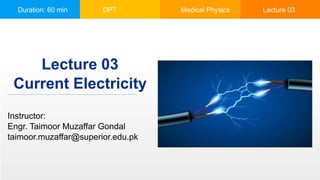
Current Electricity
Instructor:
Engr. Taimoor Muzaffar Gondal
taimoor.muzaffar@superior.edu.pk
Lecture 03
Duration: 60 min DPT Medical Physics Lecture 03
Electric Current
Electric Current: The flow of electric charge
The loosely bound outer electrons of conductors carry the charge
through circuits.
Protons tightly bound to the nuclei of atoms.
current = charge / time
or
I = q/t
Units: Amps (A)
An amp is the flow of 1 C of charge per second
NOTE: 1 C = the charge of 6,240,000,000,000,000,000 electrons
Duration: 60 min DPT Medical Physics Lecture 03
Voltage
 Potential difference between two points
 Either side of a voltage source is not an equipotential surface
 A wire is an equipotential surface
 It has the same potential
 If the wire is attached to a voltage source it is still an equipotential surface
Duration: 60 min DPT Medical Physics Lecture 03
Voltage Sources
Voltage Source: A device which provides a potential difference in
order to keep current flowing
Dry/Wet Cells: Convert chemical energy to electrical energy
Generators: Convert mechanical energy to electrical energy
The voltage available to electrons moving between
terminals is called electromotive force, or emf.
Duration: 60 min DPT Medical Physics Lecture 03
 A DC current is a current that does not change direction in time.
 Frequency of DC current is zero.
 Portable flashlight circuit.
 Internal circuit inside a DMM to measure resistance.
 Circuit to control a dimmer light using a potentiometer.
DC Current
Duration: 60 min DPT Medical Physics Lecture 03
Alternating Current
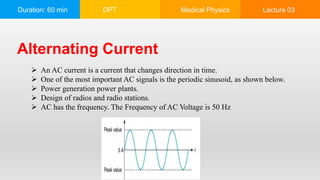
 An AC current is a current that changes direction in time.
 One of the most important AC signals is the periodic sinusoid, as shown below.
 Power generation power plants.
 Design of radios and radio stations.
 AC has the frequency. The Frequency of AC Voltage is 50 Hz
Duration: 60 min DPT Medical Physics Lecture 03
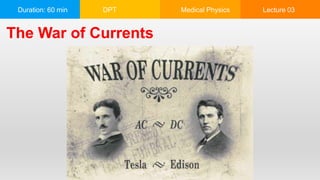
The War of Currents
Duration: 60 min DPT Medical Physics Lecture 03
War of The Currents
 Edison developed direct current -- current that runs continually in a single
direction, like in a battery or a fuel cell. During the early years of electricity,
direct current (shorthanded as DC) was the standard in the U.S.
 But there was one problem. Direct current is not easily converted to higher or
lower voltages.
 Tesla believed that alternating current (or AC) was the solution to this problem.
Alternating current reverses direction a certain number of times per second --
60 in the U.S. -- and can be converted to different voltages relatively easily
using a transformer.
 Edison, not wanting to lose the royalties he was earning from his direct current
patents, began a campaign to discredit alternating current. He spread
misinformation saying that alternating current was more dangerous, even going
so far as to publicly electrocute stray animals using alternating current to prove
his point.
Duration: 60 min DPT Medical Physics Lecture 03
Electric Components
 A resistor impedes the f low of electricity through a
circuit.
 Unit of Resistance is the ohm.
 Resistors have a set value.
 Since voltage, current and resistance are related
through Ohm’s law, resistors are a good way to
control voltage and current in your circuit.
Resistance:
Duration: 60 min DPT Medical Physics Lecture 03
Color code
Tolerance: Gold = within 5%
Black: 0
Brown: 1
Red: 2
Orange: 3
Yellow: 4
Green: 5
Blue: 6
Violet: 7
Gray: 8
White: 9
Duration: 60 min DPT Medical Physics Lecture 03
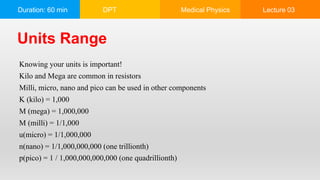
Knowing your units is important!
Kilo and Mega are common in resistors
Milli, micro, nano and pico can be used in other components
K (kilo) = 1,000
M (mega) = 1,000,000
M (milli) = 1/1,000
u(micro) = 1/1,000,000
n(nano) = 1/1,000,000,000 (one trillionth)
p(pico) = 1 / 1,000,000,000,000 (one quadrillionth)
Units Range
Duration: 60 min DPT Medical Physics Lecture 03
Capacitor
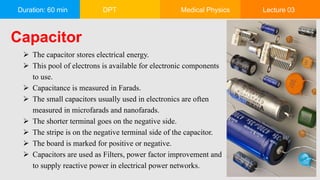
 The capacitor stores electrical energy.
 This pool of electrons is available for electronic components
to use.
 Capacitance is measured in Farads.
 The small capacitors usually used in electronics are often
measured in microfarads and nanofarads.
 The shorter terminal goes on the negative side.
 The stripe is on the negative terminal side of the capacitor.
 The board is marked for positive or negative.
 Capacitors are used as Filters, power factor improvement and
to supply reactive power in electrical power networks.
Duration: 60 min DPT Medical Physics Lecture 03
Ohm’s Law
 It Defines the relationship between voltage, current and resistance.
 These basic electrical units apply to direct current, or alternating current.
 Ohm’s Law is the foundation of electronics and electricity.
 This formula is used extensively by electricians.
 Without a thorough understanding of “Ohm’s Law” an electrician can not design or
troubleshoot even the simplest of electronic or electrical circuits.
 Ohm established in the late 1820’s that if a voltage was applied to a resistance then
“current would flow and then power would be consumed”.
Duration: 60 min DPT Medical Physics Lecture 03
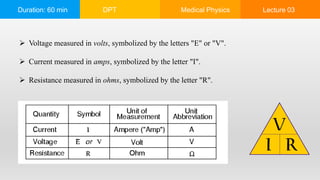
 Voltage measured in volts, symbolized by the letters "E" or "V".
 Current measured in amps, symbolized by the letter "I".
 Resistance measured in ohms, symbolized by the letter "R".
Duration: 60 min DPT Medical Physics Lecture 03
End of Lecture 03
For any kind of queries and questions you are advised to
write at
taimoor.muzaffar@superior.edu.pk
Or visit my office during consulting hours
This lectures can also be downloaded from
https://www.slideshare.net/Taimoor_Gondal

Current Electricity

  • 1.
    Duration: 60 minDPT Medical Physics Lecture 03 Current Electricity Instructor: Engr. Taimoor Muzaffar Gondal taimoor.muzaffar@superior.edu.pk Lecture 03
  • 2.
    Duration: 60 minDPT Medical Physics Lecture 03 Electric Current Electric Current: The flow of electric charge The loosely bound outer electrons of conductors carry the charge through circuits. Protons tightly bound to the nuclei of atoms. current = charge / time or I = q/t Units: Amps (A) An amp is the flow of 1 C of charge per second NOTE: 1 C = the charge of 6,240,000,000,000,000,000 electrons
  • 3.
    Duration: 60 minDPT Medical Physics Lecture 03 Voltage  Potential difference between two points  Either side of a voltage source is not an equipotential surface  A wire is an equipotential surface  It has the same potential  If the wire is attached to a voltage source it is still an equipotential surface
  • 4.
    Duration: 60 minDPT Medical Physics Lecture 03 Voltage Sources Voltage Source: A device which provides a potential difference in order to keep current flowing Dry/Wet Cells: Convert chemical energy to electrical energy Generators: Convert mechanical energy to electrical energy The voltage available to electrons moving between terminals is called electromotive force, or emf.
  • 5.
    Duration: 60 minDPT Medical Physics Lecture 03  A DC current is a current that does not change direction in time.  Frequency of DC current is zero.  Portable flashlight circuit.  Internal circuit inside a DMM to measure resistance.  Circuit to control a dimmer light using a potentiometer. DC Current
  • 6.
    Duration: 60 minDPT Medical Physics Lecture 03 Alternating Current  An AC current is a current that changes direction in time.  One of the most important AC signals is the periodic sinusoid, as shown below.  Power generation power plants.  Design of radios and radio stations.  AC has the frequency. The Frequency of AC Voltage is 50 Hz
  • 7.
    Duration: 60 minDPT Medical Physics Lecture 03 The War of Currents
  • 8.
    Duration: 60 minDPT Medical Physics Lecture 03 War of The Currents  Edison developed direct current -- current that runs continually in a single direction, like in a battery or a fuel cell. During the early years of electricity, direct current (shorthanded as DC) was the standard in the U.S.  But there was one problem. Direct current is not easily converted to higher or lower voltages.  Tesla believed that alternating current (or AC) was the solution to this problem. Alternating current reverses direction a certain number of times per second -- 60 in the U.S. -- and can be converted to different voltages relatively easily using a transformer.  Edison, not wanting to lose the royalties he was earning from his direct current patents, began a campaign to discredit alternating current. He spread misinformation saying that alternating current was more dangerous, even going so far as to publicly electrocute stray animals using alternating current to prove his point.
  • 9.
    Duration: 60 minDPT Medical Physics Lecture 03 Electric Components  A resistor impedes the f low of electricity through a circuit.  Unit of Resistance is the ohm.  Resistors have a set value.  Since voltage, current and resistance are related through Ohm’s law, resistors are a good way to control voltage and current in your circuit. Resistance:
  • 10.
    Duration: 60 minDPT Medical Physics Lecture 03 Color code Tolerance: Gold = within 5% Black: 0 Brown: 1 Red: 2 Orange: 3 Yellow: 4 Green: 5 Blue: 6 Violet: 7 Gray: 8 White: 9
  • 11.
    Duration: 60 minDPT Medical Physics Lecture 03 Knowing your units is important! Kilo and Mega are common in resistors Milli, micro, nano and pico can be used in other components K (kilo) = 1,000 M (mega) = 1,000,000 M (milli) = 1/1,000 u(micro) = 1/1,000,000 n(nano) = 1/1,000,000,000 (one trillionth) p(pico) = 1 / 1,000,000,000,000 (one quadrillionth) Units Range
  • 12.
    Duration: 60 minDPT Medical Physics Lecture 03 Capacitor  The capacitor stores electrical energy.  This pool of electrons is available for electronic components to use.  Capacitance is measured in Farads.  The small capacitors usually used in electronics are often measured in microfarads and nanofarads.  The shorter terminal goes on the negative side.  The stripe is on the negative terminal side of the capacitor.  The board is marked for positive or negative.  Capacitors are used as Filters, power factor improvement and to supply reactive power in electrical power networks.
  • 13.
    Duration: 60 minDPT Medical Physics Lecture 03 Ohm’s Law  It Defines the relationship between voltage, current and resistance.  These basic electrical units apply to direct current, or alternating current.  Ohm’s Law is the foundation of electronics and electricity.  This formula is used extensively by electricians.  Without a thorough understanding of “Ohm’s Law” an electrician can not design or troubleshoot even the simplest of electronic or electrical circuits.  Ohm established in the late 1820’s that if a voltage was applied to a resistance then “current would flow and then power would be consumed”.
  • 14.
    Duration: 60 minDPT Medical Physics Lecture 03  Voltage measured in volts, symbolized by the letters "E" or "V".  Current measured in amps, symbolized by the letter "I".  Resistance measured in ohms, symbolized by the letter "R".
  • 15.
    Duration: 60 minDPT Medical Physics Lecture 03 End of Lecture 03 For any kind of queries and questions you are advised to write at taimoor.muzaffar@superior.edu.pk Or visit my office during consulting hours This lectures can also be downloaded from https://www.slideshare.net/Taimoor_Gondal