Electricity
What Is Electricity?
• A form of energy made
up of charges that can
produce light, heat, or
motion
Kinds of Electricity
Static
• An electric charge
that collects or builds
up on the surface of
an object
• Examples
– Shocking
– Lightening
Current
• The flow of electric
charges carried
through a material
such as wire or other
conductors
• Examples
– Power lines
– Computers
– Appliances
Conductors and
Insulators
Conductors
• Any material that
allows electric
charges to move
through it
• Examples:
– Metals (esp.
copper)
– Your body
– Electric wires
Insulators
• Materials that do
not allow
electric charges
to flow freely
through them
• Examples:
– Wood
– Glass
– Rubber
Static Electricity
• Losing electrons means that the atom has
more protons than electrons, which cause
it to carry a net positive charge.
• Because electrons can move along atoms,
they can build up in matter, a
phenomenon known as Static Electricity
• Inside every substance, there are
millions of tiny electrical charges.
• All matter contains atoms (electrons are
negative, protons are positive, and
neutrons are neutral).
Static Electricity
• Protons and electrons are usually equal
and this makes the substance
electrically neutral.
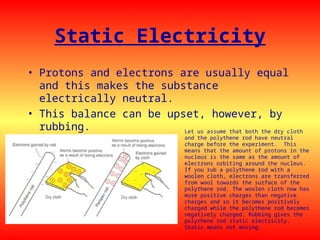
• This balance can be upset, however, by
rubbing. Let us assume that both the dry cloth
and the polythene rod have neutral
charge before the experiment. This
means that the amount of protons in the
nucleus is the same as the amount of
electrons orbiting around the nucleus.
If you rub a polythene rod with a
woolen cloth, electrons are transferred
from wool towards the surface of the
polythene rod. The woolen cloth now has
more positive charges than negative
charges and so it becomes positively
charged while the polythene rod becomes
negatively charged. Rubbing gives the
polythene rod static electricity.
Static means not moving.
Build Up of Electric Charges
• Glass, wood, plastic, and many other
substances can become charged by
rubbing.
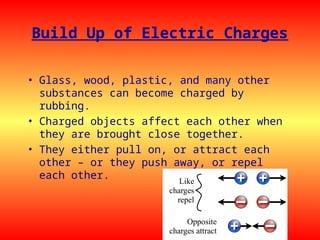
• Charged objects affect each other when
they are brought close together.
• They either pull on, or attract each
other – or they push away, or repel
each other.
Build Up of Electric Charges
• When electrical charges collect on the
surface of an object and tend to remain
there, they are called static charges.
• An object acquires static electricity
as a result of friction between itself
and another object.
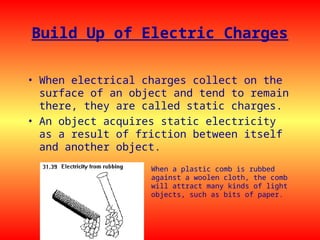
When a plastic comb is rubbed
against a woolen cloth, the comb
will attract many kinds of light
objects, such as bits of paper.
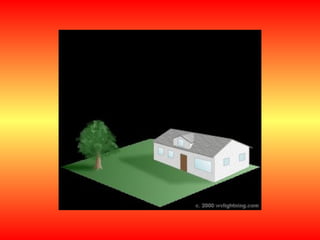
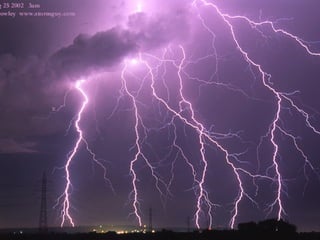
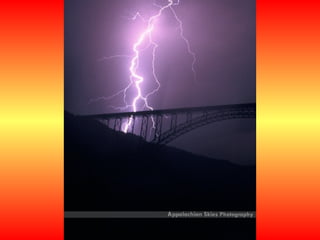
Lightning
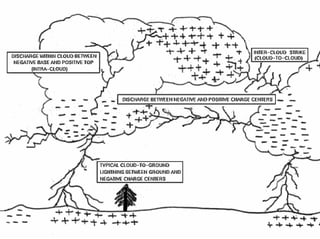
• Movement of thunder clouds in the sky
generates lightning. An electric discharge
that occurs between a positively charged area
and a negatively charged area
Can occur:
1. Cloud to cloud
2. Cloud to earth
3. In the same cloud
• https://www.youtube.com/watch?v=EM_sN_
YHNow
Thunder
• The sound that results from rapid movement of air
along a lightning strike
• As lightning flashes through the sky, it causes the
air to expand suddenly. With this sudden
expansion comes the loud rumble we call thunder
• Occurs during Thunderstorms
• Lightning first – then thunder because light travels
faster than sound.
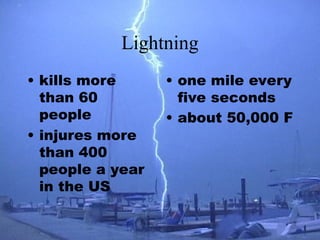
Lightning
• kills more
than 60
people
• injures more
than 400
people a year
in the US
• one mile every
five seconds
• about 50,000 F
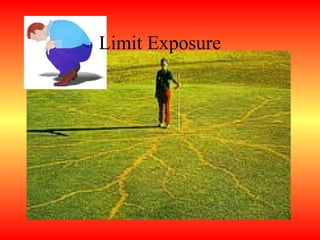
Limit Exposure
Current Electricity
Current Electricity –
what have we discussed: static
electricity
• Properties of Conductors & Insulators.
• Transfer of charge through various methods.
• Difference between static and current
electricity.
• Formulas.
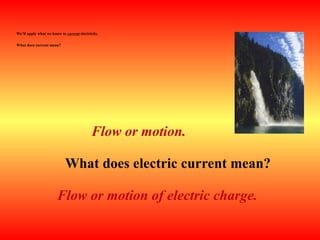
We’ll apply what we know to current electricity.
What does current mean?
What does electric current mean?
Flow or motion.
Flow or motion of electric charge.
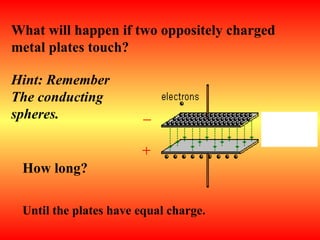
What will happen if two oppositely charged
metal plates touch?
Until the plates have equal charge.
How long?
Hint: Remember
The conducting
spheres.
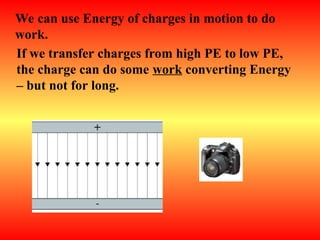
We can use Energy of charges in motion to do
work.
If we transfer charges from high PE to low PE,
the charge can do some work converting Energy
– but not for long.
With static I can charge an object, &
transfer the electric charge to do work.
Static electricity is quick transfer of charge but
charge stops when equilibrium reached.
We often want continuous flow of charge because
we want continuous work.
Current still needs a potential
difference/voltage to push charges to move.
The pd/voltage gives a push.
Current Electricity requires constant
source of potential difference or
voltage.
• Battery
• Wall outlet
• Generator
• Solar Cell
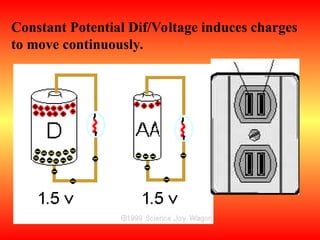
Constant Potential Dif/Voltage induces charges
to move continuously.
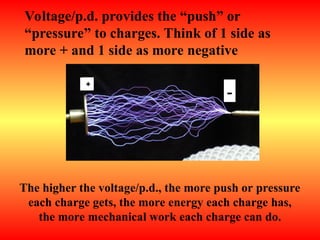
Voltage/p.d. provides the “push” or
“pressure” to charges. Think of 1 side as
more + and 1 side as more negative
The higher the voltage/p.d., the more push or pressure
each charge gets, the more energy each charge has,
the more mechanical work each charge can do.
+
-
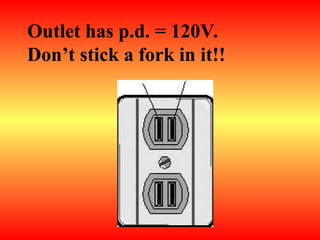
Outlet has p.d. = 120V.
Don’t stick a fork in it!!
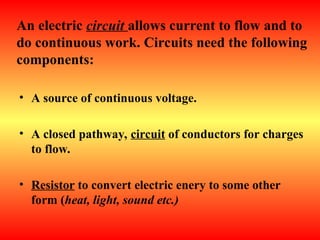
An electric circuit allows current to flow and to
do continuous work. Circuits need the following
components:
• A source of continuous voltage.
• A closed pathway, circuit of conductors for charges
to flow.
• Resistor to convert electric enery to some other
form (heat, light, sound etc.)
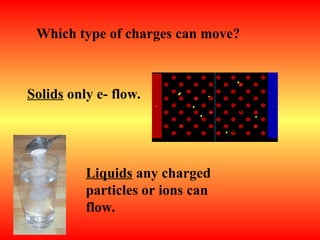
Solids only e- flow.
Liquids any charged
particles or ions can
flow.
Which type of charges can move?
Circuits
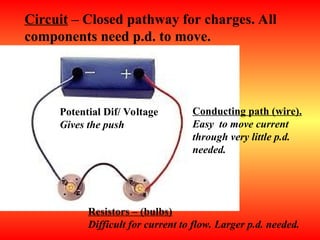
Circuit – Closed pathway for charges. All
components need p.d. to move.
Potential Dif/ Voltage
Gives the push
Conducting path (wire).
Easy to move current
through very little p.d.
needed.
Resistors – (bulbs)
Difficult for current to flow. Larger p.d. needed.
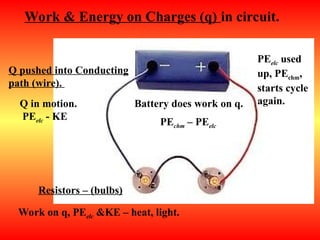
Work & Energy on Charges (q) in circuit.
Battery does work on q.
Q pushed into Conducting
path (wire).
Resistors – (bulbs)
PEchm – PEelc
Q in motion.
PEelc - KE
Work on q, PEelc &KE – heat, light.
PEelc used
up, PEchm,
starts cycle
again.
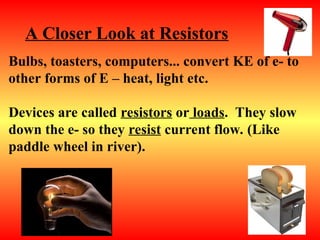
Bulbs, toasters, computers... convert KE of e- to
other forms of E – heat, light etc.
Devices are called resistors or loads. They slow
down the e- so they resist current flow. (Like
paddle wheel in river).
A Closer Look at Resistors
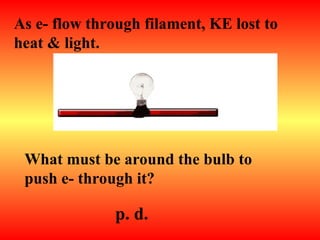
As e- flow through filament, KE lost to
heat & light.
What must be around the bulb to
push e- through it?
p. d.
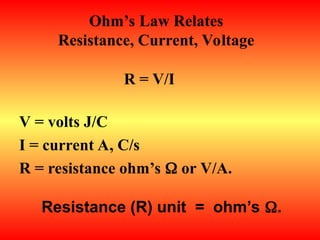
R = V/I
V = volts J/C
I = current A, C/s
R = resistance ohm’s  or V/A.
Resistance (R) unit = ohm’s .
Ohm’s Law Relates
Resistance, Current, Voltage
Resistance in Wires
Occurs in wires as well as appliances.
Certain factors affect how much
resistance a wire will offer to current
flow.
Factors affecting wire resistance.
1. Length
2. Area
3. Temperature
4. Type of material
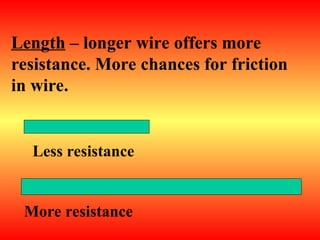
Length – longer wire offers more
resistance. More chances for friction
in wire.
More resistance
Less resistance
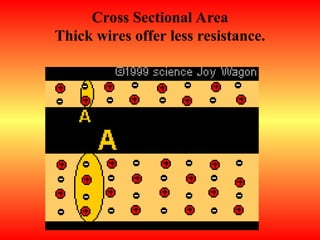
Cross Sectional Area
Thick wires offer less resistance.
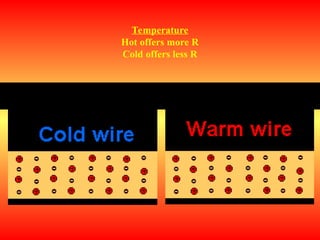
Temperature
Hot offers more R
Cold offers less R
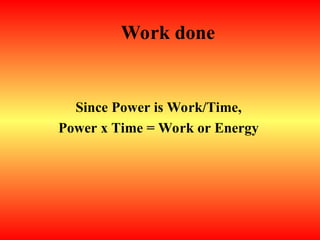
Work done
Since Power is Work/Time,
Power x Time = Work or Energy
Fuses
As current flows, wires heat up.
Fuses designed to break circuit if current becomes to high
for the wires.
Fuse should be rated just above the ideal operating
current for a circuit.
Kilowatt hours kWh.
• Power is a rate of energy use.
• Electric sold in kWh which is Pt.
• 1 kWh is energy delivered to home in
1hour.
• 1 kWh (1000 W/kW)(60 min/h)(60s/min)
= 3.6 x 10⁶
Ws = 3.6 x 10⁶
J
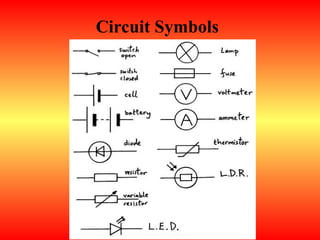
Circuit Symbols
Electricity
Know what it is
Know the different
kinds
Know about the
different kinds of
circuits
Know about
conductors and
insulators
The End