CURRENT ELECTRICITY
Wednesday, November
2, 2016
IMRAN 1
Introduction:-The branch of physics which deals
with the motion of charges is called current
electricity. Since the electronic current in a
conductor is due to the motion of free electrons
therefore these electrons are also known as
conduction electron. The flow of free charges in a
conductor constitutes electric current.
Electric current:- It is defined as the charge
flowing through any section of conductor in one
second.
Wednesday, November
2, 2016
IMRAN 2
•
Wednesday, November
2, 2016
IMRAN 3
I = q / t Amperes
The SI unit of electric current is ampere (A).
The current flowing in a conductor is said to be one
ampere if one coulomb of charge flows across any of
its cross-section in one second.
i.e., 1 ampere = (1 coulomb)/(1 second)
Electric current is macroscopic and scalar quantity.
Steady current is that current which does not vary
with time. Varying current is a current whose
magnitude varies with time.
Wednesday, November
2, 2016
IMRAN 4
An alternating current is a current whose
magnitude changes continuously with time and
direction changes periodically.
The electric current is generally measured by its
magnetic effect, chemical effect, heating effect etc.
Battery:- It is generally made up of a number of
electrochemical cells connected in series. The
chemical energy stored in these cells is converted
into electrical energy.
Dynamo:- In a dynamo (or generator), it is the
mechanical energy which is converted into
electrical energy.
Wednesday, November
2, 2016
IMRAN 5
•
Wednesday, November
2, 2016
IMRAN 6
Battery eliminator:- In this device, the alternating
current of the electric mains is converted into direct
current.
CLASSIFICATION OF MATERIALS IN TERMS OF
CONDUCTIVITY:
Conductors:- The materials whose electrical
conductivity is very high are called conductors.
Such as earth, human body, aqueous solutions of
salts, copper, iron, brass, aluminium etc.
Insulators:- The materials whose electrical
conductivity is very very small are called
insulators. Such as quartz, glass, dry air, wood etc.
Wednesday, November
2, 2016
IMRAN 7
Semiconductors:- The materials whose
conductivity lies between that of conductors and
insulators are called semiconductors. Such as
germanium, silicon.
Wednesday, November
2, 2016
IMRAN 8
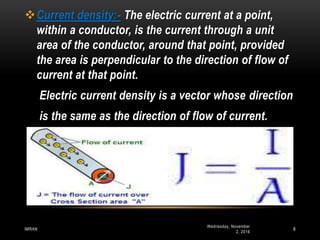
Current density:- The electric current at a point,
within a conductor, is the current through a unit
area of the conductor, around that point, provided
the area is perpendicular to the direction of flow of
current at that point.
Electric current density is a vector whose direction
is the same as the direction of flow of current.
Wednesday, November
2, 2016
IMRAN 9
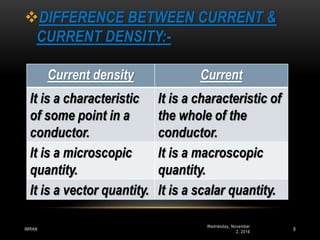
DIFFERENCE BETWEEN CURRENT &
CURRENT DENSITY:-
Current density Current
It is a characteristic
of some point in a
conductor.
It is a characteristic of
the whole of the
conductor.
It is a microscopic
quantity.
It is a macroscopic
quantity.
It is a vector quantity. It is a scalar quantity.
Wednesday, November
2, 2016
IMRAN 10
Electrical resistance:- The resistance of conductor
is the opposition offered by the conductor to the
flow of electric current through it.
The SI unit of resistance is ohm.
The resistance of a conductor is said to be one ohm
if a current of one ampere flows through the
conductor when a potential difference of one volt is
applied across its ends.
Wednesday, November
2, 2016
IMRAN 11
Resistivity (specific resistance):- The resistivity of a
material is the resistance of a conductor of this
material of unit length and unit cross-sectional
area.
Resistors:- Resistors can be carbon resistors or
wire-wound resistors. Both the types can either
have a fixed or a variable value.
To make a carbon resistor of fixed value, carbon
with a suitable binding material is moulded into a
cylinder. Wire leads are attached to this cylinder.
The resistor is encased in a plastic or ceramic
jacket. The resistor is connected to the circuit by
means of two leads.
Wednesday, November
2, 2016
IMRAN 12
COLOUR CODE FOR CARBON RESISTANCE:
Letter as an
aid to memory
Colour Number Multiplier
B Black 0 100
B Brown 1 101
R Red 2 102
O Orange 3 103
Y Yellow 4 104
G Green 5 105
B Blue 6 106
V Violet 7 107
G Grey 8 108
W White 9 109
Colour Tolerance
Gold ±5%
Silver ±10%
No colour ±20%
Wednesday, November
2, 2016
IMRAN 13
Aid to memory. B.B. Roy Great Britain Very Good
Wife. The bold faced letters correspond to colours
in the correct sequence.
Another mnemonic device used to remember this
code is “Bad Bees Ravage Our Yellow Geraniums
But Violets Grow Wildly.”

Current and electricity

  • 1.
    CURRENT ELECTRICITY Wednesday, November 2,2016 IMRAN 1 Introduction:-The branch of physics which deals with the motion of charges is called current electricity. Since the electronic current in a conductor is due to the motion of free electrons therefore these electrons are also known as conduction electron. The flow of free charges in a conductor constitutes electric current. Electric current:- It is defined as the charge flowing through any section of conductor in one second.
  • 2.
  • 3.
    Wednesday, November 2, 2016 IMRAN3 I = q / t Amperes The SI unit of electric current is ampere (A). The current flowing in a conductor is said to be one ampere if one coulomb of charge flows across any of its cross-section in one second. i.e., 1 ampere = (1 coulomb)/(1 second) Electric current is macroscopic and scalar quantity. Steady current is that current which does not vary with time. Varying current is a current whose magnitude varies with time.
  • 4.
    Wednesday, November 2, 2016 IMRAN4 An alternating current is a current whose magnitude changes continuously with time and direction changes periodically. The electric current is generally measured by its magnetic effect, chemical effect, heating effect etc. Battery:- It is generally made up of a number of electrochemical cells connected in series. The chemical energy stored in these cells is converted into electrical energy. Dynamo:- In a dynamo (or generator), it is the mechanical energy which is converted into electrical energy.
  • 5.
  • 6.
    Wednesday, November 2, 2016 IMRAN6 Battery eliminator:- In this device, the alternating current of the electric mains is converted into direct current. CLASSIFICATION OF MATERIALS IN TERMS OF CONDUCTIVITY: Conductors:- The materials whose electrical conductivity is very high are called conductors. Such as earth, human body, aqueous solutions of salts, copper, iron, brass, aluminium etc. Insulators:- The materials whose electrical conductivity is very very small are called insulators. Such as quartz, glass, dry air, wood etc.
  • 7.
    Wednesday, November 2, 2016 IMRAN7 Semiconductors:- The materials whose conductivity lies between that of conductors and insulators are called semiconductors. Such as germanium, silicon.
  • 8.
    Wednesday, November 2, 2016 IMRAN8 Current density:- The electric current at a point, within a conductor, is the current through a unit area of the conductor, around that point, provided the area is perpendicular to the direction of flow of current at that point. Electric current density is a vector whose direction is the same as the direction of flow of current.
  • 9.
    Wednesday, November 2, 2016 IMRAN9 DIFFERENCE BETWEEN CURRENT & CURRENT DENSITY:- Current density Current It is a characteristic of some point in a conductor. It is a characteristic of the whole of the conductor. It is a microscopic quantity. It is a macroscopic quantity. It is a vector quantity. It is a scalar quantity.
  • 10.
    Wednesday, November 2, 2016 IMRAN10 Electrical resistance:- The resistance of conductor is the opposition offered by the conductor to the flow of electric current through it. The SI unit of resistance is ohm. The resistance of a conductor is said to be one ohm if a current of one ampere flows through the conductor when a potential difference of one volt is applied across its ends.
  • 11.
    Wednesday, November 2, 2016 IMRAN11 Resistivity (specific resistance):- The resistivity of a material is the resistance of a conductor of this material of unit length and unit cross-sectional area. Resistors:- Resistors can be carbon resistors or wire-wound resistors. Both the types can either have a fixed or a variable value. To make a carbon resistor of fixed value, carbon with a suitable binding material is moulded into a cylinder. Wire leads are attached to this cylinder. The resistor is encased in a plastic or ceramic jacket. The resistor is connected to the circuit by means of two leads.
  • 12.
    Wednesday, November 2, 2016 IMRAN12 COLOUR CODE FOR CARBON RESISTANCE: Letter as an aid to memory Colour Number Multiplier B Black 0 100 B Brown 1 101 R Red 2 102 O Orange 3 103 Y Yellow 4 104 G Green 5 105 B Blue 6 106 V Violet 7 107 G Grey 8 108 W White 9 109 Colour Tolerance Gold ±5% Silver ±10% No colour ±20%
  • 13.
    Wednesday, November 2, 2016 IMRAN13 Aid to memory. B.B. Roy Great Britain Very Good Wife. The bold faced letters correspond to colours in the correct sequence. Another mnemonic device used to remember this code is “Bad Bees Ravage Our Yellow Geraniums But Violets Grow Wildly.”