Warm-up(Own Paper!!)What is kinetic energy?It is the energy due to motion or the energy of moving objects.What happens to kinetic energy when a ball is thrown up into the air. Gravity converts the kinetic energy into potential energy.
Warm- UpWhere is the force of gravity directed?DownWhat is the acceleration due to gravity?9.8 m/s2What are the two types of charge?Positive & Negative
8-1: Electric ChargeAnalyze factors that affect the strength and direction of electric forces and fields.Describehow electric forces and fields affect electric charges.Describe how electric charges are transferred and explain why electric discharges occur.
Electric ChargeElectrical energyEnergy associated with electrical charges.Electrical chargesA property that causes subatomic particles such as protons and electrons to attract and repel each other. Protons – positive Electrons – negative
Charged objectsObjects become charged because there is an imbalance of protons and electrons.Positive chargeMore protons than electrons.Negative chargeMore electrons than protons.Uncharged Equal numbers of each.
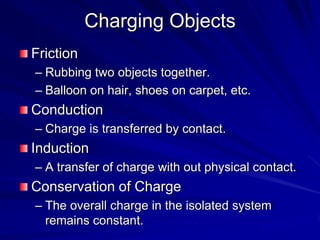
Charging ObjectsFrictionRubbing two objects together.Balloon on hair, shoes on carpet, etc.ConductionCharge is transferred by contact.InductionA transfer of charge with out physical contact.Conservation of ChargeThe overall charge in the isolated system remains constant.
Conduction
Induction
Electric forcesLike charges repel.Opposite charges attract.The electric force between two objects is directly proportional to the net charge on each object.The electric force is indirectly proportional to the square of the distance between each object.
Electric FieldsThe space around the electric charge over which the charge exerts a force.Electric field strength depends on:The amount of charge that produces the field.The distance from the charge.
2 Forms of ElectricityStatic – a build up of charge on  an objectCurrent – a steady flow of electrons through a conductor
Conductors and InsulatorsInsulators:Slow or stop the flow of electrons.Ex. Rubber, Glass, 	Plastic(the rubber coating on the outside of an electrical cord)Conductors:Allow a free flow of electronsEx.  Metals	(the wire inside an electrical cord)
ConclusionWrite a short paragraph describing the interactions between charges.Two types of chargesThe forces between chargesWay charges are transferred to and from surfaces.

8-1 Electric Charge

  • 1.
    Warm-up(Own Paper!!)What iskinetic energy?It is the energy due to motion or the energy of moving objects.What happens to kinetic energy when a ball is thrown up into the air. Gravity converts the kinetic energy into potential energy.
  • 2.
    Warm- UpWhere isthe force of gravity directed?DownWhat is the acceleration due to gravity?9.8 m/s2What are the two types of charge?Positive & Negative
  • 3.
    8-1: Electric ChargeAnalyzefactors that affect the strength and direction of electric forces and fields.Describehow electric forces and fields affect electric charges.Describe how electric charges are transferred and explain why electric discharges occur.
  • 4.
    Electric ChargeElectrical energyEnergyassociated with electrical charges.Electrical chargesA property that causes subatomic particles such as protons and electrons to attract and repel each other. Protons – positive Electrons – negative
  • 5.
    Charged objectsObjects becomecharged because there is an imbalance of protons and electrons.Positive chargeMore protons than electrons.Negative chargeMore electrons than protons.Uncharged Equal numbers of each.
  • 6.
    Charging ObjectsFrictionRubbing twoobjects together.Balloon on hair, shoes on carpet, etc.ConductionCharge is transferred by contact.InductionA transfer of charge with out physical contact.Conservation of ChargeThe overall charge in the isolated system remains constant.
  • 7.
  • 8.
  • 9.
    Electric forcesLike chargesrepel.Opposite charges attract.The electric force between two objects is directly proportional to the net charge on each object.The electric force is indirectly proportional to the square of the distance between each object.
  • 10.
    Electric FieldsThe spacearound the electric charge over which the charge exerts a force.Electric field strength depends on:The amount of charge that produces the field.The distance from the charge.
  • 11.
    2 Forms ofElectricityStatic – a build up of charge on an objectCurrent – a steady flow of electrons through a conductor
  • 12.
    Conductors and InsulatorsInsulators:Slowor stop the flow of electrons.Ex. Rubber, Glass, Plastic(the rubber coating on the outside of an electrical cord)Conductors:Allow a free flow of electronsEx. Metals (the wire inside an electrical cord)
  • 13.
    ConclusionWrite a shortparagraph describing the interactions between charges.Two types of chargesThe forces between chargesWay charges are transferred to and from surfaces.