EAT 119
Principles of EE
Chapter 1
Topics
• Electric Circuit & Theory
• Ohm’s Law
• Energy & Power
• Electrostatic
• Electric Charge
• Coulombs Law
• Electric Field
• Electric Flux
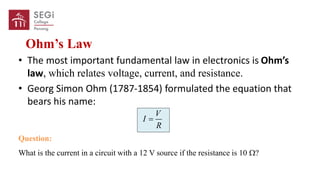
Ohm’s Law
• The most important fundamental law in electronics is Ohm’s
law, which relates voltage, current, and resistance.
• Georg Simon Ohm (1787-1854) formulated the equation that
bears his name:
V
I
R
=
Question:
What is the current in a circuit with a 12 V source if the resistance is 10 W?
Review of V, I, and R
• Voltage is the amount of energy per charge available to move
electrons from one point to another in a circuit and is
measured in volts.
• Current is the rate of charge flow and is measured in amperes.
• Resistance is the opposition to current and is measured ohms.
(resists the flow of I)
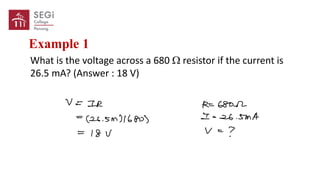
Example 1
What is the voltage across a 680 W resistor if the current is
26.5 mA? (Answer : 18 V)
Ohm’s law
V
1 s
1 s
40 mA
10 A
COM
R
ange
Autorange
T
ouch/Hold
Fused
OFF V
V
Hz
mV
A
What is the (hot) resistance of the bulb? (Answer : 132 Ω)
Example 2
115 V
I
(mA)
V (V)
0
0
2 4
4
6 8
8
10
12
14
16
A student takes data for a resistor and fits the straight line shown to the data. What
is the conductance and the resistance of the resistor?
Gradient of the slope
represents the
conductance.
14.8 mA - 0 mA
1.48 mS
10.0 V - 0 V
G = =
The reciprocal of the
conductance is the
resistance:
1 1
676 Ω
1.48 mS
R
G
= = =
Example 3
Graph of Current versus Voltage
Voltage (V)
Current
(mA)
0 10 20 30
0
2.0
4.0
6.0
8.0
10
Notice that the plot of current versus voltage for a fixed resistor is a line with a
positive slope. What is the resistance indicated by the graph? (Answer : 2.7 kΩ)
What is its conductance? (Answer 0.37 mS)
Energy and Power
• When a constant force is applied to move an object over a distance, the work done
is the force times the distance. The force must be measured in the same direction
as the distance. The unit for work is the newton-meter (N-m) or joule (J).
Force
Distance
• One joule is the work done when a force of one newton is applied
through a distance of one meter. A joule is a small amount of work
approximately equal to the work done in raising an apple over a
distance of 1 m.
• The symbol for energy, W, represents work, but should not be
confused with the unit for power, the watt, W.
• Energy is closely related to work. Energy is the ability to do work. As
such, it is measured in the same units as work, namely the newton-
meter (N-m) or joule (J)
1 n
1 m
What amount of energy is converted to heat in sliding a box along a floor for
5 meters if the force to move it is 400 N?
W = Fd = (400 N)(5 m) = 2000 N-m = 2000 J
Example 4
• Power is the rate of doing work. Because it is a rate, a time unit is
required. The unit is the joule per second (J/s), which defines a watt
(W).
What power is developed if the box in the previous example is moved in 10 s?
W
P
t
=
2000 J
10 s
W
P
t
= = = 200 W
Example 5
• In electrical work, the rate energy is dissipated can be determined
from any of three forms of the power formula.
NOTES:
2
P I R
= P VI
=
2
V
P
R
=
Together, the three forms are called Watt’s law.
What power is dissipated in a 27 W resistor if the current is 0.135 A?
( )
2
2
(0.135 A) 27
0.49 W
P I R
=
= W
=
Solution:
Given that you know the resistance and current, substitute the values into P =I 2
R.
Example 6
What power is dissipated by a heater that draws 12 A of current from a 120 V supply?
( )( )
12 A 120 V
1440 W
P IV
=
=
=
Solution:
The most direct solution is to substitute into P = IV.
Example 7
What power is dissipated in a 100 W resistor with 5 V across it?
( )
2
2
5 V
0.25 W
100
V
P
R
=
= =
W
It is useful to keep in mind that
small resistors operating in low
voltage systems need to be sized
for the anticipated power.
Example 8
Solution:
The most direct solution is to substitute into
Exercise
1) A coil has a current of 50mA flowing through it when the
applied voltage is 12 V. What is the resistance of the coil?
2) A 100V battery is connected across a resistor and causes a
current of 5mA to flow. Determine the resistance of the
resistor. If the voltage is now reduced to 25V, what will be the
new value of the current flowing?
3) What is the resistance of a coil which draws a current of
a) 50mA
b) 200𝜇A
Exercise
4) The current/voltage relationship for two resistors A and B is as
shown in Figure below. Determine the value of the resistance of
each resistor.
5) An electric kettle has a resistance of 30 Ω. What current will flow
when it is connected to a 240 V supply? Find also the power rating
of the kettle.
Electrostatic
• Study of Electricity in which electric charges are static i.e. not moving, is
called electrostatics.
• Example:-
• An annoying shock is sometimes experienced when you touch the handle of the
car door after sliding across the seat.
• You pull a wool sweater off at the end of the day and see sparks of electricity.
• You stroke your cat's fur and observe the fur standing up on its end.
• An atom is described as having a small and dense core of
positively-charged protons, neutral neutrons and
surrounded by shells of negatively charged electrons.
• The protons are tightly bound within the nucleus and
not removable by ordinary measures.
• The electron can migrants, they can leave their own
electron shells and become members of the electrons
shells of other atoms.
• The charge on a single electron/proton is 1.6 x 10 -19
Coulomb. (unit is C)
• The quantity of charge on an object reflects the amount
of imbalance between electrons and protons on that
object.
Electric Charge
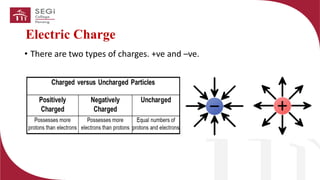
Flow of e- I
• There are two types of charges. +ve and –ve.
Electric Charge
• The unit of charge is coulomb (C), where one coulomb is one ampere
second .
• The coulomb is defined as the quantity of electricity which flows past a
given point in an electric circuit when a current of one ampere is
maintained for one second.
• Thus, charge, in coulombs Q=It where I is the current in amperes and t is
the time in seconds.
Electric Charge 1 C = 1As
1. If a current of 5A flows for 2 minutes, find the quantity of electricity
transferred.
• Solution: Quantity of electricity (quantity of charge flow), Q=It coulombs
I =5A, t=2×60=120 s
Hence Q=5×120=600 C
2. What current must flow if 0.24 coulombs is to be transferred in 15ms?
3. If a current of 10 A flows for four minutes, find the quantity of electricity
transferred.
4. In what time would a current of 10A transfer a charge of 50 C?
5. How long must a current of 100 mA flow so as to transfer a charge of 80
C?
Examples
Answer
2) Q = 0.24 C, t = 15ms, I = ?
𝑄 = 𝐼 𝑡
𝐼 =
𝑄
𝑡
=
0.24
15 ×10−3 = 16 A
3) I = 10 A, t = 4min, Q = ?
𝑄 = 𝐼 𝑡
𝑄 = 10 4 × 60 = 2400 𝐶
Answer
4) I = 10 A, Q = 50 C, t = ?
𝑄 = 𝐼 𝑡
t =
𝑄
𝐼
=
50
10
= 5s
5) I = 100 mA, Q = 80 C, t = ?
𝑄 = 𝐼 𝑡
t =
𝑄
𝐼
=
80
100 × 10−3 = 800s
• A force exists between charged bodies.
• A force of attraction exists between opposite charges and a force of
repulsion between like polarity charges.
Charge Interactions
Unlike charges attract,
and Like charges repel
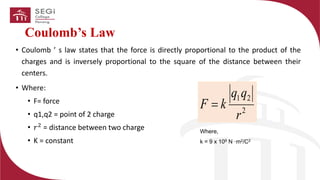
• Coulomb ’ s law states that the force is directly proportional to the product of the
charges and is inversely proportional to the square of the distance between their
centers.
• Where:
• F= force
• q1,q2 = point of 2 charge
• 𝑟2 = distance between two charge
• K = constant
Coulomb’s Law
2
2
1
r
q
q
k
F =
Where,
k = 9 x 10⁹ N ·m2/C2
Last Updated:30 January 2023
28
• Conductor is a material through which charge can be easily transferred.
• Insulator is a material that resist the flow of charge.
• Semiconductor are intermediate in their properties between good
conductor and good insulators.
Conductor & Insulator
Last Updated:30 January 2023
29
• Induction charging is a method used to charge an object without actually touching the
object to any other charged object.
• The law of conservation of charge is easily observed in the induction process. The overall
charge on the system of two objects is the same after the charging process as it was
before the charging process. Charge is neither created nor destroyed during this charging
process; it is simply transferred from one object to the other object in the form of
electrons.
Charge by Induction
• The strength of an electric field can be represented by the force per unit
charge.
• We define the electricity field intensity E at a point in terms of the force F
experienced by a small positive charge +q when it is placed at that point.
• The magnitude of the electric field intensity E is given by
Electric Fields
q
F
E =
2
2
r
kQ
qr
kQq
q
F
E =
=
=
• The direction of the electric field intensity E at a point is the same as the direction in
which a positive test charge +q would move when placed at that point.
• An electric field exists in the neighborhood of a charged body, whether or not a
second charge is placed in the field, it will experience a force F given by
Electric Field Intensity
F = qE
• To visualize the electric field, we draw a series of lines to indicate the direction of the
electric field at various points in space.
• Electric field lines indicate the direction of the electric field.
• Electric field lines start on positive charges and end on negative charges.
• The number of lines is proportional to the magnitude of the charge.
• The nearer the charge, the electric field is greater and the lines are closer together.
Ea
Eb
Ec
Electric Field Lines
Electric field lines due to 2 opposite sign
charges, known as electric dipole.
Electric field lines for two positive
charge.
Electric field lines for two
unequal charges,-Q and +2Q.
Electric Field Lines
• The figure shows two parallel conducting
plates separated from each other by air.
• They are connected to opposite terminals of a
battery of voltage V volts.
• There is therefore an electric field in the space
between the plates.
• If the plates are close together, the electric
lines of force will be straight and parallel and
equally spaced.
• Electric field strength, 𝐸 =
𝑉
𝑑
• where d is the distance between the plates and 𝑉
is voltage
Electric Field Strength
• Electric flux is the measure of the electric field
through a given surface.
• Gauss’s law involves the concept of electric flux,
which refer to the electric field passing thru a
given area.
• For a uniform electric field E passing through an
area A, as shown in (a), the electric flux ∅𝐸 is
defined as:
• ∅𝐸 = 𝐸 റ
𝐴
• For an area with an angle θ between the electric
field and a line drawn perpendicular to the area,
as shown in (b), the electric flux ∅𝐸 can defined
as :
• ∅𝐸 = 𝐸 റ
𝐴 cos 𝜃
Electric Flux
• Electric flux density, D is the amount of flux passing through a
defined area, A that is perpendicular to the direction of the flux.
• Electric flux density, D =
𝑄
𝐴
• Where Q = charge in Coulomb (C) and A = area in 𝑚2
Electric Flux Density
1. Two parallel rectangular plates measuring 20 cm by 40 cm carry an electric charge
of 0.2μC. Calculate the electric flux density. If the plates are spaced 5mm apart and
the voltage between them is 0.25kV, determine the electric field strength.
2. Two parallel plates of dimensions 30 mm by 20 mm are oppositely charged to a
value of 50 mC. Calculate the density of the electric flux existing between them.
3. Two parallel metal plates of area 400𝑚𝑚2 , are charged from a constant current
source of 50 𝜇A for a time of 3 seconds. Calculate
a) the charge on the plates
b) the density of the electric flux between them
Example
Answer
Question 1 𝐷 =
𝑄
𝐴
=
0.2 × 10⁻⁶
20 × 10−2 (40 × 10−2)
= 2.5
𝐸 =
𝑉
𝑑
=
0.2 × 10⁻³
5 × 10−3
= 50
= 50 000
Answer
Question 2
𝐷 =
𝑄
𝐴
=
50 × 10−3
20 × 10−3 (30 × 10−3)
= 83.3 c/m
Answer
Question 3
a) Find Q?
𝑄 = 𝐼𝑡 = (50 × 10−6
) (3)
= 1.5 × 10⁻⁴ C
b) Find D?
𝐷 =
𝑄
𝐴
=
1.5 × 10⁻⁴
40 × 10−6
= 0.375 c/m
• At any point in an electric field, the electric field strength, E maintains the electric
flux and produces a particular value of electric flux density, D at that point.
• For a field established in vacuum (or for practical purposes in air), the ratio
𝐷
𝐸
is a
constant 𝜀°
•
𝐷
𝐸
= 𝜀°
• where 𝜀° is called the permittivity of free space
• The value of 𝜀° is 8.85×10 F/m.
• When an insulating medium, such as mica, paper, plastic or ceramic, is
introduced into the region of an electric field the ratio of
𝐷
𝐸
is modified.
•
𝐷
𝐸
= 𝜀°𝜀𝑟
• where 𝜀𝑟 the relative permittivity of the insulating material
Permittivity
1. The flux density between two plates separated by mica of
relative permittivity 5 is 2μC/𝑚2
. Find the electric field
strength between the plates.
2. Two parallel plates having a voltage of 200V between them
are spaced 0.8mm apart.
a) What is the electric field strength?
b) Find also the flux density when the dielectric between the plates
is
i. Air (𝜀𝑟 =1)
ii. polythene of relative permittivity 2.3
Example
Answer
Question 1
Answer
Question 2
a) Find E?
b) i) Find Er?
ii) Find D?
Chapter 1 E&E Principle.pdf

Chapter 1 E&E Principle.pdf

  • 1.
  • 2.
    Topics • Electric Circuit& Theory • Ohm’s Law • Energy & Power • Electrostatic • Electric Charge • Coulombs Law • Electric Field • Electric Flux
  • 3.
    Ohm’s Law • Themost important fundamental law in electronics is Ohm’s law, which relates voltage, current, and resistance. • Georg Simon Ohm (1787-1854) formulated the equation that bears his name: V I R = Question: What is the current in a circuit with a 12 V source if the resistance is 10 W?
  • 4.
    Review of V,I, and R • Voltage is the amount of energy per charge available to move electrons from one point to another in a circuit and is measured in volts. • Current is the rate of charge flow and is measured in amperes. • Resistance is the opposition to current and is measured ohms. (resists the flow of I)
  • 5.
    Example 1 What isthe voltage across a 680 W resistor if the current is 26.5 mA? (Answer : 18 V)
  • 6.
    Ohm’s law V 1 s 1s 40 mA 10 A COM R ange Autorange T ouch/Hold Fused OFF V V Hz mV A What is the (hot) resistance of the bulb? (Answer : 132 Ω) Example 2 115 V
  • 7.
    I (mA) V (V) 0 0 2 4 4 68 8 10 12 14 16 A student takes data for a resistor and fits the straight line shown to the data. What is the conductance and the resistance of the resistor? Gradient of the slope represents the conductance. 14.8 mA - 0 mA 1.48 mS 10.0 V - 0 V G = = The reciprocal of the conductance is the resistance: 1 1 676 Ω 1.48 mS R G = = = Example 3
  • 8.
    Graph of Currentversus Voltage Voltage (V) Current (mA) 0 10 20 30 0 2.0 4.0 6.0 8.0 10 Notice that the plot of current versus voltage for a fixed resistor is a line with a positive slope. What is the resistance indicated by the graph? (Answer : 2.7 kΩ) What is its conductance? (Answer 0.37 mS)
  • 9.
    Energy and Power •When a constant force is applied to move an object over a distance, the work done is the force times the distance. The force must be measured in the same direction as the distance. The unit for work is the newton-meter (N-m) or joule (J). Force Distance
  • 10.
    • One jouleis the work done when a force of one newton is applied through a distance of one meter. A joule is a small amount of work approximately equal to the work done in raising an apple over a distance of 1 m. • The symbol for energy, W, represents work, but should not be confused with the unit for power, the watt, W. • Energy is closely related to work. Energy is the ability to do work. As such, it is measured in the same units as work, namely the newton- meter (N-m) or joule (J) 1 n 1 m
  • 11.
    What amount ofenergy is converted to heat in sliding a box along a floor for 5 meters if the force to move it is 400 N? W = Fd = (400 N)(5 m) = 2000 N-m = 2000 J Example 4
  • 12.
    • Power isthe rate of doing work. Because it is a rate, a time unit is required. The unit is the joule per second (J/s), which defines a watt (W). What power is developed if the box in the previous example is moved in 10 s? W P t = 2000 J 10 s W P t = = = 200 W Example 5
  • 13.
    • In electricalwork, the rate energy is dissipated can be determined from any of three forms of the power formula. NOTES: 2 P I R = P VI = 2 V P R = Together, the three forms are called Watt’s law.
  • 14.
    What power isdissipated in a 27 W resistor if the current is 0.135 A? ( ) 2 2 (0.135 A) 27 0.49 W P I R = = W = Solution: Given that you know the resistance and current, substitute the values into P =I 2 R. Example 6
  • 15.
    What power isdissipated by a heater that draws 12 A of current from a 120 V supply? ( )( ) 12 A 120 V 1440 W P IV = = = Solution: The most direct solution is to substitute into P = IV. Example 7
  • 16.
    What power isdissipated in a 100 W resistor with 5 V across it? ( ) 2 2 5 V 0.25 W 100 V P R = = = W It is useful to keep in mind that small resistors operating in low voltage systems need to be sized for the anticipated power. Example 8 Solution: The most direct solution is to substitute into
  • 17.
    Exercise 1) A coilhas a current of 50mA flowing through it when the applied voltage is 12 V. What is the resistance of the coil? 2) A 100V battery is connected across a resistor and causes a current of 5mA to flow. Determine the resistance of the resistor. If the voltage is now reduced to 25V, what will be the new value of the current flowing? 3) What is the resistance of a coil which draws a current of a) 50mA b) 200𝜇A
  • 18.
    Exercise 4) The current/voltagerelationship for two resistors A and B is as shown in Figure below. Determine the value of the resistance of each resistor. 5) An electric kettle has a resistance of 30 Ω. What current will flow when it is connected to a 240 V supply? Find also the power rating of the kettle.
  • 19.
    Electrostatic • Study ofElectricity in which electric charges are static i.e. not moving, is called electrostatics. • Example:- • An annoying shock is sometimes experienced when you touch the handle of the car door after sliding across the seat. • You pull a wool sweater off at the end of the day and see sparks of electricity. • You stroke your cat's fur and observe the fur standing up on its end.
  • 20.
    • An atomis described as having a small and dense core of positively-charged protons, neutral neutrons and surrounded by shells of negatively charged electrons. • The protons are tightly bound within the nucleus and not removable by ordinary measures. • The electron can migrants, they can leave their own electron shells and become members of the electrons shells of other atoms. • The charge on a single electron/proton is 1.6 x 10 -19 Coulomb. (unit is C) • The quantity of charge on an object reflects the amount of imbalance between electrons and protons on that object. Electric Charge Flow of e- I
  • 21.
    • There aretwo types of charges. +ve and –ve. Electric Charge
  • 22.
    • The unitof charge is coulomb (C), where one coulomb is one ampere second . • The coulomb is defined as the quantity of electricity which flows past a given point in an electric circuit when a current of one ampere is maintained for one second. • Thus, charge, in coulombs Q=It where I is the current in amperes and t is the time in seconds. Electric Charge 1 C = 1As
  • 23.
    1. If acurrent of 5A flows for 2 minutes, find the quantity of electricity transferred. • Solution: Quantity of electricity (quantity of charge flow), Q=It coulombs I =5A, t=2×60=120 s Hence Q=5×120=600 C 2. What current must flow if 0.24 coulombs is to be transferred in 15ms? 3. If a current of 10 A flows for four minutes, find the quantity of electricity transferred. 4. In what time would a current of 10A transfer a charge of 50 C? 5. How long must a current of 100 mA flow so as to transfer a charge of 80 C? Examples
  • 24.
    Answer 2) Q =0.24 C, t = 15ms, I = ? 𝑄 = 𝐼 𝑡 𝐼 = 𝑄 𝑡 = 0.24 15 ×10−3 = 16 A 3) I = 10 A, t = 4min, Q = ? 𝑄 = 𝐼 𝑡 𝑄 = 10 4 × 60 = 2400 𝐶
  • 25.
    Answer 4) I =10 A, Q = 50 C, t = ? 𝑄 = 𝐼 𝑡 t = 𝑄 𝐼 = 50 10 = 5s 5) I = 100 mA, Q = 80 C, t = ? 𝑄 = 𝐼 𝑡 t = 𝑄 𝐼 = 80 100 × 10−3 = 800s
  • 26.
    • A forceexists between charged bodies. • A force of attraction exists between opposite charges and a force of repulsion between like polarity charges. Charge Interactions Unlike charges attract, and Like charges repel
  • 27.
    • Coulomb ’s law states that the force is directly proportional to the product of the charges and is inversely proportional to the square of the distance between their centers. • Where: • F= force • q1,q2 = point of 2 charge • 𝑟2 = distance between two charge • K = constant Coulomb’s Law 2 2 1 r q q k F = Where, k = 9 x 10⁹ N ·m2/C2
  • 28.
    Last Updated:30 January2023 28 • Conductor is a material through which charge can be easily transferred. • Insulator is a material that resist the flow of charge. • Semiconductor are intermediate in their properties between good conductor and good insulators. Conductor & Insulator
  • 29.
    Last Updated:30 January2023 29 • Induction charging is a method used to charge an object without actually touching the object to any other charged object. • The law of conservation of charge is easily observed in the induction process. The overall charge on the system of two objects is the same after the charging process as it was before the charging process. Charge is neither created nor destroyed during this charging process; it is simply transferred from one object to the other object in the form of electrons. Charge by Induction
  • 30.
    • The strengthof an electric field can be represented by the force per unit charge. • We define the electricity field intensity E at a point in terms of the force F experienced by a small positive charge +q when it is placed at that point. • The magnitude of the electric field intensity E is given by Electric Fields q F E = 2 2 r kQ qr kQq q F E = = =
  • 31.
    • The directionof the electric field intensity E at a point is the same as the direction in which a positive test charge +q would move when placed at that point. • An electric field exists in the neighborhood of a charged body, whether or not a second charge is placed in the field, it will experience a force F given by Electric Field Intensity F = qE
  • 32.
    • To visualizethe electric field, we draw a series of lines to indicate the direction of the electric field at various points in space. • Electric field lines indicate the direction of the electric field. • Electric field lines start on positive charges and end on negative charges. • The number of lines is proportional to the magnitude of the charge. • The nearer the charge, the electric field is greater and the lines are closer together. Ea Eb Ec Electric Field Lines
  • 33.
    Electric field linesdue to 2 opposite sign charges, known as electric dipole. Electric field lines for two positive charge. Electric field lines for two unequal charges,-Q and +2Q. Electric Field Lines
  • 34.
    • The figureshows two parallel conducting plates separated from each other by air. • They are connected to opposite terminals of a battery of voltage V volts. • There is therefore an electric field in the space between the plates. • If the plates are close together, the electric lines of force will be straight and parallel and equally spaced. • Electric field strength, 𝐸 = 𝑉 𝑑 • where d is the distance between the plates and 𝑉 is voltage Electric Field Strength
  • 35.
    • Electric fluxis the measure of the electric field through a given surface. • Gauss’s law involves the concept of electric flux, which refer to the electric field passing thru a given area. • For a uniform electric field E passing through an area A, as shown in (a), the electric flux ∅𝐸 is defined as: • ∅𝐸 = 𝐸 റ 𝐴 • For an area with an angle θ between the electric field and a line drawn perpendicular to the area, as shown in (b), the electric flux ∅𝐸 can defined as : • ∅𝐸 = 𝐸 റ 𝐴 cos 𝜃 Electric Flux
  • 36.
    • Electric fluxdensity, D is the amount of flux passing through a defined area, A that is perpendicular to the direction of the flux. • Electric flux density, D = 𝑄 𝐴 • Where Q = charge in Coulomb (C) and A = area in 𝑚2 Electric Flux Density
  • 37.
    1. Two parallelrectangular plates measuring 20 cm by 40 cm carry an electric charge of 0.2μC. Calculate the electric flux density. If the plates are spaced 5mm apart and the voltage between them is 0.25kV, determine the electric field strength. 2. Two parallel plates of dimensions 30 mm by 20 mm are oppositely charged to a value of 50 mC. Calculate the density of the electric flux existing between them. 3. Two parallel metal plates of area 400𝑚𝑚2 , are charged from a constant current source of 50 𝜇A for a time of 3 seconds. Calculate a) the charge on the plates b) the density of the electric flux between them Example
  • 38.
    Answer Question 1 𝐷= 𝑄 𝐴 = 0.2 × 10⁻⁶ 20 × 10−2 (40 × 10−2) = 2.5 𝐸 = 𝑉 𝑑 = 0.2 × 10⁻³ 5 × 10−3 = 50 = 50 000
  • 39.
    Answer Question 2 𝐷 = 𝑄 𝐴 = 50× 10−3 20 × 10−3 (30 × 10−3) = 83.3 c/m
  • 40.
    Answer Question 3 a) FindQ? 𝑄 = 𝐼𝑡 = (50 × 10−6 ) (3) = 1.5 × 10⁻⁴ C b) Find D? 𝐷 = 𝑄 𝐴 = 1.5 × 10⁻⁴ 40 × 10−6 = 0.375 c/m
  • 41.
    • At anypoint in an electric field, the electric field strength, E maintains the electric flux and produces a particular value of electric flux density, D at that point. • For a field established in vacuum (or for practical purposes in air), the ratio 𝐷 𝐸 is a constant 𝜀° • 𝐷 𝐸 = 𝜀° • where 𝜀° is called the permittivity of free space • The value of 𝜀° is 8.85×10 F/m. • When an insulating medium, such as mica, paper, plastic or ceramic, is introduced into the region of an electric field the ratio of 𝐷 𝐸 is modified. • 𝐷 𝐸 = 𝜀°𝜀𝑟 • where 𝜀𝑟 the relative permittivity of the insulating material Permittivity
  • 42.
    1. The fluxdensity between two plates separated by mica of relative permittivity 5 is 2μC/𝑚2 . Find the electric field strength between the plates. 2. Two parallel plates having a voltage of 200V between them are spaced 0.8mm apart. a) What is the electric field strength? b) Find also the flux density when the dielectric between the plates is i. Air (𝜀𝑟 =1) ii. polythene of relative permittivity 2.3 Example
  • 43.
  • 44.
    Answer Question 2 a) FindE? b) i) Find Er? ii) Find D?