TECHNOLOGY
      ELECTRICITY AND
    ELECTRICAL CIRCUITS
-
BASIC CONCEPTS
                          Liezel Oosthuizen
                                 200932201
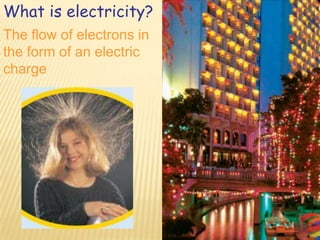
What is electricity?
The flow of electrons in
the form of an electric
charge
What are the
   two types of
   electricity?
 a. Static
     electricity
 b. Current
     electricity
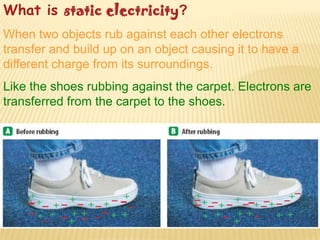
What is static electricity?
When two objects rub against each other electrons
transfer and build up on an object causing it to have a
different charge from its surroundings.
Like the shoes rubbing against the carpet. Electrons are
transferred from the carpet to the shoes.
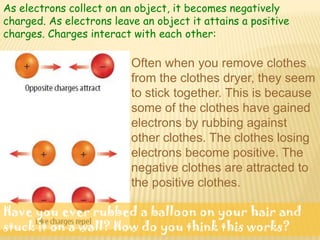
As electrons collect on an object, it becomes negatively
charged. As electrons leave an object it attains a positive
charges. Charges interact with each other:

                          Often when you remove clothes
                          from the clothes dryer, they seem
                          to stick together. This is because
                          some of the clothes have gained
                          electrons by rubbing against
                          other clothes. The clothes losing
                          electrons become positive. The
                          negative clothes are attracted to
                          the positive clothes.

Have you ever rubbed a balloon on your hair and
stuck it on a wall? How do you think this works?
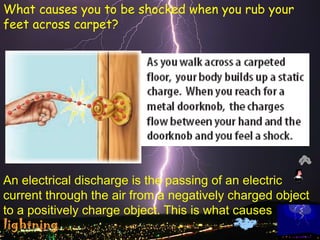
What causes you to be shocked when you rub your
feet across carpet?


An electrical discharge is the passing of an electric
current through the air from a negatively charged object
to a positively charge object. This is what causes
lightning!
What is current
      electricity?
   a.   Negative charges
        that move along a
        path or wire

How is current electricity different
   from static electricity?
a. Current electricity travels in a path made
   by a wire
b. Static Electricity doesn’t travel in a path
   or wire
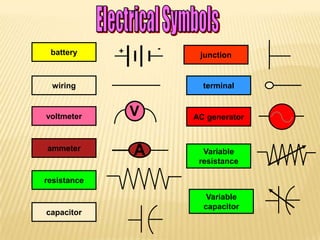
+       -
 battery                  junction


 wiring                    terminal


voltmeter        V       AC generator


ammeter
                 A         Variable
                          resistance

resistance

                            Variable
                           capacitor
capacitor
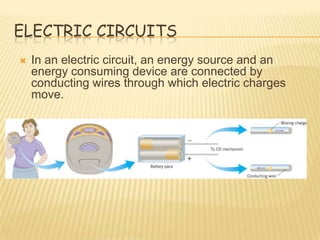
ELECTRIC CIRCUITS
   In an electric circuit, an energy source and an
    energy consuming device are connected by
    conducting wires through which electric charges
    move.
All electrical circuits require three elements.


 (1) A source voltage, that is, an electron pump usually
               a battery or power supply.
                      [ ENERGY IN]


(2) A conductor to carry electrons from and to the voltage
       source (pump). The conductor is often a wire.
                  [ENERGY TRANSFER]


(3) A load or resistance. A point where energy is extracted
   form the circuit in the form of heat, light, motion, etc.
                        [ENERGY OUT]
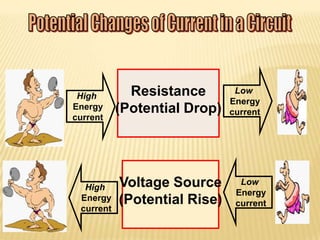
High        Resistance        Low
                              Energy
Energy     (Potential Drop)   current
current


  High     Voltage Source       Low
                               Energy
 Energy    (Potential Rise)    current
 current
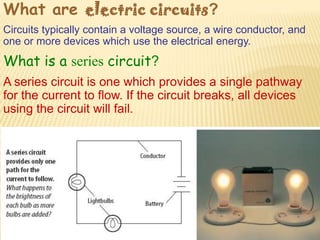
What are electric circuits?
Circuits typically contain a voltage source, a wire conductor, and
one or more devices which use the electrical energy.
What is a series circuit?
A series circuit is one which provides a single pathway
for the current to flow. If the circuit breaks, all devices
using the circuit will fail.
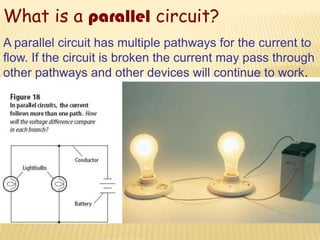
What is a parallel circuit?
A parallel circuit has multiple pathways for the current to
flow. If the circuit is broken the current may pass through
other pathways and other devices will continue to work.
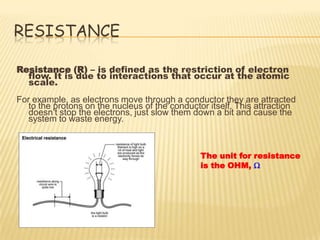
RESISTANCE

Resistance (R) – is defined as the restriction of electron
  flow. It is due to interactions that occur at the atomic
  scale.
For example, as electrons move through a conductor they are attracted
   to the protons on the nucleus of the conductor itself. This attraction
   doesn’t stop the electrons, just slow them down a bit and cause the
   system to waste energy.


                                                The unit for resistance
                                                is the OHM, W
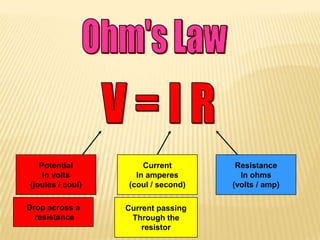
Potential          Current        Resistance
    In volts        In amperes        In ohms
(joules / coul)   (coul / second)   (volts / amp)

Drop across a     Current passing
  resistance       Through the
                      resistor
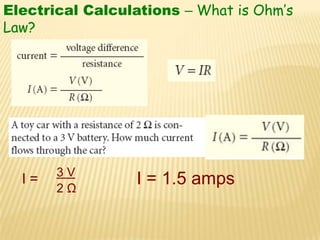
Electrical Calculations – What is Ohm’s
Law?


       3V
  I=
       2Ω
                 I = 1.5 amps
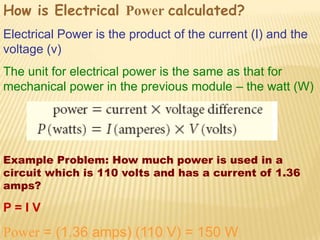
How is Electrical Power calculated?
Electrical Power is the product of the current (I) and the
voltage (v)
The unit for electrical power is the same as that for
mechanical power in the previous module – the watt (W)


Example Problem: How much power is used in a
circuit which is 110 volts and has a current of 1.36
amps?

P=IV

Power = (1.36 amps) (110 V) = 150 W
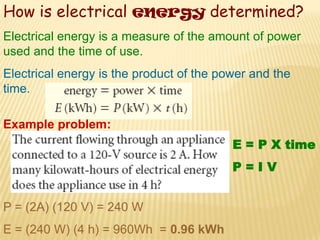
How is electrical energy determined?
Electrical energy is a measure of the amount of power
used and the time of use.
Electrical energy is the product of the power and the
time.

Example problem:
                                          E = P X time
                                          P=IV


P = (2A) (120 V) = 240 W
E = (240 W) (4 h) = 960Wh = 0.96 kWh
REFERENCING
   Ch 20 Electric Circuits. (n.d.). Retrieved March 19, 2012, from
    http://www.slideshare.net/cscottthomas/ch-20-electric-circuits-online

   Electric circuits. (n.d.). Retrieved March 19, 2012, from
    http://www.slideshare.net/jmemler/electric-circuits-10520910

   Electrical Circuits. (n.d.). Retrieved March 19, 2012, from
    http://www.slideshare.net/wsautter/electrical-circuits

   Electricity and Magnetism - Basic Concepts. (n.d.). Retrieved March 19, 2012, from
    http://www.slideshare.net/makadelhi/electricity-and-magnetism-basic-concepts

   Electricity.Electronics Ch20. (n.d.). Retrieved March 19, 2012, from
    http://www.slideshare.net/Wansyi/electricityelectronics-ch20-presentation

   Ohm’s law. (n.d.). Retrieved March 19, 2012, from http://www.slideshare.net/wathens/ohms-law-
    7892325

   chapter-12-lesson4-electricity-1216167849986490-8.ppt. (n.d.). Retrieved from
    http://s3.amazonaws.com/ppt-download/chapter-12-lesson4-electricity-1216167849986490-
    8.ppt?response-content-
    disposition=attachment&Signature=2JTi69Np8a%2FhUaX0pWkNUl139K4%3D&Expires=1331653
    554&AWSAccessKeyId=AKIAJLJT267DEGKZDHEQ
Electricity and electrical circuits   final 20 maart

Electricity and electrical circuits final 20 maart

  • 1.
    TECHNOLOGY ELECTRICITY AND ELECTRICAL CIRCUITS - BASIC CONCEPTS Liezel Oosthuizen 200932201
  • 2.
    What is electricity? Theflow of electrons in the form of an electric charge
  • 3.
    What are the two types of electricity? a. Static electricity b. Current electricity
  • 4.
    What is staticelectricity? When two objects rub against each other electrons transfer and build up on an object causing it to have a different charge from its surroundings. Like the shoes rubbing against the carpet. Electrons are transferred from the carpet to the shoes.
  • 5.
    As electrons collecton an object, it becomes negatively charged. As electrons leave an object it attains a positive charges. Charges interact with each other: Often when you remove clothes from the clothes dryer, they seem to stick together. This is because some of the clothes have gained electrons by rubbing against other clothes. The clothes losing electrons become positive. The negative clothes are attracted to the positive clothes. Have you ever rubbed a balloon on your hair and stuck it on a wall? How do you think this works?
  • 6.
    What causes youto be shocked when you rub your feet across carpet? An electrical discharge is the passing of an electric current through the air from a negatively charged object to a positively charge object. This is what causes lightning!
  • 7.
    What is current electricity? a. Negative charges that move along a path or wire How is current electricity different from static electricity? a. Current electricity travels in a path made by a wire b. Static Electricity doesn’t travel in a path or wire
  • 8.
    + - battery junction wiring terminal voltmeter V AC generator ammeter A Variable resistance resistance Variable capacitor capacitor
  • 9.
    ELECTRIC CIRCUITS  In an electric circuit, an energy source and an energy consuming device are connected by conducting wires through which electric charges move.
  • 10.
    All electrical circuitsrequire three elements. (1) A source voltage, that is, an electron pump usually a battery or power supply. [ ENERGY IN] (2) A conductor to carry electrons from and to the voltage source (pump). The conductor is often a wire. [ENERGY TRANSFER] (3) A load or resistance. A point where energy is extracted form the circuit in the form of heat, light, motion, etc. [ENERGY OUT]
  • 11.
    High Resistance Low Energy Energy (Potential Drop) current current High Voltage Source Low Energy Energy (Potential Rise) current current
  • 12.
    What are electriccircuits? Circuits typically contain a voltage source, a wire conductor, and one or more devices which use the electrical energy. What is a series circuit? A series circuit is one which provides a single pathway for the current to flow. If the circuit breaks, all devices using the circuit will fail.
  • 13.
    What is aparallel circuit? A parallel circuit has multiple pathways for the current to flow. If the circuit is broken the current may pass through other pathways and other devices will continue to work.
  • 14.
    RESISTANCE Resistance (R) –is defined as the restriction of electron flow. It is due to interactions that occur at the atomic scale. For example, as electrons move through a conductor they are attracted to the protons on the nucleus of the conductor itself. This attraction doesn’t stop the electrons, just slow them down a bit and cause the system to waste energy. The unit for resistance is the OHM, W
  • 15.
    Potential Current Resistance In volts In amperes In ohms (joules / coul) (coul / second) (volts / amp) Drop across a Current passing resistance Through the resistor
  • 16.
    Electrical Calculations –What is Ohm’s Law? 3V I= 2Ω I = 1.5 amps
  • 17.
    How is ElectricalPower calculated? Electrical Power is the product of the current (I) and the voltage (v) The unit for electrical power is the same as that for mechanical power in the previous module – the watt (W) Example Problem: How much power is used in a circuit which is 110 volts and has a current of 1.36 amps? P=IV Power = (1.36 amps) (110 V) = 150 W
  • 18.
    How is electricalenergy determined? Electrical energy is a measure of the amount of power used and the time of use. Electrical energy is the product of the power and the time. Example problem: E = P X time P=IV P = (2A) (120 V) = 240 W E = (240 W) (4 h) = 960Wh = 0.96 kWh
  • 19.
    REFERENCING  Ch 20 Electric Circuits. (n.d.). Retrieved March 19, 2012, from http://www.slideshare.net/cscottthomas/ch-20-electric-circuits-online  Electric circuits. (n.d.). Retrieved March 19, 2012, from http://www.slideshare.net/jmemler/electric-circuits-10520910  Electrical Circuits. (n.d.). Retrieved March 19, 2012, from http://www.slideshare.net/wsautter/electrical-circuits  Electricity and Magnetism - Basic Concepts. (n.d.). Retrieved March 19, 2012, from http://www.slideshare.net/makadelhi/electricity-and-magnetism-basic-concepts  Electricity.Electronics Ch20. (n.d.). Retrieved March 19, 2012, from http://www.slideshare.net/Wansyi/electricityelectronics-ch20-presentation  Ohm’s law. (n.d.). Retrieved March 19, 2012, from http://www.slideshare.net/wathens/ohms-law- 7892325  chapter-12-lesson4-electricity-1216167849986490-8.ppt. (n.d.). Retrieved from http://s3.amazonaws.com/ppt-download/chapter-12-lesson4-electricity-1216167849986490- 8.ppt?response-content- disposition=attachment&Signature=2JTi69Np8a%2FhUaX0pWkNUl139K4%3D&Expires=1331653 554&AWSAccessKeyId=AKIAJLJT267DEGKZDHEQ