Dr.SUMIT KAMBLE
SR NEUROLOGY
GMC,KOTA
Myasthenia gravis is autoimmune neuromuscular disease
caused by antibodies against postsynaptic muscle
membrane ,characterized by weakness and fatigability of
skeletal muscles
•Prevalence- 140 per million
•Annual incidence- 10-30 per million
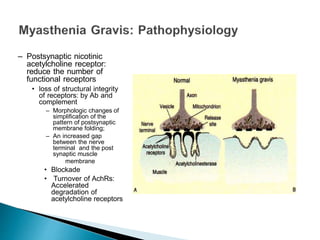
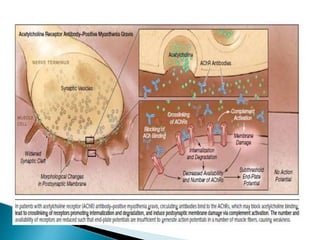
– Postsynaptic nicotinic
acetylcholine receptor:
reduce the number of
functional receptors
• loss of structural integrity
of receptors: by Ab and
complement
– Morphologic changes of
simplification of the
pattern of postsynaptic
membrane folding;
– An increased gap
between the nerve
terminal and the post
synaptic muscle
membrane
• Blockade
• Turnover of AchRs:
Accelerated
degradation of
acetylcholine receptors
 MG occurs at any age, involves either sex and begins
insidiously.
 Bimodal peak of incidence
 Women < 40 years, men >50 years
 Hallmark is fluctuating muscle weakness that worsens
with exertion.
 Ptosis and/or diplopia – initial symptoms in 85% of
patients
 Oropharyngeal muscle weakness – difficulty in
swallowing and talking initial symptoms in 15 % of
patients
 Limb or neck weakness with proximal muscle
involvement- presenting symptom in only 10% of cases.
 Isolated respiratory failure in 1%.
 Rarely, distal weakness can occur.
 Symptoms are exacerbated by heat, stress, infection,
drugs and rarely vaccines.
 Within 2 years 80% of patients with ocular symptoms
progress to GMG.
 10% will remain purely ocular.
 Disease usually most severe during first 1 or 2 years.
 10% will go in clinically stable remission.
 15-20% of AChR+ patients will develop myasthenic
crisis.
 Frequency of crisis is higher in MuSK+ patients(30%).
 Mortality 5-14%
 After 15 to 20 years, weakness becomes fixed. Burnt-
Out-Stage + muscle atrophy.
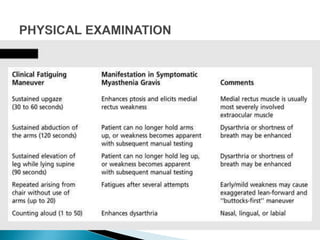
 Cogan's lid twitch sign- patient first looks down for a short
period and then makes a saccade back to primary position.
Upper eyelid elevates excessively during this upward
saccade, sometimes causing a transient lid retraction, and
then twitches in nystagmoid fashion or slowly droops back to
a ptotic position.
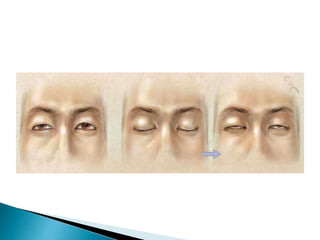
 Peek sign- manifestation of orbicularis fatigue
 Lid hopping
 Sleep Test
 Curtain sign- Patient looks straight ahead and refrains from
blinking. Examiner holds one eye open , which results in the
other lid starting to droop more (like a curtain falling).
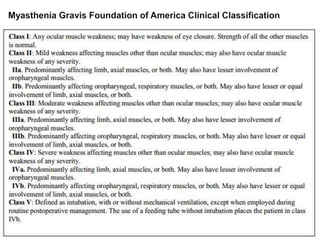
I. Ocular alone
IIa. Mild generalized
IIb. Moderately severe generalized plus
usually some bulbar involvement
III. Acute severe over weeks-months with
severe bulbar involvement
IV. Late severe with marked bulbar
involvement
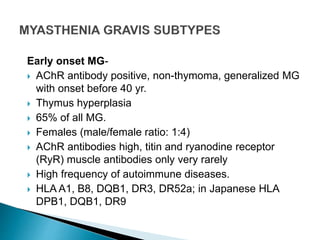
Early onset MG-
 AChR antibody positive, non-thymoma, generalized MG
with onset before 40 yr.
 Thymus hyperplasia
 65% of all MG.
 Females (male/female ratio: 1:4)
 AChR antibodies high, titin and ryanodine receptor
(RyR) muscle antibodies only very rarely
 High frequency of autoimmune diseases.
 HLA A1, B8, DQB1, DR3, DR52a; in Japanese HLA
DPB1, DQB1, DR9
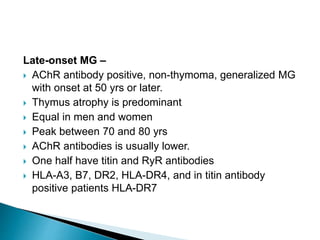
Late-onset MG –
 AChR antibody positive, non-thymoma, generalized MG
with onset at 50 yrs or later.
 Thymus atrophy is predominant
 Equal in men and women
 Peak between 70 and 80 yrs
 AChR antibodies is usually lower.
 One half have titin and RyR antibodies
 HLA-A3, B7, DR2, HLA-DR4, and in titin antibody
positive patients HLA-DR7
Ocular MG-
 AChR antibody positive (50%), non-thymoma MG with
purely ocular (non-generalized) symptoms.
 More common in children and in late-onset males.
 10-15% of all MG.
 More common in Asia (58%)
 HLA-DQ6 , BW46
Thymoma MG –
 MG patients with thymoma regardless of the extent of
muscular involvement.
 Usually have AChR antibodies.
 15% of MG patients.
 Peak of onset around 50 years
 In addition to AChR antibodies, frequent occurrence of
titin and RyR antibodies.
 Thymoma and non-thymoma MG patients have similar
MG long-term prognosis.
 HLA DR2 mostly in women.
MuSK- Antibody Myasthenia Gravis
 Seen in 50% of patients with GMG who lacks AChR
antibodies.
 Predominantly affects female.
 Begins from childhood through middle age.
 Thymic changes are absent or minimal.
 Many patients do not improve with cholinesterase
inhibitors, some may become worse, may have profuse
fasciculations with this medications.
 Disease severity tends to be worse but most improve
dramatically with PLEX or corticosteroids.
Seronegative MG –
 Double seronegative (AChR antibody and Anti-MuSK)
no evidence of thymoma.
 Low affinity anti-AChR antibodies can be detected using
specialized assays.
 Frequency is low..
 Seronegative MG patients lacking MuSK antibodies
appear to have less severe MG than seropositive MG
patients.
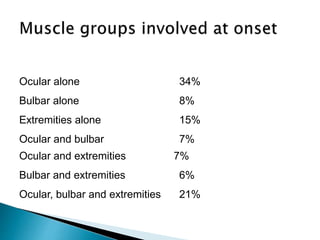
Ocular alone 34%
Bulbar alone 8%
Extremities alone 15%
Ocular and bulbar 7%
Ocular and extremities 7%
Bulbar and extremities 6%
Ocular, bulbar and extremities 21%
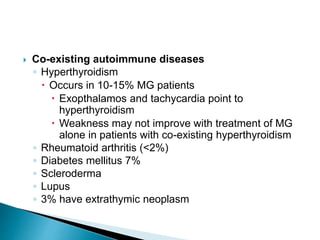
 Co-existing autoimmune diseases
◦ Hyperthyroidism
 Occurs in 10-15% MG patients
 Exopthalamos and tachycardia point to
hyperthyroidism
 Weakness may not improve with treatment of MG
alone in patients with co-existing hyperthyroidism
◦ Rheumatoid arthritis (<2%)
◦ Diabetes mellitus 7%
◦ Scleroderma
◦ Lupus
◦ 3% have extrathymic neoplasm
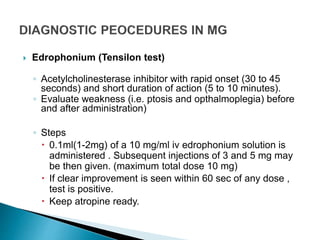
 Edrophonium (Tensilon test)
◦ Acetylcholinesterase inhibitor with rapid onset (30 to 45
seconds) and short duration of action (5 to 10 minutes).
◦ Evaluate weakness (i.e. ptosis and opthalmoplegia) before
and after administration)
◦ Steps
 0.1ml(1-2mg) of a 10 mg/ml iv edrophonium solution is
administered . Subsequent injections of 3 and 5 mg may
be then given. (maximum total dose 10 mg)
 If clear improvement is seen within 60 sec of any dose ,
test is positive.
 Keep atropine ready.
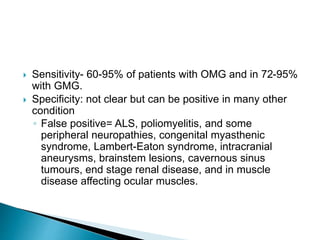
 Sensitivity- 60-95% of patients with OMG and in 72-95%
with GMG.
 Specificity: not clear but can be positive in many other
condition
◦ False positive= ALS, poliomyelitis, and some
peripheral neuropathies, congenital myasthenic
syndrome, Lambert-Eaton syndrome, intracranial
aneurysms, brainstem lesions, cavernous sinus
tumours, end stage renal disease, and in muscle
disease affecting ocular muscles.
Side effects of endrophonium-
 Increased salivation, sweating, nausea, muscle
creamps, and fasciculations.
 Serious complications (Bradycardia or Syncope) occurs
in 0.16% only.
 Cardiac disease and bronchial asthma- Relative
contraindications.
 Neostigmine test
Longer acting
1.5 mg im or 0.5 mg iv
Action begins in 15-20 mins
 Apply ice pack to ptotic lid for 2 mins
 in whom the Tensilon test is considered too risky
 Sensitivity
◦ 80%
AChR antibodies-
 85% with generalized MG, 70% with ocular MG
 Positive in nearly all thymomatous MG.
 May be normal at symptom onset.
 Level fall in most patients after treatment.
 Main immunogenic region (MIR) for the AChR antibodies
is located on the a-subunit.
 MOA- complement-mediated focal muscle membrane
damage, accelerated degradation of AChR, and also
direct blockade of AChR ligand binding.
 Polyclonal, mainly IgG, IgG1 and IgG3 subclasses
False positive AChR-Ab tests-
 Autoimmune liver disease
 SLE
 Inflammatory neuropathies
 Amyotrophic lateral sclerosis
 Penicillamine treated RA
 Patients with Thymoma but without MG
 First degree relatives
Antistriational muscle antibodies-
 StrAbs react with contractile elements of skeletal
muscles.
 Recognise muscle cytoplasmic proteins (titin, myosin,
actin, and ryanodine receptors).
 Found in 75- 85% of patients with thymomatous MG.
 Not pathogenic, also found in one-third of patients with
thymoma without MG.
 Frequent in older MG patients and in more severe
disease.
 Rarely elevated in MG in absence of AChR-Ab.
 Clinical use- predicting thymoma- 60% of patients with
MG with onset before 50 years who have elevated
StrAbs have thymoma.
Anti MuSK Antobodies-
 50 % of AChR antibody negative patients with
generalized MG have autoantibodies against MuSK, and
5-7% of all MG patients.
 Are IGG4 isotype.
 MuSK antibodies may correlate with MG severity in
AChR antibody negative MG
LRP4 Antibodies
 2-50% in seronegative patients
Agrin Antibodies
 Seen infequentely in seronegative MG
Cortactin antibodies
 Seen in 20% seronegative MG and 4.8% of seropositive
MG
 Thymoma MG patients have higher titers of anti-myosin
and anti-actomyosin antibodies than MG patients
without thymoma
 Lab studies
◦ Interleukin-2 receptors
 Increased in generalized and bulbar forms of MG
 Increase seems to correlate to progression of
disease
 Imaging studies
◦ Chest x-ray
 Plain anteroposterior and lateral views may identify a
thymoma as an anterior mediastinal mass
◦ Chest CT scan is mandatory to identify thymoma
◦ MRI of the brain and orbits may help to rule out other
causes of cranial nerve deficits.
 Electrodiagnostic studies
◦ Repetitive nerve stimulation
◦ Single fiber electromyography (SFEMG)
◦ SFEMG is more sensitive than RNS in MG
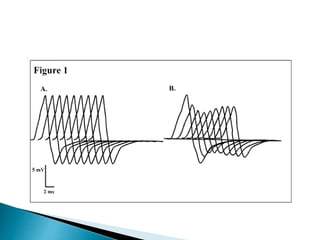
• Performed by stimulating the nerve supramaximally at 2- 3
Hz.
• 10% decrement between the first and the fifth evoked muscle
action potential is diagnostic for MG.
• In the absence of the decrement, exercise can be used to
induce exhaustion of muscles and document decrement.
• Test is abnormal in approximately 75% of patients with GMG
and 50% of patients with OMG
• Should not test clinically normal muscle
• Proximal muscles are better tested than unaffected distal
muscles
• AChE inhibitors should be avoided for atleast 1 day prior to
testing.
Exercise protocol-
 Patient is asked to exercise muscle maximally for 30 to
60 seconds.
 Train of stimuli is performed immediately after exercise.
 A repair of the CMAP decremental response is
commonly seen, reflecting post-exercise or post-
activation facilitation.
 Additional train of stimuli is delivered at one, three, and
five minutes after exercise.
 This may result in a larger decrement than seen at rest,
termed post-exercise or post-activation exhaustion.
 This exercise protocol may increase the sensitivity of
RNS by an additional 5 to 10 percent.
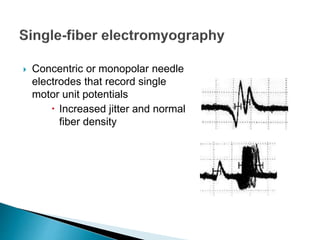
 Concentric or monopolar needle
electrodes that record single
motor unit potentials
 Increased jitter and normal
fiber density
◦ Generalized MG
 Abnormal extensor digiti minimi found in 87%
 Examination of a second abnormal muscle will
increase sensitivity to 99%
◦ Occular MG
 Frontalis muscle is abnormal in almost 100%
 Sensitive(60%)
 AChE inhibitors
 Immunomodulating therapies
 Immunoglobulins
 Plasmapheresis
 Thymectomy
◦ Patients should be advised to be as active as possible
but should rest frequently and avoid sustained activity
◦ Educate patients
◦ Speech therapy
◦ Speech assistive/communicative devices
 If dysphagia develops, liquids should be thickened
 Thickened liquids decrease risk for aspiration
AChE inhibitor
◦ Pyridostigmine bromide
 Starts working in 30-60 minutes and lasts 3-6 hours.
 Individualize dose
 Adult dose:
 30-60 mg every 4 hrly.
 2mg IV/IM q2-3h
 Pediatric=7mg/kg/day
 MuSk positive MG respond poorly
 Mestinon- 180 mg timed release
Neostigmine- shorter acting
Adult dose-15mg every 3-4 hrly
0.5-2.5mg iv/im/sc every 1-3 hrs
Pediatric dose-2mg/kg/day
 Side effects-
 Muscarinic (nausea, vomiting, salivation, bronchospasm,
abdominal cramps, diarrohea)
 Nicotinic- cholinergic crisis
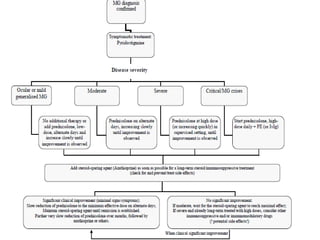
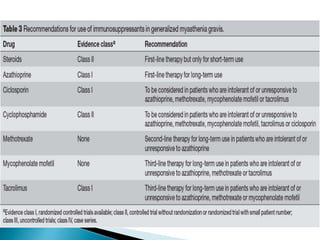
1)Prednisone
 Most commonly used
 High starting dose-60-80mg/day
 Early remission
 Worsens weakness in half
 Given for 3-6 months then tapered 5 mg per week to
less than 20 mg every other day.
 Low starting dose-15-20mg/day
 Increased by 5mg every 3 day till remission (60-
80mg)
 Trial showed that steroid decrease incidence of
disease generalisation.
2) Azathioprine
 inhibits T and B cell proliferation by interaction with
purine metabolism
 First choice of steroid sparing agent
 Effect may take 6-12 months
 Dose-1mg/kg/day increased to 2-3mg/kg/day
 Effect monitored by MCV = >100 fl or >16fl increase over
baseline
 Monitor CBC, LFT every week for first 3-4 months
 3 fold elevation requires dose reduction
 Pregnancy cat D drug
 Side effects-hepatotoxicity, Bone marrow suppression,
pancreatitis, Rare risk of lymphoreticular malignancy,
Flu-like reactions.
3) Cyclosporine
 Calcineurin inhibitor ,Inhibits T helper cell mediated
synthesis of cytokines.
 Third line immunosupressant choice
 Indicated in severe steroid and thymectomy resistant
MG
 Response seen in <7 months
 Dose- 4-10mg/kg/day divided in 2-3 doses
 Side effects- nephrotoxicity, hypertension, infection, BM
depression, neoplasm
4) Mycophenolate mofetil
 IMPDH inhibitor
 Add on drug in generalised MG
 Dose- 500 mg twice day for 4wks f/b increase till 1gm
twice a day
 C/I in Lesch-Nyhan and kelley seegmiller syndrome
 Not co-administered with azathioprine
5) Tacrolimus-
• Second line choice for moderate to severe MG
• Dose 0.1mg/kg/day
• Less nephrotoxic than cyclosporine
6)Cyclophosphamide- 500mg/m2 monthly pulse
Third line choice
7) Rituximab (anti CD20)-
More effective in MuAK+ MG than AChR+ MG
Response rate of > 80%
 Elliminates autoantibodies
 Treatment of choice for myasthenic crisis, preparation
for thymectomy, other surgery
 Short lived effect (2-3wks)
 5-6 exchanges alternate day with 2-4 litre per exchange
 Replacement with 5% albumin
Side effects
 Platelet depletion
 Citrate toxicity
 Electrolyte disturbances
 Infection
 Hypotension
 Thrombotic complications
 MOA-modulation of autoantibody response, inhibition of
complement activation, decrease membrane attack
complex formation, decrease cytokine response,
interference with antigen recognition
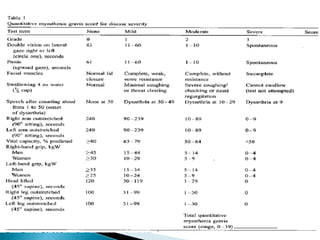
 More effective QMG score >11
 73% favourable response within 4-5 days
 Dose- 2g/kg over 2 to 5 days
 C/I in IgA defeciency (use IgA depleted
immunoglobulins)
 Side effects-flu like, transient HTN, renal failure,
thrombotic events, serum sickness
 High cost
 Cockrane review- similar efficacy of PE vs IvIg
 Indicated in non thymomatous patients with generalized
autoimmune MG of age group 10-55yrs
 All pts with thymoma
Techniques
1. Transcervical
2. Transternal extended thymectomy- standard
procedure used
3. Videoendoscopic including robotic assisted
 Remission rate-40-60% maximum with transternal
 Young pt. with short duration of disease with no
thymoma but with hyperplasia do best
Complication
 Perioperative
 Myasthenic crisis(6%)
 Infection(11%)
 Recurrent laryngeal or phrenic nerve injury(0-2%)
 Etanercept-TNF alpha receptor antibody
Concerns abt worsening MG
 Methotextrate-17.5 mg/week
 Terbutaline-beta 2 agonist
2.5 mg 3 times a day
 Complement inhibitors
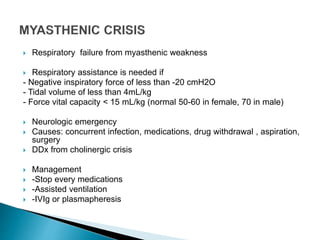
 Respiratory failure from myasthenic weakness
 Respiratory assistance is needed if
- Negative inspiratory force of less than -20 cmH2O
- Tidal volume of less than 4mL/kg
- Force vital capacity < 15 mL/kg (normal 50-60 in female, 70 in male)
 Neurologic emergency
 Causes: concurrent infection, medications, drug withdrawal , aspiration,
surgery
 DDx from cholinergic crisis
 Management
 -Stop every medications
 -Assisted ventilation
 -IVIg or plasmapheresis
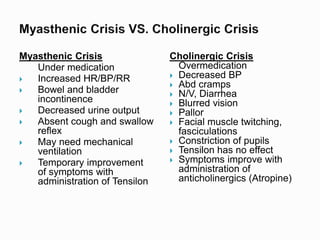
Myasthenic Crisis
Under medication
 Increased HR/BP/RR
 Bowel and bladder
incontinence
 Decreased urine output
 Absent cough and swallow
reflex
 May need mechanical
ventilation
 Temporary improvement
of symptoms with
administration of Tensilon
Cholinergic Crisis
Overmedication
 Decreased BP
 Abd cramps
 N/V, Diarrhea
 Blurred vision
 Pallor
 Facial muscle twitching,
fasciculations
 Constriction of pupils
 Tensilon has no effect
 Symptoms improve with
administration of
anticholinergics (Atropine)
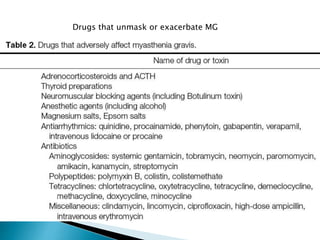
Drugs that unmask or exacerbate MG
 Myasthenia gravis: clinical, immunological, and therapeutic
advances; Acta Neurol Scand 2005: 111: 134–141 DOI:
10.1111
 Seminars in neurology vol 35 August 2015;Neuromuscular
Diorders
 Current treatment options in neurology vol 35 may 2010:
myasthenia gravis
 Current and emerging therapies for the treatment of
myasthenia gravis Neuropsychiatric Disease and Treatment
2011:7 151–160
 Guidelines for treatment of autoimmune neuromuscular
transmission disorders EFNS GUIDELINES
 UPTODATE. COM
THANK YOU

Advancesinmyastheniagravis 140921053304-phpapp02

  • 1.
  • 2.
    Myasthenia gravis isautoimmune neuromuscular disease caused by antibodies against postsynaptic muscle membrane ,characterized by weakness and fatigability of skeletal muscles •Prevalence- 140 per million •Annual incidence- 10-30 per million
  • 3.
    – Postsynaptic nicotinic acetylcholinereceptor: reduce the number of functional receptors • loss of structural integrity of receptors: by Ab and complement – Morphologic changes of simplification of the pattern of postsynaptic membrane folding; – An increased gap between the nerve terminal and the post synaptic muscle membrane • Blockade • Turnover of AchRs: Accelerated degradation of acetylcholine receptors
  • 5.
     MG occursat any age, involves either sex and begins insidiously.  Bimodal peak of incidence  Women < 40 years, men >50 years  Hallmark is fluctuating muscle weakness that worsens with exertion.
  • 6.
     Ptosis and/ordiplopia – initial symptoms in 85% of patients  Oropharyngeal muscle weakness – difficulty in swallowing and talking initial symptoms in 15 % of patients  Limb or neck weakness with proximal muscle involvement- presenting symptom in only 10% of cases.  Isolated respiratory failure in 1%.  Rarely, distal weakness can occur.  Symptoms are exacerbated by heat, stress, infection, drugs and rarely vaccines.
  • 7.
     Within 2years 80% of patients with ocular symptoms progress to GMG.  10% will remain purely ocular.  Disease usually most severe during first 1 or 2 years.  10% will go in clinically stable remission.  15-20% of AChR+ patients will develop myasthenic crisis.  Frequency of crisis is higher in MuSK+ patients(30%).  Mortality 5-14%  After 15 to 20 years, weakness becomes fixed. Burnt- Out-Stage + muscle atrophy.
  • 9.
     Cogan's lidtwitch sign- patient first looks down for a short period and then makes a saccade back to primary position. Upper eyelid elevates excessively during this upward saccade, sometimes causing a transient lid retraction, and then twitches in nystagmoid fashion or slowly droops back to a ptotic position.  Peek sign- manifestation of orbicularis fatigue  Lid hopping  Sleep Test  Curtain sign- Patient looks straight ahead and refrains from blinking. Examiner holds one eye open , which results in the other lid starting to droop more (like a curtain falling).
  • 11.
    I. Ocular alone IIa.Mild generalized IIb. Moderately severe generalized plus usually some bulbar involvement III. Acute severe over weeks-months with severe bulbar involvement IV. Late severe with marked bulbar involvement
  • 12.
    Early onset MG- AChR antibody positive, non-thymoma, generalized MG with onset before 40 yr.  Thymus hyperplasia  65% of all MG.  Females (male/female ratio: 1:4)  AChR antibodies high, titin and ryanodine receptor (RyR) muscle antibodies only very rarely  High frequency of autoimmune diseases.  HLA A1, B8, DQB1, DR3, DR52a; in Japanese HLA DPB1, DQB1, DR9
  • 13.
    Late-onset MG – AChR antibody positive, non-thymoma, generalized MG with onset at 50 yrs or later.  Thymus atrophy is predominant  Equal in men and women  Peak between 70 and 80 yrs  AChR antibodies is usually lower.  One half have titin and RyR antibodies  HLA-A3, B7, DR2, HLA-DR4, and in titin antibody positive patients HLA-DR7
  • 14.
    Ocular MG-  AChRantibody positive (50%), non-thymoma MG with purely ocular (non-generalized) symptoms.  More common in children and in late-onset males.  10-15% of all MG.  More common in Asia (58%)  HLA-DQ6 , BW46
  • 15.
    Thymoma MG – MG patients with thymoma regardless of the extent of muscular involvement.  Usually have AChR antibodies.  15% of MG patients.  Peak of onset around 50 years  In addition to AChR antibodies, frequent occurrence of titin and RyR antibodies.  Thymoma and non-thymoma MG patients have similar MG long-term prognosis.  HLA DR2 mostly in women.
  • 16.
    MuSK- Antibody MyastheniaGravis  Seen in 50% of patients with GMG who lacks AChR antibodies.  Predominantly affects female.  Begins from childhood through middle age.  Thymic changes are absent or minimal.  Many patients do not improve with cholinesterase inhibitors, some may become worse, may have profuse fasciculations with this medications.  Disease severity tends to be worse but most improve dramatically with PLEX or corticosteroids.
  • 17.
    Seronegative MG – Double seronegative (AChR antibody and Anti-MuSK) no evidence of thymoma.  Low affinity anti-AChR antibodies can be detected using specialized assays.  Frequency is low..  Seronegative MG patients lacking MuSK antibodies appear to have less severe MG than seropositive MG patients.
  • 18.
    Ocular alone 34% Bulbaralone 8% Extremities alone 15% Ocular and bulbar 7% Ocular and extremities 7% Bulbar and extremities 6% Ocular, bulbar and extremities 21%
  • 19.
     Co-existing autoimmunediseases ◦ Hyperthyroidism  Occurs in 10-15% MG patients  Exopthalamos and tachycardia point to hyperthyroidism  Weakness may not improve with treatment of MG alone in patients with co-existing hyperthyroidism ◦ Rheumatoid arthritis (<2%) ◦ Diabetes mellitus 7% ◦ Scleroderma ◦ Lupus ◦ 3% have extrathymic neoplasm
  • 20.
     Edrophonium (Tensilontest) ◦ Acetylcholinesterase inhibitor with rapid onset (30 to 45 seconds) and short duration of action (5 to 10 minutes). ◦ Evaluate weakness (i.e. ptosis and opthalmoplegia) before and after administration) ◦ Steps  0.1ml(1-2mg) of a 10 mg/ml iv edrophonium solution is administered . Subsequent injections of 3 and 5 mg may be then given. (maximum total dose 10 mg)  If clear improvement is seen within 60 sec of any dose , test is positive.  Keep atropine ready.
  • 21.
     Sensitivity- 60-95%of patients with OMG and in 72-95% with GMG.  Specificity: not clear but can be positive in many other condition ◦ False positive= ALS, poliomyelitis, and some peripheral neuropathies, congenital myasthenic syndrome, Lambert-Eaton syndrome, intracranial aneurysms, brainstem lesions, cavernous sinus tumours, end stage renal disease, and in muscle disease affecting ocular muscles.
  • 22.
    Side effects ofendrophonium-  Increased salivation, sweating, nausea, muscle creamps, and fasciculations.  Serious complications (Bradycardia or Syncope) occurs in 0.16% only.  Cardiac disease and bronchial asthma- Relative contraindications.
  • 23.
     Neostigmine test Longeracting 1.5 mg im or 0.5 mg iv Action begins in 15-20 mins
  • 24.
     Apply icepack to ptotic lid for 2 mins  in whom the Tensilon test is considered too risky  Sensitivity ◦ 80%
  • 25.
    AChR antibodies-  85%with generalized MG, 70% with ocular MG  Positive in nearly all thymomatous MG.  May be normal at symptom onset.  Level fall in most patients after treatment.  Main immunogenic region (MIR) for the AChR antibodies is located on the a-subunit.  MOA- complement-mediated focal muscle membrane damage, accelerated degradation of AChR, and also direct blockade of AChR ligand binding.  Polyclonal, mainly IgG, IgG1 and IgG3 subclasses
  • 26.
    False positive AChR-Abtests-  Autoimmune liver disease  SLE  Inflammatory neuropathies  Amyotrophic lateral sclerosis  Penicillamine treated RA  Patients with Thymoma but without MG  First degree relatives
  • 27.
    Antistriational muscle antibodies- StrAbs react with contractile elements of skeletal muscles.  Recognise muscle cytoplasmic proteins (titin, myosin, actin, and ryanodine receptors).  Found in 75- 85% of patients with thymomatous MG.  Not pathogenic, also found in one-third of patients with thymoma without MG.  Frequent in older MG patients and in more severe disease.  Rarely elevated in MG in absence of AChR-Ab.  Clinical use- predicting thymoma- 60% of patients with MG with onset before 50 years who have elevated StrAbs have thymoma.
  • 28.
    Anti MuSK Antobodies- 50 % of AChR antibody negative patients with generalized MG have autoantibodies against MuSK, and 5-7% of all MG patients.  Are IGG4 isotype.  MuSK antibodies may correlate with MG severity in AChR antibody negative MG
  • 29.
    LRP4 Antibodies  2-50%in seronegative patients Agrin Antibodies  Seen infequentely in seronegative MG Cortactin antibodies  Seen in 20% seronegative MG and 4.8% of seropositive MG  Thymoma MG patients have higher titers of anti-myosin and anti-actomyosin antibodies than MG patients without thymoma
  • 30.
     Lab studies ◦Interleukin-2 receptors  Increased in generalized and bulbar forms of MG  Increase seems to correlate to progression of disease
  • 31.
     Imaging studies ◦Chest x-ray  Plain anteroposterior and lateral views may identify a thymoma as an anterior mediastinal mass ◦ Chest CT scan is mandatory to identify thymoma ◦ MRI of the brain and orbits may help to rule out other causes of cranial nerve deficits.
  • 32.
     Electrodiagnostic studies ◦Repetitive nerve stimulation ◦ Single fiber electromyography (SFEMG) ◦ SFEMG is more sensitive than RNS in MG
  • 33.
    • Performed bystimulating the nerve supramaximally at 2- 3 Hz. • 10% decrement between the first and the fifth evoked muscle action potential is diagnostic for MG. • In the absence of the decrement, exercise can be used to induce exhaustion of muscles and document decrement. • Test is abnormal in approximately 75% of patients with GMG and 50% of patients with OMG • Should not test clinically normal muscle • Proximal muscles are better tested than unaffected distal muscles • AChE inhibitors should be avoided for atleast 1 day prior to testing.
  • 34.
    Exercise protocol-  Patientis asked to exercise muscle maximally for 30 to 60 seconds.  Train of stimuli is performed immediately after exercise.  A repair of the CMAP decremental response is commonly seen, reflecting post-exercise or post- activation facilitation.  Additional train of stimuli is delivered at one, three, and five minutes after exercise.  This may result in a larger decrement than seen at rest, termed post-exercise or post-activation exhaustion.  This exercise protocol may increase the sensitivity of RNS by an additional 5 to 10 percent.
  • 36.
     Concentric ormonopolar needle electrodes that record single motor unit potentials  Increased jitter and normal fiber density
  • 37.
    ◦ Generalized MG Abnormal extensor digiti minimi found in 87%  Examination of a second abnormal muscle will increase sensitivity to 99% ◦ Occular MG  Frontalis muscle is abnormal in almost 100%  Sensitive(60%)
  • 39.
     AChE inhibitors Immunomodulating therapies  Immunoglobulins  Plasmapheresis  Thymectomy
  • 40.
    ◦ Patients shouldbe advised to be as active as possible but should rest frequently and avoid sustained activity ◦ Educate patients ◦ Speech therapy ◦ Speech assistive/communicative devices  If dysphagia develops, liquids should be thickened  Thickened liquids decrease risk for aspiration
  • 41.
    AChE inhibitor ◦ Pyridostigminebromide  Starts working in 30-60 minutes and lasts 3-6 hours.  Individualize dose  Adult dose:  30-60 mg every 4 hrly.  2mg IV/IM q2-3h  Pediatric=7mg/kg/day  MuSk positive MG respond poorly  Mestinon- 180 mg timed release
  • 42.
    Neostigmine- shorter acting Adultdose-15mg every 3-4 hrly 0.5-2.5mg iv/im/sc every 1-3 hrs Pediatric dose-2mg/kg/day  Side effects-  Muscarinic (nausea, vomiting, salivation, bronchospasm, abdominal cramps, diarrohea)  Nicotinic- cholinergic crisis
  • 43.
    1)Prednisone  Most commonlyused  High starting dose-60-80mg/day  Early remission  Worsens weakness in half  Given for 3-6 months then tapered 5 mg per week to less than 20 mg every other day.  Low starting dose-15-20mg/day  Increased by 5mg every 3 day till remission (60- 80mg)  Trial showed that steroid decrease incidence of disease generalisation.
  • 44.
    2) Azathioprine  inhibitsT and B cell proliferation by interaction with purine metabolism  First choice of steroid sparing agent  Effect may take 6-12 months  Dose-1mg/kg/day increased to 2-3mg/kg/day  Effect monitored by MCV = >100 fl or >16fl increase over baseline
  • 45.
     Monitor CBC,LFT every week for first 3-4 months  3 fold elevation requires dose reduction  Pregnancy cat D drug  Side effects-hepatotoxicity, Bone marrow suppression, pancreatitis, Rare risk of lymphoreticular malignancy, Flu-like reactions.
  • 46.
    3) Cyclosporine  Calcineurininhibitor ,Inhibits T helper cell mediated synthesis of cytokines.  Third line immunosupressant choice  Indicated in severe steroid and thymectomy resistant MG  Response seen in <7 months  Dose- 4-10mg/kg/day divided in 2-3 doses  Side effects- nephrotoxicity, hypertension, infection, BM depression, neoplasm
  • 47.
    4) Mycophenolate mofetil IMPDH inhibitor  Add on drug in generalised MG  Dose- 500 mg twice day for 4wks f/b increase till 1gm twice a day  C/I in Lesch-Nyhan and kelley seegmiller syndrome  Not co-administered with azathioprine
  • 48.
    5) Tacrolimus- • Secondline choice for moderate to severe MG • Dose 0.1mg/kg/day • Less nephrotoxic than cyclosporine 6)Cyclophosphamide- 500mg/m2 monthly pulse Third line choice 7) Rituximab (anti CD20)- More effective in MuAK+ MG than AChR+ MG Response rate of > 80%
  • 49.
     Elliminates autoantibodies Treatment of choice for myasthenic crisis, preparation for thymectomy, other surgery  Short lived effect (2-3wks)  5-6 exchanges alternate day with 2-4 litre per exchange  Replacement with 5% albumin
  • 50.
    Side effects  Plateletdepletion  Citrate toxicity  Electrolyte disturbances  Infection  Hypotension  Thrombotic complications
  • 51.
     MOA-modulation ofautoantibody response, inhibition of complement activation, decrease membrane attack complex formation, decrease cytokine response, interference with antigen recognition  More effective QMG score >11  73% favourable response within 4-5 days  Dose- 2g/kg over 2 to 5 days
  • 52.
     C/I inIgA defeciency (use IgA depleted immunoglobulins)  Side effects-flu like, transient HTN, renal failure, thrombotic events, serum sickness  High cost  Cockrane review- similar efficacy of PE vs IvIg
  • 53.
     Indicated innon thymomatous patients with generalized autoimmune MG of age group 10-55yrs  All pts with thymoma Techniques 1. Transcervical 2. Transternal extended thymectomy- standard procedure used 3. Videoendoscopic including robotic assisted
  • 54.
     Remission rate-40-60%maximum with transternal  Young pt. with short duration of disease with no thymoma but with hyperplasia do best Complication  Perioperative  Myasthenic crisis(6%)  Infection(11%)  Recurrent laryngeal or phrenic nerve injury(0-2%)
  • 55.
     Etanercept-TNF alphareceptor antibody Concerns abt worsening MG  Methotextrate-17.5 mg/week  Terbutaline-beta 2 agonist 2.5 mg 3 times a day  Complement inhibitors
  • 56.
     Respiratory failurefrom myasthenic weakness  Respiratory assistance is needed if - Negative inspiratory force of less than -20 cmH2O - Tidal volume of less than 4mL/kg - Force vital capacity < 15 mL/kg (normal 50-60 in female, 70 in male)  Neurologic emergency  Causes: concurrent infection, medications, drug withdrawal , aspiration, surgery  DDx from cholinergic crisis  Management  -Stop every medications  -Assisted ventilation  -IVIg or plasmapheresis
  • 57.
    Myasthenic Crisis Under medication Increased HR/BP/RR  Bowel and bladder incontinence  Decreased urine output  Absent cough and swallow reflex  May need mechanical ventilation  Temporary improvement of symptoms with administration of Tensilon Cholinergic Crisis Overmedication  Decreased BP  Abd cramps  N/V, Diarrhea  Blurred vision  Pallor  Facial muscle twitching, fasciculations  Constriction of pupils  Tensilon has no effect  Symptoms improve with administration of anticholinergics (Atropine)
  • 60.
    Drugs that unmaskor exacerbate MG
  • 62.
     Myasthenia gravis:clinical, immunological, and therapeutic advances; Acta Neurol Scand 2005: 111: 134–141 DOI: 10.1111  Seminars in neurology vol 35 August 2015;Neuromuscular Diorders  Current treatment options in neurology vol 35 may 2010: myasthenia gravis  Current and emerging therapies for the treatment of myasthenia gravis Neuropsychiatric Disease and Treatment 2011:7 151–160  Guidelines for treatment of autoimmune neuromuscular transmission disorders EFNS GUIDELINES  UPTODATE. COM
  • 63.