Neuropsychiatry Department Prof Aymen Youssef Ezz El Din   Prof OMAR AL GAREM Prof. Salah Al Din Mansour Prof. Mohammed Al Fatatry Prof Farouk Talaat Prof. Nadia Hafez Prof Ahmed Deif Prof Mohammed Ramadan Prof Soliman Tahoon Prof. Mohammed Foad  Prof Abd Al Fattah Al Kersh Prof Lubna Sultan Prof Ashraf Abdou Prof Sameh Saeed Ass Prof Ismael Ramadan Ass Prof Hazem Marouf Ass Prof Mohammed Hamdy AA Prof Horya Saad Dr Doaad Hanafy Dr Gadaa Abd Al Hady Dr Mervat  Prof Siham Rashid Prof Ade Al Shashae   Prof Hoda Salama Prof Mostafa Al Sadani Ass Prof Manal Hassan Ass Prof Tarek Molukhia Ass Prof Afaf Ass Prof Maha Al Taybany Dr Soha Ghobashy Dr Osama Al kholy Dr Ahmed Rady Dr Amr Al Fatatry Dr Jaeda Mekky Dr Heba Essam Dr Hisham Sheshtawy Dr Hisham Abud 2008-09
http://groups.google.com/group/alexneuropsych E-mail:   [email_address] [email_address]
Myasthenia Gravis: Update Dr Ashraf Abdou Professor Neuropsychiatry dept
Clinical Myasthenia gravis (MG) is a neuromuscular junction transmission disorder characterized by muscle weakness and fatigue.  Peaks  around the 2 nd and 3 rd decades and the 6 th and 7 th decades of life.  The prevalence of myasthenia gravis ranges between 4-14/100,000.  [Orphan disease]
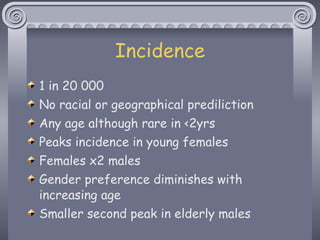
Incidence 1 in 20 000 No racial or geographical prediliction Any age although rare in <2yrs Peaks incidence in young females Females x2 males Gender preference diminishes with increasing age Smaller second peak in elderly males
 
 
Cholinesterase Inhibitors
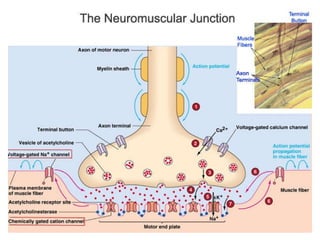
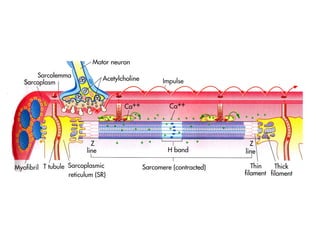
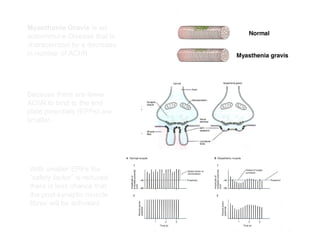
Myasthenia Gravis  is an autoimmune Disease that is characterized by a decrease in number of AChR Because there are fewer AChR to bind to the end plate potentials (EPPs) are smaller. With smaller EPPs the “ safety factor” is reduced there is less chance that the post-synaptic muscle fibres will be activated
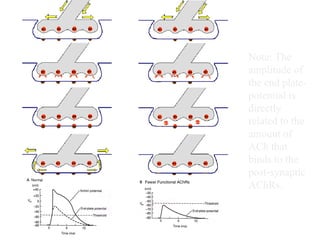
Note: The amplitude of the end plate-potential is directly related to the amount of ACh that binds to the post-synaptic AChRs.
Pathophysiology  IgG AB interact with the postsynaptic AChR at the nicotinic neuromuscular junction(NMJ). This reduces the number of functional receptors by blocking Ach attachment, by increasing the degradation of receptors and by complement induced damage to the NMJ MG pts have a reduced AChR density and have 30% the normal number of AChR  This reduces the safety margin at the NMJ
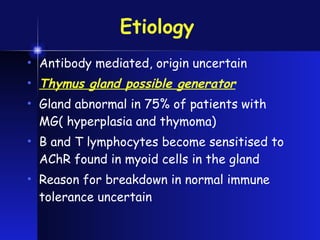
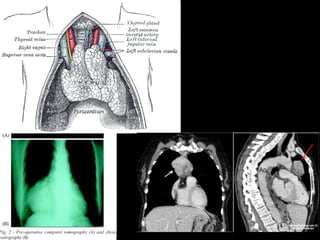
Etiology   Antibody mediated, origin uncertain Thymus gland possible generator Gland abnormal in 75% of patients with MG( hyperplasia and thymoma) B and T lymphocytes become sensitised to AChR found in myoid cells in the gland  Reason for breakdown in normal immune tolerance uncertain
 
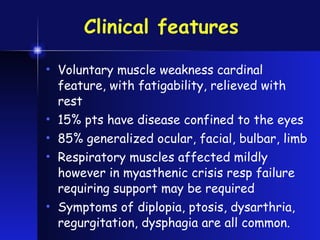
Clinical features Voluntary muscle weakness cardinal feature, with fatigability, relieved with rest 15% pts have disease confined to the eyes 85% generalized ocular, facial, bulbar, limb Respiratory muscles affected mildly however in myasthenic crisis resp failure requiring support may be required Symptoms of diplopia, ptosis, dysarthria, regurgitation, dysphagia are all common.
Clinical  [cont.] The salient clinical features of myasthenia gravis are skeletal muscle weakness and fatigability. Symptoms are usually aggravated by physical activity and relieved by rest. 60%  starts in the ocular muscles , with ptosis and/or diplopia. 15%  remain confined to the eye muscles.  85%  weakness  spreads to facial, bulbar, and limb muscles.
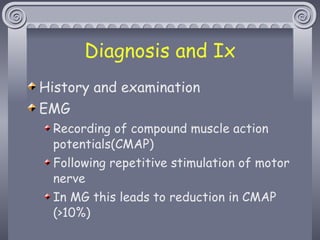
Diagnosis and Ix History and examination EMG  Recording of compound muscle action potentials(CMAP) Following repetitive stimulation of motor nerve In MG this leads to reduction in CMAP (>10%)
Diagnosis Edrophonium or prostigmine test. EMG: Repetitive nerve stimulation.
Detection of anti-AChR antibodies In 80-85% cases and are pathognomonic The Tensilon test- up to 10mg edrophonium is administered IV is standard test. Mg pts show marked improvement after 30sec and lasts 5min
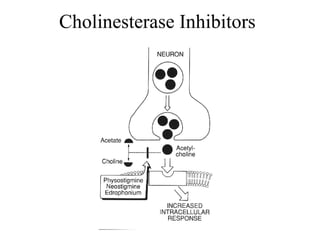
Cholinesterase Inhibitors Examples:  Neostigmine, edrophonium. Mechanism of Action : Inhibit acetylcholinesterase Therapeutic Use:   Antidote for nondepolarizing  blockers Treatment of myasthenia gravis (neostigmine) Diagnosis of myasthenia gravis (edrophonium)
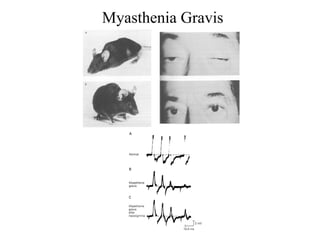
Myasthenia Gravis
Evidence based long-term management of MG Few controlled studies. Most are case series and expert-opinions.
Immunomodulatory therapy Short term: Plasmapheresis. IVIG. Long term: Thymectomy. Imminusuppresant drugs.
Immunomodulatory therapy [Short-term] Plasmapheresis. IVIG When acute temporary improvement is needed.
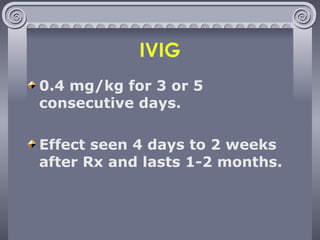
IVIG 0.4 mg/kg for 3 or 5 consecutive days. Effect seen 4 days to 2 weeks after Rx and lasts 1-2 months.
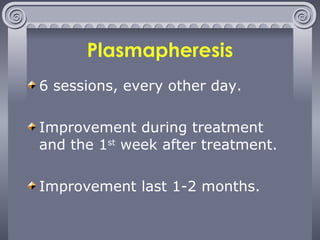
Plasmapheresis 6 sessions, every other day. Improvement during treatment and the 1 st  week after treatment. Improvement last 1-2 months.
Immunomodulatory therapy [long-term] Thymectomy. Immunomodulatory drugs. To induce remission
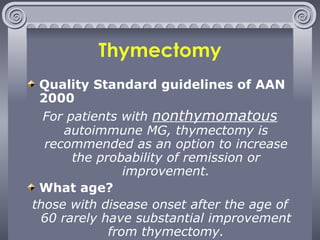
Thymectomy Quality Standard guidelines of AAN 2000 For patients with  nonthymomatous  autoimmune MG, thymectomy is recommended as an option to increase the probability of remission or improvement. What age? those with disease onset after the age of 60 rarely have substantial improvement from thymectomy.
Thymectomy  [cont.] Thymoma :  Do thmectomy due to risk of invasive thymoma, heart and lung damage, phrenic nerve damage, and other problems. Acetylcholine receptor antibodies : thymectomy may help. MUSK antibodies : thymectomy does not help. No antibodies : unknown if thymectomy helps.
Immunomodulatory Drugs [Long-term] Corticosteroids.[15 $/month] Azathioprine.[70-140$/month] Methotrexate [10-25 mg q week – 13-30$/month] Mycophenolate mofetil (CellCept). [1g BID – 400-600$/month] Cyclosporine A [5 mg/kg BID – 400-600$/month]  Cyclophosphamide. [20 mg q week IV – 100-300$/month]
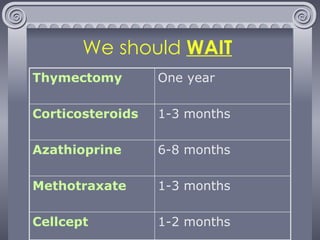
We should  WAIT 1-2 months Cellcept 1-3 months Methotraxate 6-8 months Azathioprine 1-3 months Corticosteroids One year Thymectomy
 
THANK YOU

Myasthenia gravis

  • 1.
  • 2.
    Neuropsychiatry Department ProfAymen Youssef Ezz El Din Prof OMAR AL GAREM Prof. Salah Al Din Mansour Prof. Mohammed Al Fatatry Prof Farouk Talaat Prof. Nadia Hafez Prof Ahmed Deif Prof Mohammed Ramadan Prof Soliman Tahoon Prof. Mohammed Foad Prof Abd Al Fattah Al Kersh Prof Lubna Sultan Prof Ashraf Abdou Prof Sameh Saeed Ass Prof Ismael Ramadan Ass Prof Hazem Marouf Ass Prof Mohammed Hamdy AA Prof Horya Saad Dr Doaad Hanafy Dr Gadaa Abd Al Hady Dr Mervat Prof Siham Rashid Prof Ade Al Shashae Prof Hoda Salama Prof Mostafa Al Sadani Ass Prof Manal Hassan Ass Prof Tarek Molukhia Ass Prof Afaf Ass Prof Maha Al Taybany Dr Soha Ghobashy Dr Osama Al kholy Dr Ahmed Rady Dr Amr Al Fatatry Dr Jaeda Mekky Dr Heba Essam Dr Hisham Sheshtawy Dr Hisham Abud 2008-09
  • 3.
  • 4.
    Myasthenia Gravis: UpdateDr Ashraf Abdou Professor Neuropsychiatry dept
  • 5.
    Clinical Myasthenia gravis(MG) is a neuromuscular junction transmission disorder characterized by muscle weakness and fatigue. Peaks around the 2 nd and 3 rd decades and the 6 th and 7 th decades of life. The prevalence of myasthenia gravis ranges between 4-14/100,000. [Orphan disease]
  • 6.
    Incidence 1 in20 000 No racial or geographical prediliction Any age although rare in <2yrs Peaks incidence in young females Females x2 males Gender preference diminishes with increasing age Smaller second peak in elderly males
  • 7.
  • 8.
  • 9.
  • 10.
    Myasthenia Gravis is an autoimmune Disease that is characterized by a decrease in number of AChR Because there are fewer AChR to bind to the end plate potentials (EPPs) are smaller. With smaller EPPs the “ safety factor” is reduced there is less chance that the post-synaptic muscle fibres will be activated
  • 11.
    Note: The amplitudeof the end plate-potential is directly related to the amount of ACh that binds to the post-synaptic AChRs.
  • 12.
    Pathophysiology IgGAB interact with the postsynaptic AChR at the nicotinic neuromuscular junction(NMJ). This reduces the number of functional receptors by blocking Ach attachment, by increasing the degradation of receptors and by complement induced damage to the NMJ MG pts have a reduced AChR density and have 30% the normal number of AChR This reduces the safety margin at the NMJ
  • 13.
    Etiology Antibody mediated, origin uncertain Thymus gland possible generator Gland abnormal in 75% of patients with MG( hyperplasia and thymoma) B and T lymphocytes become sensitised to AChR found in myoid cells in the gland Reason for breakdown in normal immune tolerance uncertain
  • 14.
  • 15.
    Clinical features Voluntarymuscle weakness cardinal feature, with fatigability, relieved with rest 15% pts have disease confined to the eyes 85% generalized ocular, facial, bulbar, limb Respiratory muscles affected mildly however in myasthenic crisis resp failure requiring support may be required Symptoms of diplopia, ptosis, dysarthria, regurgitation, dysphagia are all common.
  • 16.
    Clinical [cont.]The salient clinical features of myasthenia gravis are skeletal muscle weakness and fatigability. Symptoms are usually aggravated by physical activity and relieved by rest. 60% starts in the ocular muscles , with ptosis and/or diplopia. 15% remain confined to the eye muscles. 85% weakness spreads to facial, bulbar, and limb muscles.
  • 17.
    Diagnosis and IxHistory and examination EMG Recording of compound muscle action potentials(CMAP) Following repetitive stimulation of motor nerve In MG this leads to reduction in CMAP (>10%)
  • 18.
    Diagnosis Edrophonium orprostigmine test. EMG: Repetitive nerve stimulation.
  • 19.
    Detection of anti-AChRantibodies In 80-85% cases and are pathognomonic The Tensilon test- up to 10mg edrophonium is administered IV is standard test. Mg pts show marked improvement after 30sec and lasts 5min
  • 20.
    Cholinesterase Inhibitors Examples: Neostigmine, edrophonium. Mechanism of Action : Inhibit acetylcholinesterase Therapeutic Use: Antidote for nondepolarizing blockers Treatment of myasthenia gravis (neostigmine) Diagnosis of myasthenia gravis (edrophonium)
  • 21.
  • 22.
    Evidence based long-termmanagement of MG Few controlled studies. Most are case series and expert-opinions.
  • 23.
    Immunomodulatory therapy Shortterm: Plasmapheresis. IVIG. Long term: Thymectomy. Imminusuppresant drugs.
  • 24.
    Immunomodulatory therapy [Short-term]Plasmapheresis. IVIG When acute temporary improvement is needed.
  • 25.
    IVIG 0.4 mg/kgfor 3 or 5 consecutive days. Effect seen 4 days to 2 weeks after Rx and lasts 1-2 months.
  • 26.
    Plasmapheresis 6 sessions,every other day. Improvement during treatment and the 1 st week after treatment. Improvement last 1-2 months.
  • 27.
    Immunomodulatory therapy [long-term]Thymectomy. Immunomodulatory drugs. To induce remission
  • 28.
    Thymectomy Quality Standardguidelines of AAN 2000 For patients with nonthymomatous autoimmune MG, thymectomy is recommended as an option to increase the probability of remission or improvement. What age? those with disease onset after the age of 60 rarely have substantial improvement from thymectomy.
  • 29.
    Thymectomy [cont.]Thymoma : Do thmectomy due to risk of invasive thymoma, heart and lung damage, phrenic nerve damage, and other problems. Acetylcholine receptor antibodies : thymectomy may help. MUSK antibodies : thymectomy does not help. No antibodies : unknown if thymectomy helps.
  • 30.
    Immunomodulatory Drugs [Long-term]Corticosteroids.[15 $/month] Azathioprine.[70-140$/month] Methotrexate [10-25 mg q week – 13-30$/month] Mycophenolate mofetil (CellCept). [1g BID – 400-600$/month] Cyclosporine A [5 mg/kg BID – 400-600$/month] Cyclophosphamide. [20 mg q week IV – 100-300$/month]
  • 31.
    We should WAIT 1-2 months Cellcept 1-3 months Methotraxate 6-8 months Azathioprine 1-3 months Corticosteroids One year Thymectomy
  • 32.
  • 33.