NEUROMUSCULAR JUNCTION DISEASE Alina Valdes, M.D.
Background   Disorders of neuromuscular junction interfere with transmission of electrical impulses from peripheral nerve to muscle Acquired or inherited Weakness and fatigability on exertion Specific defects : Acetylcholine (ACh) synthesis or packaging into synaptic vesicles Release of ACh from nerve terminal by nerve impulse Efficiency of released ACh to generate postsynaptic depolarization
Myasthenia Gravis Acquired autoimmune disorder Pathogenic autoantibodies induce ACh receptor deficiency at motor end plate Circulating AChR antibodies present in 80% to 90% of cases IgG and complement components deposited on postsynaptic membrane Female-to-male ratio is 6:4 Peaks in women in third decade and in men in sixth or seventh decade
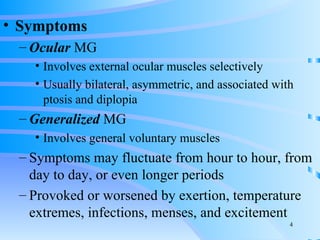
Symptoms Ocular  MG Involves external ocular muscles selectively Usually bilateral, asymmetric, and associated with ptosis and diplopia Generalized  MG Involves general voluntary muscles Symptoms may fluctuate from hour to hour, from day to day, or even longer periods Provoked or worsened by exertion, temperature extremes, infections, menses, and excitement
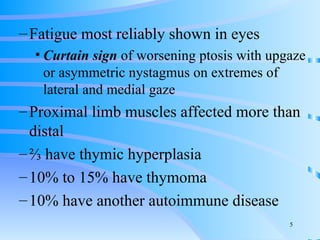
Fatigue most reliably shown in eyes Curtain sign  of worsening ptosis with upgaze or asymmetric nystagmus on extremes of lateral and medial gaze Proximal limb muscles affected more than distal ⅔  have thymic hyperplasia 10% to 15% have thymoma 10% have another autoimmune disease
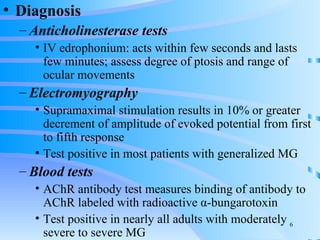
Diagnosis Anticholinesterase tests IV edrophonium: acts within few seconds and lasts few minutes; assess degree of ptosis and range of ocular movements Electromyography Supramaximal stimulation results in 10% or greater decrement of amplitude of evoked potential from first to fifth response Test positive in most patients with generalized MG Blood tests AChR antibody test measures binding of antibody to AChR labeled with radioactive  α-bungarotoxin Test positive in nearly all adults with moderately severe to severe MG
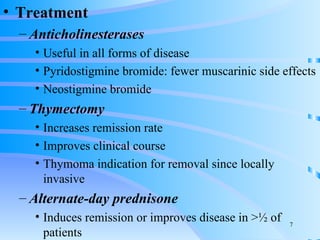
Treatment Anticholinesterases Useful in all forms of disease Pyridostigmine bromide: fewer muscarinic side effects Neostigmine bromide Thymectomy Increases remission rate Improves clinical course Thymoma indication for removal since locally invasive Alternate-day prednisone Induces remission or improves disease in > ½ of patients
Azathioprine Induces remission or improvement in > ½ of patients Need 12 to 15 months for improvement Adjunct to alternate-day prednisone to reduce side effects Cyclosporine Plasmapheresis Helpful in patients with sudden worsening Indicated in severe, generalized, refractory MG IV immunoglobulin May improve severe MG with 2 to 3 weeks of therapy
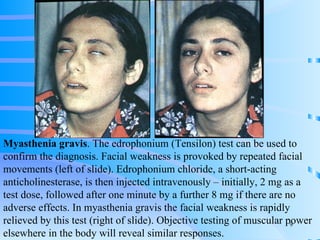
Myasthenia gravis . The edrophonium (Tensilon) test can be used to confirm the diagnosis. Facial weakness is provoked by repeated facial movements (left of slide). Edrophonium chloride, a short-acting anticholinesterase, is then injected intravenously – initially, 2 mg as a test dose, followed after one minute by a further 8 mg if there are no adverse effects. In myasthenia gravis the facial weakness is rapidly relieved by this test (right of slide). Objective testing of muscular power elsewhere in the body will reveal similar responses.
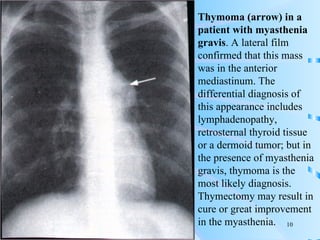
Thymoma (arrow) in a patient with myasthenia gravis . A lateral film confirmed that this mass was in the anterior mediastinum. The differential diagnosis of this appearance includes lymphadenopathy, retrosternal thyroid tissue or a dermoid tumor; but in the presence of myasthenia gravis, thymoma is the most likely diagnosis. Thymectomy may result in cure or great improvement in the myasthenia.
Lambert-Eaton Myasthenic Syndromes Acquired autoimmune disease Pathogenic autoantibodies cause deficiency of voltage-sensitive calcium channels at motor nerve terminal In patients >40 years old, 70% of men and 30% of women have associated carcinoma, usually small cell of lung Non-neoplastic syndrome associated with other autoimmune disorders Weakness and fatigability of proximal limb and trunk muscles
Relative sparing of extraocular and bulbar muscles Lower limbs more severely involved Tendon reflexes usually hypoactive or absent Autonomic manifestations in 50% of patients Dry mouth, impotence, decreased sweating, orthostatic hypotension, or altered pupillary reflexes Treatment Corticosteroids, azathioprine, and IV immune globulin
Drug-Induced Myasthenic Syndromes  Symptoms not usually appear unless overdose or renal or hepatic elimination impaired Drugs may worsen syndromes Polymixin and aminoglycoside antibiotics Antiarrhythmic agents (procainamide, quinidine) β-adrenergic blockers (propranolol, timolol) Phenothiazines, lithium Succinylcholine, curare and related drugs Trimethaphan Methoxyflurane Magnesium given parenterally or in cathartics
Organophosphate Intoxication Irreversibly inhibit cholinesterases Alterations in sensorium, convulsions, coma, severe muscarinic side effects, cramps, fasciculations, and muscle weakness from depolarization block

Neuromuscular Junction Disease

  • 1.
  • 2.
    Background Disorders of neuromuscular junction interfere with transmission of electrical impulses from peripheral nerve to muscle Acquired or inherited Weakness and fatigability on exertion Specific defects : Acetylcholine (ACh) synthesis or packaging into synaptic vesicles Release of ACh from nerve terminal by nerve impulse Efficiency of released ACh to generate postsynaptic depolarization
  • 3.
    Myasthenia Gravis Acquiredautoimmune disorder Pathogenic autoantibodies induce ACh receptor deficiency at motor end plate Circulating AChR antibodies present in 80% to 90% of cases IgG and complement components deposited on postsynaptic membrane Female-to-male ratio is 6:4 Peaks in women in third decade and in men in sixth or seventh decade
  • 4.
    Symptoms Ocular MG Involves external ocular muscles selectively Usually bilateral, asymmetric, and associated with ptosis and diplopia Generalized MG Involves general voluntary muscles Symptoms may fluctuate from hour to hour, from day to day, or even longer periods Provoked or worsened by exertion, temperature extremes, infections, menses, and excitement
  • 5.
    Fatigue most reliablyshown in eyes Curtain sign of worsening ptosis with upgaze or asymmetric nystagmus on extremes of lateral and medial gaze Proximal limb muscles affected more than distal ⅔ have thymic hyperplasia 10% to 15% have thymoma 10% have another autoimmune disease
  • 6.
    Diagnosis Anticholinesterase testsIV edrophonium: acts within few seconds and lasts few minutes; assess degree of ptosis and range of ocular movements Electromyography Supramaximal stimulation results in 10% or greater decrement of amplitude of evoked potential from first to fifth response Test positive in most patients with generalized MG Blood tests AChR antibody test measures binding of antibody to AChR labeled with radioactive α-bungarotoxin Test positive in nearly all adults with moderately severe to severe MG
  • 7.
    Treatment Anticholinesterases Usefulin all forms of disease Pyridostigmine bromide: fewer muscarinic side effects Neostigmine bromide Thymectomy Increases remission rate Improves clinical course Thymoma indication for removal since locally invasive Alternate-day prednisone Induces remission or improves disease in > ½ of patients
  • 8.
    Azathioprine Induces remissionor improvement in > ½ of patients Need 12 to 15 months for improvement Adjunct to alternate-day prednisone to reduce side effects Cyclosporine Plasmapheresis Helpful in patients with sudden worsening Indicated in severe, generalized, refractory MG IV immunoglobulin May improve severe MG with 2 to 3 weeks of therapy
  • 9.
    Myasthenia gravis .The edrophonium (Tensilon) test can be used to confirm the diagnosis. Facial weakness is provoked by repeated facial movements (left of slide). Edrophonium chloride, a short-acting anticholinesterase, is then injected intravenously – initially, 2 mg as a test dose, followed after one minute by a further 8 mg if there are no adverse effects. In myasthenia gravis the facial weakness is rapidly relieved by this test (right of slide). Objective testing of muscular power elsewhere in the body will reveal similar responses.
  • 10.
    Thymoma (arrow) ina patient with myasthenia gravis . A lateral film confirmed that this mass was in the anterior mediastinum. The differential diagnosis of this appearance includes lymphadenopathy, retrosternal thyroid tissue or a dermoid tumor; but in the presence of myasthenia gravis, thymoma is the most likely diagnosis. Thymectomy may result in cure or great improvement in the myasthenia.
  • 11.
    Lambert-Eaton Myasthenic SyndromesAcquired autoimmune disease Pathogenic autoantibodies cause deficiency of voltage-sensitive calcium channels at motor nerve terminal In patients >40 years old, 70% of men and 30% of women have associated carcinoma, usually small cell of lung Non-neoplastic syndrome associated with other autoimmune disorders Weakness and fatigability of proximal limb and trunk muscles
  • 12.
    Relative sparing ofextraocular and bulbar muscles Lower limbs more severely involved Tendon reflexes usually hypoactive or absent Autonomic manifestations in 50% of patients Dry mouth, impotence, decreased sweating, orthostatic hypotension, or altered pupillary reflexes Treatment Corticosteroids, azathioprine, and IV immune globulin
  • 13.
    Drug-Induced Myasthenic Syndromes Symptoms not usually appear unless overdose or renal or hepatic elimination impaired Drugs may worsen syndromes Polymixin and aminoglycoside antibiotics Antiarrhythmic agents (procainamide, quinidine) β-adrenergic blockers (propranolol, timolol) Phenothiazines, lithium Succinylcholine, curare and related drugs Trimethaphan Methoxyflurane Magnesium given parenterally or in cathartics
  • 14.
    Organophosphate Intoxication Irreversiblyinhibit cholinesterases Alterations in sensorium, convulsions, coma, severe muscarinic side effects, cramps, fasciculations, and muscle weakness from depolarization block