Guillain-Barre Syndrome
(GBS(
Dr. Mohamed Abunada
Pediatric Neurology Department
Dr. Al rantisi specialized
children Hospital
Outline
Definition
Epidemiology
Etiology
Pathogenesis & Pathology
Clinical features
Investigations
Diagnosis
Differential diagnosis
Treatment
Prognosis
Definition
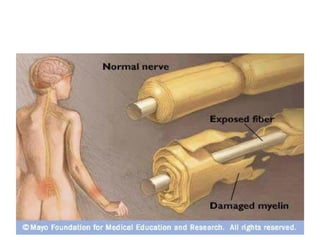
Postinfectious polyneuropathy involving
mainly motor but sometimes also sensory and
autonomic nerves
Affects people of all ages and is not
hereditary
Most patients have a demyelinating
neuropathy, but primarily axonal
degeneration is documented in some cases.
also known as: Acute inflammatory
demyelinating polyneuropathy (AIDP)
Epidemiology
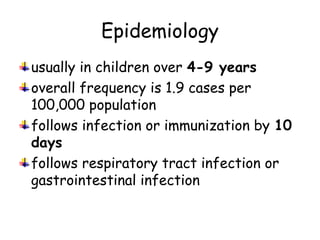
usually in children over 4-9 years
overall frequency is 1.9 cases per
100,000 population
follows infection or immunization by 10
days
follows respiratory tract infection or
gastrointestinal infection
Etiology
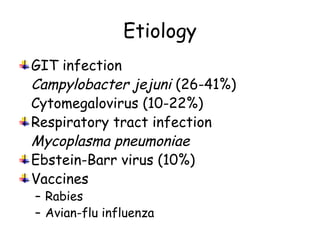
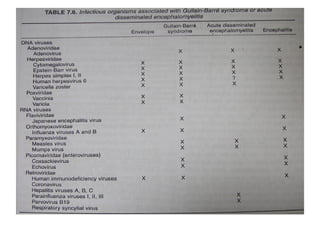
GIT infection
Campylobacter jejuni (26-41%)
Cytomegalovirus (10-22%)
Respiratory tract infection
Mycoplasma pneumoniae
Ebstein-Barr virus (10%)
Vaccines
– Rabies
– Avian-flu influenza
Pathogenesis
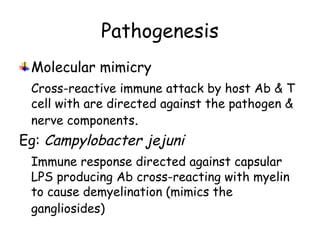
Molecular mimicry
Cross-reactive immune attack by host Ab & T
cell with are directed against the pathogen &
nerve components.
Eg: Campylobacter jejuni
Immune response directed against capsular
LPS producing Ab cross-reacting with myelin
to cause demyelination (mimics the
gangliosides)
Clinical Features
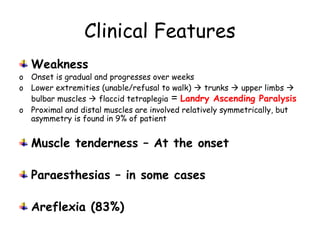
Weakness
o Onset is gradual and progresses over weeks
o Lower extremities (unable/refusal to walk)  trunks  upper limbs 
bulbar muscles  flaccid tetraplegia = Landry Ascending Paralysis
o Proximal and distal muscles are involved relatively symmetrically, but
asymmetry is found in 9% of patient
Muscle tenderness – At the onset
Paraesthesias – in some cases
Areflexia (83%)
Clinical Features
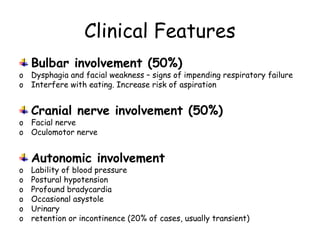
Bulbar involvement (50%)
o Dysphagia and facial weakness – signs of impending respiratory failure
o Interfere with eating. Increase risk of aspiration
Cranial nerve involvement (50%)
o Facial nerve
o Oculomotor nerve
Autonomic involvement
o Lability of blood pressure
o Postural hypotension
o Profound bradycardia
o Occasional asystole
o Urinary
o retention or incontinence (20% of cases, usually transient)
Clinical Features
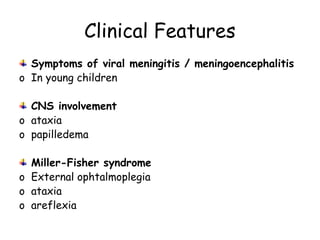
Symptoms of viral meningitis / meningoencephalitis
o In young children
CNS involvement
o ataxia
o papilledema
Miller-Fisher syndrome
o External ophtalmoplegia
o ataxia
o areflexia
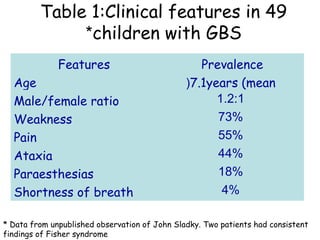
Table 1:Clinical features in 49
children with GBS*
Features Prevalence
Age 7.1years (mean(
Male/female ratio 1.2:1
Weakness 73%
Pain 55%
Ataxia 44%
Paraesthesias 18%
Shortness of breath 4%
* Data from unpublished observation of John Sladky. Two patients had consistent
findings of Fisher syndrome
Course
Initial phase
– Gradually increasing involvement lasts 10-30 days
(less than 4 weeks)
Plateau phase
– Short phase (within 2 weeks)
– Long plateau phase poor prognosis→
Recovery phase
– Within months
– Usually complete
– Motor sequelae (5-25%)
– Relapse & late recurrences (3%)
Investigations
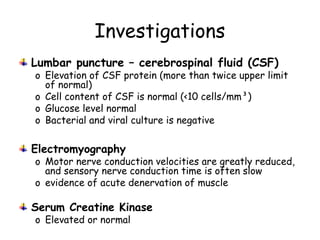
Lumbar puncture – cerebrospinal fluid (CSF)
o Elevation of CSF protein (more than twice upper limit
of normal)
o Cell content of CSF is normal (<10 cells/mm³)
o Glucose level normal
o Bacterial and viral culture is negative
Electromyography
o Motor nerve conduction velocities are greatly reduced,
and sensory nerve conduction time is often slow
o evidence of acute denervation of muscle
Serum Creatine Kinase
o Elevated or normal
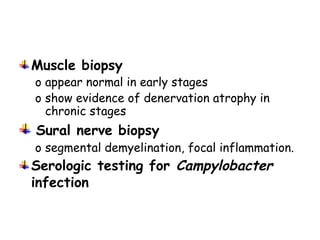
Muscle biopsy
o appear normal in early stages
o show evidence of denervation atrophy in
chronic stages
Sural nerve biopsy
o segmental demyelination, focal inflammation.
Serologic testing for Campylobacter
infection
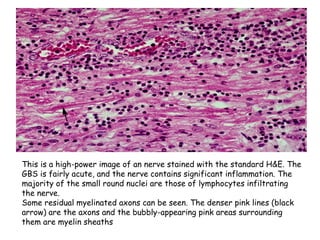
This is a high-power image of an nerve stained with the standard H&E. The
GBS is fairly acute, and the nerve contains significant inflammation. The
majority of the small round nuclei are those of lymphocytes infiltrating
the nerve.
Some residual myelinated axons can be seen. The denser pink lines (black
arrow) are the axons and the bubbly-appearing pink areas surrounding
them are myelin sheaths
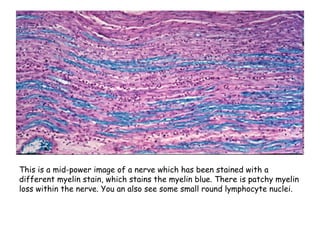
This is a mid-power image of a nerve which has been stained with a
different myelin stain, which stains the myelin blue. There is patchy myelin
loss within the nerve. You an also see some small round lymphocyte nuclei.
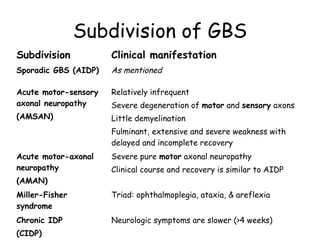
Subdivision of GBS
Subdivision Clinical manifestation
Sporadic GBS (AIDP) As mentioned
Acute motor-sensory
axonal neuropathy
(AMSAN)
Relatively infrequent
Severe degeneration of motor and sensory axons
Little demyelination
Fulminant, extensive and severe weakness with
delayed and incomplete recovery
Acute motor-axonal
neuropathy
(AMAN)
Severe pure motor axonal neuropathy
Clinical course and recovery is similar to AIDP
Miller-Fisher
syndrome
Triad: ophthalmoplegia, ataxia, & areflexia
Chronic IDP
(CIDP)
Neurologic symptoms are slower (>4 weeks)
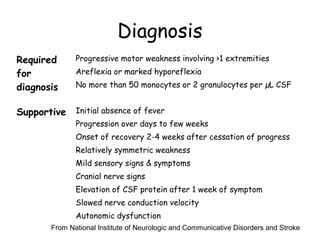
Diagnosis
Required
for
diagnosis
Progressive motor weakness involving >1 extremities
Areflexia or marked hyporeflexia
No more than 50 monocytes or 2 granulocytes per µL CSF
Supportive Initial absence of fever
Progression over days to few weeks
Onset of recovery 2-4 weeks after cessation of progress
Relatively symmetric weakness
Mild sensory signs & symptoms
Cranial nerve signs
Elevation of CSF protein after 1 week of symptom
Slowed nerve conduction velocity
Autonomic dysfunction
From National Institute of Neurologic and Communicative Disorders and Stroke
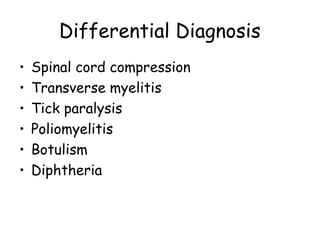
Differential Diagnosis
• Spinal cord compression
• Transverse myelitis
• Tick paralysis
• Poliomyelitis
• Botulism
• Diphtheria
Treatment
Patients with early stages of this acute disease
Should be admitted to the hospital for observation because the
ascending paralysis may rapidly involve respiratory muscles during the
next 24 hour.
Patients with slow progression:
may simply be observed for stabilization and spontaneous remission
without treatment.
Patients with rapidly progressive ascending paralysis:
o Intravenous immunoglobulin (IVIG), administered for 2, 3, or 5 days
o Plasmapheresis, steroids, and/or immunosuppressive drugs are
alternatives, if IVIG is ineffective
o Combined administration of immunoglobulin and interferon is effective
in some patients.
Supportive care, such as respiratory support, prevention of decubiti in
children with flaccid tetraplegia, and treatment of secondary bacterial
infections, is important
Prognosis
Spontaneous recovery begins within 2–3 weeks.
Most regain normal muscular function
Tendon reflexes are usually the last function to recover
Improvement usually follows a gradient inverse to the
direction of involvement.
Bulbar and respiratory muscle involvement may lead to
death if the syndrome is not recognized and treated
3 clinical features predictive to poor outcome:
– Cranial nerve involvement
– Intubation
– Maximum disability at the time of presentation
References
• Menkes & Sarnat: Child Neurology, 6th
ed. USA, Lippincott Williams & Wilkins,
2000
• Aicardi, Jean: Clinics in Developmental
Medicine: Diseases of The Nervous
System in Childhood, 2nd
ed. London, Mac
Keith Press, 1998
• Behrman, Kliegman, Jenson: Nelson
Textbook of Pediatrics, 17th
ed. China,
Elsevier Saunders, 2004
Guillain barre syndrome (gbs)

Guillain barre syndrome (gbs)

  • 1.
    Guillain-Barre Syndrome (GBS( Dr. MohamedAbunada Pediatric Neurology Department Dr. Al rantisi specialized children Hospital
  • 2.
    Outline Definition Epidemiology Etiology Pathogenesis & Pathology Clinicalfeatures Investigations Diagnosis Differential diagnosis Treatment Prognosis
  • 3.
    Definition Postinfectious polyneuropathy involving mainlymotor but sometimes also sensory and autonomic nerves Affects people of all ages and is not hereditary Most patients have a demyelinating neuropathy, but primarily axonal degeneration is documented in some cases. also known as: Acute inflammatory demyelinating polyneuropathy (AIDP)
  • 4.
    Epidemiology usually in childrenover 4-9 years overall frequency is 1.9 cases per 100,000 population follows infection or immunization by 10 days follows respiratory tract infection or gastrointestinal infection
  • 5.
    Etiology GIT infection Campylobacter jejuni(26-41%) Cytomegalovirus (10-22%) Respiratory tract infection Mycoplasma pneumoniae Ebstein-Barr virus (10%) Vaccines – Rabies – Avian-flu influenza
  • 7.
    Pathogenesis Molecular mimicry Cross-reactive immuneattack by host Ab & T cell with are directed against the pathogen & nerve components. Eg: Campylobacter jejuni Immune response directed against capsular LPS producing Ab cross-reacting with myelin to cause demyelination (mimics the gangliosides)
  • 9.
    Clinical Features Weakness o Onsetis gradual and progresses over weeks o Lower extremities (unable/refusal to walk)  trunks  upper limbs  bulbar muscles  flaccid tetraplegia = Landry Ascending Paralysis o Proximal and distal muscles are involved relatively symmetrically, but asymmetry is found in 9% of patient Muscle tenderness – At the onset Paraesthesias – in some cases Areflexia (83%)
  • 10.
    Clinical Features Bulbar involvement(50%) o Dysphagia and facial weakness – signs of impending respiratory failure o Interfere with eating. Increase risk of aspiration Cranial nerve involvement (50%) o Facial nerve o Oculomotor nerve Autonomic involvement o Lability of blood pressure o Postural hypotension o Profound bradycardia o Occasional asystole o Urinary o retention or incontinence (20% of cases, usually transient)
  • 11.
    Clinical Features Symptoms ofviral meningitis / meningoencephalitis o In young children CNS involvement o ataxia o papilledema Miller-Fisher syndrome o External ophtalmoplegia o ataxia o areflexia
  • 12.
    Table 1:Clinical featuresin 49 children with GBS* Features Prevalence Age 7.1years (mean( Male/female ratio 1.2:1 Weakness 73% Pain 55% Ataxia 44% Paraesthesias 18% Shortness of breath 4% * Data from unpublished observation of John Sladky. Two patients had consistent findings of Fisher syndrome
  • 13.
    Course Initial phase – Graduallyincreasing involvement lasts 10-30 days (less than 4 weeks) Plateau phase – Short phase (within 2 weeks) – Long plateau phase poor prognosis→ Recovery phase – Within months – Usually complete – Motor sequelae (5-25%) – Relapse & late recurrences (3%)
  • 14.
    Investigations Lumbar puncture –cerebrospinal fluid (CSF) o Elevation of CSF protein (more than twice upper limit of normal) o Cell content of CSF is normal (<10 cells/mm³) o Glucose level normal o Bacterial and viral culture is negative Electromyography o Motor nerve conduction velocities are greatly reduced, and sensory nerve conduction time is often slow o evidence of acute denervation of muscle Serum Creatine Kinase o Elevated or normal
  • 15.
    Muscle biopsy o appearnormal in early stages o show evidence of denervation atrophy in chronic stages Sural nerve biopsy o segmental demyelination, focal inflammation. Serologic testing for Campylobacter infection
  • 16.
    This is ahigh-power image of an nerve stained with the standard H&E. The GBS is fairly acute, and the nerve contains significant inflammation. The majority of the small round nuclei are those of lymphocytes infiltrating the nerve. Some residual myelinated axons can be seen. The denser pink lines (black arrow) are the axons and the bubbly-appearing pink areas surrounding them are myelin sheaths
  • 17.
    This is amid-power image of a nerve which has been stained with a different myelin stain, which stains the myelin blue. There is patchy myelin loss within the nerve. You an also see some small round lymphocyte nuclei.
  • 18.
    Subdivision of GBS SubdivisionClinical manifestation Sporadic GBS (AIDP) As mentioned Acute motor-sensory axonal neuropathy (AMSAN) Relatively infrequent Severe degeneration of motor and sensory axons Little demyelination Fulminant, extensive and severe weakness with delayed and incomplete recovery Acute motor-axonal neuropathy (AMAN) Severe pure motor axonal neuropathy Clinical course and recovery is similar to AIDP Miller-Fisher syndrome Triad: ophthalmoplegia, ataxia, & areflexia Chronic IDP (CIDP) Neurologic symptoms are slower (>4 weeks)
  • 19.
    Diagnosis Required for diagnosis Progressive motor weaknessinvolving >1 extremities Areflexia or marked hyporeflexia No more than 50 monocytes or 2 granulocytes per µL CSF Supportive Initial absence of fever Progression over days to few weeks Onset of recovery 2-4 weeks after cessation of progress Relatively symmetric weakness Mild sensory signs & symptoms Cranial nerve signs Elevation of CSF protein after 1 week of symptom Slowed nerve conduction velocity Autonomic dysfunction From National Institute of Neurologic and Communicative Disorders and Stroke
  • 20.
    Differential Diagnosis • Spinalcord compression • Transverse myelitis • Tick paralysis • Poliomyelitis • Botulism • Diphtheria
  • 21.
    Treatment Patients with earlystages of this acute disease Should be admitted to the hospital for observation because the ascending paralysis may rapidly involve respiratory muscles during the next 24 hour. Patients with slow progression: may simply be observed for stabilization and spontaneous remission without treatment. Patients with rapidly progressive ascending paralysis: o Intravenous immunoglobulin (IVIG), administered for 2, 3, or 5 days o Plasmapheresis, steroids, and/or immunosuppressive drugs are alternatives, if IVIG is ineffective o Combined administration of immunoglobulin and interferon is effective in some patients. Supportive care, such as respiratory support, prevention of decubiti in children with flaccid tetraplegia, and treatment of secondary bacterial infections, is important
  • 22.
    Prognosis Spontaneous recovery beginswithin 2–3 weeks. Most regain normal muscular function Tendon reflexes are usually the last function to recover Improvement usually follows a gradient inverse to the direction of involvement. Bulbar and respiratory muscle involvement may lead to death if the syndrome is not recognized and treated 3 clinical features predictive to poor outcome: – Cranial nerve involvement – Intubation – Maximum disability at the time of presentation
  • 23.
    References • Menkes &Sarnat: Child Neurology, 6th ed. USA, Lippincott Williams & Wilkins, 2000 • Aicardi, Jean: Clinics in Developmental Medicine: Diseases of The Nervous System in Childhood, 2nd ed. London, Mac Keith Press, 1998 • Behrman, Kliegman, Jenson: Nelson Textbook of Pediatrics, 17th ed. China, Elsevier Saunders, 2004